flat tire SAAB 9-3 2001 User Guide
[x] Cancel search | Manufacturer: SAAB, Model Year: 2001, Model line: 9-3, Model: SAAB 9-3 2001Pages: 260, PDF Size: 12.01 MB
Page 220 of 260
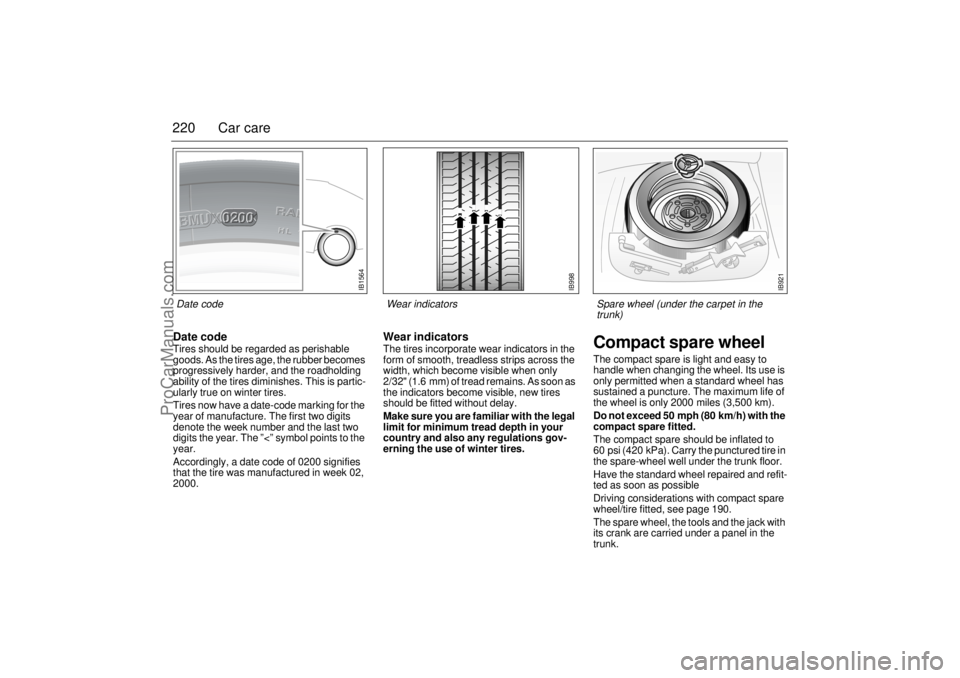
220 Car careDate codeTires should be regarded as perishable
goods. As the tires age, the rubber becomes
progressively harder, and the roadholding
ability of the tires diminishes. This is partic-
ularly true on winter tires.
Tires now have a date-code marking for the
year of manufacture. The first two digits
denote the week number and the last two
digits the year. The ”<” symbol points to the
year.
Accordingly, a date code of 0200 signifies
that the tire was manufactured in week 02,
2000.
Wear indicatorsThe tires incorporate wear indicators in the
form of smooth, treadless strips across the
width, which become visible when only
2/32" (1.6 mm) of tread remains. As soon as
the indicators become visible, new tires
should be fitted without delay.
Make sure you are familiar with the legal
limit for minimum tread depth in your
country and also any regulations gov-
erning the use of winter tires.
Compact spare wheelThe compact spare is light and easy to
handle when changing the wheel. Its use is
only permitted when a standard wheel has
sustained a puncture. The maximum life of
the wheel is only 2000 miles (3,500 km).
Do not exceed 50 mph (80 km/h) with the
compact spare fitted.
The compact spare should be inflated to
60 psi (420 kPa). Carry the punctured tire in
the spare-wheel well under the trunk floor.
Have the standard wheel repaired and refit-
ted as soon as possible
Driving considerations with compact spare
wheel/tire fitted, see page 190.
The spare wheel, the tools and the jack with
its crank are carried under a panel in the
trunk.
IB1564
Date code
IB998
Wear indicators
IB921
Spare wheel (under the carpet in the
trunk)
ProCarManuals.com
Page 224 of 260
224 Car care
Flat spottingAll tires get hot, especially on long journeys
or when the car is driven hard. After the car
has been parked with hot tires and the tires
have cooled down, a flat spot can form in the
tire, where it is in contact with the ground.
The same can occur if the car has not been
moved for a long time.
Flat spots can cause vibration that can be
felt through the steering wheel, similar to
that experienced when the wheels need bal-
ancing. Flat spots of this type disappear
once the tires get hot again, usually after
10–15 miles (20–25 km) of driving at cruis-
ing speed.
Safety beltsA check should be made periodically to
ensure that the safety belts are working
properly.
Hold the diagonal strap and pull it sharply.
The safety belt should lock and it should
not be possible to withdraw it further.
A sharp tug on the belt should cause the
inertia reel to lock. Check the floor anchor-
age points for corrosion damage. If a belt is
worn or has any fraying edges, it should be
replaced.
Safety belts must not come into contact with
substances such as polishes, oil or chemi-
cals. If the belts get dirty, wash them with
warm water and a detergent or have them
replaced.
WARNING
Safety belts and belt pretensioners that
were in use in a serious collision must be
replaced even if they are not visibly
damaged.
No attempt must be made to repair, or
modify the function of, safety belts.
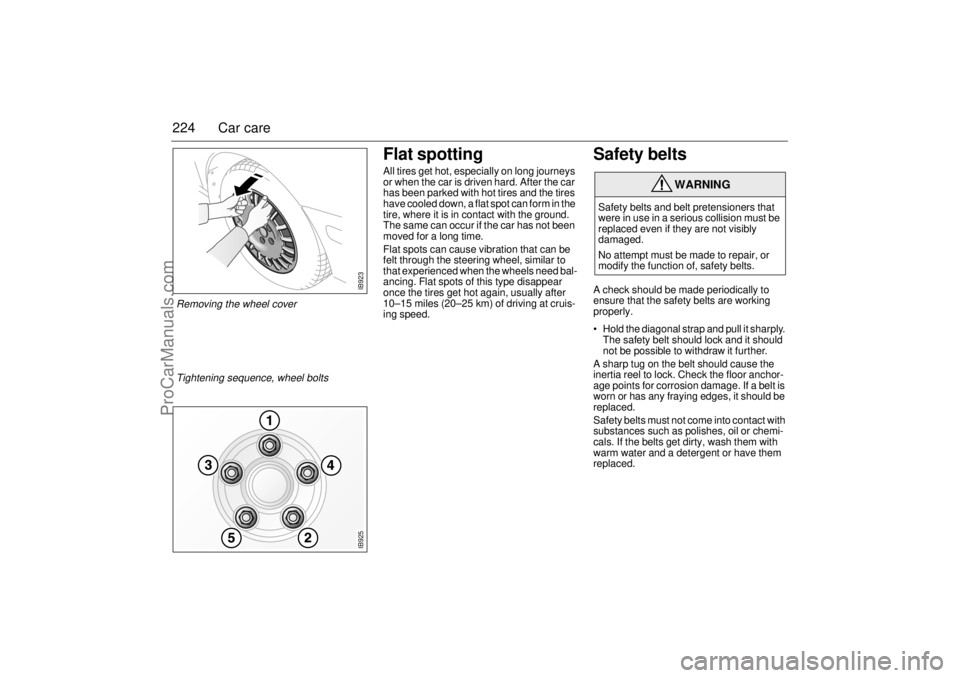
IB923
Removing the wheel cover
IB925
Tightening sequence, wheel bolts
ProCarManuals.com
Page 233 of 260

233 Car care
Maintenance The drive belt for the compressor should
be inspected under the regular service
program.
Clean dirt and insects away from the con-
denser and radiator to prevent clogging.
When washing the car, use the hose to
spray the radiator and condenser (located
forward of the radiator) from both sides
(both from the front of the car and from
inside the engine bay). Do not use a pres-
sure washer.
Caution: Do not use the hose when the
engine is hot.
Other than in extremely cold weather, do not
cover the radiator, e.g. with screen netting,
as this will greatly diminish its cooling capac-
ity.
Note: The A/C system will only operate
when the outdoor temperature is above the
freezing point (0°C, 32°F). Switch on the
A/C system when the car stands in a warm
place.
Headlight aimingThe vehicle is equipped with vertical and
horizontal aim indicators. The aim has been
preset at the factory and should normally not
need further adjustments. This is true even
though your vertical and horizontal aim indi-
cators may not fall exactly on the "0" (zero)
marks on their scales.
If your headlight is damaged in an accident,
the headlight aim may be affected. If you
believe your headlights need to be
re-aimed, we recommend that you take it to
your Saab dealer for service. However, it is
possible for you to re-aim your headlights as
described in the following procedure.
To check the aim, the vehicle should be
properly prepared as follows: Place the vehicle on a level pad or surface
The vehicle should be unladen and fuel
tank full, and one person or 160 lbs.
(75 kg) on the drivers seat
The vehicle should not have any snow, ice
or mud attached to it
Tires should be inflated to the prescribed
pressure
Rock the vehicle to stabilize the suspen-
sion
WARNING
Before checking/adjusting the headlight
aiming, switch off the engine to avoid
danger of fingers and hands being injured
by moving parts.
The radiator fan can start up even when
the engine is switched off.
ProCarManuals.com