transmission oil SAAB 9-3 2003 Owners Manual
[x] Cancel search | Manufacturer: SAAB, Model Year: 2003, Model line: 9-3, Model: SAAB 9-3 2003Pages: 256, PDF Size: 21.66 MB
Page 6 of 256
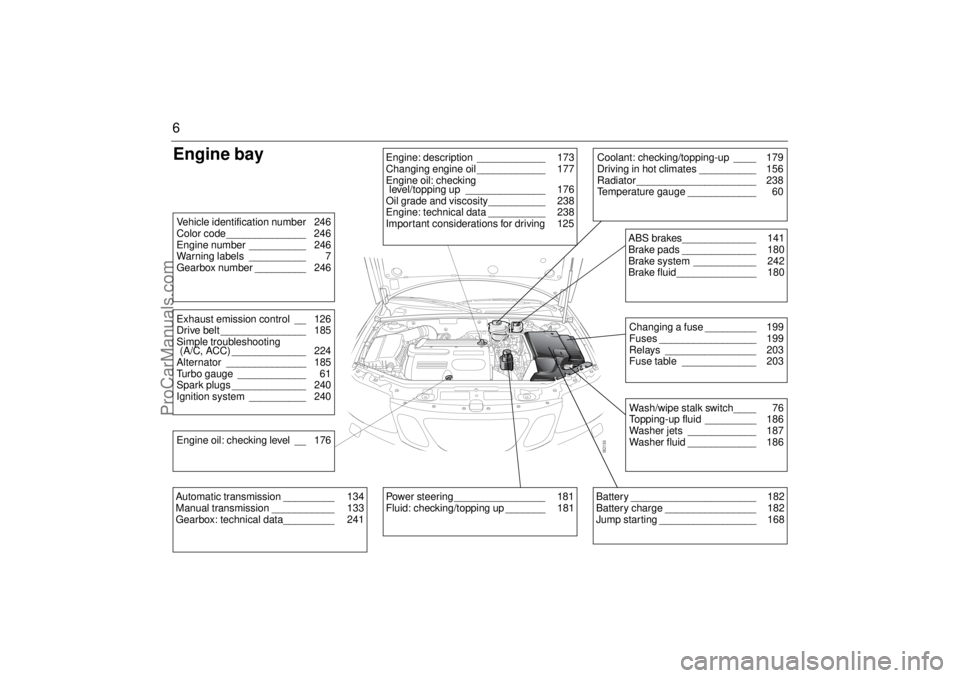
6Engine bayVehicle identification number 246
Color code______________ 246
Engine number __________ 246
Warning labels __________ 7
Gearbox number _________ 246Exhaust emission control __ 126
Drive belt _______________ 185
Simple troubleshooting
(A/C, ACC) _____________ 224
Alternator ______________ 185
Turbo gauge ____________ 61
Spark plugs _____________ 240
Ignition system __________ 240Engine oil: checking level __ 176Automatic transmission _________ 134
Manual transmission ___________ 133
Gearbox: technical data_________ 241
Battery ______________________ 182
Battery charge ________________ 182
Jump starting _________________ 168
Engine: description ____________ 173
Changing engine oil ____________ 177
Engine oil: checking
level/topping up ______________ 176
Oil grade and viscosity__________ 238
Engine: technical data __________ 238
Important considerations for driving 125
Wash/wipe stalk switch____ 76
Topping-up fluid _________ 186
Washer jets ____________ 187
Washer fluid ____________ 186
Power steering ________________ 181
Fluid: checking/topping up _______ 181
Coolant: checking/topping-up ____ 179
Driving in hot climates __________ 156
Radiator _____________________ 238
Temperature gauge ____________ 60
Changing a fuse _________ 199
Fuses _________________ 199
Relays ________________ 203
Fuse table _____________ 203ABS brakes_____________ 141
Brake pads _____________ 180
Brake system ___________ 242
Brake fluid______________ 180
ProCarManuals.com
Page 124 of 256

124 Starting and drivingDo not run the starter motor for more than
25 seconds at a time. Wait 20–30 seconds
before running the starter again, to give the
battery time to recover.
Avoid racing the engine or putting a heavy
load on it before it has warmed up. Let the
engine idle for at least 10 seconds and then
drive away as long as the engine oil warning
light has gone out to enable the engine to
attain its normal temperature as quickly as
possible
It is possible for air to enter the lubricating
system in conjunction with an oil or oil-filter
change, or if the car has been stored for
some time. This air can cause the hydraulic
cam followers to emit a ticking noise, which
can persist for up to 15 minutes after start-
ing. Although this is quite normal and does
not indicate any malfunction, it is advisable
not to exceed 3,000 rpm before the noise
has disappeared.
Starting the engineAvoid racing the engine or loading it heavily
before it has warmed up. Do not drive away
before the warning and indicator lights have
gone out.
The engine has an automatic choke and
should be started as follows:
Cars with manual transmission
To start the engine the clutch pedal must
be fully depressed.
1 Make sure the parking brake is applied.
2 Depress the clutch pedal but do not
touch the accelerator.
3 Start the engine. Let the remote control
spring back as soon as the engine has
started and is running smoothly.
Allow the engine to idle for about
10 seconds. Do not apply full throttle for at
least 3 minutes after starting.Cars with automatic transmission
The selector lever must be in the P or N
position.
1 The selector lever must be in the P or N
position.
2 Keep your foot on the brake pedal.
Note! Once the engine has started, the
brake pedal will sink. This is perfectly
normal.
3 Start the engine. Let the remote control
spring back as soon as the engine has
started and is running smoothly.
Allow the engine to idle for about
10 seconds. Do not apply full throttle for at
least 3 minutes after starting.
ProCarManuals.com
Page 136 of 256

136 Starting and drivingLock-upThe transmission’s torque converter has a
lock-up function. This can lock the torque
converter in 3rd, 4th and 5th gears, thus
reducing the engine speed and fuel con-
sumption.Kick-downWhen the accelerator is pressed down fully,
a down change is made to optimize acceler-
ation, e.g. for overtaking.
Following this, the next higher gear will be
selected at the optimum engine speed,
unless you ease off the accelerator before
reaching this. Kick-down works in manual
mode in 4th and 5th gears if the engine
speed is lower than 2,000 rpm.
Driving in hilly country with a heavy
loadThe transmission fluid can overheat when
the gearbox is strained, for example, when
driving with a trailer on hilly roads. To avoid
the transmission fluid overheating, always
drive with the selector lever in the D posi-
tion. The adaptive gear change patterns are
then active.
High air temperatures or a faulty oil cooler
can also cause the transmission fluid to
overheat. Overheating reduces the service
life of the fluid.TowingTowing of cars with automatic transmission,
see page 164.
Descending hillsIf the speed of the car increases while
descending a steep hill, despite the acceler-
ator being released, the control module will
change down to 4th gear. If you desire more
powerful engine braking, manually select a
lower gear (see page 139).
WARNING
Remember to use the braking effect of the
engine (1st, 2nd or 3rd gear) when you
are descending long or steep hills to
spare the brakes.
Overheating can cause the brakes to
fade!
ProCarManuals.com
Page 155 of 256

155 Starting and driving
Driving in cold weatherIn cold weather, special attention should be
paid to the following:
Before driving off, make sure that the
wiper blades have not frozen to the wind-
shield.
Remove any snow from the heating
system air intakes between the hood and
the windshield.
If necessary, inject oil into the locks to
prevent them from freezing. Use molyb-
denum-sulphide oil (MoS
2). If the locks
freeze, exercise care when unlocking the
car (manual unlocking) to avoid breaking
the key. Warm up the key or use a de-icer.
It is particularly important when the roads
are slippery that the brakes and tires are
in good condition.
For how to check the level of antifreeze in
the engine coolant, see page 179. Add gasoline anti-freeze when refueling
several times before the onset of winter.
This will prevent condensation water in
the fuel tank from freezing and causing
interruptions in the fuel supply. The likeli-
hood of condensation is lowest when the
fuel tank is full.
If the car is parked outside and the
temperature is below zero, carburettor
spirit is of little use as it cannot remove
water that has already frozen. Park the
car in a warm place so that any ice that
may have built up melts, then add carbu-
rettor spirit when refueling.
Condensation is caused by temperature
fluctuations, either in the outside temper-
ature alone or when the car is alternately
parked outdoors and in a garage.
The car is equipped with tires designed to
provide optimum grip on both wet and dry
roads, although this has been achieved at
the expense of somewhat reduced grip on
snow and ice. For regular driving on snow
and ice, we therefore recommend that
winter (snow) tires be fitted.Winter tires, particularly studded tires,
generally make driving safer on snow and
ice.
Acquaint yourself with the legal provi-
sions governing the use of different
types of winter tires and snow chains.
Studded tires are not allowed in some
countries. If winter tires are fitted, the same
type must be fitted to all four wheels. Your
Saab dealer will be pleased to advise you on
the best tires for your car.
Remember that tires age: it may therefore
be necessary to change winter tires before
they reach the legal wear limit, as they grad-
ually lose their friction properties with age.
If you get into a front wheel skid and the car
has a manual transmission, the best
response is to freewheel, which means
declutching so that the wheels neither drive
nor brake, and to cautiously steer in the
desired direction.
If the car has automatic transmission, ease
off the accelerator slightly and steer cau-
tiously in the desired direction.
If you get into a rear wheel skid, steer in the
same direction as the movement of the rear
of the car.
ProCarManuals.com
Page 170 of 256

170 Starting and drivingFor long tripsBefore starting off on a long journey, it is
advisable to have your car inspected by
your Saab dealer.
Obtain a few important items to take along
on your journey, such as spare bulbs, wiper
blades, fuses, a drive belt (poly-V-belt) and
the like.
You can check some points yourself before-
hand:
Check that no oil or fuel leaks out of the
engine or gearbox/transmission.
Check the coolant and power steering
fluid levels. Check also for leaks.
Inspect the drive belt (poly-V-belt) and
replace if it shows any signs of wear.
Check the battery charge.
Check the tires for tread pattern and air
pressure, including the compact spare
wheel.
Take an extra remote control and keep it
separate.
Check the brakes.
Check all bulbs.
Check for the presence of the tool kit and
jack in the car.
ProCarManuals.com
Page 171 of 256
171 Car care
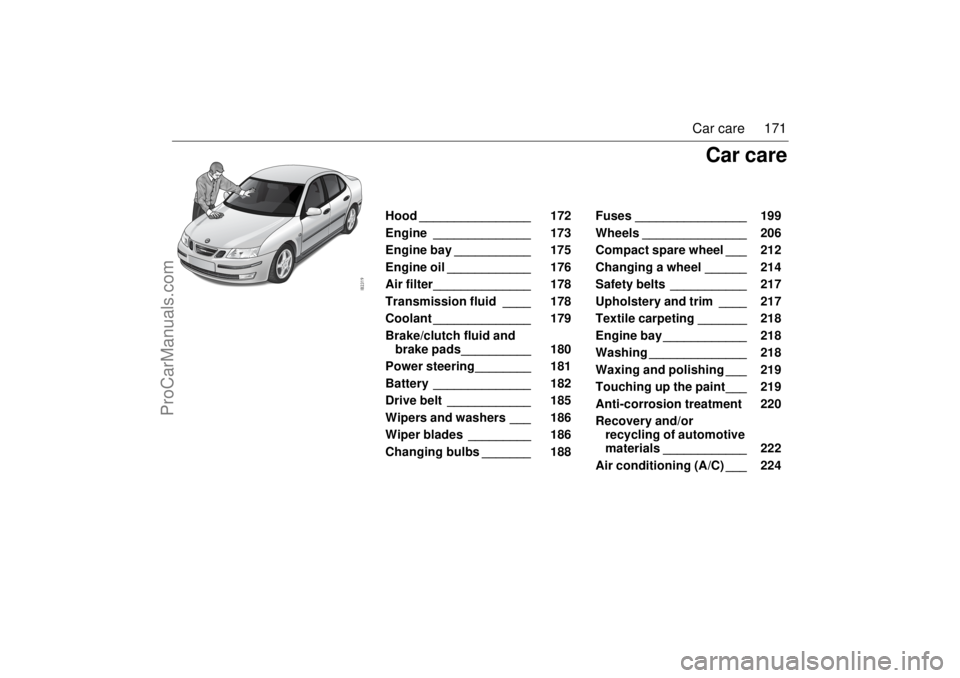
Hood ________________ 172
Engine ______________ 173
Engine bay ___________ 175
Engine oil ____________ 176
Air filter______________ 178
Transmission fluid ____ 178
Coolant ______________ 179
Brake/clutch fluid and
brake pads__________ 180
Power steering________ 181
Battery ______________ 182
Drive belt ____________ 185
Wipers and washers ___ 186
Wiper blades _________ 186
Changing bulbs _______ 188 Fuses ________________ 199
Wheels _______________ 206
Compact spare wheel ___ 212
Changing a wheel ______ 214
Safety belts ___________ 217
Upholstery and trim ____ 217
Textile carpeting _______ 218
Engine bay ____________ 218
Washing ______________ 218
Waxing and polishing ___ 219
Touching up the paint___ 219
Anti-corrosion treatment 220
Recovery and/or
recycling of automotive
materials ____________ 222
Air conditioning (A/C) ___ 224
Car care
ProCarManuals.com
Page 178 of 256
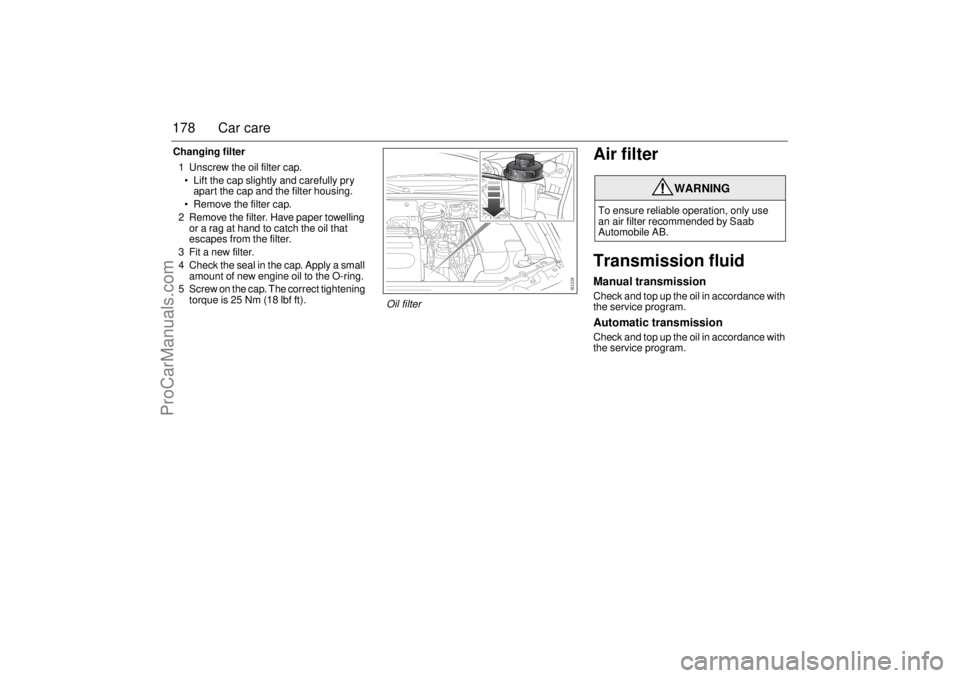
178 Car careChanging filter
1 Unscrew the oil filter cap.
Lift the cap slightly and carefully pry
apart the cap and the filter housing.
Remove the filter cap.
2 Remove the filter. Have paper towelling
or a rag at hand to catch the oil that
escapes from the filter.
3 Fit a new filter.
4 Check the seal in the cap. Apply a small
amount of new engine oil to the O-ring.
5 Screw on the cap. The correct tightening
torque is 25 Nm (18 lbf ft).
Air filter
Transmission fluidManual transmissionCheck and top up the oil in accordance with
the service program.Automatic transmissionCheck and top up the oil in accordance with
the service program.
WARNING
To ensure reliable operation, only use
an air filter recommended by Saab
Automobile AB.
Oil filter
ProCarManuals.com
Page 231 of 256

231 Maintenance and owner assistance
Engine oil and filter changesChanging the engine oil and filter is required
at every service point. Use only a Saab
approved long-life oil filter and engine oils
meeting the SAE viscosity ratings and API
service classifications stated in the “Techni-
cal data” section of this Owner’s Manual.
The use of extra additives in the oil is not
necessary and is not recommended, and
may be harmful to turbochargers.
More frequent oil changes are recom-
mended if your vehicle is operated under
any of the following conditions:
Most trips are less than 5–10 miles (8–
16 km). This is particularly important
when outside temperatures are below
freezing.
Most trips include extensive idling
(frequent stop-and-go traffic).
Most trips are through dusty areas (such
as construction zones).
If the vehicle is used for delivery service,
police, taxi or other commercial applica-
tions.
If your driving habits match this description,
have the engine oil and filter changed in-
between normal services at 5,000 mile
(8,000 km) intervals. These conditions
cause the engine oil to break down faster.
The Warranties and Service Record Book-
let has provisions to record extra oil
changes.
Service record retentionIt is the owner’s responsibility to retain ser-
vice records. If possible, you should keep
copies of all shop work orders for all service
and repairs, whenever performed. As indi-
cated in the new car and emission control
system warranties, it is important to docu-
ment that all necessary maintenance has
been done.
HOW THE SERVICE RECORD IS ORGA-
NIZED
The service record is comprised of a main-
tenance log and a separate log sheet for list-
ing any additional service and repairs.
There are five coupons at the front of the
section, three of which are for documenting
extra engine oil and filter changes, one for
extra automatic transmission fluid services
necessary for severe service conditions,
one for brake fluid changes and one for
coolant flushes. These are followed by log
sheets for all normal scheduled mainte-
nance in the order it is to be performed,
beginning with the “First Service”.HOW TO USE THE SERVICE RECORD
COUPONS
When the car is brought to a Saab dealer for
scheduled maintenance, present the War-
ranties & Service Record Booklet to the ser-
vice manager. When the technician has
completed the service, the technician will
sign the maintenance record. The person
responsible for quality assurance at the
dealership will also sign and stamp the
record with the dealer identification stamp.
ProCarManuals.com
Page 235 of 256
235 Technical data
General particulars _____ 236
Engine _______________ 238
Engine oil _____________ 238
Fuel__________________ 240
Engines ______________ 240
Electrical system_______ 240
Drive belt _____________ 240
Manual transmission ___ 241
Automatic transmission _ 241
Suspension ___________ 242
Steering ______________ 242
Brake system__________ 242
Wheels and tires _______ 243
Plates and labels _______ 246
Technical data
ProCarManuals.com
Page 241 of 256

241 Technical data
Manual transmission Automatic transmissionType _____________________________ Fully synchronized
with final drive gear
and differential
Oil type (for topping up) _______________ Saab MTF 0063
Oil capacity ________________________ 2.0 qts. (1.9 l)
Speed (mph/km/h) at 1000 rpm in highest
gear (5th gear):
1.8t and 2.0t ______________________ 27–30/43–45Type _____________________________ Electronically-
controlled, 5-speed,
fully-automatic with
hydraulic torque
converter, planetary
gears and integral
final drive.
Lock-up function in
selector positions 3,
4 and 5.
Selector lever positions _______________ P, R, N, D, M
Oil capacity, total ____________________ 7.6 qts. (7.2 litres)
Oil type ___________________________ Saab 3309
Clutch type ________________________ Hydraulic plate
clutches, brake
bands and one-way
couplings
Speed (mph/km/h) at 1000 rpm in top gear:
1.8t, 2.0t and 2.0T _________________ 28–30/46–49
ProCarManuals.com