air condition SAAB 9-3 2006 User Guide
[x] Cancel search | Manufacturer: SAAB, Model Year: 2006, Model line: 9-3, Model: SAAB 9-3 2006Pages: 318, PDF Size: 28.05 MB
Page 166 of 318
166 Starting and driving Never park the car on dry grass or other
combustible material. The catalytic
converter gets very hot and could there-
fore start a fire.
Never drive off if the engine is misfiring.
If you bump start the car when the engine
is already at normal working temperature,
the engine must start to run on all cylin-
ders. Abort bump starting if the engine
fails to start immediately.
Failure to strictly follow these instructions
can result in damage to the catalytic con-
verter and associated components, and
could represent a breach of the warranty
conditions.
NOTICEIf the car runs out of gas, air may be drawn
in with the fuel, which, in turn, can cause
the catalytic converter to be damaged by
overheating.
WARNING
If the engine is being run with the car on a
rolling road or dynamometer, to ensure
adequate cooling, air must be blown into
the engine compartment and under the
car at a rate equivalent to the ram-air
effect that would obtain at the corre-
sponding road speed.
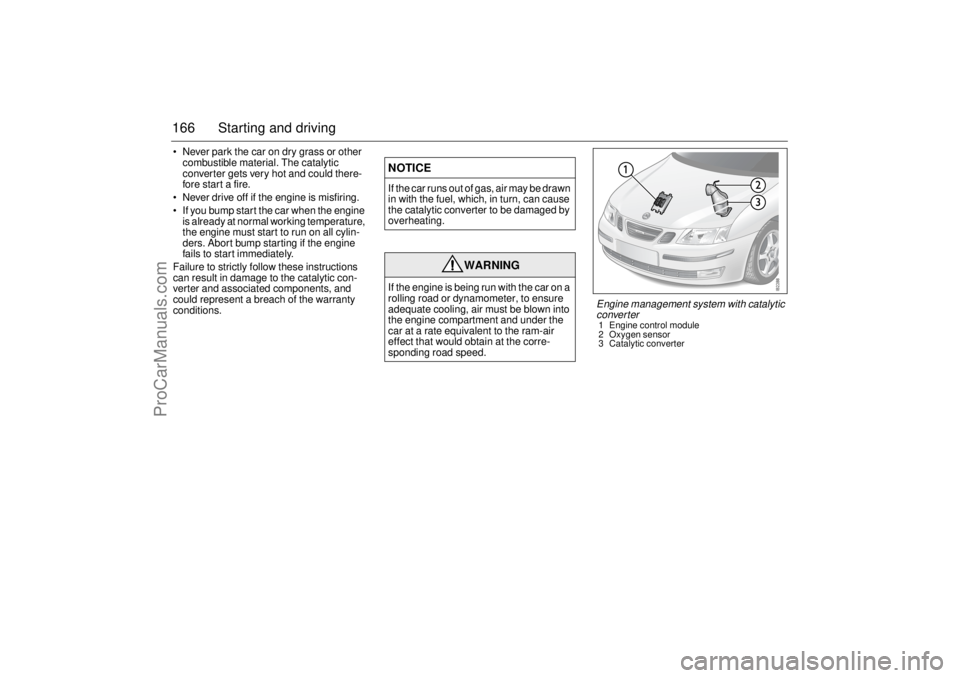
Engine management system with catalytic
converter1 Engine control module
2 Oxygen sensor
3 Catalytic converter
93U S M 06.book Page 166 Friday, February 18, 2005 1:15 PM
ProCarManuals.com
Page 170 of 318

170 Starting and drivingGasoline Specifications
It is recommended that gasoline meet spec-
ifications which were developed by automo-
bile manufacturers around the world and
contained in the World-Wide Fuel Charter
which is available from the Alliance of Auto-
mobile Manufacturers at www.autoalli-
ance.org/fuel_charter.htm. Gasoline meet-
ing these specifications could provide
improved driveability and emission control
system performance compared to other
gasoline.California Fuel
If your vehicle is certified to meet California
Emission Standards (see the underhood
emission control label), it is designed to
operate on fuels that meet California speci-
fications. If this fuel is not available in states
adopting California emissions standards,
your vehicle will operate satisfactorily on
fuels meeting federal specifications, but
emission control system performance may
be affected. The malfunction indicator lamp
may turn on and your vehicle may fail a
smog-check test. See Engine malfunction
(CHECK ENGINE) on page 85. If this
occurs, return to your authorized Saab
dealer for diagnosis. If it is determined that
the condition is caused by the type of fuel
used, repairs may not be covered by your
warranty.Additives
To provide cleaner air, all gasolines in the
United States are now required to contain
additives that will help prevent engine and
fuel system deposits from forming, allowing
your emission control system to work prop-
erly. You should not have to add anything to
your fuel. However, some gasolines contain
only the minimum amount of additive
required to meet U.S. Environmental Pro-
tection Agency regulations. Saab recom-
mends that you buy gasolines that are
advertised to help keep fuel injectors and
intake valves clean. If your vehicle experi-
ences problems due to dirty injectors or
valves, try a different brand of gasoline.
Gasolines containing oxygenates, such as
ethers and ethanol, and reformulated gaso-
lines may be available in your area to con-
tribute to clean air. Saab recommends that
you use these gasolines, particularly if they
comply with the specifications described
earlier.
Notice: Your vehicle was not designed
for fuel that contains methanol. Do not
use fuel containing methanol. It can cor-
rode metal parts in your fuel system and
also damage the plastic and rubber
parts. That damage would not be cov-
ered under your warranty.
Some gasolines that are not reformulated
for low emissions may contain an octane-
enhancing additive called methylcyclopen-
tadienyl manganese tricarbonyl (MMT); ask
the attendant where you buy gasoline 93U S M 06.book Page 170 Friday, February 18, 2005 1:15 PM
ProCarManuals.com
Page 171 of 318

171 Starting and driving
whether the fuel contains MMT. Saab does
not recommend the use of such gasolines.
Fuels containing MMT can reduce the life of
spark plugs and the performance of the
emission control system may be affected.
The malfunction indicator lamp may turn on.
If this occurs, return to your authorized Saab
dealer for service.
Fuels in Foreign Countries
If you plan on driving in another country out-
side the United States or Canada, the
proper fuel may be hard to find. Never use
leaded gasoline or any other fuel not recom-
mended in the previous text on fuel. Costly
repairs caused by use of improper fuel
would not be covered by your warranty.
To check the fuel availability, ask an auto
club, or contact a major oil company that
does business in the country where you will
be driving.
Engine Break-in PeriodPistons, cylinder bores and bearings need
time to obtain uniform, wear-resistant
surfaces.
If a new engine is driven too hard, this grad-
ual process of bedding-in will not be possi-
ble and the life of the engine will be short-
ened.
During the first 1,200 miles (2,000 km),
do not exceed 5,000 rpm.
In addition, refrain from driving the car at full
throttle, other than for brief instances,
during the first 1,800 miles (3,000 km).
Wearing in new brake padsNew brake pads take time to bed in, about
90 miles (150 km) if the car is driven largely
under stop-and-go conditions or about
300 miles (500 km) of highway driving.
To extend the useful life of the pads, avoid
hard braking as much as possible.
93U S M 06.book Page 171 Friday, February 18, 2005 1:15 PM
ProCarManuals.com
Page 195 of 318

195 Starting and driving
Driving in cold weatherIn cold weather, special attention should be
paid to the following:
Before driving off, make sure that the
wiper blades have not frozen to the wind-
shield.
Remove any snow from the heating
system air intakes between the hood and
the windshield.
If necessary, inject oil into the locks to
prevent them from freezing. Use molyb-
denum-sulphide oil (MoS
2). If the locks
freeze, exercise care when unlocking the
car (manual unlocking) to avoid breaking
the key. Warm up the key or use a de-icer.
It is particularly important when the roads
are slippery that the brakes and tires are
in good condition.
For how to check the level of antifreeze in
the engine coolant, see page 222.
Add gasoline anti-freeze when refueling
several times before the onset of winter.
This will prevent condensation water in
the fuel tank from freezing and causing
interruptions in the fuel supply. The likeli-
hood of condensation is lowest when the
fuel tank is full.
If the car is parked outside and the
temperature is below zero, gasoline anti-
freeze is of little use as it cannot remove
water that has already frozen. Park the
car in a warm place so that any ice that
may have built up melts, then add gaso-
line anti-freeze when refueling.Condensation is caused by temperature
fluctuations, either in the outside temper-
ature alone or when the car is alternately
parked outdoors and in a garage.
Convertible: Avoid operating the soft top
at temperatures below 23°F (–5°C).
The car is equipped with tires designed to
provide optimum grip on both wet and dry
roads, although this has been achieved at
the expense of somewhat reduced grip on
snow and ice. For regular driving on snow
and ice, we therefore recommend that
winter tires be fitted. However, winter tires
achieve this extra grip at the expense of
grip on bare road surfaces.
Winter tires, particularly studded tires, gen-
erally make driving safer on snow and ice.
Acquaint yourself with the legal provi-
sions governing the use of different
types of winter tires and snow chains.
Studded tires are not allowed in some
countries. If winter tires are fitted, the same
type must be fitted to all four wheels. Your
Saab dealer will be pleased to advise you on
the best tires for your car.
93U S M 06.book Page 195 Friday, February 18, 2005 1:15 PM
ProCarManuals.com
Page 213 of 318
213 Car care
Hood ________________ 214
Engine ______________ 215
Engine bay, 4-cyl engine 217
Engine oil ____________ 219
Air filter______________ 222
Transmission fluid ____ 222
Coolant ______________ 222
Brake/clutch fluid and
brake pads__________ 224
Power steering________ 225
Battery ______________ 226
Drive belt ____________ 229
Wipers and washers ___ 230
Wiper blades _________ 230
Changing bulbs _______ 232 Fuses ________________ 247
Automatic tire pressure
monitoring3_________ 254
Tires _________________ 256
Compact spare ________ 270
Changing a tire ________ 273
Safety belts ___________ 276
Upholstery and trim ____ 276
Textile carpeting _______ 277
Engine bay ____________ 277
Washing ______________ 277
Waxing and polishing ___ 279
Touching up the paint___ 279
Anti-corrosion treatment 280
Recovery and/or
recycling of automotive
materials ____________ 282
Air conditioning (A/C) ___ 282
Car care
3Asterisk means: equipment not fitted in all cars
(can depend on model variant, engine variant,
market specification, options or accessories).93U S M 06.book Page 213 Friday, February 18, 2005 1:15 PM
ProCarManuals.com
Page 257 of 318

257 Car care
Inflation - Tire PressureThe Tire-Loading Information label shows
the correct inflation pressures for your tires
when they’re cold. “Cold” means your vehi-
cle has been sitting for at least three hours
or driven no more than 1 mile (1.6 km).Notice:
Don’t let anyone tell you that
underinflation or overinflation is all
right. It’s not. If your tires don’t have
enough air (underinflation), you can get
the following:
Too much flexing
Too much heat
Tire overloading
Bad wear
Bad handling
Bad fuel economy
If your tires have too much air (overinfla-
tion), you can get the following:
Unusual wear
Bad handling
Rough ride
Needless damage from road hazardsAdjust the tire pressure to match the current
load and speed of the car (see page 306).
The stated tire pressures apply to cold tires,
i.e. tires that are the same temperature as
the outside air temperature. Tire pressure
increases as the tires become warm (e.g.
during highway driving) by approximately
4 psi (28 kPa). When the temperature of the
tires changes by 50°F (10°C), the tire pres-
sure will change 2 psi (14 kPa).
Never reduce the pressure of a hot tire. If the
tires are hot when you check them, only
increase the pressure, if necessary.
High speed operation
WARNING
Driving at high speeds, 100 mph
(160 km/h) or higher, puts an additional
strain on tires.
Sustained high-speed driving causes
excessive heat build up and can cause
sudden tire failure. You could have a
crash and you or others could be killed.
Some high-speed rated tires require infla-
tion pressure adjustment for high speed
operation. When speed limits and road
conditions are such that a vehicle can be
driven at high speeds, make sure the tires
are rated for high speed operation, in
excellent condition, and set to the correct
cold tire inflation pressure for the vehicle
load.
93U S M 06.book Page 257 Friday, February 18, 2005 1:15 PM
ProCarManuals.com
Page 260 of 318

260 Car careBuying New TiresTo find out what kind and size of tires you
need, look at the Tire-Loading Information
label.
If you wish to fit other tires or wheels than
those supplied with the car, consult your
Saab dealer first as to the possibilities
available.
Wheels/tires combinations that are not
approved by Saab can negatively affect the
car’s directional stability, steering and brak-
ing in both wet and dry conditions.The wheels and tires have been carefully
matched to the characteristics of the car and
play a key role in its outstanding roadhold-
ing and handling.
Do not take it for granted that a wheel/tire
combination will work in the best possible
way, just because it can be fitted to the car.
To ensure that the speedometer is as accu-
rate as possible it should be reprogrammed
if wheels of a different dimension are fitted.
Contact a Saab dealer.
Because of front wheel drive, the front tires
tend to wear faster than the rear ones. New
tires should always be fitted in pairs, so that
tires on the same axle have the same
amount of tread.
Store wheels lying flat or hanging – never
standing upright.
NOTICEAlways consult your Saab dealer before
changing the car’s wheels or tires on your
Saab.
Wide wheels and tires with side walls that
are too low can:
be damaged in potholes, etc.
cause springs, shock absorbers and
wheel bearings and body mountings
to be overloaded.
affect the function of the Electronic
Stability Program (ESP).
The speed and load limits of the tires
must not be exceeded; see page 266.
Wheels larger than 17" must not be fitted
on the Saab 9-3 for reasons above. The
permissible offset is 1.61 inch (41 mm).
93U S M 06.book Page 260 Friday, February 18, 2005 1:15 PM
ProCarManuals.com
Page 262 of 318
262 Car careTemperature – A, B, C
The temperature grades are A (the highest),
B, and C, representing the tire’s resistance
to the generation of heat and its ability to dis-
sipate heat when tested under controlled
conditions on a specified indoor laboratory
test wheel. Sustained high temperature can
cause the material of the tire to degenerate
and reduce tire life, and excessive temper-
ature can lead to sudden tire failure. The
grade C corresponds to a level of perfor-
mance which all passenger car tires must
meet under the Federal Motor Vehicle
Safety Standard No. 109. Grades B and A
represent higher levels of performance on
the laboratory test wheel than the minimum
required by law.
Warning: The temperature grade for this tire
is established for a tire that is properly
inflated and not overloaded. Excessive
speed, underinflation, or excessive loading,
either separately or in combination, can
cause heat buildup and possible tire failure.
Wheel Alignment and Tire
BalanceThe wheels on your vehicle were aligned
and balanced carefully at the factory to give
you the longest tire life and best overall per-
formance.
Scheduled wheel alignment and wheel bal-
ancing are not needed. However, if you
notice unusual tire wear or your vehicle pull-
ing one way or the other, the alignment may
need to be reset. If you notice your vehicle
vibrating when driving on a smooth road,
your wheels may need to be rebalanced.
Wheel ReplacementReplace any wheel that is bent, cracked or
badly rusted or corroded. If wheel nuts keep
coming loose, the wheel, wheel bolts and
wheel nuts should be replaced. If the wheel
leaks air, replace it (except some aluminum
wheels, which can sometimes be repaired).
See your dealer if any of these conditions
exist.
Your dealer will know the kind of wheel you
need.
Each new wheel should have the same
load-carrying capacity, diameter, width,
offset and be mounted the same way as the
one it replaces.
If you need to replace any of your wheels,
wheel bolts or wheel nuts, replace them only
with new Saab original equipment parts.
This way, you will be sure to have the right
wheel, wheel bolts and wheel nuts for your
vehicle.
WARNING
Using the wrong replacement wheels,
wheel bolts or wheel nuts on your vehicle
can be dangerous. It could affect the
braking and handling of your vehicle,
make your tires lose air and make you
lose control. You could have a collision in
which you or others could be injured.
Always use the correct wheel, wheel bolts
and wheel nuts for replacement.
93U S M 06.book Page 262 Friday, February 18, 2005 1:15 PM
ProCarManuals.com
Page 263 of 318
263 Car care
Notice:
The wrong wheel can also cause
problems with bearing life, brake cool-
ing, speedometer or odometer calibra-
tion, headlamp aim, bumper height, vehi-
cle ground clearance and tire or tire
chain clearance to the body and chassis.
See “Changing a tire” on page 273.Used Replacement Wheels
Tire Chains
WARNING
When fitting just one new pair of tires,
these should be fitted to the rear wheels,
as these are more critical to the direc-
tional stability of the car (e.g. on braking
or in a skid). The existing rear wheels
should therefore be moved to the front.
WARNING
Putting a used wheel on your vehicle is
dangerous. You can’t know how it’s been
used or how far it’s been driven. It could
fail suddenly and cause a crash. If you
have to replace a wheel, use a new GM
original equipment wheel.
WARNING
If your vehicle has 235/45 R17 size tires,
don’t use tire chains, there’s not enough
clearance.
Tire chains used on a vehicle without the
proper amount of clearance can cause
damage to the brakes, suspension or
other vehicle parts. The area damaged by
the tire chains could cause you to lose
control of your vehicle and you or others
may be injured in a crash.
Use another type of traction device only if
its manufacturer recommends it for use
on your vehicle and tire size combination
and road conditions. Follow that manu-
facturer’s instructions. To help avoid
damage to your vehicle, drive slowly,
readjust or remove the device if it’s
contacting your vehicle, and don’t spin
your wheels.
If you do find traction devices that will fit,
install them on the front tires.
93U S M 06.book Page 263 Friday, February 18, 2005 1:15 PM
ProCarManuals.com
Page 267 of 318
267 Car care
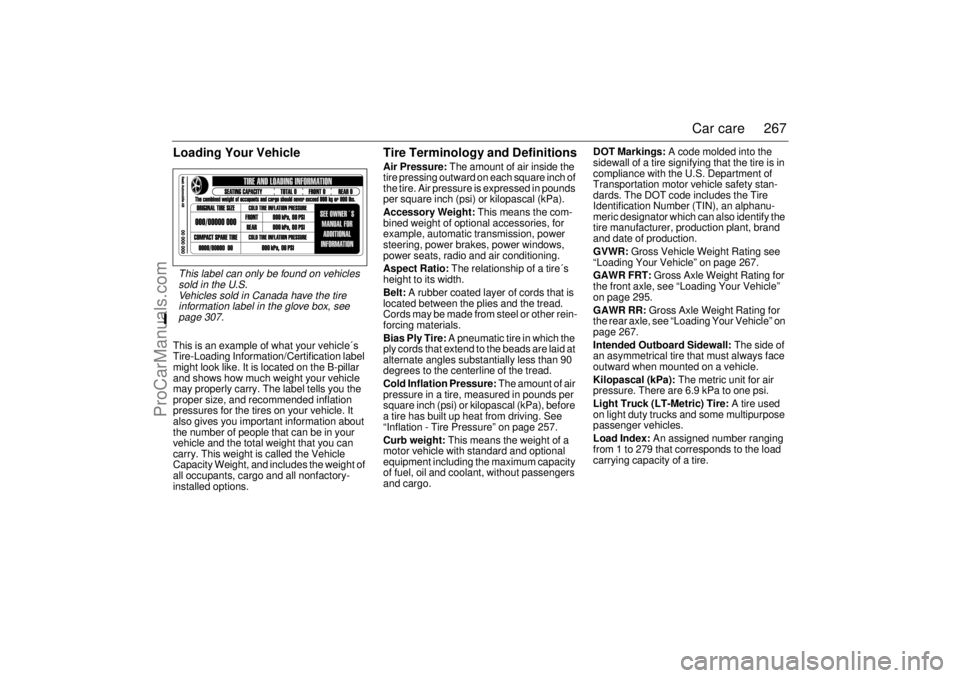
Loading Your VehicleThis is an example of what your vehicle´s
Tire-Loading Information/Certification label
might look like. It is located on the B-pillar
and shows how much weight your vehicle
may properly carry. The label tells you the
proper size, and recommended inflation
pressures for the tires on your vehicle. It
also gives you important information about
the number of people that can be in your
vehicle and the total weight that you can
carry. This weight is called the Vehicle
Capacity Weight, and includes the weight of
all occupants, cargo and all nonfactory-
installed options.
Tire Terminology and DefinitionsAir Pressure: The amount of air inside the
tire pressing outward on each square inch of
the tire. Air pressure is expressed in pounds
per square inch (psi) or kilopascal (kPa).
Accessory Weight: This means the com-
bined weight of optional accessories, for
example, automatic transmission, power
steering, power brakes, power windows,
power seats, radio and air conditioning.
Aspect Ratio: The relationship of a tire´s
height to its width.
Belt: A rubber coated layer of cords that is
located between the plies and the tread.
Cords may be made from steel or other rein-
forcing materials.
Bias Ply Tire: A pneumatic tire in which the
ply cords that extend to the beads are laid at
alternate angles substantially less than 90
degrees to the centerline of the tread.
Cold Inflation Pressure: The amount of air
pressure in a tire, measured in pounds per
square inch (psi) or kilopascal (kPa), before
a tire has built up heat from driving. See
“Inflation - Tire Pressure” on page 257.
Curb weight: This means the weight of a
motor vehicle with standard and optional
equipment including the maximum capacity
of fuel, oil and coolant, without passengers
and cargo.DOT Markings: A code molded into the
sidewall of a tire signifying that the tire is in
compliance with the U.S. Department of
Transportation motor vehicle safety stan-
dards. The DOT code includes the Tire
Identification Number (TIN), an alphanu-
meric designator which can also identify the
tire manufacturer, production plant, brand
and date of production.
GVWR: Gross Vehicle Weight Rating see
“Loading Your Vehicle” on page 267.
GAWR FRT: Gross Axle Weight Rating for
the front axle, see “Loading Your Vehicle”
on page 295.
GAWR RR: Gross Axle Weight Rating for
the rear axle, see “Loading Your Vehicle” on
page 267.
Intended Outboard Sidewall: The side of
an asymmetrical tire that must always face
outward when mounted on a vehicle.
Kilopascal (kPa): The metric unit for air
pressure. There are 6.9 kPa to one psi.
Light Truck (LT-Metric) Tire: A tire used
on light duty trucks and some multipurpose
passenger vehicles.
Load Index: An assigned number ranging
from 1 to 279 that corresponds to the load
carrying capacity of a tire.
This label can only be found on vehicles
sold in the U.S.
Vehicles sold in Canada have the tire
information label in the glove box, see
page 307.93U S M 06.book Page 267 Friday, February 18, 2005 1:15 PM
ProCarManuals.com