ECU SAAB 9-5 2000 Owners Manual
[x] Cancel search | Manufacturer: SAAB, Model Year: 2000, Model line: 9-5, Model: SAAB 9-5 2000Pages: 256, PDF Size: 14.24 MB
Page 1 of 256
1
Owner’s Manual
Saab 9-5, Model Year 2000
Safety 11
Security 31
Instruments and controls 45
Saab 9-5 Audio System 77
Interior equipment and trunk 101
Starting and driving 129
Car care and technical information 165
Maintenance and owner assistance 217
Specifications 225
Index 241
© Saab Automobile AB 1998
Service Readiness, Saab Automobile AB, Trollhättan, Sweden
Printed in Sweden
ProCarManuals.com
Page 9 of 256
9
IB336
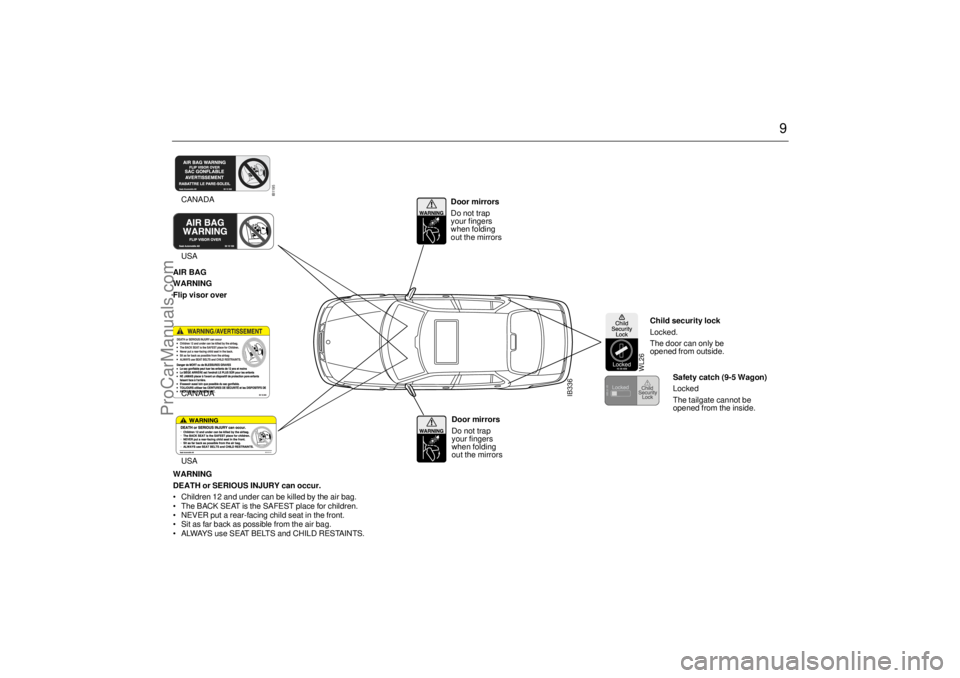
AIR BAG
WARNING
Flip visor overWARNING
DEATH or SERIOUS INJURY can occur.
Children 12 and under can be killed by the air bag.
The BACK SEAT is the SAFEST place for children.
NEVER put a rear-facing child seat in the front.
Sit as far back as possible from the air bag.
ALWAYS use SEAT BELTS and CHILD RESTAINTS.
50 10 111IB1195
CANADA
USAUSACANADA
Door mirrors
Do not trap
your fingers
when folding
out the mirrors
Door mirrors
Do not trap
your fingers
when folding
out the mirrors
WL26Child security lock
Locked.
The door can only be
opened from outside.
Safety catch (9-5 Wagon)
Locked
The tailgate cannot be
opened from the inside.
ProCarManuals.com
Page 10 of 256
10
IB336
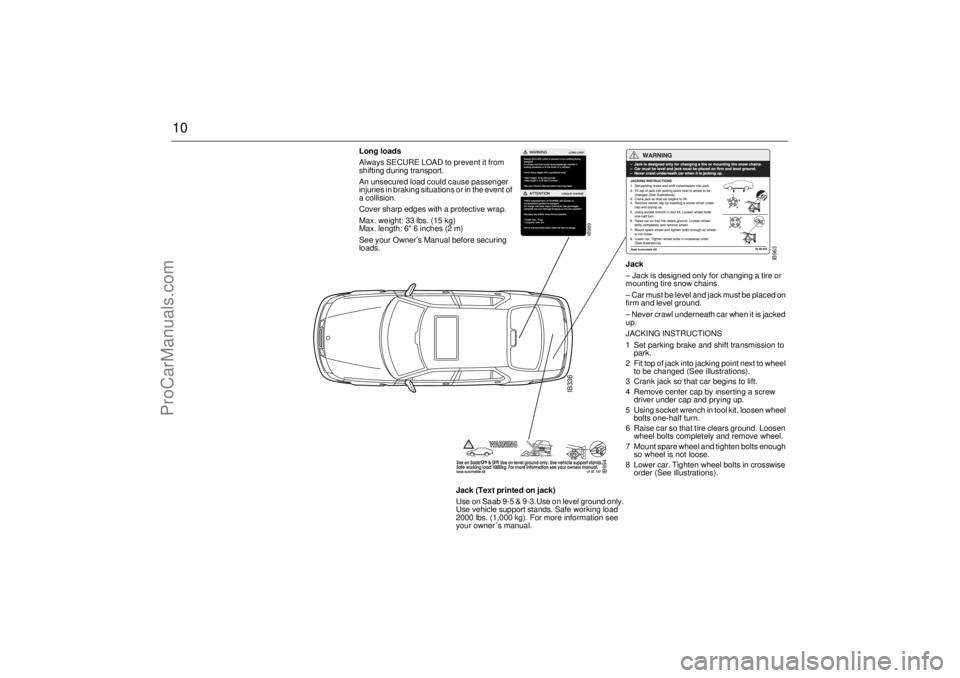
Jack
– Jack is designed only for changing a tire or
mounting tire snow chains.
– Car must be level and jack must be placed on
firm and level ground.
– Never crawl underneath car when it is jacked
up.
JACKING INSTRUCTIONS
1 Set parking brake and shift transmission to
park.
2 Fit top of jack into jacking point next to wheel
to be changed (See illustrations).
3 Crank jack so that car begins to lift.
4 Remove center cap by inserting a screw
driver under cap and prying up.
5 Using socket wrench in tool kit, loosen wheel
bolts one-half turn.
6 Raise car so that tire clears ground. Loosen
wheel bolts completely and remove wheel.
7 Mount spare wheel and tighten bolts enough
so wheel is not loose.
8 Lower car. Tighten wheel bolts in crosswise
order (See illustrations).
IB963
Jack (Text printed on jack)
Use on Saab 9-5 & 9-3.Use on level ground only.
Use vehicle support stands. Safe working load
2000 lbs. (1,000 kg). For more information see
your owner´s manual.
IB994
IB989
Long loads
Always SECURE LOAD to prevent it from
shifting during transport.
An unsecured load could cause passenger
injuries in braking situations or in the event of
a collision.
Cover sharp edges with a protective wrap.
Max. weight: 33 lbs. (15 kg)
Max. length: 6" 6 inches (2 m)
See your Owner’s Manual before securing
loads.
ProCarManuals.com
Page 14 of 256
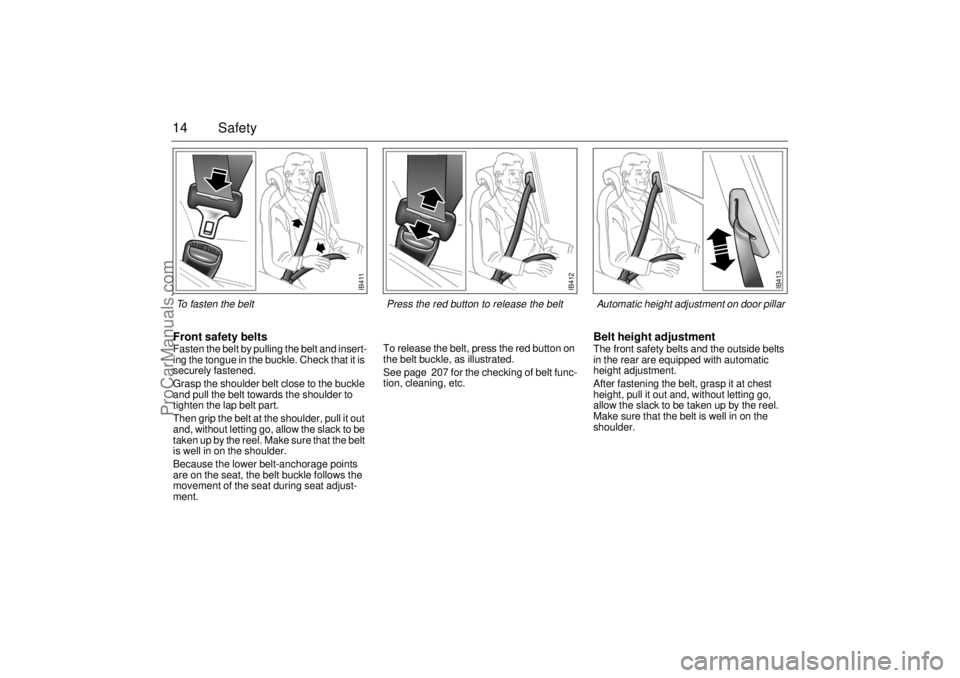
14 SafetyFront safety belts Fasten the belt by pulling the belt and insert-
ing the tongue in the buckle. Check that it is
securely fastened.
Grasp the shoulder belt close to the buckle
and pull the belt towards the shoulder to
tighten the lap belt part.
Then grip the belt at the shoulder, pull it out
and, without letting go, allow the slack to be
taken up by the reel. Make sure that the belt
is well in on the shoulder.
Because the lower belt-anchorage points
are on the seat, the belt buckle follows the
movement of the seat during seat adjust-
ment.To release the belt, press the red button on
the belt buckle, as illustrated.
See page 207 for the checking of belt func-
tion, cleaning, etc.
Belt height adjustmentThe front safety belts and the outside belts
in the rear are equipped with automatic
height adjustment.
After fastening the belt, grasp it at chest
height, pull it out and, without letting go,
allow the slack to be taken up by the reel.
Make sure that the belt is well in on the
shoulder.
IB411
To fasten the belt
IB412
Press the red button to release the belt
IB413
Automatic height adjustment on door pillar
ProCarManuals.com
Page 16 of 256
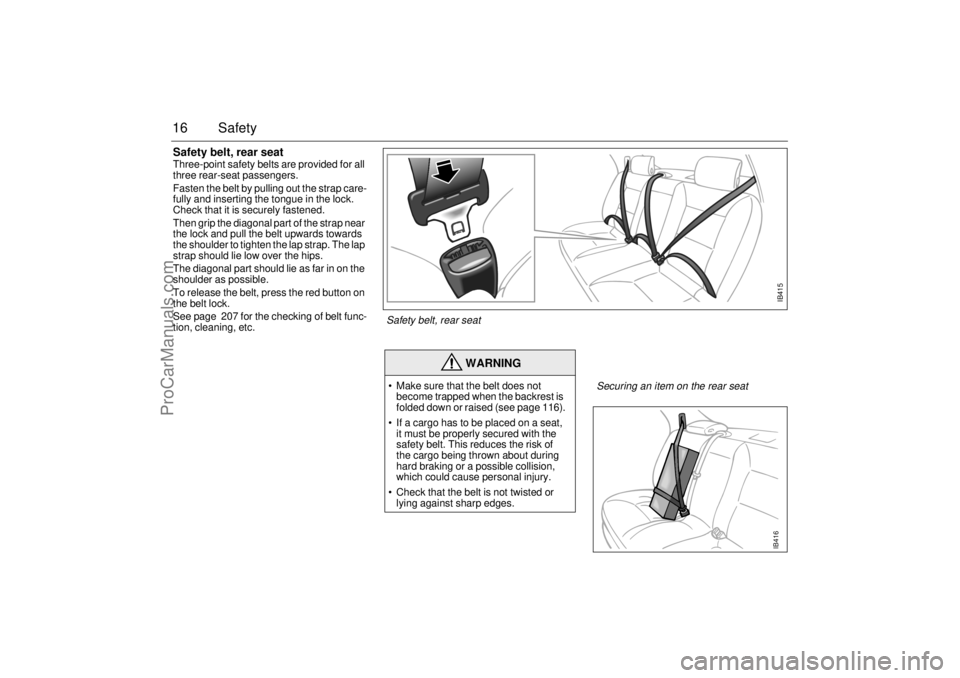
16 SafetySafety belt, rear seat Three-point safety belts are provided for all
three rear-seat passengers.
Fasten the belt by pulling out the strap care-
fully and inserting the tongue in the lock.
Check that it is securely fastened.
Then grip the diagonal part of the strap near
the lock and pull the belt upwards towards
the shoulder to tighten the lap strap. The lap
strap should lie low over the hips.
The diagonal part should lie as far in on the
shoulder as possible.
To release the belt, press the red button on
the belt lock.
See page 207 for the checking of belt func-
tion, cleaning, etc.
WARNING
Make sure that the belt does not
become trapped when the backrest is
folded down or raised (see page 116).
If a cargo has to be placed on a seat,
it must be properly secured with the
safety belt. This reduces the risk of
the cargo being thrown about during
hard braking or a possible collision,
which could cause personal injury.
Check that the belt is not twisted or
lying against sharp edges.
IB???IB415
Safety belt, rear seat
IB416
Securing an item on the rear seat
ProCarManuals.com
Page 17 of 256
17 Safety
Lockable belt tongue In fitting a child seat that is intended to be
secured in position by the lap portion of the
safety belt, make use of the locking function
of the buckle.
Locking the lap portion of the belt lessens
the risk that the seat will work loose while
the car is in motion.
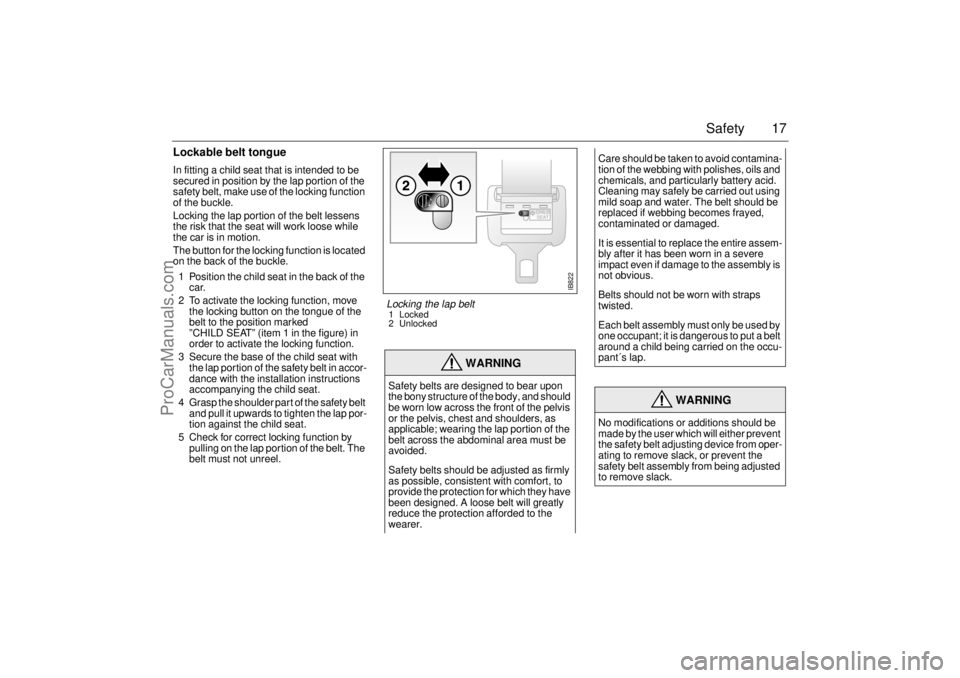
The button for the locking function is located
on the back of the buckle.
1 Position the child seat in the back of the
car.
2 To activate the locking function, move
the locking button on the tongue of the
belt to the position marked
”CHILD SEAT” (item 1 in the figure) in
order to activate the locking function.
3 Secure the base of the child seat with
the lap portion of the safety belt in accor-
dance with the installation instructions
accompanying the child seat.
4 Grasp the shoulder part of the safety belt
and pull it upwards to tighten the lap por-
tion against the child seat.
5 Check for correct locking function by
pulling on the lap portion of the belt. The
belt must not unreel.
WARNING
Safety belts are designed to bear upon
the bony structure of the body, and should
be worn low across the front of the pelvis
or the pelvis, chest and shoulders, as
applicable; wearing the lap portion of the
belt across the abdominal area must be
avoided.
Safety belts should be adjusted as firmly
as possible, consistent with comfort, to
provide the protection for which they have
been designed. A loose belt will greatly
reduce the protection afforded to the
wearer.
Care should be taken to avoid contamina-
tion of the webbing with polishes, oils and
chemicals, and particularly battery acid.
Cleaning may safely be carried out using
mild soap and water. The belt should be
replaced if webbing becomes frayed,
contaminated or damaged.
It is essential to replace the entire assem-
bly after it has been worn in a severe
impact even if damage to the assembly is
not obvious.
Belts should not be worn with straps
twisted.
Each belt assembly must only be used by
one occupant; it is dangerous to put a belt
around a child being carried on the occu-
pant´s lap.
WARNING
No modifications or additions should be
made by the user which will either prevent
the safety belt adjusting device from oper-
ating to remove slack, or prevent the
safety belt assembly from being adjusted
to remove slack.
IB822
Locking the lap belt1 Locked
2 Unlocked
ProCarManuals.com
Page 18 of 256
18 SafetyChild safety
The same attention must be given to child
safety in the car as is given to adults.
Children travel most safely when properly
restrained, but restraints must be suitable
for the size of the child. Always follow the
child seat/booster cushion manufacturer´s
instructions when installing these devices in
your vehicle.
Make sure you are acquainted with the
legal requirements for seating children
in the car.
Make sure that it is possible to fit a child
restraint in accordance with the manufac-
turer’s child seat instructions.Saab 9-5 Sedan
For child car seats that are approved for
rear-facing installation in the rear seat and
have top tether straps, we recommend that
you position it on one of the outer places.
Fasten such a child seat with the three-point
seat belt and the two underside anchorage
tethers.
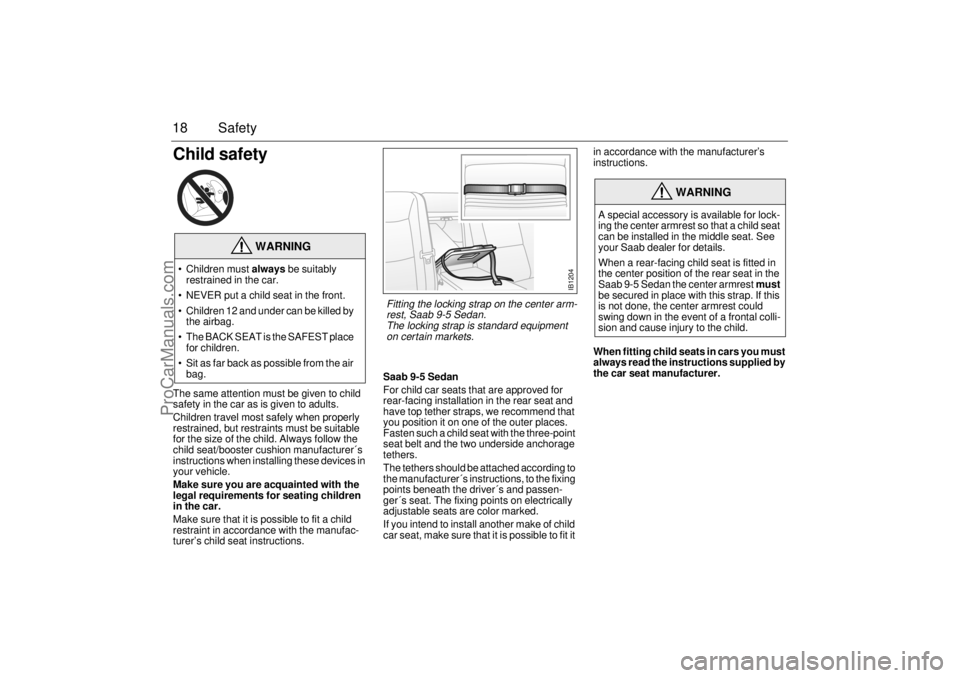
The tethers should be attached according to
the manufacturer´s instructions, to the fixing
points beneath the driver´s and passen-
ger´s seat. The fixing points on electrically
adjustable seats are color marked.
If you intend to install another make of child
car seat, make sure that it is possible to fit it in accordance with the manufacturer’s
instructions.
When fitting child seats in cars you must
always read the instructions supplied by
the car seat manufacturer.
WARNING
Children must always be suitably
restrained in the car.
NEVER put a child seat in the front.
Children 12 and under can be killed by
the airbag.
The BACK SEAT is the SAFEST place
for children.
Sit as far back as possible from the air
bag.
WARNING
A special accessory is available for lock-
ing the center armrest so that a child seat
can be installed in the middle seat. See
your Saab dealer for details.
When a rear-facing child seat is fitted in
the center position of the rear seat in the
Saab 9-5 Sedan the center armrest must
be secured in place with this strap. If this
is not done, the center armrest could
swing down in the event of a frontal colli-
sion and cause injury to the child.
IB1204
Fitting the locking strap on the center arm-
rest, Saab 9-5 Sedan.
The locking strap is standard equipment
on certain markets.
ProCarManuals.com
Page 19 of 256
19 Safety
Saab 9-5 Wagon:
For child car seats that are approved for
rear-facing installation in the rear seat and
have top tether straps, we recommend that
you position the seat in the center seat. This
type of child seat must be secured with the
three-point seat belt and the two underside
anchorage belts. These belts should be
attached to the attachment points beneath
the driver’s and passenger’s seat. The
attachment points on electrically-adjusted
seats are marked in colour.
If a child seat from another manufacturer is
used, ensure that it can be correctly
mounted, according to the child-seat
instructions.
When fitting child seats in cars you must
always follow the instructions supplied
by the car seat manufacturer.
Child tether anchorages(required in Canada, available at no
charge from Saab in the U.S.)
Child restraints with a tether strap must be
anchored according to Canadian law.
If you have any questions regarding child
tether anchorages please contact your
Saab dealer.
There are two designs of child tether
anchorages.
Upon request, your Saab dealer will obtain
the anchorage hardware kit and install it for
you. Please use the tether anchorage hard-
ware kit available from your Saab dealer as
the hardware was specifically designed for
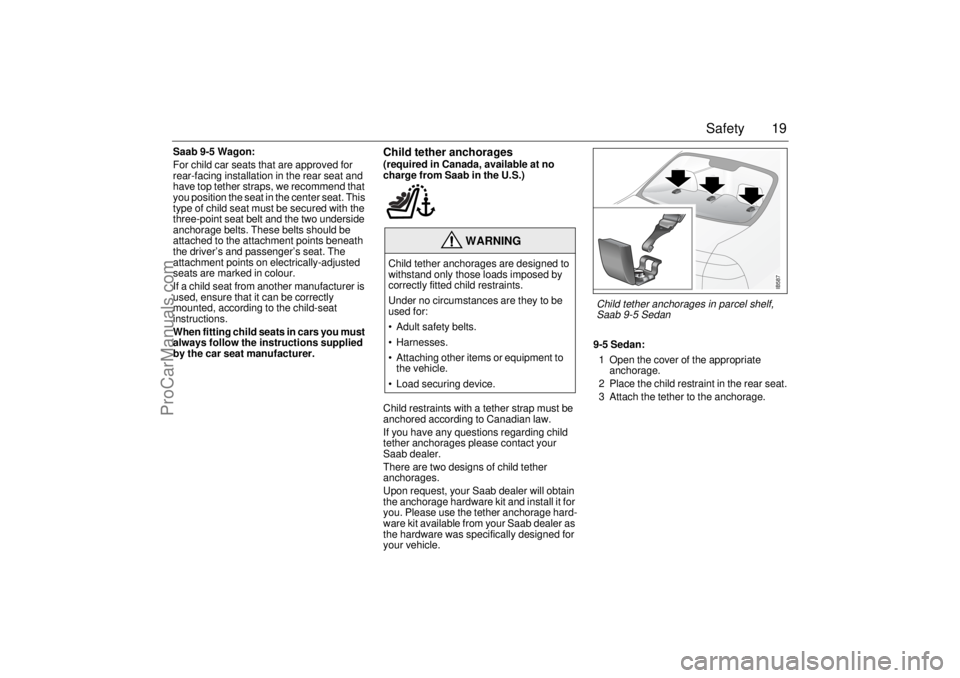
your vehicle.9-5 Sedan:
1 Open the cover of the appropriate
anchorage.
2 Place the child restraint in the rear seat.
3 Attach the tether to the anchorage.
WARNING
Child tether anchorages are designed to
withstand only those loads imposed by
correctly fitted child restraints.
Under no circumstances are they to be
used for:
Adult safety belts.
Harnesses.
Attaching other items or equipment to
the vehicle.
Load securing device.
IB587
Child tether anchorages in parcel shelf,
Saab 9-5 Sedan
ProCarManuals.com
Page 21 of 256
21 Safety
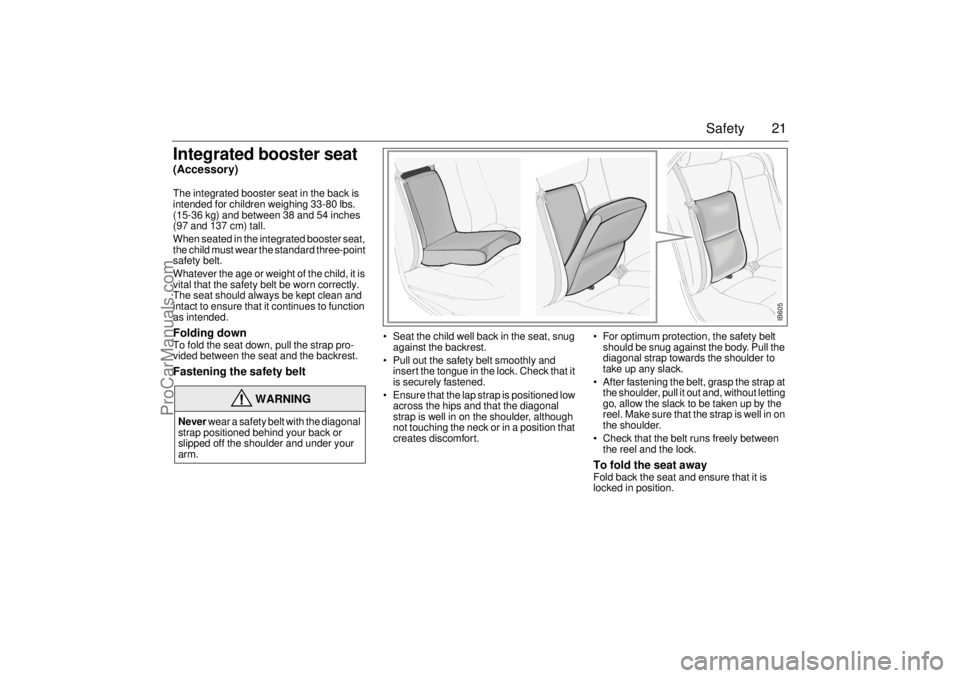
Integrated booster seat(Accessory) The integrated booster seat in the back is
intended for children weighing 33-80 lbs.
(15-36 kg) and between 38 and 54 inches
(97 and 137 cm) tall.
When seated in the integrated booster seat,
the child must wear the standard three-point
safety belt.
Whatever the age or weight of the child, it is
vital that the safety belt be worn correctly.
The seat should always be kept clean and
intact to ensure that it continues to function
as intended. Folding down To fold the seat down, pull the strap pro-
vided between the seat and the backrest. Fastening the safety belt
Seat the child well back in the seat, snug
against the backrest.
Pull out the safety belt smoothly and
insert the tongue in the lock. Check that it
is securely fastened.
Ensure that the lap strap is positioned low
across the hips and that the diagonal
strap is well in on the shoulder, although
not touching the neck or in a position that
creates discomfort. For optimum protection, the safety belt
should be snug against the body. Pull the
diagonal strap towards the shoulder to
take up any slack.
After fastening the belt, grasp the strap at
the shoulder, pull it out and, without letting
go, allow the slack to be taken up by the
reel. Make sure that the strap is well in on
the shoulder.
Check that the belt runs freely between
the reel and the lock.
To fold the seat away Fold back the seat and ensure that it is
locked in position.
WARNING
Never wear a safety belt with the diagonal
strap positioned behind your back or
slipped off the shoulder and under your
arm.
IB605
ProCarManuals.com
Page 25 of 256
25 Safety
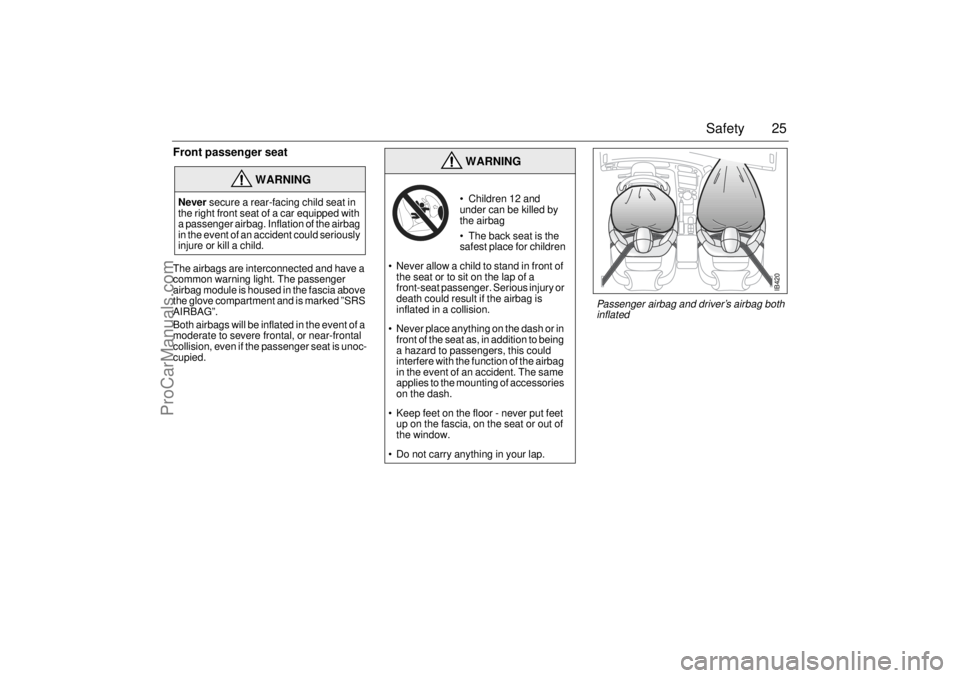
Front passenger seat The airbags are interconnected and have a
common warning light. The passenger
airbag module is housed in the fascia above
the glove compartment and is marked ”SRS
AIRBAG”.
Both airbags will be inflated in the event of a
moderate to severe frontal, or near-frontal
collision, even if the passenger seat is unoc-
cupied.
WARNING
Never secure a rear-facing child seat in
the right front seat of a car equipped with
a passenger airbag. Inflation of the airbag
in the event of an accident could seriously
injure or kill a child.
WARNING Children 12 and
under can be killed by
the airbag
The back seat is the
safest place for children
Never allow a child to stand in front of
the seat or to sit on the lap of a
front-seat passenger. Serious injury or
death could result if the airbag is
inflated in a collision.
Never place anything on the dash or in
front of the seat as, in addition to being
a hazard to passengers, this could
interfere with the function of the airbag
in the event of an accident. The same
applies to the mounting of accessories
on the dash.
Keep feet on the floor - never put feet
up on the fascia, on the seat or out of
the window.
Do not carry anything in your lap.
IB420
Passenger airbag and driver’s airbag both
inflated
ProCarManuals.com