ESP SAAB 9-5 2001 Owner's Guide
[x] Cancel search | Manufacturer: SAAB, Model Year: 2001, Model line: 9-5, Model: SAAB 9-5 2001Pages: 272, PDF Size: 14.83 MB
Page 193 of 272
193 Car care and technical information
Engine oilChecking the oil level Check the engine-oil level regularly. This
should be done after the engine has been
run to normal temperature and then allowed
to cool for 2–5 minutes, with the car stand-
ing on level ground. Remove the dipstick
and wipe it clean before checking the level.
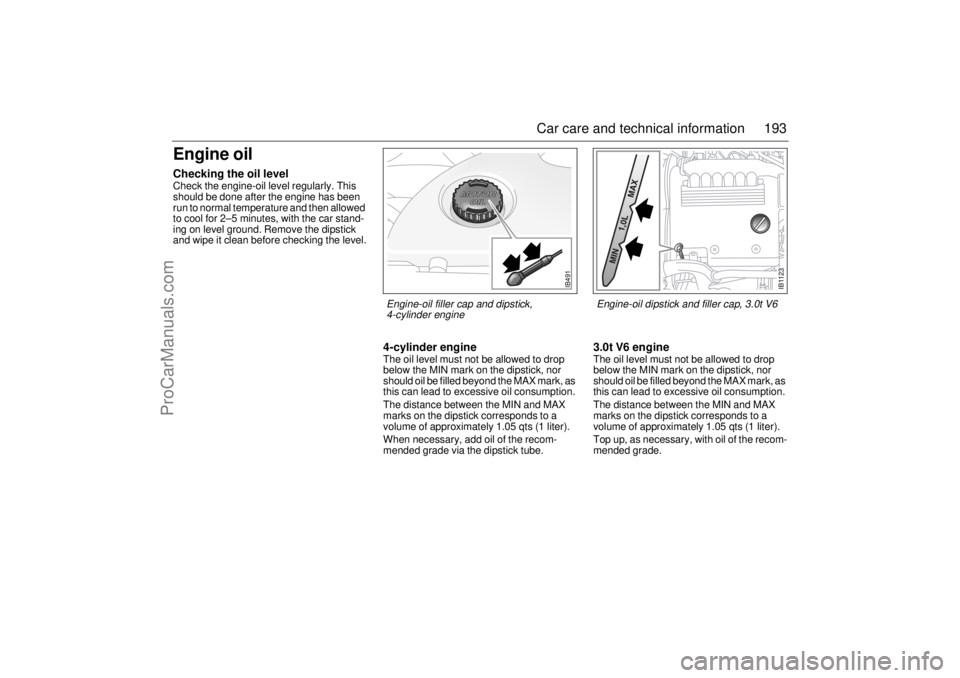
4-cylinder engine The oil level must not be allowed to drop
below the MIN mark on the dipstick, nor
should oil be filled beyond the MAX mark, as
this can lead to excessive oil consumption.
The distance between the MIN and MAX
marks on the dipstick corresponds to a
volume of approximately 1.05 qts (1 liter).
When necessary, add oil of the recom-
mended grade via the dipstick tube.
3.0t V6 engine The oil level must not be allowed to drop
below the MIN mark on the dipstick, nor
should oil be filled beyond the MAX mark, as
this can lead to excessive oil consumption.
The distance between the MIN and MAX
marks on the dipstick corresponds to a
volume of approximately 1.05 qts (1 liter).
Top up, as necessary, with oil of the recom-
mended grade.
IB491
Engine-oil filler cap and dipstick,
4-cylinder engine
IB1123
Engine-oil dipstick and filler cap, 3.0t V6
ProCarManuals.com
Page 195 of 272
195 Car care and technical information
Transmission fluidManual transmission Check and top up the fluid in accordance
with the service program.
If original fluid cannot can be obtained for
topping up (see page 255), automatic trans-
mission fluid Dexron III (synthetic fluid) can
be used. If so, the car should be taken to an
authorized Saab dealer as soon as possible
to have the reason for low fluid level cor-
rected and original fluid installed.Automatic transmission Check the fluid level as follows:
1 Stand the car on level ground and apply
the parking brake. The automatic trans-
mission fluid must be at normal running
temperature, approximately 175°F
(80°C). This can be achieved by driving
the car for about 30 min on the open
road.
2 With the engine idling, move the selector
lever to D and wait for at least
15 seconds. Next, move the selector
lever to R and wait for 15 seconds again.
Finally, move the selector lever to P. Let
the engine idle.
3 Wipe the dipstick clean with a lint-free
cloth and put it back.
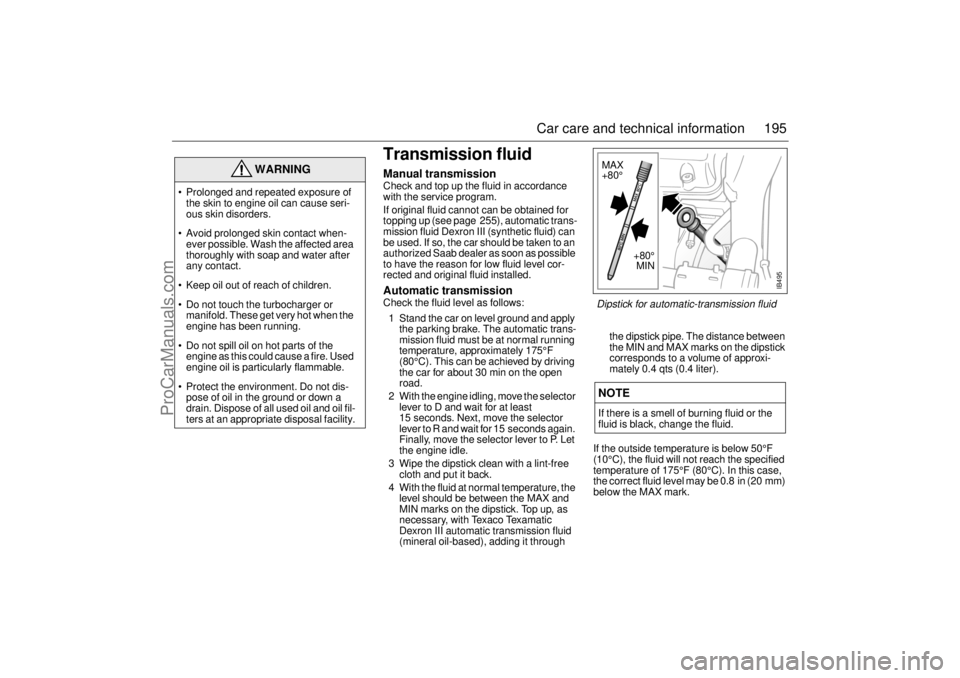
4 With the fluid at normal temperature, the
level should be between the MAX and
MIN marks on the dipstick. Top up, as
necessary, with Texaco Texamatic
Dexron III automatic transmission fluid
(mineral oil-based), adding it through the dipstick pipe. The distance between
the MIN and MAX marks on the dipstick
corresponds to a volume of approxi-
mately 0.4 qts (0.4 liter).
If the outside temperature is below 50°F
(10°C), the fluid will not reach the specified
temperature of 175°F (80°C). In this case,
the correct fluid level may be 0.8 in (20 mm)
below the MAX mark.
WARNING
Prolonged and repeated exposure of
the skin to engine oil can cause seri-
ous skin disorders.
Avoid prolonged skin contact when-
ever possible. Wash the affected area
thoroughly with soap and water after
any contact.
Keep oil out of reach of children.
Do not touch the turbocharger or
manifold. These get very hot when the
engine has been running.
Do not spill oil on hot parts of the
engine as this could cause a fire. Used
engine oil is particularly flammable.
Protect the environment. Do not dis-
pose of oil in the ground or down a
drain. Dispose of all used oil and oil fil-
ters at an appropriate disposal facility.
NOTEIf there is a smell of burning fluid or the
fluid is black, change the fluid.
+80°
MIN MAX
+80°
IB495
Dipstick for automatic-transmission fluid
ProCarManuals.com
Page 198 of 272
198 Car care and technical informationBrake and clutch fluid Checking the fluid level The combined brake and clutch-fluid reser-
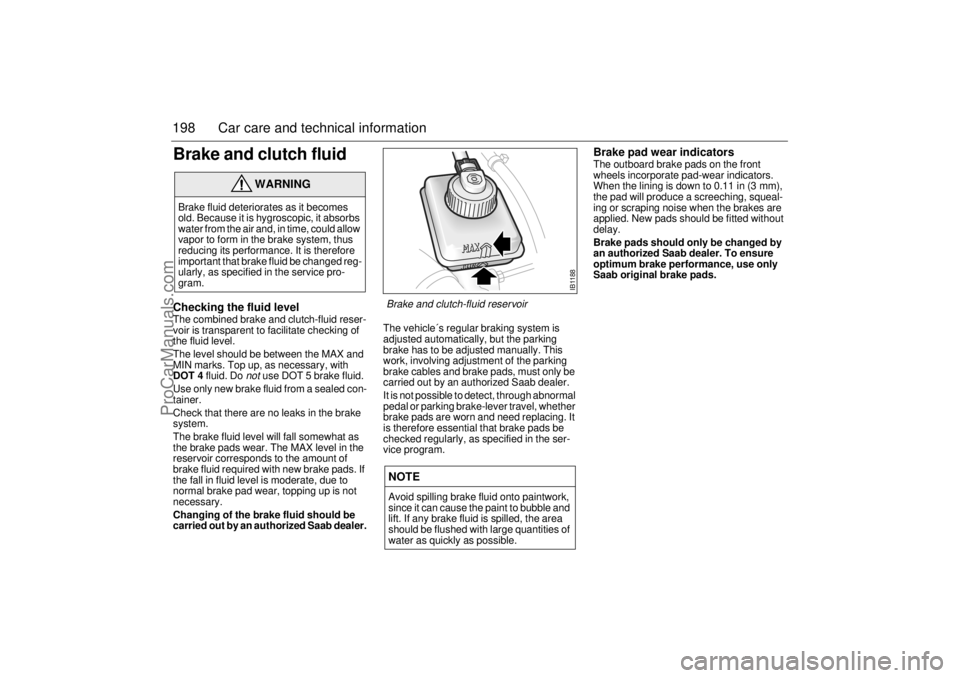
voir is transparent to facilitate checking of
the fluid level.
The level should be between the MAX and
MIN marks. Top up, as necessary, with
DOT 4 fluid. Do
not
use DOT 5 brake fluid.
Use only new brake fluid from a sealed con-
tainer.
Check that there are no leaks in the brake
system.
The brake fluid level will fall somewhat as
the brake pads wear. The MAX level in the
reservoir corresponds to the amount of
brake fluid required with new brake pads. If
the fall in fluid level is moderate, due to
normal brake pad wear, topping up is not
necessary.
Changing of the brake fluid should be
carried out by an authorized Saab dealer.The vehicle´s regular braking system is
adjusted automatically, but the parking
brake has to be adjusted manually. This
work, involving adjustment of the parking
brake cables and brake pads, must only be
carried out by an authorized Saab dealer.
It is not possible to detect, through abnormal
pedal or parking brake-lever travel, whether
brake pads are worn and need replacing. It
is therefore essential that brake pads be
checked regularly, as specified in the ser-
vice program.
Brake pad wear indicators The outboard brake pads on the front
wheels incorporate pad-wear indicators.
When the lining is down to 0.11 in (3 mm),
the pad will produce a screeching, squeal-
ing or scraping noise when the brakes are
applied. New pads should be fitted without
delay.
Brake pads should only be changed by
an authorized Saab dealer. To ensure
optimum brake performance, use only
Saab original brake pads.
WARNING
Brake fluid deteriorates as it becomes
old. Because it is hygroscopic, it absorbs
water from the air and, in time, could allow
vapor to form in the brake system, thus
reducing its performance. It is therefore
important that brake fluid be changed reg-
ularly, as specified in the service pro-
gram.
NOTEAvoid spilling brake fluid onto paintwork,
since it can cause the paint to bubble and
lift. If any brake fluid is spilled, the area
should be flushed with large quantities of
water as quickly as possible.
IB1188
Brake and clutch-fluid reservoir
ProCarManuals.com
Page 208 of 272
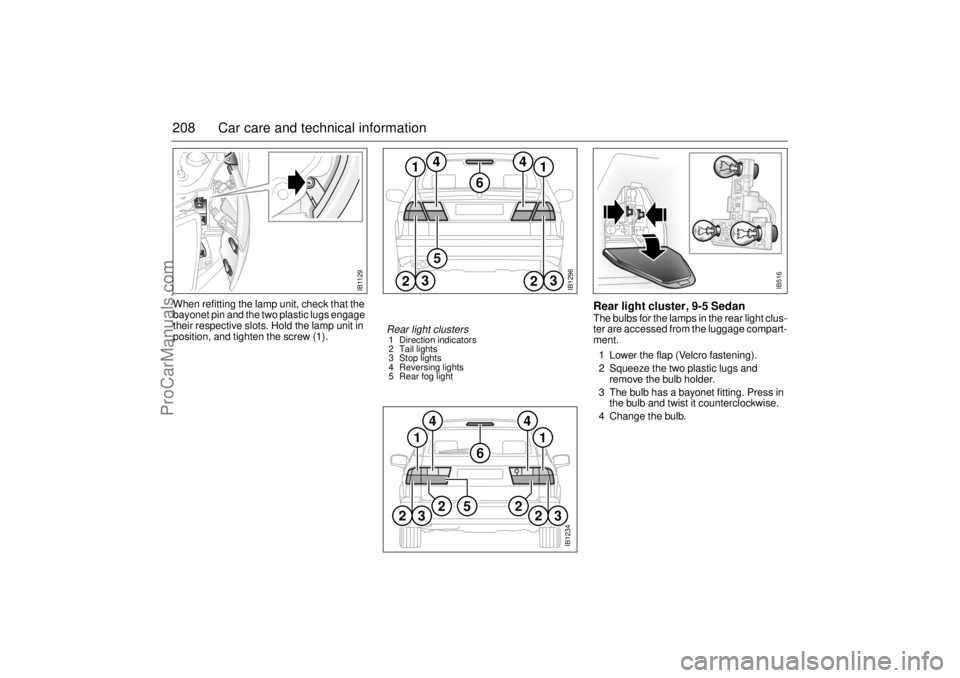
208 Car care and technical informationWhen refitting the lamp unit, check that the
bayonet pin and the two plastic lugs engage
their respective slots. Hold the lamp unit in
position, and tighten the screw (1).
Rear light cluster, 9-5 SedanThe bulbs for the lamps in the rear light clus-
ter are accessed from the luggage compart-
ment.
1 Lower the flap (Velcro fastening).
2 Squeeze the two plastic lugs and
remove the bulb holder.
3 The bulb has a bayonet fitting. Press in
the bulb and twist it counterclockwise.
4 Change the bulb.
IB1129
IB1296
12
3
2
3
5
6
4
1
4
Rear light clusters 1 Direction indicators
2 Tail lights
3 Stop lights
4 Reversing lights
5 Rear fog light
IB516
IB1234
1
4
2
3
2
6
1
42 5
23
ProCarManuals.com
Page 209 of 272
209 Car care and technical information
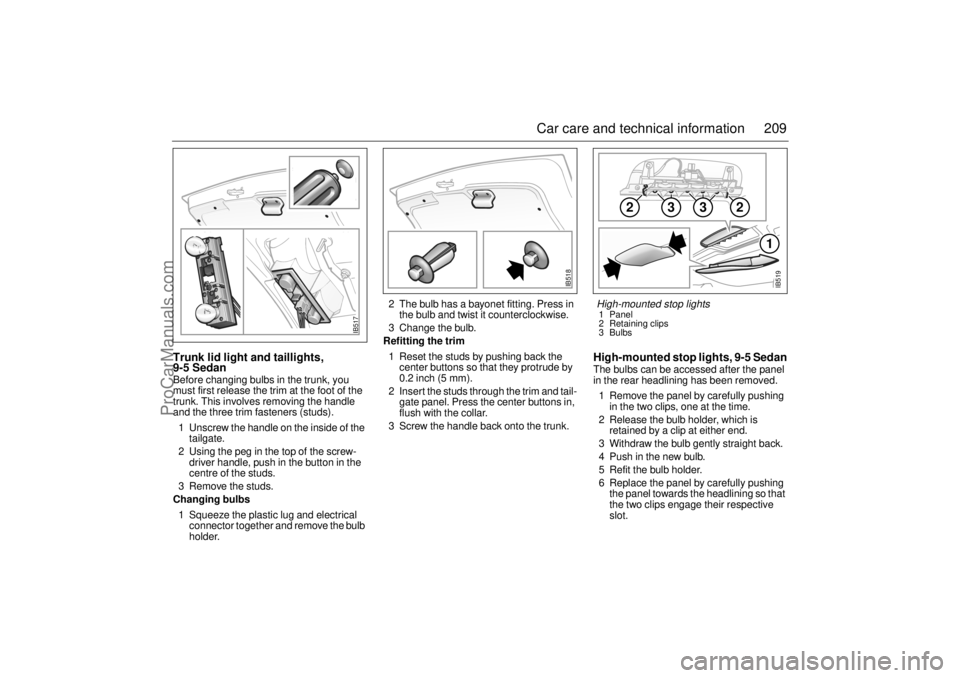
Trunk lid light and taillights,
9-5 SedanBefore changing bulbs in the trunk, you
must first release the trim at the foot of the
trunk. This involves removing the handle
and the three trim fasteners (studs).
1 Unscrew the handle on the inside of the
tailgate.
2 Using the peg in the top of the screw-
driver handle, push in the button in the
centre of the studs.
3 Remove the studs.
Changing bulbs
1 Squeeze the plastic lug and electrical
connector together and remove the bulb
holder.2 The bulb has a bayonet fitting. Press in
the bulb and twist it counterclockwise.
3 Change the bulb.
Refitting the trim
1 Reset the studs by pushing back the
center buttons so that they protrude by
0.2 inch (5 mm).
2 Insert the studs through the trim and tail-
gate panel. Press the center buttons in,
flush with the collar.
3 Screw the handle back onto the trunk.
High-mounted stop lights, 9-5 SedanThe bulbs can be accessed after the panel
in the rear headlining has been removed.
1 Remove the panel by carefully pushing
in the two clips, one at the time.
2 Release the bulb holder, which is
retained by a clip at either end.
3 Withdraw the bulb gently straight back.
4 Push in the new bulb.
5 Refit the bulb holder.
6 Replace the panel by carefully pushing
the panel towards the headlining so that
the two clips engage their respective
slot.
IB517
IB518
3
2
2
3
1
IB519
High-mounted stop lights1 Panel
2 Retaining clips
3 Bulbs
ProCarManuals.com
Page 224 of 272
224 Car care and technical informationTemperatureThe temperature grades are A (the highest),
B, and C, representing the tire’s resistance
to the generation of heat and its ability to dis-
sipate heat when tested under controlled
conditions on a specified indoor laboratory
test wheel. Sustained high temperature can
cause the material of the tire to degenerate
and reduce tire life, and excessive temper-
ature can lead to sudden tire failure. The
grade C corresponds to a level of perfor-
mance which all passenger car tires must
meet under the Federal Motor Vehicle
Safety Standard No. 109.
Grades B and A represent higher levels of
performance on the laboratory test wheel
than the minimum required by law.
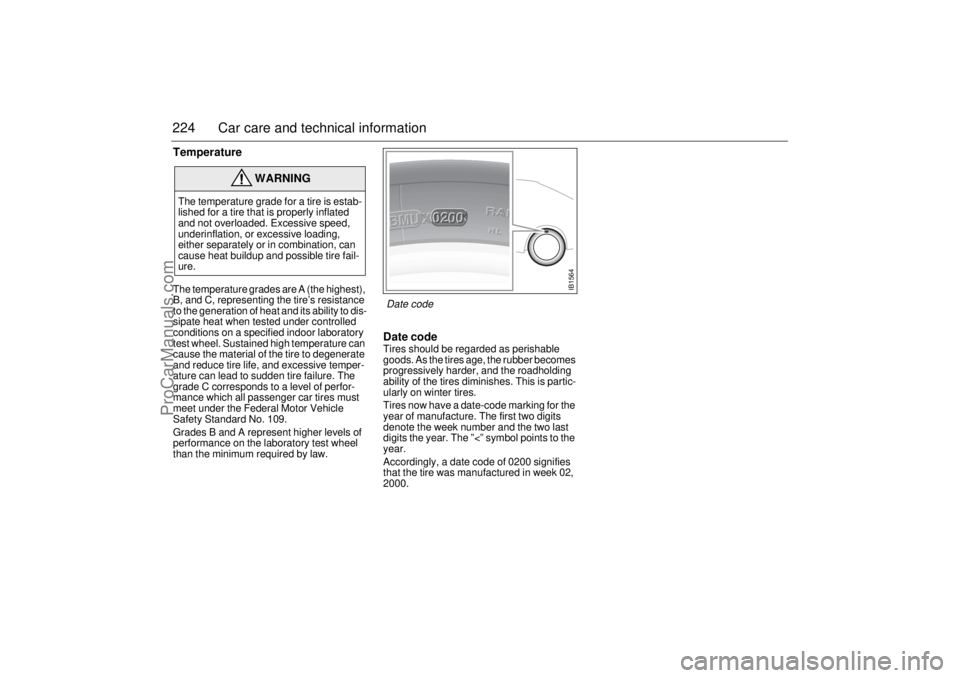
Date codeTires should be regarded as perishable
goods. As the tires age, the rubber becomes
progressively harder, and the roadholding
ability of the tires diminishes. This is partic-
ularly on winter tires.
Tires now have a date-code marking for the
year of manufacture. The first two digits
denote the week number and the two last
digits the year. The ”<” symbol points to the
year.
Accordingly, a date code of 0200 signifies
that the tire was manufactured in week 02,
2000.
WARNING
The temperature grade for a tire is estab-
lished for a tire that is properly inflated
and not overloaded. Excessive speed,
underinflation, or excessive loading,
either separately or in combination, can
cause heat buildup and possible tire fail-
ure.
IB1564
Date code
ProCarManuals.com
Page 229 of 272
229 Car care and technical information
Flat spottingAll tires get hot, especially on long journeys
or when the car is driven hard. After the car
has been parked with hot tires and the tires
have cooled down, a flat spot can appear in
the tire, where it is in contact with the
ground. The same can occur if the car has
not been moved for a long time.
Flat spots can give rise to vibration that can
be felt through the steering wheel, similar to
that experienced when the wheels need bal-
ancing. Flat spots of this type disappear
once the tires get hot again, usually after
10–15 miles (20–25 km) of driving at cruis-
ing speed.
IB539
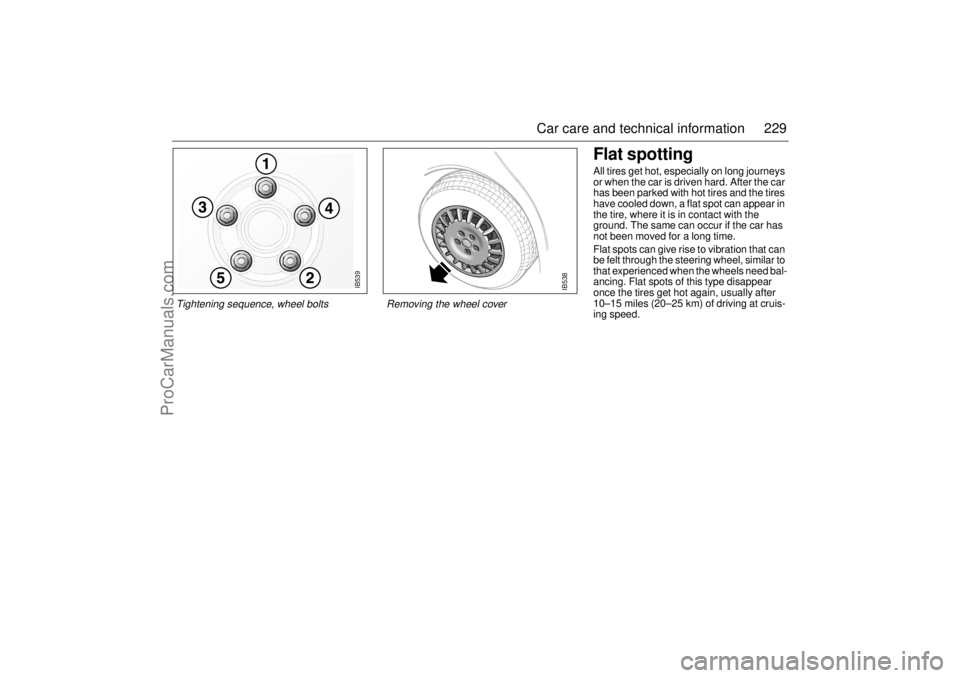
Tightening sequence, wheel bolts
IB538
Removing the wheel cover
ProCarManuals.com
Page 235 of 272

235 Car care and technical information
What causes rust?Steel body panels of automobiles are sub-
ject to rusting whenever air and moisture
manage to penetrate the protective finish,
and body panels may rust through if the pro-
cess is unchecked. Rusting can occur wher-
ever water is trapped or where the car’s
panels are continuously damp. Damage to
paint and undercoating by stones, gravel
and minor accidents immediately exposes
metal to air and moisture. Road salts used
for de-icing will collect on the bottom of the
car and promote rusting. Areas of the coun-
try with high humidity have great potential
for rust problems, especially where salt is
used on roads or there is moist sea air.
Industrial pollution (fallout) may also
damage paint and promote rusting.
Preventive maintenanceThe following procedures are necessary to
help protect against rusting. Refer also to
the terms and conditions of the Sheet Metal
Coverage described in the warranty book-
let.
1Wash the car frequently, and wax at
least twice a year. Under adverse con-
ditions, where there is a rapid buildup of
dirt, sand or road salt, wash your car at
least once a week. After extreme expo-
sure to salted snow or slush, evidenced
by a white film on the car, wash the car
immediately. Frequent washing will pre-
vent paint damage from acid rain and
other airborne contaminants such as
tree sap and bird droppings. If any of
these contaminants are noticed on the
car the finish should be washed immedi-
ately.
Begin washing by rinsing the entire car
with water to loosen and flush off heavy
concentrations of dirt (include the
underbody).
Sponge the car with a solution of either
a good quality car soap or mild general
purpose (dish washing) detergent and
water.
Rinse car thoroughly with clean water.
After washing, check and clear all
drains in doors and body panels.
Wipe the car dry, preferably using a
chamois.2Clean the underside of the car during
the winter. Use high pressure water to
clean the car’s underside (floor panels,
wheel wells) at least at mid- winter and
in the spring.
3Inspect the car frequently for leaks or
damage, and arrange for needed
repairs promptly. After washing or after
heavy rain, check for leaks. When wash-
ing the car inspect body surfaces for
paint damage. While checking for leaks,
lift the floor mats and check beneath
them. Water can collect in these areas
and remain for prolonged periods. Dry
any wet areas including the floor mats.
Have leaks repaired as soon as possi-
ble.
Use touch-up paint to repair small
scratches or minor finish damage. Areas
where metal is exposed will rust quickly
and MUST be repaired immediately by
touch-up or professional repainting.
Rust must be removed, the bare metal
primed and painted. Major body
damage should be repaired immediately
and new panels or exposed areas
should be undercoated with anti- corro-
sion material.
Repairs of this type are the owner’s
responsibility and are not covered under
warranty.
ProCarManuals.com
Page 243 of 272

243 Maintenance and owner assistance
Service record retentionService instruction coupons and record
stubs are provided in the Saab Warranties
and Service Record Booklet which accom-
panies this Owner’s Manual. The coupons
are arranged in the order that normal ser-
vice should be performed. The edge of each
coupon is shaded to correspond to the type
of service point:
Striped - "Check Up"
Blue - Oil change/inspection service
Black - Major service
Note that in Canada a combined service
and warranty book is used, but not service
coupons.
When scheduled services are performed,
your dealer will tear out the applicable
coupon and use it to check off the opera-
tions performed and enter it into the service
file at the dealership. The servicing dealer’s
stamp, along with the date and mileage at
which the service was done, should be
entered on the corresponding stub which
remains in your booklet. The booklet is your
permanent record of the services per-
formed. It also includes a log sheet for
unscheduled repairs.
It is advisable to retain receipts and, if pos-
sible, copies of shop work orders for all ser-
vice and repair work, wherever performed.
Service costsDealer pricing practices and labor for ser-
vice work vary. Saab’s recommended ser-
vice times for each service point do not
include the labor required to replace wear
items, such as wiper blades, brake pads or
tires. Nor is labor to perform other service or
repairs found to be necessary as a result of
the inspections included in these times.
Additional labor and parts will be charged
for such work when necessary, except as
covered under an applicable Saab warranty
or any optional extended service contract.
Transmission fluid changes or suspension
alignment, when necessary, are also addi-
tional.
Dealer charges for general shop material,
regulated hazardous waste removal, recy-
cling expenses or other operation costs may
also be applied to service and repair
invoices and are apt to vary by dealer and
locality.
Owner assistanceWarranties and service problem
assistanceFor complete information about all applica-
ble warranties, including the New Car War-
ranty, Perforation Warranty, Vehicle Emis-
sion Warranty and Emission Perforation
Warranty, consult the Warranties and Ser-
vice Record Booklet which accompanies
this Owner’s Manual. It also contains owner
assistance information including Saab
Roadside Assistance. If the booklet is lost or
misplaced, a new one may be ordered
through a Saab dealer or by contacting
Saab.
In the U.S. there is a national Customer
Assistance Center at Saab Cars USA, Inc.
The toll-free number to call from all 50 states
is 1-800-955-9007.
In Canada, please call the Saab Customer
Assistance Centre at 1-800-263-1999.
A list of authorized Saab sales and service
dealers is available for those planning to
travel in the United States and Canada.
Canadian or U.S. travelers may call the
Customer Assistance Center in the country
in which they are traveling.
ProCarManuals.com