trailer SAAB 9-5 2005 User Guide
[x] Cancel search | Manufacturer: SAAB, Model Year: 2005, Model line: 9-5, Model: SAAB 9-5 2005Pages: 276, PDF Size: 16.72 MB
Page 165 of 276

163 Starting and driving
When negotiating long hills, bear the follo-
wing important considerations in mind:
Use Normal mode when driving with a
caravan or trailer on hilly roads. The adap-
tive gear change pattern function will pre-
vent the transmission overheating.
Rises in coolant temperature are indica-
ted by the temperature gauge in the main
instrument panel.
Recommendations for cars with
automatic transmissionRises in coolant temperature are indicated
by the temperature gauge in the main instru-
ment panel.
The following steps are taken in order as the
temperature of the engine increases:
Gear change pattern is altered.
A/C compressor is switched off.
Engine torque is reduced.
The following message will be displayed on
the SID if the transmission fluid becomes
too hot:
“Gearbox too hot.
Make a safe stop.
If this message appears, stop the car as
soon as it is safe to do so and allow the
engine to idle until the message has gone
out. The selector lever should be in
position P.When continuing your journey, select
manual mode and a gear in which the
engine speed is about 3,000 rpm until the
incline eases (see page 149).
WARNING
Remember to use the braking effect of the
engine (position D or L) when you are
descending long or steep hills to spare
the brakes.
Brake failure can result from overheated
brakes!
ProCarManuals.com
Page 166 of 276
164 Starting and drivingRecommendations for cars with manual
gearboxRises in coolant temperature are indicated
by the temperature gauge in the main instru-
ment panel.
The following steps are taken in order as the
temperature of the engine increases:
A/C compressor is switched off.
engine torque is reduced.
When continuing your journey, select a gear
in which the engine speed is about
3,000 rpm until the incline eases.
Driving considerations Always take extra care when towing a
trailer, as the car’s handling will be different
and its braking effect reduced. The trailer’s
braking system and suspension also have a
considerable effect on these characteris-
tics, see also ”Driving with a load” page 168.
If the car has automatic transmission, select
position D when ascending steep hills. This
ensures that the adaptive gear change pat-
terns are operational, see page 150. Use
position D or L for steep descents.
Checks before drivingMake sure that the car and camper or trailer
are in good working order. This is essential
since towing a camper or trailer increases
the strain on the car.
Check and if necessary adjust the tire
pressure of the car and camper or trailer.
Make sure all wheel bolts are properly
tightened.
Make sure that the equipment joining the
car and camper or trailer is properly secu-
red and adjusted.
Make sure the camper or trailer’s electri-
cal cable is properly connected and is not
so long that it drags along the ground.
Also, make sure the cable is not too short
and risks breaking when turning a corner.
Check all bulbs.
Check the car and camper or trailer bra-
kes.
Make sure that all items on or in the cara-
van or trailer are properly secured.
Make sure that the camper or trailer’s
jockey wheel is raised and locked.
Check the distribution of the load so that
the car and camper or trailer are well
balanced.
Check that the rearview mirrors provide
the best possible rearward vision.
Make sure the camper or trailer’s safety
cable is correctly attached.
WARNING
Utilize the braking effect of the engine
(1st, 2nd or 3rd gear) when you are
descending long or steep hills to spare
the brakes.
Brake failure can result from overheated
brakes!
NOTICEIf the ”Automatic transmission, fault indi-
cator” indicator comes on, cease
towing until the problem has been recti-
fied.
ProCarManuals.com
Page 167 of 276
165 Starting and driving
Trailer hitch loadThe weight distribution on the trailer makes
a lot of difference to the handling properties
of the car and trailer combination. As
regards single-axle trailers, whenever pos-
sible, concentrate the load over the wheels
and keep it as low as possible.
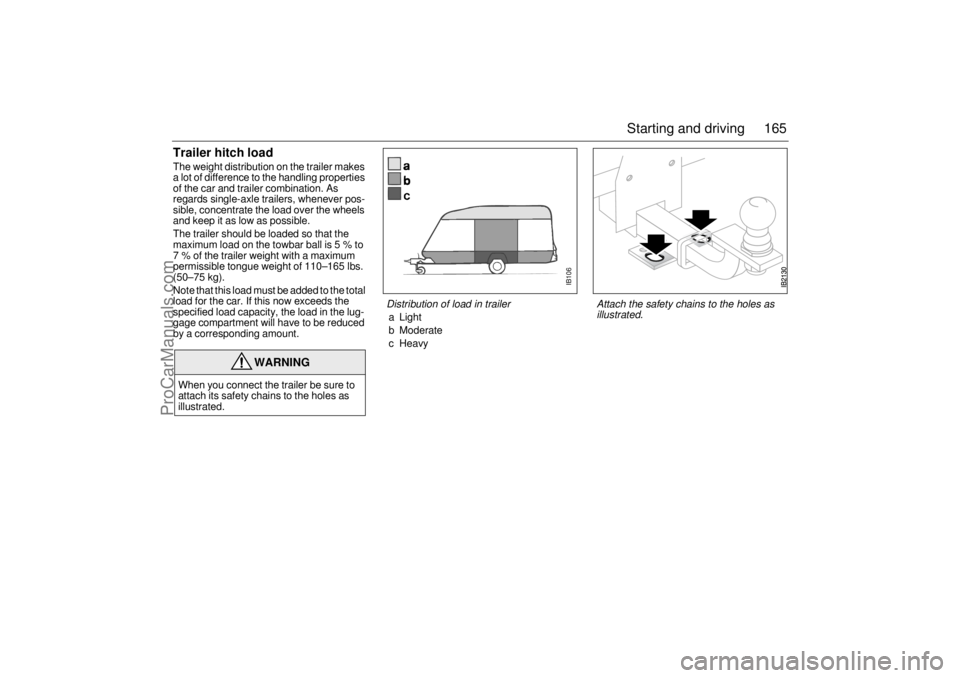
The trailer should be loaded so that the
maximum load on the towbar ball is 5 % to
7 % of the trailer weight with a maximum
permissible tongue weight of 110–165 lbs.
(50–75 kg).
Note that this load must be added to the total
load for the car. If this now exceeds the
specified load capacity, the load in the lug-
gage compartment will have to be reduced
by a corresponding amount.
WARNING
When you connect the trailer be sure to
attach its safety chains to the holes as
illustrated.
IB106
Distribution of load in trailer aLight
b Moderate
cHeavy
Attach the safety chains to the holes as
illustrated.
ProCarManuals.com
Page 174 of 276
172 Starting and drivingFront towing eye
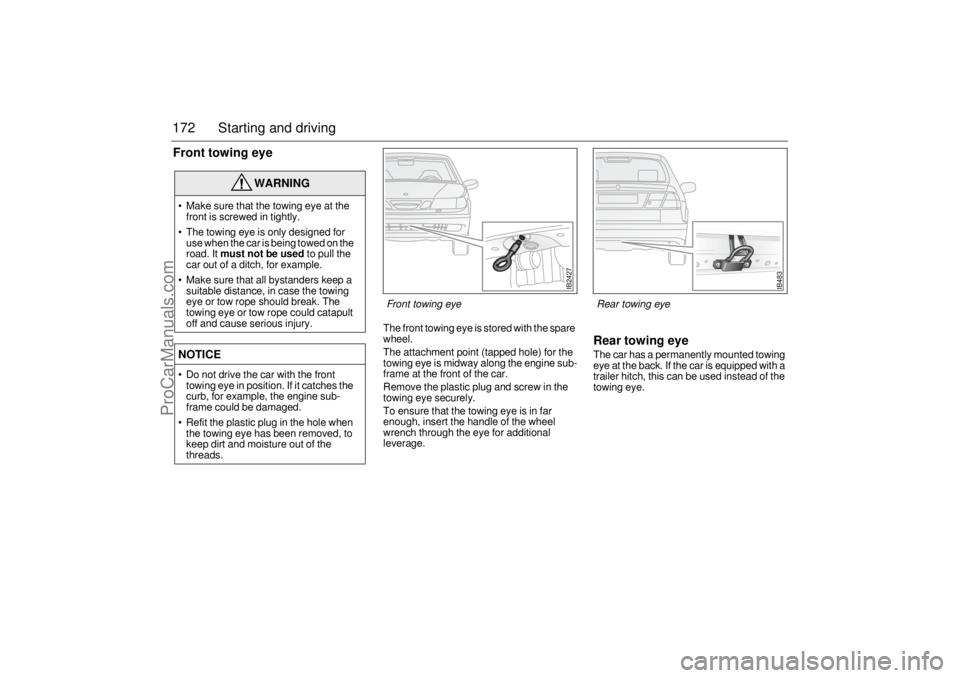
The front towing eye is stored with the spare
wheel.
The attachment point (tapped hole) for the
towing eye is midway along the engine sub-
frame at the front of the car.
Remove the plastic plug and screw in the
towing eye securely.
To ensure that the towing eye is in far
enough, insert the handle of the wheel
wrench through the eye for additional
leverage.
Rear towing eyeThe car has a permanently mounted towing
eye at the back. If the car is equipped with a
trailer hitch, this can be used instead of the
towing eye.
WARNING
Make sure that the towing eye at the
front is screwed in tightly.
The towing eye is only designed for
use when the car is being towed on the
road. It
must not be used
to pull the
car out of a ditch, for example.
Make sure that all bystanders keep a
suitable distance, in case the towing
eye or tow rope should break. The
towing eye or tow rope could catapult
off and cause serious injury.
NOTICE Do not drive the car with the front
towing eye in position. If it catches the
curb, for example, the engine sub-
frame could be damaged.
Refit the plastic plug in the hole when
the towing eye has been removed, to
keep dirt and moisture out of the
threads.
IB2427
Front towing eye
IB483
Rear towing eye
ProCarManuals.com
Page 180 of 276

178 Starting and drivingWhen an object is approximately 3 feet
(90 cm) from the car, the sound pulses
change character markedly. A distance of
about 3 feet (90 cm) is suitable if you wish
to load or unload the luggage compartment.
If the distance between an object and the
corner sensors does not change for three
seconds, e.g. if you are reversing alongside
a wall, the system will switch to monitoring
straight back. The system indicates if the
distance to the wall decreases again.
The system can be disengaged for when
driving with a trailer. Press and hold the
CLEAR button on the SID when the display
shows "PARK ASSIST", until the display
shows "PARK ASSIST OFF". The system is
re-engaged in the same way. The system is
also always activated when the ignition key
is turned to ON. Pressing a SID button briefly will not disen-
gage the system, the display will simply
show the previously selected function.
Ice, snow and dirt can affect the sensitivity
of the sensors. In such cases a continuous
tone will sound warning the driver that the
system cannot measure the distance to an
object. You can turn the system off by press-
ing and holding the CLEAR button for
1.5 seconds.
If the text "PARK ASSIST FAILURE" is dis-
played on the SID, have the system
checked by an authorized Saab dealer.NOTICEReverse slowly so that you have time to
stop the car when the continuous tone is
heard at approx. 12 in. (30 cm).
NOTICETo function well, the sensors must be kept
clean. Ice snow and dirt can affect their
sensitivity.
Do not spray the sensors or closer than
8 in. (20 cm) to the sensors with a pres-
sure washer, as this could damage them.
ProCarManuals.com
Page 215 of 276
213 Car care and technical information
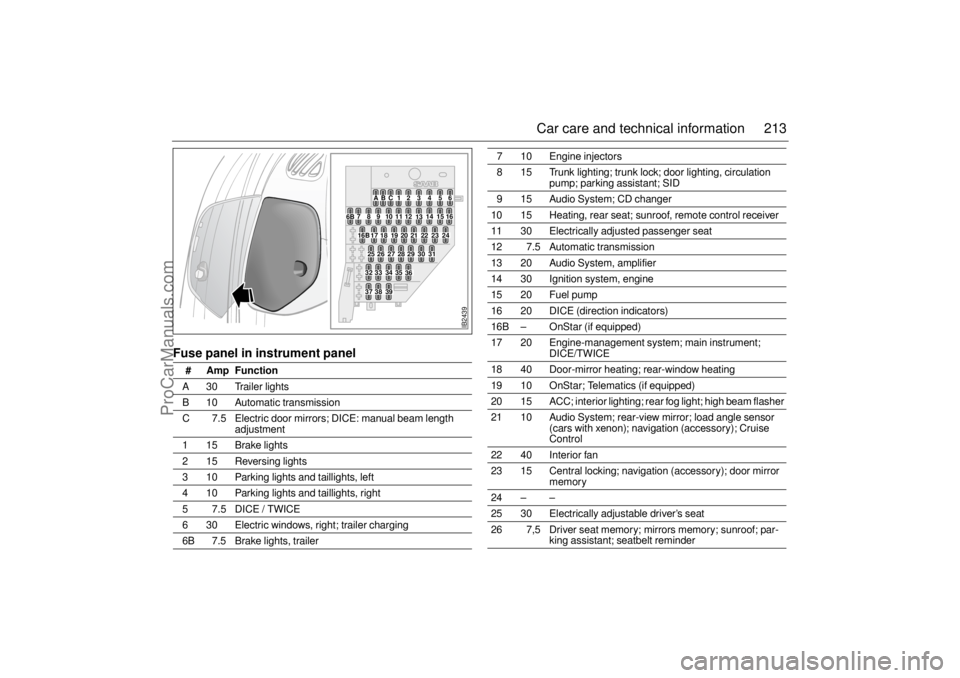
Fuse panel in instrument panel
# Amp Function A 30 Trailer lights
B 10 Automatic transmission
C 7.5 Electric door mirrors; DICE: manual beam length
adjustment
115Brake lights
2 15 Reversing lights
3 10 Parking lights and taillights, left
4 10 Parking lights and taillights, right
5 7.5 DICE / TWICE
6 30 Electric windows, right; trailer charging
6B 7.5 Brake lights, trailer
7 10 Engine injectors
8 15 Trunk lighting; trunk lock; door lighting, circulation
pump; parking assistant; SID
9 15 Audio System; CD changer
10 15 Heating, rear seat; sunroof, remote control receiver
11 30 Electrically adjusted passenger seat
12 7.5 Automatic transmission
13 20 Audio System, amplifier
14 30 Ignition system, engine
15 20 Fuel pump
16 20 DICE (direction indicators)
16B – OnStar (if equipped)
17 20 Engine-management system; main instrument;
DICE/TWICE
18 40 Door-mirror heating; rear-window heating
19 10 OnStar; Telematics (if equipped)
20 15 ACC; interior lighting; rear fog light; high beam flasher
21 10 Audio System; rear-view mirror; load angle sensor
(cars with xenon); navigation (accessory); Cruise
Control
22 40 Interior fan
23 15 Central locking; navigation (accessory); door mirror
memory
24 – –
25 30 Electrically adjustable driver’s seat
26 7,5 Driver seat memory; mirrors memory; sunroof; par-
king assistant; seatbelt reminder
IB2439
BC123456 A
14
121110987
13
6B
1516
2324
222120191817
16B25262728293031
3635343332
393837
ProCarManuals.com
Page 230 of 276

228 Car care and technical informationSteps for Determining Correct
Load Limit1 Locate the statement “The
combined weight of occupants and
cargo should never exceed
XXX pounds” on your vehicle´s
label.
2 Determine the combined weight of
the driver and passengers that will
be riding in your vehicle.
3 Subtract the combined weight of the
driver and passengers from
XXX kilograms or XXX pounds.
4 The resulting figure equals the avail-
able amount of cargo and luggage
load capacity. For example, if the
“XXX” amount equals 1400 lbs. and
there will be five 150 lb. passengers
in your vehicle, the amount of avail-
able cargo and luggage load capac-
ity is 650 lbs. (1400–750 (5x150) =
650 lbs.).5 Determine the combined weight of
luggage and cargo being loaded on
the vehicle. That weight may not
safely exceed the available cargo
and luggage load capacity calcu-
lated in Step 4.
6 If your vehicle will be towing a trailer,
load from your trailer will be trans-
ferred to your vehicle. Consult this
manual to determine how this
reduces the available cargo and
luggage load capacity of your vehi-
cle.
Winter tiresWinter (snow) tires are recommended for
winter climates where the majority of your
driving will be done on snow and ice. Winter
tires should be fitted to all four wheels to
maintain a proper balance. Your Saab
dealer can advise you of to the correct size
tire for your car (if different from the original
size) and also supply Saab approved winter
tires pre-mounted on steel or alloy rims.
Winter tires normally use a different speed
rating compared to summer/all season tires.
Make sure not to exceed the stated speed
rating on the tires you use.
ProCarManuals.com
Page 234 of 276
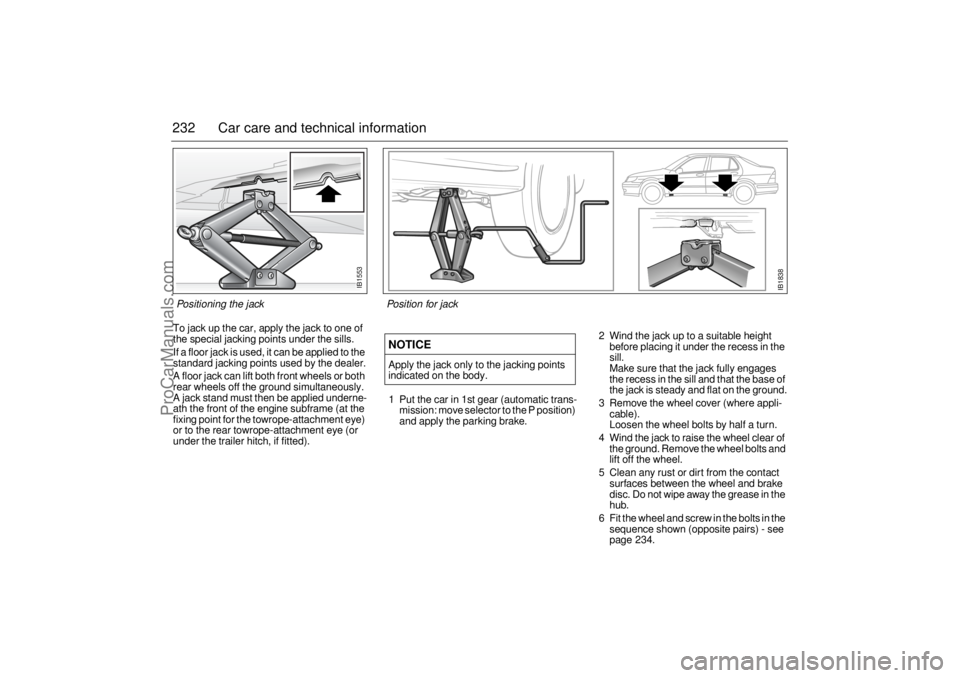
232 Car care and technical informationTo jack up the car, apply the jack to one of
the special jacking points under the sills.
If a floor jack is used, it can be applied to the
standard jacking points used by the dealer.
A floor jack can lift both front wheels or both
rear wheels off the ground simultaneously.
A jack stand must then be applied underne-
ath the front of the engine subframe (at the
fixing point for the towrope-attachment eye)
or to the rear towrope-attachment eye (or
under the trailer hitch, if fitted).1 Put the car in 1st gear (automatic trans-
mission: move selector to the P position)
and apply the parking brake.2 Wind the jack up to a suitable height
before placing it under the recess in the
sill.
Make sure that the jack fully engages
the recess in the sill and that the base of
the jack is steady and flat on the ground.
3 Remove the wheel cover (where appli-
cable).
Loosen the wheel bolts by half a turn.
4 Wind the jack to raise the wheel clear of
the ground. Remove the wheel bolts and
lift off the wheel.
5 Clean any rust or dirt from the contact
surfaces between the wheel and brake
disc. Do not wipe away the grease in the
hub.
6 Fit the wheel and screw in the bolts in the
sequence shown (opposite pairs) - see
page 234.
NOTICEApply the jack only to the jacking points
indicated on the body.Position for jack
IB1838
IB1553
Positioning the jack
ProCarManuals.com
Page 248 of 276

246 Customer Assistance and InformationMaintenance scheduleThe Maintenance Schedule prescribes a
service program to the purchaser/operator
of a Saab that is reasonable and necessary
to ensure the proper emission control sys-
tems function, safety and reliability of the
Saab automobile in normal use. Additional
maintenance is recommended for specific
components when the car is operated under
certain severe conditions. Proper mainte-
nance is always good advice!
Authorized Saab dealers are equipped and
trained to meet your Saab’s service needs.
They regularly receive up-to-date Saab ser-
vice manuals and parts and technical ser-
vice bulletins from Saab and are able,
through their franchise agreement, to attend
Saab service schools, obtain Saab special
tools and technical assistance and pur-
chase original equipment service and
replacement parts.
Today’s complex automobiles should only
be entrusted to the most knowledgeable
service professionals. A Saab dealer is your
best choice.
Service intervalsThe maintenance schedule prescribes a
service at every 15,000 miles (24,000 km)
thereafter (15,000, 30,000, 45,000 miles/
24,000, 48,000, 72,000 km etc.).
Engine oil and filter changesChanging the engine oil and filter is required
at every service point. Use only a Saab
approved long-life oil filter and engine oils
stated in the Specification section of this
Owner’s Manual. The use of extra additives
in the oil is not necessary and is not recom-
mended, and may be harmful to turbo-
chargers.
More frequent oil changes are recom-
mended if your vehicle is operated under
the following conditions:
Most trips are less than 5 to 10 miles (8 to
16 km). This is particularly important
when outside temperatures are below
freezing.
Most trips include extensive idling (such
as frequent stop-and-go driving).
Most trips are through dusty areas.
You frequently tow a trailer or use a carrier
on top of your vehicle.
If the vehicle is used for delivery service,
police, taxi or other commercial applica-
tions.
If your driving habits match this description,
have the engine oil and filter changed in-
between normal services at 7,500 mile
(12,000 km) intervals. The Saab Warranty
and Service Record Booklet has provisions
to record extra oil changes.
ProCarManuals.com
Page 255 of 276

253 Specifications
Trailer:
Luggage compartment Volume (SAE):
9-5 Sedan _______________________ 15.9 cu.ft.
(450 litres)
9-5 SportWagon, rear seat upright ____ 31.4 cu. ft.
(890 litres)
9-5 SportWagon, rear seat folded_____ 73.0 cu. ft.
(2067 litres)
Luggage compartment, length, 9-5 Sedan:
Rear seat upright _________________ 43.0 in (1092 mm)
Rear seat folded down _____________ 67.5 in (1714 mm)
Luggage compartment, length, 9-5 Sport-
Wagon:
Rear seat upright _________________ 42.8 in (1087 mm)
Rear seat folded __________________ 68.2 in (1732 mm)
WARNING
The GVW and maximum axle loads must not be exceeded.
Note that if some accessories (e.g. towbar, CD changer) are
fitted, the available load capacity is reduced by the weight of
these.
When carrying a load in the luggage compartment, make sure
that it is tied down securely, particularly when part or all of the
rear seat is folded down.
Maximum towing speed, trailer with brakes 60 mph (100 km/h)
Trailer with brakes _________________ Maximum weight:
3500 lbs (1588 kg)
Trailer without brakes ______________ Maximum weight:
1000 lbs (450 kg)
Maximum load on ball hitch __________ 110–165 lbs
(50–75 kg)
The above speed and weight restrictions are those specified by
Saab Automobile AB.
Note that local restrictions may apply to trailer speeds and
weights (see page 161).
ProCarManuals.com