child restraint Seat Alhambra 2006 User Guide
[x] Cancel search | Manufacturer: SEAT, Model Year: 2006, Model line: Alhambra, Model: Seat Alhambra 2006Pages: 299, PDF Size: 6.33 MB
Page 40 of 299
Airbag system 38
In order to provide the desired extra protection in an accident, the airbags
have to deploy extremely rapidly (within fractions of a second). A fine dust
may develop when the airbag deploys. This is normal and is no indication
that there was a fire in the vehicle.
The function of the airbag covers if the airbags are triggered
The airbag covers fold out of the steering wheel or dash panel when the driver
and front passenger airbags deploy. The airbag covers remain connected to
the steering wheel or the dash panel.
Safety notes on front airbag system
If you use airbags correctly, they can considerably reduce the
risk of injury in many kinds of accident.
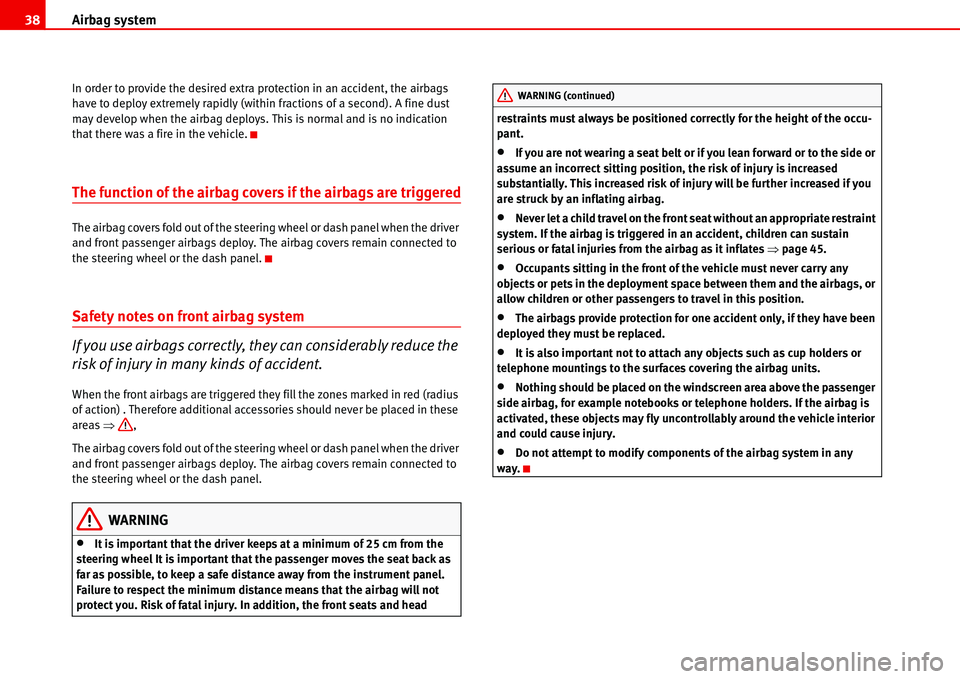
When the front airbags are triggered they fill the zones marked in red (radius
of action) . Therefore additional accessories should never be placed in these
areas Ÿ,
The airbag covers fold out of the steering wheel or dash panel when the driver
and front passenger airbags deploy. The airbag covers remain connected to
the steering wheel or the dash panel.
WARNING
•It is important that the driver keeps at a minimum of 25 cm from the
steering wheel It is important that the passenger moves the seat back as
far as possible, to keep a safe distance away from the instrument panel.
Failure to respect the minimum distance means that the airbag will not
protect you. Risk of fatal injury. In addition, the front seats and head restraints must always be positioned correctly for the height of the occu-
pant.
•If you are not wearing a seat belt or if you lean forward or to the side or
assume an incorrect sitting position, the risk of injury is increased
substantially. This increased risk of injury will be further increased if you
are struck by an inflating airbag.
•Never let a child travel on the front seat without an appropriate restraint
system. If the airbag is triggered in an accident, children can sustain
serious or fatal injuries from the airbag as it inflates Ÿpage 45.
•Occupants sitting in the front of the vehicle must never carry any
objects or pets in the deployment space between them and the airbags, or
allow children or other passengers to travel in this position.
•The airbags provide protection for one accident only, if they have been
deployed they must be replaced.
•It is also important not to attach any objects such as cup holders or
telephone mountings to the surfaces covering the airbag units.
•Nothing should be placed on the windscreen area above the passenger
side airbag, for example notebooks or telephone holders. If the airbag is
activated, these objects may fly uncontrollably around the vehicle interior
and could cause injury.
•Do not attempt to modify components of the airbag system in any
way.
WARNING (continued)
Page 47 of 299
Child safety45
Safety FirstOperating instructionsTips and MaintenanceTe c h n i c a l D a t a
Child safety
Brief introduction
Introduction
Statistics show that children are generally safer on the rear
seat than on the front passenger seat.
We recommend that children under 12 years of age be transported on the rear
seats. Children travelling on the rear seat must use a child restraint system or
the seat belts provided, depending on their age, height and weight. For
safety reasons, the child restraint system should be installed in the centre of
the rear seat or behind the front passenger's seat.
The physical principles involved and the forces acting in a collision apply to
children just as much as adults Ÿpage 19. But unlike adults, children do not
have fully developed muscle and bone structures. This means that children
are subject to a greater risk of injury.
To reduce this risk, children must always use special child restraint systems
when travelling in the vehicle.
We recommend the use of child safety products from the SEAT Genuine Acces-
sories Program including systems for all ages made by “Peke”
2).
These systems have been especially designed and approved, complying with
the ECE-R44. regulation.
Follow the manufacturer's instructions and observe any statutory require-
ments when installing and using child seats. Always read and observe
Ÿpage 45.We recommend that you include the manufacturer's directions for child seat
use in the vehicle wallet and always keep them in the vehicle.
Safety notes on using child seats
Proper use of child seats substantially reduces the risk of
injury in an accident!
As the driver, you are responsible for any children you transport in
your vehicle.
– Protect your children by properly using appropriate child seats.
– Always ensure that the belt webbing is properly positioned
according to the instructions provided by the manufacturer of the
child seat.
– When travelling, do not allow children to distract you from traffic.
– Take breaks regularly during long trips. Take a break at least
every two hours.
We recommend that you include the manufacturer's directions for child seat
use in the vehicle wallet and always keep them in the vehicle.
WARNING
•Never fit a child seat in the passenger seat, where the child faces back-
wards to the direction of travel and the frontal airbag has not been deacti-
vated. This is highly dangerous for the child. If it is necessary, in excep-
2)Not for all countries
Page 48 of 299
Child safety 46
tional circumstances, to transport a child on the front passenger seat,
always disable the front passenger airbag Ÿpage 43.
•All passengers, especially children, must assume the proper sitting
position and be properly belted in while travelling.
•Never hold children or babies on your lap, this can result in potentially
fatal injuries to the child!
•Never allow a child to be transported in a vehicle without being properly
secured, or to stand up or kneel on a seat while travelling. In an accident,
the child could be flung through the vehicle, causing possibly fatal injuries
to themselves and other occupants.
•If children assume an improper sitting position when the car is moving,
they expose themselves to greater risk of injury during a sudden braking
manoeuvre or in an accident. This is particularly the case if the child is trav-
elling on the front passenger seat and the airbag system is triggered in an
accident; this could have consequences including serious injury or death.
•A suitable child seat can protect your child!
•Make sure that no hard or sharp objects, for example toys, are on the
child seats. Risk of injury.
•Never leave a child unsupervised in a child seat or alone in the vehicle.
•Depending on the time of year, the interior of a parked vehicle can reach
extreme temperatures which may endanger the life of people and animals.
•Children who are less than 1.5 metres tall must not wear a normal seat
belt without a child restraint system, as this could cause injuries to the
abdominal and neck areas during a sudden braking manoeuvre or in an
accident.
•Do not allow the belt webbing to become twisted or jammed, or to rub
on any sharp edges.
•Incorrectly worn seat belts can cause injuries even in a minor collision
or sudden braking manoeuvres.
•The seat belt cannot offer its full protection if the belt web is not posi-
tioned correctly.
• Only one child may occupy a child seat.
WARNING (continued)WARNING (continued)
Page 50 of 299
Child safety 48
Group 1 child seats
A suitable child seat and a correctly adjusted seat belt can
help to protect your child.
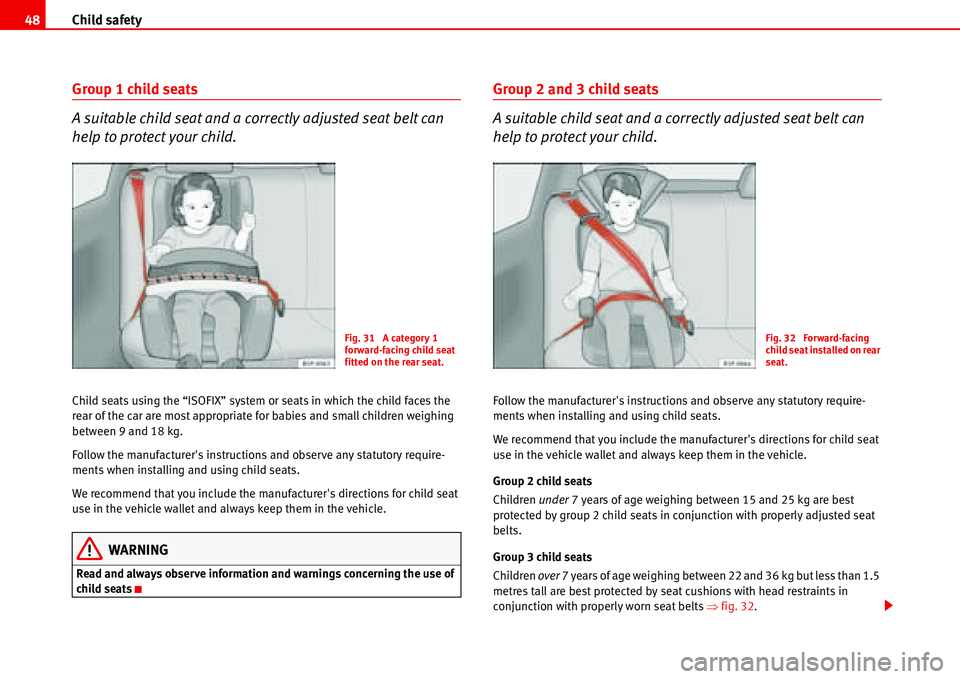
Child seats using the “ISOFIX” system or seats in which the child faces the
rear of the car are most appropriate for babies and small children weighing
between 9 and 18 kg.
Follow the manufacturer's instructions and observe any statutory require-
ments when installing and using child seats.
We recommend that you include the manufacturer's directions for child seat
use in the vehicle wallet and always keep them in the vehicle.
WARNING
Read and always observe information and warnings concerning the use of
child seats
Group 2 and 3 child seats
A suitable child seat and a correctly adjusted seat belt can
help to protect your child.
Follow the manufacturer's instructions and observe any statutory require-
ments when installing and using child seats.
We recommend that you include the manufacturer's directions for child seat
use in the vehicle wallet and always keep them in the vehicle.
Group 2 child seats
Children under 7 years of age weighing between 15 and 25 kg are best
protected by group 2 child seats in conjunction with properly adjusted seat
belts.
Group 3 child seats
Children over 7 years of age weighing between 22 and 36 kg but less than 1.5
metres tall are best protected by seat cushions with head restraints in
conjunction with properly worn seat belts Ÿfig. 32.
Fig. 31 A category 1
forward-facing child seat
fitted on the rear seat.Fig. 32 Forward-facing
child seat installed on rear
seat.
Page 51 of 299
Child safety49
Safety FirstOperating instructionsTips and MaintenanceTe c h n i c a l D a t a
WARNING
•The shoulder part of the seat belt must lie approximately on the centre
of the shoulder, never across the neck or the arm. The seat belt must lie
close to the torso. The lap belt part must lie across the pelvis, not across
the stomach, and always fit closely. Pull the belt tight if necessary to take
up any slack Ÿpage 22, “Seat belts”.
•Read and always observe information and warnings concerning the use
of child seats Ÿpage 45.
Installation of child seats in vehicle seats
General notes
The correct fitting of child seats in the different seats is described below.
Child restraint systems that have been checked according to ECE-R 44 are
suitable for installation on the front passenger seat or on the rear seats.
Note
The passenger seat and the rear seats comply with directive 77/541 EEC for
the installation of child restraint systems .
Front passenger seat
Only the use of an officially approved child seat corre-
sponding to the weight and height of the child is permitted.
Universal seats for children in groups 0, 0+, 1, 2, or 3 (Ÿpage 52) Ÿ can
be fitted in the passenger seat.
To fit a child seat, position the seat in the upright position and move the
passenger seat as far back as possible. The seat must be in the highest posi-
tion
3) on vehicles with a height-adjustableŸ front passenger seat.
WARNING
•Never fit a child seat in the passenger seat, where the child faces back-
wards to the direction of travel and the frontal airbag has not been deacti-
vated. This is highly dangerous for the child. If it is necessary in excep-
tional cases to transport a child on the front passenger seat, you must
always disable the front and side passenger airbags Ÿpage 43
•Children must travel in a child seat appropriate to their weight and
height.
•The vehicle seat must always be fitted in the direction of travel when
securing child restraint systems in weight class 0 or 0+.
•Read and always observe information and warnings concerning the use
of child seats Ÿ in “Safety notes on using child seats” on page 45.
•Please always read and follow the information and warnings provided
by the child seat manufacturer.
3)Optional equipment
Page 52 of 299
Child safety 50
Outer seats in the second row of seats and seats in the third
row of seats
Only the use of an officially approved child seat corre-
sponding to the weight and height of the child is permitted.
In the outer seats of seats in the second and third row universal child seats
for groups 0, 0+, 1, 2, or 3 (Ÿpage 52) Ÿ may be fitted.
Seat with ISOFIX retainers
These seats are suitable for ISOFIX child seats specially designed for this type
of vehicle in accordance with regulation ECE-R 44 Ÿ.
Vehicle seat with integrated child seat
Universal child restraint systems for any group can be fitted to this seat if the
integrated child seat Ÿpage 52, “Integrated child seat” is not used.Ÿ
WARNING
•Children must travel in a child seat appropriate to their weight and
height.
•The vehicle seat must always be fitted in the direction of travel when
securing child restraint systems in weight class 0 or 0+.
•Read and always observe information and warnings concerning the use
of child seats Ÿ in “Safety notes on using child seats” on page 45.
•Please always read and follow the information and warnings provided
by the child seat manufacturer.
Note
•Due to space limitation, only the two outer seats can be used if two ISOFIX
system seats are to be fitted in the second row of seats.
Centre seat in the second row of seats (with three-point roof-
anchored belt)
Only the use of an officially approved child seat corre-
sponding to the weight and height of the child is permitted.
The centre seat with the three-point roof-anchored belt is suitable for weight
classes 0 to 2 Ÿ.
Seat with ISOFIX retainers
Child seats fitted with the ISOFIX system can be used on the centre seat if it
is equipped with ISOFIX retainers Ÿ.
WARNING
The central seat with three-point roof anchored belt is not suited to
universal child seats in group 3.
•The vehicle seat must always be fitted in the direction of travel when
securing child restraint systems in weight class 0 or 0+.
•Children must travel in a child seat appropriate to their weight and
height.
•Read and always observe information and warnings concerning the use
of child seats Ÿ in “Safety notes on using child seats” on page 45.
•Please always read and follow the information and warnings provided
by the child seat manufacturer.
Note
•Due to space limitations, no further ISOFIX restraint systems can be fitted
in the second row of seats once an ISOFIX system has been fitted to the centre
seat.
Page 55 of 299
Child safety53
Safety FirstOperating instructionsTips and MaintenanceTe c h n i c a l D a t a
– Pull the loop in the direction of the arrow and push the seat
cushion down until it engages.
Fitting the slumber roll
– Remove the head restraint.
– Fit the head restraint onto the slumber roll
– Reinsert the head restraint and push down until it can be heard
to engage.
Removing the slumber roll
– Remove the head restraint.
– Pull the slumber roll off the head restraint.
– Reinsert the head restraint and push down until it can be heard
to engage.
For safety reasons, we recommend that the child seat for children in Group 1
is installed facing against the direction of travel.
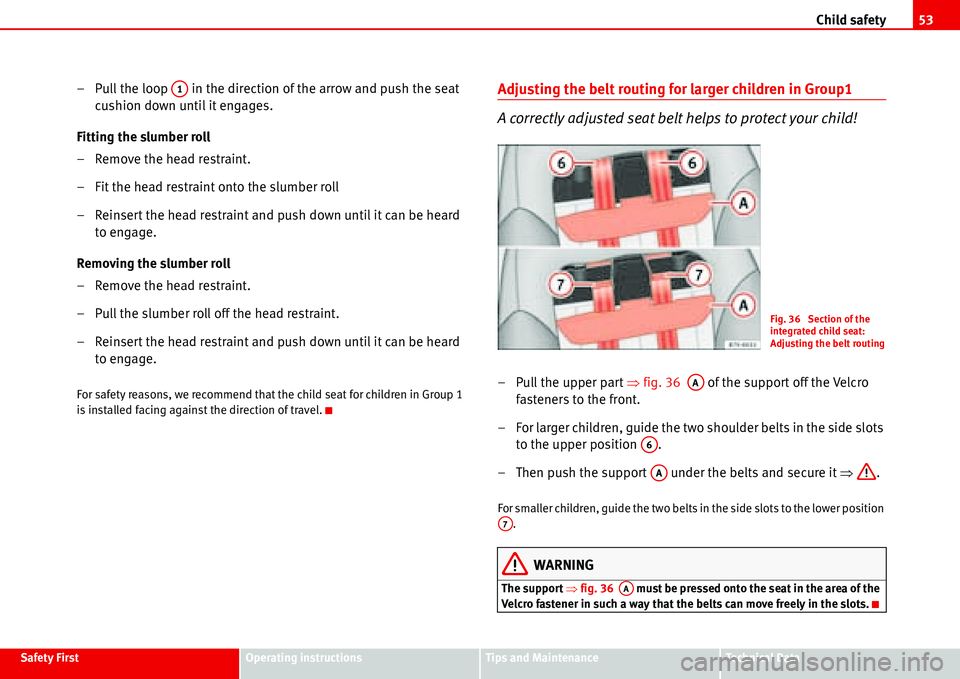
Adjusting the belt routing for larger children in Group1
A correctly adjusted seat belt helps to protect your child!
– Pull the upper part Ÿfig. 36 of the support off the Velcro
fasteners to the front.
– For larger children, guide the two shoulder belts in the side slots
to the upper position .
– Then push the support under the belts and secure it Ÿ.
For smaller children, guide the two belts in the side slots to the lower position
.
WARNING
The support Ÿfig. 36 must be pressed onto the seat in the area of the
Velcro fastener in such a way that the belts can move freely in the slots.
A1
Fig. 36 Section of the
integrated child seat:
Adjusting the belt routing
AA
A6
AA
A7
AA
Page 57 of 299
Child safety55
Safety FirstOperating instructionsTips and MaintenanceTe c h n i c a l D a t a
Releasing the harness belt for children in Group 1
A correctly adjusted seat belt helps to protect your child!
– Press and hold the release button Ÿfig. 39 in the direction
of the arrow.
– With the release button pressed, pull the lower part of the
harness belt down in the direction of the arrow.
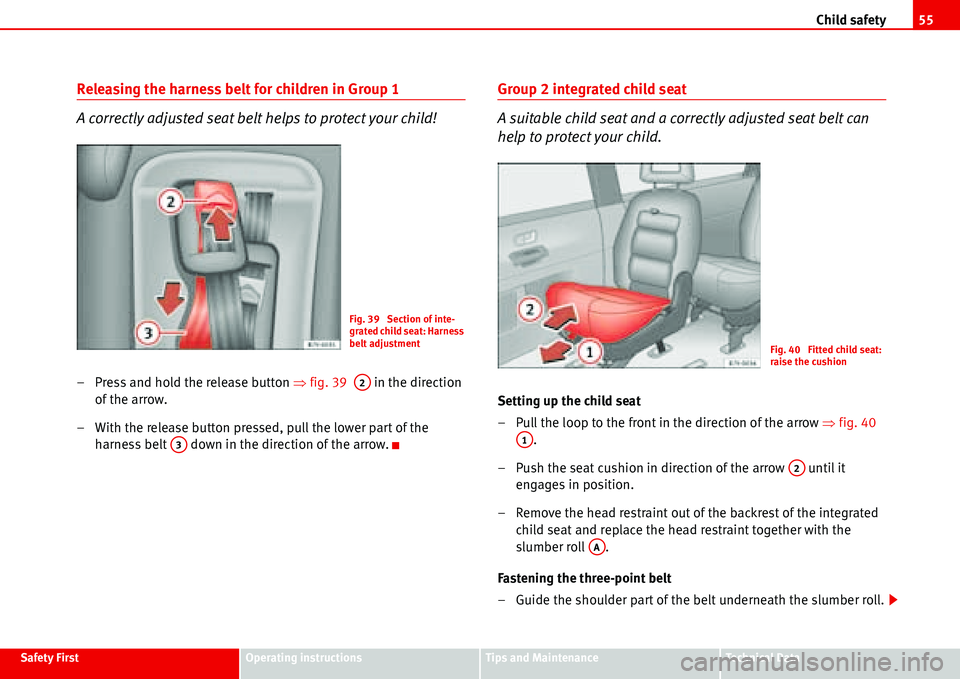
Group 2 integrated child seat
A suitable child seat and a correctly adjusted seat belt can
help to protect your child.
Setting up the child seat
– Pull the loop to the front in the direction of the arrow Ÿfig. 40
.
– Push the seat cushion in direction of the arrow until it
engages in position.
– Remove the head restraint out of the backrest of the integrated
child seat and replace the head restraint together with the
slumber roll .
Fastening the three-point belt
– Guide the shoulder part of the belt underneath the slumber roll.
Fig. 39 Section of inte-
grated child seat: Harness
belt adjustment
A2
A3
Fig. 40 Fitted child seat:
raise the cushion
A1
A2
AA
Page 58 of 299
Child safety 56
– To fasten the three-point belt, take hold of the tongue and pull it
slowly across the chest and lap.
– Push the tongue of the belt into the lock for that seat so that it
engages audibly (pull to check!)
– Adjust the three-point belt to suit body size Ÿ.
Restoring the normal seat
– Pull the loop in the direction of the arrow and push the seat
cushion down until it engages.
Removing the slumber roll
– Remove the head restraint.
– Pull the slumber roll off the head restraint.
– Reinsert the head restraint and push down until it can be heard
to engage.
Use the following measures to guarantee the proper routing of the shoulder
belt:
•Seatbelt height setting
•Adjustment of the seat forwards and backwards
•Backrest angle adjustment
WARNING
•For safety reasons, the seat for children in Group 2 may only be fitted in
the direction of travel and in one of the outer positions (not on the centre
seat).
•The risk of injury is increased if the belt is not correctly routed .
•The shoulder part of the belt should be positioned roughly over the
centre of the shoulder, never across the neck, and fit closely against the
upper part of the body.
•The lap belt part must lie across the pelvis, not across the stomach, and
always fit closely. Tighten the lap belt as necessary.
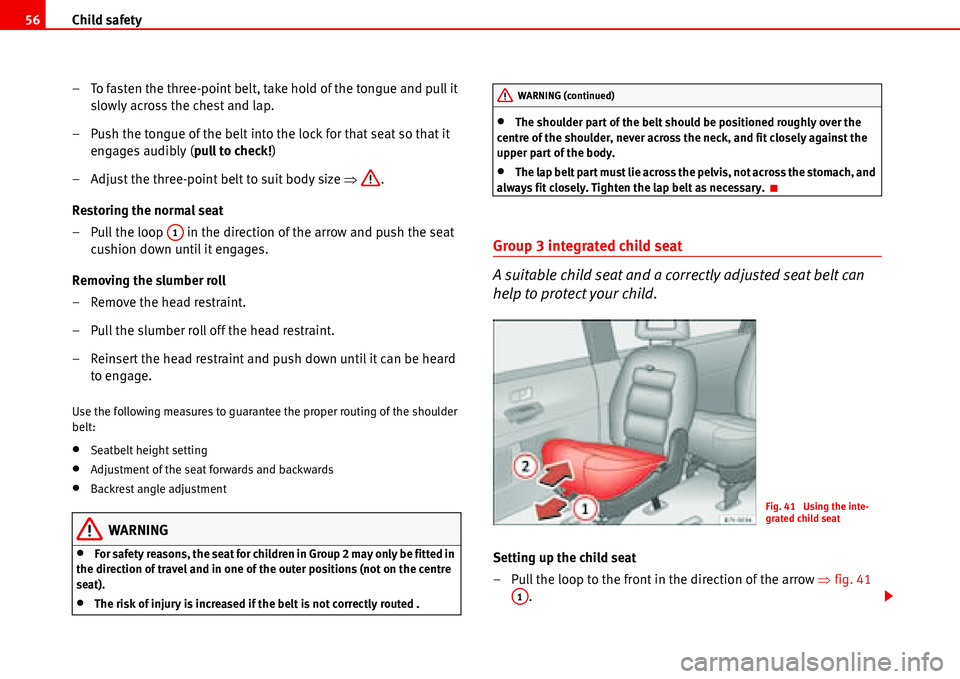
Group 3 integrated child seat
A suitable child seat and a correctly adjusted seat belt can
help to protect your child.
Setting up the child seat
– Pull the loop to the front in the direction of the arrow Ÿfig. 41
.
A1
WARNING (continued)
Fig. 41 Using the inte-
grated child seat
A1
Page 123 of 299
Seats and stowage121
Safety FirstOperating instructionsTips and MaintenanceTe c h n i c a l D a t a
Seats and stowage
The importance of correct seat adjustment
Proper seat adjustment optimises the level of protection
offered by seat belts and airbags.
The driver seat, front passenger seat, and seats in the passenger compart-
ment, can be adjusted in many ways to suit the physical requirements of the
vehicle occupants. The correct seat position is very important for:
•fast and easy operation of all controls on the instrument panel,
•relaxed posture that does not cause drowsiness,
•safe driving,
•optimum protection from the seat belts and airbag system Ÿpage 7.
Vehicle seats
Your vehicle has a total of five or seven
24) seats.
•First row of seats: two seats
•Second row of seats: three seats
•Third row of seats24): two seats
Each seat is equipped with a three-point seat belt.
WARNING
If the driver and passengers assume improper sitting positions, they may
sustain critical injuries.
•Never transport more people than there are seats available in the
vehicle.
•Every occupant in the vehicle must properly fasten and wear the seat
belt belonging to his or her seat. Children must be protected with an appro-
priate child restraint system. Section “Child Safety”
•The seats and all head restraints must always be adjusted to body size
and the seat belt must always be properly adjusted to provide you and your
passengers with optimum protection.
•Always keep your feet in the foot well when the vehicle is moving; never
rest them on the dash panel, out of the window or on the seat. This also
applies to passengers. An incorrect sitting position exposes you to an
increased risk of injury in the event of a braking manoeuvre or an accident.
If the airbag is triggered, you could sustain fatal injuries due to an improper
sitting position.
•It is important for the driver and front passenger to maintain a distance
of at least 25 cm from the steering wheel or dash panel. Failure to respect
the minimum distance means that the airbag will not protect you. Risk of
fatal injury. The distance between the driver and the steering wheel or
between the front passenger and the dash panel should always be as great
as possible.
•Adjust the driver or front passenger seat only when the vehicle is
stationary. Otherwise your seat could move unexpectedly while the vehicle
is moving. This could increase the risk of an accident and therefore injury.
In addition, while adjusting your seat, you will assume an incorrect sitting
position. Risk of fatal accidents.
•Special guidelines apply to installing a child seat on the front
passenger seat. When installing a child seat, observe the warning note in
“Child safety”.
•The seats in the third row of seats may, for safety reasons, only be used
if the luggage compartment cover has been removed.
24)Optional equipment
WARNING (continued)