check oil Seat Alhambra 2007 Owner's Guide
[x] Cancel search | Manufacturer: SEAT, Model Year: 2007, Model line: Alhambra, Model: Seat Alhambra 2007Pages: 291, PDF Size: 9.13 MB
Page 224 of 291
Checking and refilling levels
222However, if the level goes down noticeably in a short time, or drops below the
“MIN” mark, there may be a leak in the brake system. A display on the instru-
ment panel will warn you if the brake fluid level is too low ⇒page 70.
WARNING
Before opening the bonnet to check the brake fluid level, read and observe
the warnings ⇒page 209.Changing the brake fluid
The Maintenance Program indicates the brake fluid change
intervals.We recommend that you have the brake fluid changed by an Authorised
Service Centre.
Before opening the bonnet, please read and follow the warnings ⇒ in
“Safety instructions on working in the engine compartment” on page 209 in
“Working in the engine compartment”.
Brake fluid absorbs moisture. In the cour se of time, it will absorb water from
the ambient air. If the water content in the brake fluid is too high, the brake
system could corrode. This also considerably reduces the boiling point of the
brake fluid. Heavy use of the brakes may then cause a vapour lock which
could impair the braking effect.
It is important that you use only use brake fluid compliant with the US
standard FMVSS 116 DOT 4. We recommend the use of Genuine SEAT brake
fluid.
WARNING
Brake fluid is poisonous. Old brake fluid impairs the braking effect.
•
Before opening the bonnet to check the brake fluid level, read and
observe the warnings ⇒page 209.
•
Brake fluid should be stored in the closed original container in a safe
place out of reach of children. There is a toxic risk.
•
Complete the brake fluid change according to the Maintenance
Program. Heavy use of the brakes may cause a vapour lock if the brake fluid
is left in the system for too long. Th is would seriously affect the efficiency
of the brakes and the safety of the vehicle. This may cause an accident.Caution
Brake fluid could damage the paintwork. Wipe off any brake fluid from the
paintwork immediately.
For the sake of the environment
Brake fluid must be drained and disposed of in the proper manner observing
environmental regulations.
WARNING (continued)
alhambra ingles.book Seite 222 Donnerstag, 19. April 2007 4:04 16
Page 227 of 291
Checking and refilling levels225
Safety First
Operating instructions
Tips and Maintenance
Te c h n i c a l D a t a
For the sake of the environment
Batteries contain toxic substances such as sulphuric acid and lead. They
must be disposed of appropriately and must not be disposed of with ordinary
household waste.WheelsGeneral notesAvoiding damage
– If you have to drive over a kerb or similar obstacle, drive very
slowly and as near as possible at a right angle to the kerb.
– Keep grease, oil and fuel off the tyres.
– Inspect the tyres regularly for damage (cuts, cracks or blisters, etc.). Remove any foreign objects embedded in the treads.
Storing tyres
– Mark tyres when you remove them to indicate the direction of rotation. This ensures you will be able to install them correctly
when you replace them.
– When removed, the wheels and/or tyres should be stored in a cool, dry and preferably dark location.
– Store tyres in a vertical position if they are not fitted on wheel rims.
New tyres
New tyres have to be run in ⇒page 185.
The tread depth of new tyres may vary, according to the type and make of tyre
and the tread pattern.
Concealed damage
Damage to tyres and rims is often not readily visible. If you notice unusual
vibrations or the car pulling to one side, this may indicate that one of the tyres
is damaged. The tyres should be checked immediately by an Authorised
Service Centre.
Tyres with directional tread pattern
An arrow on the tyre sidewall indicates the direction of rotation on tyres with
directional tread. Always observe the direction of rotation indicated when
fitting the wheel. This guarantees optimum grip and helps to avoid aqua-
planing, excessive noise and wear.
WARNING
•
New tyres do not have maximum grip in the first 500 km. Drive particu-
larly carefully to avoid risk of accident.
•
Never drive with damaged tyres. This may cause an accident.
•
If you notice unusual vibration or if the vehicle pulls to one side when
driving, stop the vehicle immediately and check the tyres for damage.
alhambra ingles.book Seite 225 Donnerstag, 19. April 2007 4:04 16
Page 229 of 291
Checking and refilling levels227
Safety First
Operating instructions
Tips and Maintenance
Te c h n i c a l D a t a
Wear indicators
The original tyres on your vehicle have 1.6 mm high “tread wear indicators”
⇒
page 226, fig. 150 , running across the tread. Depending on the make,
there will be six to eight of them evenly spaced around the tyre. Markings on
the tyre sidewall (for instance the letters “TWI” or other symbols) indicate the
positions of the tread wear indicators. The minimum tread depth required by
law is 1.6 mm (measured in the tread grooves next to the tread wear indica-
tors). Worn tyres must be replaced. Different figures may apply in export
countries ⇒.
Tyre pressure
Incorrect tyre pressure causes premature wear and could cause tyre blow-out.
For this reason, the tyre pressure should be checked at least once per month
⇒ page 226.
Driving style
Fast cornering, heavy acceleration and hard braking all increase tyre wear.
Changing wheels around
If the front tyres are worn considerably more than the rear ones it is advisable
to change them around as shown ⇒page 226, fig. 151 . All the tyres will then
last for about the same time.
Wheel balance
The wheels on new vehicles are balanced. However, various factors encoun-
tered in normal driving can cause them to become unbalanced, which results
in steering vibration.
Unbalanced wheels should be rebalanced, as they otherwise cause excessive
wear on steering, suspension and tyres. A wheel must also be rebalanced
when a new tyre is fitted.
Incorrect wheel alignment
Incorrect wheel alignment causes excessive tyre wear, impairing the safety of
the vehicle. If tyres show excessive wear, you should have the wheel align-
ment checked by an Authorised Service Centre.
WARNING
There is a serious danger of accidents if a tyre bursts during driving!•
The tyres must be replaced at the latest when the tread is worn down to
the tread wear indicators. Failure to do so could result in an accident. Worn
tyres do not grip well at high speeds on wet roads. There is also a greater
risk of “aquaplaning”.
•
At continuously high speeds, a tyre with insufficient pressure flexes
more. This causes it to overheat. This can cause tread separation and tyre
blow-out. Risk of accident. Always observe the recommended tyre pres-
sures.
•
If tyres show excessive wear, you should have the running gear checked
by an Authorised Service Centre.
•
Keep chemicals such as oil, fuel and brake fluid away from tyres.
•
Damaged wheels and tyres must be replaced immediately!For the sake of the environment
Under-inflated tyres will increase fuel consumption.New tyres and wheels
New tyres and wheels have to be run-in.The tyres and wheel rims are an essential part of the vehicle's design. The
tyres and rims approved by SEAT are specially matched to the characteristics
of the vehicle and make a major contribution to good road holding and safe
handling ⇒.
Tyres should be replaced at least in pair s and not individually (i.e. both front
tyres or both rear tyres together). A knowledge of tyre designations makes it
alhambra ingles.book Seite 227 Donnerstag, 19. April 2007 4:04 16
Page 231 of 291
Checking and refilling levels229
Safety First
Operating instructions
Tips and Maintenance
Te c h n i c a l D a t a
heads must be used. This ensures that wheels are fitted securely and that the
brake system functions correctly.
In certain circumstances, you may not
use wheel bolts from a different car -
even if it is the same model ⇒page 202.
WARNING
If the wheel bolts are not tightened correctly, the wheel could become
loose while driving. Risk of accident.•
The wheel bolts must be clean and turn easily. Never apply grease or oil
to them.
•
Use only wheel bolts which belong to the wheel.
•
If the prescribed torque of the wheel bolts is too low, they could loosen
whilst the vehicle is in motion. Risk of accident! If the tightening torque is
too high, the wheel bolts and threads could be damaged.Caution
The prescribed torque for wheel bolts for steel and alloy wheels is 120 Nm.Winter tyres
Winter tyres will improve the vehicles handling on snow and
ice.In winter conditions winter tyres will considerably improve the vehicles
handling. The design of summer tyre s (width, rubber compound, tread
pattern) gives less grip on ice and snow.
Winter tyres must be inflated to a pressure 0.2 bar higher than the pressures
specified for summer tyres (see sticker on tank flap).
Winter tyres must be fitted on all four wheels. Information on permitted
winter tyre sizes can be found in the vehicle's regis-
tration documents. Use only radial winter tyres. All tyre sizes listed in the
vehicle documentation also apply to winter tyres.
Winter tyres lose their effectiveness when the tread is worn down to a depth
of 4 mm.
The speed rating code ⇒page 227, “New tyres and wheels” determines the
following speed limits: ⇒
Q max. 160 km/h
S max. 180 km/h
T max. 190 km/h
H max. 210 km/h
In some countries, vehicles which can exceed the speed rating of the fitted
tyre must have an appropriate sticker in the driver's field of view. These
stickers are available from your Authorised Service Centre. The legal require-
ments of each country must be followed.
Do not have winter tyres fitted for unnecessarily long periods. Vehicles with
summer tyres handle better when the roads are free of snow and ice.
If you have a flat tyre, please refer to the notes on the spare wheel
⇒ page 227, “New tyres and wheels”.
WARNING
The maximum speed for the winter tyres must not be exceeded. Otherwise,
this could lead to tyre damage and thus, an accident risk.
For the sake of the environment
Fit your summer tyres in good time. They are quieter, do not wear so quickly
and reduce fuel consumption.
alhambra ingles.book Seite 229 Donnerstag, 19. April 2007 4:04 16
Page 242 of 291
If and when
240
NoteThe hexagonal socket in the screwdri ver handle should be used for turning
wheel bolts only. Do not use it to loosen or tighten the wheel bolts.Changing a wheel Removing the wheel
– Using the hexagonal socket in the screwdriver handle, unscrew the slackened wheel bolts and place them on a clean surface.
– Take off the wheel.
– Store the defective wheel as described on ⇒page 233.
Fitting the spare wheel
– Put the spare wheel in place.
– Screw in the wheel bolts and tighten them lightly using the
hexagonal socket.
– Lower the vehicle on the jack.
– Tighten the wheel bolts firmly using the box spanner. Do not tighten the bolts in clockwise or anti-clockwise sequence.
Tighten them in diagonal sequence.Tyres with directional tread pattern
Tyres with directional tread pattern must be mounted so that they rotate in the
correct direction.
A directional tread pattern can be identified by arrows on the sidewall that
point in the direction of rotation. Alwa ys observe the direction of rotation indicated when mounting the wheel. This is important so that these tyres can
give maximum grip and avoid excessive noise, tread wear and aquaplaning.
If, in an emergency, you have to moun
t a wheel so it rotates in the wrong
direction, you must drive extremely care fully. The tyre will not give optimum
performance. This is particularly impo rtant when driving on wet roads. To
benefit from the advantages of tyres with directional tread pattern, the tyre
should be replaced as soon as possible so that it rotates in the correct direc-
tion.
Caution
•
The wheel bolts should be clean and turn easily. Do not grease or oil them.
•
The hexagonal socket in the screwdriver handle should be used for
turning wheel bolts only. Do not use it to loosen or tighten the wheel bolts.
After changing a wheel– Place the wheel with the defective tyre in the spare wheel bracket
⇒page 233.
– Have the flat tyre replaced as quickly as possible.
– Have the tightening torque of the wheel bolts checked as soon as possible with a torque wrench ⇒page 240.
– Check tyre pressure at the next opportunity.
– Avoid fast driving manoeuvres.
alhambra ingles.book Seite 240 Donnerstag, 19. April 2007 4:04 16
Page 243 of 291
If and when241
Safety First
Operating instructions
Tips and Maintenance
Te c h n i c a l D a t a
WARNING
•
If the prescribed torque of the wheel bolts is too low, they could loosen
whilst the vehicle is in motion. Risk of accident! If the tightening torque is
too high, the wheel bolts and threads could be damaged.Caution
The stipulated torque for the wheel bolts on steel wheels and alloy wheels is
170 Nm with a tolerance of ± 10 Nm. You should visit a specialised workshop
as soon as possible to check the torque with a torque wrench.
Note
•
The wheel bolts should be clean and turn easily. Do not grease or oil them.
•
The hexagonal socket in the screwdriver handle should be used only for
turning wheel bolts which have been slackened off. Do not use it to loosen or
tighten the wheel bolts.
•
If you notice that the wheel bolts are corroded and difficult to turn when
changing a wheel, they must be replaced before you have the tightening
torque checked.
•
If the spare tyre is not the same as the tyres that are mounted on the car -
for example with winter tyres - you should only use the spare tyre for a short
period of time and drive with extra care. Refit the normal road wheel as soon
as possible.
•
Have the flat tyre replaced as quickly as possible.
FusesChanging a fuse– Use the fuse tables, to find out where, and in which fuse box, the damaged fuse is located ⇒page 242.
– Switch off the ignition and the component concerned.
– Remove the fuse box cover ⇒fig. 163 .
– Use the plastic pliers in the fuse box to remove the fuse.
– If the fuse has blown (the metal strip will have melted), replace it with a new fuse of the same amp rating (same colour and same
imprint) and size.The individual electrical circuits are protected by fuses. It is advisable to carry
several spare fuses at all times.
Fig. 163 Left side of dash
panel: fuse box
alhambra ingles.book Seite 241 Donnerstag, 19. April 2007 4:04 16
Page 258 of 291
If and when
256Your vehicle may only be lifted by a lifting platform at the points shown in the
illustrations ⇒page 255, fig. 176 and ⇒page 255, fig. 177 ⇒.
Using the jack to lift the vehicle ⇒ page 239.
To prevent damage to the underside of the vehicle when lifting the vehicle,
rubber pads must be used.
Before driving onto a lifting platform, you must check there is sufficient clear-
ance between low parts of the vehicle and the lifting platform.
WARNING
If the lifting platform is inappropriate or the vehicle is lifted incorrectly,
accidents or injuries may be caused. The vehicle could even fall from the
lifting platform.•
All occupants should leave the vehicle before it is lifted.
•
The vehicle must only be lifted at the points indicated in the diagrams
⇒ page 255, fig. 176 and ⇒page 255, fig. 177 . If the vehicle is not lifted
at the indicated points, it may fall from the platform while the engine or
gearbox is being dismounted, for example.
•
Never start the engine when the vehicle is raised. Risk of accident. The
vehicle may fall from the platfo rm due to the engine vibrations.
•
When work is being carried out underneath the vehicle, it must be
secured using suitable frames. If not, an accident may occur.
•
To lift the vehicle, only two-pillar or two-post lifting platforms with
sufficiently long arms and load-bearing capacity should be used.
•
Lifting platforms with fluid filled cu shions may not be used for lifting
the vehicle.Caution
•
The vehicle should never be lifted at the engine oil sump, the gearbox, or
the front or rear axle. This could cause serious damage to the vehicle.
•
Before driving onto a lifting platform, you must check there is sufficient
clearance between low parts of the vehicle and the lifting platform.
alhambra ingles.book Seite 256 Donnerstag, 19. April 2007 4:04 16
Page 264 of 291
Technical Data
262Te c h n i c a l D a t aChecking fluid levelsFrom time to time, the levels of the different fluids in the
vehicle must be checked. Never fi ll with incorrect fluids, to do
so may cause serious damage to the engine.
Engine oil dipstick
Oil filler neck
Brake fluid reservoir
Vehicle battery (underneath a cover)
Coolant temperature deposit
Windscreen washer fluid reservoir
The checking and replenishment of the service fluids are carried out on the
components mentioned above. These operations are described in the
⇒ page 209. Overview
Further explanations, instructions and restrictions on the technical data are
contained as of
⇒page 257.
Fig. 178 Diagram for the
location of the various
elements
A1A2A3A4A5A6
alhambra ingles.book Seite 262 Donnerstag, 19. April 2007 4:04 16
Page 282 of 291
Index
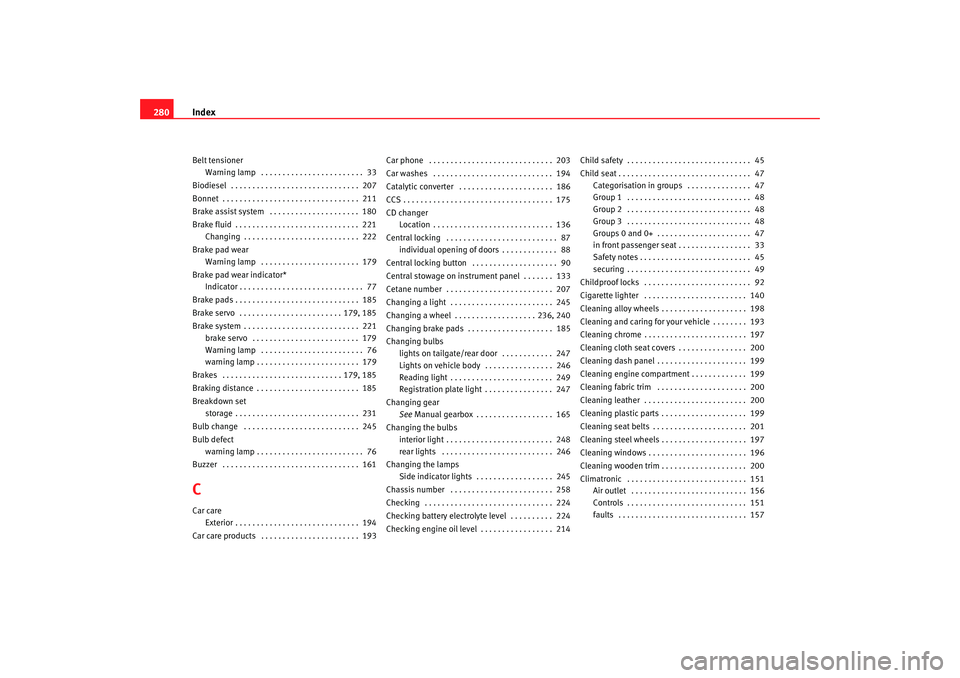
280Belt tensioner
Warning lamp . . . . . . . . . . . . . . . . . . . . . . . . 33
Biodiesel . . . . . . . . . . . . . . . . . . . . . . . . . . . . . . 207
Bonnet . . . . . . . . . . . . . . . . . . . . . . . . . . . . . . . . 211
Brake assist system . . . . . . . . . . . . . . . . . . . . . 180
Brake fluid . . . . . . . . . . . . . . . . . . . . . . . . . . . . . 221 Changing . . . . . . . . . . . . . . . . . . . . . . . . . . . 222
Brake pad wear Warning lamp . . . . . . . . . . . . . . . . . . . . . . . 179
Brake pad wear indicator* Indicator . . . . . . . . . . . . . . . . . . . . . . . . . . . . . 77
Brake pads . . . . . . . . . . . . . . . . . . . . . . . . . . . . . 185
Brake servo . . . . . . . . . . . . . . . . . . . . . . . . 179, 185
Brake system . . . . . . . . . . . . . . . . . . . . . . . . . . . 221 brake servo . . . . . . . . . . . . . . . . . . . . . . . . . 179
Warning lamp . . . . . . . . . . . . . . . . . . . . . . . . 76
warning lamp . . . . . . . . . . . . . . . . . . . . . . . . 179
Brakes . . . . . . . . . . . . . . . . . . . . . . . . . . . . 179, 185
Braking distance . . . . . . . . . . . . . . . . . . . . . . . . 185
Breakdown set storage . . . . . . . . . . . . . . . . . . . . . . . . . . . . . 231
Bulb change . . . . . . . . . . . . . . . . . . . . . . . . . . . 245
Bulb defect warning lamp . . . . . . . . . . . . . . . . . . . . . . . . . 76
Buzzer . . . . . . . . . . . . . . . . . . . . . . . . . . . . . . . . 161CCar care Exterior . . . . . . . . . . . . . . . . . . . . . . . . . . . . . 194
Car care products . . . . . . . . . . . . . . . . . . . . . . . 193 Car phone . . . . . . . . . . . . . . . . . . . . . . . . . . . . . 203
Car washes . . . . . . . . . . . . . . . . . . . . . . . . . . . . 194
Catalytic converter . . . . . . . . . . . . . . . . . . . . . . 186
CCS . . . . . . . . . . . . . . . . . . . . . . . . . . . . . . . . . . . 175
CD changer
Location . . . . . . . . . . . . . . . . . . . . . . . . . . . . 136
Central locking . . . . . . . . . . . . . . . . . . . . . . . . . . 87 individual opening of doors . . . . . . . . . . . . . 88
Central locking button . . . . . . . . . . . . . . . . . . . . 90
Central stowage on instrument panel . . . . . . . 133
Cetane number . . . . . . . . . . . . . . . . . . . . . . . . . 207
Changing a light . . . . . . . . . . . . . . . . . . . . . . . . 245
Changing a wheel . . . . . . . . . . . . . . . . . . . 236, 240
Changing brake pads . . . . . . . . . . . . . . . . . . . . 185
Changing bulbs lights on tailgate/rear door . . . . . . . . . . . . 247
Lights on vehicle body . . . . . . . . . . . . . . . . 246
Reading light . . . . . . . . . . . . . . . . . . . . . . . . 249
Registration plate light . . . . . . . . . . . . . . . . 247
Changing gear See Manual gearbox . . . . . . . . . . . . . . . . . . 165
Changing the bulbs interior light . . . . . . . . . . . . . . . . . . . . . . . . . 248
rear lights . . . . . . . . . . . . . . . . . . . . . . . . . . 246
Changing the lamps Side indicator lights . . . . . . . . . . . . . . . . . . 245
Chassis number . . . . . . . . . . . . . . . . . . . . . . . . 258
Checking . . . . . . . . . . . . . . . . . . . . . . . . . . . . . . 224
Checking battery electrolyte level . . . . . . . . . . 224
Checking engine oil level . . . . . . . . . . . . . . . . . 214 Child safety . . . . . . . . . . . . . . . . . . . . . . . . . . . . . 45
Child seat . . . . . . . . . . . . . . . . . . . . . . . . . . . . . . . 47
Categorisation in groups . . . . . . . . . . . . . . . 47
Group 1 . . . . . . . . . . . . . . . . . . . . . . . . . . . . . 48
Group 2 . . . . . . . . . . . . . . . . . . . . . . . . . . . . . 48
Group 3 . . . . . . . . . . . . . . . . . . . . . . . . . . . . . 48
Groups 0 and 0+ . . . . . . . . . . . . . . . . . . . . . . 47
in front passenger seat . . . . . . . . . . . . . . . . . 33
Safety notes . . . . . . . . . . . . . . . . . . . . . . . . . . 45
securing . . . . . . . . . . . . . . . . . . . . . . . . . . . . . 49
Childproof locks . . . . . . . . . . . . . . . . . . . . . . . . . 92
Cigarette lighter . . . . . . . . . . . . . . . . . . . . . . . . 140
Cleaning alloy wheels . . . . . . . . . . . . . . . . . . . . 198
Cleaning and caring for your vehicle . . . . . . . . 193
Cleaning chrome . . . . . . . . . . . . . . . . . . . . . . . . 197
Cleaning cloth seat covers . . . . . . . . . . . . . . . . 200
Cleaning dash panel . . . . . . . . . . . . . . . . . . . . . 199
Cleaning engine compartment . . . . . . . . . . . . . 199
Cleaning fabric trim . . . . . . . . . . . . . . . . . . . . . 200
Cleaning leather . . . . . . . . . . . . . . . . . . . . . . . . 200
Cleaning plastic parts . . . . . . . . . . . . . . . . . . . . 199
Cleaning seat belts . . . . . . . . . . . . . . . . . . . . . . 201
Cleaning steel wheels . . . . . . . . . . . . . . . . . . . . 197
Cleaning windows . . . . . . . . . . . . . . . . . . . . . . . 196
Cleaning wooden trim . . . . . . . . . . . . . . . . . . . . 200
Climatronic . . . . . . . . . . . . . . . . . . . . . . . . . . . . 151 Air outlet . . . . . . . . . . . . . . . . . . . . . . . . . . . 156
Controls . . . . . . . . . . . . . . . . . . . . . . . . . . . . 151
faults . . . . . . . . . . . . . . . . . . . . . . . . . . . . . . 157
alhambra ingles.book Seite 280 Donnerstag, 19. April 2007 4:04 16
Page 284 of 291
Index
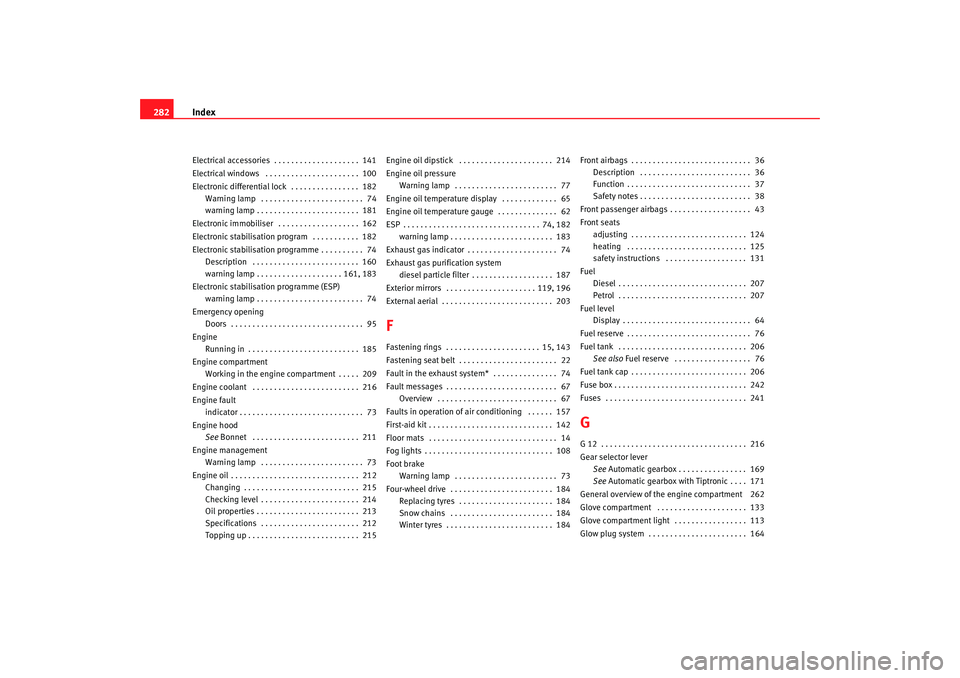
282Electrical accessories . . . . . . . . . . . . . . . . . . . . 141
Electrical windows . . . . . . . . . . . . . . . . . . . . . . 100
Electronic differential lock . . . . . . . . . . . . . . . . 182
Warning lamp . . . . . . . . . . . . . . . . . . . . . . . . 74
warning lamp . . . . . . . . . . . . . . . . . . . . . . . . 181
Electronic immobiliser . . . . . . . . . . . . . . . . . . . 162
Electronic stabilisation program . . . . . . . . . . . 182
Electronic stabilisation programme . . . . . . . . . . 74 Description . . . . . . . . . . . . . . . . . . . . . . . . . 160
warning lamp . . . . . . . . . . . . . . . . . . . . 161, 183
Electronic stabilisat ion programme (ESP)
warning lamp . . . . . . . . . . . . . . . . . . . . . . . . . 74
Emergency opening Doors . . . . . . . . . . . . . . . . . . . . . . . . . . . . . . . 95
Engine Running in . . . . . . . . . . . . . . . . . . . . . . . . . . 185
Engine compartment Working in the engine compartment . . . . . 209
Engine coolant . . . . . . . . . . . . . . . . . . . . . . . . . 216
Engine fault indicator . . . . . . . . . . . . . . . . . . . . . . . . . . . . . 73
Engine hood See Bonnet . . . . . . . . . . . . . . . . . . . . . . . . . 211
Engine management Warning lamp . . . . . . . . . . . . . . . . . . . . . . . . 73
Engine oil . . . . . . . . . . . . . . . . . . . . . . . . . . . . . . 212 Changing . . . . . . . . . . . . . . . . . . . . . . . . . . . 215
Checking level . . . . . . . . . . . . . . . . . . . . . . . 214
Oil properties . . . . . . . . . . . . . . . . . . . . . . . . 213
Specifications . . . . . . . . . . . . . . . . . . . . . . . 212
Topping up . . . . . . . . . . . . . . . . . . . . . . . . . . 215 Engine oil dipstick . . . . . . . . . . . . . . . . . . . . . . 214
Engine oil pressure
Warning lamp . . . . . . . . . . . . . . . . . . . . . . . . 77
Engine oil temperature display . . . . . . . . . . . . . 65
Engine oil temperature gauge . . . . . . . . . . . . . . 62
ESP . . . . . . . . . . . . . . . . . . . . . . . . . . . . . . . . 74, 182 warning lamp . . . . . . . . . . . . . . . . . . . . . . . . 183
Exhaust gas indicator . . . . . . . . . . . . . . . . . . . . . 74
Exhaust gas purification system diesel particle filter . . . . . . . . . . . . . . . . . . . 187
Exterior mirrors . . . . . . . . . . . . . . . . . . . . . 119, 196
External aerial . . . . . . . . . . . . . . . . . . . . . . . . . . 203
FFastening rings . . . . . . . . . . . . . . . . . . . . . . 15, 143
Fastening seat belt . . . . . . . . . . . . . . . . . . . . . . . 22
Fault in the exhaust system* . . . . . . . . . . . . . . . 74
Fault messages . . . . . . . . . . . . . . . . . . . . . . . . . . 67 Overview . . . . . . . . . . . . . . . . . . . . . . . . . . . . 67
Faults in operation of air conditioning . . . . . . 157
First-aid kit . . . . . . . . . . . . . . . . . . . . . . . . . . . . . 142
Floor mats . . . . . . . . . . . . . . . . . . . . . . . . . . . . . . 14
Fog lights . . . . . . . . . . . . . . . . . . . . . . . . . . . . . . 108
Foot brake Warning lamp . . . . . . . . . . . . . . . . . . . . . . . . 73
Four-wheel drive . . . . . . . . . . . . . . . . . . . . . . . . 184 Replacing tyres . . . . . . . . . . . . . . . . . . . . . . 184
Snow chains . . . . . . . . . . . . . . . . . . . . . . . . 184
Winter tyres . . . . . . . . . . . . . . . . . . . . . . . . . 184 Front airbags . . . . . . . . . . . . . . . . . . . . . . . . . . . . 36
Description . . . . . . . . . . . . . . . . . . . . . . . . . . 36
Function . . . . . . . . . . . . . . . . . . . . . . . . . . . . . 37
Safety notes . . . . . . . . . . . . . . . . . . . . . . . . . . 38
Front passenger airbags . . . . . . . . . . . . . . . . . . . 43
Front seats adjusting . . . . . . . . . . . . . . . . . . . . . . . . . . . 124
heating . . . . . . . . . . . . . . . . . . . . . . . . . . . . 125
safety instructions . . . . . . . . . . . . . . . . . . . 131
Fuel Diesel . . . . . . . . . . . . . . . . . . . . . . . . . . . . . . 207
Petrol . . . . . . . . . . . . . . . . . . . . . . . . . . . . . . 207
Fuel level Display . . . . . . . . . . . . . . . . . . . . . . . . . . . . . . 64
Fuel reserve . . . . . . . . . . . . . . . . . . . . . . . . . . . . . 76
Fuel tank . . . . . . . . . . . . . . . . . . . . . . . . . . . . . . 206 See also Fuel reserve . . . . . . . . . . . . . . . . . . 76
Fuel tank cap . . . . . . . . . . . . . . . . . . . . . . . . . . . 206
Fuse box . . . . . . . . . . . . . . . . . . . . . . . . . . . . . . . 242
Fuses . . . . . . . . . . . . . . . . . . . . . . . . . . . . . . . . . 241
GG 12 . . . . . . . . . . . . . . . . . . . . . . . . . . . . . . . . . . 216
Gear selector lever See Automatic gearbox . . . . . . . . . . . . . . . . 169
See Automatic gearbox with Tiptronic . . . . 171
General overview of the engine compartment 262
Glove compartment . . . . . . . . . . . . . . . . . . . . . 133
Glove compartment light . . . . . . . . . . . . . . . . . 113
Glow plug system . . . . . . . . . . . . . . . . . . . . . . . 164
alhambra ingles.book Seite 282 Donnerstag, 19. April 2007 4:04 16