wheel bolts Seat Ateca 2018 Owner's Manual
[x] Cancel search | Manufacturer: SEAT, Model Year: 2018, Model line: Ateca, Model: Seat Ateca 2018Pages: 348, PDF Size: 7.32 MB
Page 66 of 348
The essentials
● Sc r
ew the c
ompressor tyre inflator into the
valve.
● Repeat the inflation process.
● If the indicated pressure still cannot be
reac
hed, the tyre is too badly damaged. Stop
and request assistance from an authorised
technician.
● Disconnect the air compressor. Unscrew
the tyre infl
ator tube from the tyre valve.
● When the tyre pressure is between 2.5 and
2.0 bars, c
ontinue driving without exceeding
80 km/h (50 mph).
● Check the pressure again after 10 minutes
›››
page 97.
››› in TMS (Tyre Mobility System)* on
page 95
››› page 95 Changing a wheel
V ehic
l
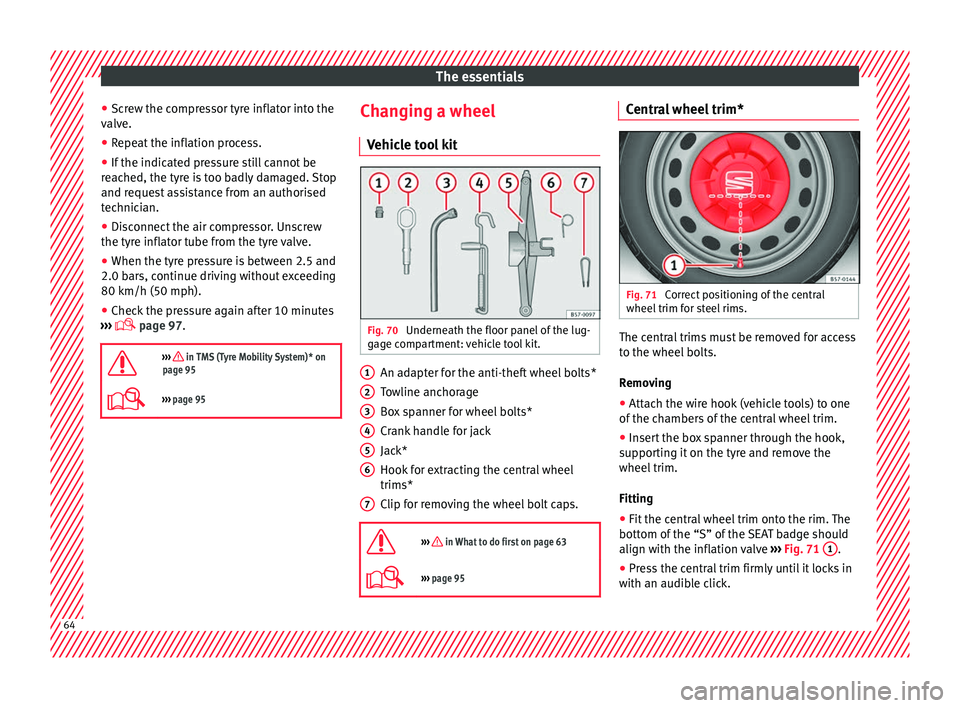
e tool kit Fig. 70
Underneath the floor panel of the lug-
g ag
e c
ompartment: vehicle tool kit. An adapter for the anti-theft wheel bolts*
T
o
wline anc
horage
Box spanner for wheel bolts*
Crank handle for jack
Jack*
Hook for extracting the central wheel
trims*
Clip for removing the wheel bolt caps.
››› in What to do first on page 63
››› page 95 1
2
3
4
5
6
7 Central wheel trim*
Fig. 71
Correct positioning of the central
wheel trim f
or s
teel rims. The central trims must be removed for access
t
o the wheel
bo
lts.
Removing
● Attach the wire hook (vehicle tools) to one
of the ch
ambers of the central wheel trim.
● Insert the box spanner through the hook,
suppor
ting it on the tyre and remove the
wheel trim.
Fitting
● Fit the central wheel trim onto the rim. The
bottom of the
“S” of the SEAT badge should
align with the inflation valve ›››
Fig. 71 1 .
● Press the central trim firmly until it locks in
w ith an audib
l
e click.64
Page 67 of 348
The essentials
Note
There is also a valve mark on the back of the
centr a
l wheel trim that indicates the correct
alignment. Wheel bolt caps*
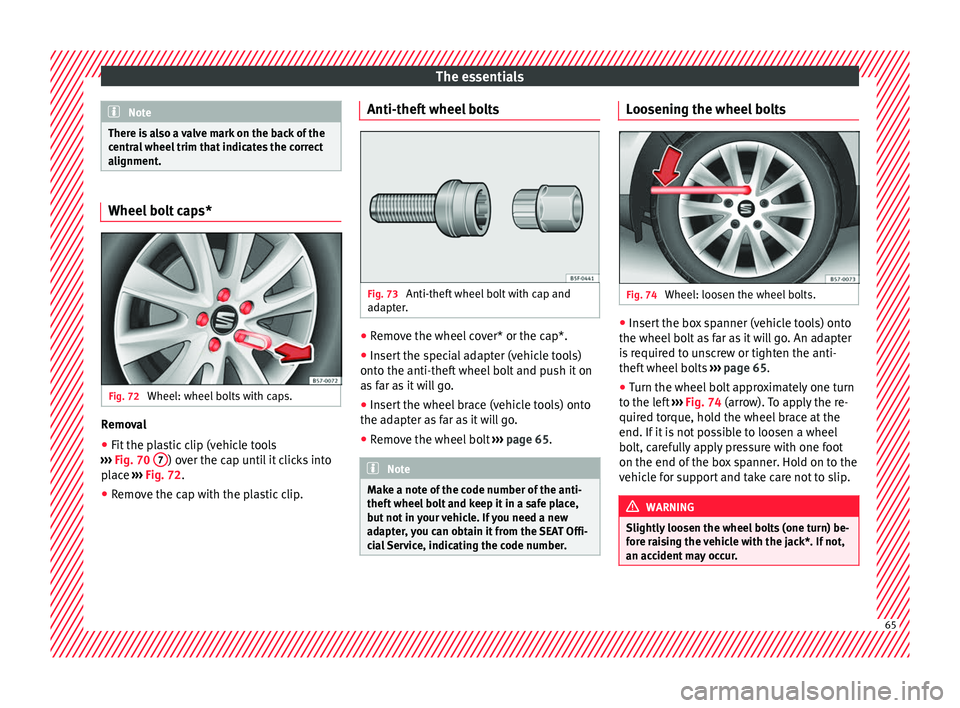
Fig. 72
Wheel: wheel bolts with caps. Removal
● Fit the plastic clip (vehicle tools
› ›
›
Fig. 70 7 ) over the cap until it clicks into
p l
ac
e ›››
Fig. 72.
● Remove the cap with the plastic clip. Anti-theft wheel bolts
Fig. 73
Anti-theft wheel bolt with cap and
a d
apt
er. ●
Remove the wheel cover* or the cap*.
● Insert the special adapter (vehicle tools)
ont o the anti-thef
t
wheel bolt and push it on
as far as it will go.
● Insert the wheel brace (vehicle tools) onto
the adapt
er as far as it will go.
● Remove the wheel bolt ›››
page 65 . Note
Make a note of the code number of the anti-
theft wheel
bolt and keep it in a safe place,
but not in your vehicle. If you need a new
adapter, you can obtain it from the SEAT Offi-
cial Service, indicating the code number. Loosening the wheel bolts
Fig. 74
Wheel: loosen the wheel bolts. ●
Insert the box spanner (vehicle tools) onto
the wheel bo
lt
as far as it will go. An adapter
is required to unscrew or tighten the anti-
theft wheel bolts ››› page 65.
● Turn the wheel bolt approximately one turn
to the lef
t ››› Fig. 74 (arrow). To apply the re-
quired torque, hold the wheel brace at the
end. If it is not possible to loosen a wheel
bolt, carefully apply pressure with one foot
on the end of the box spanner. Hold on to the
vehicle for support and take care not to slip. WARNING
Slightly loosen the wheel bolts (one turn) be-
for e r
aising the vehicle with the jack*. If not,
an accident may occur. 65
Page 68 of 348
The essentials
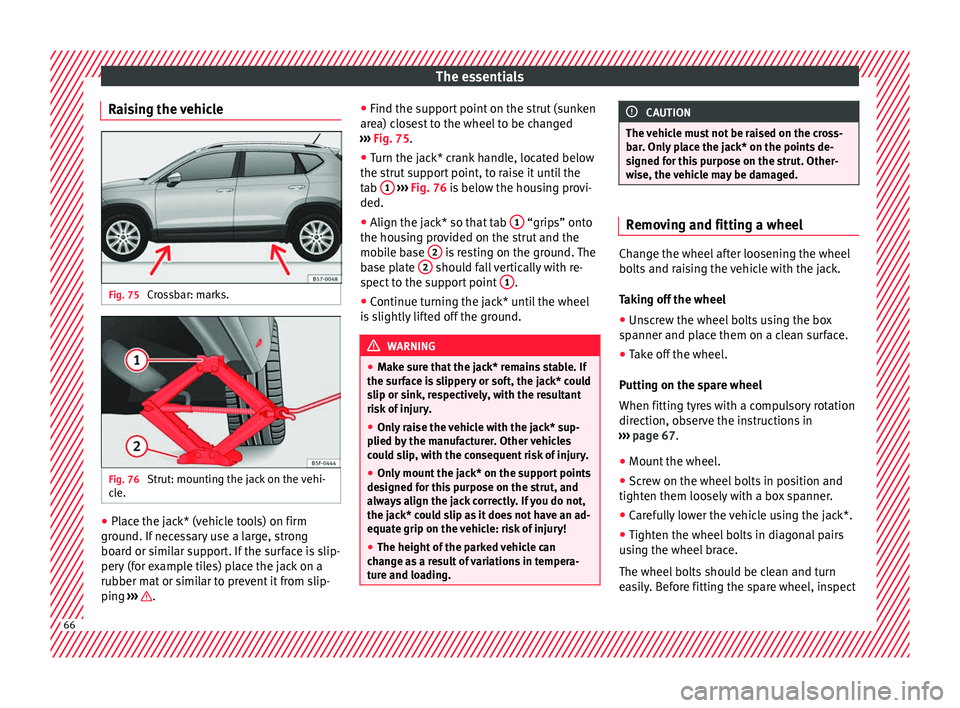
Raising the vehicle Fig. 75
Crossbar: marks. Fig. 76
Strut: mounting the jack on the vehi-
c l
e. ●
Place the jack* (vehicle tools) on firm
gr ou
nd. If
necessary use a large, strong
board or similar support. If the surface is slip-
pery (for example tiles) place the jack on a
rubber mat or similar to prevent it from slip-
ping ››› . ●
Find the s up
por
t point on the strut (sunken
area) closest to the wheel to be changed
››› Fig. 75.
● Turn the jack* crank handle, located below
the strut s
upport point, to raise it until the
tab 1
› ››
Fig. 76
i
s below the housing provi-
ded.
● Align the jack* so that tab 1 “grips” onto
the hou s
in
g provided on the strut and the
mobile base 2 is resting on the ground. The
b a
se p
late 2 should fall vertically with re-
s pect
t
o the support point 1 .
● Continue turning the jack* until the wheel
i s
s
lightly lifted off the ground. WARNING
● Mak e s
ure that the jack* remains stable. If
the surface is slippery or soft, the jack* could
slip or sink, respectively, with the resultant
risk of injury.
● Only raise the vehicle with the jack* sup-
plied by
the manufacturer. Other vehicles
could slip, with the consequent risk of injury.
● Only mount the jack* on the support points
designed f
or this purpose on the strut, and
always align the jack correctly. If you do not,
the jack* could slip as it does not have an ad-
equate grip on the vehicle: risk of injury!
● The height of the parked vehicle can
chan
ge as a result of variations in tempera-
ture and loading. CAUTION
The vehicle must not be raised on the cross-
bar . On
ly place the jack* on the points de-
signed for this purpose on the strut. Other-
wise, the vehicle may be damaged. Removing and fitting a wheel
Change the wheel after loosening the wheel
bolts
and r
aising the vehicle with the jack.
Taking off the wheel ● Unscrew the wheel bolts using the box
sp anner and p
lace them on a clean surface.
● Take off the wheel.
Putting on the s
pare wheel
When fitting tyres with a compulsory rotation
direction, observe the instructions in
››› page 67.
● Mount the wheel.
● Screw on the wheel bolts in position and
tighten them loosely
with a box spanner.
● Carefully lower the vehicle using the jack*.
● Tighten the wheel bolts in diagonal pairs
usin
g the wheel brace.
The wheel bolts should be clean and turn
easily. Before fitting the spare wheel, inspect 66
Page 69 of 348
The essentials
the wheel condition and hub mounting surfa-
c e
s.
These surfaces must be clean before fit-
ting the wheel.
Tyres with compulsory direction of ro-
tation A directional tread pattern can be identified
by
the arr
ows on the sidewall that point in
the direction of rotation. Always observe the
direction of rotation indicated when fitting
the wheel to guarantee optimum properties
of this type of tyres with regard to grip,
noises, wear and aquaplaning.
If it is absolutely necessary to fit the spare
tyre* against the direction of rotation, drive
with care as this means the tyre does not of-
fer optimum driving properties. This is of par-
ticular importance when the road surface is
wet.
To return to directional tread tires, replace
the punctured tyre as soon as possible and
restore the obligatory direction of rotation of
all tyres.
Subsequent work ●
Alloy wheels: rep
l
ace the wheel bolt caps.
● Plate wheels: fit the centr
al wheel rim again
››› page 64. ●
Return al
l tools to their proper storing loca-
tion.
● If the replaced wheel does not fit in the
spar
e wheel housing, store it safely in the
luggage compartment ›››
page 162.
● Check the tyre pressure of the newly moun-
ted tyr
e as soon as possible.
● In vehicles fitted with a tyre pressure indi-
cator
, adjust the pressure and store the read-
ing in the radio/Easy Connect system*
››› page 311.
● Have the tightening torque of the wheel
bolts c
hecked as soon as possible with a tor-
que wrench (it should be 140 Nm). Mean-
while, drive carefully.
● Have the flat tyre replaced as quickly as
poss
ible.
Snow chains Use Snow chains should only be used on the
fr
ont
wheel
s.
Check that they are correctly seated after
driving for a few yards; correct the position if
necessary, in accordance with the manufac-
turer's fitting instructions. Keep your speed
below 50 km/h (30 mph). If there is a danger of being trapped despite
havin
g mounted the chains, it is best to disa-
ble the driving wheels (ASR) in the ESC
››› page 191, Switching on/off the ESC
and ASR.
Snow chains will improve braking ability as
well as traction in winter conditions.
For technical reasons snow chains may only
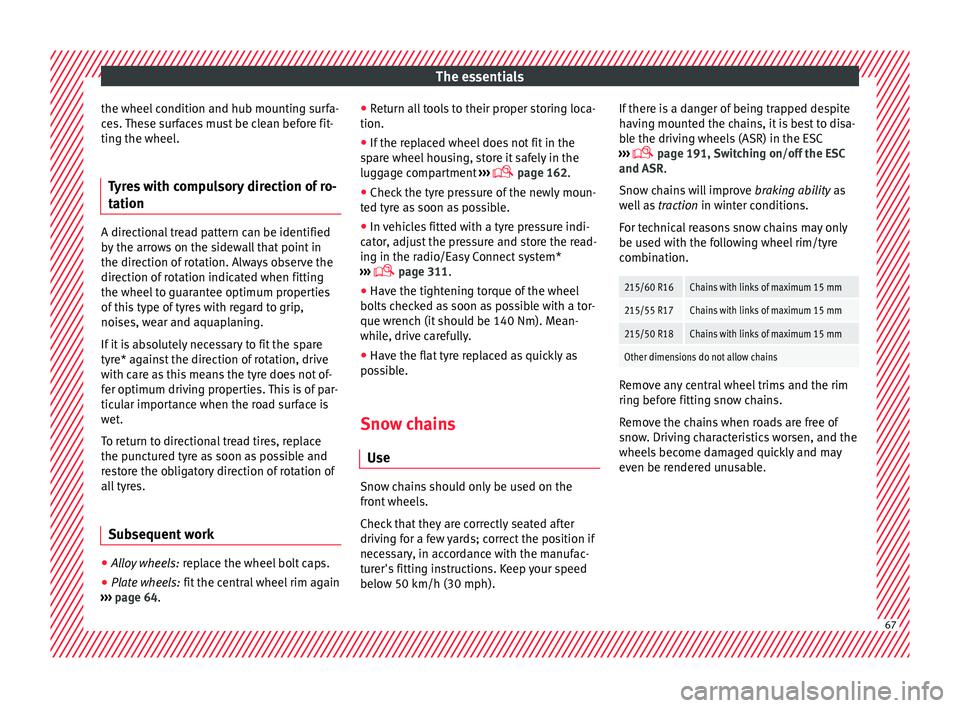
be used with the following wheel rim/tyre
combination.
215/60 R16Chains with links of maximum 15 mm
215/55 R17Chains with links of maximum 15 mm
215/50 R18Chains with links of maximum 15 mm
Other dimensions do not allow chains Remove any central wheel trims and the rim
rin
g bef
or
e fitting snow chains.
Remove the chains when roads are free of
snow. Driving characteristics worsen, and the
wheels become damaged quickly and may
even be rendered unusable. 67
Page 97 of 348

Self-help
Emergencies
Self -help
V ehic
le tool kit, anti-puncture kit* The tools and anti-puncture kit* are stored
under the floor p
anel
in the luggage compart-
ment.
To access the vehicle tools:
– Lift up the floor surface by the plastic han-
dle u nti
l it is fastened to the tabs on both
sides.
Depending on the vehicle equipment, the an-
ti-puncture kit* is located under the floor
panel in the luggage compartment.
The tool kit includes:
● Jack*
● Wire hook for pulling off the wheel cov-
er*/wheel bolt
cap clip.
● Box spanner for wheel bolts*
● Towline anchorage
● Adapter for the anti-theft wheel bolts*
● Towing bracket device
Some of the items
listed are only provided in
certain model versions, or are optional ex-
tras. Note
The jack does not generally require any main-
ten anc
e. If required, it should be greased us-
ing universal type grease. Tyre repair
TMS (T
yre Mobility System)* Read the additional information carefully
›› ›
page 63
The Anti-puncture kit* (Tyre Mobility System)
will reliably seal punctures caused by the
penetration of a foreign body of up to about
4 mm in diameter. Do not remove foreign ob-
jects, e.g. screws or nails, from the tyre.
After inserting the sealant residue in the tyre,
you must again check the tyre pressure about
10 minutes after starting the engine.
You should only use the tyre mobility set if
the vehicle is parked in a safe place, you are
familiar with the procedure and you have the
necessary tyre mobility set! Otherwise, you
should seek professional assistance.
Do not use the tyre sealant in the following
cases:
● If the wheel rim has been damaged.
● In outside temperatures below -20°C (-4°F). ●
In the ev ent
of
cuts or perforations in the
tyre greater than 4 mm.
● If you have been driving with very low pres-
sure or a c
ompletely flat tyre.
● If the sealant bottle has passed its use by
date. WARNING
Using the tyre mobility system can be dan-
ger ou
s, especially when filling the tyre at the
roadside. Please observe the following rules
to minimise the risk of injury:
● Stop the vehicle safely as soon as possible.
Park it
at a safe distance from surrounding
traffic to fill the tyre.
● Ensure the ground on which you park is flat
and solid.
● Al
l passengers and particularly children
must
keep a safe distance from the work area.
● Turn on the hazard warning lights to warn
other roa
d users.
● Use the tyre mobility system only if you are
famili
ar with the necessary procedures. Oth-
erwise, you should seek professional assis-
tance.
● The tyre mobility set is intended for tempo-
rary
emergency use only until you can reach
the nearest specialised workshop.
● Replace the repaired tyre with the tyre mo-
bility
set as soon as possible. » 95
Technical data
Advice
Operation
Emergencies
Safety
Page 290 of 348
Advice
Plastic parts Plastic parts are cleaned with a power wash-
er. If
thi
s is not sufficient, plastic parts
should only be treated with a special solvent-
free plastic cleaning agent . Do not use paint-
work cleaners, polishes or wax on plastic
parts.
Carbon parts The carbon parts on your vehicle have a pain-
t
ed s
ur
face. They do not need any special
care and are cleaned just like any other pain-
ted part ›››
page 285.
Paint damage Minor damage to the paint, such as scratches
or s
t
one c
hips, should be touched up without
delay before the metal starts to corrode. Suit-
able touch-up brushes or sprays for your car
can be obtained from a SEAT Official Service.
The number of the original paint finish on the
vehicle is given on the data sticker
››› page 317.
If corrosion is already visible it must be thor-
oughly removed by a specialised workshop. Windows Clear vision is an essential safety factor.
The wind
s
creen must not be cleaned with in-
sect remover or wax, otherwise the wind-
screen wipers will not function properly (jud-
dering).
Traces of rubber, oil, grease or silicone can
be removed with a window cleaning solution
or a silicone remover. Wax residue can only
be removed with a special cleaner. Your SEAT
Official Service will be able to provide you
with more detailed information.
The windows should also be cleaned on the
inside at regular intervals.
Use a separate cloth or chamois to dry the
windows. Cloths used for waxing and polish-
ing contain residues that will cause smears
on the glass. WARNING
Do not use water-repellent coatings on the
wind s
creen. In bad visibility conditions (e.g.
in the rain, dark or with a low sun), these
coatings may cause dazzle: risk of accident!
Such coatings can also cause the windscreen
wiper blades to make noise. CAUTION
● Remo v
e snow and ice from windows and ex-
terior mirrors with a plastic scraper only. To avoid scratches caused by dirt on the glass,
the sc
r
aper should only be pushed in one di-
rection and not moved to and fro.
● The heating element for the rear window is
located on the inner s
ide of the window. To
avoid damaging them, do not apply stickers
to these heating elements.
● Never use warm or hot water to remove
snow and ic
e from windows and mirrors. This
could cause the glass to crack! Rims
The wheels require regular attention to pre-
ser
v
e their ap
pearance. It is important to re-
move road salt and brake dust by washing
the wheels at regular intervals, otherwise the
finish will be impaired.
After washing, the wheels should only be
cleaned with an "acid-free" cleaning agent
for alloy wheels. This is available from SEAT
Official Services and specialist retailers. Nev-
er leave the cleaning agent on the rims for
any longer than specified in the instructions
before rinsing it off. If the wheel cleaner fluid
contains acid it can attack the surfaces of the
wheel bolts.
Car polish or other abrasive agents should
not be used for maintaining the rims. If the
protective coating is damaged, e.g. by flying
stones, the damaged area should be re-
paired immediately.
288
Page 313 of 348
Wheels
●
Av oid ru
nning the vehicle on tyres that are
more than 6 years old. If you have no alterna-
tive, you should drive slowly and with extra
care at all times.
● If wheel trims are fitted after the car is pur-
cha
sed, ensure that there is an adequate flow
of air for cooling the brake system. For the sake of the environment
Old tyres must be disposed of according to
the l aw
s in the country concerned. Note
● A S EA
T Service Centre should be consulted
to find out whether wheels or tyres of differ-
ent sizes to those originally fitted by SEAT
can be fitted, and to find out about the com-
binations allowed between the front axle
(axle 1) and the rear axle (axle 2).
● Never mount used tyres if you are not sure
of their “pr
evious history”.
● For technical reasons, it is not generally
poss
ible to use the wheels from other vehi-
cles. In some cases, this may also be true for
the same model of wheel. Wheel bolts
The wheel
bolts
ar
e m
atched to the rims.
When installing different wheels (for instance
alloy wheels or wheels with winter tyres) it is
important to use the correct wheel bolts with the right length and correctly shaped bolt
head
s. This ensures that wheels are fitted se-
curely and that the brake system functions
correctly.
The wheel bolts must be clean and turn easi-
ly.
A special adapter is required to turn the anti-
theft wheel bolts* ›››
page 65.
Tyre monitoring systems Introduction WARNING
Unsuitable handling of the wheels and tyres
ma y
lead to sudden tyre pressure losses, to
tread separation or even to a blow-out.
● Check tyre pressures regularly and ensure
they are m
aintained at the pressures indica-
ted. Tyre pressure that is too low could cause
overheating, resulting in tread detachment or
even burst tyres.
● Tyre pressure should be that indicated on
the label when the ty
res are cold at all times
››› page 319.
● Regularly check the cold inflation pressure
of the tyr
es. If necessary, change the tyre
pressure of the vehicle tyres while they are
cold. ●
Re gu
larly check your tyres for damage and
wear.
● Never exceed the maximum permitted
speed or loa
ds specified for the type of tyre
fitted on your vehicle. For the sake of the environment
Under-inflated tyres lead to increased fuel
c on s
umption and tyre wear. Note
● Driv ing f
or the first time with new tyres at a
high speed can cause them to slightly ex-
pand, which could then produce an air pres-
sure warning.
● Only replace used tyres with those author-
ised by
SEAT for the corresponding type vehi-
cle.
● Do not only rely on the tyre monitoring sys-
tem. Re
gularly check your tyres to ensure
that the tyre pressure is correct and that the
tyres are not damaged due to puncture, cuts,
tears and impacts/dents. Remove objects
from the tyres only when they have not
pierced the tyres. 311
Technical data
Advice
Operation
Emergencies
Safety
Page 321 of 348
Technical specifications
Trailer mode Tr
ai
ler weights Trailer weight
The trai
l
er weights and drawbar loads ap-
proved are selected in intensive trials accord-
ing to precisely defined criteria. The ap-
proved trailer weights are valid for vehicles in
the EU for maximum speeds of 80 km/h (50
mph) (in certain circumstances up to 100
km/h (62 mph)). The figures may be different
in other countries. All data in the official vehi-
cle documentation takes precedence over
these data at all times ››› .
Dr a
wb
ar loads
The maximum permitted drawbar load on the
ball joint of the towing bracket must not ex-
ceed 88 kg.
In the interest of road safety, we recommend
that you always tow approaching the maxi-
mum drawbar load. The response of the trail-
er on the road will be poor, if the drawbar
load is too small.
If the maximum permissible drawbar load
cannot be met (e.g. with small, empty and
light-weight single axle trailers or tandem
axle trailers with a wheelbase of less than 1
metre), a minimum of 4% of the actual trailer
weight is legally required for the drawbar
load. WARNING
● For s af
ety reasons, you should not drive at
speeds above 80 km/h (50 mph) when towing
a trailer. This also applies in countries where
higher speeds are permitted.
● Never exceed the maximum trailer weights
or the drawb
ar load. If the permissible axle
load or the permissible total weight is excee-
ded, the driving characteristics of the vehicle
may change, leading to accidents, injuries
and damage to the vehicle. Wheels
Ty
r
e pressure, snow chains and wheel
bolts Tyre pressure
The s
tic
k
er with the tyre pressure values can
be found on the back of the left front door
frame. The tyre pressure values given there
are for cold tyres. The slightly raised pres-
sures of warm tyres must not be reduced.
››› The pressure for win
t
er
tyres is 0.2 bar
(2.9 psi / 20 kPa) higher than that of summer
tyres.
Snow chains
Snow chains may be fitted only to the front
wheels, and only for the following tyres:
215/60 R16Chains with links of maximum 15 mm
215/55 R17Chains with links of maximum 15 mm
215/50 R18Chains with links of maximum 15 mm
Other dimensions do not allow chains Wheel bolts
Aft
er the wheel
s have been changed, the
tightening torque of the wheel bolts should
be checked as soon as possible with a torque
wrench ››› . The tightening torque for steel
and allo y
wheels is 140 Nm. WARNING
● Check the ty
re pressure at least once per
month. Checking the tyre pressure is very im-
portant. If the tyre pressure is too high or too
low, there is an increased danger of accidents
- particularly at high speeds.
● If the tightening torque of the wheel bolts
is t
oo low, they could loosen while the vehi-
cle is in motion. Risk of accident! If the tight-
ening torque is too high, the wheel bolts and
threads can be damaged. Note
We recommend that you ask your Technical
Serv ic
e for information about appropriate
wheel, tyre and snow chain size. 319
Technical data
Advice
Operation
Emergencies
Safety
Page 341 of 348
Index
the engine does not switch off . . . . . . . . . . . . 209
the en gine s
t
arts by itself . . . . . . . . . . . . . . . . 209
Starter button . . . . . . . . . . . . . . . . . . . . . . . . . . . . 183
Starting the engine . . . . . . . . . . . . . . . . . . . . . . . 181
Starting the vehicle . . . . . . . . . . . . . . . . . . . . . . . . 30
Steering electromechanical steering . . . . . . . . . . . . . . . 200
engaging the steering lock . . . . . . . . . . . . . . . 182
Steering wheel adjusting . . . . . . . . . . . . . . . . . . . . . . . . . . . . . . . 75
adjustment . . . . . . . . . . . . . . . . . . . . . . . . . . . . . 20
gear shift paddles (automatic gearbox) . . . . . 195
Storage area front seat . . . . . . . . . . . . . . . . . . . . . . . . . . . . . . 160
Storage compartments . . . . . . . . . . . . . . . 160, 161 glove compartment . . . . . . . . . . . . . . . . . . . . . 161
glove compartment lighting . . . . . . . . . . . . . . 152
Storing objects trailer . . . . . . . . . . . . . . . . . . . . . . . . . . . . . . . . . 273
Sun blinds anti-trap function (sunroof) . . . . . . . . . . . . . . . 143
sunroof . . . . . . . . . . . . . . . . . . . . . . . . . . . . . . . 143
Sun protection . . . . . . . . . . . . . . . . . . . . . . . . . . . 152
Sunroof . . . . . . . . . . . . . . . . . . . . . . . . . . . . . . . . . 141 anti-trap function . . . . . . . . . . . . . . . . . . . . . . . 143
closing . . . . . . . . . . . . . . . . . . . . . . . . . . . . . . . . 142
opening . . . . . . . . . . . . . . . . . . . . . . . . . . . . . . . 142
operating malfunction . . . . . . . . . . . . . . . . . . . 142
sun blind . . . . . . . . . . . . . . . . . . . . . . . . . . . . . . 143
Sun visors . . . . . . . . . . . . . . . . . . . . . . . . . . . . . . . 152
Switch hazard warning lights . . . . . . . . . . . . . . . . . . . 149
Switching off the engine with the key . . . . . . . . . . . . . . . . . . . . . . . . . . . . 182
Switching off the lights . . . . . . . . . . . . . . . . . . . . 144
Switching on the lights . . . . . . . . . . . . . . . . . . . . 144
Switching the ignition on and off . . . . . . . . 30, 181 System Easy Connect . . . . . . . . . . . . . . . . . . . . . . 120
T Tail
board for transporting long items . . . . . . . . . 164
Tail lights changing a bulb . . . . . . . . . . . . . . . . . . . . . . . . 106
Taking care of your vehicle . . . . . . . . . . . . . . . . . 285 exterior . . . . . . . . . . . . . . . . . . . . . . . . . . . . . . . 285
interior . . . . . . . . . . . . . . . . . . . . . . . . . . . . . . . . 289
Technical data capacity . . . . . . . . . . . . . . . . . . . . . . . . . . . . . . . 304
roof load . . . . . . . . . . . . . . . . . . . . . . . . . . . . . . 170
vertical load on the coupling . . . . . . . . . . . . . . 273
Technical modifications . . . . . . . . . . . . . . . . . . . . 284
Technical specifications . . . . . . . . . . . . . . . . . . . . 317
Textiles: cleaning . . . . . . . . . . . . . . . . . . . . . . . . . 289
Things to note towing . . . . . . . . . . . . . . . . . . . . . . . . . . . . . . . . 100
Tightening torque of wheel bolts . . . . . . . . . . . . 319
Tiptronic (automatic gearbox) . . . . . . . . . . 193, 195
Top speed . . . . . . . . . . . . . . . . . . . . . . . . . . . . . . . . 42
Top Tether . . . . . . . . . . . . . . . . . . . . . . . . . . . . . 26, 29
Top Tether system . . . . . . . . . . . . . . . . . . . . . . 26, 29
Top View Camera . . . . . . . . . . . . . . . . . . . . . . . . . 265 see Top View Camera system . . . . . . . . . . . . . . 265
Top View Camera system Instructions for use . . . . . . . . . . . . . . . . . . . . . 268
menus . . . . . . . . . . . . . . . . . . . . . . . . . . . . . . . . 269
modes . . . . . . . . . . . . . . . . . . . . . . . . . . . . . . . . 269
screen . . . . . . . . . . . . . . . . . . . . . . . . . . . . . . . . 268
Tow-starting . . . . . . . . . . . . . . . . . . . . . . . . . . . . . . 69
Tow-starting the engine . . . . . . . . . . . . . . . . . . . . . 99 special characteristics . . . . . . . . . . . . . . . . . . . . 98
Tow hitch control lamp . . . . . . . . . . . . . . . . . . . . . . . . . . . 277
electrical unlocking . . . . . . . . . . . . . . . . . . . . . 276 Towing
blind spot detector (BSD) . . . . . . . . . . . . . . . . 242
special characteristics . . . . . . . . . . . . . . . . . . . 242
Towing bracket . . . . . . . . . . . . . . . . . . . . . . . . . . . 276 also see Trailer . . . . . . . . . . . . . . . . . . . . . . . . . 276
control lamp . . . . . . . . . . . . . . . . . . . . . . . . . . . 275
electrical unlocking tow hitch . . . . . . . . . . . . . 276
fitting a bicycle rack . . . . . . . . . . . . . . . . . . . . . 277
malfunction . . . . . . . . . . . . . . . . . . . . . . . . . . . . 279
retrofitting . . . . . . . . . . . . . . . . . . . . . . . . . . . . . 282
Towing the vehicle . . . . . . . . . . . . . . . . . . 68, 98, 99 automatic gearbox . . . . . . . . . . . . . . . . . . . . . . . 99
driving tips . . . . . . . . . . . . . . . . . . . . . . . . . . . . 102
four-wheel drive . . . . . . . . . . . . . . . . . . . . . . . . . 99
front towing eye . . . . . . . . . . . . . . . . . . . . . . . . 100
manual gearbox . . . . . . . . . . . . . . . . . . . . . . . . . 99
rear towing eye . . . . . . . . . . . . . . . . . . . . . . . . . 101
special characteristics . . . . . . . . . . . . . . . . . . . . 98
things to note . . . . . . . . . . . . . . . . . . . . . . . . . . 100
tow bar . . . . . . . . . . . . . . . . . . . . . . . . . . . . . . . . 99
towing not allowed . . . . . . . . . . . . . . . . . . . . . . . 99
with towing bracket . . . . . . . . . . . . . . . . . . . . . . 99
Towline anchorages . . . . . . . . . . . . . . . . . . . . . 68, 95
Tow rope . . . . . . . . . . . . . . . . . . . . . . . . . . . 275, 278
Traffic Jam Assist . . . . . . . . . . . . . . . . . . . . . . . . . 233 malfunctions . . . . . . . . . . . . . . . . . . . . . . . . . . . 234
situations in which Traffic Jam Assist must beswitched off . . . . . . . . . . . . . . . . . . . . . . . . . . 234
Traffic sign detection system . . . . . . . . . . . . . . . . 245 limited operation . . . . . . . . . . . . . . . . . . . . . . . 247
operation . . . . . . . . . . . . . . . . . . . . . . . . . . . . . . 246
speed warning . . . . . . . . . . . . . . . . . . . . . . . . . 247
trailer . . . . . . . . . . . . . . . . . . . . . . . . . . . . . . . . . 247
windscreen damage . . . . . . . . . . . . . . . . . . . . . 245
Traffic Sign Detection System . . . . . . . . . . . . . . . 246 indication on display . . . . . . . . . . . . . . . . . . . . 246
Traffic signs indication on display . . . . . . . . . . . . . . . . . . . . 246 339
Page 343 of 348
Index
Vertical load on the coupling . . . . . . . . . . . . . . . . 273
V er
tic
al load on the trailer coupling
loading the trailer . . . . . . . . . . . . . . . . . . . . . . . 279
W Warning symbols see Control and warning lamps . . . . . . . . . . . . 119
Warning triangle . . . . . . . . . . . . . . . . . . . . . . . . . . 149
Washing the vehicle . . . . . . . . . . . . . . . . . . . . . . . 285 sensors . . . . . . . . . . . . . . . . . . . . . . . . . . . . . . . 249
things to note . . . . . . . . . . . . . . . . . . . . . . . . . . 132
Weights . . . . . . . . . . . . . . . . . . . . . . . . . . . . . . . . . 318
Welcome light . . . . . . . . . . . . . . . . . . . . . . . . . . . . 149
What negatively affects driving safety? . . . . . . . . 73
Wheel balance . . . . . . . . . . . . . . . . . . . . . . . . . . . 308
Wheel bolts . . . . . . . . . . . . . . . . . . . . . . . . . . . . . . 319 anti-theft . . . . . . . . . . . . . . . . . . . . . . . . . . . . . . . 65
caps . . . . . . . . . . . . . . . . . . . . . . . . . . . . . . . . . . . 65
loosening . . . . . . . . . . . . . . . . . . . . . . . . . . . . . . 65
tightening torque . . . . . . . . . . . . . . . . . . . . . . . 311
Wheels . . . . . . . . . . . . . . . . . . . . . . . . . . . . 307, 319 central wheel trim . . . . . . . . . . . . . . . . . . . . . . . . 64
chains . . . . . . . . . . . . . . . . . . . . . . . . . . . . . . . . 319
changing . . . . . . . . . . . . . . . . . . . . . . . . . . . . 64, 66
new wheels . . . . . . . . . . . . . . . . . . . . . . . . . . . . 309
snow chains . . . . . . . . . . . . . . . . . . . . . . . . . . . . 67
temporary spare wheel . . . . . . . . . . . . . . . . . . 314
Wheel spanner . . . . . . . . . . . . . . . . . . . . . . . . . . . . 95
Wheel trim removing . . . . . . . . . . . . . . . . . . . . . . . . . . . . . . . 65
Windows electric . . . . . . . . . . . . . . . . . . . . . . . . . . . . 18, 139
removing ice . . . . . . . . . . . . . . . . . . . . . . . . . . . 288
Window wiper . . . . . . . . . . . . . . . . . . . . . . . . . . . . 153
Window wiper blade . . . . . . . . . . . . . . . . . . . . . . . . 32
Windscreen heated . . . . . . . . . . . . . . . . . . . . . . . . . . . . . . . . 175 windscreen and rear window wiper blades
chan ging . . . . . . . . . . . . . . . . . . . . . . . . . . . . . . . 71
cleaning . . . . . . . . . . . . . . . . . . . . . . . . . . . . . . . 71
Windscreen and rear window wiper blades . . . . . 97
Windscreen washer . . . . . . . . . . . . . . . . . . . 59, 153
Windscreen washer water capacity . . . . . . . . . . . . . . . . . . . . . . . . . . . . . . . 304
checking . . . . . . . . . . . . . . . . . . . . . . . . . . . . . . 304
topping up . . . . . . . . . . . . . . . . . . . . . . . . . . . . 304
Windscreen wiper and rear window wiper sys- tems
service position . . . . . . . . . . . . . . . . . . . . . . . . . 71
Windscreen wipers . . . . . . . . . . . . . . . . . . . . 32, 153 functions . . . . . . . . . . . . . . . . . . . . . . . . . . . . . . 153
headlight washer system . . . . . . . . . . . . . . . . . 153
heated windscreen washer jets . . . . . . . . . . . . 153
lifting the wiper blade . . . . . . . . . . . . . . . . . . . . 71
rain sensor . . . . . . . . . . . . . . . . . . . . . . . . . . . . 154
replacing the wiper blades . . . . . . . . . . . . . . . . 71
service position . . . . . . . . . . . . . . . . . . . . . . . . . 71
special characteristics . . . . . . . . . . . . . . . . . . . 153
window wiper lever . . . . . . . . . . . . . . . . . . . . . . 153
Winter conditions battery . . . . . . . . . . . . . . . . . . . . . . . . . . . . . . . . 305
defrosting the windows . . . . . . . . . . . . . . . . . . 288
diesel . . . . . . . . . . . . . . . . . . . . . . . . . . . . . . . . . 294
snow chains . . . . . . . . . . . . . . . . . . . . . . . . . . . . 67
taking care of your vehicle . . . . . . . . . . . . . . . . 285
tyres . . . . . . . . . . . . . . . . . . . . . . . . . . . . . . . . . . 315
Winter driving sunroof . . . . . . . . . . . . . . . . . . . . . . . . . . . . . . . 142
Winter operation headlight washers . . . . . . . . . . . . . . . . . . . . . . 154
heated windscreen washer jets . . . . . . . . . . . . 153
salt on the roads . . . . . . . . . . . . . . . . . . . . . . . . 154
Winter tyres . . . . . . . . . . . . . . . . . . . . . . . . . . . . . . 315 four-wheel drive . . . . . . . . . . . . . . . . . . . . . . . . 206
Wireless Charger . . . . . . . . . . . . . . . . . . . . . . . . . 123 X
XDS . . . . . . . . . . . . . . . . . . . . . . . . . . . . . . . . . . . . 190
341