change wheel Seat Exeo ST 2009 Owner's manual
[x] Cancel search | Manufacturer: SEAT, Model Year: 2009, Model line: Exeo ST, Model: Seat Exeo ST 2009Pages: 316, PDF Size: 8.83 MB
Page 95 of 316
Steering wheel controls93
Safety First
Controls and equipment
Practical tips
Technical Data
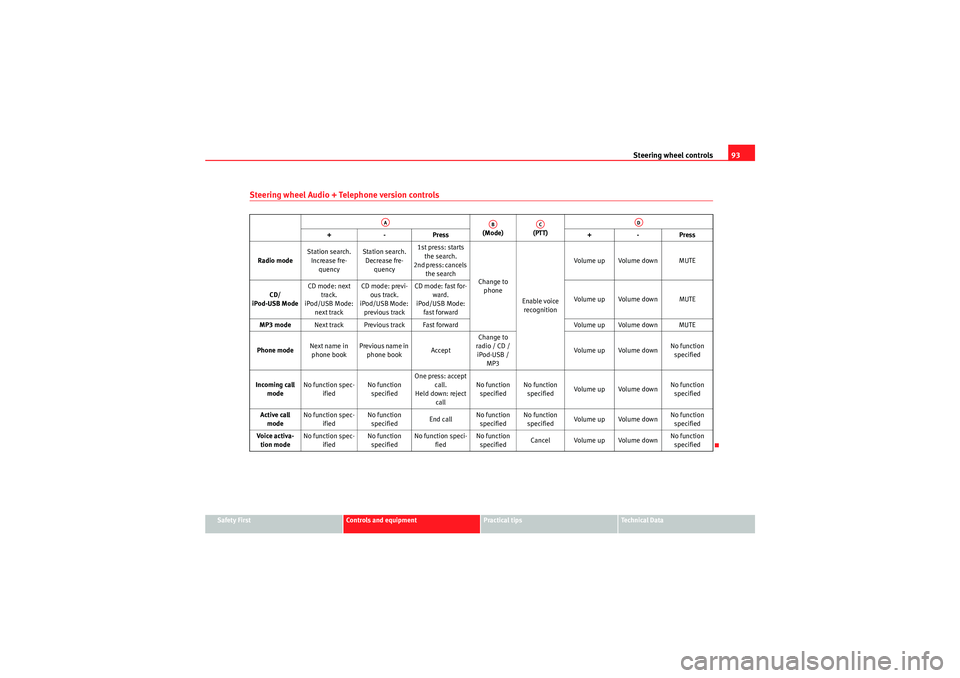
Steering wheel Audio + Telephone version controls
(Mode) (PTT)
+-P re ss +-Pre ss
Radio mode Station search.
Increase fre- quency Station search.
Decrease fre- quency 1st press: starts
the search.
2nd press: cancels the search Change to
phone
Enable voice recognition Volume up Volume down MUTE
CD/
iPod-USB Mode CD mode: next
track.
iPod/USB Mode: next track CD mode: previ-
ous track.
iPod/USB Mode: previous track CD mode: fast for-
ward.
iPod/USB Mode: fast forward Volume up Volume down MUTE
MP3 mode Next track Previous track Fast forward Volume up Volume down MUTE
Phone mode Next name in
phone book Previous name in
phone book AcceptChange to
radio / CD / iPod-USB / MP3 Volume up Volume down
No function
specified
Incoming call mode No function spec-
ified No function
specified One press: accept
call.
Held down: reject call No function
specified No function
specified Volume up Volume down No function
specified
Active call mode No function spec-
ified No function
specified End callNo function
specified No function
specified Volume up Volume down No function
specified
Voice activa- tion mode No function spec-
ified No function
specified No function speci-
fied No function
specified Cancel Volume up Volume down No function
specified
AA
AB
AC
AD
ExeoST_EN.book Seite 93 Donnerstag, 3. September 2009 12:24 12
Page 97 of 316
Steering wheel controls95
Safety First
Controls and equipment
Practical tips
Technical Data
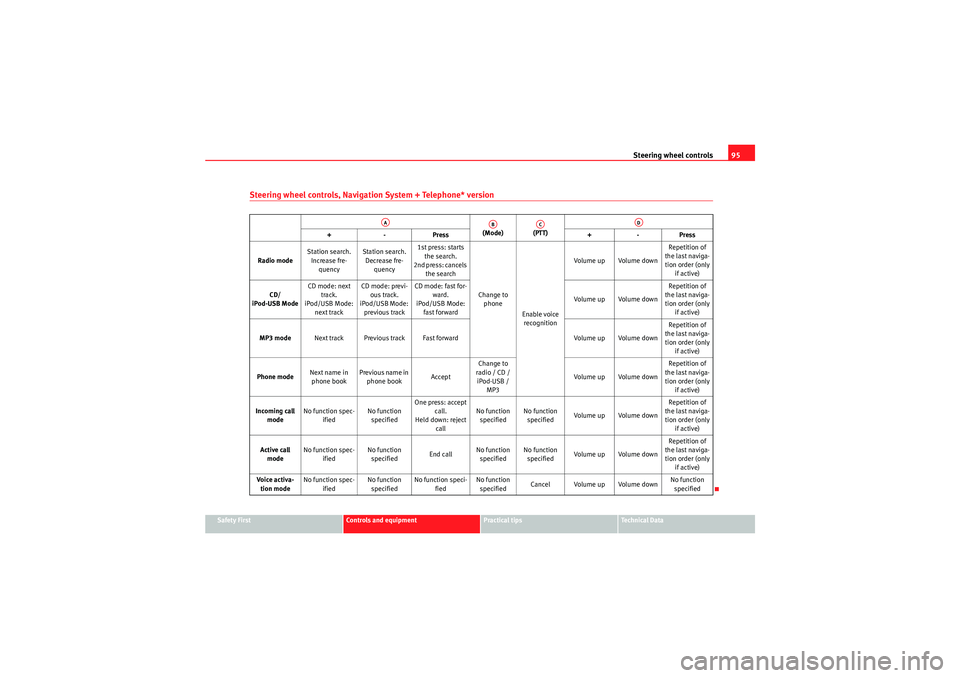
Steering wheel controls, Navigation System + Telephone* version
(Mode) (PTT)
+-P re ss +-Pre ss
Radio mode Station search.
Increase fre- quency Station search.
Decrease fre- quency 1st press: starts
the search.
2nd press: cancels the search
Change to phone
Enable voice recognition Volume up Volume down
Repetition of
the last naviga- tion order (only if active)
CD/
iPod-USB Mode CD mode: next
track.
iPod/USB Mode: next track CD mode: previ-
ous track.
iPod/USB Mode: previous track CD mode: fast for-
ward.
iPod/USB Mode: fast forward Volume up Volume downRepetition of
the last naviga- tion order (only if active)
MP3 mode Next track Previous track Fast forward Volume up Volume downRepetition of
the last naviga- tion order (only if active)
Phone mode Next name in
phone book Previous name in
phone book AcceptChange to
radio / CD / iPod-USB / MP3 Volume up Volume down Repetition of
the last naviga- tion order (only if active)
Incoming call mode No function spec-
ified No function
specified One press: accept
call.
Held down: reject call No function
specified No function
specified Volume up Volume down Repetition of
the last naviga- tion order (only if active)
Active call mode No function spec-
ified No function
specified End callNo function
specified No function
specified Volume up Volume down Repetition of
the last naviga- tion order (only if active)
Voice activa- tion mode No function spec-
ified No function
specified No function speci-
fied No function
specified Cancel Volume up Volume down No function
specified
AA
AB
AC
AD
ExeoST_EN.book Seite 95 Donnerstag, 3. September 2009 12:24 12
Page 124 of 316
Lights and visibility
122
– Press the knob in again to prevent the setting from being changed unintentionally.This button activates or deactivates the daytime running lights function. With
the function activated, when the ignition is switched on the daytime running
lights are turned on automatically.
Note
Please observe any relevant legal requirements which may apply in your
country.Adaptive headlights* (for cornering)
When driving around bends, the headlights will light the
most important areas of the road.
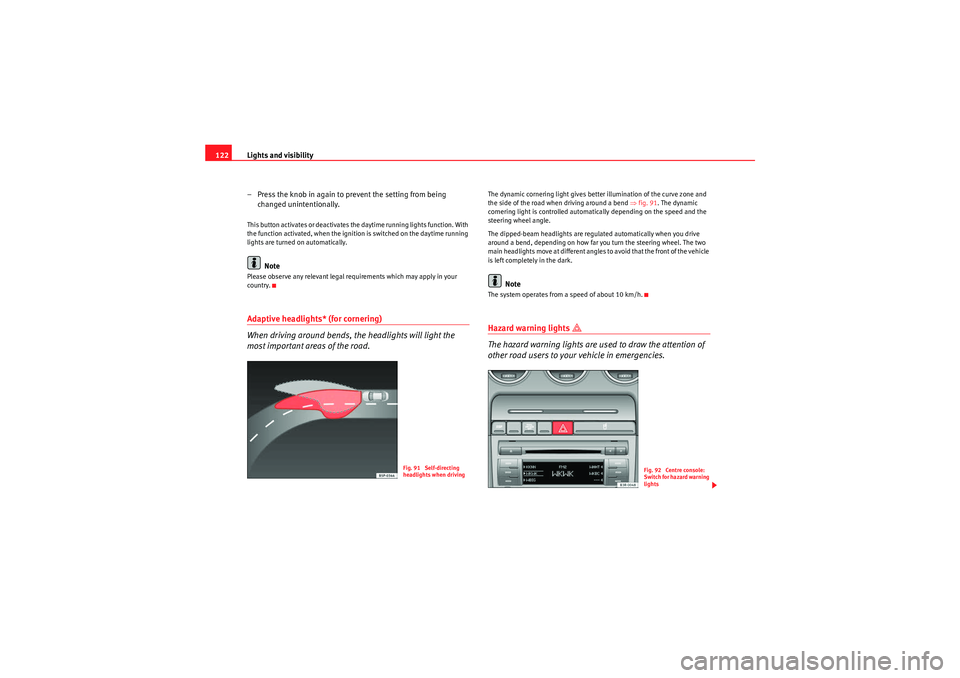
The dynamic cornering light gives better illumination of the curve zone and
the side of the road when driving around a bend ⇒fig. 91 . The dynamic
cornering light is controlled automatically depending on the speed and the
steering wheel angle.
The dipped-beam headlights are regulated automatically when you drive
around a bend, depending on how far you turn the steering wheel. The two
main headlights move at different angles to avoid that the front of the vehicle
is left completely in the dark.
Note
The system operates from a speed of about 10 km/h.Hazard warning lights
The hazard warning lights are used to draw the attention of
other road users to your vehicle in emergencies.
Fig. 91 Self-directing
headlights when driving
Fig. 92 Centre console:
Switch for hazard warning
lights
ExeoST_EN.book Seite 122 Donnerstag, 3. September 2009 12:24 12
Page 188 of 316
Driving
186Applies to vehicles with tiptronic gearbox
When the accelerator pedal is pressed right down past the point of resistance
at full throttle, the gearbox will shift down to a lower gear, depending on road
speed and engine speed. The upshift to the next higher gear is delayed until
the engine reaches maximum rpm.
WARNING
P l eas e n o te t ha t i f t h e road s u r fa ce is s l i pp e r y o r w e t , t h e k ick- d ow n fe at u re
could cause the driving wheels to spin, which could result in skidding.Dynamic gear control program (DCP)
The automatic gearbox is controlled electronically.The vehicle is equipped with an electronically controlled gearbox. The gear
ratios are selected automatically according to preset gearshift programmes.
When you drive at moderate speeds the gearbox will select the most econom-
ical shift programme. It will then change up early and delay the downshifts to
give better fuel economy.
If you drive at higher speeds with heavy acceleration, if you open the throttle
quickly, or if you use the kick-down or the car's maximum speed, the gearbox
will automatically select the more sporty shift programmes.
The gearbox is self-adapting, and continuously selects the most suitable shift
programme. At the same time, the driver can also make the gearbox switch to
a more sporty programme by pressing the accelerator quickly. Depending on
road speed, this makes the gearbox shift down early into a lower gear ratio
for more rapid acceleration (for instance to pass another vehicle), without
having to press the accelerator all the way down into the kick-down position.
After the gearbox has shifted back up it returns to the original programme,
depending on your style of driving. Vehicles with multitronic® gearbox: the gearbox continuously adapts the
gear ratios to gradients. If the brake
pedal is pressed on a downhill gradient
the gearbox automatically shifts to a lower gear ratio. This increases the
engine braking effect.
Vehicles with tiptronic gearbox: in mountainous areas, the gearbox adapts
the gearshifts for uphill and downhill gradients. This prevents the gearbox
from shifting up and down unnecessarily on uphill gradients.
ExeoST_EN.book Seite 186 Donnerstag, 3. September 2009 12:24 12
Page 190 of 316

Driving
188Back-up programme
A back-up system is in place if a fault should occur in the
control system.The automatic gearbox switches to the back-up programme if a fault should
occur in the control system. This is indicated by a gear-wheel symbol which
lights up on the dash panel display (the symbol represents a gear pinion).
It is still possible to move the selector lever to all positions. The manual shift
programme (Tiptronic) is not available when the back-up programme is
active.
Vehicles with tiptronic gearbox: When the selector lever is in position D or S
or in the manual shift programme, the gearbox will remain in 3rd gear if 1st,
2nd or 3rd gears were engaged when the fault occurred. The gearbox will
remain in 5th gear if 4th, 5th or 6th gears were engaged. The gearbox will
then engage 3rd gear when you drive away from a standstill or after the
engine is restarted.
It will still be possible to use reverse gear in the normal way. However, the
electronic lock for reverse gear will be switched off.
Caution
Should the gearbox ever switch into the back-up programme, you should take
the vehicle to a technical service or qualified workshop as soon as possible.
Steering wheel with paddle levers
The paddle levers on the steering wheel enable the driver to
manually select pre-programmed ratios or gears.– Briefly pull the left-hand paddle lever to change down to a
lower gear.
– Briefly pull the right-hand paddle lever to change up to a higher gear.The paddle levers are activated when the selector lever is in position D or S,
or the position for the manual shift programme (tiptronic).
The manual shift programme can, of course, still be operated using the
selector lever in the centre console.
Fig. 159 Steering wheel:
Tiptronic controls
A–A+
ExeoST_EN.book Seite 188 Donnerstag, 3. September 2009 12:24 12
Page 191 of 316
Intelligent technology189
Safety First
Controls and equipment
Practical tips
Technical Data
Practical tipsIntelligent technologyElectronic stabilisation programme (ESP)General notes
The electronic stabilisation programme increases the
vehicle's stability on the road.The ESP is designed to increase the degree of control in situations where the
car approaches the limits of adhesion, especially when accelerating and
cornering. It reduces the risk of skidding and improves stability in all road
conditions. The system is active across the entire speed range. The anti-lock brake system (ABS), the electronic differential lock (EDL) and
the traction control system (TCS) are all integrated into the electronic stabili-
sation programme.
How it works
The ESP control unit processes data from the three integrated systems. It also
processes additional inputs provided by other high-precision sensors. These
register the vehicle's rotation about the vertical axis (yaw rate), lateral accel-
eration, brake pressure and steering wheel angle.
The system uses the steering wheel angle and road speed to calculate the
changes of direction desired by the driver, and constantly compares them
with the actual behaviour of the vehicle. If the desired course is not being
maintained (for instance, if the car is starting to skid), then the ESP compen-
sates automatically by braking the appropriate wheel.
The forces acting on the braked wheel bring the car back to a stable condi-
tion. If the vehicle
over swerves (tendency of the rear to leave the road), the
brakes will act on the front wheel facing the outside of the bend. If the vehicle
under swerves (tendency to leave the bend), the braking force is applied to
the rear wheel facing the inside of the bend.
The ESP works in conjunction with the ABS ⇒page 190. If a malfunction
should occur in the ABS, the ESP will also be out of action.
Disabling
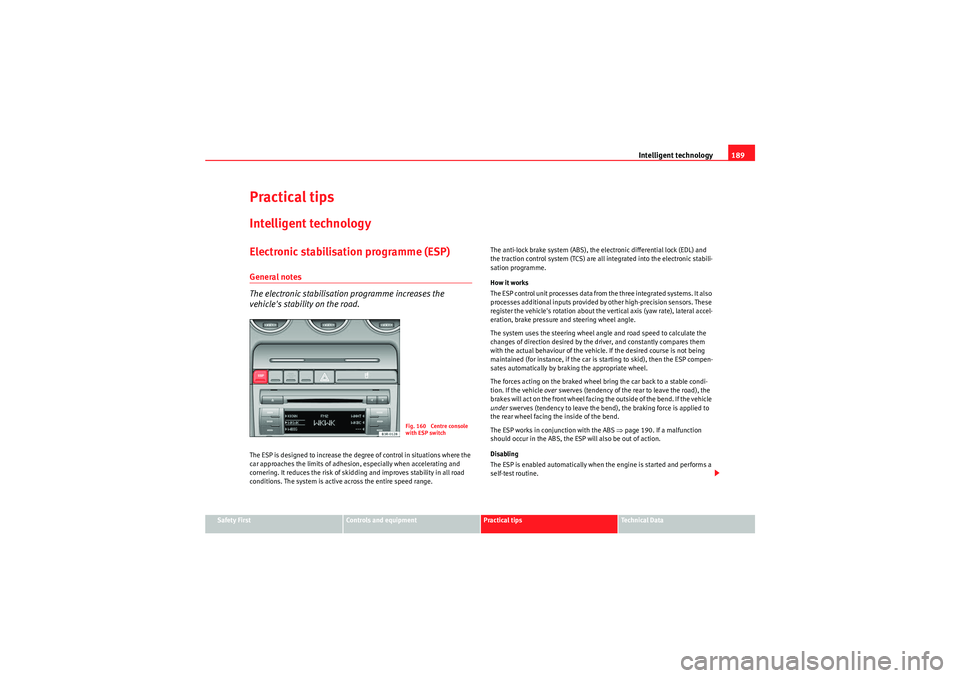
The ESP is enabled automatically when the engine is started and performs a
self-test routine.
Fig. 160 Centre console
with ESP switch
ExeoST_EN.book Seite 189 Donnerstag, 3. September 2009 12:24 12
Page 195 of 316
Intelligent technology193
Safety First
Controls and equipment
Practical tips
Technical Data
Corrosion
There may be a tendency for dirt to build up on the brake pads and corrosion
to form on the discs if the car is used infrequently, or if you only drive low
mileages without using the brakes very much.
If the brakes are not used frequently, or if rust has formed on the disks, it is
advisable to clean off the pads and disks by braking firmly a few times from a
moderately high speed
⇒.
Faults in the brake system
If the brake pedal travel should ever increase suddenly, this may mean that
one of the two brake circuits has failed. Drive immediately to the nearest qual-
ified workshop and have the fault rectified. On the way to the dealer, be
prepared to use more pressure on the brake pedal, and allow for longer stop-
ping distances.
Low brake fluid level
Malfunctions can occur in the brake system if the brake fluid level is too low.
The brake fluid level is monitored electronically.
WARNING
When applying the brakes to clean off deposits on the pads and discs,
select a clear, dry road. Be sure not to inconvenience or endanger other
road users. Risk of accident.
Caution
•Never let the brakes “drag” by leaving your foot on the pedal when you do
not really intend to brake. This overheats the brakes, resulting in longer stop-
ping distances and greater wear.•Before driving down a long, steep gradient, it is advisable to reduce speed
and change to a lower gear (or move the selector lever to a lower gear position
if your car has automatic transmission). This makes use of engine braking and prolongs the service life of the brakes. If you still have to use the brakes,
it is better to brake firmly at intervals than to apply the brakes continuously.
Note
If you wish to equip the car with accessories such as a front spoiler or wheel
covers, it is important that the flow of air to the front wheels is not obstructed,
otherwise the brakes can overheat.Brake servo
The brake servo assists the driver when brakingThe brake servo amplifies the pressure you apply to the brake pedal. The
brake servo works only when the engine is running.
WARNING
Ensure the vehicle does not move while in neutral, when the motor is
stopped. Failure to do so could result in an accident.
Note
If the brake servo is not working, e.g. because the vehicle has to be towed or
because it is broken, you will have to press the brake pedal considerably
harder to make up for the lack of servo assistance.
ExeoST_EN.book Seite 193 Donnerstag, 3. September 2009 12:24 12
Page 246 of 316

Wheels and tyres
244Significant tyre pressure lossThe tyre symbol
is displayed and indicates that the tyre pressure for a least
one tyre is insufficient.
- Stop the vehicle.
- Switch the engine off.
- Check the tyre(s).
- Change the wheel if necessary.
Tyre pressure monitoring (RKA+)*
The type pressure monitor display on the instrument panel
indicates that the pressure is too low.The tyre pressure monitoring system makes use of the ABS sensors to
compare the rolling circumference and the frequency characteristics of the wheels. If the rolling circumference or frequency characteristic changes on
one or more wheels, the tyre pressure warning lamp
will light up. The fault
will also be indicated by a warning buzzer. The position of the affected tyre
will also be shown (if only one tyre is affected) on the centre display of the
instrument panel.
The rolling circumference and frequency characteristics can change if:
•the tyre pressure is too low.•the tyre has suffered structural damage.•the wheels or the inflation pressures have been changed without initial-
ising the system (see Adjusting the tyre pressure settings).•there is a greater load on the wheels of one axle (e.g. if you are carrying
more passengers or luggage).•the road surface under the left wheels is different to the road surface
under the right wheels for a long period.•when driving with snow chains.
Adjusting the tyre pressure settings (initialising the tyre pressure
monitoring system)
After any incident regarding the wheels of your vehicle, e.g. after modify the
tyre pressure ⇒page 245 or after changing of swapping around wheels ⇒
page 180 - with the vehicle at a standstill and the engine running - press
⇒ fig. 188. The yellow warning lamp
will light up. Hold the button down
for 2 seconds until the warning lamp goes out and an acoustic warning is
given. You can now release the button.
If the wheels are subjected to extremely stress (e.g. heavy load), the tyre pres-
sure must be increased to the recommended value for the maximum load
(see the adhesive label on the inside of the fuel tank flap) and then initialise
the system.
Tyre pressure warning lamp on
When you switch on the ignition, the tyre pressure warning lamp
will light
up for about 2 seconds. There is a fault in the system if the indicator stays on
permanently after switching on the ignition. The instrument panel also
Fig. 188 Detailed view of
the centre console: Button
for the tyre pressure
monitoring system
ExeoST_EN.book Seite 244 Donnerstag, 3. September 2009 12:24 12
Page 247 of 316

Wheels and tyres245
Safety First
Controls and equipment
Practical tips
Technical Data
display TMPS (Tyre Pressure Monitoring System). Please contact the nearest
specialist garage as soon as possible.
The tyre pressure warning lamp
lights up if the tyre pressure on one or
more wheels is significantly lower than the tyre pressure setting which was
confirmed by the driver ⇒.
WARNING
•If the tyre pressure warning lamp lights up
you must slow down
immediately and avoid any severe braking or steering manoeuvres. Stop
the vehicle as soon as possible and check the tyres and their pressure.
•The driver is responsible for maintaining correct tyre pressures. There-
fore, the tyre pressure must be regularly checked.•Under certain conditions (e.g. driving at high speeds, on ice and snow
or on poor road surfaces) the tyre pressure warning lamp
may not light
up immediately or not at all.
•Please ask your Dealer or specialist garage whether run-flat tyres can
be used on your vehicle. Fitting this type of tyre in an undue manner could
lead to your driving licence being taken away from you. Furthermore, it may
led to damage to the vehicle or, under certain circumstances, may cause
accidents.•If you change normal tyres for run-flat tyres or vice versa, the control
unit must be reprogrammed by the Dealer or a specialist garage.Note
If you did not press the button for the tyre pressure monitoring system to
confirm a new tyre pressure setting after making changes to the tyre pres-
sures or changing one or more wheels, the warning lamp
may light up
although the tyre pressures are correct. In this case, stop the vehicle as soon
as possible and, after examining the tyres, press the button for the tyre pres-
sure monitoring system.
Tyre ser vice life
The service life of tyres is dependent on tyre pressure, driving
style and fitting.
Fig. 189 Tyre tread wear
indicatorsFig. 190 Diagram for
changing wheels
ExeoST_EN.book Seite 245 Donnerstag, 3. September 2009 12:24 12
Page 248 of 316
Wheels and tyres
246Wear indicators
The original tyres on your vehicle have 1.6 mm high “tread wear indicators”
⇒ page 245, fig. 189 , running across the tread. Depending on the make,
there will be six to eight of them evenly spaced around the tyre. Markings on
the tyre sidewall (for instance the letters “TWI” or other symbols) indicate the
positions of the tread wear indicators. The minimum tread depth required by
law is 1.6 mm (measured in the tread grooves next to the tread wear indica-
tors). Worn tyres must be replaced. Different figures may apply in export
countries ⇒.
Tyre pressure
Under-inflation or over-inflation will reduce the life of the tyres considerably
and also impair the car's handling. The inflation pressures are listed on a
sticker on the inside of the fuel tank flap.
Correct inflation pressures are very important, especially at high speeds. The
pressure should therefore be checked at least once a month and before
starting any long journey.
Tyre pressure monitoring (RKA+)*
Monitoring of the tyre pressures is based on the tyre pressures you have
stored. The tyre pressure monitoring system cannot function as intended if
you store tyre pressure settings for a normal load, but then drive with the
vehicle fully laden. The tyre pressure must be adapted to the actual load and
stored accordingly in the tyre pressure monitoring system ⇒ page 244.
Driving style
Fast cornering, heavy acceleration and hard braking all increase tyre wear.
Changing wheels around
If the front tyres are worn considerably more than the rear ones it is advisable
to change them around as shown ⇒page 245, fig. 190. All the tyres will then
last for about the same time. Wheel balance
The wheels on new vehicles are balanced. However, various factors encoun-
tered in normal driving can cause them to become unbalanced, which results
in steering vibration.
Unbalanced wheels should be rebalanced, as they otherwise cause excessive
wear on steering, suspension and tyres. A wheel must also be rebalanced
when a new tyre is fitted.
Incorrect wheel alignment
Incorrect wheel alignment causes excessive tyre wear, impairing the safety of
the vehicle. If tyres show excessive wear, you should have the wheel align-
ment checked by an Authorised Service Centre.
WARNING
There is a serious danger of accidents if a tyre bursts during driving!•The tyres must be replaced at the latest when the tread is worn down to
the tread wear indicators. Failure to do so could result in an accident. Worn
tyres do not grip well at high speeds on wet roads. There is also a greater
risk of “aquaplaning” •At continuously high speeds, a tyre with insufficient pressure flexes
more. This causes it to overheat. This can cause tread separation and tyre
blow-out. Risk of accident. Always observe the recommended tyre pres-
sures.•I f t y r e s s h o w e x ce s s i v e w e a r, y o u s h o u l d h a v e t h e r u n n i n g g e a r ch e cke d
by an Authorised Service Centre.•Keep chemicals such as oil, fuel and brake fluid away from tyres.•Damaged wheels and tyres must be replaced immediately!For the sake of the environment
Under-inflated tyres will increase fuel consumption.
ExeoST_EN.book Seite 246 Donnerstag, 3. September 2009 12:24 12