brakes Seat Ibiza 5D 2005 User Guide
[x] Cancel search | Manufacturer: SEAT, Model Year: 2005, Model line: Ibiza 5D, Model: Seat Ibiza 5D 2005Pages: 252, PDF Size: 7.56 MB
Page 160 of 252
Cleaning and caring for your vehicle
158
WARNING
•
Never wash tyres with a cylindrical jet. Even at large spraying distances
and short cleaning times, visible and invisible damage can occur to the
tyres. This may be an accident risk.
•
Moisture, ice and salt on the brakes may affect braking efficiency. Risk
of accident. If possible, avoid sudden braking immediately after washing
the vehicle. You must “dry” the brakes by applying the brakes carefully
several times ⇒page 143, “Braking effect and braking distance”.
Cleaning alloy wheelsEvery two weeks
– Wash salt and brake dust from alloy wheels.
– Use an acid free detergent to clean the wheels.
Every three months
– Apply a hard wax compound to the wheels.Alloy wheels require regular attention to preserve their appearance. It is
important to remove road salt and brake dust by washing the wheels at
regular intervals, otherwise the finish will be impaired.
Always use an acid-free detergent for alloy wheels.
Car polish or other abrasive agents should not be used. If the protective
coating is damaged, e.g. by stone impact, the damaged area should be
repaired immediately.
WARNING
•
Never wash tyres with a cylindrical jet. Even at large spraying distances
and short cleaning times, visible and invisible damage can occur to the
tyres. This may be an accident risk.
•
Moisture, ice and salt on the brakes may affect braking efficiency. Risk
of accident. If possible, avoid sudden braking immediately after washing
the vehicle. You must “dry” the brakes by applying the brakes carefully
several times ⇒page 143, “Braking effect and braking distance”.
Underbody sealant
The underside of the vehicle is coated to protect it from corro-
sion and damage.The protective coating could be dama ged when driving. We recommend that
the protective coating under the body and on the running gear should be
checked, and reinstated if necessary, before and after the winter season.
We recommend that repair work and addi tional anti-corrosion work is carried
out by your Authorised Service Centre.
WARNING
Do not apply underseal or anti-corros ion coatings to the exhaust pipes,
catalytic converter or the heat shields on the exhaust system. The heat of
the exhaust system or the engine could cause them to ignite! This is a fire
hazard.
ibiza_ingles Seite 158 Mittwoch, 5. Oktober 2005 5:17 17
Page 161 of 252
Cleaning and caring for your vehicle159
Safety First
Operating instructions
Tips and Maintenance
Te c h n i c a l D a t a
Cleaning the engine compartment
Take special care when cleaning the engine compartment.Anti-corrosion treatment
The engine compartment and the surface of the power unit are given anti-
corrosion treatment at the factory.
Good corrosion protection is particularly important in winter when the car is
frequently driven on salted roads. To prevent the salt corroding the vehicle,
the entire engine compartment should be thoroughly cleaned before and
after the salting period.
Your Authorised Service Centre is able to provide the correct cleaning and
preserving products and has the necessary equipment. For this reason, we
recommend having this work performed by them.
The anti-corrosion protection is usua lly removed if the engine compartment
is cleaned with grease removing solution s, or if you have the engine cleaned.
If this job is carried out, you should ensure that all surfaces, seams, joints and
components in the engine compartmen t are given anti-corrosion treatment
afterwards.
WARNING
•
When working in the engine compartment, always observe the safety
warnings ⇒ page 169.
•
Switch off the engine, apply the parking brake firmly and always
remove the key from the ignition before you open the bonnet.
•
Allow the engine to cool before you clean the engine compartment.
•
Do not clean the underside of vehicle, wheel arches without protecting
your hands and arms. You may cut your self on sharp-edged metal parts.
Failure to comply could result in injury.
•
Moisture, ice and salt on the brakes may affect braking efficiency. Risk
of accident. If possible, avoid sudden braking immediately after washing
the vehicle.
•
Never touch the radiator fan. It is temperature-controlled and could
start automatically, even when the key is removed from the ignition!For the sake of the environment
Fuel, grease and oil deposits could be removed when the engine is washed.
The polluted water must be cleaned in an oil separator. For this reason,
engine washing should be carried out only by a qualified workshop or a suit-
able filling station.Care of the vehicle interiorCleaning plastic parts and the dash panel– Use a clean, damp cloth to clean plastic parts and the dash panel.
– If this does not provide satisfactory results, use a special solvent-free plastic cleaning product.
WARNING
Never clean the dash panel and surface of the airbag module with cleansers
containing solvents. Solvents cause the surface to become porous. If the
airbag inflates, disintegrating plastic parts can cause substantial injuries.
WARNING (continued)
ibiza_ingles Seite 159 Mittwoch, 5. Oktober 2005 5:17 17
Page 184 of 252
Checking and refilling levels
182Brake fluidChecking the brake fluid level
The brake fluid is checked at the intervals given in the service
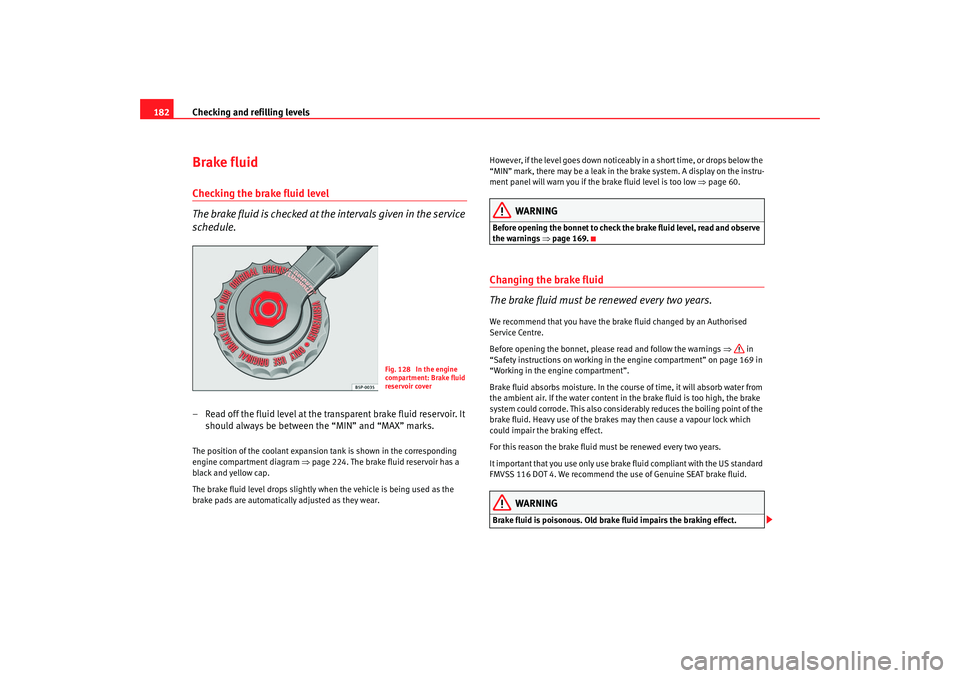
schedule.– Read off the fluid level at the transparent brake fluid reservoir. It
should always be between the “MIN” and “MAX” marks.The position of the coolant expansion tank is shown in the corresponding
engine compartment diagram ⇒page 224. The brake fluid reservoir has a
black and yellow cap.
The brake fluid level drops slightly when the vehicle is being used as the
brake pads are automatically adjusted as they wear. However, if the level goes down noticeab
ly in a short time, or drops below the
“MIN” mark, there may be a leak in the brake system. A display on the instru-
ment panel will warn you if the brake fluid level is too low ⇒page 60.
WARNING
Before opening the bonnet to check the brake fluid level, read and observe
the warnings ⇒page 169.Changing the brake fluid
The brake fluid must be renewed every two years.We recommend that you have the brake fluid changed by an Authorised
Service Centre.
Before opening the bonnet, please read and follow the warnings ⇒ in
“Safety instructions on working in the engine compartment” on page 169 in
“Working in the engine compartment”.
Brake fluid absorbs moisture. In the cour se of time, it will absorb water from
the ambient air. If the water content in the brake fluid is too high, the brake
system could corrode. This also consider ably reduces the boiling point of the
brake fluid. Heavy use of the brakes may then cause a vapour lock which
could impair the braking effect.
For this reason the brake fluid must be renewed every two years.
It important that you use only use brake fluid compliant with the US standard
FMVSS 116 DOT 4. We recommend the use of Genuine SEAT brake fluid.
WARNING
Brake fluid is poisonous. Old brake fluid impairs the braking effect.
Fig. 128 In the engine
compartment: Brake fluid
reservoir cover
ibiza_ingles Seite 182 Mittwoch, 5. Oktober 2005 5:17 17
Page 185 of 252
Checking and refilling levels183
Safety First
Operating instructions
Tips and Maintenance
Te c h n i c a l D a t a
•
Before opening the bonnet to check the brake fluid level, read and
observe the warnings ⇒page 169.
•
Brake fluid should be stored in the closed original container in a safe
place out of reach of children. This represents a toxic danger.
•
Have the brake fluid changed every two years at the latest. Heavy use
of the brakes may cause a vapour lock if the brake fluid is left in the system
for too long. This would seriously affect the efficiency of the brakes and the
safety of the vehicle. This may be an accident risk.Caution
Brake fluid could damage the paintwork. Wipe off any brake fluid from the
paintwork immediately.
For the sake of the environment
Brake fluid must be drained and disposed of in the proper manner observing
environmental regulations.
BatteryWarnings on handling the battery
WARNING
Always be aware of the danger of injury and chemical burns as well as the
risk of accident or fire when working on the battery and the electrical
system:•
Wear eye protection. Protect your eyes , skin and clothing from acid and
particles containing lead.
•
Battery acid is very corrosive and caustic. Wear protective gloves and
eye protection. Do not tilt the batter ies. This could spill acid through the
vents. Rinse battery acid from eyes immediately for several minutes with
clear water. Then seek medical care immediately. Neutralize any acid
splashes on the skin or clothing with a soapy solution, and rinse off with
plenty of water. If acid is swallowed by mistake, consult a doctor immedi-
ately.
•
Fires, sparks, naked lights and smoki ng are prohibited. When handling
cables and electrical equipment, avoid causing sparks and electrostatic
WARNING (continued)
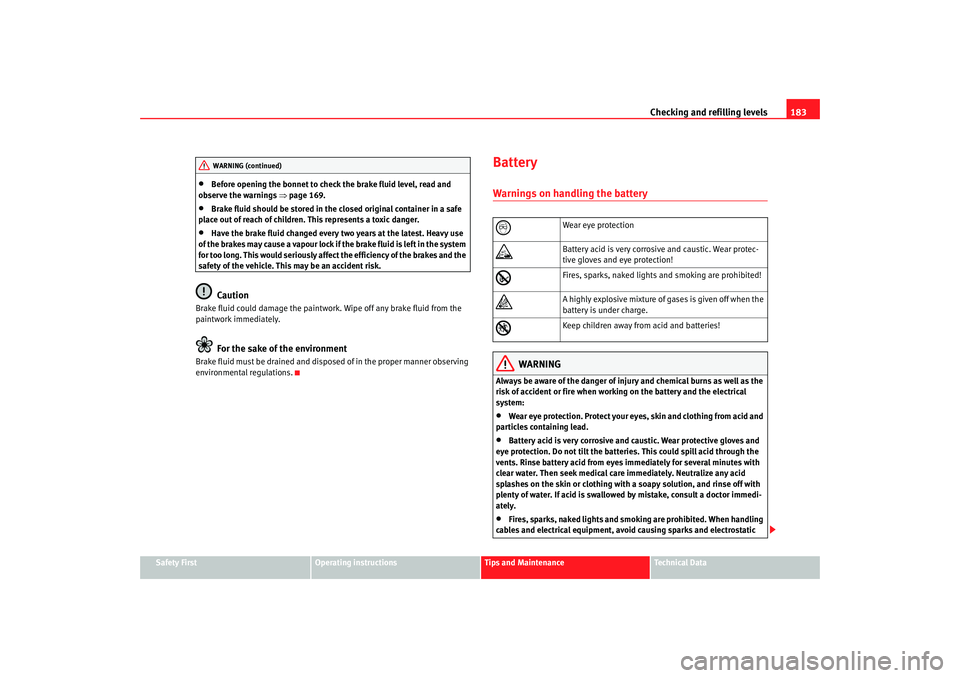
Wear eye protection
Battery acid is very corrosive and caustic. Wear protec-
tive gloves and eye protection!
Fires, sparks, naked lights and smoking are prohibited!
A highly explosive mixture of gases is given off when the
battery is under charge.
Keep children away from acid and batteries!
ibiza_ingles Seite 183 Mittwoch, 5. Oktober 2005 5:17 17
Page 191 of 252
Checking and refilling levels189
Safety First
Operating instructions
Tips and Maintenance
Te c h n i c a l D a t a
•
Avoid running the vehicle on tyres th at are more than six years old. If
you have no alternative, you should drive slowly and with extra care at all
times.
•
Never use old tyres or those with an unknown “history of use”.
•
If wheel trims are retrofitted, you must ensure that the flow of air to the
brakes is not restricted. This could cause them to overheat.
•
All four wheels must be fitted with radial tyres of the same type, size
(rolling circumference) and the same tread pattern.For the sake of the environment
Old tyres must be disposed of according to the laws in the country concerned.
Note
•
For technical reasons, it is not generally possible to use the wheels from
other vehicles. This can also apply to wheels of the same model. The use of
wheels or tyres which have not been approved by SEAT for use with your
model may invalidate the vehicle's type approval for use on public roads.
•
If the spare tyre is not the same as the tyres that are mounted on the
vehicle - for example with winter tyres - you should only use the spare tyre for
a short period of time and drive with extra care. Refit the normal road wheel
as soon as possible.
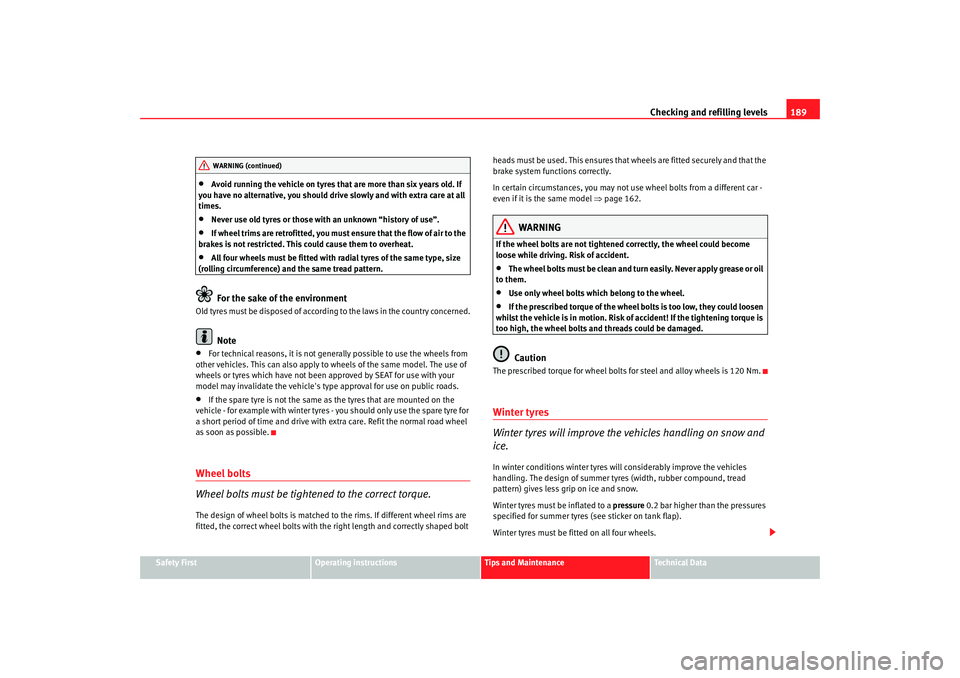
Wheel bolts
Wheel bolts must be tightened to the correct torque.The design of wheel bolts is matched to the rims. If different wheel rims are
fitted, the correct wheel bolts with the right length and correctly shaped bolt heads must be used. This ensures that wheels are fitted securely and that the
brake system functions correctly.
In certain circumstances, you may not use wheel bolts from a different car -
even if it is the same model
⇒page 162.
WARNING
If the wheel bolts are not tightened correctly, the wheel could become
loose while driving. Risk of accident.•
The wheel bolts must be clean and turn easily. Never apply grease or oil
to them.
•
Use only wheel bolts which belong to the wheel.
•
If the prescribed torque of the wheel bolts is too low, they could loosen
whilst the vehicle is in motion. Risk of accident! If the tightening torque is
too high, the wheel bolts and threads could be damaged.Caution
The prescribed torque for wheel bolts for steel and alloy wheels is 120 Nm.Winter tyres
Winter tyres will improve the vehicles handling on snow and
ice.In winter conditions winter tyres will considerably improve the vehicles
handling. The design of summer tyre s (width, rubber compound, tread
pattern) gives less grip on ice and snow.
Winter tyres must be inflated to a pressure 0.2 bar higher than the pressures
specified for summer tyres (see sticker on tank flap).
Winter tyres must be fitted on all four wheels.
WARNING (continued)
ibiza_ingles Seite 189 Mittwoch, 5. Oktober 2005 5:17 17
Page 228 of 252
Technical Data
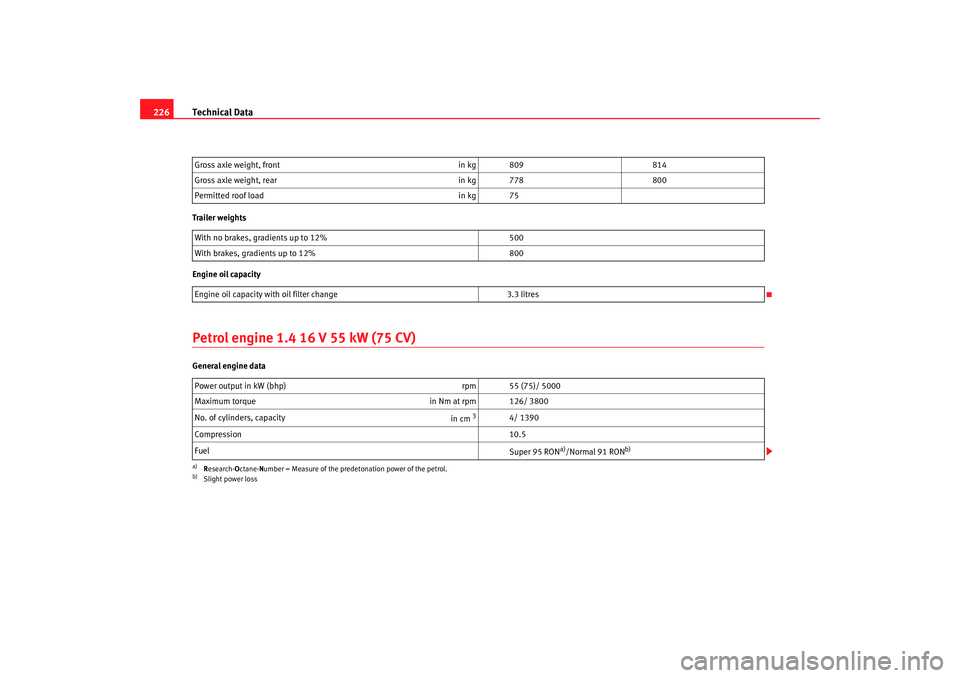
226Trailer weights
Engine oil capacityPetrol engine 1.4 16 V 55 kW (75 CV)General engine data Gross axle weight, front
in kg 809814
Gross axle weight, rear in kg 778800
Permitted roof load in kg 75
With no brakes, gradients up to 12% 500
With brakes, gradients up to 12% 800
Engine oil capaci ty with oil filter change 3.3 litres
Power output in kW (bhp) rpm 55 (75)/ 5000
Maximum torque in Nm at rpm 126/ 3800
No. of cylinders, capacity in cm
3
4/ 1390
Compre ssion 10.5
Fuel Super 95 RON
a)/Normal 91 RON
b)
a)Research-Octane-Number = Measure of the predetonation power of the petrol.b)Slight power loss
ibiza_ingles Seite 226 Mittwoch, 5. Oktober 2005 5:17 17
Page 229 of 252
Technical Data227
Safety First
Operating instructions
Tips and Maintenance
Te c h n i c a l D a t a
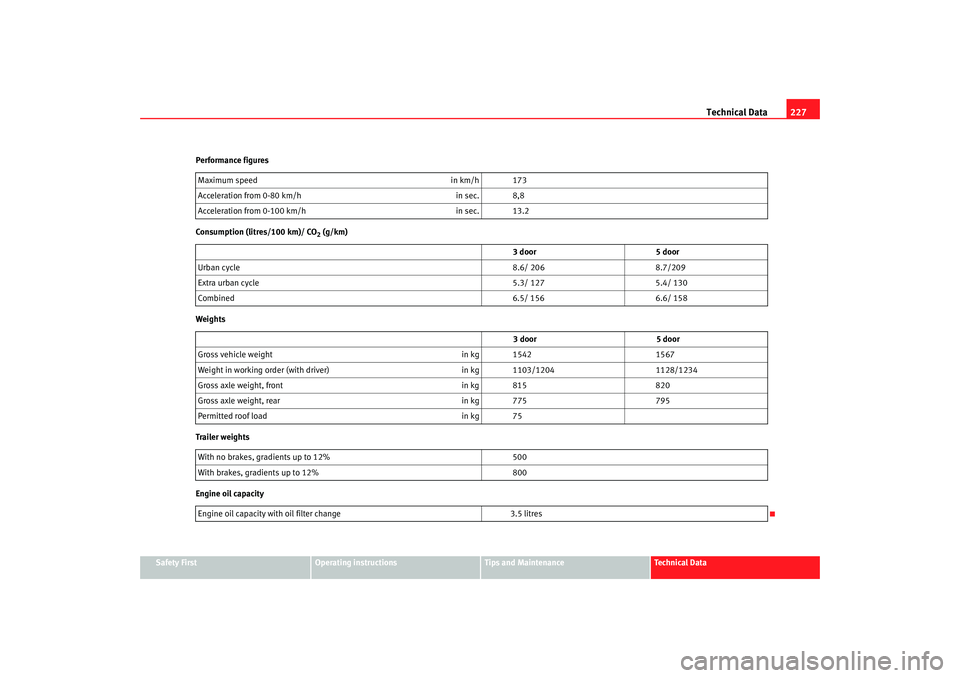
Performance figures
Consumption (litres/100 km)/ CO
2 (g/km)
Weights
Trailer weights
Engine oil capacity Maximum speed
in km/h 173
Acceleration from 0-80 km/h in sec. 8,8
Acceleration from 0-100 km/h in sec. 13.2
3 door 5 door
Urban cycle 8.6/ 206 8.7/209
Extra urban cycle 5.3/ 127 5.4/ 130
Combined 6.5/ 156 6.6/ 158
3 door 5 door
Gross vehicle weight in kg 15421567
Weight in working order (with driver) in kg 1103/12041128/1234
Gross axle weight, front in kg 815820
Gross axle weight, rear in kg 775795
Permitted roof load in kg 75
With no brakes, gradients up to 12% 500
With brakes, gradients up to 12% 800
Engine oil capacity with oil filter change 3.5 litres
ibiza_ingles Seite 227 Mittwoch, 5. Oktober 2005 5:17 17
Page 231 of 252
Technical Data229
Safety First
Operating instructions
Tips and Maintenance
Te c h n i c a l D a t a
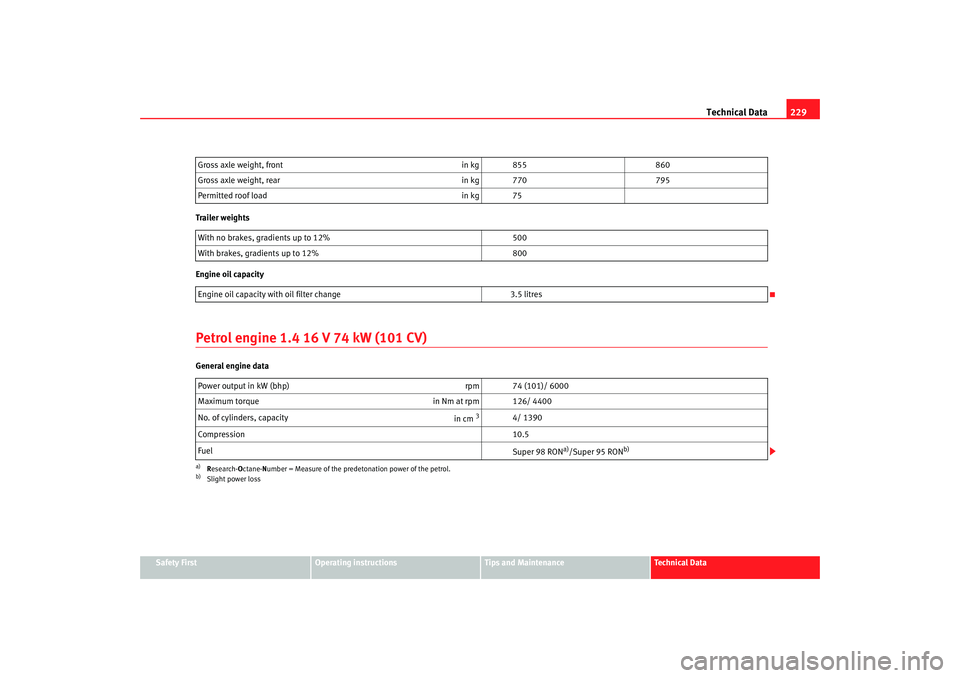
Trailer weights
Engine oil capacity
Petrol engine 1.4 16 V 74 kW (101 CV)General engine data
Gross axle weight, front
in kg 855860
Gross axle weight, rear in kg 770795
Permitted roof load in kg 75
With no brakes, gradients up to 12% 500
With brakes, gradients up to 12% 800
Engine oil capacity with oil filter change 3.5 litres
Power output in kW (bhp) rpm 74 (101)/ 6000
Maximum torque in Nm at rpm 126/ 4400
No. of cylinders, capacity in cm
3
4/ 1390
Compression 10.5
Fuel Super 98 RON
a)/Super 95 RON
b)
a)Research-O ctane-Number = Mea sure of the pr
edetonation power of the petrol.
b)Slight power loss
ibiza_ingles Seite 229 Mittwoch, 5. Oktober 2005 5:17 17
Page 232 of 252
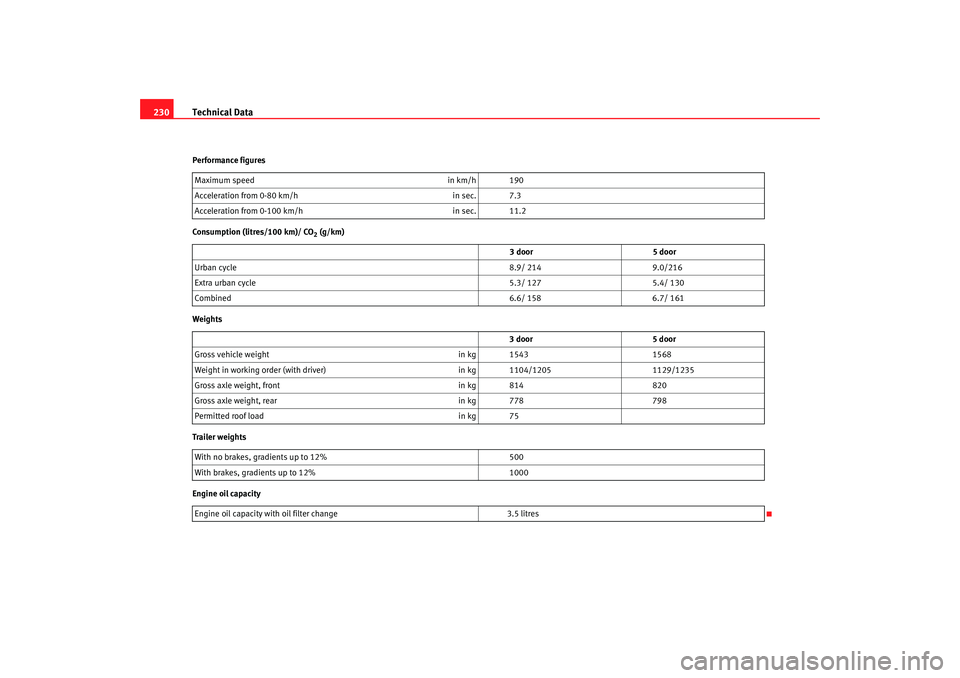
Technical Data
230Performance figures
Consumption (litres/100 km)/ CO
2 (g/km)
Weights
Trailer weights
Engine oil capacity Maximum speed
in km/h 190
Accelera tion from 0-80 km/h in sec. 7.3
Accelera tion from 0-100 km/h in sec. 11.2
3 door 5 door
Urban cycle 8.9/ 214 9.0/216
Extra urban cycle 5.3/ 127 5.4/ 130
Combined 6.6/ 158 6.7/ 161
3 door 5 door
Gross vehicle weight in kg 15431568
Weight in working order (with driver) in kg 1104/12051129/1235
Gross axle weight, front in kg 814820
Gross axle weight, rear in kg 778798
Permitted roof load in kg 75
With no brakes, gradients up to 12% 500
With brakes, gradients up to 12% 1000
Engine oil capaci ty with oil filter change 3.5 litres
ibiza_ingles Seite 230 Mittwoch, 5. Oktober 2005 5:17 17
Page 234 of 252
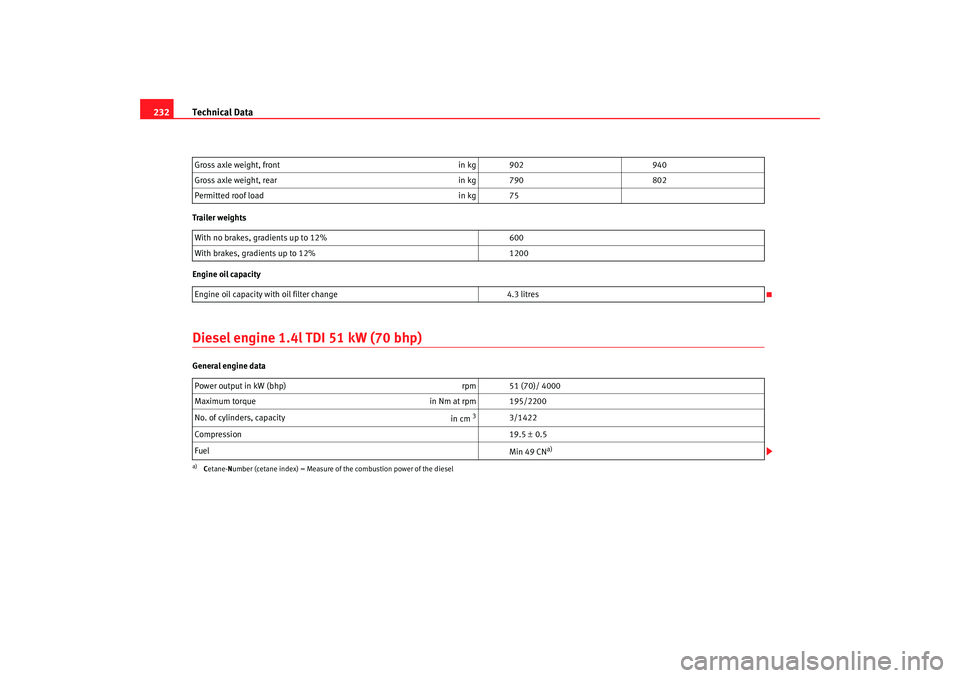
Technical Data
232Trailer weights
Engine oil capacityDiesel engine 1.4l TDI 51 kW (70 bhp)General engine data Gross axle weight, front
in kg 902940
Gross axle weight, rear in kg 790802
Permitted roof load in kg 75
With no brakes, gradients up to 12% 600
With brakes, gradients up to 12% 1200
Engine oil capaci ty with oil filter change 4.3 litres
Power output in kW (bhp) rpm 51 (70)/ 4000
Maximum torque in Nm at rpm 195/2200
No. of cylinders, capacity in cm
3
3/1422
Compre ssion 19.5 ±
0.5
Fuel Min 49 CN
a)
a)Cetane- Number (cetane index) = Measure of the combustion power of the diesel
ibiza_ingles Seite 232 Mittwoch, 5. Oktober 2005 5:17 17