maintenance Seat Ibiza ST 2016 Owner's manual
[x] Cancel search | Manufacturer: SEAT, Model Year: 2016, Model line: Ibiza ST, Model: Seat Ibiza ST 2016Pages: 252, PDF Size: 5.56 MB
Page 3 of 252
Foreword
This Instruction Manual and its correspond-
in
g s
upp
lements should be read carefully to
familiarise yourself with your vehicle.
Besides the regular care and maintenance of
the vehicle, its correct handling will help pre-
serve its value.
For safety reasons, always note the informa-
tion concerning accessories, modifications
and part replacements.
If selling the vehicle, give all of the on-board
documentation to the new owner, as it
should be kept with the vehicle. You can access the information in this man-
ual usin
g:
● Thematic table of contents that follows the
manual’s gener
al chapter structure.
● Visual table of contents that uses graphics
to indicate the p
ages containing “essential”
information, which is detailed in the corre-
sponding chapters.
● Alphabetical index with many terms and
synonyms t
o help you find information. WARNING
Read and always observe safety informa-
tion concernin g the p
assenger's front air-
bag ››› page 72, Important information
regarding the front passenger's airbag .»
Page 6 of 252
Table of Contents
Engine management and exhaust gas purifica-
tion sy s
tem
. . . . . . . . . . . . . . . . . . . . . . . . . . . . . 169
Driving tips . . . . . . . . . . . . . . . . . . . . . . . . . . . . . 171
Driver assistance systems . . . . . . . . . . . . . . . . . 172
Start-Stop System* . . . . . . . . . . . . . . . . . . . . . . . 172
Fatigue detection (break recommendation)* . . 174
Parking aid . . . . . . . . . . . . . . . . . . . . . . . . . . . . . 175
Rear Assist “Rear View Camera”* . . . . . . . . . . . 180
Cruise speed* (cruise control - GRA) . . . . . . . . . 183
“SEAT Drive Profile” system . . . . . . . . . . . . . . . . 184
Towing bracket device and trailer . . . . . . . . . . . 186
Trailer mode . . . . . . . . . . . . . . . . . . . . . . . . . . . . 186
Retrofitting a towing bracket* . . . . . . . . . . . . . . 188
Advice . . . . . . . . . . . . . . . . . . . . . . . . . . . . . . . . 190
Care and maintenance . . . . . . . . . . . . . . . . . . . . 190
Accessories and modifications to the vehi-
cle . . . . . . . . . . . . . . . . . . . . . . . . . . . . . . . . . . . . 190
C
are and cleaning . . . . . . . . . . . . . . . . . . . . . . . 191
Care of the vehicle exterior . . . . . . . . . . . . . . . . 192
Caring for the vehicle interior . . . . . . . . . . . . . . 197
Checking and refilling levels . . . . . . . . . . . . . . . 199
Refuelling . . . . . . . . . . . . . . . . . . . . . . . . . . . . . . 199
Fuel . . . . . . . . . . . . . . . . . . . . . . . . . . . . . . . . . . . 200
Working in the engine compartment . . . . . . . . 201
Engine oil . . . . . . . . . . . . . . . . . . . . . . . . . . . . . . 204
Cooling system . . . . . . . . . . . . . . . . . . . . . . . . . . 207
Brake fluid . . . . . . . . . . . . . . . . . . . . . . . . . . . . . 209
Windscreen washer reservoir . . . . . . . . . . . . . . 210
Vehicle battery . . . . . . . . . . . . . . . . . . . . . . . . . . 210
Wheels . . . . . . . . . . . . . . . . . . . . . . . . . . . . . . . . 213
Wheels and tyres . . . . . . . . . . . . . . . . . . . . . . . . 213
Winter service . . . . . . . . . . . . . . . . . . . . . . . . . . . 217
Technical data . . . . . . . . . . . . . . . . . . . . . . . . 219
Technical specifications . . . . . . . . . . . . . . . . . . 219
Important information . . . . . . . . . . . . . . . . . . . . 219
Information on fuel consumption . . . . . . . . . . . 220 Trailer mode . . . . . . . . . . . . . . . . . . . . . . . . . . . . 220
Wheels . . . . . . . . . . . . . . . . . . . . . . . . . . . . . . . . 221
Engine data . . . . . . . . . . . . . . . . . . . . . . . . . . . . . 222
Dimensions . . . . . . . . . . . . . . . . . . . . . . . . . . . . . 234
Index . . . . . . . . . . . . . . . . . . . . . . . . . . . . . . . . . 235
4
Page 35 of 252
The essentials
on the instrument panel, as well as a mes-
s ag
e for the driv
er: speed warning ex-
ceeded! The warning lamp switches off
when reducing speed below the stored maxi-
mum limit.
Speed warning programming is recommen-
ded if you wish to be reminded of a maxi-
mum speed, such as when travelling in a
country with different speed limits or for a
maximum speed for winter tyres.
Setting speed limit warning
You can use the radio or the Easy Connect* to
set, alter or cancel the speed limit warning.
● Vehicles with radio : press
the button SETUP> control button Driver Assistant
>
Speed warning .
● Vehicles with Easy Connect : pre
ss
the but-
ton Systems or else Vehicle systems >
Driver assistant > Speed warning.
The warning limit can be set from 30 to
240 km/h (20 to 150 mph). The adjustment
is done in 10 km/h intervals. Note
● Plea se be
ar in mind that, even with the
speed warning function, it is still important
to keep an eye on the vehicle speed with the
speedometer and to observe the legal speed
limits. ●
The speed limit w arnin
g function in the ver-
sion for several countries warns you at a
speed of 120 km/h (80 mph). This is a facto-
ry-set speed limit. Service intervals
The service interval indication appears on the
instrument
p
anel display ›››
Fig. 121
3 .
SEAT di s
tinguishes between services with en-
gine oil change (e.g. Oil change service) and
services without engine oil change (e.g. In-
spection).
In vehicles with Services established by time
or mileage, the service intervals are already
pre-defined.
In vehicles with LongLife Service , the inter-
vals are determined individually. Thanks to
technological progress, maintenance work
has been greatly reduced. Because of the
technology used by SEAT, with this service
you only need to change the oil when the ve-
hicle so requires. To calculate this change
(max. 2 years), the vehicle's conditions of
use and individual driving styles are consid-
ered. The advance warning first appears 20
days before the date established for the cor-
responding service. The kilometres (miles)
remaining until the next service are always
rounded up to the nearest 100 km (miles)
and the time is given in complete days. The
current service message cannot be viewed until 500 km after the last service. Prior to
this, only
line
s are visible on the display.
Inspection reminder
When the Service date is approaching, when
the ignition is switched on a Service remind-
er is displayed.
Vehicles without text messages : a span-
ner will be displayed on the instrument
panel plus an indication in km.
The kilometres indicated are the maximum
number of kilometres that can be travelled
until the next service. After a few seconds,
the display mode changes. A clock symbol
appears and the number of days until the
next service is due.
Vehicles with text messages : Service in
--- km or --- days will be shown on the
instrument panel display.
Service due
When the service date is due , an audible
warning is given when the ignition is switch-
ed on and the spanner displayed on the
screen flashes for a few seconds .
Vehicles with text messages : Service now
will be shown on the instrument panel dis-
play. » 33
Page 36 of 252
The essentials
Reading a service notification
W ith the ignition sw
itc
hed on, the engine off
and the vehicle at a standstill, the current
service notification can be read:
Press and hold the button 4 for more than 5
sec ond
s t
o consult the service message.
When the service date has passed , a minus
sign is displayed in front of the number of kil-
ometres or days.
Vehicles with text messages : the following
message is displayed: Service --- km
(miles) or --- days ago .
The time can also be set via the key and
Set up function button in the Easy Connect
sy s
tem
›
›› page 101.
Resetting service interval display
If the service was not carried out by a SEAT
dealership, the display can be reset as fol-
lows: ● Switch off the ignition, press and hold but-
ton ›››
Fig. 121
4 .
● Switch ignition back on.
● Release THE 4
› ›
›
Fig. 121
b
utton and
press it again for the next 20 seconds. Note
● The servic e me
ssage disappears after a few
seconds, when the engine is started or when OK/RESET
is pressed on the windscreen wiper
lever , or OK on the multifunction steering
wheel.
● In v ehic
les with the LongLife system in
which the batter
y has been disconnected for
a long period of time, it is not possible to cal-
culate the date of the next service. Therefore
the service interval display may not be cor-
rect. In this case, bear in mind the maximum
service intervals permitted in the ››› Book-
let Maintenance Programme. Cruise control
Oper atin
g the c rui
se control system
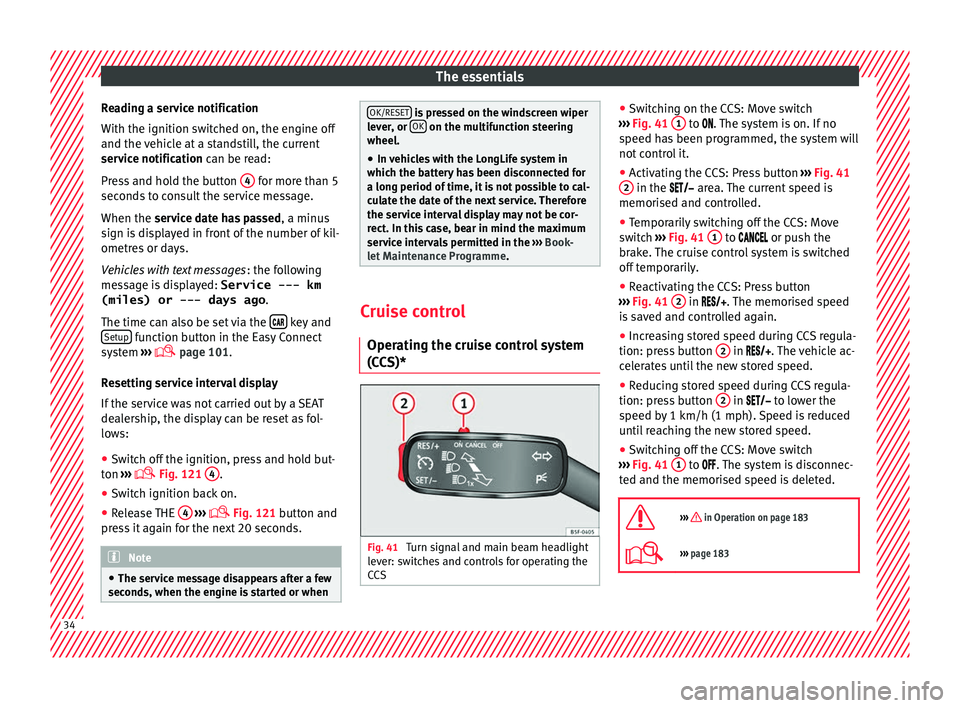
(CCS)* Fig. 41
Turn signal and main beam headlight
l ev
er: sw it
ches and controls for operating the
CCS ●
Sw it
chin
g on the CCS: Move switch
››› Fig. 41 1 to .
The system is on. If no
s peed h a
s been programmed, the system will
not control it.
● Activating the CCS: Press button ››› Fig. 41
2 in the ar
e
a. The c
urrent speed is
memorised and controlled.
● Temporarily switching off the CCS: Move
switch ›
›› Fig. 41 1 to
or push the
br ak e.
The cruise control system is switched
off temporarily.
● Reactivating the CCS: Press button
››› Fig. 41
2 in
. The memorised speed
i s
saved and controlled again.
● Increasing stored speed during CCS regula-
tion: press
button 2 in
. The vehicle ac-
c el
erates until the new stored speed.
● Reducing stored speed during CCS regula-
tion: press
button 2 in t
o lower the
s peed b y
1 km/h (1 mph). Speed is reduced
until reaching the new stored speed.
● Switching off the CCS: Move switch
››› Fig. 41
1 to .
The system is disconnec-
t ed and the memori sed s
peed is deleted.
››› in Operation on page 183
››› page 183 34
Page 45 of 252
The essentials
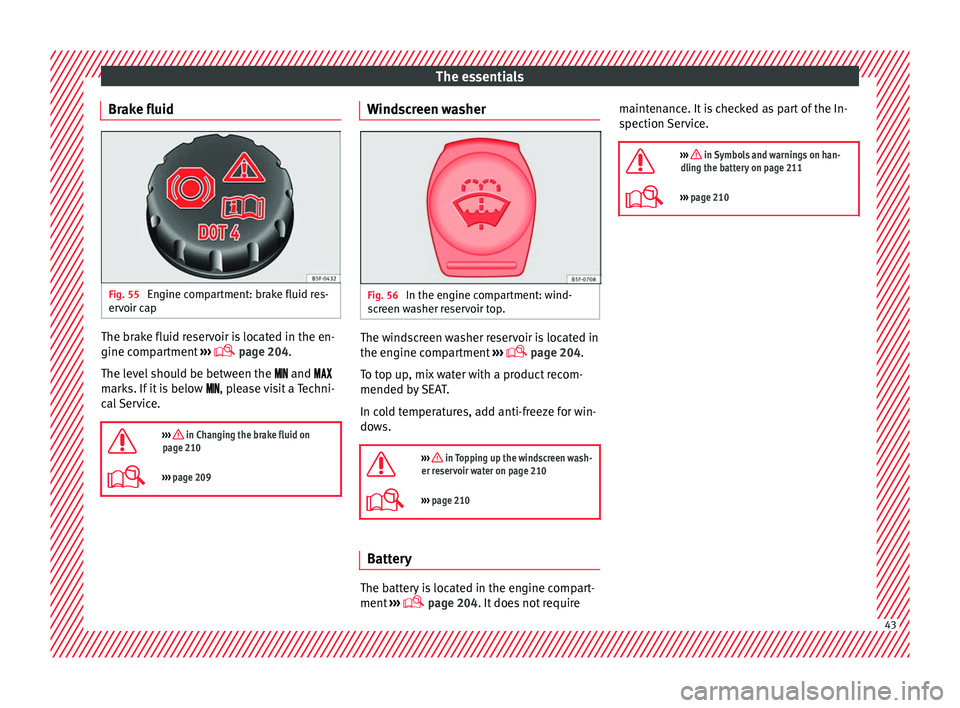
Brake fluid Fig. 55
Engine compartment: brake fluid res-
er v
oir c ap The brake fluid reservoir is located in the en-
gine c
omp
artment
›››
page 204.
The level should be between the and
marks. If it is below , please visit a Techni-
cal Service.
››› in Changing the brake fluid on
page 210
››› page 209 Windscreen washer
Fig. 56
In the engine compartment: wind-
s c
reen w
asher reservoir top. The windscreen washer reservoir is located in
the en
gine c
ompar
tment ›››
page 204.
To top up, mix water with a product recom-
mended by SEAT.
In cold temperatures, add anti-freeze for win-
dows.
››› in Topping up the windscreen wash-
er reservoir water on page 210
››› page 210 Battery
The battery is located in the engine compart-
ment
›
››
page 204. It does not require maintenance. It is checked as part of the In-
spection Serv
ice.
››› in Symbols and warnings on han-
dling the battery on page 211
››› page 210 43
Page 142 of 252
Operation
Air conditioning
He atin
g, v
entilation and cool-
ing
General notes Read the additional information carefully
›››
p
age 39
Pollution filter
The pollution filter (a combined particulate
filter and active carbon filter) serves as a bar-
rier against impurities in the outside air, in-
cluding dust and pollen.
For the climate control system to work with
maximum efficiency, the pollution filter must
be replaced at the specified intervals in the
Maintenance Programme.
If the filter loses efficiency prematurely due
to use in areas reaching very high pollution
levels, the pollen filter must be changed
more frequently than stated in the Service
Schedule. WARNING
Reduced visibility through the windows in-
cre a
ses the risk of serious accidents.
● Always ensure that all windows are free of
ice and snow
, and that they are not fogged, so as to maintain good visibility of everything
outside.
●
The m ax
imum heat output required to de-
frost
windows as quickly as possible is only
available when the engine has reached its
normal running temperature. Only drive when
you have good visibility.
● Always ensure that you use the heating
system, fr
esh air system, air conditioner and
the heated rear window to maintain good visi-
bility to the outside.
● Never leave the air recirculation on for a
long period of time. If the c
ooling system is
switched off and air recirculation mode
switched on, the windows can mist over very
quickly, considerably limiting visibility.
● Switch air recirculation mode off when it is
not required. WARNING
Stuffy or used air will increase fatigue and re-
duce driver c onc
entration possibly resulting
in a serious accident.
● Never leave the fresh air fan turned off or
use the air recir
culation for long periods of
time; the air in the vehicle interior will not be
refreshed. CAUTION
● If y ou s
uspect that the air conditioner is
damaged, switch it off with the A/C button to prevent further damage and have it checked
by a s
pec
ialised workshop.
● Repairs to the air conditioner require spe-
ciali
st knowledge and special tools. There-
fore, we recommend you to take the vehicle
to a specialised workshop. Note
● If the humidity and t emper
ature outside the
vehicle are high, condensation can drip off
the evaporator in the cooling system and
form a pool underneath the vehicle. This is
normal and does not indicate a leak.
● Keep the air intake slots in front of the
windsc
reen free of snow, ice and leaves to en-
sure heating and cooling are not impaired,
and to prevent the windows from misting
over.
● The air from the vents flows through the ve-
hicle interior and i
s extracted by slots in the
luggage compartment designed for this pur-
pose. Therefore, you should avoid obstruct-
ing these slots with any kind of object.
● The air conditioner operates most effective-
ly with the windo
ws and the sliding/tilting
sunroof* closed. However, if the temperature
inside the vehicle is excessive because of the
sun, the air inside can be cooled faster by
opening the windows for a short time.
● Do not smoke while air recirculation mode
is on, as
smoke drawn into the air condition-
ing system leaves residue on the evaporator,
producing a permanent unpleasant odour. 140
Page 155 of 252
Driving
of your brake pads checked by technical serv-
ic e
s mor
e frequently than recommended in
the Maintenance Programme.
If you drive with wet brakes, for example, af-
ter crossing areas of water, on days of heavy
rainfall or even after washing the car, the ef-
fect of the brakes is reduced as the brake
discs are wet or even frozen (in winter): in
this case, the brakes should be “dried” by
pressing the brake pedal several times. WARNING
Longer braking distances and faults in the
brake sy s
tem increase the risk of accidents.
● New brake pads must be run in and do not
have the corr
ect friction during the first
200 km. This reduced braking capacity may
be compensated for by pressing on the brake
pedal a little harder, which also applies when
the brake pads have to be changed further
on.
● If brakes are wet or frozen, or if you are
driving on ro
ads which have been salted,
braking power may be lower than normal.
● On steep slopes, if brakes are excessively
used, they wi
ll overheat. Before driving down
a long steep slope, it is advisable to reduce
speed and change down into a lower gear or
range (depending on the type of transmis-
sion). Thus, make use of engine braking and
relieve the brakes.
● Never let the brakes “drag” by applying
light pres
sure. Continuous braking will cause the brakes to overheat and the braking dis-
tance w
i
ll increase. Apply and then release
the brakes alternately.
● Never let the vehicle run with the engine
switched off
. The braking distance is in-
creased considerably when the brake servo is
not active.
● If the brake fluid loses its viscosity and is
subject
ed to heavy use, vapour bubbles can
form in the brake system. This reduces the ef-
ficiency of the brakes.
● Non-standard or damaged front spoilers
could r
estrict the airflow to the brakes and
cause them to overheat. Before purchasing
accessories please observe the relevant in-
structions ››› page 190, Modifications.
● If a brake system circuit fails, the braking
distanc
e will be increased considerably. Con-
tact a specialised workshop immediately and
avoid unnecessary journeys. Control lamp
Situations in which the warning lamp lights
up *
●
the brake fluid level is too low
› ›
›
p
age 209.
● there is a fault in the brake system.
This warnin
g lamp can light up together with
the ABS system warning lamp. WARNING
● If the brak e w
arning lamp does not go out
or if it lights up when driving, the brake fluid
level in the reservoir is too low so there is a
risk of an accident ››› page 209, Brake fluid.
Stop the vehicle and do not drive on. Obtain
technical assistance.
● If the brake warning lamp lights up to-
gether with the ABS
lamp this could be
due to an ABS fault. This could cause the rear
wheels to lock quickly when you brake. This
could cause the rear to break away. Risk of
skidding. Stop the vehicle and seek technical
assistance. Handbrake
Fig. 169
Handbrake between the front seats. The handbrake should be applied firmly to
pr
ev
ent the
vehicle from accidentally rolling
away. Always apply the handbrake when you
leave your vehicle and when you park. »
153
Technical data
Advice
Operation
Emergencies
Safety
Page 170 of 252
Operation
● Use of
solv
ent-free adhesives.
● Use of CFC-free coolants in cooling sys-
tems.
● Recyc
ling and energy recovery from resi-
dues (RDF).
● Impro
vement in the quality of waste water.
● Use of systems for the recovery of residual
heat (thermal
recovery, enthalpy wheels,
etc.).
● The use of water-soluble paints.
Economical and environmentally-
friendly driving Fuel consumption, environmental pollution
and w
e
ar t o the en
gine, brakes and tyres de-
pends in large part on your driving style. By
adopting an economical driving style and an-
ticipating the traffic situation ahead, you can
easily reduce fuel consumption by 10-15%.
Some tips on how to help you reduce pollu-
tion while saving money are listed below.
Active cylinder management (ACT ®
)
Depending on the equipment, the vehicle
may have active cylinder management
(ACT ®
).
The active cylinder management (ACT ®
) may
automatically deactivate some of the engine
cylinders if the driving situation does not re-
quire too much power. When it is switched off, no fuel is injected into these cylinders,
hence total
fuel consumption may be re-
duced. The number of active cylinders can be
seen on the instrument panel display
››› page 30.
Drive anticipating the traffic situation
A vehicle uses most fuel when accelerating.
When you anticipate situations, you have to
brake less often and, thus, accelerate less. If
it is possible, let the vehicle roll with a gear
engaged, for example, if you see a red light
ahead. The braking effect achieved in this
way helps to reduce the wear of brakes and
tyres; emissions and fuel consumption are
reduced to zero (disconnection due to iner-
tia).
Change gear early to save energy
An effective way of saving fuel is to change
up quickly through the gears. Running the
engine at high rpm in the lower gears uses
an unnecessary amount of fuel.
Manual gearbox: shift up from first to second
gear as soon as possible. We recommend
that, whenever possible, you change to a
higher gear upon reaching 2000 rpm. Follow
the “recommended gear” indication that ap-
pears on the instrument panel ››› page 161. Avoid driving at high speed
We advi
se you not to drive at the top speed
permitted by the vehicle. Fuel consumption,
exhaust emissions and noise levels all in-
crease very rapidly at higher speeds. Driving
at moderate speeds will help to save fuel.
Avoid idling
It is worthwhile switching off the engine
when waiting in a traffic jam, at level cross-
ings or at traffic lights with a long red phase.
The fuel saved after only 30 - 40 seconds is
greater than the amount of fuel needed to re-
start the engine.
The engine takes a long time to warm up
when it is idling. Mechanical wear and pollu-
tant emissions are also especially high dur-
ing this initial warm-up phase. It is therefore
best to drive off immediately after starting
the engine. Avoid running the engine at high
speed.
Periodic maintenance
Periodic maintenance work guarantees that,
before beginning a journey, you will not con-
sume more than the required amount of fuel.
A well-serviced engine gives you the benefit
of improved fuel efficiency as well as maxi-
mum reliability and an enhanced resale val-
ue.
A badly serviced engine can consume up to
10% more fuel than necessary.
168
Page 172 of 252
Operation
Catalytic converter To maintain the useful life of the catalytic
conv
er
ter
– Use only unleaded petrol with petrol en-
gines, as l
ead damages the catalytic con-
verter.
– Do not let the fuel get too low in the tank.
– For engine oil changes, do not replenish
with too much en
gine oil ››› page 206, Top-
ping up engine oil.
– Never tow the vehicle to start it, use jump
lea d
s if necessary ›››
page 52.
If you notice misfiring, uneven running or
loss of power when the vehicle is moving, re-
duce speed immediately and have the vehi-
cle inspected at the nearest specialised
workshop. In general, the exhaust warning
lamp will light up when any of the described
symptoms occur ›››
page 100. If this hap-
pens, unburnt fuel can enter the exhaust sys-
tem and escape into the environment. The
catalytic converter can also be damaged by
overheating. CAUTION
Never run the fuel tank completely dry be-
cause the irr e
gularity of the fuel supply may
cause ignition problems. This allows unburnt
fuel to enter the exhaust system, which could
cause overheating and damage the catalytic
converter. For the sake of the environment
Even when the emission control system is
workin g per
fectly, there may be a smell of
sulphur from the exhaust gas under some
conditions. This depends on the sulphur con-
tent of the fuel used. Quite often the problem
can be solved by changing to another brand
of fuel. Diesel engine particulate filter*
Fig. 173
Vehicle data sticker on back cover of
the M aint
enanc
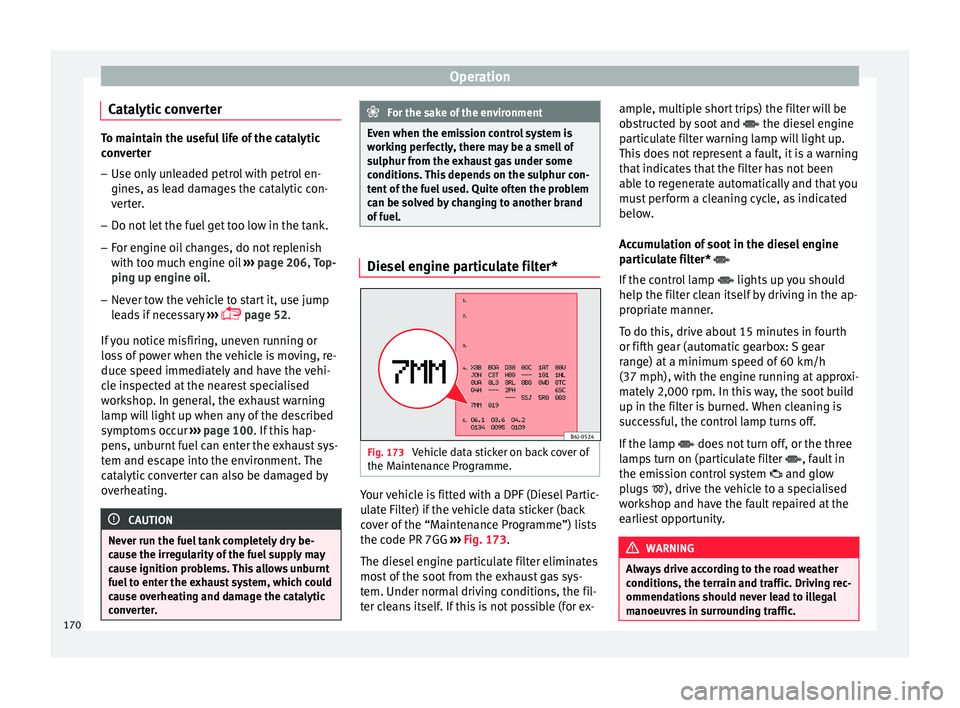
e Programme. Your vehicle is fitted with a DPF (Diesel Partic-
u
l
at e Fi
lter) if the vehicle data sticker (back
cover of the “Maintenance Programme”) lists
the code PR 7GG ››› Fig. 173.
The diesel engine particulate filter eliminates
most of the soot from the exhaust gas sys-
tem. Under normal driving conditions, the fil-
ter cleans itself. If this is not possible (for ex- ample, multiple short trips) the filter will be
obstruct
ed by soot and the diesel engine
particulate filter warning lamp will light up.
This does not represent a fault, it is a warning
that indicates that the filter has not been
able to regenerate automatically and that you
must perform a cleaning cycle, as indicated
below.
Accumulation of soot in the diesel engine
particulate filter*
If the control lamp lights up you should
help the filter clean itself by driving in the ap-
propriate manner.
To do this, drive about 15 minutes in fourth
or fifth gear (automatic gearbox: S gear
range) at a minimum speed of 60 km/h
(37 mph), with the engine running at approxi-
mately 2,000 rpm. In this way, the soot build
up in the filter is burned. When cleaning is
successful, the control lamp turns off.
If the lamp does not turn off, or the three
lamps turn on (particulate filter , fault in
the emission control system and glow
plugs ), drive the vehicle to a specialised
workshop and have the fault repaired at the
earliest opportunity. WARNING
Always drive according to the road weather
conditions, the t err
ain and traffic. Driving rec-
ommendations should never lead to illegal
manoeuvres in surrounding traffic. 170
Page 173 of 252
Driving
CAUTION
● Your v ehic
le is not designed to use biodie-
sel fuel. Never, under any circumstances re-
fuel with biodiesel. The use of biodiesel fuel
could damage the engine and the fuel sys-
tem. The addition of biodiesel to diesel by
the diesel producer in accordance with stand-
ard EN 590 is authorised and will not cause
damage to the engine or the fuel system.
● Using diesel fuel with a high sulphur con-
tent ma
y significantly reduce the useful life of
the diesel particulate filter. Your Technical
Service will be able to tell you which coun-
tries have diesel with a high sulphur content. Engine management*
This warning lamp monitors the engine man-
ag
ement
sys
tem for petrol engines.
The warning lamp (Electronic Power Con-
trol) lights up when the ignition is switched
on while system operation is being verified. It
should go out once the engine is started.
If there is a fault in the electronic engine
management system while you are driving,
this warning lamp will light up. Take the vehi-
cle to a specialised workshop as soon as
possible and have the engine checked. Emission control system* Control lamp
flashes:
When ther
e is misfiring that can damage the
catalytic converter. Reduce speed and drive
carefully to the nearest specialised workshop
to have the engine checked.
The control lamp lights up:
If a fault has developed during driving which
has reduced the quality of the exhaust gas
(e.g. lambda probe fault). Reduce speed and
drive carefully to the nearest specialised
workshop to have the engine checked.
Engine pre-heating/fault system* The warning lamp lights up to show that the
glo
w p
lugs
are preheating the diesel engine.
The control lamp lights up
If the control lamp lights up when the en-
gine is started it means that the glow plugs
are preheating. The engine can be started
straight away when the lamp switches off.
Control lamp flashes
If a fault develops in the engine management
system while you are driving, the glow plug
system lamp will flash . Take the vehicle to
a specialised workshop as soon as possible
and have the engine checked. Driving tips
Driving abro
ad To drive abroad, the following must be taken
into con
s
ideration:
● For vehicles fitted with a catalytic converter
ensure th
at unleaded petrol is available for
the journey. See the chapter “Refuelling”. Au-
tomobile organisations will have information
about service station networks selling unlea-
ded fuel.
● In some countries, it is possible that your
car model i s
not sold, and therefore some
spare parts are not available or the technical
services may only be able to carry out limited
repairs.
SEAT importers and distributors will gladly
provide information about the technical prep-
aration that your vehicle requires and also
about necessary maintenance and repair
possibilities.
Adhesive strips for headlights
In countries where vehicles drive on the other
side of the road to your home country, the
asymmetric dipped beam may dazzle drivers
of oncoming vehicles. »
171
Technical data
Advice
Operation
Emergencies
Safety