check oil Seat Mii 2012 User Guide
[x] Cancel search | Manufacturer: SEAT, Model Year: 2012, Model line: Mii, Model: Seat Mii 2012Pages: 308, PDF Size: 4.13 MB
Page 188 of 308
186In the engine compartment
The correct oil must be used to ensure the correct operation and long serv-
ice life of the engine. The engine comes with a high-quality multigrade oil
that can generally be used all year round.
Only use an engine oil that complies to SEAT standards whenever possible
⇒
. Only refill engine oil using approved engine oil in accordance with the
corresponding SEAT standard ( ⇒ table on page 186). All oils indicated are
synthetic multigrade oils .
Engine oils are being continuously further developed. Technical Services
are permanently informed of any modifications. SEAT therefore recommends
that you have the engine oil changed by a Technical Service.
EnginesSpecifications of engine oil with a service dependent on time/dis- tance travelled
44 kW - 55 kW Petrol enginesVW 504 00, VW 502 00
CAUTION
● Only use engine oils whose specifications are expressly approved by
SEAT. The use of any other type of engine oil could cause engine damage!
● No additives should be used with engine oil. Any damage caused by the
use of such additives would not be covered by the factory warranty. Checking the engine oil level and topping up
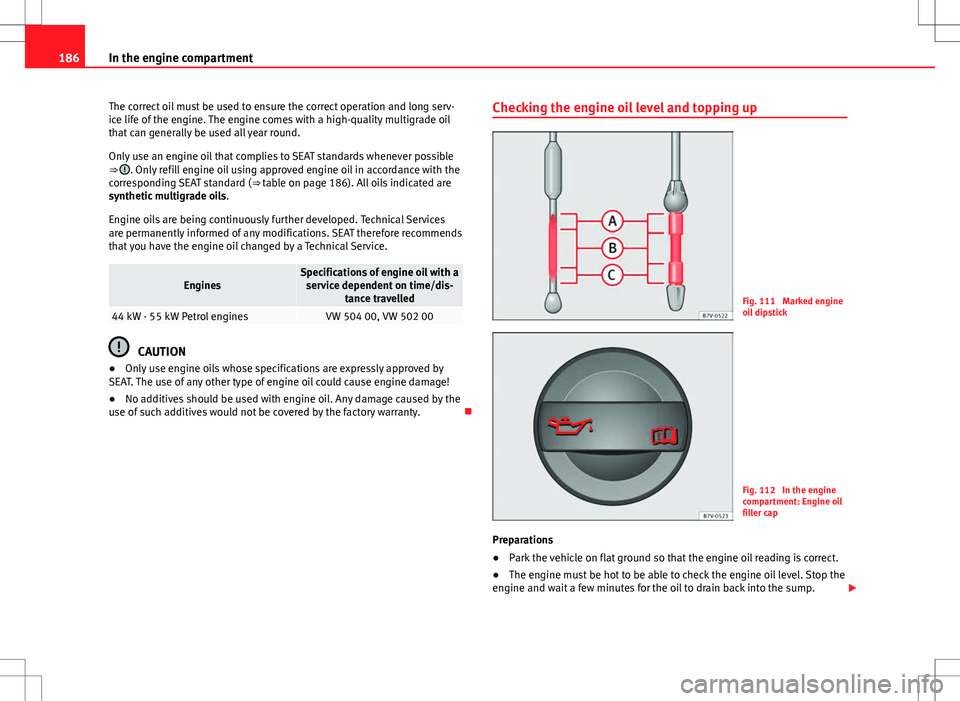
Fig. 111 Marked engine
oil dipstick
Fig. 112 In the engine
compartment: Engine oil
filler cap
Preparations
● Park the vehicle on flat ground so that the engine oil reading is correct.
● The engine must be hot to be able to check the engine oil level. Stop the
engine and wait a few minutes for the oil to drain back into the sump.
Page 189 of 308
187
In the engine compartment
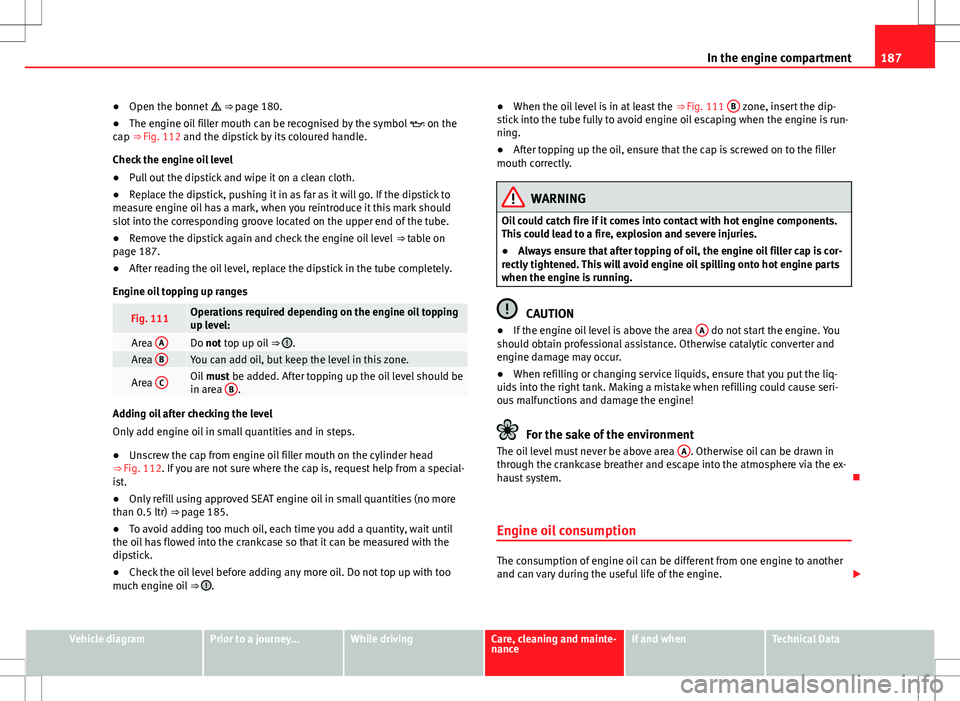
● Open the bonnet ⇒ page 180.
● The engine oil filler mouth can be recognised by the symbol on the
cap ⇒ Fig. 112 and the dipstick by its coloured handle.
Check the engine oil level
● Pull out the dipstick and wipe it on a clean cloth.
● Replace the dipstick, pushing it in as far as it will go. If the dipstick to
measure engine oil has a mark, when you reintroduce it this mark should
slot into the corresponding groove located on the upper end of the tube.
● Remove the dipstick again and check the engine oil level ⇒ table on
page 187.
● After reading the oil level, replace the dipstick in the tube completely.
Engine oil topping up ranges
Fig. 111Operations required depending on the engine oil topping
up level:
Area ADo not top up oil
⇒ .Area BYou can add oil, but keep the level in this zone.
Area COil
must be added. After topping up the oil level should be
in area B.
Adding oil after checking the level
Only add engine oil in small quantities and in steps.
●
Unscrew the cap from engine oil filler mouth on the cylinder head
⇒ Fig. 112. If you are not sure where the cap is, request help from a special-
ist.
● Only refill using approved SEAT engine oil in small quantities (no more
than 0.5 ltr) ⇒ page 185.
● To avoid adding too much oil, each time you add a quantity, wait until
the oil has flowed into the crankcase so that it can be measured with the
dipstick.
● Check the oil level before adding any more oil. Do not top up with too
much engine oil ⇒
. ●
When the oil level is in at least the ⇒ Fig. 111 B
zone, insert the dip-
stick into the tube fully to avoid engine oil escaping when the engine is run-
ning.
● After topping up the oil, ensure that the cap is screwed on to the filler
mouth correctly.
WARNING
Oil could catch fire if it comes into contact with hot engine components.
This could lead to a fire, explosion and severe injuries.
● Always ensure that after topping of oil, the engine oil filler cap is cor-
rectly tightened. This will avoid engine oil spilling onto hot engine parts
when the engine is running.
CAUTION
● If the engine oil level is above the area A do not start the engine. You
should obtain professional assistance. Otherwise catalytic converter and
engine damage may occur.
● When refilling or changing service liquids, ensure that you put the liq-
uids into the right tank. Making a mistake when refilling could cause seri-
ous malfunctions and damage the engine!
For the sake of the environment
The oil level must never be above area A. Otherwise oil can be drawn in
through the crankcase breather and escape into the atmosphere via the ex-
haust system.
Engine oil consumption
The consumption of engine oil can be different from one engine to another
and can vary during the useful life of the engine.
Vehicle diagramPrior to a journey...While drivingCare, cleaning and mainte-
nanceIf and whenTechnical Data
Page 190 of 308

188In the engine compartment
Depending on how you drive and the conditions in which the vehicle is
used, oil consumption can be up to 1 ltr./2000 km. In the case of new vehi-
cles, the consumption can exceed this figure over 5000 kilometres. For this
reason the engine oil level must be checked at regular intervals, preferably
when filling the tank and before a journey.
When the engine is working hard, for instance during sustained high-speed
motorway cruising in summer, or when climbing mountain passes, the oil
level should preferably be kept within area ⇒ Fig. 111 A
.
Changing the engine oil
The engine oil must be changed regularly according to the specifications of
the Maintenance Programme.
Due to the problems linked with disposing of used oil and the need for suit-
able tools and special knowledge, always visit a Specialised workshop to
have the engine oil and filter changed. SEAT recommends visiting a Techni-
cal Service.
Detailed information on the service intervals are shown in the Maintenance
Programme.
Engine oil additives make new oil darker after the engine has been running
for a short period. This is normal and does not mean more frequent oil
changes are required.
WARNING
If, in exceptional circumstances, you must change the engine oil yourself,
please note the following:
● Wear eye protection.
WARNING (Continued)
● Always wait until the engine has completely cooled to avoid being
burned.
● Always keep your arms horizontal when unscrewing the oil drainage
bolt so that the oil does not run down your arms when it begins to drain.
● Use a suitable and large enough container to collect all of the used oil
in the engine.
● Never collect engine oil in empty food containers, cans, bottles and
other containers as not all people are able to identify engine oil.
● Oil is toxic and must be kept out of the reach of children.
For the sake of the environment
Before changing the engine oil, find a suitable location or service for proper
disposal.
For the sake of the environment
Always dispose of engine oil with the utmost respect for the environment.
Never dispose of used engine oil in places such as a garden, woods, drains,
roads, paths, rivers and drainage systems.
Page 200 of 308

198Vehicle care and maintenance
For the sake of the environment
The remains of vehicle care products should not be disposed of with ordina-
ry household waste. Observe information provided by the manufacturer.
Washing the vehicle
The longer substances such as insects, bird droppings, resinous tree sap,
road dirt, industrial deposits, tar, soot or road salt and other aggressive ma-
terials remain on the vehicle, the more damage they do to the paintwork.
High temperatures (for instance due to strong sunlight) further intensify the
corrosive effect. The vehicle undercarriage should also be thoroughly wash-
ed at regular intervals.
Automatic car washes
Always observe the instructions provided at the automatic car wash. The
standard precautionary measures prior to entering the car wash should be
taken to avoid damage to the vehicle (close all windows, fold in exterior mir-
rors). If the vehicle is fitted with additional components (spoiler, roof-rack,
aerial...), check with the car wash supervisor whether these can enter the
car wash ⇒
.
The vehicle paintwork is so durable that the vehicle can normally be washed
without problems in an automatic car washing tunnel. However, wear and
damage to the paintwork will depend on the type of car wash used. SEAT
recommends the use of car washes without brushes.
To remove traces of wax on windows and to prevent wiper blades from
scratching, please observe the following ⇒ page 200, Cleaning windows
and exterior mirrors.
Washing the vehicle by hand
When washing the vehicle by hand, use plenty of water to soften the dirt
first, and rinse off as well as possible. Then clean the vehicle with a soft
sponge, glove or brush using only slight
pressure. Start at the roof and work downwards. Special vehicle shampoo
should only be used for very persistent dirt.
Rinse the sponge or glove thoroughly and often.
Wheels, sills and similar should be cleaned last. Use a second sponge for
this.
WARNING
Sharp components on the vehicle may cause injury.
● Protect arms and hands from sharp edges when cleaning the vehicle
undercarriage or the interior of the wheel hubs.
WARNING
After the vehicle has been washed, the braking effect will be reduced
(and the braking distance increased) due to moisture (and ice in winter)
on the brakes.
● “Dry the brakes and remove ice” by braking carefully. Ensure that you
are not endangering other road-users or breaking traffic regulations in
the process.
CAUTION
● The temperature of the water must not exceed +60 °C (+140 °F).
● To avoid damage to the paintwork, do not wash the vehicle in full sun.
● Do not use rough sponges or similar which could damage the surface to
clean away the traces of insects.
● Never wipe the headlights with a dry cloth or sponge, always moisten
first. It is best to use soapy water.
● Washing the vehicle in low temperatures: When washing the vehicle
with a hose, do not direct water into the lock cylinders or the gaps around
the doors, rear lid, or sunroof. Locks and seals could freeze!
Page 213 of 308

211
Vehicle care and maintenance
About your tyres and wheels
Fig. 120 Diagram for
changing wheels
The tyres of a vehicle are the components which are subjected to most
stress and are the most underestimated. Tyres are very important, as the
support offered by their narrow surface is the only point of contact between
the vehicle and the road.
The service life of tyres is dependent on tyre pressure, driving style, the care
they receive and the correct fitting.
The tyres and wheel rims are an essential part of the vehicle's design. The
tyres and rims approved by SEAT are specially matched to the characteris-
tics of the vehicle and our critical to good road holding and safe handling.
Avoiding damage to tyres and wheels
● If you have to drive over a kerb or similar obstacle, drive very slowly and
as near as possible at a right angle to the kerb.
● Inspect the tyres regularly for damage (punctures, cuts, cracks, dents).
● Remove any foreign bodies found on the outside of the tread provided
they have not passed through the wall of the tyre
⇒ page 216.
● The instructions for tyre control systems should always be observed. ●
Replace damaged or worn tyres as soon as possible ⇒ page 216.
● Regularly check tyres for non-visible damage ⇒ page 216.
● Never exceed the maximum permitted speed or loads specified for the
type of tyre fitted on your vehicle ⇒ page 218.
● Do not allow tyres (including the spare wheel) to come into contact with
aggressive substances, grease, oil, fuel or brake fluid ⇒
.
● Lost valve caps should be replaced immediately.
Tyres with directional tread pattern
Tyres with directional tread pattern have been designed to operate best
when rotating in only one direction. An arrow on the tyre sidewall indicates
the direction of rotation on tyres with directional tread ⇒ page 218. Always
observe the direction of rotation indicated when mounting the wheel. This
guarantees optimum grip and helps to avoid aquaplaning, excessive noise
and wear.
If the tyre is mounted in the opposite direction of rotation, drive with ex-
treme caution, as the tyre is no longer being used correctly. This is of partic-
ular importance when the road surface is wet. Change the tyre as soon as
possible or remount it with the correct direction of rotation.
Interchanging tyres
To ensure that the wear is equal on all tyres the wheels should be changed
round from time to time according to the system ⇒ Fig. 120. All the tyres will
then last for about the same time.
SEAT recommends you take the vehicle to a Specialised workshop to have
the tyres changed.
Tyres that are over 6 years old
Tyres are subject to an ageing process as a result of physical and chemical
processes. This may affect their performance. Tyres which are stored for
long periods of time without being used, harden and become more fragile
than tyres which are in constant use.
SEAT recommends that tyres over six years old are replaced with new tyres.
This also applies to tyres (including the spare wheel) which appear to be in
Vehicle diagramPrior to a journey...While drivingCare, cleaning and mainte-
nanceIf and whenTechnical Data
Page 234 of 308

232Vehicle care and maintenance
CAUTION
● Never raise the vehicle at the engine oil sump, the gearbox or the rear or
front axles.
● Always use an intermediate rubber support to prevent damage to the
vehicle underbody. Check that the arms of the lifting platform are able to
move with obstruction.
● The arms should not come into contact with the side running boards or
other parts of the vehicle.
Page 238 of 308

236Vehicle care and maintenance
Engine management and exhaust gas
purification system
Introduction
Additional information and warnings:
● Changing gear ⇒ page 124
● Refuelling ⇒ page 171
● Fuel ⇒ page 177
● Engine oil ⇒ page 185
● Vehicle battery ⇒ page 193
● Information stored in the control units ⇒ page 222
● Tow-starting and towing away ⇒ page 276
WARNING
The components of the exhaust system reach very high temperatures.
This could cause a fire.
● Always park your vehicle so that no part of the exhaust system can
come in contact with flammable materials (such as dried grass).
● Never apply additional underseal or anti-corrosion coatings to the ex-
haust pipes, catalytic converter or the heat shields on the exhaust sys-
tem.
Control lamps
lights
upPossible causeSolution
Fault in engine management
(Electronic Power Control).Take the vehicle to a Specialised
workshop as soon as possible
and have the engine checked.
Fault in catalytic converter.
You should reduce speed accord-
ingly. Drive carefully until you
reach the next Specialised work-
shop. Have the engine checked
there.
flashesPossible causeSolution
Combustion fault which could
damage the catalytic convert-
er.You should reduce speed accord-
ingly. Drive carefully until you
reach the next Specialised work-
shop. Have the engine checked
there.
Several warning and control lamps light up for a few seconds when the igni-
tion is switched on while a test of the function is being carried out. They will
switch off after a few seconds.
CAUTION
Always pay attention to any lit lamps and to the corresponding descriptions
and instructions to avoid damage to the vehicle.
Note
While the control lamps or maintain lit up, the engine will present
faults, a higher consumption of fuel and a loss of engine power.
Page 254 of 308

252Practical information
If the wheel bolt is very tight, you may be able to loosen it by pushing down
on the end of the wheel brace carefully with your foot. Hold on to the vehicle
for support and take care not to slip.
Loosening wheel bolts
● Fit the wheel brace as far as it will go over the wheel bolt ⇒ Fig. 141.
● Hold the wheel brace at the end and rotate the bolt approximately one
turn anticlockwise ⇒
.
Loosening anti-theft wheel bolts
For wheels with full hubcap, the anti-theft wheel lock must be threaded into
position ⇒ Fig. 142 2
before mounting the hubcap. Otherwise it will not be
possible to mount the full hubcap.
● Take the adapter for anti-theft wheel bolts out of the vehicle tool kit.
● Insert the adapter onto the wheel bolt ⇒ Fig. 142. Push it on as far as it
will go.
● Fit the wheel brace onto the adapter as far as possible.
● Hold the wheel brace at the end and rotate the bolt approximately one
turn anticlockwise ⇒
.
Important information about wheel bolts
The wheel rims and bolts have been designed to be fitted to factory op-
tions. If different rims are fitted, the correct wheel bolts with the right length
and correctly shaped bolt heads must be used. This ensures that wheels are
fitted securely and that the brake system functions correctly.
In some circumstances, wheel bolts from the same model vehicle should
not be used.
Wheel bolt tightening torque
The prescribed tightening torque for wheel bolts for steel and alloy wheels
is 110 Nm. Have the tightening torque of the wheel bolts checked as soon
as possible with a reliable torque wrench. If wheel bolts are rusty and it is difficult to tighten them, the threads should
be replaced and cleaned before checking the tightening torque.
Never grease or lubricate wheel bolts or the wheel hub threads. Although
they have been tightened to the prescribed torque, they could come loose
while driving.
WARNING
If the wheel bolts are not fitted correctly they could be released while
driving leading to loss of vehicle control and serious damage.
● Only use wheel bolts which correspond to the wheel rims in question.
● Never use different wheel bolts.
● The bolts and threads should be clean, free of oil and grease and easy
to thread.
● To loosen and tighten the wheel bolts, always use the wheel brace
supplied with the vehicle.
● Loosen the wheel bolts only about one turn before raising the vehicle
with the jack.
● Never grease or lubricate wheel bolts or the wheel hub threads. Al-
though they have been tightened to the prescribed torque, they could
come loose while driving.
● Never loosen the bolted joints of wheel trims with bolted ring trims.
● If the wheel bolts are not tightened to the correct torque, they may
come loose while driving, and the bolts and rims may come out. If the
tightening torque is too high, the wheel bolts and threads can be dam-
aged.
Page 257 of 308

255
Practical information
Changing a wheel
Fig. 145 Changing the
wheel: loosen wheel
bolts with the socket at
the end of the wheel
brace
Removing the wheel
● Please observe the check list ⇒ page 251.
● Loosen the wheel bolts ⇒ page 251.
● Jacking up the vehicle ⇒ page 253.
● Using the hexagonal socket in the wheel brace ⇒ Fig. 145, unscrew the
slackened wheel bolts and place them on a clean surface.
● Take off the wheel.
How to use the spare wheel or temporary spare wheel
Check the direction of rotation of the tyre ⇒ page 218, Tyre code.
● Place the spare wheel or temporary spare wheel into position.
● Replace the wheel bolts and tighten slightly using the hexagonal socket
on the end of the wheel brace.
● To tighten the anti-theft locking wheel bolts use the corresponding
adaptor.
● Lower the vehicle with the jack. ●
Tighten all of the wheel bolts clockwise ⇒
. Tighten the bolts in diago-
nal pairs (not in a circle).
● Put the caps, trim or full hubcap back on ⇒ page 248.
WARNING
If the wheel bolts are not treated suitably or not tightened to the correct
torque then this could lead to loss of vehicle control and to a serious ac-
cident.
● All the wheel bolts and hub threads should be clean and free of oil
and grease. The wheel bolts should be easily tightened to the correct tor-
que.
● The hexagonal socket in the wheel brace should be used for turning
wheel bolts only. Do not use it to loosen or tighten the wheel bolts.
After changing the wheel
● Clean the vehicle tools, if necessary and put them away in the luggage
compartment foam holder ⇒ page 246.
● Store the spare wheel, the temporary spare wheel or the changed wheel
securely in the luggage compartment.
● Have the tightening torque of the wheel bolts checked as soon as possi-
ble with a torque wrench ⇒ page 252.
● Have the flat tyre replaced as quickly as possible.
Vehicle diagramPrior to a journey...While drivingCare, cleaning and mainte-
nanceIf and whenTechnical Data
Page 295 of 308

Changing gear . . . . . . . . . . . . . . . . . . . . . . . . . 124Automatic gearbox . . . . . . . . . . . . . . . . . . . 129
Engaging gears (automatic gearbox) . . . . 129
Engaging gears (manual gearbox) . . . . . . 128
Manual gearbox . . . . . . . . . . . . . . . . . . . . . 128
Warning and control lamps . . . . . . . . . . . . 125
with Tiptronic . . . . . . . . . . . . . . . . . . . . . . . 130
Changing gears Gear recommendation . . . . . . . . . . . . . . . . 132
Changing the bulbs Side turn signal . . . . . . . . . . . . . . . . . . . . . 271
Changing the wheel After changing the wheel . . . . . . . . . . . . . . 255
Chassis number . . . . . . . . . . . . . . . . . . . . . . . . 281
Checking Tyre pressures . . . . . . . . . . . . . . . . . . . . . . . 215
Checking the oil level . . . . . . . . . . . . . . . . . . . . 186
Checklist Before working in the engine compart-ment . . . . . . . . . . . . . . . . . . . . . . . . . . . . . 182
Changing bulbs . . . . . . . . . . . . . . . . . . . . . 265
In case of an emergency . . . . . . . . . . . . . . 240
Check list Journey preparations . . . . . . . . . . . . . . . . . . 25
Preparations for changing a wheel . . . . . . 251
Raising the vehicle with the jack . . . . . . . . 254
Checklist Refuelling precautions . . . . . . . . . . . . . . . . 176
Check list Safe driving . . . . . . . . . . . . . . . . . . . . . . . . . 25 Checklist
Seat belts . . . . . . . . . . . . . . . . . . . . . . . . . . . 61
Tire Mobility Set . . . . . . . . . . . . . . . . . . . . . 258
Transporting children in the vehicle . . . . . . 77
Check list Upholstery . . . . . . . . . . . . . . . . . . . . . . . . . 206
Child safety seat Securing with seat belt . . . . . . . . . . . . . . . . 80
Child seat ISOFIX child seat on rear seats . . . . . . . . . . 80
Mounting child seats . . . . . . . . . . . . . . . . . . 78
Mounting systems . . . . . . . . . . . . . . . . . . . . 79
On rear seats . . . . . . . . . . . . . . . . . . . . . . . . 80
On the front passenger seat . . . . . . . . . . . . 79
Regulations . . . . . . . . . . . . . . . . . . . . . . . . . . 77
Securing using a Top Tether retaining strap 83
Securing using ISOFIX . . . . . . . . . . . . . . . . . 81
Securing using LATCH . . . . . . . . . . . . . . . . . 81
Transporting children in the vehicle . . . . . . 77
Weight categories . . . . . . . . . . . . . . . . . . . . 77
Child seats . . . . . . . . . . . . . . . . . . . . . . . . . . . . . 76 Disabling the front passenger airbag . . . . . 73
Chromework care . . . . . . . . . . . . . . . . . . . . . . . 202
Cigarette lighter . . . . . . . . . . . . . . . . . . . . . . . . 115
City Safety Assist function . . . . . . . . . . . . . . . . 155 Control lamp . . . . . . . . . . . . . . . . . . . . . . . . 156
Function . . . . . . . . . . . . . . . . . . . . . . . . . . . 158
Sensor . . . . . . . . . . . . . . . . . . . . . . . . . . . . . 157
Special driving situations . . . . . . . . . . . . . 159
Warning lamp . . . . . . . . . . . . . . . . . . . . . . . 156
Cleaning dash panel . . . . . . . . . . . . . . . . . . . . . . . . . 208
Engine compartment . . . . . . . . . . . . . . . . . 204 Seat belts . . . . . . . . . . . . . . . . . . . . . . . . . . 208
See "Care of your vehicle" . . . . . . . . . . . . . 197
wheel rims . . . . . . . . . . . . . . . . . . . . . . . . . 203
Windscreen wiper blades . . . . . . . . . . . . . 201
Clock . . . . . . . . . . . . . . . . . . . . . . . . . . . . . . . . . . 18
Close Sliding/tilting electric panoramic sunroof . 44
Closing Doors . . . . . . . . . . . . . . . . . . . . . . . . . . . . . . . 38
from the exterior . . . . . . . . . . . . . . . . . . . . . . 34
from the inside . . . . . . . . . . . . . . . . . . . . . . . 36
Rear lid . . . . . . . . . . . . . . . . . . . . . . . . . . . . . 41
Windows . . . . . . . . . . . . . . . . . . . . . . . . . . . . 43
Coat hooks . . . . . . . . . . . . . . . . . . . . . . . . . . . . 112
Code number . . . . . . . . . . . . . . . . . . . . . . . . . . 247
Collection of end-of-life vehicles . . . . . . . . . . . 235
Compartments Centre console . . . . . . . . . . . . . . . . . . . . . . 109
Glove compartment . . . . . . . . . . . . . . 110, 111
Other storage compartments . . . . . . . . . . 112
Passenger side . . . . . . . . . . . . . . . . . . 110, 111
Sunglasses storage compartment . . . . . . 110
Components . . . . . . . . . . . . . . . . . . . . . . . . . . . 224
Conformity certification . . . . . . . . . . . . . . . . . . 234
Consumer disconnection . . . . . . . . . . . . . . . . . 196
Consumption How it is determined . . . . . . . . . . . . . . . . . 282
Information . . . . . . . . . . . . . . . . . . . . . . . . . 282
control lamp on the driver door . . . . . . . . . . . . . . . . . . . . . 37
Vehicle key . . . . . . . . . . . . . . . . . . . . . . . . . . 30
293
Index