airbag Seat Mii 2017 Owner's manual
[x] Cancel search | Manufacturer: SEAT, Model Year: 2017, Model line: Mii, Model: Seat Mii 2017Pages: 232, PDF Size: 4.91 MB
Page 3 of 232
Foreword
Thi s
In
struction Manual and its correspond-
ing supplements should be read carefully to
familiarise yourself with your vehicle.
Besides the regular care and maintenance of
the vehicle, its correct handling will help pre-
serve its value.
For safety reasons, always note the informa-
tion concerning accessories, modifications
and part replacements.
If selling the vehicle, give all of the on-board
documentation to the new owner, as it
should be kept with the vehicle.
You can access the information in this man-
ual using:
● Thematic table of contents that follows the
manual’s g
eneral chapter structure.
● Visual table of contents that uses graphics
to indicat
e the pages containing “essential”
information, which is detailed in the corre-
sponding chapters.
● Alphabetical index with many terms and
synonyms
to help you find information. WARNING
Read and always observe safety informa-
tion conc ernin
g the passenger's front air-
bag ››› page 64, Important information
regarding the front passenger's airbag .
Thank you for trusting in us.
We wish you safe and enjoya-
ble motoring.
SEAT, S.A.
Page 5 of 232
Table of Contents
Table of Contents
The e s
senti
als . . . . . . . . . . . . . . . . . . . . . . . . 5
Exterior view . . . . . . . . . . . . . . . . . . . . . . . . . . . . 5
Exterior view . . . . . . . . . . . . . . . . . . . . . . . . . . . . 6
Interior view (left guide) . . . . . . . . . . . . . . . . . . 7
How it works . . . . . . . . . . . . . . . . . . . . . . . . . . . . 8
Unlocking and locking . . . . . . . . . . . . . . . . . . . . 8
Before driving . . . . . . . . . . . . . . . . . . . . . . . . . . . 12
Airbags . . . . . . . . . . . . . . . . . . . . . . . . . . . . . . . . 14
Child seats . . . . . . . . . . . . . . . . . . . . . . . . . . . . . 16
Starting the vehicle . . . . . . . . . . . . . . . . . . . . . . 20
Lights and visibility . . . . . . . . . . . . . . . . . . . . . . 21
SEAT information system . . . . . . . . . . . . . . . . . . 23
Cruise control . . . . . . . . . . . . . . . . . . . . . . . . . . . 24
Warning lamps . . . . . . . . . . . . . . . . . . . . . . . . . . 25
Gearbox lever . . . . . . . . . . . . . . . . . . . . . . . . . . . 26
Air conditioning . . . . . . . . . . . . . . . . . . . . . . . . . 28
Fluid Level control . . . . . . . . . . . . . . . . . . . . . . . 31
Emergencies . . . . . . . . . . . . . . . . . . . . . . . . . . . . 34
Fuses . . . . . . . . . . . . . . . . . . . . . . . . . . . . . . . . . . 34
Bulbs . . . . . . . . . . . . . . . . . . . . . . . . . . . . . . . . . . 35
Action in the event of a puncture . . . . . . . . . . . 35
Changing a wheel . . . . . . . . . . . . . . . . . . . . . . . 36
Snow chains . . . . . . . . . . . . . . . . . . . . . . . . . . . . 41
Emergency towing of the vehicle . . . . . . . . . . . 42
How to jump start . . . . . . . . . . . . . . . . . . . . . . . . 43
Changing the wiper blades . . . . . . . . . . . . . . . . 45
Safety . . . . . . . . . . . . . . . . . . . . . . . . . . . . . . . . 47
Safe driving . . . . . . . . . . . . . . . . . . . . . . . . . . . . 47
Safety first! . . . . . . . . . . . . . . . . . . . . . . . . . . . . . 47
Driving advice . . . . . . . . . . . . . . . . . . . . . . . . . . . 47
Correct position of the vehicle occupants . . . . 48
Pedal area . . . . . . . . . . . . . . . . . . . . . . . . . . . . . . 51 Seat belts
. . . . . . . . . . . . . . . . . . . . . . . . . . . . . . 52
Why wear a set belt . . . . . . . . . . . . . . . . . . . . . . 52
How to properly adjust your seatbelt . . . . . . . . 56
Seat belt tensioners . . . . . . . . . . . . . . . . . . . . . . 57
Airbag system . . . . . . . . . . . . . . . . . . . . . . . . . . 58
Brief introduction . . . . . . . . . . . . . . . . . . . . . . . . 58
Airbag safety instructions . . . . . . . . . . . . . . . . . 61
Deactivating airbags . . . . . . . . . . . . . . . . . . . . . 62
Transporting children safely . . . . . . . . . . . . . . . 64
Safety for children . . . . . . . . . . . . . . . . . . . . . . . 64
Child seats . . . . . . . . . . . . . . . . . . . . . . . . . . . . . 65
Emergencies . . . . . . . . . . . . . . . . . . . . . . . . . . 70
Self-help . . . . . . . . . . . . . . . . . . . . . . . . . . . . . . . 70
In case of emergency . . . . . . . . . . . . . . . . . . . . . 70
Vehicle tool kit* . . . . . . . . . . . . . . . . . . . . . . . . . 70
Changing a wheel . . . . . . . . . . . . . . . . . . . . . . . 72
Tyre repair . . . . . . . . . . . . . . . . . . . . . . . . . . . . . . 72
Changing the windscreen wiper blades . . . . . . 75
Tow-starting and towing . . . . . . . . . . . . . . . . . . 75
Emergency locking and unlocking . . . . . . . . . . 77
Fuses and bulbs . . . . . . . . . . . . . . . . . . . . . . . . . 78
Fuses . . . . . . . . . . . . . . . . . . . . . . . . . . . . . . . . . . 78
Changing bulbs . . . . . . . . . . . . . . . . . . . . . . . . . 79
Operation . . . . . . . . . . . . . . . . . . . . . . . . . . . . . 87
General instrument panel . . . . . . . . . . . . . . . . . 87
Instrument panel . . . . . . . . . . . . . . . . . . . . . . . . 86
Instruments . . . . . . . . . . . . . . . . . . . . . . . . . . . . 88
Opening and closing . . . . . . . . . . . . . . . . . . . . . 92
Vehicle key set . . . . . . . . . . . . . . . . . . . . . . . . . . 92
Central locking* and locking system . . . . . . . . 94
Doors . . . . . . . . . . . . . . . . . . . . . . . . . . . . . . . . . . 98
Rear lid . . . . . . . . . . . . . . . . . . . . . . . . . . . . . . . . 99
Controls for the windows . . . . . . . . . . . . . . . . . . 101
Sliding/tilting electric panoramic sunroof . . . . 102 Lights and visibility
. . . . . . . . . . . . . . . . . . . . . . 103
Lights . . . . . . . . . . . . . . . . . . . . . . . . . . . . . . . . . 103
Visibility . . . . . . . . . . . . . . . . . . . . . . . . . . . . . . . 108
Windscreen wiper and window wiper sys-
tems . . . . . . . . . . . . . . . . . . . . . . . . . . . . . . . . . . 108
Mirr
or . . . . . . . . . . . . . . . . . . . . . . . . . . . . . . . . . 110
Seats and head restraints . . . . . . . . . . . . . . . . . 112
Adjusting the seat and head restraints . . . . . . 112
Seat functions . . . . . . . . . . . . . . . . . . . . . . . . . . 113
Transport and practical equipment . . . . . . . . . 114
Transporting objects . . . . . . . . . . . . . . . . . . . . . 114
Practical equipment . . . . . . . . . . . . . . . . . . . . . . 115
Luggage compartment . . . . . . . . . . . . . . . . . . . . 123
Roof carrier . . . . . . . . . . . . . . . . . . . . . . . . . . . . . 127
Air conditioning . . . . . . . . . . . . . . . . . . . . . . . . . 129
Heating, ventilation and air conditioning . . . . . 129
Driving . . . . . . . . . . . . . . . . . . . . . . . . . . . . . . . . 133
Stopping and starting the engine . . . . . . . . . . . 133
Braking and parking . . . . . . . . . . . . . . . . . . . . . 135
Changing gear . . . . . . . . . . . . . . . . . . . . . . . . . . 142
Steering . . . . . . . . . . . . . . . . . . . . . . . . . . . . . . . 147
Run-in and economical driving . . . . . . . . . . . . . 148
Engine management and exhaust gas purifica-
tion syst
em . . . . . . . . . . . . . . . . . . . . . . . . . . . . . 151
Driving tips . . . . . . . . . . . . . . . . . . . . . . . . . . . . . 152
Driver assistance systems . . . . . . . . . . . . . . . . . 153
Parking distance warning system* . . . . . . . . . . 153
Cruise control* (Cruise control system -
CCS)
. . . . . . . . . . . . . . . . . . . . . . . . . . . . . . . . . . . 155
Safety Assist* (City Safety Assist function) . . . . 156
Hill driving assistant* . . . . . . . . . . . . . . . . . . . . 160
Start-Stop System . . . . . . . . . . . . . . . . . . . . . . . . 160
Towing bracket device . . . . . . . . . . . . . . . . . . . . 163
Driving with a trailer . . . . . . . . . . . . . . . . . . . . . . 163
3
Page 16 of 232
The essentials
side (L, left) and the passenger side (R,
right) t o the dir
ection de
sired.
Depending on the equipment fitted on
the vehicle, the mirrors may be heated
according to the outside temperature.
››› in Exterior mirrors on page 111
››› page 111 Adjusting the steering wheel
Fig. 17
Mechanical steering wheel adjust-
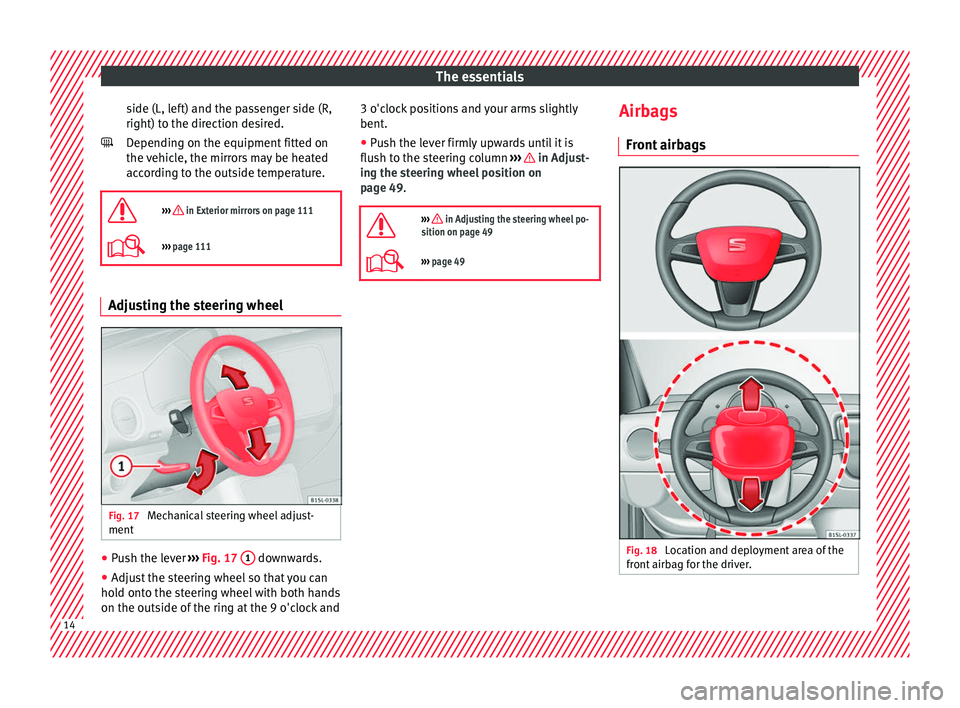
ment ●
Push the lever ››
›
Fig. 17 1 downwards.
● Adjust the steering wheel so that you can
ho ld ont
o the steering wheel with both hands
on the outside of the ring at the 9 o'clock and 3 o'clock positions and your arms slightly
bent.
●
Pu
sh the lever firmly upwards until it is
flush to the s
teering column ››› in Adjust-
in g the s
t
eering wheel position on
page 49.
››› in Adjusting the steering wheel po-
sition on page 49
››› page 49 Airbags
Fr ont
airb
ags Fig. 18
Location and deployment area of the
fr ont
airb
ag for the driver. 14
Page 17 of 232
The essentials
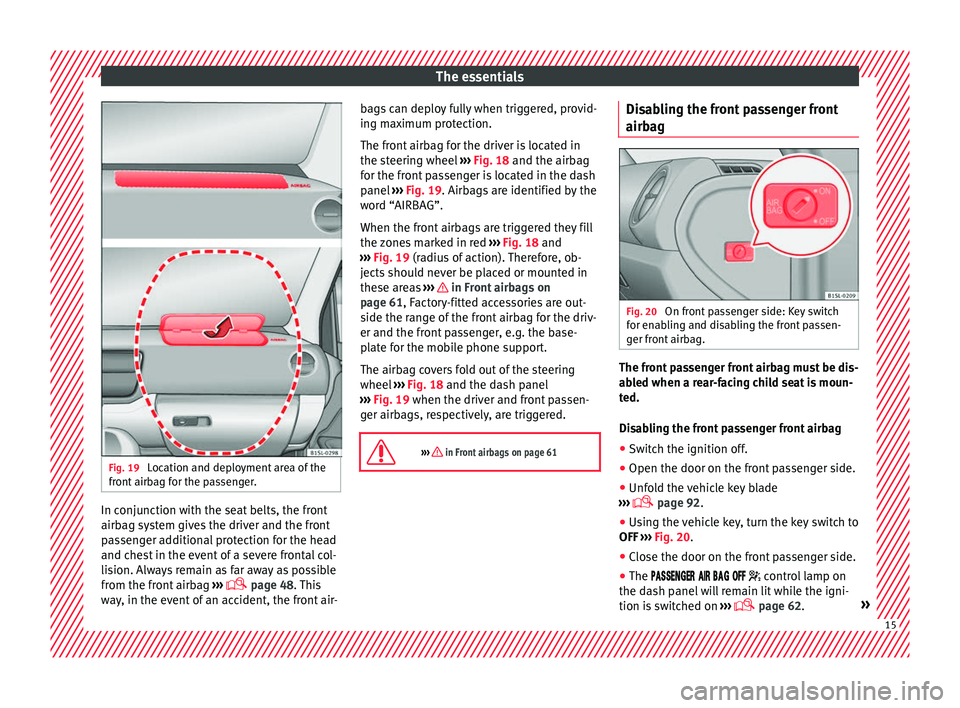
Fig. 19
Location and deployment area of the
fr ont
airb
ag for the passenger. In conjunction with the seat belts, the front
airb
ag sy
s
tem gives the driver and the front
passenger additional protection for the head
and chest in the event of a severe frontal col-
lision. Always remain as far away as possible
from the front airbag ›››
page 48. This
way, in the event of an accident, the front air- bags can deploy fully when triggered, provid-
ing max
imum protection.
The front airbag for the driver is located in
the steering wheel ››› Fig. 18 and the airbag
for the front passenger is located in the dash
panel ››› Fig. 19. Airbags are identified by the
word “AIRBAG”.
When the front airbags are triggered they fill
the zones marked in red ››› Fig. 18 and
››› Fig. 19 (radius of action). Therefore, ob-
jects should never be placed or mounted in
these areas ››› in Front airbags on
p ag
e 61
, Factory-fitted accessories are out-
side the range of the front airbag for the driv-
er and the front passenger, e.g. the base-
plate for the mobile phone support.
The airbag covers fold out of the steering
wheel ››› Fig. 18 and the dash panel
››› Fig. 19 when the driver and front passen-
ger airbags, respectively, are triggered.
››› in Front airbags on page 61 Disabling the front passenger front
airb
ag Fig. 20
On front passenger side: Key switch
f or en
ab
ling and disabling the front passen-
ger front airbag. The front passenger front airbag must be dis-
ab
l
ed when a r
ear-facing child seat is moun-
ted.
Disabling the front passenger front airbag
● Switch the ignition off.
● Open the door on the front passenger side.
● Unfold the vehicle key blade
›››
page 92.
● Using the vehicle key, turn the key switch to
OFF ›››
Fig. 20.
● Close the door on the front passenger side.
● The
control lamp on
the dash panel will remain lit while the igni-
tion is switched on ›››
page 62. » 15
Page 18 of 232
The essentials
››› in Manual disabling and enabling of
the front passenger front airbag with the
key switch on page 63
››› page 62 Side airbags
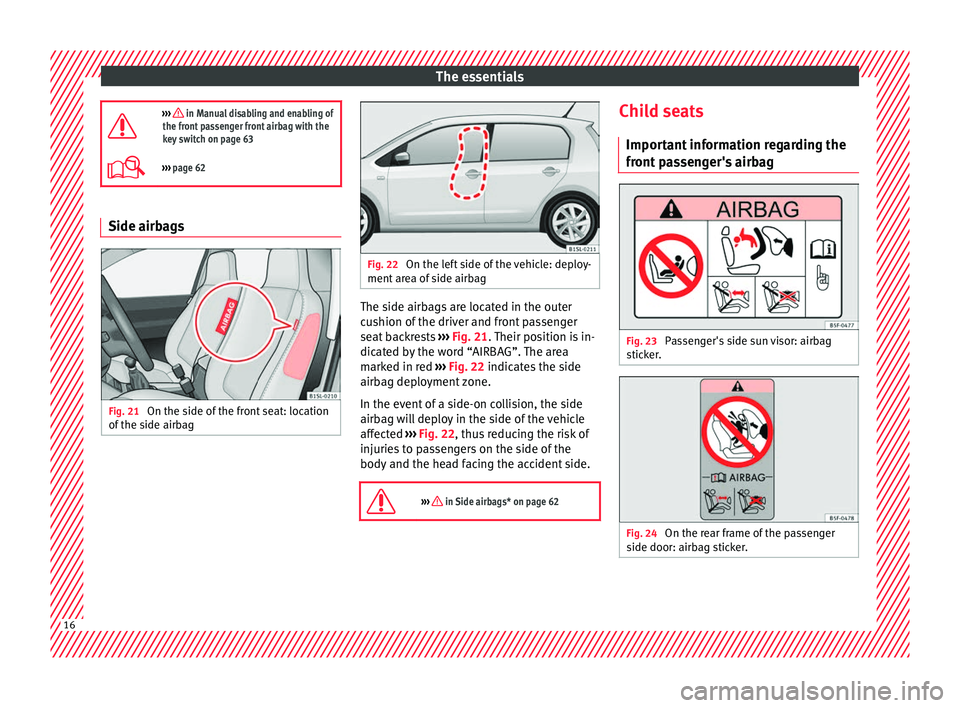
Fig. 21
On the side of the front seat: location
of the s
ide airb
ag Fig. 22
On the left side of the vehicle: deploy-
ment ar e
a of side airbag The side airbags are located in the outer
c
u
shion of
the driver and front passenger
seat backrests ››› Fig. 21. Their position is in-
dicated by the word “AIRBAG”. The area
marked in red ››› Fig. 22 indicates the side
airbag deployment zone.
In the event of a side-on collision, the side
airbag will deploy in the side of the vehicle
affected ››› Fig. 22, thus reducing the risk of
injuries to passengers on the side of the
body and the head facing the accident side.
››› in Side airbags* on page 62 Child seats
Impor t
ant
information regarding the
front passenger's airbag Fig. 23
Passenger's side sun visor: airbag
s tic
k
er. Fig. 24
On the rear frame of the passenger
s ide door: airb
ag s
ticker.16
Page 19 of 232
The essentials
A sticker with important information about
the p a
s
senger airbag is located on the pas- senger's sun visor and/or on the passenger
side door frame.
››› in Important information regarding
the front passenger's airbag on page 65
››› page 64 Mounting systems
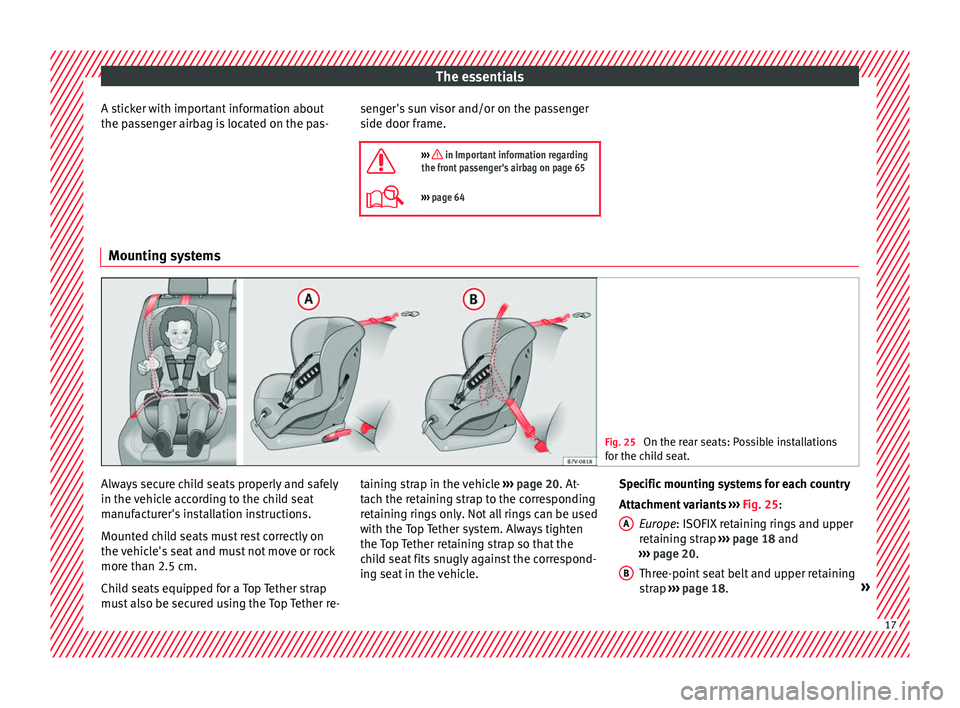
Fig. 25
On the rear seats: Possible installations
for the c hi
ld seat. Always secure child seats properly and safely
in the
v
ehic
le according to the child seat
manufacturer's installation instructions.
Mounted child seats must rest correctly on
the vehicle's seat and must not move or rock
more than 2.5 cm.
Child seats equipped for a Top Tether strap
must also be secured using the Top Tether re- taining strap in the vehicle
››› page 20. At-
tach the retaining strap to the corresponding
retaining rings only. Not all rings can be used
with the Top Tether system. Always tighten
the Top Tether retaining strap so that the
child seat fits snugly against the correspond-
ing seat in the vehicle. Specific mounting systems for each country
Attachment
variants ››› Fig. 25:
Europe: ISOFIX retaining rings and upper
retaining strap ››› page 18 and
››› page 20.
Three-point seat belt and upper retaining
strap ››› page 18. »
A B
17
Page 27 of 232
The essentials
● Re
activ
ating the CCS: Press button
››› Fig. 34 2 in
. The memorised speed
i s
saved and controlled again.
● Increasing stored speed during CCS regula-
tion: pres
s button 2 in
. The vehicle ac-
c el
erates until the new stored speed.
● Reducing stored speed during CCS regula-
tion: pres
s button 2 in t
o lower the
s peed b
y 1 km/h (1 mph). Speed is reduced
until reaching the new stored speed.
● Switching off the CCS: Move switch
›››
Fig. 34 1 to .
The system is disconnec-
t ed and the memori
sed speed is deleted.
››› in Cruise control operation on
page 156
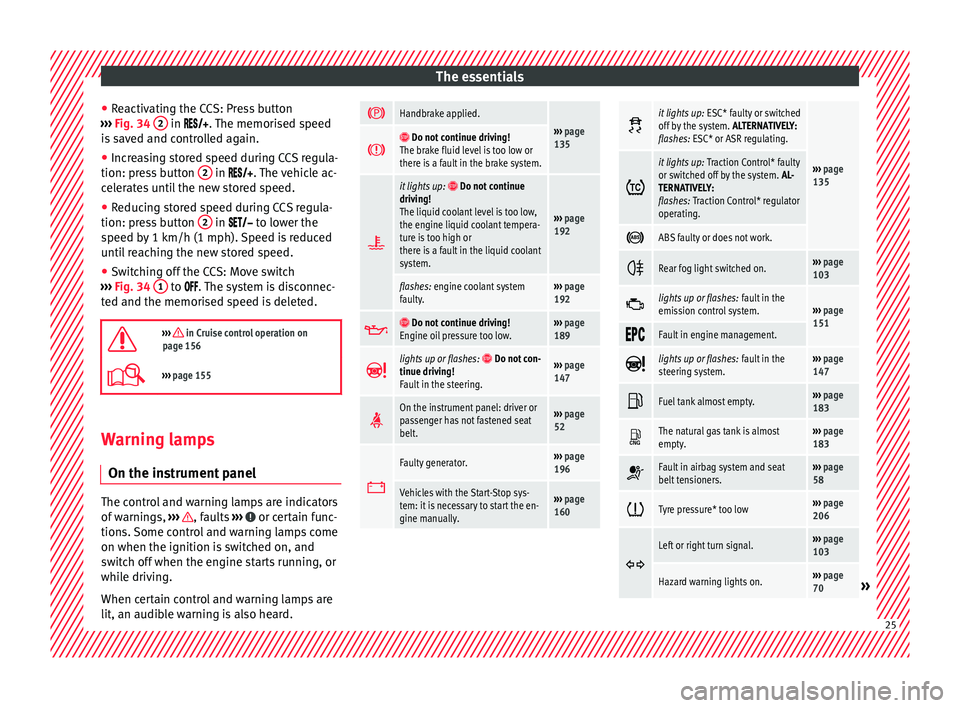
››› page 155 Warning lamps
On the in s
trument
panelThe control and warning lamps are indicators
of
w
arnin
gs, ››› , faults
››
› or certain func-
tion s.
Some c
ontrol and warning lamps come
on when the ignition is switched on, and
switch off when the engine starts running, or
while driving.
When certain control and warning lamps are
lit, an audible warning is also heard.
Handbrake applied.
›››
page
135 Do not continue driving!
The brake fluid level is too low or
there is a fault in the brake system.
it lights up:
Do not continue
driving!
The liquid coolant level is too low,
the engine liquid coolant tempera-
ture is too high or
there is a fault in the liquid coolant
system.
››› page
192
flashes: engine coolant system
faulty.››› page
192
Do not continue driving!
Engine oil pressure too low.››› page
189
lights up or flashes: Do not con-
tinue driving!
Fault in the steering.››› page
147
On the instrument panel: driver or
passenger has not fastened seat
belt.›››
page
52
Faulty generator.›››
page
196
Vehicles with the Start-Stop sys-
tem: it is necessary to start the en-
gine manually.››› page
160
it lights up:
ESC* faulty or switched
off by the system. ALTERNATIVELY:
flashes: ESC* or ASR regulating.
››› page
135 it lights up:
Traction Control* faulty
or switched off by the system. AL-
TERNATIVELY:
flashes: Traction Control* regulator
operating.
ABS faulty or does not work.
Rear fog light switched on.›››
page
103
lights up or flashes:
fault in the
emission control system.››› page
151
Fault in engine management.
lights up or flashes: fault in the
steering system.››› page
147
Fuel tank almost empty.›››
page
183
The natural gas tank is almost
empty.›››
page
183
Fault in airbag system and seat
belt tensioners.›››
page
58
Tyre pressure* too low›››
page
206
Left or right turn signal.›››
page
103
Hazard warning lights on.››› page
70» 25
Page 50 of 232
Safety
Safety equipment Never put your safety or the safety of your
pa
s
sengers in danger. In the event of an acci-
dent, the safety equipment may reduce the
risk of injury. The following points cover part
of the safety equipment in your SEAT:
● three-point seat belts,
● belt tension limiters for the front seats,
● Belt tensioners for the front seats,
● front airbags,
● side airbags in the front seat backrests,
● “ISOFIX” anchor points for child seats in
the re ar s
ide seats with the “ISOFIX” system,
● rear head restraints with in-use position
and non-use pos
ition,
● adjustable steering column.
The safety
equipment mentioned above
works together to provide you and your pas-
sengers with the best possible protection in
the event of an accident. However, these
safety systems can only be effective if you
and your passengers are sitting in a correct
position and use this equipment properly.
Safety is everyone's business! Correct position of the vehicle
occup
ants
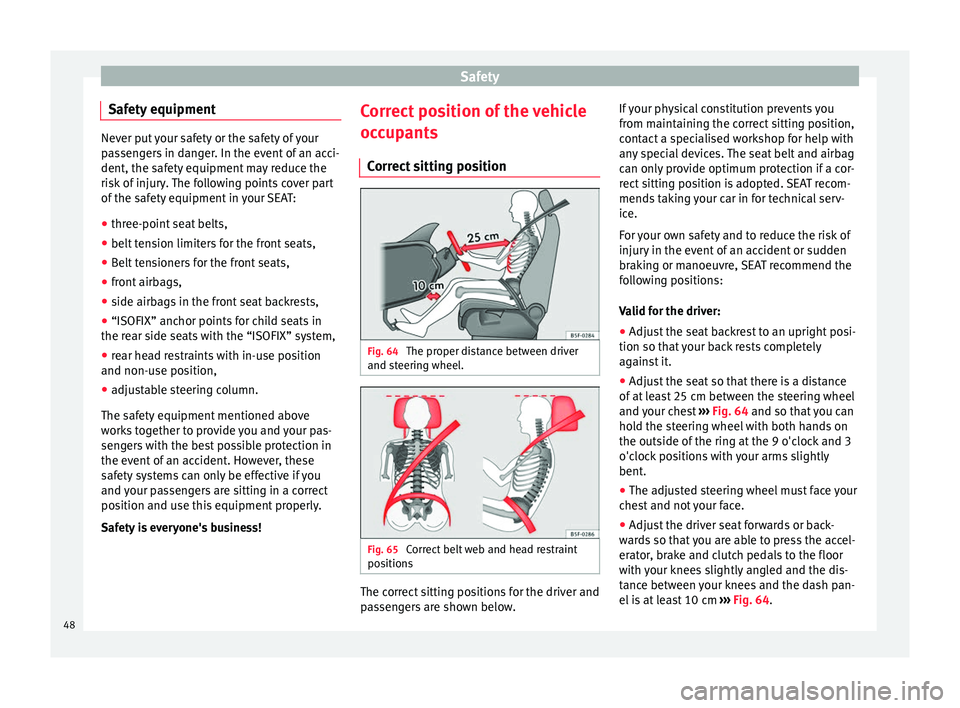
Correct sitting position Fig. 64
The proper distance between driver
and s t
eerin
g wheel. Fig. 65
Correct belt web and head restraint
po s
ition
s The correct sitting positions for the driver and
p
a
s
sengers are shown below. If your physical constitution prevents you
from maint
aining the correct sitting position,
contact a specialised workshop for help with
any special devices. The seat belt and airbag
can only provide optimum protection if a cor-
rect sitting position is adopted. SEAT recom-
mends taking your car in for technical serv-
ice.
For your own safety and to reduce the risk of
injury in the event of an accident or sudden
braking or manoeuvre, SEAT recommend the
following positions:
Valid for the driver:
● Adjust the seat backrest to an upright posi-
tion so that
your back rests completely
against it.
● Adjust the seat so that there is a distance
of at l
east 25 cm between the steering wheel
and your chest ››› Fig. 64 and so that you can
hold the steering wheel with both hands on
the outside of the ring at the 9 o'clock and 3
o'clock positions with your arms slightly
bent.
● The adjusted steering wheel must face your
ches
t and not your face.
● Adjust the driver seat forwards or back-
ward
s so that you are able to press the accel-
erator, brake and clutch pedals to the floor
with your knees slightly angled and the dis-
tance between your knees and the dash pan-
el is at least 10 cm ››› Fig. 64.
48
Page 51 of 232
Safe driving
● Adju s
t
the height of the driver seat so that
you can easily reach the top of the steering
wheel.
● Keep both feet in the footwell so that you
have the
vehicle under control at all times.
● Adjust and fasten your seat belt correctly
›››
page 52.
Valid for the passenger:
● Adjust the seat backrest to an upright posi-
tion so that
your back rests completely
against it.
● Move the front passenger seat back as far
as po
ssible for optimum protection should
the airbag deploy.
● Always keep your feet in the footwell while
the vehic
le is in motion.
● Adjust and fasten your seat belt correctly
›››
page 52.
Valid for the passengers in the rear section:
● Adjust the head restraint so that its upper
edge is
at the same level as the top of your
head, or as close as possible to the same lev-
el as the top of your head and under no cir-
cumstances below eye level. Keep the back
of your neck as close as possible to the head
restraint ››› Fig. 64 and ››› Fig. 65.
● Short people must lower the head restraint
to the fir s
t anchorage position, even if your
head is below its upper edge. ●
Tal l
people must raise the head restraint
completely.
● Always keep your feet in the footwell while
the vehic
le is in motion.
● Adjust and fasten your seat belt correctly
›››
page 52.
Adjusting the steering wheel position Read the additional information carefully
›› ›
page 14.
Adjust the steering wheel before your trip
and only when the vehicle is stationary.
Adjust the correct distance between the driv-
er and the steering wheel ››› Fig. 64 using the
controls on the driver seat ›››
page 12. WARNING
Incorrect use of the steering wheel adjust-
ment f u
nction and an incorrect adjustment of
the steering wheel can result in severe or fa-
tal injury.
● After adjusting the steering column, push
the lever firm
ly upwards to ensure the steer-
ing wheel does not accidentally change posi-
tion while driving.
● Never adjust the steering wheel while the
vehicl
e is in motion. If you need to adjust the
steering wheel while the vehicle is in motion,
stop safely and make the proper adjustment. ●
The adju s
ted steering wheel should be fac-
ing your chest and not your face so as not to
hinder the driver's front airbag protection in
the event of an accident.
● When driving, always hold the steering
wheel with both h
ands on the outside of the
ring at the 9 o'clock and 3 o'clock positions
to reduce injuries when the driver's front air-
bag deploys.
● Never hold the steering wheel at the 12
o'clock
position or in any other manner (e.g.
in the centre of the steering wheel). In such
cases, if the driver's airbag deploys, you may
sustain injuries to your arms, hands and
head. Danger of injuries due to an incorrect
s
ittin
g po
sition Number of seats
The
v
ehic
le has a total of 4 seats: 2 front
seats and 2 rear seats. Each seat is equipped
with a seat belt.
If the seat belts are worn incorrectly or not at
all, the risk of severe injuries increases. Seat
belts can provide optimal protection only if
the belt web is properly worn. Being seated
in an incorrect position means the seat belt
cannot offer its full protection. This could re-
sult in severe and even fatal injuries. The risk »
49
Technical data
Advice
Operation
Emergencies
Safety
Page 52 of 232
Safety
of severe or fatal injuries is especially height-
ened when a dep lo
y
ing airbag strikes a vehi-
cle occupant who has assumed an incorrect
sitting position. The driver is responsible for
all passengers in the vehicle, particularly
children.
The following list shows just some examples
of incorrect sitting positions which can be
dangerous to all vehicle occupants.
When the vehicle is in motion:
● Never stand in the vehicle.
● Never stand on the seats.
● Never kneel on the seats.
● Never tilt your seat backrest too far to the
rear
.
● Never lean against the dash panel.
● Never lie on the rear seats.
● Never sit on the front edge of a seat.
● Never sit sideways.
● Never lean out of a window.
● Never put your feet out of a window.
● Never put your feet on the dash panel.
● Never put your feet on the surface of a seat
or seat b
ackrest.
● Never travel in a footwell.
● Never travel on a seat without wearing the
seat belt
. ●
Never carr
y any person in the luggage com-
partment. WARNING
An incorrect sitting position in the vehicle
can l e
ad to severe injuries or death in the
event of sudden braking or manoeuvres, colli-
sion or accidents or if the airbag deploys.
● Before the vehicle moves, assume the prop-
er sitting po
sition and maintain it throughout
the trip. This also includes fastening the seat
belt.
● Never transport more people than there are
seats
with a seat belt available in the vehicle.
● Children must always be protected with an
appro
ved child restraint system suited to
their height and weight ››› page 64,
››› page 58.
● Always keep your feet in the footwell while
the vehic
le is in motion. Never, for example,
put your feet on the surface of a seat or on
the dash panel and never put them out of a
window. Otherwise the airbag and seat belt
offer insufficient protection and the risk of in-
jury in the event of an accident is increased. WARNING
Before every trip, adjust the seat, the seat
belt and the he a
d restraints and instruct your
passengers to fasten their seat belts proper-
ly.
● Move the front passenger seat back as far
as po
ssible. ●
Adjus t
the driver seat so that there is at
least 25 cm distance between your chest and
the hub of the steering wheel. Adjust the
driver seat so that you are able to press the
accelerator, brake and clutch pedals to the
floor with your knees slightly angled and that
the distance between your knees and the
dash panel is at least 10 cm. If your physical
constitution prevents you from meeting these
requirements, contact a specialised work-
shop to make any modifications required.
● Never drive with the seat backrest tilted far
back.
The further the seat backrests are tilted
to the rear, the greater the risk of injury due
to incorrect positioning of the belt web or to
the incorrect sitting position!
● Never drive with the seat backrest tilted
forw
ards. Should a front airbag deploy, it
could throw the seat backrest backwards and
injure the passengers of the rear seats.
● Sit as far away as possible from the steer-
ing wheel and the d
ash panel.
● Keep your back straight and resting com-
plet
ely against the seat backrest and the
front seats correctly adjusted. Never place
any part of your body in the area of the airbag
or very close to it.
● If passengers on the rear seats are not sit-
ting in an upright po
sition, the risk of severe
injury due to incorrect positioning of the belt
web increases. 50