service Seat Toledo 2014 Owner's Guide
[x] Cancel search | Manufacturer: SEAT, Model Year: 2014, Model line: Toledo, Model: Seat Toledo 2014Pages: 200, PDF Size: 4.37 MB
Page 59 of 200

Opening and closing
Childproof locks Fig. 40
Activating the childproof lock. The childproof lock prevents the rear doors
from being opened from the inside. Doors
can only be opened from the outside.
The childproof lock is activated and deactiva-
ted using the ignition key.
Activating the childproof lock
– Turn the slot in the direction of the arrow
››› Fig. 40 (in the other direction on the
right -h
and door).
Deactivating the childproof lock
– Turn the slot in the opposite direction of
the arrow (in the other direction on the
right-hand door). Anti-theft alarm system*
General notes The anti-theft alarm system increases vehicle
protection from intruders. The system will ini-
tiate acoustic and optical warning signals
when your vehicle is tried to be forced.
Activating the alarm system
The anti-theft alarm switches on automatical-
ly when the vehicle is locked using the re-
mote control key or inserting the key in the
driver door. The alarm is activated around 30
seconds after the vehicle is locked.
Deactivating the alarm system
The anti-theft alarm system is deactivated
when the remote control unlock button is
pressed. If the vehicle is not opened within
30 seconds after emitting the radio frequen-
cy signal, the system will be reactivated.
If the vehicle is unlocked using by inserting
the key in the driver door, the ignition must
be switched on within 15 seconds. This deac-
tivates the alarm system. If, during these 15
seconds,
the vehicle is not started , the alarm
i
s triggered . When does the system trigger an alarm?
The following areas of the vehicle are moni-
tored:
● Bonnet
● Rear lid
● Doors
● Ignition
● Tilt angle ››› page 58, Vehicle interior
monitoring and tow-away protection system
● The interior ››› page 58, Vehicle interior
monitoring and tow-away protection system
● Drop in voltage in the car systems
● The factory-fitted towing bracket
The alarm is triggered immediately if one of
the battery cables is disconnected while the
alarm system is active.
How to turn OFF the alarm
To deactivate the alarm, press the unlock but-
ton on the remote control key or switch on
the ignition. Note
● The alarm horn power supply has a 5-year
useful life. Contact an Official Service for
more detailed information.
● To make sure that the anti-theft alarm is
fully operative when leaving the vehicle, » 57
Technical specifications
Advice
Operation
Safety
Page 60 of 200
Operation
check that all the doors and windows are
closed.
● Remote control and receiver unit coding
means that the remote control cannot be
used on other vehicles. Vehicle interior monitoring and tow-
away protection system
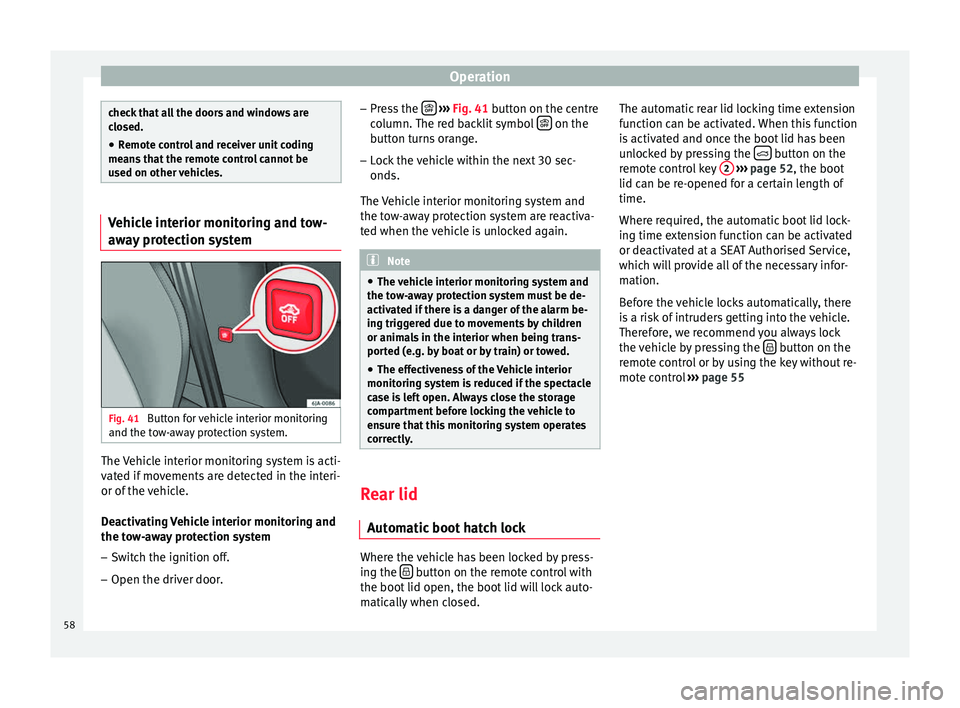
Fig. 41
Button for vehicle interior monitoring
and the tow-away protection system. The Vehicle interior monitoring system is acti-
vated if movements are detected in the interi-
or of the vehicle.
Deactivating Vehicle interior monitoring and
the tow-away protection system
– Switch the ignition off.
– Open the driver door. –
Press the
››› Fig. 41 button on the centre
column. The red backlit symbol on the
button turns orange.
– Lock the vehicle within the next 30 sec-
onds.
The Vehicle interior monitoring system and
the tow-away protection system are reactiva-
ted when the vehicle is unlocked again. Note
● The vehicle interior monitoring system and
the tow-away protection system must be de-
activated if there is a danger of the alarm be-
ing triggered due to movements by children
or animals in the interior when being trans-
ported (e.g. by boat or by train) or towed.
● The effectiveness of the Vehicle interior
monitoring system is reduced if the spectacle
case is left open. Always close the storage
compartment before locking the vehicle to
ensure that this monitoring system operates
correctly. Rear lid
Automatic boot hatch lock Where the vehicle has been locked by press-
ing the
button on the remote control with
the boot lid open, the boot lid will lock auto-
matically when closed. The automatic rear lid locking time extension
function can be activated. When this function
is activated and once the boot lid has been
unlocked by pressing the
button on the
remote control key 2
››› page 52, the boot
lid can be re-opened for a certain length of
time.
Where required, the automatic boot lid lock-
ing time extension function can be activated
or deactivated at a SEAT Authorised Service,
which will provide all of the necessary infor-
mation.
Before the vehicle locks automatically, there
is a risk of intruders getting into the vehicle.
Therefore, we recommend you always lock
the vehicle by pressing the button on the
remote control or by using the key without re-
mote control ››› page 55
58
Page 68 of 200
Operation
Note
● The parking lights can only be activated
with the ignition disconnected.
● The parking light will not come on automat-
ically after switching off the ignition if the
left- or right-hand turn signal is left on. Adjusting the headlights
The light beam of the dipped beam lights is
asymmetric: the side of the road on which
you are driving is lit more intensely.
When a car that is manufactured in a country
that drives on the right travels to a country
that drives on the left (or vice versa), it is nor-
mally necessary to cover part of the headlight
bulbs with stickers or to change the adjust-
ment of the headlights to avoid dazzling oth-
er drivers.
In such cases, the regulations specify certain
light values that must be complied with for
designated points of the light distribution.
This is known as “Tourist light”.
The light distribution of the halogen and full-
LED headlights of the SEAT Toledo allows the
specific “tourist light” values to be met with-
out the need for stickers or changes in the
settings. Note
“Tourist light” is only allowed temporarily. If
you are planning a long stay in a country that
drives on the other side, you should take the
vehicle to an Authorised Technical Service to
change the headlights. Interior lights
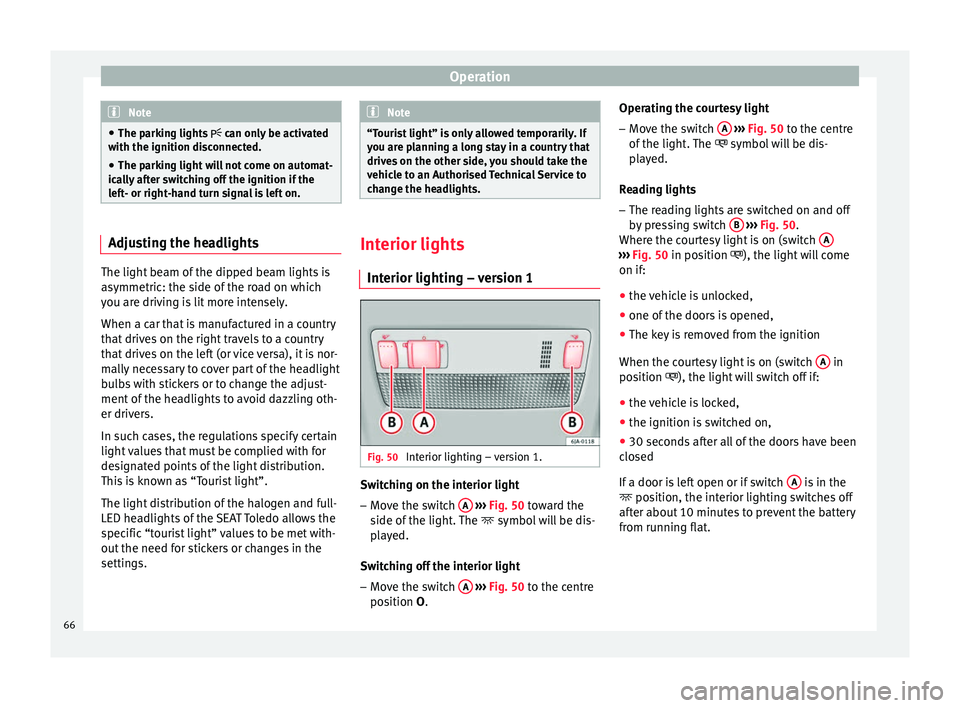
Interior lighting – version 1 Fig. 50
Interior lighting – version 1. Switching on the interior light
– Move the switch A
›››
Fig. 50 toward the
s ide of
the light. The symbol will be dis-
played.
Switching off the interior light – Move the switch A
›››
Fig. 50 to the centre
po s
ition O. Operating the courtesy light
–
Move the switch A
››› Fig. 50 to the centre
of the light
. The symbol will be dis-
played.
Reading lights
– The reading lights are switched on and off
by pressing switch B
››› Fig. 50 .
Wher e the c
ourtesy light is on (switch A ›››
Fig. 50 in position
), the light will come
on if:
● the
vehicle is unlocked,
● one of the doors is opened,
● The key is removed from the ignition
When the courtesy light is on (switch A in
position ), the light will switch off if:
● the vehicle is locked,
● the ignition is switched on,
● 30 seconds after all of the doors have been
closed
If a door is left open or if switch A is in the
position, the interior lighting switches off
after about 10 minutes to prevent the battery
from running flat.
66
Page 71 of 200

Lights and visibility
●
Remove snow and ice from the wipers be-
fore starting your journey.
● Careless handling could lead to the wiper
arms damaging the windscreen.
● For safety reasons, the wiper blades should
be changed once or twice a year. They can be
purchased at a SEAT Authorised Service.
● The ignition cannot be switched on while
the windscreen wiper arms are in a raised po-
sition. Otherwise, the windscreen wipers
would return to their original position and
could damage the paintwork on the bonnet. Note
Keep the wipers clean. The wipers can be
soiled with remains of wax solutions from car
washes ››› page 124.
● On vehicles equipped with windscreen
washer jets, these are heated once the en-
gine is running. Handling windscreen wipers and
washers
Fig. 56
Window wiper lever. Short wipe
– Give the windscreen a brief wipe by moving
the lever down to position 4
››› Fig. 56 .
W ipe int
ervals/automatic wipe with rain
sensor*
– Push the lever up to position 1
››› Fig. 56 .
– With sw
itch A , adjust the wipe interval or
rain sensor sensitivity.
Switch A has 4 positions.
The rain sensor* is part of the intermittent
wipe function.
The rain sensor* controls the frequency of
the windscreen wiper intervals, depending
on the amount of rain. Slow wipe
–
Push the lever up to position 2
››› Fig. 56 .
C ontinuou
s wipe
– Push the lever up to position 3
››› Fig. 56 .
Aut om
atic windscreen wash and wipe
– Pull the lever towards the steering wheel,
position 5
››› Fig. 56 , and the windscreen
w a
sher and wipers are switched on.
– Release the lever. The washer will stop and
the windscreen wipers will keep running for
1-3 wipes (depending on the windscreen
washer operating time).
Rear window wiper*
– Press the lever forward to position 6 ›››
Fig. 56 and the rear window wiper will
ru n ev
ery 6 seconds.
Automatic rear window wash and wipe* – Press the lever fully forward to position 7 ›››
Fig. 56 and the rear window wiper and
w a
sher switch on at the same time.
– Release the lever. The rear window washer
will stop and the rear window wipers will
keep running for 1-3 wipes (depending on
the jet operating time). When released, the
lever remains in position 6 .
»
69
Technical specifications
Advice
Operation
Safety
Page 73 of 200

Seats and head restraints
●
Do not touch the exterior mirrors when the
heating system is running.
● If the electrical adjustment should ever fail
to operate, the rear vision mirrors can be ad-
justed by hand by pressing the edge of the
mirror glass.
● Visit the technical service in the event of a
fault in the electrical rear vision mirror ad-
justment system. Seats and head restraints
Adjusting seats and head
restraints
Introduction Set the driver seat in such a way that the
pedals can be fully depressed with your legs
slightly bent.
Set the driver seat backrest so that you can
reach the upper point of the steering wheel
with your arms slightly bent.
The correct seat position is very important
for:
●
reaching all of the controls safely and
quickly,
● a relaxed posture that will not produce fati-
gue,
● maximum protection from the seat belts
and airbag system WARNING
● Adjust the driver seat only when the vehi-
cle is stationary. Risk of accident!
● Be careful when adjusting the front seats!
Careless and uncontrolled adjustment can
cause injuries. ●
The backrests must not be reclined too far
back while driving. This could limit the effect
of the seat belts and the airbag system. Risk
of injury!
● Never transport more than the permitted
amount of people in your vehicle.
● Every occupant in the vehicle must properly
fasten and wear the seat belt belonging to
his or her seat. Children must be protected
with an appropriate child restraint system
››› page 24, Transporting children safety.
● The front seats, head restraints and seat
belts must always be adjusted to the size of
the vehicle occupant to provide you and your
passengers with the greatest possible protec-
tion.
● Your feet should remain in the footwell
while the vehicle is moving; never rest them
on the dash panel, on the window or on the
seat! This also applies to passengers. An in-
correct sitting position exposes you to an in-
creased risk of injury in case of a sudden
braking or an accident. If the airbag is trig-
gered, you could sustain severe injuries due
to an incorrect sitting position!
● It is important for the driver and front pas-
senger to keep a distance of at least 25 cm
from the steering wheel and dash panel. Fail-
ure to respect the minimum distance means
that the airbag will not protect you. Risk of
fatal injury if triggered!
● Objects must not be placed in the footwell,
as they could move to the area of the pedals
in the event of a braking manoeuvre or
change of direction. This would prevent the » 71Technical specifications
Advice
Operation
Safety
Page 89 of 200

Heating and air conditioning
Heating and air conditioning Heating and air conditioning General notes The power of the heating depends on the
temperature of the coolant. Therefore, maxi-
mum power is only obtained when the en-
gine has reached operating temperature.
The temperature and humidity of the air in-
side the vehicle decrease when the cooling
system is turned on. This therefore increases
the comfort of all vehicle occupants when
outside temperatures and humidity are high.
It also helps prevent the windows from mist-
ing over during cold periods of the year.
The air recirculation system can be switched
on temporarily to increase the cooling effect.
Keep the air intake slots in front of the wind-
screen clear of ice, snow or leaves to ensure
unimpaired heating and cooling.
When the air conditioning is on,
condensa-
tion can drip from the evaporator in the air
c oo
ling system and form a pool underneath
the vehicle. This is normal and does not indi-
cate a leak! WARNING
● All windows must be clear of ice, snow and
condensation for driving safety. Therefore, make sure you familiarise yourself with the
correct use of heating and ventilation, win-
dow demisting and defrosting and cooling.
●
Never use the air recirculation system for
too long, as it prevents fresh air from enter-
ing the vehicle and used air can cause tired-
ness, reduce your attention span and cause
the windows to mist over. This increases the
risk of an accident. Switch off the air recircu-
lation system as soon as the windows begin
to mist over. Note
● Used air escapes through ventilation slots
in the rear of the luggage compartment.
● Smoking is not recommended while the air
recirculation system is in use, as the smoke
drawn from the interior of the vehicle settles
in the evaporator of the air conditioning sys-
tem. This causes a persistent, unpleasant
smell while the system is running that is
time-consuming and expensive (evaporator
replacement) to eliminate.
● To ensure proper functioning, never cover
the air outlets. Economic use of the air conditioning
system
When the air conditioning is switched on, the
compressor consumes engine power and has
influence on fuel consumption.If the vehicle interior has overheated due to
excessive solar radiation, it is best to open
the windows or doors to allow the hot air to
escape.
While in motion, the air conditioning should
not be switched on if the windows are open.
If the interior temperature can be reached
without switching on the air conditioning, the
fresh air mode should be used.
For the sake of the environment
Saving fuel reduces emissions. Faults
If the air conditioning does not work at out-
side temperatures above +5 °C (+41 °F) then
the system is faulty. This may be due to one
of the following reasons:
● One of the fuses has blown. Check the fuse
and replace if necessary ›››
page 163.
● The air conditioning compressor has
switched off temporarily because of in-
creased engine coolant temperature
››› page 31 .
If
you cannot repair the fault yourself or
where cooling power continues to drop,
switch off the system. Contact a specialised
service.
87
Technical specifications
Advice
Operation
Safety
Page 92 of 200
Operation
Note
● Controls A
››› Fig. 86 ››› page 88, B ,
C and button
1 .
● Air vents 4 ››› page 88.
● We r
ecommend you leave the air vents 3
››› page 88 in the open position. Air recirculation
Air recirculation prevents unpleasant smells,
e.g. when passing through a tunnel or in
queuing traffic, from entering the interior.
Switching on air recirculation mode
– Press button
1
›››
Fig. 86 ›
›
›
page 88
and the lamp in the button will illuminate.
Switching off air recirculation mode
– Press button
1
›››
Fig. 86 ›
›
›
page 88
again and the lamp in the button will
switch off.
If air vent C
›››
Fig. 86 ›
›
›
page 88 is in posi-
tion , air recirculation mode switches off
automatically. Press the button to switch
air recirculation mode back on in this posi-
tion. WARNING
Read and observe the safety warnings ››› in
General notes on page 87. Air conditioning (manual)*
General notes The air cooling system only works if
A/C but-
ton 2
›››
Fig. 87 ›
›
›
page 90 is pressed and
under following conditions:
● The engine is running,
● The outside temperature is above +2 °C
(+36 °F),
● The blower control is in position 1–4.
When the cooling system is on and under cer-
tain conditions, air can be blown from the
vents at a temperature of approximately
+5 °C (+41 °F). In the event of prolonged, ir-
regular distribution of the air flow from the
outlets and significant differences in temper-
ature, e.g. on leaving the vehicle, sensitive
people may catch cold. Note
A visit to the specialised service once a year
is recommended to clean the air conditioning
system. Operation
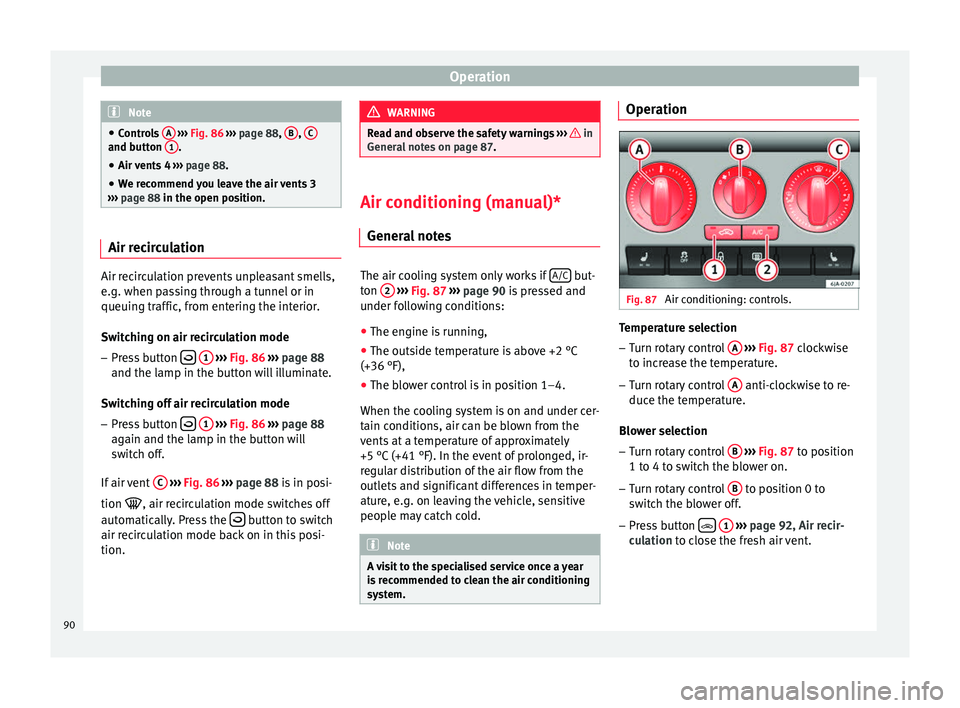
Fig. 87
Air conditioning: controls. Temperature selection
– Turn rotary control A
››› Fig. 87 clockwise
t o inc
rease the temperature.
– Turn rotary control A anti-clockwise to re-
duce the temperature.
Blower selection
– Turn rotary control B
››› Fig. 87 to position
1 t o 4 t
o switch the blower on.
– Turn rotary control B to position 0 to
switch the blower off.
– Press button
1
››› page 92, Air recir-
culation to close the fresh air vent.
90
Page 95 of 200

Heating and air conditioning
Switching on air recirculation mode
– Press button
1
››› Fig. 87
›
›› page 90
and the lamp in the button will illuminate.
Switching off air recirculation mode
– Press button
1
››› Fig. 87
›
›› p
age 90
again and the lamp in the button will
switch off.
If air distribution control C
››› Fig. 87
››› page 90 is in position
, air r
ec
irculation
mode switches off automatically Press the button to switch air recirculation mode
back on in this position. WARNING
Read and observe the safety warnings ››› in
General notes on page 87. Climatronic* (automatic air
conditioning)
General notes Climatronic automatically maintains a com-
fortable temperature. To do so, it automati- cally regulates the supplied air temperature
and the blower and air distribution levels.
The system also allows for the effect of sun-
light, so there is no need for manual adjust-
ment.
Automatic operations
›
›
› page 94
guarantee maximum comfort any time of
year.
Climatronic description
Cooling only works if the following conditions
are met:
● The engine is running
● the outside temperature is above +2 °C
(+36 °F);
● A/C
18
››› Fig. 88
›
›› p
age 94 switched
on.
In order to ensure engines subject to heavy
loads are cooled, the air conditioning com-
pressor is switched off in the event of high
coolant temperatures.
Recommended setting for all seasons of the
year
● Set the required temperature. We recom-
mend +22 °C (72 °F). ●
Press the AUTO button
12
››› Fig. 88
››› page 94 .
● Adju s
t vents 3 ››› p
age 88 and 4 so that the
air flow is directed slightly upwards.
Change between degrees Centigrade and
degrees Fahrenheit
Keep the AUTO and
A/C
››› Fig. 88
››› page 94 buttons pressed down at the
s ame time.
The data is displayed on the
screen in the units required. Note
A visit to the specialised service once a year
is recommended to clean the Climatronic sys-
tem. 93
Technical specifications
Advice
Operation
Safety
Page 101 of 200

Driving
●
On long, steep gradients, reduce your
speed and change to a lower gear (manual
gearbox) or move the selector lever to a lower
gear position (automatic gearbox). This uses
the force of the engine and the brakes do not
suffer as much. If you still have to brake, do
so intermittently, pressing down repeatedly
on the brake pedal.
● Vehicle modifications (e.g. to the engine,
brakes, frame or a combination of wheels and
tyres) could impair the brake assist systems
››› page 122, Accessories and modifications
to the vehicle .
● In the event of a fault in the ABS system,
the ESC, TCS and EDL are switched off auto-
matically. A fault in the ABS is indicated by
the ››› page 36 warning lamp. Brakes
Wear
The rate of wear of the brake pads depends
on the driving style and on the way in which
the vehicle is used. The brake pads will wear
more quickly if you use your vehicle frequent-
ly in urban traffic and short trips or drive in a
sporty style. Under these
demanding condi-
tions , visit your specialised service, even be-
f or
e the scheduled service date, so that the
thickness of the brake pads can be meas-
ured. Wet roads or road salt
If brakes are wet or frozen, or if you are driv-
ing on roads which have been gritted with
salt, braking power may set in later than nor-
mal. Dry the brakes as soon as possible by
braking repeatedly.
Corrosion
Long periods of inactivity and little use can
lead to rust on the brake discs and dirt on the
brake pads. Where the brake system is sub-
jected to light stress or in the case of corro-
sion, clean the brake discs by braking fully
several times at a high speed.
Brake system fault
If you notice that the braking distance sud-
denly increases and the brake pedal can be
pressed down more fully, there may be a fault
in the brake system. Visit a specialised serv-
ice immediately and adjust your driving style
to the extent of the damage and to limit the
effect of the brakes.
Low brake fluid level
Insufficient brake fluid could cause faults in
the brake system. The brake fluid level is con-
trolled electronically
››› page 33, Brake sys-
tem . Brake servo
The brake servo supplements the pressure
you exert on the brake pedal. The brake servo
only works when the engine is running.
Handbrake Fig. 90
Centre console: handbrake. Applying the handbrake
– Pull the handbrake lever up all the way.
Releasing the handbrake
– Pull the handbrake lever up slightly and
press the unlock button at the same time
››› Fig. 90 .
– Keep the b
utton pressed down and push
the lever all the way down.
The warning lamp lights up when the hand-
brake is applied with the ignition on .
99
Technical specifications
Advice
Operation
Safety
Page 106 of 200

Operation
shift down manually when driving downhill to
use the braking effect of the engine.
Back-up programme A back-up programme exists in case of faults.
In the event of a fault in the gearbox electron-
ics, it will continue to work in one of the cor-
responding back-up programmes. All seg-
ments of the screen are lit up or switched off.
The fault can be seen as follows:
● The gearbox only engages certain gears
● Reverse gear R cannot be engaged
● The m
anual gearbox switches off in the
back-up programme Note
If the gearbox switches to the back-up pro-
gramme, visit an Authorised Service as soon
as possible to solve the problem. Run-in and economical driving
The first 1,500 km Over the first 1,500 kilometres the engine
must be run in. Up to 1000 kilometres
– Do not drive at more than 3/4 of the maxi-
mum speed corresponding to the engaged
gear, i.e. up to 3/4 of the maximum permit-
ted engine speed.
– Do not drive at full speed.
– Avoid high engine speeds.
– Do not tow a trailer.
From 1000 to 1500 kilometres (600 to 900
miles) – Slowly increase the engine speed until
r e
aching the maximum permitted speed of
the engaged gear, i.e. the maximum per-
mitted engine speed.
During its first few hours of running, the in-
ternal friction in the engine is greater than
later on, when all the moving parts have bed-
ded in. How the vehicle is driven over approx-
imately the first 1,500 kilometres (900
miles), determines the success of the proc-
ess of running in the engine.
Even after running in, the vehicle should not
be unnecessarily driven at high engine
speeds
. The maximum permitted engine
speed is marked at the start of the red zone
on the rev counter dial. The gear must be
changed up when the red area is reached in
vehicles with a manual gearbox. Extremely
high engine speeds when accelerating are
automatically limited, however the engine is not protected against high engine speeds
produced by incorrectly changing to a lower
gear, which could cause the engine to run at
revs above the maximum permitted amount,
and consequently result in damage to the en-
gine.
Additionally, vehicles with a manual gearbox
must also bear the following in mind: do not
drive with the engine speed too low. Change
down to a lower gear when the engine no
longer runs smoothly. Observe the recom-
mendations for changing gear
››› page 32,
Recommended gear display.
New tyres
New tyres must be submitted to “running in”,
given that initially their grip is not yet at the
maximum level. During the first 500 km (120
miles) drive very carefully.
New brake pads
New brake pads do not yet provide maximum
friction capacity. First they must be “run in”.
During the first 200 km (120 miles) drive very
carefully. CAUTION
All the information for speed and engine
speed refers to an engine that operates at op-
erating temperature. Do not run the engine at
high engine speeds, neither when stopped or
while driving. 104