tow SKODA CITIGO 2015 1.G Owner's Guide
[x] Cancel search | Manufacturer: SKODA, Model Year: 2015, Model line: CITIGO, Model: SKODA CITIGO 2015 1.GPages: 160, PDF Size: 23.1 MB
Page 132 of 160
›Attach clamp 3 to the negative terminal of the battery supplying power B.›Attach the clamp 4 to a solid metal component firmly connected to the en-
gine block or to the engine block itself.
On vehicles with the START-STOPsystem the jump-start cable must be con-
nected to the engine earthing point » Fig. 125.
Starting engine›
Start the engine on the vehicle providing the power and allow it to idle.
›
Start the engine of the vehicle with the discharged battery.
›
If the engine does not start, halt the attempt to start the engine after 10 sec-
onds and wait for 30 seconds before repeating the process.
›
Remove the jump start cables in the reverse order as attachment.
Both batteries must have a rated voltage of 12 V. The capacity (Ah) of the bat-
tery supplying the power must not be significantly less than the capacity of
the discharged battery in your vehicle.
Jump-start cables
Only use jump-start cables which have an adequately large cross-section and
insulated terminal clamps. Observe the instructions of the jumper lead manu-
facturer.
Positive cable – colour coding in the majority of cases is red.
Negative cable – colour coding in the majority of cases is black.
WARNING■
Do not clamp the jump-start cable to the negative terminal of the dis-
charged battery. There is the risk of detonating gas seeping out the battery
being ignited by the strong spark which results from the engine being star-
ted.■
The non-insulated parts of the terminal clamps must never touch each
other – there is a risk of short circuit.
■
The jump-start cable connected to the positive terminal of the battery
must not come into contact with electrically conducting parts of the vehicle
– there is a risk of short circuit.
■
Route the jump-start cables so that they cannot be caught by any rotat-
ing parts in the engine compartment.
Towing the vehicle
Introduction
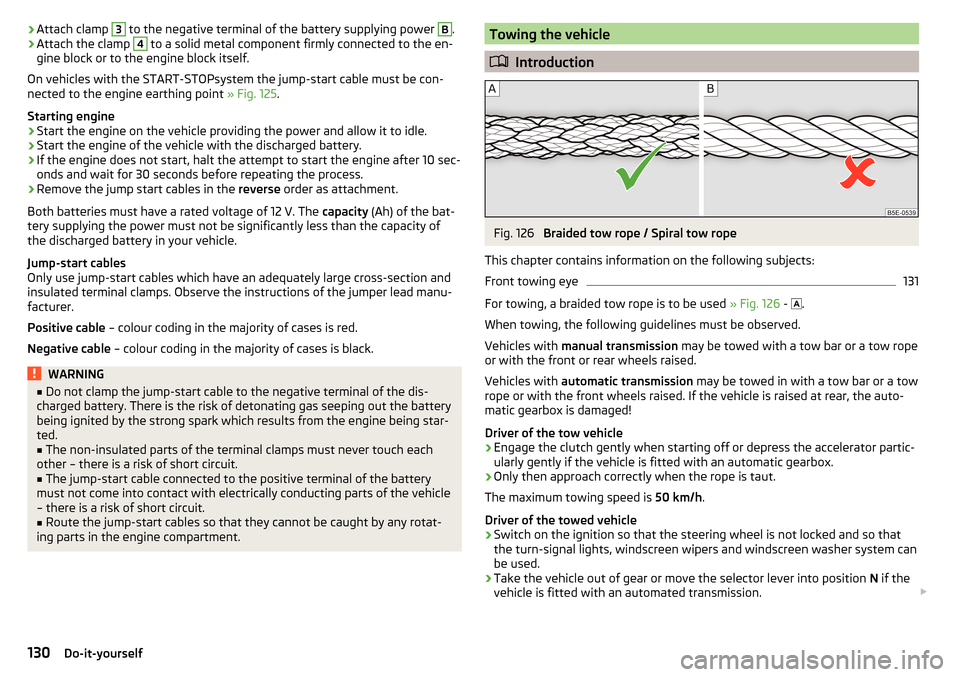
Fig. 126
Braided tow rope / Spiral tow rope
This chapter contains information on the following subjects:
Front towing eye
131
For towing, a braided tow rope is to be used » Fig. 126 -
.
When towing, the following guidelines must be observed.
Vehicles with manual transmission may be towed with a tow bar or a tow rope
or with the front or rear wheels raised.
Vehicles with automatic transmission may be towed in with a tow bar or a tow
rope or with the front wheels raised. If the vehicle is raised at rear, the auto-
matic gearbox is damaged!
Driver of the tow vehicle
›
Engage the clutch gently when starting off or depress the accelerator partic-
ularly gently if the vehicle is fitted with an automatic gearbox.
›
Only then approach correctly when the rope is taut.
The maximum towing speed is 50 km/h.
Driver of the towed vehicle
›
Switch on the ignition so that the steering wheel is not locked and so that
the turn-signal lights, windscreen wipers and windscreen washer system can
be used.
›
Take the vehicle out of gear or move the selector lever into position N if the
vehicle is fitted with an automated transmission.
130Do-it-yourself
Page 133 of 160
Please note that the brake servo unit and power steering only operate if the
engine is running. If the engine is not running, significantly more physical force
is required to depress the brake pedal and steer the vehicle.
If using a tow rope, ensure that it is always kept taught.
General information on towing
Both drivers should be familiar with the problems which might occur while a
vehicle is being towed. Unskilled drivers should not attempt to tow in another
vehicle or to be towed in.
The vehicle must be transported on a special breakdown vehicle or trailer if it
is not possible to tow in the vehicle in the way described or if the towing dis-
tance is greater than 50 km.
If the gearbox has no oil, your vehicle must be towed with the front axle raised
clear of the ground or on a breakdown vehicle or trailer.
To protect both vehicles when tow-starting or towing, the tow rope should be elastic. Thus one should only use plastic fibre rope or a rope made out of a
similarly elastic material.
Attach the tow rope or the tow bar only to the towing eye » page 131 .WARNING■
When towing, exercise increased caution.■Do not use spiral rope for towing » Fig. 126- , the towing eye may un-
screw from the vehicle - risk of accident.■
Ensure tow rope is not twisted - risk of accident.
CAUTION
■ Do not start engine by towing - there is a risk of damaging the engine parts.
The battery from another vehicle can be used as a jump-start aid » page 129,
Jump-starting .■
There is always a risk of excessive stresses and damage resulting at the
points to which you attach the tow rope or tow bar when you attempt to tow a
vehicle which is not standing on a paved road.
Note
We recommend using a tow rope from ŠKODA Original Accessories, which is
available from a ŠKODA Partner.Front towing eyeFig. 127
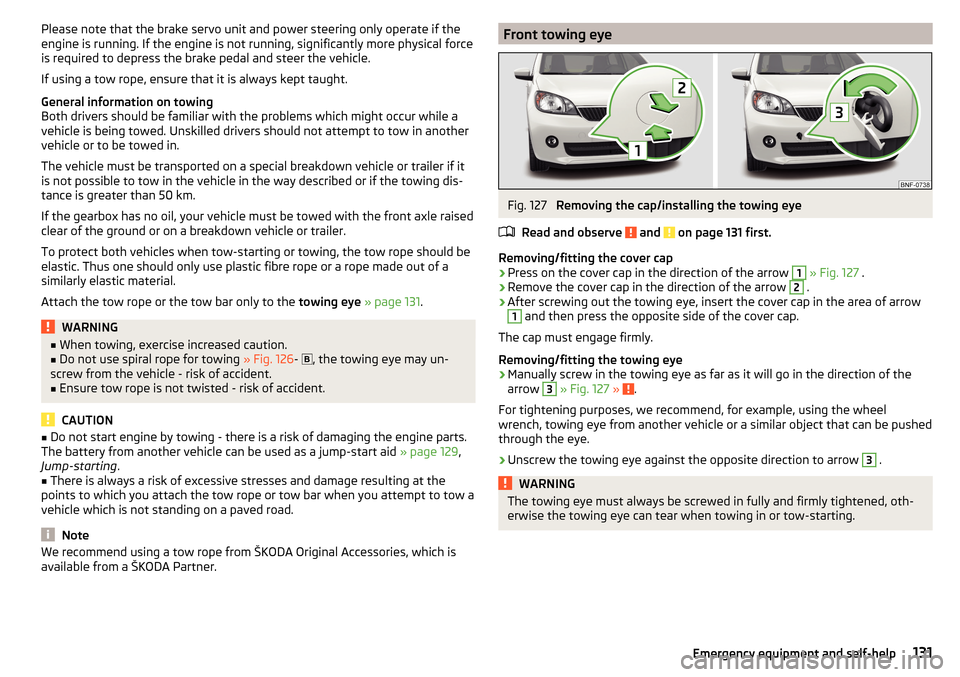
Removing the cap/installing the towing eye
Read and observe
and on page 131 first.
Removing/fitting the cover cap
›
Press on the cover cap in the direction of the arrow
1
» Fig. 127 .
›
Remove the cover cap in the direction of the arrow
2
.
›
After screwing out the towing eye, insert the cover cap in the area of arrow
1
and then press the opposite side of the cover cap.
The cap must engage firmly.
Removing/fitting the towing eye
›
Manually screw in the towing eye as far as it will go in the direction of the
arrow
3
» Fig. 127 » .
For tightening purposes, we recommend, for example, using the wheel
wrench, towing eye from another vehicle or a similar object that can be pushed through the eye.
›
Unscrew the towing eye against the opposite direction to arrow
3
.
WARNINGThe towing eye must always be screwed in fully and firmly tightened, oth-
erwise the towing eye can tear when towing in or tow-starting.131Emergency equipment and self-help
Page 140 of 160
No.Consumer3Control unit for radiator fan, ignition4ABS/ESP5Central control unit, battery data module6Ignition lock, starter
Replacing bulbs
Introduction
This chapter contains information on the following subjects:
Bulb arrangement in the headlights
138
Changing the low beam and high beam bulb (halogen headlights)
139
Replacing bulb for daytime running lights and parking lights
139
Changing the front turn signal bulb
139
Replacing the bulb for the fog light
140
Replacing the bulb for the licence plate light
140
Rear Light
141
Changing a bulb in the tail light
141
Some manual skills are required to change a bulb. For this reason, we recom-
mend having bulbs replaced by a specialist garage or seeking other expert help
in the event of any uncertainties.
▶ Switch off the ignition and all of the lights before replacing a bulb.
▶ Faulty bulbs must only be replaced with the same type of bulbs. The designa-
tion is located on the light socket or the glass bulb.
▶ A stowage compartment for replacement bulbs is located in a plastic box in
the spare wheel or underneath the floor covering in the luggage compart-
ment.
Depending on the vehicle design, some vehicles may be equipped with LED
daytime running lights in the front bumper instead of the fog lights.
WARNING■ Always read and observe the warnings before completing any work in the
engine compartment » page 106.■
Accidents can be caused if the road in front of the vehicle is not suffi-
ciently illuminated and the vehicle cannot or can only be seen with difficul-
ty by other road users.
■
The H4 bulb is pressurised and may explode during a bulb replacement -
risk of injury! We therefore recommended wearing gloves and safety
glasses when changing a bulb.
■
Switch off the respective vehicle light when changing the bulb.
CAUTION
Do not take hold of the glass bulb with naked fingers (even the smallest
amount of dirt reduces the working life of the light bulb). Use a clean cloth,
napkin, or similar.
Note
■ This Owner's Manual only describes the replacement of bulbs where it is pos-
sible to replace the bulbs on your own without any complications arising. Other
bulbs must be replaced by a specialist garage.■
We recommend that a box of replacement bulbs always be carried in the ve-
hicle. Replacement bulbs can be purchased from ŠKODAOriginal Accessories.
■
We recommend having the headlight settings checked by a specialist garage
after replacing a bulb in the main beam, low beam or fog lights.
■
If the LED diode is defect visit a specialist garage.
Bulb arrangement in the headlights
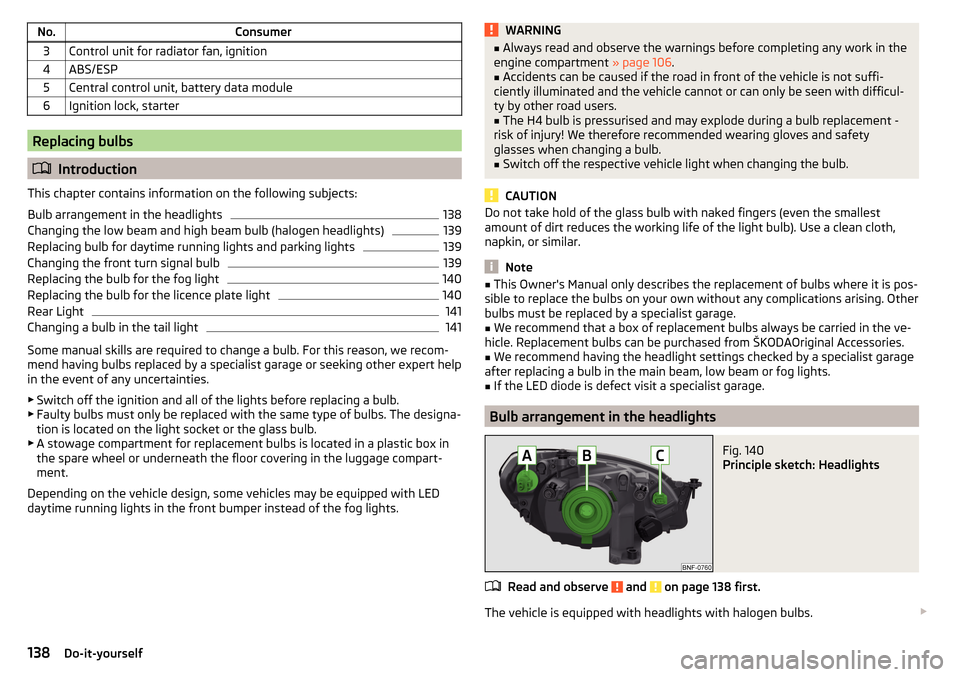
Fig. 140
Principle sketch: Headlights
Read and observe and on page 138 first.
The vehicle is equipped with headlights with halogen bulbs.
138Do-it-yourself
Page 151 of 160
cruise controloperation88
operation Description88
Cruise control system Warning light
38
Cruise Control System88
Cup holders59
D
DAY LIGHT see Daylight running lights
48
Daylight running lights48
De-icing windows
98
Deactivating an airbag17
Decorative films97
Defrosting rear window51
Delayed locking of the boot lid see boot lid
43
Departure angle145
Digital Clock Time
33
Dimmed headlights47
Dipstick109
Disconnecting and reconnecting vehicle battery
115
Display Service interval
30
Display of fuel reserve
29
Disposal Acceptance and recycling of used vehicles
95
Distance driven30
Door Child safety lock
42
Closing41
Emergency locking132
Opening41
Door opening lever locking of42
unlocking of42
Drive Driving through water
84
Driving Emissions
143
Fuel consumption143
through water84
Top speed146
Trailer operation95
E
Economical driving Tips
83
EDL86
Electric Windows44
Button in driver's door44
Button in the front passenger door44
Electronic Differential Lock (EDL)86
Electronic immobilizer75
Emergency Changing a wheel
123
Hazard warning light system49
Jump-starting129
Locking the door without a locking cylinder132
Towing the vehicle130
Tyre repair127
Emergency equipment Jack
122
Reflective vest122
Vehicle tool kit122
Warning triangle122
Emissions143
Engine Running-in
83
Switch off engine76
Engine compartment106
Brake fluid112
Overview108
Vehicle battery112
Engine number142
engine oil specification
109
Engine oil109
Checking109
Replenishing110
Warning light35
EPC Warning light
37
ESC Operation
85
Warning light36
Exhaust inspection system Warning light
37
F
Films
97
Fog Lights49
Foldable hook63
Footmats80
see footmats80
Force limit Sliding/tilting roof
45
Force limiter Sliding/tilting roof
46
Front airbag15
fuel lead-free petrol
103
Fuel102
CNG105
Fuel reserve display29
refer to Fuel102
Refuelling103
Refuelling - natural gas104
Fuel consumption143
149Index
Page 155 of 160
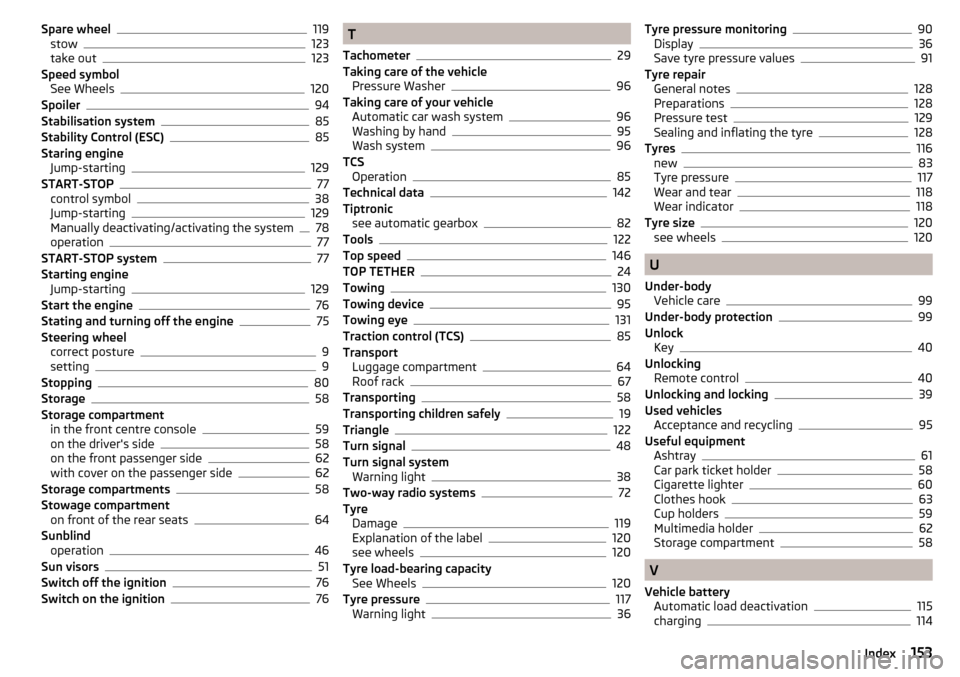
Spare wheel119
stow123
take out123
Speed symbol See Wheels
120
Spoiler94
Stabilisation system85
Stability Control (ESC)85
Staring engine Jump-starting
129
START-STOP77
control symbol38
Jump-starting129
Manually deactivating/activating the system78
operation77
START-STOP system77
Starting engine Jump-starting
129
Start the engine76
Stating and turning off the engine75
Steering wheel correct posture
9
setting9
Stopping80
Storage58
Storage compartment in the front centre console
59
on the driver's side58
on the front passenger side62
with cover on the passenger side62
Storage compartments58
Stowage compartment on front of the rear seats
64
Sunblind operation
46
Sun visors51
Switch off the ignition76
Switch on the ignition76
T
Tachometer
29
Taking care of the vehicle Pressure Washer
96
Taking care of your vehicle Automatic car wash system
96
Washing by hand95
Wash system96
TCS Operation
85
Technical data142
Tiptronic see automatic gearbox
82
Tools122
Top speed146
TOP TETHER24
Towing130
Towing device95
Towing eye131
Traction control (TCS)85
Transport Luggage compartment
64
Roof rack67
Transporting58
Transporting children safely19
Triangle122
Turn signal48
Turn signal system Warning light
38
Two-way radio systems72
Tyre Damage
119
Explanation of the label120
see wheels120
Tyre load-bearing capacity See Wheels
120
Tyre pressure117
Warning light36
Tyre pressure monitoring90
Display36
Save tyre pressure values91
Tyre repair General notes
128
Preparations128
Pressure test129
Sealing and inflating the tyre128
Tyres116
new83
Tyre pressure117
Wear and tear118
Wear indicator118
Tyre size120
see wheels120
U
Under-body Vehicle care
99
Under-body protection99
Unlock Key
40
Unlocking Remote control
40
Unlocking and locking39
Used vehicles Acceptance and recycling
95
Useful equipment Ashtray
61
Car park ticket holder58
Cigarette lighter60
Clothes hook63
Cup holders59
Multimedia holder62
Storage compartment58
V
Vehicle battery Automatic load deactivation
115
charging114
153Index
Page 156 of 160
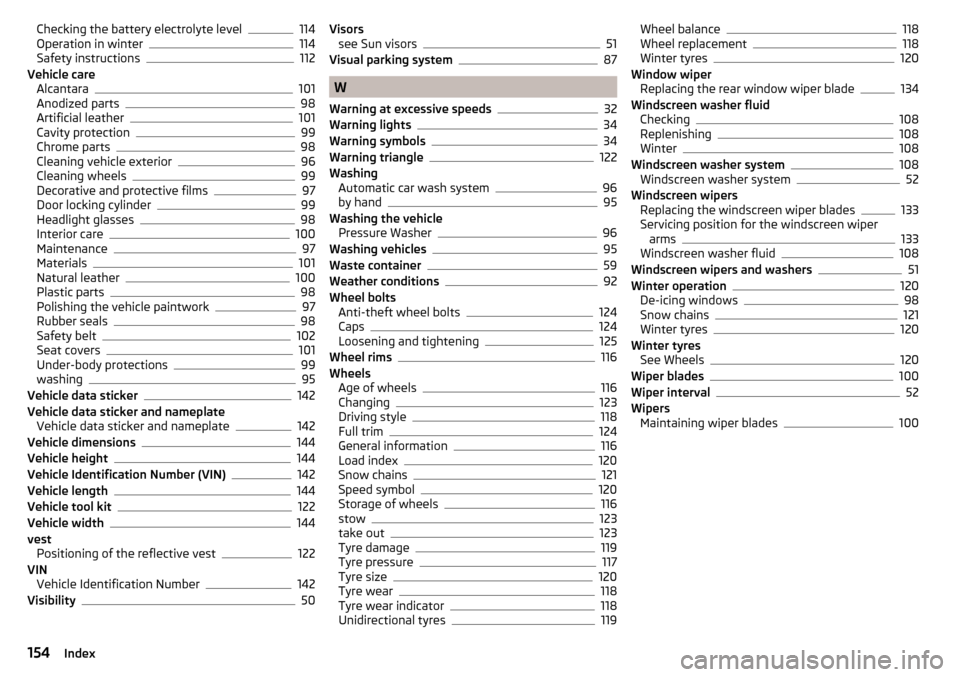
Checking the battery electrolyte level114
Operation in winter114
Safety instructions112
Vehicle care Alcantara
101
Anodized parts98
Artificial leather101
Cavity protection99
Chrome parts98
Cleaning vehicle exterior96
Cleaning wheels99
Decorative and protective films97
Door locking cylinder99
Headlight glasses98
Interior care100
Maintenance97
Materials101
Natural leather100
Plastic parts98
Polishing the vehicle paintwork97
Rubber seals98
Safety belt102
Seat covers101
Under-body protections99
washing95
Vehicle data sticker142
Vehicle data sticker and nameplate Vehicle data sticker and nameplate
142
Vehicle dimensions144
Vehicle height144
Vehicle Identification Number (VIN)142
Vehicle length144
Vehicle tool kit122
Vehicle width144
vest Positioning of the reflective vest
122
VIN Vehicle Identification Number
142
Visibility50
Visors see Sun visors51
Visual parking system87
W
Warning at excessive speeds
32
Warning lights34
Warning symbols34
Warning triangle122
Washing Automatic car wash system
96
by hand95
Washing the vehicle Pressure Washer
96
Washing vehicles95
Waste container59
Weather conditions92
Wheel bolts Anti-theft wheel bolts
124
Caps124
Loosening and tightening125
Wheel rims116
Wheels Age of wheels
116
Changing123
Driving style118
Full trim124
General information116
Load index120
Snow chains121
Speed symbol120
Storage of wheels116
stow123
take out123
Tyre damage119
Tyre pressure117
Tyre size120
Tyre wear118
Tyre wear indicator118
Unidirectional tyres119
Wheel balance118
Wheel replacement118
Winter tyres120
Window wiper Replacing the rear window wiper blade
134
Windscreen washer fluid Checking
108
Replenishing108
Winter108
Windscreen washer system108
Windscreen washer system52
Windscreen wipers Replacing the windscreen wiper blades
133
Servicing position for the windscreen wiper arms
133
Windscreen washer fluid108
Windscreen wipers and washers51
Winter operation120
De-icing windows98
Snow chains121
Winter tyres120
Winter tyres See Wheels
120
Wiper blades100
Wiper interval52
Wipers Maintaining wiper blades
100
154Index