radio SKODA FABIA 2006 2.G / 5J User Guide
[x] Cancel search | Manufacturer: SKODA, Model Year: 2006, Model line: FABIA, Model: SKODA FABIA 2006 2.G / 5JPages: 258, PDF Size: 44.86 MB
Page 43 of 258
Unlocking and locking42
Indicator light in the driver's door on vehicles with anti-theft alarm system
After locking the vehicle the indicator light flashes for 2 seconds fast, then more slowly.
If the vehicle is locked and the safe securing system ⇒page 42 is not operating, the indicator light in the driver door flashes for about 2 seconds fast, goes out and starts to flash slowly after about 30 seconds.
If the indicator light first of all flashes fast for about 2 seconds, afterwards lights up for about 30 seconds and then flashes slowly, there is a fault in the system of the central locking or the interior monitor* ⇒page 49. Contact a specialist garage to obtain assistance.
Convenience operation of windows
One can open and close the electrically powered windows when unlocking and locking the vehicle ⇒page 52, “Window convenience operation”.
Opening a single door*
This function allows one to just unlock the driver's door. The other doors remain locked and are only unlocked when the command is repeated. The single door opening function can be first activate d by recoding the control unit of the central locking system. This work is und ertaken by a Škoda Service Partner can give you more information.
Automatic locking*
All the doors and the tailgate are locked automatically once the car reaches a speed of about 15 km/h.
If the ignition key is withdrawn, the ca r is then automatically unlocked again. In addition, it is possible for the driver to unlock the car by pressing the central locking button or by pulling the door opening lever.
If you wish, your Škoda Service Partner can convert the central locking system of your car to the automatic locking mode.
WARNING
•Locking the doors prevents involu ntary opening in an exceptional situation (an accident). Locked doors prevent unwanted entry into the vehicle from outside, for example at road crossings. Locked doors do, however, make it more difficult for rescuers to get into the vehicle in an emergency - danger to life!
Note
•In the event of an accident in which the airbags are deployed, the locked doors are automatically unlocked in order to enable rescuers to gain access to the vehicle.
•Only the front doors can be unlocked an d locked using the key if the central locking system fails. You can operate the rear door manually.
− Emergency locking of the door ⇒page 45.
Safe securing
The central locking system is equipped with a safe securing system. Locking the vehicle from the outside causes the d oor locks to be automatically blocked. The indicator light in the driver's door fl ashes. It is not possible to open the doors with the door handle either from th e inside or from the outside. This acts as an effective deterrent for atte mpts to break into your vehicle.
You can deactivate the safe securing syst em. This is done by locking the vehicle with the key or radio-operated key twice within 2 seconds.
The safe securing system is again activate d the next time the vehicle is unlocked and locked again.
The doors can be opened from the inside if the vehicle is locked and the safe securing system is deactivated:
NKO A05Fabia 20.book Page 42 Tuesday, September 26, 2006 8:38 AM
Page 48 of 258
Unlocking and locking47
Using the systemSafetyDriving TipsGeneral MaintenanceBreakdown assistanceTechnical Data
Remote control*
Description
You can use the remote control:
•to unlock and lock the car,
•unlock the tailgate.
The transmitter with the battery is housed in the handle of the master key. The receiver is located in the interior of th e car. The operating range of the remote control is 10 metres but this range can be reduced if the batteries are weak.
The master key has a fold-open key bit which can be used for unlocking and locking the car manually and al so for starting the engine.
If a lost key is replaced or if the rece iver unit has been repaired or a new unit installed, it is then necessary for a Škoda Service Partner to initialise the system. Only after this is it possible to again use the remote control.
Note
•The remote control is automatically deactivated when the ignition is switched on.
•The operation of the remote control may temporarily be affected by inter- ference from transmitters close to th e car and which operate in the same frequency range (e.g. mobile phone, TV transmitter).
•The battery must be replaced if the central locking or anti-theft alarm system does react to the remote control at less than 3 metres away. We recom- mend having the battery replaced by a Škoda Service Partner.
Unlocking and locking car
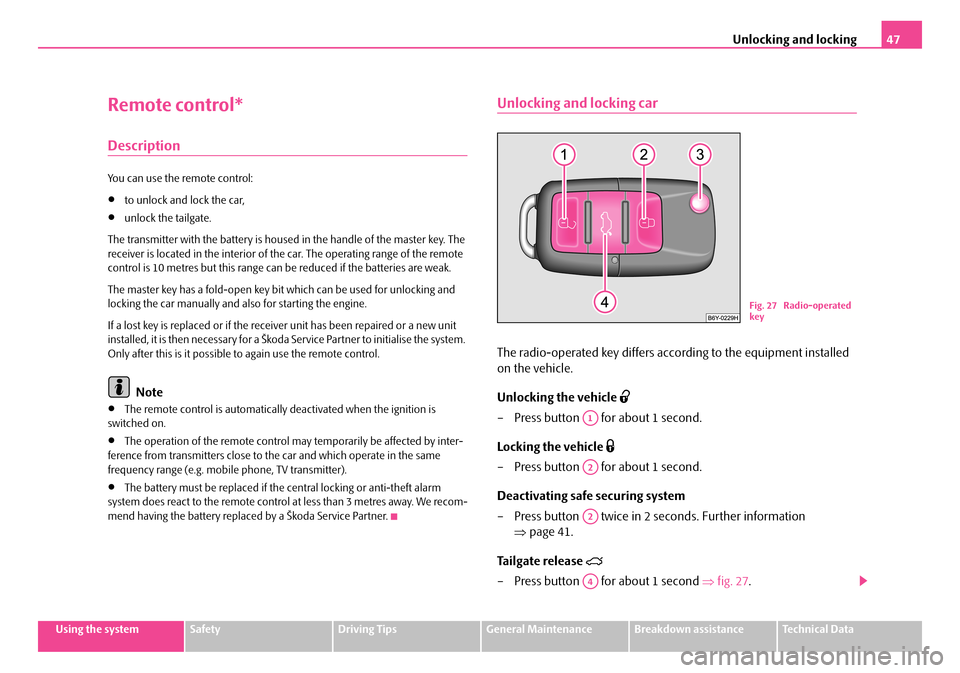
The radio-operated key differs according to the equipment installed
on the vehicle.
Unlocking the vehicle
– Press button for about 1 second.
Locking the vehicle
– Press button for about 1 second.
Deactivating safe securing system
– Press button twice in 2 seconds. Further information
⇒ page 41.
Tailgate release
– Press button for about 1 second ⇒fig. 27.
Fig. 27 Radio-operated key
A1
A2
A2
A4
NKO A05Fabia 20.book Page 47 Tuesday, September 26, 2006 8:38 AM
Page 49 of 258
Unlocking and locking48
Folding out of the key
– Press button .
Folding up of the key
– Press button and collapse the key bit in the housing.
The turn signal lights flash twice as confirmation that the vehicle has been unlocked. The vehicle will lock again au tomatically if you unlock the vehicle using button but do not open a door or the tailgate within the next 30 seconds. This function is intended to prevent the car being unlocked uninten- tionally.
The safe securing system along with the anti-theft alarm system* are, however, deactivated during these 30 seconds.
When the vehicle is unlocked or locked, th e interior lights in the door contact are automatically switched on or off.
The turn signal lights flas h once to confirm that the vehicle has been correctly locked.
If the turn signal lights do not flash, check the doors, bonnet and tailgate again to ensure that they are closed. If the doors, the bonnet or the tailgate remain open when the anti-theft alarm system* is activated, the turn signal lights do not flash until after th ey have been closed.
WARNING
If the vehicle is locked from the outside and the safe securing system is activated, there must not be any person in the vehicle as it is then not possible to open either a door or a window from the inside. The locked doors make it more difficult for rescuers to get into the vehicle in an emergency - hazard!
Note
•Operate the radio remote control only when the doors and tailgate are closed and you have visual contact with the vehicle.
•Once in the car, you must not press the lock button of the master key before inserting the key into the ignition lock in order to avoid the car being inadvertently locked and, in addition , the anti-theft alarm system* being switched on. Should this happe n, press the unlock button of the master key.
Synchonisation of the remote control
If the vehicle cannot be unlocked by actuating the remote control system then it is possible that the code in the key and the control unit in the vehicle are no longer synchronised. This can occur when the buttons on the radio-operated key are actuated a number of times outsid e of the operative range of the equip- ment or the battery on the remote control was replaced.
This means it is necessary to synchronise the code as follows:
•Press any button on the remote control.
•pressing of the button means that the door will unlock with the key within 1 minute.
Anti-theft alarm system*
The anti-theft alarm system increases the level of protection against people seeking to break into the vehicle. The system triggers audible and visual warning signals if an attempt is made to break into the vehicle.
A3
A3
A1
NKO A05Fabia 20.book Page 48 Tuesday, September 26, 2006 8:38 AM
Page 50 of 258
Unlocking and locking49
Using the systemSafetyDriving TipsGeneral MaintenanceBreakdown assistanceTechnical Data
How is the alarm system switched on?
The anti-theft alarm system is activated automatically when the vehicle is locked with the key on the closed driver's door or by using the remote control. It is activated 30 seconds after closing the door.
How is the alarm sy stem switched off?
The anti-theft alarm system is switched off if the vehicle is unlocked by only using the remote control. The vehicle is automatically locked again if the vehicle is not opened within 30 seconds after reactivating the anti-theft alarm system.
Once you unlock the vehicle by inserting the key into the driver door you then have to insert the key into the ignition lock and switch the ignition on within 15 seconds after unlocking the door in order to deactivate the anti-theft alarm system. The alarm will be triggered if you do not switch on the ignition within 15 seconds.
When is the alarm triggered?
The following security areas of the locked vehicle are monitored:
•Bonnet,
•Tailgate,
•Doors,
•Ignition lock,
•Vehicle interior* ⇒page 49,
•Angle of the vehicle*,
•A drop in voltage of the on-board power supply.
An alarm is immediately triggered if either of the two battery terminals is disconnected while the anti-theft alarm system is activated.
How is the alarm switched off?
You switch the alarm off if you unlock th e car with the radio remote control in the key or if you switch the ignition on.
Note
•The working life of the alarm siren is 5 years. More detailed information is available from your Škoda Service Partner.
•Before leaving the car, check that all the doors, windows and the electric sliding/tilting roof* are properly closed in order to ensure that the anti-theft alarm system is fully operational.
•Coding of the radio remote control and the receptor part precludes the use of the radio remote control from other vehicles.
Interior monitor* and Towing
protection*
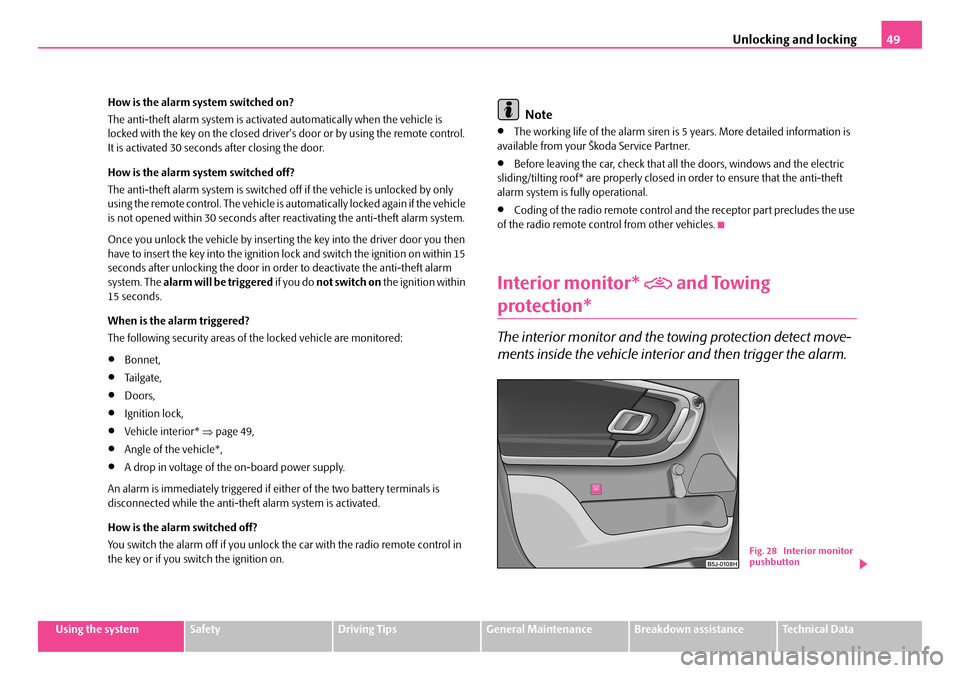
The interior monitor and the to wing protection detect move-
ments inside the vehicle interi or and then trigger the alarm.
Fig. 28 Interior monitor pushbutton
NKO A05Fabia 20.book Page 49 Tuesday, September 26, 2006 8:38 AM
Page 119 of 258
Communication118
Communication
Operating the radio
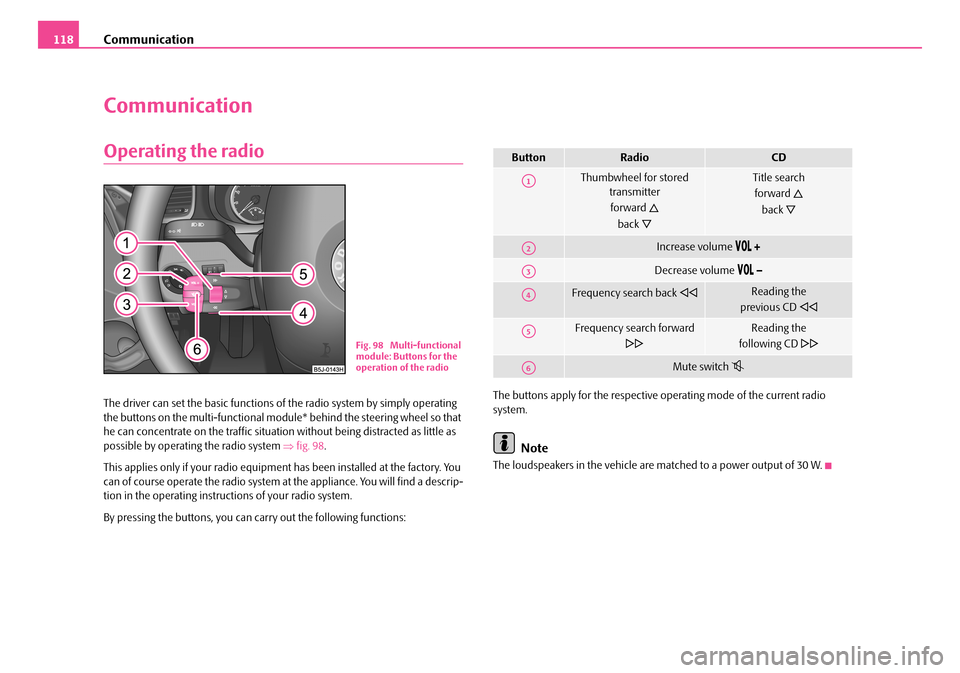
The driver can set the basic functions of the radio system by simply operating the buttons on the multi-functional modu le* behind the steering wheel so that he can concentrate on the traffic situation without being distracted as little as possible by operating the radio system ⇒fig. 98.
This applies only if your radio equipment has been installed at the factory. You can of course operate the radio system at the appliance. You will find a descrip- tion in the operating instructions of your radio system.
By pressing the buttons, you can ca rry out the following functions:
The buttons apply for the respective operating mode of the current radio system.
Note
The loudspeakers in the vehicle are matched to a power output of 30 W.
Fig. 98 Multi-functional module: Buttons for the operation of the radio
ButtonRadioCD
Thumbwheel for stored transmitter
forward
back
Title search
forward
back
Increase volume
Decrease volume
Frequency search back Reading the
previous CD
Frequency search forward
Reading the
following CD
Mute switch
A1
A2
A3
A4
A5
A6
NKO A05Fabia 20.book Page 118 Tuesday, September 26, 2006 8:38 AM
Page 120 of 258

Communication119
Using the systemSafetyDriving TipsGeneral MaintenanceBreakdown assistanceTechnical Data
Radio and mobile phone operation
The driver can set the basic functions of the radio and telephone system by simply operating the buttons on the multi-functional module* behind the steering wheel so that he can concentrate on the traffic situation without being distracted as little as possible by operating the radio system ⇒fig. 99.
This applies only if your radio and mo bile phone equipment has been installed at the factory. You can of course operate the radio and mobile system at the appliance. You will find a description in the operating instructions of your radio system.
By pressing the buttons, you can carry out the following functions:
The buttons apply for the respective operating mode of the current radio system.
Fig. 99 Multi-functional module: Buttons for the radio and mobile phone operation
ButtonRadioCDPhone
Thumbwheel for stored transmitter
forward
back
Title search
forward
back
Scroll through with the aid of the thumbwheel
Increase volume
Decrease volume
Switching over between radio system and mobile phone
without functionReceive, accept a call, call up menu telephone,
confirm menu selection /
without functionActivation/deactivation button for voice control
(button PTT)
A1
A2
A3
A4
A5
A6
NKO A05Fabia 20.book Page 119 Tuesday, September 26, 2006 8:38 AM
Page 121 of 258
Communication120
Note
The operation of the mobile phone fitted with multi-functional module* is only possible on certain models of mobile phone. More detailed information is available from your Škoda Service Partner.
Universal telephone preinstallation with
voice control*
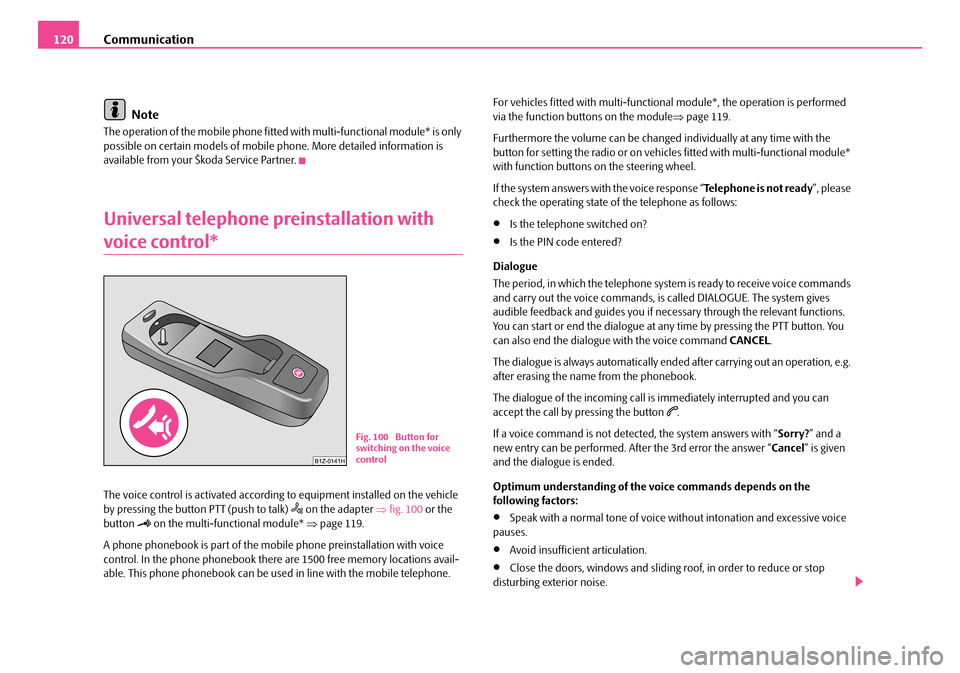
The voice control is activated according to equipment installed on the vehicle by pressing the button PTT (push to talk) on the adapter ⇒fig. 100 or the button on the multi-functional module* ⇒page 119.
A phone phonebook is part of the mobile phone preinstallation with voice control. In the phone phonebook there are 1500 free memory locations avail-able. This phone phonebook can be used in line with the mobile telephone.
For vehicles fitted with multi-function al module*, the operation is performed via the function buttons on the module ⇒page 119.
Furthermore the volume can be changed individually at any time with the button for setting the radio or on vehicles fitted with multi-functional module* with function buttons on the steering wheel.
If the system answers with the voice response “ Telephone is not ready”, please check the operating state of the telephone as follows:
•Is the telephone switched on?
•Is the PIN code entered?
Dialogue
The period, in which the telephone system is ready to receive voice commands and carry out the voice commands, is called DIALOGUE. The system gives audible feedback and guides you if necessary through the relevant functions. You can start or end the dialogue at any time by pressing the PTT button. You can also end the dialogue with the voice command CANCEL.
The dialogue is always automatically ended after carrying out an operation, e.g. after erasing the name from the phonebook.
The dialogue of the incoming call is immediately interrupted and you can accept the call by pressing the button .
If a voice command is not detected, the system answers with “ Sorry?” and a new entry can be performed. After the 3rd error the answer “ Cancel” is given and the dialogue is ended.
Optimum understanding of the voice commands depends on the following factors:
•Speak with a normal tone of voice wi thout intonation and excessive voice pauses.
•Avoid insufficient articulation.
•Close the doors, windows and sliding roof, in order to reduce or stop disturbing exterior noise.
Fig. 100 Button for switching on the voice control
NKO A05Fabia 20.book Page 120 Tuesday, September 26, 2006 8:38 AM
Page 122 of 258

Communication121
Using the systemSafetyDriving TipsGeneral MaintenanceBreakdown assistanceTechnical Data
•It is recommended to speak louder at higher speeds, so that the tone of your voice is louder than the increased surrounding noise.
•During the dialogue avoid additional noise in the vehicle, e.g. simultane- ously talking occupants.
•Do not speak, if the system makes an announcement.
•The microphone for voice control is directed to the driver and front passenger. Therefore the driver and the front passenger can operate the equip- ment.
WARNING
Pay attention primarily to the traffic situation! As the driver you are fully responsible for the traffic safety. Use the telephone system only to such an extent, so that you are in full control of your vehicle at any time.
Caution
Taking the mobile phone out of the adapte r during the call can lead to interrup- tion of the connection. When taking ou t the mobile phone, the connection to the factory-fitted antenna is interrupted, this reduces the quality of the trans- mitting and receiving signal. This might result additionally in harmful radiation from the mobile phone in the interior of the vehicle and the charging of the tele-phone battery is interrupted.
Note
•Please also refer to the additional instructions ⇒page 129, “Mobile phones and two-way radio systems”.
•Please contact your Škoda Service Part ner if there are any points which are not clear.
•The voice control of the telephone is only possible for adapters with PTT button. Suitable adapters are available at a Škoda Service Partner.
Inserting the mobile phone and adapter
A telephone mount is factory-fitted. The mount is attached to the
centre console. The adapter “Paragon - Fidelity” is offered as Škoda
Original Accessory.
Inserting the mobile phone and adapter
– First of all push the adapter in the direction of arrow ⇒fig. 101 up
to the stop into the mount. Press the adapter slightly downwards,
until it locks securely into position.
– Insert the mobile phone into the adapter (as specified in manufac-
turer's instructions).
Removing the mobile phone and adapter
– Press simultaneouly the side locks of the mount and remove the
mobile phone and adapter ⇒fig. 101.
Fig. 101 Universal prep- aration for the mobile phone
NKO A05Fabia 20.book Page 121 Tuesday, September 26, 2006 8:38 AM
Page 130 of 258

Communication129
Using the systemSafetyDriving TipsGeneral MaintenanceBreakdown assistanceTechnical Data
with the hands-free system . If a fifth mobile phone is connected to the hands- free-system, then the telephone, which has been used together with the hands- free system for the shortest period, is disconnected.
Establishing the Bluetooth connection
After switching on the ignition, the Bluetooth connection is automatically established for the already adapted mobile phone 3). You can hear an increasing tone sequence from the loudspeakers of the vehicle.
Disconnecting the Bluetooth connection
After withdrawing the ignition key, the Bluetooth connection is disonnected. You can hear an increasing tone sequence from the loudspeakers of the vehicle.
WARNING
•Pay attention primarily to the traffic situation! As the driver you are fully responsible for the traffic safety . Use the telephone system only to such an extent, so that you are in full control of your vehicle at any time - risk of accident!
•In the event of air transport, the Bluetooth function of the handsfree-system must be switched off by a specialist garage.
Caution
Taking the mobile phone out of the adapter during the call can lead to interrup- tion of the connection. When taking ou t the mobile phone, the connection to the factory-fitted antenna is interrupted, this reduces the quality of the trans- mitting and receiving signal. This might result additionally in harmful radiation from the mobile phone in the interior of the vehicle and the charging of the tele- phone battery is interrupted.
Note
•Not valid for all mobile phones whic h enable a communication via Blue- tooth.
•Please operate your mobile phone excl usively with a suitable adapter, in order to keep a low radiation in the vehicle.
•Inserting the mobile phone into the adapter ensures an optimal sending and receiving power and offers at the sa me time the advantage of the battery charging.
•If you insert the mobile telephone into the adapter, the connection is estab- lished via the interface in the adapte r set and the Bluetooth connection is disconnected. You can hear an increa sing tone sequence from the loud- speakers of the vehicle.
•Note that the range of the Bluetooth connection to the handsfree-system is limited to the vehicle interior. The rang e is dependent on local factors, e.g. obstacles between the devices and interferences with other devices. If your mobile phone is e.g. in a jacket pocket, th is can lead to difficulties when estab- lishing the Bluetooth connection with the handsfree-system or the data transfer.
•If you have set the Portugue se language in the information display, it is used automatically for the mobile phone operation, as this is the language, which was entered during coding of the handsfree-system.
Mobile phones and two-way radio systems
We recommend that you have the installation of a mobile phone and two-way radio system in a vehicle carried out by a Škoda Service Partner.
Škoda Auto a.s. permits the operation of mobile phones and two-way radio systems with a professionally installed external aerial and a maximum transmis- sion power of up to 10 watts.
Our Škoda Service Partners are also happy to inform you about the possibilities available for installing and operating mobile telephones and radio transmitters which have an output greater than 10 watts. The Škoda Service Partners can provide you with details about the technical possibilities for retrofitting of mobile telephones and radio transmitters.
NKO A05Fabia 20.book Page 129 Tuesday, September 26, 2006 8:38 AM
Page 131 of 258
Communication130
Operation of mobile phones or two-way radio systems may interfere with func- tioning of the electronic systems of your vehicle. The reasons for this may be:
•no external aerial,
•external aerial incorrectly installed,
•transmission power greater than 10 watts.
You should therefore not operate a mobile phone or two-way radio system inside the vehicle without the use of an external aerial, or with an external aerial which has been incorrectly installed.
You should also be aware of the fact that only an external aerial makes it possible to achieve the optimal range of such equipment.
WARNING
•If a mobile phone or two-way radio system is operated inside the vehicle without using an external aerial , or with an external aerial which has been incorrectly installed, the result can be excessive electromag- netic fields which may cause harm to your health.
•Please always pay full attention to the traffic situation around you!
•You must not install two-way radio systems, mobile phones or mounts on the covers of the airbags or within the immediate deploy- ment range of airbags. This might resu lt in injuries to the occupants in the event of an accident!
Note
Please also refer to the operating inst ructions of the mobile phones and two- way radio systems.
Input AUX-IN*
The input for external audio source s AUX-IN is located on the right
next to the handbrake and is marked with . This input serves for
connecting external audio sources (e.g. portable mp3 player) to the
your radio system. The input AUX-IN* is only available in combination
with a radio installed in the factory. The description on how to operate
AUX-IN* can be found in the releva nt operating instructions of the
radio.
Note
If an external audio source is connected via AUX-IN*, which has a separate power supply, this can lead to an interference of the audio signals.
NKO A05Fabia 20.book Page 130 Tuesday, September 26, 2006 8:38 AM