catalytic converter SKODA FABIA 2006 2.G / 5J Owner's Manual
[x] Cancel search | Manufacturer: SKODA, Model Year: 2006, Model line: FABIA, Model: SKODA FABIA 2006 2.G / 5JPages: 258, PDF Size: 44.86 MB
Page 7 of 258
Contents6
Head airbags* . . . . . . . . . . . . . . . . . . . . . . . . . . . . . . . . Deactivating an airbag . . . . . . . . . . . . . . . . . . . . . . . .
Transporting children safely . . . . . . . . . . . . . . . . . . What you should know about transporting children! . . . . . . . . . . . . . . . . . . . . . . . . . . . . . . . . . . . . . Child seat . . . . . . . . . . . . . . . . . . . . . . . . . . . . . . . . . . . . Attaching a child seat using the “ISOFIX” system* Attaching child seat using the “Top Tether” system
Driving Tips. . . . . . . . . . . . . . . . . . . . . . . . . . . . . .
Intelligent Technology . . . . . . . . . . . . . . . . . . . . . . . . Electronic stability programme (ESP)* . . . . . . . . . . Brakes . . . . . . . . . . . . . . . . . . . . . . . . . . . . . . . . . . . . . . . Brake booster . . . . . . . . . . . . . . . . . . . . . . . . . . . . . . . . Antilock brake system (ABS)* . . . . . . . . . . . . . . . . . . Brake Assist* . . . . . . . . . . . . . . . . . . . . . . . . . . . . . . . . . Electrohydraulic power steering . . . . . . . . . . . . . . . Tyre inflation pressure-control system* . . . . . . . . .
Driving and the Environment. . . . . . . . . . . . . . . . . The first 1 500 kilometres and then afterwards . . Catalytic converter . . . . . . . . . . . . . . . . . . . . . . . . . . . . Driving in an economical and environmentally conscious manner . . . . . . . . . . . . . . . . . . . . . . . . . . . . Environmental compatibility . . . . . . . . . . . . . . . . . . . Motoring abroad . . . . . . . . . . . . . . . . . . . . . . . . . . . . . Avoiding damage to your vehicle . . . . . . . . . . . . . .
Towing a trailer. . . . . . . . . . . . . . . . . . . . . . . . . . . . . . . . Towing a trailer . . . . . . . . . . . . . . . . . . . . . . . . . . . . . . .
General Maintenance. . . . . . . . . . . . . . .
Taking care of your ve hicle and cleaning the vehicle . . . . . . . . . . . . . . . . . . . . . . . . . . . . . . . . . . . . . . . . General . . . . . . . . . . . . . . . . . . . . . . . . . . . . . . . . . . . . . . Care of the exterior of vehicle . . . . . . . . . . . . . . . . . Care of the interior of vehicle . . . . . . . . . . . . . . . . . .
Fuel . . . . . . . . . . . . . . . . . . . . . . . . . . . . . . . . . . . . . . . . . . . Petrol . . . . . . . . . . . . . . . . . . . . . . . . . . . . . . . . . . . . . . . . Diesel . . . . . . . . . . . . . . . . . . . . . . . . . . . . . . . . . . . . . . . Refuelling . . . . . . . . . . . . . . . . . . . . . . . . . . . . . . . . . . . .
Inspecting and Replenishing . . . . . . . . . . . . . . . . . Engine compartment . . . . . . . . . . . . . . . . . . . . . . . . . Engine oil . . . . . . . . . . . . . . . . . . . . . . . . . . . . . . . . . . . . Cooling system . . . . . . . . . . . . . . . . . . . . . . . . . . . . . . . Brake fluid . . . . . . . . . . . . . . . . . . . . . . . . . . . . . . . . . . . Battery . . . . . . . . . . . . . . . . . . . . . . . . . . . . . . . . . . . . . . Windshield washer system . . . . . . . . . . . . . . . . . . . .
Wheels and Tyres . . . . . . . . . . . . . . . . . . . . . . . . . . . . . Wheels . . . . . . . . . . . . . . . . . . . . . . . . . . . . . . . . . . . . . .
Accessories, changes and replacement of parts. . . . . . . . . . . . . . . . . . . . . . . . . . . . . . . . . . . . . . . . . . . Accessories and replacement parts . . . . . . . . . . . . Technical changes . . . . . . . . . . . . . . . . . . . . . . . . . . . .
Breakdown assistance . . . . . . . . . . . . .
Breakdown assistance . . . . . . . . . . . . . . . . . . . . . . . . First-aid box* and Warning triangle* . . . . . . . . . . . Fire extinguisher* . . . . . . . . . . . . . . . . . . . . . . . . . . . . Vehicle tool kit . . . . . . . . . . . . . . . . . . . . . . . . . . . . . . . Tyre repair kit* . . . . . . . . . . . . . . . . . . . . . . . . . . . . . . . Spare wheel* . . . . . . . . . . . . . . . . . . . . . . . . . . . . . . . . . Changing a wheel . . . . . . . . . . . . . . . . . . . . . . . . . . . . Jump-starting . . . . . . . . . . . . . . . . . . . . . . . . . . . . . . . . Tow-starting and towing vehicle . . . . . . . . . . . . . . .
Fuses and light bulbs . . . . . . . . . . . . . . . . . . . . . . . . . Electric fuses . . . . . . . . . . . . . . . . . . . . . . . . . . . . . . . . . Bulbs . . . . . . . . . . . . . . . . . . . . . . . . . . . . . . . . . . . . . . . .
Technical Data . . . . . . . . . . . . . . . . . . . . . . . . .
General . . . . . . . . . . . . . . . . . . . . . . . . . . . . . . . . . . . . . . . Identification data . . . . . . . . . . . . . . . . . . . . . . . . . . . .
Index . . . . . . . . . . . . . . . . . . . . . . . . . . . . . . . . . . . . . . .
150 152
155
155 159163164
165
165 165 168169169170170171
173 173 174
175 179179180
181 181
185
185 185 185191
193 193 193195
197 197 200203206207211
213 213
220 220 220
221
221 221 221222222223223229231
235 235 239
247
247 247
249
NKO A05Fabia 20.book Page 6 Tuesday, September 26, 2006 8:38 AM
Page 16 of 258
Instruments and Indicator/Warning Lights15
Using the systemSafetyDriving TipsGeneral MaintenanceBreakdown assistanceTechnical Data
The fuel tank has a capacity of ab out 55 litres. The warning symbol in the instrument cluster lights up when th e pointer reaches the reserve marking. There are now about 7 litres of fuel remaining in the tank. This symbol is a reminder for you, that you must refuel.
The following will be displayed in the information display*:
PLEASE REFUEL
A peep sounds as an additional warning signal.
Caution
Never run the fuel tank completely empty! An irregular fuel supply can result in poor ignition or misfiring. Unburnt fuel may get into the exhaust system and damage the catalytic converter.
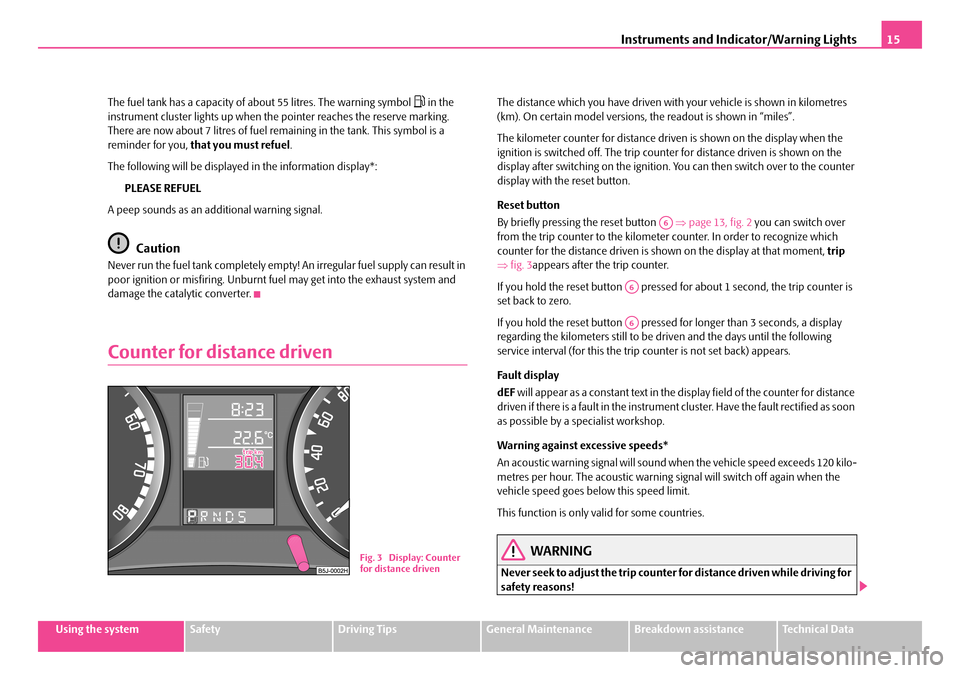
Counter for distance driven
The distance which you have driven with your vehicle is shown in kilometres (km). On certain model versions, the readout is shown in “miles”.
The kilometer counter for distance driven is shown on the display when the ignition is switched off. The trip count er for distance driven is shown on the display after switching on the ignition. Yo u can then switch over to the counter display with the reset button.
Reset button
By briefly pressing the reset button ⇒page 13, fig. 2 you can switch over from the trip counter to the kilomete r counter. In order to recognize which counter for the distance driven is shown on the display at that moment, trip ⇒ fig. 3appears after the trip counter.
If you hold the reset button pressed fo r about 1 second, the trip counter is set back to zero.
If you hold the reset button pressed for longer than 3 seconds, a display regarding the kilometers still to be driven and the days until the following service interval (for this the trip counter is not set back) appears.
Fa u l t d i s p l a y
dEF will appear as a constant text in the display field of the counter for distance driven if there is a fault in the instrument cluster. Have the fault rectified as soon as possible by a specialist workshop.
Warning against excessive speeds*
An acoustic warning signal will sound wh en the vehicle speed exceeds 120 kilo- metres per hour. The acoustic warning si gnal will switch off again when the vehicle speed goes below this speed limit.
This function is only valid for some countries.
WARNING
Never seek to adjust the trip counter for distance driven while driving for safety reasons!
Fig. 3 Display: Counter for distance driven
A6
A6
A6
NKO A05Fabia 20.book Page 15 Tuesday, September 26, 2006 8:38 AM
Page 106 of 258
Starting-off and Driving105
Using the systemSafetyDriving TipsGeneral MaintenanceBreakdown assistanceTechnical Data
Starting the engine
General
You can only start the engine only using an original ignition
key.
•Place the gearshift lever into neutral an d put on the handbrake firmly before starting the engine.
•The clutch pedal should be fully depr essed when starting the engine which means that the starter only has to crank the engine.
•Let go of the key as soon as the engine starts otherwise there may be damage to the starter.
The engine running noises ma y louder at first be louder for a short time after starting the cold engine until oil pressure can be built up in the hydraulic valve clearance compensation. This is quite normal and is not an operating problem.
If the engine does not start ...
You can use the battery of anothe r vehicle as a jump-start aid ⇒page 229.
It is only possible to tow-start vehicl es fitted with a manual gearbox. The tow- starting distance must not be more than 50 metres ⇒page 233.
WARNING
•Never run the engine in non ventilated or enclosed areas. The exhaust gases of the engine contain besides the odorless and colourless carbon monoxide a poisonous gas - hazard! Carbon monoxide can cause unconsciousness and death.
•Never leave your vehicle unattended with the engine running.
Caution
•The starter may only be operated (ignition key position ), if the engine is not running. If the starter is immediately operated after switching off the engine, the starter or the engine can be damaged.
•Avoid high engine revolutions, full thrott le and high engine loads as long as the engine has not yet reached its norm al operating temperature - risk of damaging the engine!
•Vehicles which are fitted with an exha ust gas catalytic converter should not be tow-started over a distance of more than 50 metres.
For the sake of the environment
Never warm up the engine when the vehi cle is standing. Drive off right away. When driving the engine reaches its operating temperature more rapidly and the pollutant emissions are lower.
Petrol engines
These engines are fitted with a starter system which selects the correct fuel/air mixture for every external air temperature.
•Do not operate accelerator before and when starting engine.
•Interrupt the attempt at starting after 10 seconds if the engine does not start right awayand wait for about 30 seconds before repeating the attempt.
•It is possible that the fuse on the electrical fuel pump is defect if the engine still does not start. Check the fuse and replace it if necessary ⇒page 235.
•If the engine does not start, contact the nearest specialist garage to obtain professional assistance.
It may be necessary, if the engine is very hot, to slightly depress the accelerator after the engine has started.
A3
NKO A05Fabia 20.book Page 105 Tuesday, September 26, 2006 8:38 AM
Page 175 of 258
Driving and the Environment174
New brake pads
Allow for the fact that new brake pads do not achieve their full braking efficiency until approximately 200 ki lometres. New brake pads must be first “run in” before they develop their optimal friction force. You can, however, compensate for this slightly reduced braking force by increasing the pressure on the brake pedal.
This guideline also applies to any new brake pads installed at a future date.
During the running-in peri od, you should avoid excessive stresses on the brakes. This includes, for example, violen t braking, particularly from very high speeds, and also when cr ossing mountain passes.
Catalytic converter
Proper operation of the emission control system (catalytic
converter) is of major significan ce for driving your vehicle in
an environmentally conscious way.
Please refer to the following guidelines:
– For vehicles with petrol engine only refuel with unleaded petrol
⇒ page 193, “Grades of petrol”.
– Never run the fuel tank completely empty.
– Do not switch off the ignition while you are driving the vehicle.
– Do not pour too much oil into the engine ⇒page 202, “Replen-
ishing engine oil”.
– Do not tow-start the vehicle over a distance of more than 50
metres ⇒page 233, “Tow-starting a vehicle”.
If you drive your vehicle in a country in which unleaded petrol is not available, you must have the catalyti c converter replaced later when driving the vehicle into a country in which use of a catalytic converter is mandatory.
WARNING
•In view of the high temperatures which may be produced in the cata- lytic converter, one should always park a vehicle in such a way that the catalytic converter cannot come into contact with easily flammable materials below the vehicle - a risk of fire!
•Never use additional underbody protection or corrosion-protection agents for the exhaust pipes, catalyti c converters or heat shields. Such substances might ignite when driving - risk of fire!
Caution
•Vehicles fitted with catalytic converte r should never be allowed to let the fuel tank to run completely empty. An ir regular fuel supply can result in poor ignition or misfiring. Unburnt fuel may get into the exhaust system and damage the catalytic converter.
•Filling the tank even only once with lead ed petrol will result in the catalytic converter being destroyed.
•If you detect misfiring, a drop in pe rformance or irregular engine running when driving, reduce your speed immediately and have the vehicle inspected by the nearest specialist garage. The sy mptoms described may be caused by a fault in the ignition system. Unburnt fu el may get into the exhaust system and damage the cata lytic converter.
For the sake of the environment
Even if the exhaust system is operating properly, a sulphur-like exhaust odour may be produced under certain operat ing conditions of the engine. This depends on the sulphur content of the fuel. It is often sufficient to refuel with unleaded premium-grade petrol of a diff erent brand or at a different filling station.
NKO A05Fabia 20.book Page 174 Tuesday, September 26, 2006 8:38 AM
Page 179 of 258
Driving and the Environment178
– Avoid driving a distance of no more than 4 km if the engine is cold.
The engine and catalytic converter must first have reached their optimal oper- ating temperature in order to effectively reduce fuel consumption and pollutant emissions.
The cold engine vehicle consumes approx. 15 - 20 litres/100 km of fuel imme- diately after starting. Fuel consumption drops to 10 litres/100 km after just 1 kilometre. The engine reaches its operating temperature (outside temperature and engine dependent) only after about 4 to 10 kilometres and the fuel consumption then stabilizes. You should therefore avoid driving short distances whenever possible.
An important factor in this connection is also the ambient temperature. The ⇒ page 177, fig. 138 shows the different fuel consumptions for the same distance, on the one hand at +20°C an d on the other hand at -10°C. Your vehicle has a higher fuel consum ption in winter than in summer.
Checking tyre inflation pressures
Tyres which are correctly inflated save fuel.
Always ensure that your tyres are inflated to the correct pressure at all times. The rolling resistance will be increased if the tyre filling pressure is too low. This will not only increase fuel consumptio n but also tyre wear and the driving behaviour will worsen.
Always check the inflation pr essure of the tyres when cold.
Do not drive with winter tyres all year round for this costs about 10 % more fuel. Winter tyres are also louder.
No unnecessary ballast
Transporting ballast costs fuel.
The fact that every kilogram of extra weight increases your fuel consumption means that it is worth taking a look in the luggage compartment to avoid trans- porting any unnecessary ballast.
It is particularly in town traffic, when one is accelerating quite often, that the vehicle weight will have a significant effe ct upon the fuel consumption. A rule of thumb here is that an increase in weight of 100 kilograms will cause an increase in fuel consumption of about 1 litre/100 kilometres.
You may frequently also leave a roof rack fitted on just out of convenience, although you no longer need it. The incr eased aerodynamic drag of your vehicle causes it to use about 1 l more fuel th an normal at a speed of 100 - 120 km/h, even when you are not carrying a load on the roof.
Saving electricity
Generating electricity costs fuel.
– Switch off electrical components as soon as you no longer need
them.
When the engine is running, the alternator generates and supplies electrical power. If more electrical components are switched on, more fuel is needed to operate the alternator.
NKO A05Fabia 20.book Page 178 Tuesday, September 26, 2006 8:38 AM
Page 191 of 258
Taking care of your vehicle and cleaning the vehicle190
Underbody protection
The underside of your vehicle is protected for life against chemical and mechanical influences.
One cannot, however, complete ly rule out damage to the protective layer when driving so we recommend that you inspect the protective layer on the underside of your ve hicle and on the chassis at certain intervals - this is best done at the beginning and end of the winter - and to touch up any damaged areas.
Škoda Service Partne rs have suitable spray products available as well as the necessary equipment and are familiar with the instructions for use. We there- fore recommend to have repairs and addi tional corrosion protection measures preferably carried out by a Škoda Service Partner.
WARNING
Never use additional underbody protection or corrosion-protection agents for the exhaust pipes, catalytic converters or heat shields. Such substances might ignite when driving - risk of fire!
Protection of hollow spaces
All the cavities of your vehicle which are at risk from corrosion are protected for life by a layer of protective wax applied in the factory.
This wax protection does not require to be inspected or re-treated. Please remove any small amount of wax which flow s out of the cavities at high temper- atures with a plastic scraper and cl ean the spot using petroleum cleaner.
WARNING
Safety and environmental protection regulations should observed when using petroleum cleaner to remove wax - a risk of fire!
Engine compartment
Good corrosion protection is very import ant, particularly in winter when one often drives over its salt-strewn roads. One should therefore clean the entire engine compartment before and after the salt spreading period, in order to prevent the salt from being destructive.
Škoda Service Partners have the cleani ng agents recommended by the manu- facturer and also the required equipment.
WARNING
•It is necessary to observe the guid elines given in the chapter before working on the engine compartment ⇒page 198.
•Let the engine cool down before cleaning the engine compartment.
Caution
•Engine cleaning may be only be undertaken when the ignition is off.
•It is recommended to cover the generator before washing the engine compartment.
For the sake of the environment
The dirty water produced by washing the engine has washed away petrol, and residues of grease and oil and should therefore be cleaned by an oil separator. This is why engine washing should only be undertaken in a garage or at a fueling station (when these are fitted with the required equipment).
NKO A05Fabia 20.book Page 190 Tuesday, September 26, 2006 8:38 AM
Page 194 of 258
Fuel193
Using the systemSafetyDriving TipsGeneral MaintenanceBreakdown assistanceTechnical Data
Fuel
Petrol
Grades of petrol
There are various grades of petrol. Please read the brochure “Technical Data” in order to know which grade of petrol your vehicle requires. You will also find the same information affixed to the inside of the fuel filler flap of your vehicle ⇒ page 195, fig. 140.
A distinction is made between unleaded and leaded petrol. All Škoda vehicles with petrol engines are equipped with a catalytic converter and must therefore be only driven with unleaded petrol. Unleaded petrol complies with the standard EN 228 .
The individual grades of petrol are distinguished by their octane number (RON). Please adopt the following procedure if the grade of petrol which you normally use is not be availabl e in exceptional circumstances:
•Engines which need unleaded premium petrol 95 RON can also be run on unleaded regular petrol 91 RON. This does, however, result in a slight loss in performance.
•Engines which need unleaded premium plus petrol 98 RON can also be run on unleaded regular petrol 95 RON. Th is does, however, result in a slight loss in performance. You can in exceptional circumstances also use unleaded regular petrol of 91 RON in the event that neither unleaded premium petrol of 98 RON nor 95 RON is available. Refuel as soon as possible with unleaded premium plus of 98 RON or unleaded premium petrol of 95 RON.
If, in an emergency, the only fuel av ailable is one which has a lower octane number than that required by the engine then only drive at medium engine speeds and lower engine loadings.
You can make unlimited use of fuel which has a higher octane number than that required by the engine. There will, however, be no advantages gained by this in terms of engine performance and fuel consumption!
The handling, performance and life of yo ur engine are determined to a signifi- cant extent by the quality of the fu el. Do not use any petrol additives. Use a fuel complying with the standard.
You can find further info rmation on refuelling ⇒page 195.
Caution
•Filling the tank even only once with leaded petrol will result in the catalytic converter being destroyed.
•Operating the engine with petrol of a low octane number than that required can result in engine damage at high revolutions or severe engine loading.
Diesel
Diesel fuel
Your vehicle can be operated with diesel fuel, which complies with the standard EN 590.
It is prohibited to use biofuel (RME) and diesel fuel mixture.
Fuel additives
You must not use fuel additives, so-called “flow improvers” (petrol and similar products) in diesel fuel.
NKO A05Fabia 20.book Page 193 Tuesday, September 26, 2006 8:38 AM
Page 196 of 258
Fuel195
Using the systemSafetyDriving TipsGeneral MaintenanceBreakdown assistanceTechnical Data
Refuelling
Opening the fuel filler cap
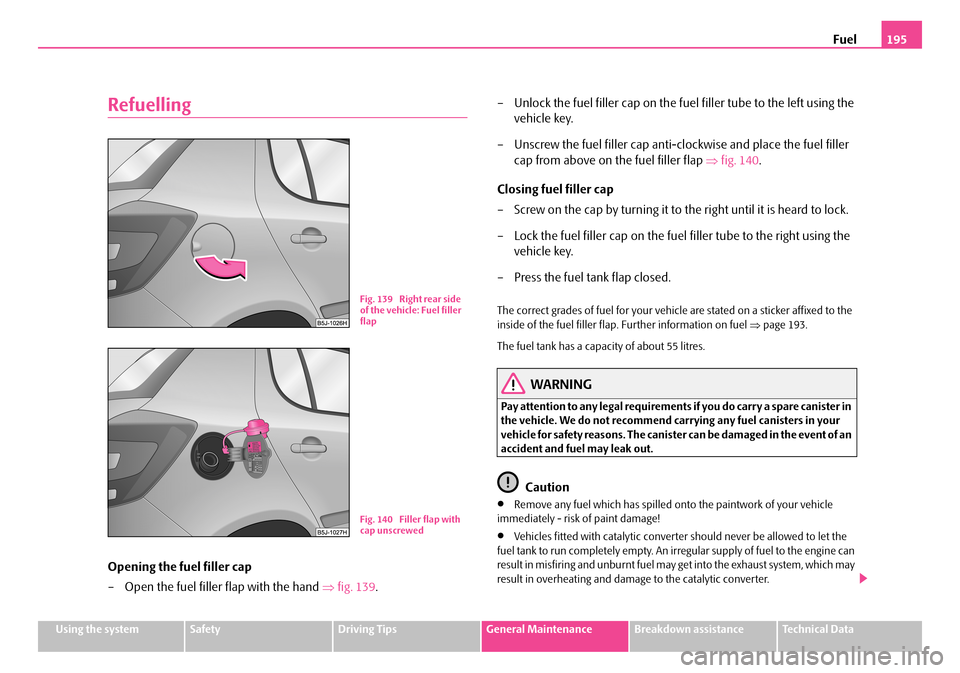
– Open the fuel filler flap with the hand ⇒fig. 139.
– Unlock the fuel filler cap on the fuel filler tube to the left using the
vehicle key.
– Unscrew the fuel filler cap anti-clockwise and place the fuel filler
cap from above on the fuel filler flap ⇒fig. 140.
Closing fuel filler cap
– Screw on the cap by turning it to the right until it is heard to lock.
– Lock the fuel filler cap on the fuel filler tube to the right using the
vehicle key.
– Press the fuel tank flap closed.
The correct grades of fuel for your vehicl e are stated on a sticker affixed to the inside of the fuel filler flap. Further information on fuel ⇒page 193.
The fuel tank has a capa city of about 55 litres.
WARNING
Pay attention to any legal requirements if you do carry a spare canister in the vehicle. We do not recommend ca rrying any fuel canisters in your vehicle for safety reasons. The canister can be damaged in the event of an accident and fuel may leak out.
Caution
•Remove any fuel which has spilled onto the paintwork of your vehicle immediately - risk of paint damage!
•Vehicles fitted with cata lytic converter should never be allowed to let the fuel tank to run completely empty. An irregular supply of fuel to the engine can result in misfiring and unburnt fuel ma y get into the exhaust system, which may result in overheating and dama ge to the catalytic converter.
Fig. 139 Right rear side of the vehicle: Fuel filler flap
Fig. 140 Filler flap with cap unscrewed
NKO A05Fabia 20.book Page 195 Tuesday, September 26, 2006 8:38 AM
Page 203 of 258
Inspecting and Replenishing202
The warning light in the instrument cluster* will indicate ⇒page 31 whether the oil level is too low. In this case, check the oil level as soon as possible. Top up with an appropriate quantity of oil.
WARNING
Read and observe the warning notes ⇒page 198, “Working in the engine compartment” before working in the engine compartment.
Caution
•Always check the oil level on vehicles with engine 1.2 l/47 kW when the engine is warm. Otherwise the measuring result is incorrect und oil could be incorrectly replenished - risk of engine damage!
•The oil level must on no account ex tend beyond the range . Danger of damaging the catalytic converter.
•Do not continue your journey if for some reason it is not possible under the conditions prevailing to top up with oil. Switch the engine off and obtain professional assistance from a specialist garage, otherwise it could lead to severe engine damage.
Replenishing engine oil
– Inspect the oil level ⇒page 201.
– Unscrew the cap of the engine oil filler opening.
– Pour in a suitable grade of oil in portions of 0.5 litres ⇒page 200,
“Engine oil specifications”.
– Inspect the oil level ⇒page 201.
– Carefully screw on the cap of the filler opening and push the
dipstick in fully.
WARNING
•Avoid dripping oil onto hot parts of the engine when topping up will oil - a risk of fire!
•Read and observe the warning notes ⇒page 198, “Working in the engine compartment” before work ing in the engine compartment.
For the sake of the environment
The oil level must on no account be above the range ⇒page 201. Oil will otherwise be drawn in through the cran kcase ventilation and may pass through the exhaust system to atmosphere. The oil may combust in the catalytic converter and damage it.
Changing engine oil
The engine oil must be changed at the intervals stated in the Service schedule or according to the service interval indicator ⇒page 16.
WARNING
•Only carry out the engine oil change, if you have the required profes- sional knowledge!
•Read and observe the warning notes ⇒page 198, “Working in the engine compartment” before work ing in the engine compartment.
•Let the engine cool down - risk of burning from hot oil.
•Wear an eye protection - risk of caustic burns due to oil splashes.
Aa
Aa
NKO A05Fabia 20.book Page 202 Tuesday, September 26, 2006 8:38 AM
Page 234 of 258
Breakdown assistance233
Using the systemSafetyDriving TipsGeneral MaintenanceBreakdown assistanceTechnical Data
Rear towing eye
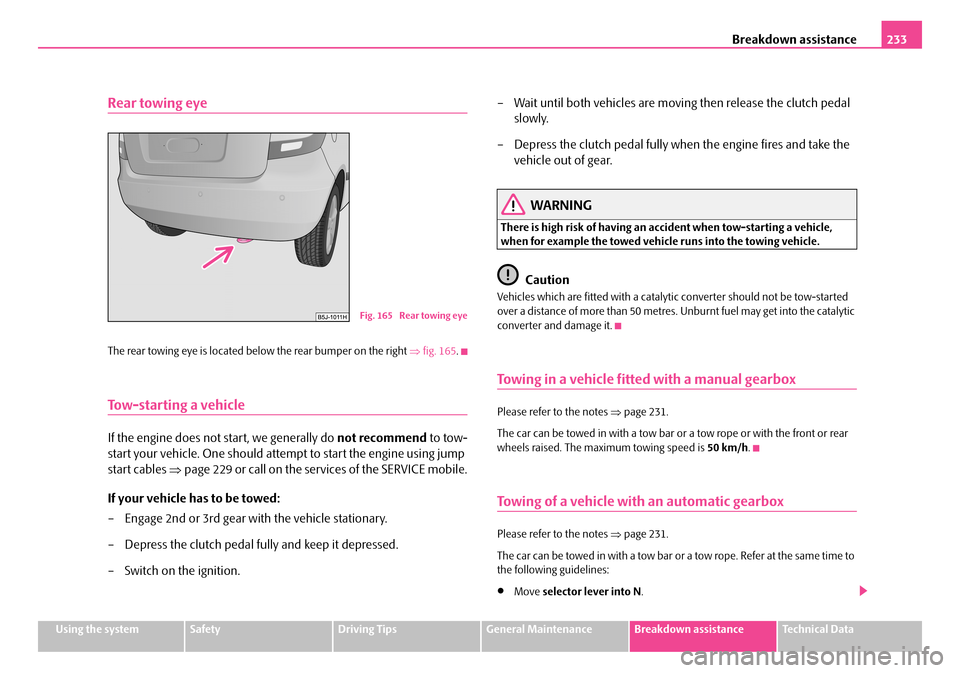
The rear towing eye is located below the rear bumper on the right ⇒fig. 165.
Tow-starting a vehicle
If the engine does not start, we generally do not recommend to tow-
start your vehicle. One should attempt to start the engine using jump
start cables ⇒page 229 or call on the services of the SERVICE mobile.
If your vehicle has to be towed:
– Engage 2nd or 3rd gear wi th the vehicle stationary.
– Depress the clutch pedal fully and keep it depressed.
– Switch on the ignition.
– Wait until both vehicles are movi ng then release the clutch pedal
slowly.
– Depress the clutch pedal fully when the engine fires and take the
vehicle out of gear.
WARNING
There is high risk of having an accident when tow-starting a vehicle, when for example the towed vehicl e runs into the towing vehicle.
Caution
Vehicles which are fitted with a catalytic converter should not be tow-started over a distance of more than 50 metres . Unburnt fuel may get into the catalytic converter and damage it.
Towing in a vehicle fitted with a manual gearbox
Please refer to the notes ⇒page 231.
The car can be towed in with a tow bar or a tow rope or with the front or rear wheels raised. The maximum towing speed is 50 km/h.
Towing of a vehicle with an automatic gearbox
Please refer to the notes ⇒page 231.
The car can be towed in with a tow bar or a tow rope. Refer at the same time to the following guidelines:
•Move selector lever into N.
Fig. 165 Rear towing eye
NKO A05Fabia 20.book Page 233 Tuesday, September 26, 2006 8:38 AM