roof SKODA FABIA 2006 2.G / 5J Owner's Manual
[x] Cancel search | Manufacturer: SKODA, Model Year: 2006, Model line: FABIA, Model: SKODA FABIA 2006 2.G / 5JPages: 258, PDF Size: 44.86 MB
Page 3 of 258
Introduction2
On-board literature
The on-board literature for your vehicle consists of this “ Owner's
Manual ” as well as the brochures “Service schedule”, “Brief instruc-
tion ”, “Technical data” and “Help on the road”. There can also be a
variety of other additional operat ing manuals and instructions on-
board (e.g. an operating manual for the radio) depending on the
vehicle model and equipment.
If one of the publications listed ab ove is missing, please contact a
Škoda Service Partner immediately, where one will be glad to assist
you in such matters.
One should note that the details given in the vehicle's papers
always take precedence over those in the Owner's Manual.
Owner's Manual
This Owner's Manual describes the current scope of equipment.
Certain items of equipment listed ar e only installed later on and only
envisaged for particular markets. The illustrations can differ in minor
details from your vehicle; they are only intended for general informa-
tion.
In addition to information regarding all the controls and equipment,
the Owner's Manual also contains important information regarding
care and operation for your safety and also to retain the value of your
vehicle. To provide you with valuab le tips and aids. You can learn how
how you can operate your vehicle safely, economically and in an
environmentally conscious way.
For safety reasons, please also pay attention to the information
on accessories, modifications and replacement of parts
⇒ page 220.
The other chapters of the Owner's Manual are also important,
however, for proper treatment of your car - in addition to regular care
and maintenance - helps to retain its value and in many cases is also
one of the conditions for possible warranty claims.
The Brief instruction
includes an overview of the most important controls of your vehicle.
The Service schedule
contains:
•Vehicle data,
•Service intervals,
•Overview of the service work,
•Service proof,
•Confirmation of mobility warranty,
•important information on the warranty.
The confirmations of the carried out service work are one of the
conditions for possible warranty claims.
Please always present the Service sc hedule when you take your car to
a Škoda Service Partner.
If the Service schedule is missing or worn, please contact your Škoda
Service Partner, where your car is se rviced regularly. You will receive a
duplicate, in which the previously carried out service work are
confirmed.
Help on the road
contains the addresses and telephone numbers of Škoda Importers.
NKO A05Fabia 20.book Page 2 Tuesday, September 26, 2006 8:38 AM
Page 6 of 258
Contents5
Contents
Layout of this Owner's Manual
(explanations). . . . . . . . . . . . . . . . . . . . . . . . . .
Using the system. . . . . . . . . . . . . . . . . . . . . .
Cockpit. . . . . . . . . . . . . . . . . . . . . . . . . . . . . . . . . . . . . . . . General view . . . . . . . . . . . . . . . . . . . . . . . . . . . . . . . . .
Instruments and Indicator/Warning Lights. . . General view of the instrument cluster . . . . . . . . . Engine revolutions counter . . . . . . . . . . . . . . . . . . . . Coolant temperature gauge* . . . . . . . . . . . . . . . . . . Fuel gauge* . . . . . . . . . . . . . . . . . . . . . . . . . . . . . . . . . . Counter for distance driven . . . . . . . . . . . . . . . . . . . Service Interval Display . . . . . . . . . . . . . . . . . . . . . . . Digital clock . . . . . . . . . . . . . . . . . . . . . . . . . . . . . . . . . . Multi-functional indicato r (onboard computer)* Information display* . . . . . . . . . . . . . . . . . . . . . . . . . . Auto Check Control . . . . . . . . . . . . . . . . . . . . . . . . . . . Warning lights . . . . . . . . . . . . . . . . . . . . . . . . . . . . . . . .
Unlocking and locking . . . . . . . . . . . . . . . . . . . . . . . . Key . . . . . . . . . . . . . . . . . . . . . . . . . . . . . . . . . . . . . . . . . . Locking . . . . . . . . . . . . . . . . . . . . . . . . . . . . . . . . . . . . . . Child safety lock . . . . . . . . . . . . . . . . . . . . . . . . . . . . . . Central locking system* . . . . . . . . . . . . . . . . . . . . . . . Remote control* . . . . . . . . . . . . . . . . . . . . . . . . . . . . . . Anti-theft alarm system* . . . . . . . . . . . . . . . . . . . . . . Interior monitor* and Towing protection* . . . Power windows* . . . . . . . . . . . . . . . . . . . . . . . . . . . . . Electric sliding/tilting roof* . . . . . . . . . . . . . . . . . . . .
Lights and Visibility . . . . . . . . . . . . . . . . . . . . . . . . . . . Lights . . . . . . . . . . . . . . . . . . . . . . . . . . . . . . . . . . . . . . . . Interior lighting . . . . . . . . . . . . . . . . . . . . . . . . . . . . . . .
Visibility . . . . . . . . . . . . . . . . . . . . . . . . . . . . . . . . . . . . . Windshield wiper and wash system . . . . . . . . . . . . Rear mirror . . . . . . . . . . . . . . . . . . . . . . . . . . . . . . . . . .
Seats and Stowage. . . . . . . . . . . . . . . . . . . . . . . . . . . . Front seats . . . . . . . . . . . . . . . . . . . . . . . . . . . . . . . . . . . Head restraints . . . . . . . . . . . . . . . . . . . . . . . . . . . . . . . Heating the front seats* . . . . . . . . . . . . . . . . . . . . . . . Rear seats . . . . . . . . . . . . . . . . . . . . . . . . . . . . . . . . . . . . Pedals . . . . . . . . . . . . . . . . . . . . . . . . . . . . . . . . . . . . . . . luggage compartment . . . . . . . . . . . . . . . . . . . . . . . . The roof rack* . . . . . . . . . . . . . . . . . . . . . . . . . . . . . . . . Front cup holder . . . . . . . . . . . . . . . . . . . . . . . . . . . . . Rear cup holder* . . . . . . . . . . . . . . . . . . . . . . . . . . . . . Note holder . . . . . . . . . . . . . . . . . . . . . . . . . . . . . . . . . . Ashtray* . . . . . . . . . . . . . . . . . . . . . . . . . . . . . . . . . . . . . Cigarette lighter* and power sockets* . . . . . . . . . . Storage compartments . . . . . . . . . . . . . . . . . . . . . . . .
Heating and air conditioning system. . . . . . . . . Heating . . . . . . . . . . . . . . . . . . . . . . . . . . . . . . . . . . . . . . Climatic (semi-automatic air conditioning system)* . . . . . . . . . . . . . . . . . . . . . . . . . . . . . . . . . . . . . Climatronic (automatic air conditioning)* . . . . . .
Starting-off and Driving. . . . . . . . . . . . . . . . . . . . . . . Setting steering wheel position* . . . . . . . . . . . . . . . Ignition lock . . . . . . . . . . . . . . . . . . . . . . . . . . . . . . . . . . Starting the engine . . . . . . . . . . . . . . . . . . . . . . . . . . . Switching off the engine . . . . . . . . . . . . . . . . . . . . . . . Shifting (manual gearbox) . . . . . . . . . . . . . . . . . . . . . Handbrake . . . . . . . . . . . . . . . . . . . . . . . . . . . . . . . . . . . Parking aid* . . . . . . . . . . . . . . . . . . . . . . . . . . . . . . . . . . Cruise control system (CCS)* . . . . . . . . . . . . . . . . . .
Automatic gearbox . . . . . . . . . . . . . . . . . . . . . . . . . . . 6-speed automatic gearbox* . . . . . . . . . . . . . . . . . .
Communication . . . . . . . . . . . . . . . . . . . . . . . . . . . . . . Operating the radio . . . . . . . . . . . . . . . . . . . . . . . . . . . Radio and mobile phone operation . . . . . . . . . . . . Universal telephone preinstallation with voice control* . . . . . . . . . . . . . . . . . . . . . . . . . . . . . . . . . . . . . Inserting the mobile phone and adapter . . . . . . . Mobile phone operation . . . . . . . . . . . . . . . . . . . . . . Voice commands . . . . . . . . . . . . . . . . . . . . . . . . . . . . . Enter PIN code . . . . . . . . . . . . . . . . . . . . . . . . . . . . . . . Select number . . . . . . . . . . . . . . . . . . . . . . . . . . . . . . . Repeat last call . . . . . . . . . . . . . . . . . . . . . . . . . . . . . . . Phone voice phonebook* . . . . . . . . . . . . . . . . . . . . . Bluetooth™* . . . . . . . . . . . . . . . . . . . . . . . . . . . . . . . . . Mobile phones and two-way radio systems . . . . . Input AUX-IN* . . . . . . . . . . . . . . . . . . . . . . . . . . . . . . . CD changer* . . . . . . . . . . . . . . . . . . . . . . . . . . . . . . . . .
Safety . . . . . . . . . . . . . . . . . . . . . . . . . . . . . . . . . . . . . .
Passive Safety . . . . . . . . . . . . . . . . . . . . . . . . . . . . . . . . . Basic information . . . . . . . . . . . . . . . . . . . . . . . . . . . . Correct seated position . . . . . . . . . . . . . . . . . . . . . . .
Seat belts. . . . . . . . . . . . . . . . . . . . . . . . . . . . . . . . . . . . . . Why seat belts? . . . . . . . . . . . . . . . . . . . . . . . . . . . . . . The physical principle of a frontal collision . . . . . Important safety information regarding the use of seat belts . . . . . . . . . . . . . . . . . . . . . . . . . . . . . . . . . . . . How are seat belts correctly fastened? . . . . . . . . . Belt tensioner . . . . . . . . . . . . . . . . . . . . . . . . . . . . . . . .
Airbag system. . . . . . . . . . . . . . . . . . . . . . . . . . . . . . . . . Description of the airbag system . . . . . . . . . . . . . . . Front airbags . . . . . . . . . . . . . . . . . . . . . . . . . . . . . . . . . Side airbags* . . . . . . . . . . . . . . . . . . . . . . . . . . . . . . . . .
8
9
11 11
13 13 14141415161717212326
38 38 4041414748495053
56 56 61
63 6467
69 69 717273757579818182828384
91 91
94 98
103 103 104105106107107108109
112 112
118 118 119
120 121122123124124125125128129130131
133
133 133 135
138 138 139
140 141143
144 144 146148
NKO A05Fabia 20.book Page 5 Tuesday, September 26, 2006 8:38 AM
Page 44 of 258
Unlocking and locking43
Using the systemSafetyDriving TipsGeneral MaintenanceBreakdown assistanceTechnical Data
•The door is unlocked by actuating the door-opening lever.
•The door opens upon actuating the door-opening lever again.
WARNING
If the vehicle is locked from the outside and the safe securing system is activated, there must not be any person and animals in the vehicle as it is then not possible to open either a door or a window from the inside. The locked doors make it more difficult for rescuers to get into the vehicle in an emergency - hazard!
Unlocking the vehicle using the key
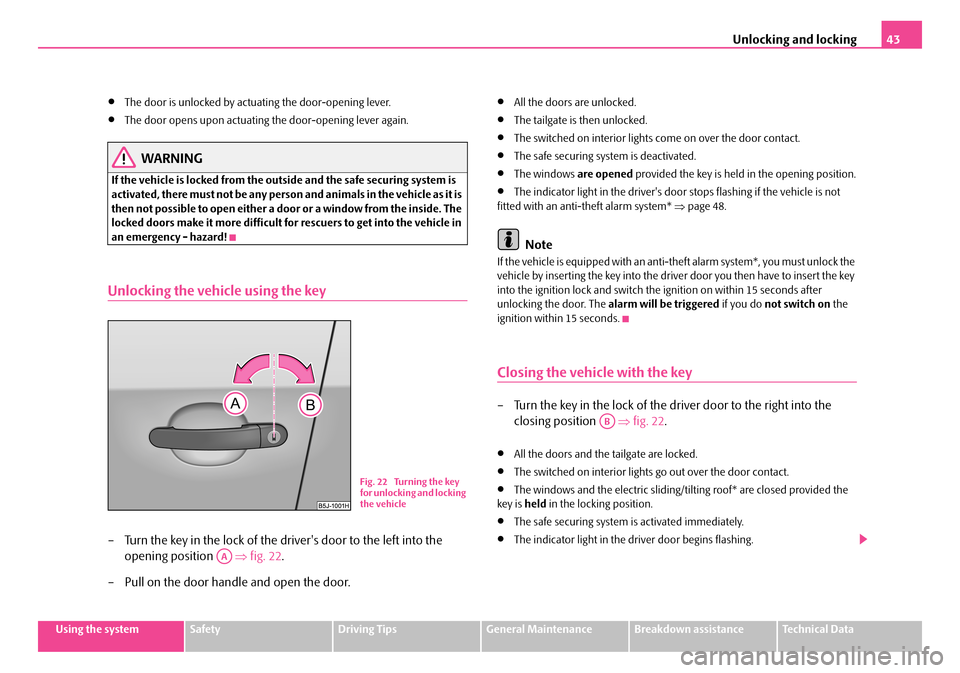
– Turn the key in the lock of the dr iver's door to the left into the
opening position ⇒fig. 22.
– Pull on the door handle and open the door.
•All the doors are unlocked.
•The tailgate is then unlocked.
•The switched on interior lights come on over the door contact.
•The safe securing system is deactivated.
•The windows are opened provided the key is held in the opening position.
•The indicator light in the driver's door stops flashing if the vehicle is not fitted with an anti-theft alarm system* ⇒page 48.
Note
If the vehicle is equipped with an anti-theft alarm system*, you must unlock the vehicle by inserting the key into the driver door you then have to insert the key into the ignition lock and switch th e ignition on within 15 seconds after unlocking the door. The alarm will be triggered if you do not switch on the ignition within 15 seconds.
Closing the vehicle with the key
– Turn the key in the lock of the dr iver door to the right into the
closing position ⇒fig. 22.
•All the doors and the tailgate are locked.
•The switched on interior lights go out over the door contact.
•The windows and the electric sliding/tilting roof* are closed provided the key is held in the locking position.
•The safe securing system is activated immediately.
•The indicator light in the driver door begins flashing.
Fig. 22 Turning the key for unlocking and locking the vehicle
AA
AB
NKO A05Fabia 20.book Page 43 Tuesday, September 26, 2006 8:38 AM
Page 50 of 258
Unlocking and locking49
Using the systemSafetyDriving TipsGeneral MaintenanceBreakdown assistanceTechnical Data
How is the alarm system switched on?
The anti-theft alarm system is activated automatically when the vehicle is locked with the key on the closed driver's door or by using the remote control. It is activated 30 seconds after closing the door.
How is the alarm sy stem switched off?
The anti-theft alarm system is switched off if the vehicle is unlocked by only using the remote control. The vehicle is automatically locked again if the vehicle is not opened within 30 seconds after reactivating the anti-theft alarm system.
Once you unlock the vehicle by inserting the key into the driver door you then have to insert the key into the ignition lock and switch the ignition on within 15 seconds after unlocking the door in order to deactivate the anti-theft alarm system. The alarm will be triggered if you do not switch on the ignition within 15 seconds.
When is the alarm triggered?
The following security areas of the locked vehicle are monitored:
•Bonnet,
•Tailgate,
•Doors,
•Ignition lock,
•Vehicle interior* ⇒page 49,
•Angle of the vehicle*,
•A drop in voltage of the on-board power supply.
An alarm is immediately triggered if either of the two battery terminals is disconnected while the anti-theft alarm system is activated.
How is the alarm switched off?
You switch the alarm off if you unlock th e car with the radio remote control in the key or if you switch the ignition on.
Note
•The working life of the alarm siren is 5 years. More detailed information is available from your Škoda Service Partner.
•Before leaving the car, check that all the doors, windows and the electric sliding/tilting roof* are properly closed in order to ensure that the anti-theft alarm system is fully operational.
•Coding of the radio remote control and the receptor part precludes the use of the radio remote control from other vehicles.
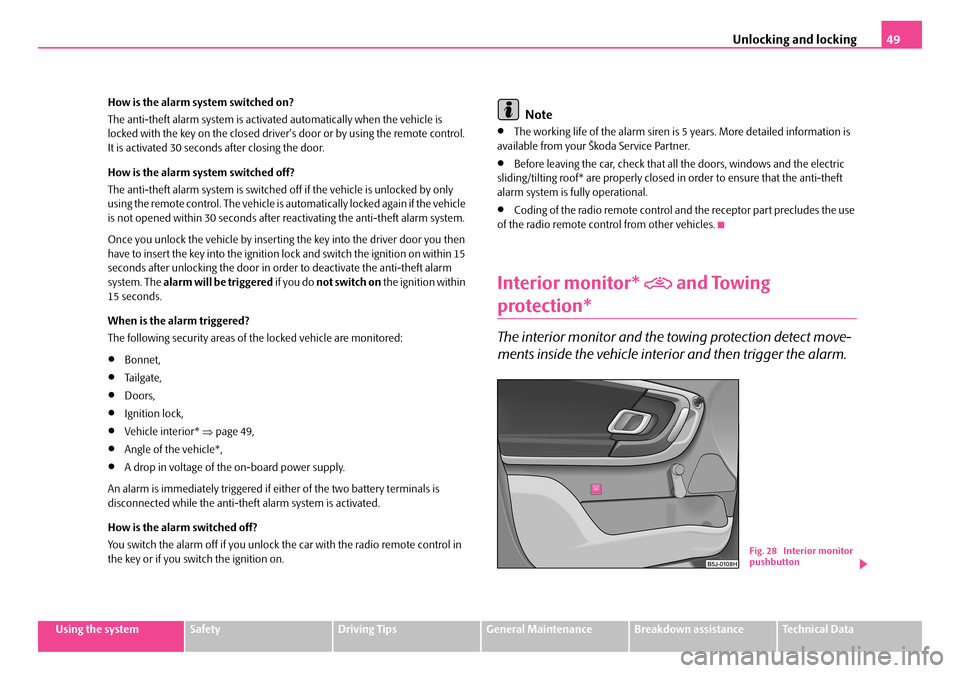
Interior monitor* and Towing
protection*
The interior monitor and the to wing protection detect move-
ments inside the vehicle interi or and then trigger the alarm.
Fig. 28 Interior monitor pushbutton
NKO A05Fabia 20.book Page 49 Tuesday, September 26, 2006 8:38 AM
Page 54 of 258

Unlocking and locking53
Using the systemSafetyDriving TipsGeneral MaintenanceBreakdown assistanceTechnical Data
Proceed as follows to close the window fully:
•turn the key in the lock of the driver door into the closing position and hold it there until all of the windows are closed,
•repeat this operation until the window stops.
WARNING
•Obstruction protection is not active during the closing of the windows ⇒ in “Switch for power windows” on page 50.
•You should take particular care when closing the windows! You may otherwise suffer severe injuries as a re sult of getting an arm, for example, jammed in the window!
Electric sliding/tilting roof*
Description
The sliding/tilting roof is operated by means of the control dial ⇒fig. 31 and only functions when the ignition is switched on. The control dial has a number of fixed positions.
After switching the ignition off, it is still possible to open or close the sliding/tilting roof for a further 10 minutes. It is no longer possible to operate the sliding/tilting roof after opening or closing one of the front doors, however.
Note
•If the battery has been disconnected and reconnected, it is possible that the sliding/tilting roof does not close fully. Here you have to set the control dial to the switch position and press it forward for about 10 seconds.
•It is necessary after each emergency op eration (using crank handle) to move the sliding/tilting roof into the basic position. Here you have to set the control dial to the switch position and press it forward for about 10 seconds.
Opening and tilting
Comfort position
– Turn the switch to position ⇒fig. 31.
Opening roof fully
– Turn the switch to position and hold it in this position (spring-
tensioned position).
Tilting roof
– Turn the switch to position .
The wind noise in the comfort position is less than when the roof is fully opened.Fig. 31 Control dial for the power sliding/tilting roof
AA
AA
AC
AB
AD
NKO A05Fabia 20.book Page 53 Tuesday, September 26, 2006 8:38 AM
Page 55 of 258
Unlocking and locking54
The sun screen is also opened automatically when the roof slides open. You can slide the sun screen into the opened or closed position by hand when the sliding/tilting roof is closed.
Caution
It m ay be ne ce ss ar y during winter to re move any i ce and s now in the a re a of the sliding/tilting roof before opening it in order to prevent damaging the opening mechanism and the seal.
Closing
Sliding closed/closing the sliding/tilting roof
– Turn the switch to position ⇒page 53, fig. 31.
Safety closing
The sliding/tilting roof is equipped with an overload protection system. The sliding/tilting roof stops and moves back several centimetres when it cannot be closed because there is something in the way (e.g. ice). You can close the sliding/tilting roof completely without overload protection by pressing the switch to the position ⇒page 53, fig. 31 at the front or rear for as long as it takes for the sliding/tilting roof to shut completely ⇒.
WARNING
Close the sliding/tilting roof carefully - risk of injury!
Convenience operation
You can also close an open sliding/tilting roof from the outside.
– Turn the key in the lock of the driv er door into the closing position
and hold until the sliding/tilting roof is closed ⇒.
The closing process stops when one releases the key.
WARNING
Close the sliding/tilting roof carefully - risk of injury! The overload protection system does not functi on with the convenience closing.
AA
AA
NKO A05Fabia 20.book Page 54 Tuesday, September 26, 2006 8:38 AM
Page 56 of 258

Unlocking and locking55
Using the systemSafetyDriving TipsGeneral MaintenanceBreakdown assistanceTechnical Data
Emergency operation
You can close the sliding/tilting roof by hand if the system is defect.
– Position the flat blade of a screwdriver carefully against the rear
edge of the cover of the electrical drive ⇒fig. 32.
– Pull the cover down.
– Take the crank handle out of the inside of the cover.
– Press the crank handle fully into the hexagon hole ⇒fig. 33.
– Hold the crank pressed and turn it - the roof closes.
– Insert the crank handle into the cover again.
– Press on the cover again by first of all inserting the plastic lugs and
then pushing the cover up.
– Have the fault rectified by a specialist workshop.
Note
It is necessary after each emergency operation (using crank handle) to move the sliding/tilting roof into the basic position. Here you have to press the control dial forward to switch position ⇒page 53, fig. 31 for about 10 seconds.
Fig. 32 Detail of the headliner: point for posi-tioning screwdriver
Fig. 33 Detail of the headliner: Emergency operation
A1A2
AA
NKO A05Fabia 20.book Page 55 Tuesday, September 26, 2006 8:38 AM
Page 63 of 258
Lights and Visibility62
– On the version without reading lights press the switch to the
right, the symbol O appears.
Reading lights
– Press on one of the switches ⇒page 61, fig. 40 in order to
switch the right or left reading light on or off.
Lighting of storage compartme nt on the front passenger side
– When opening the flap of the st orage compartment on the front
passenger side the lighting in the storage compartment comes on.
– The light switches on automatically when the parking light is
switched on and goes out when the flap is closed.
The interior light is switched on for about 20 seconds when a vehicle with a central locking system is unlocked, when a door is opened or when the ignition key is removed. The requirement for this is that the switch is in the door contact position. The inner light goes out out immediately after the ignition is switched on.
A time delay switch* causes the inner lighting on vehicles without a central locking system stays on for a few seconds after the doors have been closed. The inner light goes out out immediately after the ignition is switched on.
The interior lighting is switched off after about 30 minutes when a door has been left open in order to avoid discharging the battery of the vehicle.
Rear interior li ghting* - type 1
The rear interior lighting ⇒fig. 41 is actuated by moving the switch to the symbol , O or to the middle position .
The same principles apply for the interior lighting at the rear as for the for the interior lighting at the front ⇒page 61.
Note
We recommend having the bulb replaced by a specialist garage.
AA
AB
Fig. 41 Roof liner light at the rear
NKO A05Fabia 20.book Page 62 Tuesday, September 26, 2006 8:38 AM
Page 64 of 258

Lights and Visibility63
Using the systemSafetyDriving TipsGeneral MaintenanceBreakdown assistanceTechnical Data
Rear interior lighting* - type 2
The rear interior lighting is operated by pressing the button ⇒fig. 42.
The same principles apply for the interior lighting at the rear as for the for the interior lighting at the front.
Note
We recommend having the bulb re placed by a specialist garage.
Luggage compartment light
The lighting comes on automatically when the tailgate is opened. The luggage compartment lighting will switch off agai n automatically if the boot lid remains open for more than about 30 minutes.
Visibility
Rear window heater
– Press switch ⇒fig. 43 to switch on the rear window heater.
The rear window heater only operates when the engine is running. An indicator light in the switch is illuminated when the rear window heater is switched on.
The rear window heater switches off automatically after 20 minutes. If you press the switch once again, the rear window heater is switched on perma- nently - the automatic deactivation is thus deactivated.
For the sake of the environment
You should switch off the rear window heater as soon as the rear window is clear. The reduced current consumption will have a favourable effect on fuel economy ⇒page 178, “Saving electricity”.
Fig. 42 Roof liner light at the rear
Fig. 43 Switch for rear window heater
NKO A05Fabia 20.book Page 63 Tuesday, September 26, 2006 8:38 AM
Page 80 of 258
Seats and Stowage79
Using the systemSafetyDriving TipsGeneral MaintenanceBreakdown assistanceTechnical Data
The luggage compartment cover can also be put into the lower position on the supporting elements ⇒fig. 60.
The luggage compartment cover in the lower position is foreseen for storage of small objects of up to 6 kg. in weight.
The luggage compartment cover can also be stowed behind the rear seats ⇒ fig. 61.
WARNING
No objects should be placed on the luggage compartment cover, the vehicle occupants could be endangered if there is sudden braking or the vehicle collides with something.
Caution
Please ensure that the heating elements of the rear window heater are not damaged as a result of obje cts placed in this area.
Note
When opening the tailgate, lift the luggage compartment cover - risk that objects placed in this area can slip forward!
The roof rack*
Description
Pay attention to the following points if you wish to transport luggage or other items on the roof of your vehicle:
•A special roof luggage rack system was developed for the vehicle, that is why you should only use a roof luggage rack which has been released for use by Škoda Auto a.s.
•The base carrier is the basis for a comp lete roof luggage rack system. Sepa- rate additional holders are required for safety reasons for transporting luggage, bikes, surfboards, skis and boats.
•The basic version of the roof luggage rack system and further components are obtainable as accessories from Škoda Service Partners.
Caution
•If you use other roof rack systems or if the roof bars are not properly fitted, then any damage which may result to yo ur car is not covered by the warranty agreements. It is therefore essential to pay attention to the fitting instructions supplied with the roof luggage rack system.
•On models fitted with a power sliding/ tilting roof, ensure that the opened sliding/tilting roof does not strike any items of luggage transported on the roof.
•Ensure that the opened tailgate does not collide with the roof load.
For the sake of the environment
The increased aerodynamic drag results in a higher fuel consumption. One should therefore take off the roof bar system after use.
NKO A05Fabia 20.book Page 79 Tuesday, September 26, 2006 8:38 AM