coolant SKODA OCTAVIA 2005 1.G / (1U) Owner's Guide
[x] Cancel search | Manufacturer: SKODA, Model Year: 2005, Model line: OCTAVIA, Model: SKODA OCTAVIA 2005 1.G / (1U)Pages: 315, PDF Size: 11.8 MB
Page 254 of 315
Inspecting and Replenishing253
Using the systemSafetyDriving TipsGeneral MaintenanceBreakdown assistanceTechnical Data
Changing engine oil
The engine oil must be changed at the intervals stated in the Service
schedule or according to the service interval indicator ⇒page 16.
WARNING
•Only carry out the engine oil change, if you have the required
professional knowledge!
•Read and observe the warning notes ⇒page 248, “Working in
the engine compartment” before working in the engine compart-
ment.
•Let the engine cool down - risk of burning from hot oil.
•Wear an eye protection - risk of caustic burns due to oil
splashes.
•Oil is toxic! Store old oil in a safe place out of the reach of chil-
dren and unauthorized persons until you dispose of it properly.
Caution
You must not pour any additives into the engine oil - risk of engine
damage! Damage, which results from such product, are excluded from the
warranty.
For the sake of the environment
•You must on no account pour oil into the ground or into the sewage
system.
•In view of the problems involved in properly disposing of old oil, the
material, equipment and the knowledge required for such work, we recom-
mend that you have the oil and oil filter change carried out by your Škoda
dealer.
Note
After your skin has come in contact with the oil, you must thoroughly wash
your skin.
Cooling system
Coolant
The job of the coolant is to cool the engine.
The cooling system does not require any maintenance under normal oper-
ating conditions. The coolant consists of water with a concentration of
coolant additive of 40 %. This mixture not only provides antifreeze protec-
tion down to -25°C but also protects the cooling and heating system from
corrosion. It also prevents the formation of scale and significantly
increases the boiling point of the coolant.
You must therefore not reduce the concentration of antifreeze agent in the
coolant by adding water, also not during the summer months or in coun-
tries with a warm climate. The concentration of coolant additive in the
coolant must be at least 40%.
You can increase the amount of antifreeze in the coolant iIf a higher
concentration of antifreeze is necessary for climatic reasons but only up
to 60% (antifreeze protection down to approx. -40°C). The antifreeze
protection tails off above that concentration.
Vehicles exported to countries with a cold climate (e.g. Sweden, Norway,
Finland) are already factory-filled with a coolant which offers antifreeze
protection down to about -35°C. In these countries the concentration of
coolant additive should be at least 50 %.
s24s.book Page 253 Thursday, November 24, 2005 12:27 PM
Page 255 of 315
Inspecting and Replenishing
254
Coolant
The cooling system is filled at the works with coolant (purple in colour),
which complies with the specification TL-VW 774 F.
We recommend that you use the same coolant additive - G12 PLUS
(purple in colour).
Please contact your Škoda dealer if you have any questions regarding the
coolant or if you wish to fill up with a different coolant.
Your Škoda dealer can also supply you with the correct coolant additives.
Caution
•Other coolant additives may cause operational problems which,
in particular, involves significantly reducing the anticorrosion effect.
•Any faults or problems resulting from corrosion may cause a loss
of coolant and, as a consequence of this, result in major engine
damage.
Inspecting the coolant level
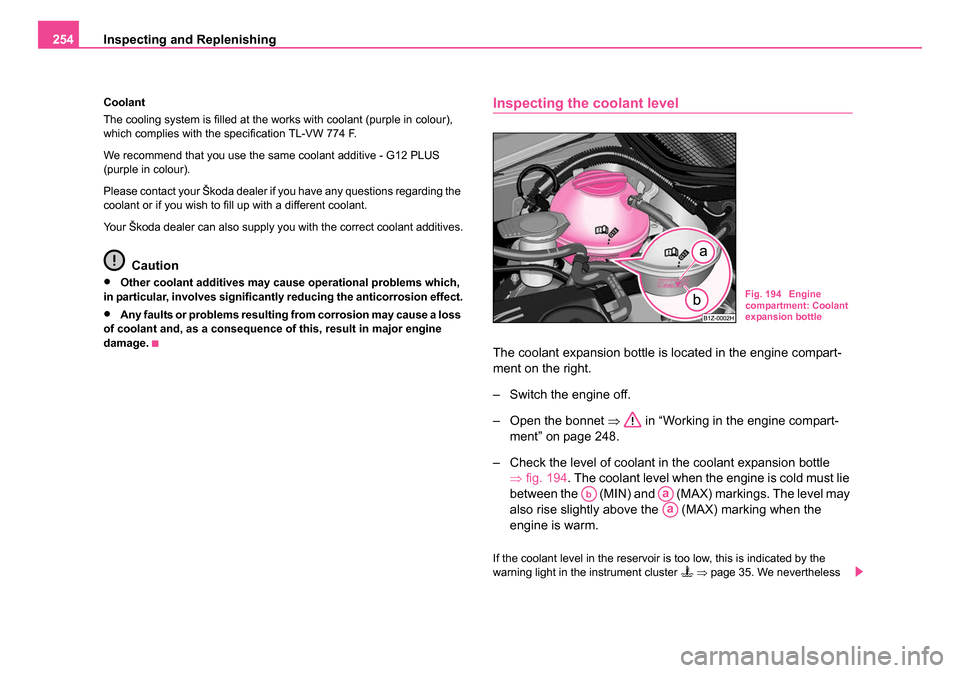
The coolant expansion bottle is located in the engine compart-
ment on the right.
– Switch the engine off.
– Open the bonnet ⇒ in “Working in the engine compart-
ment” on page 248.
– Check the level of coolant in the coolant expansion bottle ⇒fig. 194 . The coolant level when the engine is cold must lie
between the (MIN) and (MAX) markings. The level may
also rise slightly above the (MAX) marking when the
engine is warm.
If the coolant level in the reservoir is too low, this is indicated by the
warning light in the instrument cluster ⇒ page 35. We nevertheless
Fig. 194 Engine
compartment: Coolant
expansion bottle
AbAa
Aa
s24s.book Page 254 Thursday, November 24, 2005 12:27 PM
Page 256 of 315
Inspecting and Replenishing255
Using the systemSafetyDriving TipsGeneral MaintenanceBreakdown assistanceTechnical Data
recommend inspecting the coolant level directly at the reservoir from time
to time.
Loss of coolant
A loss of coolant is first and foremost an
indication of a leak in the
system. You should not merely top up the coolant in the reservoir. It is also
important to have the cooling system inspected without delay by a
specialist garage.
Losses can only occur through the pressure relief in the cap of the coolant
expansion bottle which is completely free of leaks if the coolant boils as a
result of overheating and is forced out of the cooling system.
WARNING
Read and observe the warning notes ⇒page 248, “Working in the
engine compartment” before working in the engine compartment.
Caution
One should contact a specialist garage as soon as possible if the source
of overheating itself cannot be determined and removed, since there may
be grave damage to the engine.
Replenishing the coolant
– Switch the engine off.
– Allow the engine to cool down.
– Place a cloth over the cap of the coolant expansion reservoir ⇒fig. 194 and unscrew the cap carefully by turning it to the
left ⇒ . – Top up the coolant.
– Screw the cap tight until it is heard to lock.
The coolant which you use for replenishing the system, must comply with
one specific specification
⇒page 253, “Coolant”. Do not use an alternative
additive if the coolant additive G12 PLUS is not available in exceptional
cases. Just top up the system with water and as soon as possible arrange
adjustment to correct the mixing ratio of water and coolant additive again
by a specialist garage.
Only use fresh coolant for topping up the system.
Do not fill up over the “MAX” marking! Excess coolant which is heated up
is forced out of the cooling system through the pressure relief valve in the
cap of the coolant compensation bottle.
Wait until the engine has cooled down for a system which has suffered a
major loss of coolant before pouring in coolant. This is necessary to avoid
engine damage.
WARNING
•The cooling system is pressurized! Do not open the cap of the
coolant expansion bottle if the engine is still hot - risk of scalding!
•The coolant additive and thus all of the coolant is harmful to
your health. Avoid contact with the coolant. Coolant vapours are
also harmful to the he alth. It is important, therefore, to always
safely store any coolant additive in its original container out of the
reach of children - risk of poisoning!
•If any splashes of coolant get into your eyes, rinse out your eyes
immediately with clear water and contact a doctor as soon as
possible.
•You should also consult a doctor without delay if you have inad-
vertently swallowed coolant.
s24s.book Page 255 Thursday, November 24, 2005 12:27 PM
Page 257 of 315
Inspecting and Replenishing
256
Caution
Do not continue your journey if for some reason it is not possible
under the conditions prevailing to top up with coolant. Switch of the
engine and contact and obtain professional assistance from a specialist
garage.
For the sake of the environment
Do not re-use coolant if it is necessary to drain the coolant in the system.
It should be collected and disposed of in compliance with environmental
protection regulations.
The radiator fan
The radiator fan may switch on suddenly.
The radiator fan is driven by an electric motor and controlled according to
the coolant temperature.
The radiator fan may continue running for up to 10 minutes after the
engine has been switched off - even if the ignition is also off. It may also
switch on suddenly after a certain time, if
•the coolant temperature has risen because of an accumulation of heat
or
•the warm engine compartment is heated up additionally by strong
sunlight.
WARNING
You must therefore be aware when working in the engine compart-
ment that the fan may switch on suddenly - risk of injury!
Brake fluid
Inspecting the brake fluid level
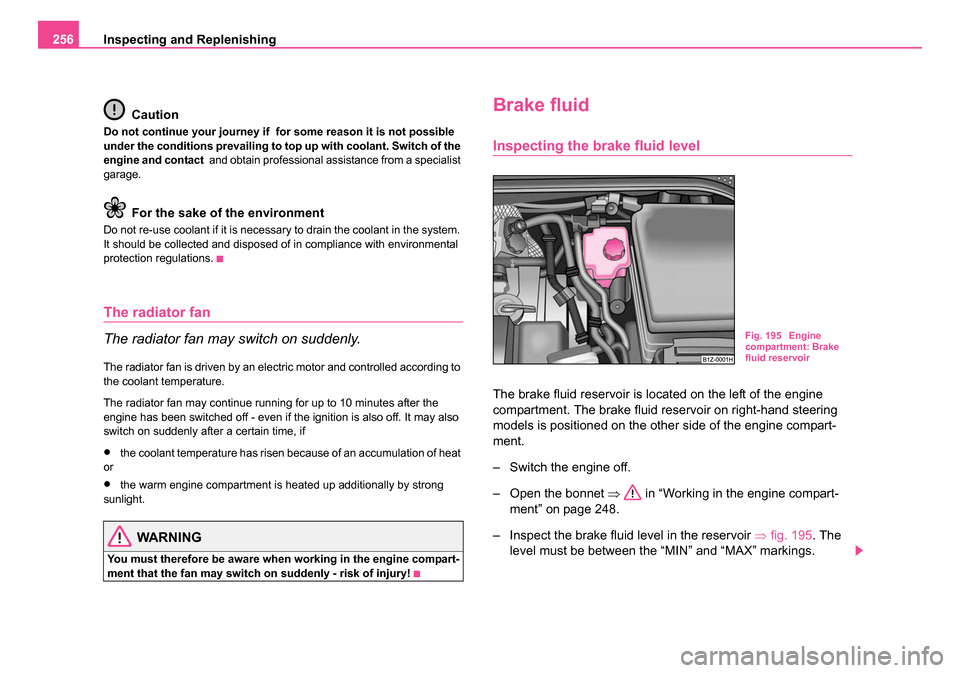
The brake fluid reservoir is located on the left of the engine
compartment. The brake fluid reservoir on right-hand steering
models is positioned on the other side of the engine compart-
ment.
– Switch the engine off.
– Open the bonnet ⇒ in “Working in the engine compart-
ment” on page 248.
– Inspect the brake fluid level in the reservoir ⇒fig. 195 . The
level must be between the “MIN” and “MAX” markings.
Fig. 195 Engine
compartment: Brake
fluid reservoir
s24s.book Page 256 Thursday, November 24, 2005 12:27 PM
Page 291 of 315
Fuses and light bulbs
290
Caution
•When unlocking and locking the fuse cover, it must be pressed on the
sides to the box, otherwise damage can occur to the locking mechanism.
•Carefully position the fuse cover in the engine compartment. If the
cover was not correctly positioned, water can get into the fuses and this
results in a damage to the vehicle!
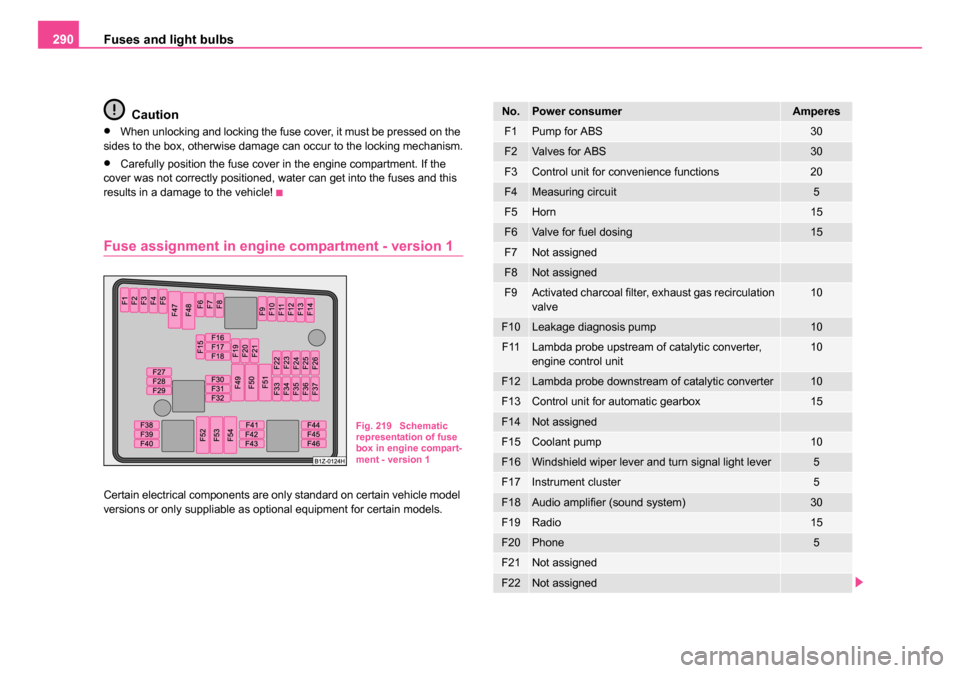
Fuse assignment in engine compartment - version 1
Certain electrical components are only standard on certain vehicle model
versions or only suppliable as optional equipment for certain models.
Fig. 219 Schematic
representation of fuse
box in engine compart-
ment - version 1
No.Power consumerAmperes
F1Pump for ABS30
F2Valves for ABS30
F3Control unit for convenience functions20
F4Measuring circuit5
F5Horn15
F6Valve for fuel dosing15
F7Not assigned
F8Not assigned
F9Activated charcoal filter, exhaust gas recirculation
valve10
F10Leakage diagnosis pump10
F11Lambda probe upstream of catalytic converter,
engine control unit10
F12Lambda probe downstream of catalytic converter10
F13Control unit for automatic gearbox15
F14Not assigned
F15Coolant pump10
F16Windshield wiper lever and turn signal light lever5
F17Instrument cluster5
F18Audio amplifier (sound system)30
F19Radio15
F20Phone5
F21Not assigned
F22Not assigned
s24s.book Page 290 Thursday, November 24, 2005 12:27 PM
Page 292 of 315
Fuses and light bulbs291
Using the systemSafetyDriving TipsGeneral MaintenanceBreakdown assistanceTechnical Data
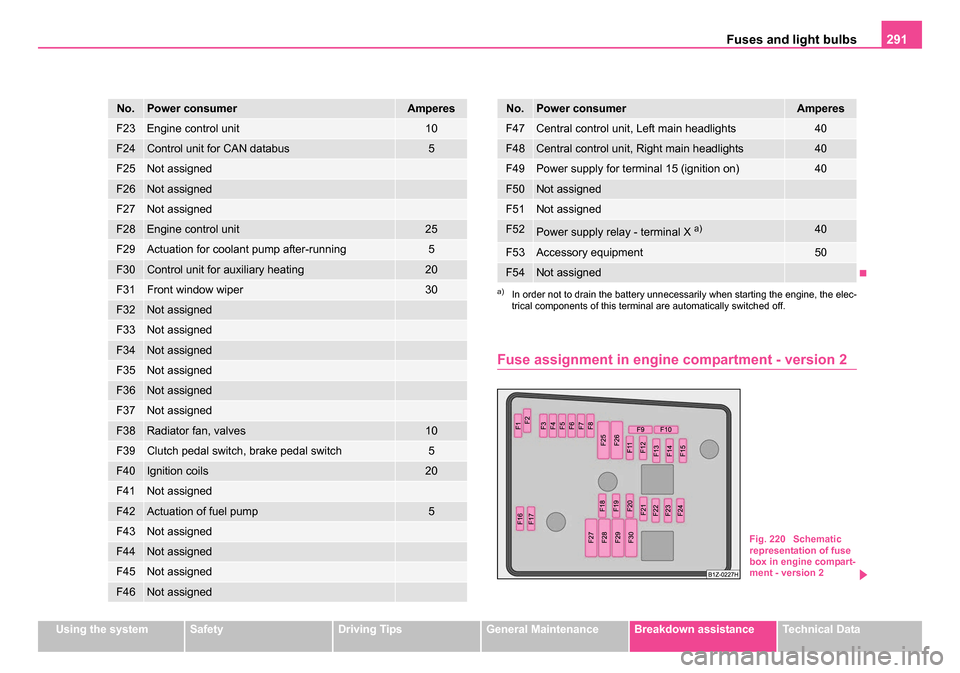
Fuse assignment in engine compartment - version 2
F23Engine control unit10
F24Control unit for CAN databus5
F25Not assigned
F26Not assigned
F27Not assigned
F28Engine control unit25
F29Actuation for coolant pump after-running5
F30Control unit for auxiliary heating20
F31Front window wiper30
F32Not assigned
F33Not assigned
F34Not assigned
F35Not assigned
F36Not assigned
F37Not assigned
F38Radiator fan, valves10
F39Clutch pedal switch, brake pedal switch5
F40Ignition coils20
F41Not assigned
F42Actuation of fuel pump5
F43Not assigned
F44Not assigned
F45Not assigned
F46Not assigned
No.Power consumerAmperes
F47Central control unit, Left main headlights40
F48Central control unit, Right main headlights40
F49Power supply for terminal 15 (ignition on)40
F50Not assigned
F51Not assigned
F52Power supply relay - terminal X a)40
F53Accessory equipment50
F54Not assigned
a)In order not to drain the battery unnecessarily when starting the engine, the elec-
trical components of this terminal are automatically switched off.
No.Power consumerAmperes
Fig. 220 Schematic
representation of fuse
box in engine compart-
ment - version 2
s24s.book Page 291 Thursday, November 24, 2005 12:27 PM
Page 307 of 315
Index
306
Child safety locks . . . . . . . . . . . . . . . . . . . . . 45
Child safety seats
ISOFIX system . . . . . . . . . . . . . . . . . . . 210
Child seat . . . . . . . . . . . . . . . . . . . . . . . . . . 206 Classification into groups . . . . . . . . . . . 206
on the front passenger seat . . . . . . . . . 204
Safety instructions . . . . . . . . . . . . . . . . . 202
Use of child seats . . . . . . . . . . . . . . . . . 206
Children and safety . . . . . . . . . . . . . . . . . . . 202
Chrome parts . . . . . . . . . . . . . . . . . . . . . . . 236
Cigarette lighter . . . . . . . . . . . . . . . . . . . . . 106
Cleaning . . . . . . . . . . . . . . . . . . . . . . . . . . . 233
Climatronic Air outlet vents . . . . . . . . . . . . . . . . . . . 133
Defrosting windows . . . . . . . . . . . . . . . . 131
Recirculated air mode . . . . . . . . . . . . . . 132
Setting temperature . . . . . . . . . . . . . . . . 132
Climatronic (automatic air conditioning) . . . 128
Clock . . . . . . . . . . . . . . . . . . . . . . . . . . . . . . . 17
Clothes hooks . . . . . . . . . . . . . . . . . . . . . . . 117
Cockpit An overview . . . . . . . . . . . . . . . . . . . . . . . 11
Compartments . . . . . . . . . . . . . . . . . . . . . . 108
Computer . . . . . . . . . . . . . . . . . . . . . . . . . . . 18
Convenience operation . . . . . . . . . . . . . . . . . 58
Converting/masking over headlights . . . . . . 228
Coolant . . . . . . . . . . . . . . . . . . . . . . . . . . . . 253 replenishing . . . . . . . . . . . . . . . . . . . . . . 255
Warning light . . . . . . . . . . . . . . . . . . . . . . 35 Coolant level
Warning light . . . . . . . . . . . . . . . . . . . . . . 35
Coolant quantity Warning light . . . . . . . . . . . . . . . . . . . . . . 35
Coolant temperature gauge . . . . . . . . . . . . . 14
Coolant temperature/coolant level Warning light . . . . . . . . . . . . . . . . . . . . . . 35
Correct seated position . . . . . . . . . . . . . . . . 179
Counter for distance driven . . . . . . . . . . . . . . 15
Cruise control system . . . . . . . . . . . . . . . . . 146
Cup holder at the front . . . . . . . . . . . . . . . . . . . . . . . 103
at the rear . . . . . . . . . . . . . . . . . . . . . . . 104
D
Deactivating an airbag . . . . . . . . . . . . . . . . 199
Defrosting rear window . . . . . . . . . . . . . . . . . 72
De-icing the windows . . . . . . . . . . . . . . . . . 236
Detachable towing device . . . . . . . . . . . . . . 231
Diesel . . . . . . . . . . . . . . . . . . . . . . . . . . . . . 242
Diesel enginesStarting engine . . . . . . . . . . . . . . . . . . . 141
Diesel particle filter . . . . . . . . . . . . . . . . . . . . 33
Digital clock . . . . . . . . . . . . . . . . . . . . . . . . . . 17
Dipstick . . . . . . . . . . . . . . . . . . . . . . . . . . . . 251
Direction indicators . . . . . . . . . . . . . . . . . . . . 68 Warning light . . . . . . . . . . . . . . . . . . . . . . 32
Display . . . . . . . . . . . . . . . . . . . . . . . . . . . . . 23
Displays . . . . . . . . . . . . . . . . . . . . . . . . . . . . 13 Distance driven . . . . . . . . . . . . . . . . . . . . . . . 15
Door
Child safety locks . . . . . . . . . . . . . . . . . . . 45
Driver-steering recommendation . . . . . . . . . 216
Driving economically . . . . . . . . . . . . . . . . . . 223
Dynamo Warning light . . . . . . . . . . . . . . . . . . . . . . 40
E
EDL . . . . . . . . . . . . . . . . . . . . . . . . . . . . . . . 214
Electric sliding/tilting roof . . . . . . . . . . . . . . . . 59
Electrically adjustable exterior mirrors . . . . . . 80
Electronic Differential Lock . . . . . . . . . . . . . 214
Electronic immobiliserWarning light . . . . . . . . . . . . . . . . . . . . . . 32
Electronic stability programme . . . . . . . . . . 213
Electronic stability programme (ESP) Warning light . . . . . . . . . . . . . . . . . . . . . . 40
Engine Starting . . . . . . . . . . . . . . . . . . . . . . . . . . 140
switch off . . . . . . . . . . . . . . . . . . . . . . . . 141
Engine compartment Safety instructions . . . . . . . . . . . . . . . . . 248
Engine electronics Warning light . . . . . . . . . . . . . . . . . . . . . . 34
Engine oil . . . . . . . . . . . . . . . . . . . . . . . . . . . 250 Changing . . . . . . . . . . . . . . . . . . . . . . . . 253
changing . . . . . . . . . . . . . . . . . . . . . . . . 253
check . . . . . . . . . . . . . . . . . . . . . . . . . . . 251
s24s.book Page 306 Thursday, November 24, 2005 12:27 PM