deactivate airbag SKODA OCTAVIA 2010 2.G / (1Z) User Guide
[x] Cancel search | Manufacturer: SKODA, Model Year: 2010, Model line: OCTAVIA, Model: SKODA OCTAVIA 2010 2.G / (1Z)Pages: 275, PDF Size: 16.43 MB
Page 164 of 275
Transporting children safely163
Using the system
Safety
Driving Tips
General Maintenance
Breakdown assistance
Technical Data
You should have the front passenger airbag (or airbags) reactivated just as
soon as you no longer use a child safe ty seat on the front passenger seat.
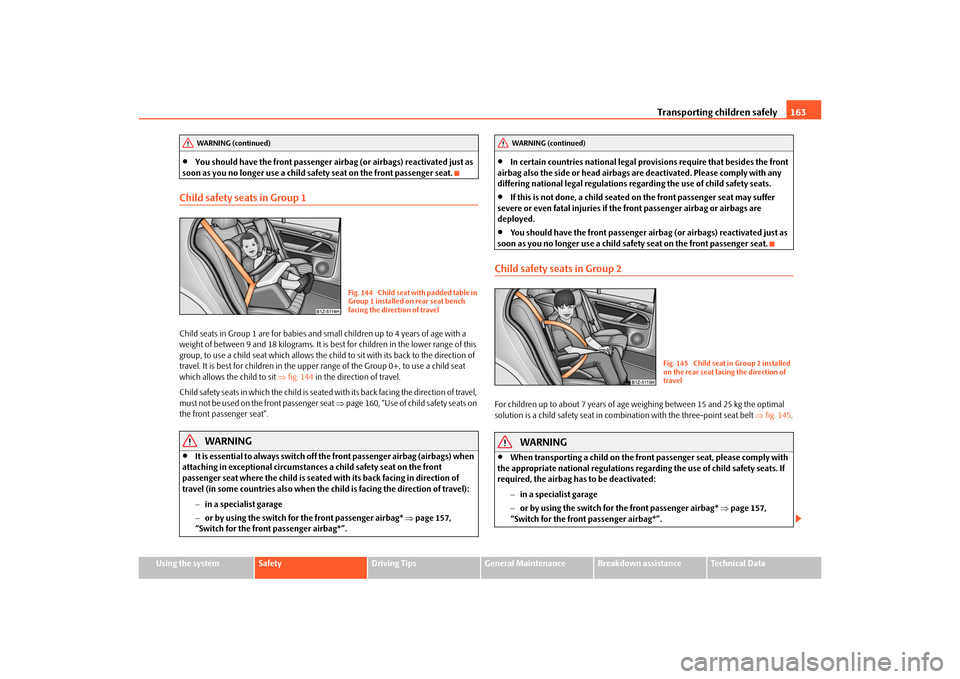
Child safety seats in Group 1Child seats in Group 1 are for babies and small children up to 4 years of age with a
weight of between 9 and 18 kilograms. It is best for children in the lower range of this
group, to use a child seat which allows the ch ild to sit with its back to the direction of
travel. It is best for children in the uppe r range of the Group 0+, to use a child seat
which allows the child to sit fig. 144 in the direction of travel.
Child safety seats in which the child is seated with its back facing the direction of travel,
must not be used on the front passenger seat page 160, “Use of child safety seats on
the front passenger seat”.
WARNING
It is essential to always switch off th e front passenger airbag (airbags) when
attaching in exceptional circumstances a child safety seat on the front
passenger seat where the child is seated with its back facing in direction of
travel (in some countries also when the child is facing the direction of travel):
in a specialist garage
or by using the switch for the front passenger airbag* page 157,
“Switch for the front passenger airbag*”.
In certain countries national legal provisions require that besides the front
airbag also the side or head airbags ar e deactivated. Please comply with any
differing national legal r egulations regarding the use of child safety seats.
If this is not done, a child seated on the front passenger seat may suffer
severe or even fatal injuries if the front passenger airbag or airbags are
deployed.
You should have the front passenger airbag (or airbags) reactivated just as
soon as you no longer use a child safe ty seat on the front passenger seat.
Child safety seats in Group 2For children up to about 7 years of age weighing between 15 and 25 kg the optimal
solution is a child safety seat in combination with the three-point seat belt fig. 145 .
WARNING
When transporting a child on the front passenger seat, please comply with
the appropriate national regulations regard ing the use of child safety seats. If
required, the airbag has to be deactivated:
in a specialist garage
or by using the switch for the front passenger airbag* page 157,
“Switch for the front passenger airbag*”.
WARNING (continued)
Fig. 144 Child seat with padded table in
Group 1 installed on rear seat bench
facing the direction of travel
WARNING (continued)
Fig. 145 Child seat in Group 2 installed
on the rear seat facing the direction of
travel
s43s.1.book Page 163 Thursday, May 13, 2010 1:21 PM
Page 165 of 275
Transporting children safely
164
The shoulder part of the seat belt mu st run approximately across the middle
of the shoulder and fit snugly against the chest. It must on no account run
across the neck. The lap part of the seat belt must run across the pelvis and fits
snugly; it must not run over the belly. Tighten the belt webbing over your hip if
necessary.
Please comply with any differing nati onal legal regulations regarding the
use of child safety seats.
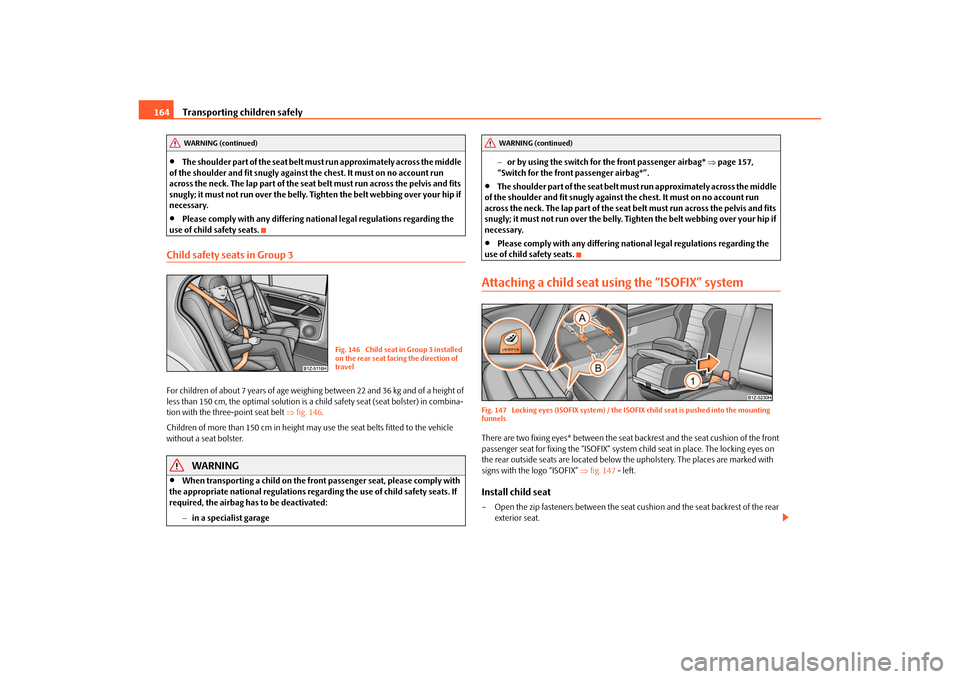
Child safety seats in Group 3For children of about 7 years of age weighing between 22 and 36 kg and of a height of
less than 150 cm, the optimal solution is a ch ild safety seat (seat bolster) in combina-
tion with the three-point seat belt fig. 146 .
Children of more than 150 cm in height may use the seat belts fitted to the vehicle
without a seat bolster.
WARNING
When transporting a child on the front passenger seat, please comply with
the appropriate national regu lations regarding the use of child safety seats. If
required, the airbag has to be deactivated:
in a specialist garage
or by using the switch for the front passenger airbag* page 157,
“Switch for the front passenger airbag*”.
The shoulder part of the seat belt mu st run approximately across the middle
of the shoulder and fit snugly against the chest. It must on no account run
across the neck. The lap part of the seat belt must run across the pelvis and fits
snugly; it must not run over the belly. Tighten the belt webbing over your hip if
necessary.
Please comply with any differing nati onal legal regulations regarding the
use of child safety seats.
Attaching a child seat using the “ISOFIX” systemFig. 147 Locking eyes (ISOFIX system) / the IS OFIX child seat is pushed into the mounting
funnelsThere are two fixing eyes* between the seat backrest and the seat cushion of the front
passenger seat for fixing the “ISOFIX” system child seat in place. The locking eyes on
the rear outside seats are located below th e upholstery. The places are marked with
signs with the logo “ISOFIX” fig. 147 - left.Install child seat– Open the zip fasteners between the seat cushion and the seat backrest of the rear
exterior seat.
WARNING (continued)
Fig. 146 Child seat in Group 3 installed
on the rear seat facing the direction of
travel
WARNING (continued)
s43s.1.book Page 164 Thursday, May 13, 2010 1:21 PM