lights SKODA OCTAVIA 2010 2.G / (1Z) Manual PDF
[x] Cancel search | Manufacturer: SKODA, Model Year: 2010, Model line: OCTAVIA, Model: SKODA OCTAVIA 2010 2.G / (1Z)Pages: 275, PDF Size: 16.43 MB
Page 178 of 275

Driving and the Environment177
Using the system
Safety
Driving Tips
General Maintenance
Breakdown assistance
Technical Data
guidelines given in this chapter in order to
make best use of these characteristics and
to maintain their effectiveness.
The optimal engine speed should be obtained when accelerating, in order to avoid a
high fuel consumption and resonance of the vehicle.
Looking ahead when driving
A vehicle's highest fuel consumption occurs it accelerates.Avoid accelerating and braking unnecessarily. If you drive with forsight you will not
need to brake so often and will also then not have to accelerate so much. Let your
vehicle coast to a stop, for example, if this is possible, when you see that the next set of
traffic lights is at red.Shifting gears and saving energy
Shifting up early saves on fuel.Manual gearbox– Drive no more than about one length of your vehicle in first gear.
– Always shift up into the next higher gear at approx. 2 000 to 2 500 revs.Automatic gearbox– Depress the accelerator pedal slowly. Do not depress it beyond the kickdown
position, however. An effective way of achieving good fuel economy is to shift up
early. You will consume
more fuel if you drive at unnecessaril y high revolutions in any given gear.
The fig. 153 shows the ratio of fuel consumption to the speed of your vehicle in the
relevant gears. Fuel consumptio n in 1st gear is the highest, while that in 5th or 6th gear
is the lowest.
Only depress the accelerator pedal slowly if your vehicle is fitted with an automatic
gearbox in order to automatically select an economic driving programme. You will
achieve good fuel economy by shifting up early and shifting down late.
Note
Also use the information supplied by the multi-functional indicator* page 19.Avoiding full throttle
Driving more slowly means saving fuel.Sensitive use of the accelerator will not only significantly reduce fuel consumption but
also positively influence environmenta l pollution and wear of your vehicle.
You should avoid exploiting the top speed of your vehicle wherever possible. Fuel
consumption, pollutant emissions and vehicl e noises increase disproportionally at
high speeds.
The fig. 154 shows the ratio of fuel consumption to the speed of your vehicle. You
will cut your fuel consumption by half if you only make use three-quarters of the
possible top speed of your vehicle.
Fig. 153 Fuel consumption in litres/100
km. and speed in km/h.
Fig. 154 Fuel consumption in litres/100
km. and speed in km/h.
s43s.1.book Page 177 Thursday, May 13, 2010 1:21 PM
Page 179 of 275
Driving and the Environment
178
Reducing idling
Idling also costs fuel.It is worthwhile switching off the engine in a traffic jam or when waiting at a level
crossing or at traffic lights with a lengthy red phase. Even after just 30 - 40 seconds you
will have saved more fuel th an that is needed when you start the engine up again.
If an engine is only idling it takes much longer for it to reach its normal operating
temperature. Wear-and-tear and pollutant emis sions, though, are particularly high in
the warming-up phase. This is why you should drive off right after starting the engine.
Do avoid high engine revolu tions at this time, however.Regular servicing
A poorly tuned engine consumes an unnecessarily high amount of fuel.Having your vehicle serviced regularly at a specialist garge enables you to satisfy one
of the requirements for economical motoring even before you set off on your journey.
Keeping your vehicle properly serviced not on ly has a positive effect on the safety of
your vehicle and maintaining its value, but also saves on fuel.
A poorly tuned engine can result in a fu el consumption which is 10% higher than
normal.
The foreseen maintenance work should be undertaken exactly according to the
Service schedule by a specialist garage.
Also check the oil level after refueling. Oil consumption is dependent to a consider-
able extent on the load and speed of the en gine. Oil consumption could be as high as
0.5 litres/1 000 km depending on your style of driving.
It is quite normal that a new engine has a higher oil consumption at first, and reaches
its lowest level only after a certain running in time. It is therefore not possible to
correctly assess the oil consumption of a new vehicle until after you have driven about
5 000 km.
For the sake of the environment
You can achieve additional improvements in your fuel economy by using high-
lubricity oils.
Check the ground below your vehicle at regular intervals to detect any leakages in
good time. Please have your vehicle inspec ted by a specialist garge if you find any
stains caused by oil or other fluids on the floor.
Avoid driving short distances
Short distances result in an above-average high fuel consumption.– Avoid driving a distance of no more than 4 km if the engine is cold.
The engine and catalytic converter mu st first have reached their optimal operating
temperature in order to effectively reduce fuel consumption and pollutant emissions.
The cold engine vehicle cons umes approx. 15 - 20 litres/100 km of fuel immediately
after starting. Fuel co nsumption drops to 10 litres/100 km after just 1 kilometre. The
engine reaches its operating temperat ure (outside temperature and engine
dependent) only after about 4 to 10 kilometres and the fuel consumption then stabi-
lizes. You should therefore avoid driving short distances whenever possible.
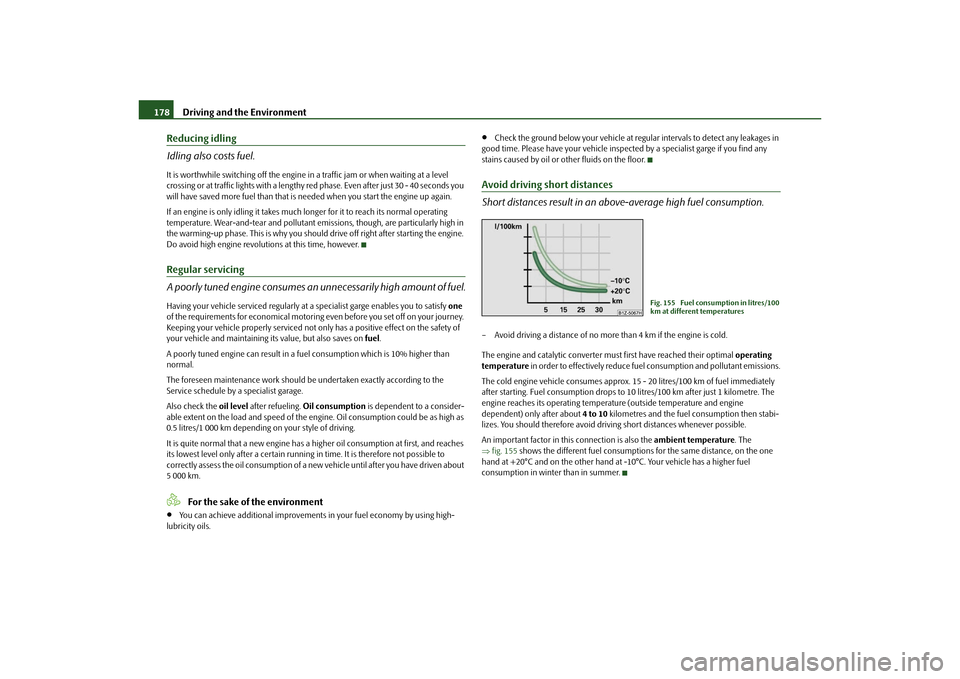
An important factor in this connection is also the ambient temperature. The
fig. 155 shows the different fuel consumptions for the same distance, on the one
hand at +20°C and on the other hand at -10°C. Your vehicle has a higher fuel
consumption in winter than in summer.
Fig. 155 Fuel consumption in litres/100
km at different temperatures
s43s.1.book Page 178 Thursday, May 13, 2010 1:21 PM
Page 181 of 275
Driving and the Environment
180
Solvent-free protection of the vehicle for transportation from the production plant
to the customer.
The use of solvent-free adhesives.
No CFCs used in the production process.
Without use of mercury.
Use of water-soluble paints.
Trade-in and recycling of old cars
Škoda Auto meets the requirements of the brand and its products regarding environ-
ment and ressource protection. All new Škoda vehicles can be utilized up to 95% and
always
15) be returned. In a lot of countries sufficient trade-in networks have been
created, where you can trade-in your vehicle. After you trade-in your vehicle, you will
receive a confirmation stating the recycling in accordance with environmental regula-
tions.
Vehicles with special built-on types
Technical documents regarding changes carried out on the vehicle must be kept by the
vehicle user, in order to hand over later to the old car user. This ensures the recycling
in accordance with en vironmental regulations.
Note
Detailed information about the trade-in and recycling of old cars is available from a
Škoda Service Partner.Motoring abroadGeneral
Other circumstances may exist abroad.It is also possible, in certai n countries, that the Škoda Service Partner network is limited
or has not been established yet. This is the reason why obtaining certain spare parts
may be somewhat complicated and specialist garage personnel may only be able to
make limited repairs. Škoda Auto in the Czech Republic and relevant importers are happy to provide information about technical
aspects of the vehicle, required mainte-
nance work and possibilities for getting repairs done.
Unleaded petrolA vehicle fitted with a petrol engine must always be refuelled with unleaded petrol
page 176. The automobile associations can provide you with information regarding
the locations of filling stations which offer unleaded petrol.HeadlightThe low beam of your headligh ts is set asymmetrically. It illuminates the side of the
road on which you are driving to a greater ex tent. If you drive abroad on the other side
of the road, you will da zzle oncoming traffic.
In order to prevent the dazzling of oncoming tr affic, it is necessary that an adjustment
of the headlights is carried out by your auth orised Škoda Service Partner.
The adaptation of the headlights with Xenon lights* (applies only to vehicles which are
designed for driving on the left and on the right) is performed in the menu Setup
Lights & Vision & Tra v e l m o d e in the main menu of the information display*
page 22.Avoiding damage to your vehicleWhen driving on poor roads and lanes or when driving over kerbstones, steep ramps
etc., you must pay particular attention to ensuring that any low-slung parts of the
vehicle, such as spoiler and exhaust, do not touch the ground and get damaged.
This particularly applies to models with a lowered suspension (sport suspension) and
also when your vehicle is fully laden.
15)Subject to fulfilment of the national legal requirements.s43s.1.book Page 180 Thursday, May 13, 2010 1:21 PM
Page 184 of 275
Towing a trailer183
Using the system
Safety
Driving Tips
General Maintenance
Breakdown assistance
Technical Data
Headlights
Before starting off with a hitched trailer, also check the setting of the headlights. Alter
the setting as necessary with the ai
d of the headlight beam adjuster page 56.
Detachable ball head
The ball rod is detachable on vehicles which feature a factory-fitted towing device. It is
stowed together with separate fitting instru ctions in the spare wheel well in the luggage
compartment of the vehicle.
Further information on the towing device page 184.
Note
We recommend that you also have your vehicle inspected between service inter-
vals if you tow a trailer frequently.
The handbrake on the towing vehicle must be put on when coupling and decou-
pling the trailer.
Driving Tips
Particular caution is required when towing a trailer.– Do not, as far as possible, drive with your vehicle unladen and the trailer laden.
– Do not make full use of the legal maximum speeds. This applies in particular to downhill sections.
– Apply the brakes in good time.
– Keep a check on the coolant temperature gauge if the outside temperature is high.
Distribution of weight
The distribution of the weight is very poor if your vehicle is unladen and the trailer is
laden. Maintain a particularly low speed if you cannot avoid driving with this combina-
tion.
Driving speed
Do not drive faster than 80 km/hour for safety reasons. This also applies for countries
in which higher speeds are allowed. The fact that the driving stability of the vehicle + trailer combination reduces with
increasing speed means that the legally allowed speed should not be used when there
are unfavourable road, weather or wind cond
itions, particularly near accident black
spots.
You must always reduce your speed immediat ely as soon as you detect even just the
slightest swaying of the trailer. On no account attempt to stop the trailer from
“swaying” by accelerating.
Apply the brakes in good time! If the trailer is fitted with a trailer brake, apply the
brakes gently at first and then brake firmly. This will avoid brake jolts resulting from the
trailer wheels locking. Shift down gears in good time before negotiating a downhill
section to allow the engine to also act as a brake.
Engine overheating
Please keep a check on the coolant temperature gauge if you have to negotiate a
lengthy slope in a low gear at a high engi ne speed when the outside temperature is
very high page 16, “Coolant temperature gauge”.
If the needle of the coolant temperature gauge moves into the right-hand area or even
the red area of the scale, reduce your speed immediately. Stop and switch off the
engine if the warning light
in the instrument cluster begins flashing. Wait a few
minutes and check the level of coolant in the coolant expansion bottle page 201,
“Inspecting the coolant level”.
Please refer to the following guidelines page 31, “Coolant temperature/coolant
level ”.
The coolant temperature can be reduced by switching on the heating.
Any increase in the cooling effect of the coolant fan through shifting down a gear and
increasing the engine speed is not possible since the fan speed is independent of the
engine speed. One should also not drop a gear for this reason when towing a trailer as
long as the engine can manage th e slope without any drop in speed.
s43s.1.book Page 183 Thursday, May 13, 2010 1:21 PM
Page 189 of 275
Taking care of your vehicle and cleaning the vehicle
188
Do not use window leathers which you have us ed to polish the vehicle body to dry off
the windows. Residues of preservatives in the window leather can dirty the window
and reduce visibility.
Do not affix any stickers over the inside of the rear window to avoid damage to the
heating elements of the rear window heater .
We recommend using a preserva tive from Škoda genuine accessories offered by your
Škoda dealer.
Caution
Never remove snow or ice from the glass parts with warm or hot water - risk of forma-
tion of cracks in the glass!The headlight lensesPlease do not use any aggressi ve cleaning or chemical solvent products for cleaning
the front headlights - risk of damage to the plastic lenses. Please use soap and clean
warm water.
Caution
Never wipe the headlights dry and do not use any sharp objects for cleaning the plastic
lenses, this may result in damage to the protective paintwork and consequently in
formation of cracks on the headlight lenses, e.g through effect of chemical products.Door and window sealsThe rubber seals on the doors, boot lid, bonnet and windows remain supple and last
longer if you treat them from time to time with a rubber care product (e.g. with a spray
with silicone-free oil). You also avoid premature wear of the seals and prevent leakages
in this way. It is also easier to open the doors. Rubber seals which are well cared for also
do not stick together in cold winter weather.Locking cylinderWe recommend that you use the spray from Škoda original accessories with regreasing
and anticorrosive effect for de-icing locking cylinders.
Note
When washing your vehicle, ensure that as little water as possible gets into the locking
cylinders.WheelsSteel wheels
You should also thoroughly wash the wheels and wheel trims when giving your vehicle
its regular wash. This prevents any brake dust, dirt and road salt from sticking to the
wheel hubs. You can remove stubborn brake abrasion adhering to the wheels with an
industrial cleaner. Touch up any damage to the paintwork on the wheels before rust is
able to form.
Light alloy wheels
Regular care of light alloy wh eels is necessary in order to retain their decorative
appearance over long periods. It is particul arly important to remove regularly any road
salt and brake abrasion from light alloy wheels, otherwise the light metal will suffer.
Wash thoroughly and then treat the wheels with a protective product for light alloy
wheels which does not cont ain any acidic components. We recommend to apply a
hard wax layer onto the wheel hubs every three months. You must not use any prod-
ucts which cause abrasion when treating the wheel hubs. Any damage to the paint
layer on the wheel hubs must be touched up immediately.
We recommend using a preservative from Šk oda genuine accessories offered by your
Škoda dealer.
WARNING
One should remember when cleaning th e wheels that moisture, ice and road
salt may adversely affect braking ef ficiency - risk of an accident!
Note
Severe layers of dirt on the wheels can also result in wheel imbalance. This may show
itself in the form of a wheel vibration which is transmitted to the steering wheel which,
in certain circumstances, can cause premature wear of the steering. This means it is
necessary to remove the dirt.
s43s.1.book Page 188 Thursday, May 13, 2010 1:21 PM
Page 208 of 275
Inspecting and replenishing207
Using the system
Safety
Driving Tips
General Maintenance
Breakdown assistance
Technical Data
We recommend having the vehicle checked by a Škoda Service Partner to ensure full
functionality of all electrical systems.
Replacing the batteryYou should only replace a battery with a ne
w battery of the same capacity, voltage (12
V), amperage and of the same size. Škoda Service Partners have a range of suitable
batteries available.
We recommend that you only have an old ba ttery disposed of by your Škoda Service
Partner since it does require special disposal.
For the sake of the environment
Batteries contain poisonous substances such as sulphuric acid and lead. They must be
disposed of in accordance with local environmental protection regulations and on no
account as domestic waste.
In view of the problems involved with it s proper disposal, we recommend having
the battery replaced by a specialist garage.
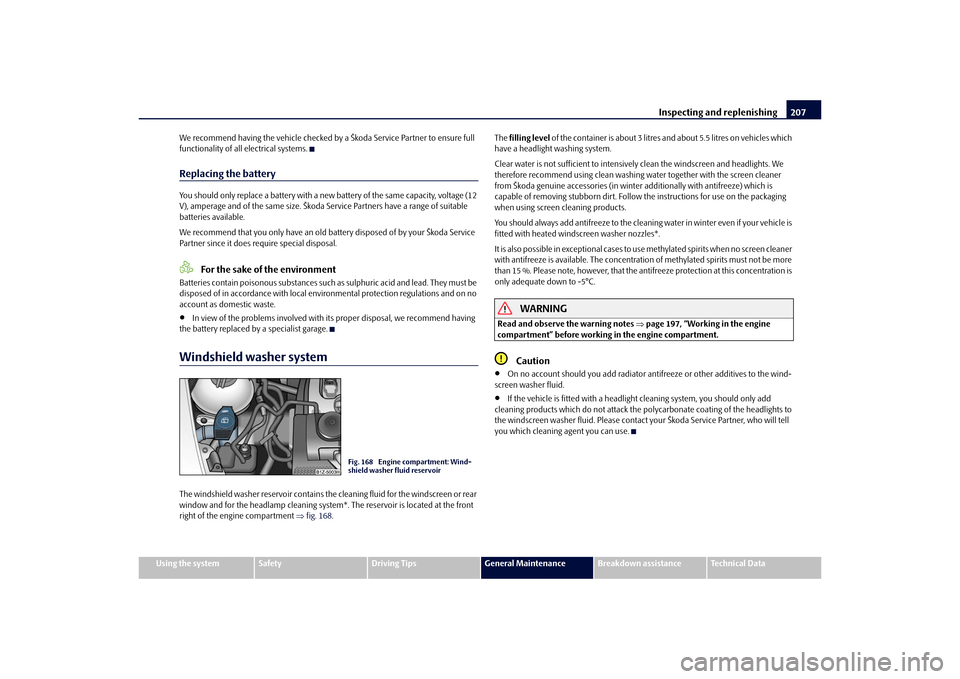
Windshield washer systemThe windshield washer reservoir contains the cleaning fluid for the windscreen or rear
window and for the headlamp cleaning system*. The reservoir is located at the front
right of the engine compartment fig. 168 . The
filling level of the container is about 3 litres and about 5.5 litres on vehicles which
have a headlight washing system.
Clear water is not sufficient to intensively clean the windscreen and headlights. We
therefore recommend using clean washing water together with the screen cleaner
from Škoda genuine accessories (in winter additionally with antifreeze) which is
capable of removing stubborn dirt. Follow the instructions for use on the packaging
when using screen cleaning products.
You should always add antifreeze to the cleaning water in winter even if your vehicle is
fitted with heated wind screen washer nozzles*.
It is also possible in exceptional cases to use methylated spirits when no screen cleaner
with antifreeze is available. The concentration of methylated spirits must not be more
than 15 %. Please note, however, that the anti freeze protection at this concentration is
only adequate down to -5°C.
WARNING
Read and observe the warning notes page 197, “Working in the engine
compartment” before working in the engine compartment.
Caution
On no account should you add radiator an tifreeze or other additives to the wind-
screen washer fluid.
If the vehicle is fitted with a headlight cleaning system, you should only add
cleaning products which do not attack the polycarbonate coating of the headlights to
the windscreen washer fluid. Please contac t your Škoda Service Partner, who will tell
you which cleaning agent you can use.
Fig. 168 Engine compartment: Wind-
shield washer fluid reservoir
s43s.1.book Page 207 Thursday, May 13, 2010 1:21 PM
Page 217 of 275
Breakdown assistance
216WARNING
If the fire extinguisher is not correctl y attached, in case of sudden manoeuvres
or an accident it can be “thrown” through the interior compartment and cause
injuries.
Note
The fire extinguisher must comply with the relevant and valid legal requirements.
Pay attention to the expiration date of the fire extinguisher. If the fire extinguisher
is used after the expiration date, its proper function is no longer assured.
The fire extinguisher is only supplied in certain countries within the scope of
delivery.
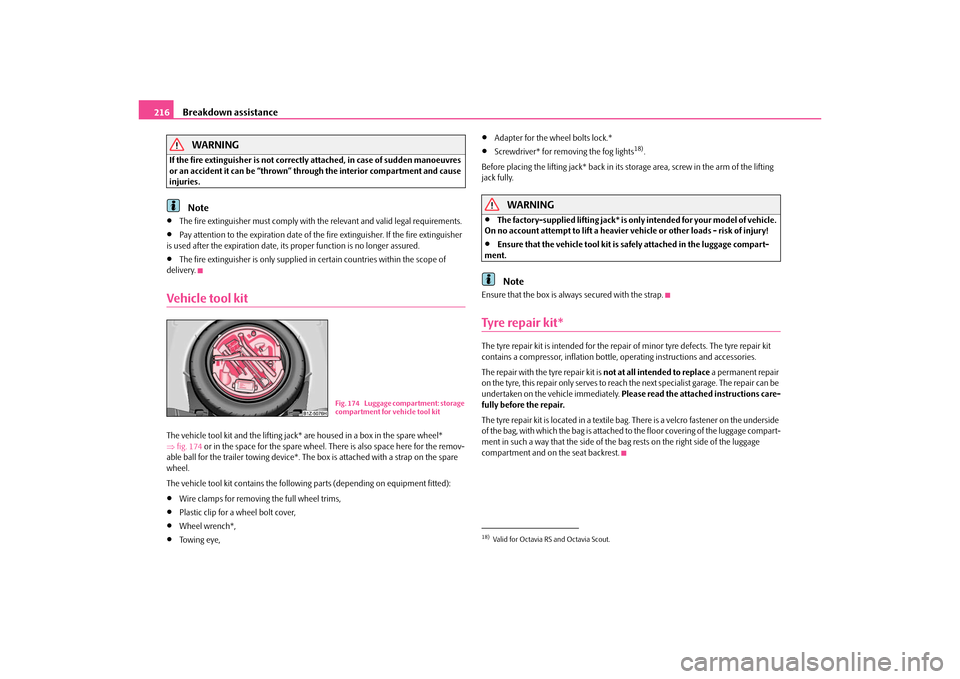
Vehicle tool kitThe vehicle tool kit and the lifting jack* are housed in a box in the spare wheel*
fig. 174 or in the space for the spare wheel. There is also space here for the remov-
able ball for the trailer towing device*. Th e box is attached with a strap on the spare
wheel.
The vehicle tool kit contains the following parts (depending on equipment fitted):
Wire clamps for removing the full wheel trims,
Plastic clip for a wheel bolt cover,
Wheel wrench*,
To w i n g e y e ,
Adapter for the wheel bolts lock.*
Screwdriver* for removing the fog lights
18).
Before placing the lifting jack* back in its storage area, screw in the arm of the lifting
jack fully.
WARNING
The factory-supplied lifting jack* is only intended for your model of vehicle.
On no account attempt to lift a heavier vehicle or other loads - risk of injury!
Ensure that the vehicle tool kit is sa fely attached in the luggage compart-
ment.Note
Ensure that the box is always secured with the strap.Tyre repair kit*The tyre repair kit is intended for the repair of minor tyre defects. The tyre repair kit
contains a compressor, inflation bottle, operating instructions and accessories.
The repair with the tyre repair kit is not at all intended to replace a permanent repair
on the tyre, this repair only serves to reach the next specialist garage. The repair can be
undertaken on the vehicle immediately. Please read the attached instructions care-
fully before the repair.
The tyre repair kit is located in a textile bag. There is a velcro fastener on the underside
of the bag, with which the bag is attached to the floor covering of the luggage compart-
ment in such a way that the side of the bag rests on the right side of the luggage
compartment and on the seat backrest.
Fig. 174 Luggage compartment: storage
compartment for vehicle tool kit
18)Valid for Octavia RS and Octavia Scout.
s43s.1.book Page 216 Thursday, May 13, 2010 1:21 PM
Page 218 of 275
Breakdown assistance217
Using the system
Safety
Driving Tips
General Maintenance
Breakdown assistance
Technical Data
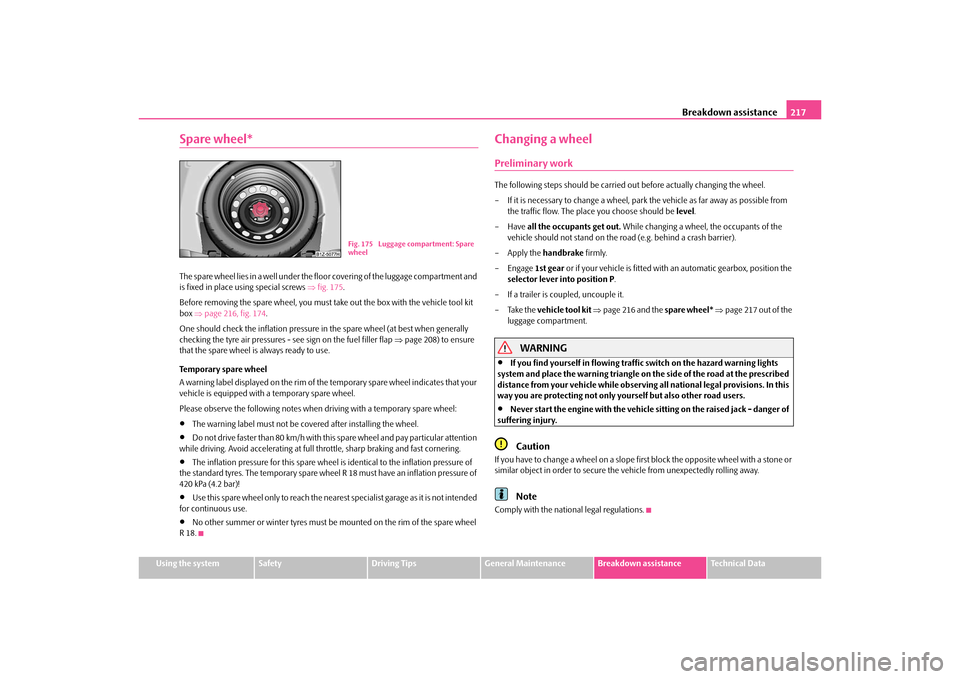
Spare wheel*The spare wheel lies in a well under the floor covering of the luggage compartment and
is fixed in place using special screws fig. 175 .
Before removing the spare wheel, you must take out the box with the vehicle tool kit
box page 216, fig. 174.
One should check the inflation pressure in the spare wheel (at best when generally
checking the tyre air pressures - see sign on the fuel filler flap page 208) to ensure
that the spare wheel is always ready to use.
Temporary spare wheel
A warning label displayed on the rim of the temporary spare wheel indicates that your
vehicle is equippe d with a temporary spare wheel.
Please observe the following notes when driving with a temporary spare wheel:
The warning label must not be covered after installing the wheel.
Do not drive faster than 80 km/h with this spare wheel and pay particular attention
while driving. Avoid accelerating at full throttle, sharp braking and fast cornering.
The inflation pressure for this spare wheel is identical to the inflation pressure of
the standard tyres. The temporary spare wheel R 18 must have an inflation pressure of
420 kPa (4.2 bar)!
Use this spare wheel only to reach the nearest specialist garage as it is not intended
for continuous use.
No other summer or winter tyres must be mounted on the rim of the spare wheel
R 18.
Changing a wheelPreliminary workThe following steps should be carried ou t before actually changing the wheel.
– If it is necessary to change a wheel, park the vehicle as far away as possible from
the traffic flow. The place you choose should be level.
–Have all the occupants get out. While changing a wheel, the occupants of the
vehicle should not stand on the ro ad (e.g. behind a crash barrier).
– Apply the handbrake firmly.
–Engage 1st gear or if your vehicle is fitted with an automatic gearbox, position the
selector lever into position P .
– If a trailer is coupled, uncouple it.
–Take the vehicle tool kit page 216 and the spare wheel* page 217 out of the
luggage compartment.
WARNING
If you find yourself in flowing traffic switch on the hazard warning lights
system and place the warning triangle on the side of the road at the prescribed
distance from your vehicle while observin g all national legal provisions. In this
way you are protecting not only yourself but also other road users.
Never start the engine with the vehicle si tting on the raised jack - danger of
suffering injury.Caution
If you have to change a wheel on a slope fi rst block the opposite wheel with a stone or
similar object in order to secure the vehicle from unexpectedly rolling away.
Note
Comply with the national legal regulations.
Fig. 175 Luggage compartment: Spare
wheel
s43s.1.book Page 217 Thursday, May 13, 2010 1:21 PM
Page 223 of 275
Breakdown assistance
222
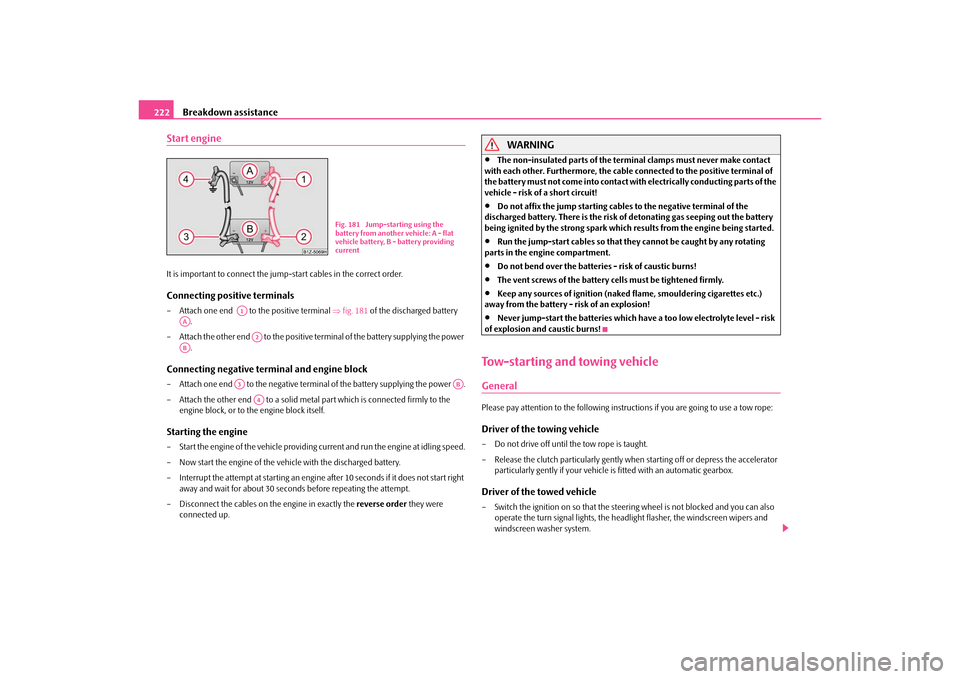
Start engineIt is important to connect the jump -start cables in the correct order.Connecting positive terminals– Attach one end to the positive terminal fig. 181 of the discharged battery
.
– Attach the other end to the positive term inal of the battery supplying the power
.Connecting negative terminal and engine block– Attach one end to the negative termin al of the battery supplying the power .
– Attach the other end to a solid metal part which is connected firmly to the
engine block, or to the engine block itself.Starting the engine– Start the engine of the vehicle providing current and run the engine at idling speed.
– Now start the engine of the vehicle with the discharged battery.
– Interrupt the attempt at starting an engine after 10 seconds if it does not start right
away and wait for about 30 seconds before repeating the attempt.
– Disconnect the cables on the engine in exactly the reverse order they were
connected up.
WARNING
The non-insulated parts of the terminal clamps must never make contact
with each other. Furthermore, the cable connected to the positive terminal of
the battery must not come into contact with electrically conducting parts of the
vehicle - risk of a short circuit!
Do not affix the jump starting cables to the negative terminal of the
discharged battery. There is the risk of detonating gas seeping out the battery
being ignited by the strong spark which results from the engine being started.
Run the jump-start cables so that they cannot be caught by any rotating
parts in the engine compartment.
Do not bend over the batteries - risk of caustic burns!
The vent screws of the battery cells must be tightened firmly.
Keep any sources of ignition (naked flame, smouldering cigarettes etc.)
away from the battery - risk of an explosion!
Never jump-start the batteries which ha ve a too low electrolyte level - risk
of explosion and caustic burns!
Tow-starting and towing vehicleGeneralPlease pay attention to the following instru ctions if you are going to use a tow rope:Driver of the towing vehicle– Do not drive off until the tow rope is taught.
– Release the clutch particularly gently wh en starting off or depress the accelerator
particularly gently if yo ur vehicle is fitted with an automatic gearbox.Driver of the towed vehicle– Switch the ignition on so that the steeri ng wheel is not blocked and you can also
operate the turn signal lights, the headlight flasher, the windscreen wipers and
windscreen washer system.
Fig. 181 Jump-starting using the
battery from another vehicle: A - flat
vehicle battery, B - battery providing
current
A1
AA
A2
AB
A3
AB
A4
s43s.1.book Page 222 Thursday, May 13, 2010 1:21 PM
Page 224 of 275
Breakdown assistance223
Using the system
Safety
Driving Tips
General Maintenance
Breakdown assistance
Technical Data
– Take the vehicle out of gear or move the selector lever into position
N if your
vehicle is fitted with an automatic gearbox.
– Note that the brake servo unit and power steering only operate if the engine is running. You will require significantly grea ter physical force to depress the brake
pedal and to steer th e vehicle if the engine is not running.
– Ensure that the tow rope is always kept taught.
Tow rope or tow bar
A tow bar is safest way of towing a vehicle an d also minimizes any shocks. You can use
a tow rope only if a suitable tow bar is not available.
The tow rope must be elastic to protect the vehicle. Thus one should only use plastic
fibre rope or a rope made out of a similarly elastic material.
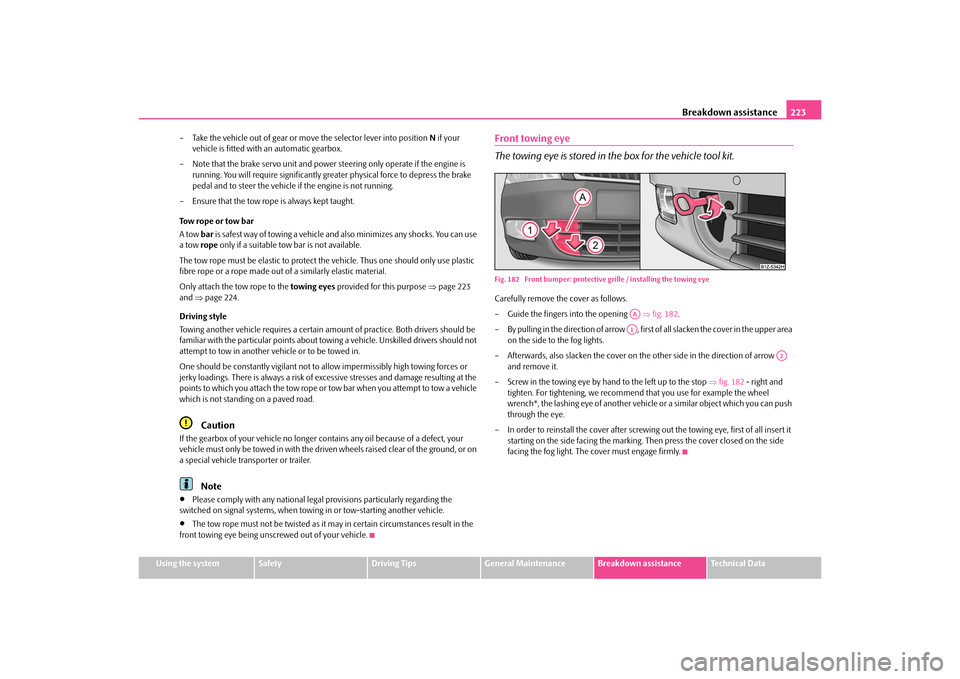
Only attach the tow rope to the towing eyes provided for this purpose page 223
and page 224.
Driving style
Towing another vehicle requires a certain am ount of practice. Both drivers should be
familiar with the particular points about to wing a vehicle. Unskilled drivers should not
attempt to tow in another vehicle or to be towed in.
One should be constantly vigi lant not to allow impermissibly high towing forces or
jerky loadings. There is always a risk of excessive stresses and damage resulting at the
points to which you attach the tow rope or tow bar when you attempt to tow a vehicle
which is not standing on a paved road.
Caution
If the gearbox of your vehicle no longer contains any oil because of a defect, your
vehicle must only be towed in with the driven wheels raised clear of the ground, or on
a special vehicle transporter or trailer.
Note
Please comply with any national legal provisions particularly regarding the
switched on signal systems, when towi ng in or tow-starting another vehicle.
The tow rope must not be twisted as it ma y in certain circumstances result in the
front towing eye being unscrewed out of your vehicle.
Front towing eye
The towing eye is stored in th e box for the vehicle tool kit.Fig. 182 Front bumper: protective gr ille / installing the towing eyeCarefully remove the cover as follows.
– Guide the fingers into the opening fig. 182 .
– By pulling in the direction of arrow , first of all slacken the cover in the upper area on the side to the fog lights.
– Afterwards, also slacken the cover on th e other side in the direction of arrow
and remove it.
– Screw in the towing eye by hand to the left up to the stop fig. 182 - right and
tighten. For tightening, we recommen d that you use for example the wheel
wrench*, the lashing eye of another vehicl e or a similar object which you can push
through the eye.
– In order to reinstall the cover after screwing out the towing eye, first of all insert it
starting on the side facing the marking. Then press the cover closed on the side
facing the fog light. The cover must engage firmly.
AAA1
A2
s43s.1.book Page 223 Thursday, May 13, 2010 1:21 PM