ESP SKODA RAPID 2013 1.G Owner's Guide
[x] Cancel search | Manufacturer: SKODA, Model Year: 2013, Model line: RAPID, Model: SKODA RAPID 2013 1.GPages: 226, PDF Size: 15.16 MB
Page 116 of 226
The brake pressure drops gradually the more you operate the accelerator pedal. Ifthe vehicle does not start off within 2 seconds, it starts to roll back.
The HHC is active from a 5% slope if the driver's door is closed. HHC is only ever active on slopes when in forward or reverse start off. When driving downhill, it isinactive.
Parking aid
Introduction
This chapter contains information on the following subjects:
Function
113
Activation/deactivation
114WARNING■ The parking aid is not a substitute for the driver paying proper attention and
it is always the driver's responsibility to take care when reversing the vehicle
or carrying out similar manoeuvres. Pay particular attention to small children
and animals as they may not be recognised by the system sensors.■
Before reversing, you should make sure that there are no small obstacles,
such as rocks, thin posts, trailer drawbars etc. behind your vehicle. Such ob-
stacles may not be recognised by the system sensors.
■
Under certain circumstances, surfaces of certain objects and types of cloth-
ing cannot reflect the system signals. Thus, these objects or people who wear
such clothing are not recognised by the System sensors.
■
External sound sources can have a detrimental effect on the system. Under
adverse conditions, this may cause objects or people to not be recognised by
the system.
CAUTION
■ If a continuous tone sounds for about 3 seconds after activating the system and
there is no obstacle close to your car, this indicates a system fault. Have the fault
rectified by a specialist garage.■
The sensors must be kept clean (free of ice, etc.) to enable the system to oper-
ate properly.
■ The system function may be limited under adverse weather conditions (heavy
rain, water vapour, very low or high temperatures etc.).■
Additionally installed modules such as bicycle carriers can impair the function of
the parking aid.
Function
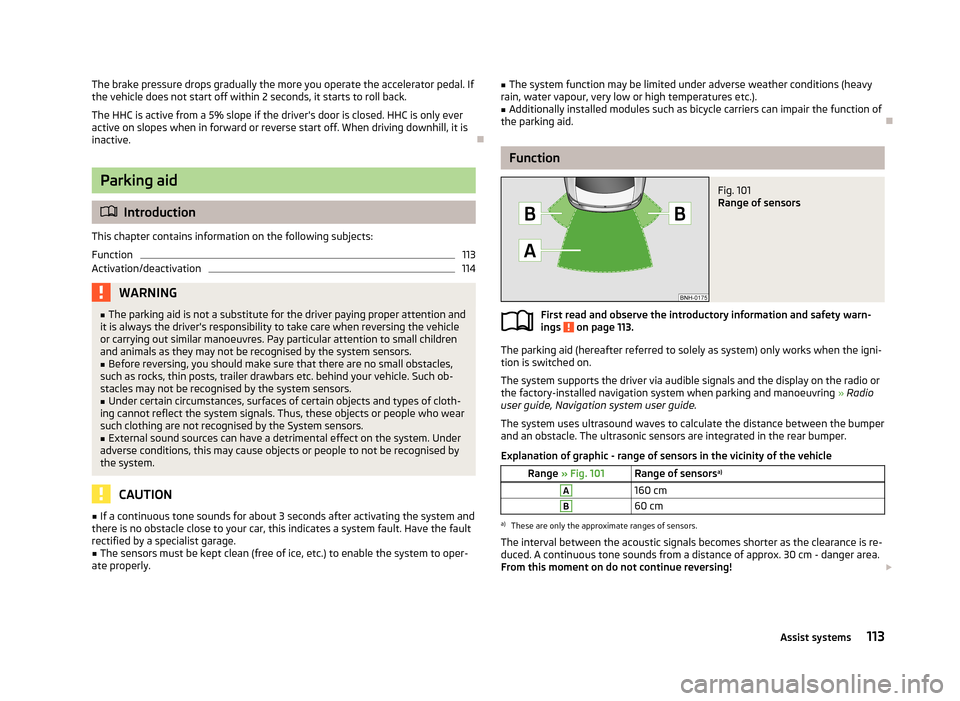
Fig. 101
Range of sensors
First read and observe the introductory information and safety warn-
ings on page 113.
The parking aid (hereafter referred to solely as system) only works when the igni- tion is switched on.
The system supports the driver via audible signals and the display on the radio or
the factory-installed navigation system when parking and manoeuvring » Radio
user guide, Navigation system user guide.
The system uses ultrasound waves to calculate the distance between the bumper
and an obstacle. The ultrasonic sensors are integrated in the rear bumper.
Explanation of graphic - range of sensors in the vicinity of the vehicle
Range » Fig. 101Range of sensors a)A160 cmB60 cma)
These are only the approximate ranges of sensors.
The interval between the acoustic signals becomes shorter as the clearance is re- duced. A continuous tone sounds from a distance of approx. 30 cm - danger area.
From this moment on do not continue reversing!
113Assist systems
Page 130 of 226
›Adjust the mirrors, the front seat and head restraint to your body size.
› Advise your passengers to adjust the head restraints to their body size.
› Protect children in suitable child seats with correctly fastened seat
belts » page 142 , Transporting children safely .
› Adopt the correct seated position
» page 127. Tell your passengers to assume
the correct seated position.
› Correctly fasten the seat belt. Also inform passengers to fasten the seat belt
correctly » page 130 .
What influences the driving safety?
First read and observe the introductory information and safety warn-ings
on page 126.
The driver is fully responsible for himself and his occupants. If your driving safety
is effected, you place yourself and the oncoming traffic at risk.
The following guidelines must therefore be observed. › Do not become distracted from concentrating on the traffic situation, e.g. by
your passengers or mobile phone calls.
› Never drive when your driving ability is impaired, e.g. due to medication, alcohol
or drugs.
› Keep to the traffic regulations and the permissible speed limit.
› Always adjust the driving speed to the road, traffic and weather conditions.
› Take regular breaks on long journeys – at least every two hours.
Correct seated position
Introduction
This chapter contains information on the following subjects:
Correct seated position for the driver
128
Correct seated position for the front passenger
128
Correct seated position for the passengers in the rear seats
128
Examples of incorrect seated positions
129WARNINGGeneral information■The front seats and head restraints must be adjusted to match the body
size at all times and the seat belt must always be fastened properly to provide the most effective levels of protection to the passengers.■
If the occupant adopts an incorrect seated position, he is exposed to life-
threatening injuries, in case he is hit by a deployed airbag.
■
If the occupants on the rear seats are not sitting upright, the risk of injury is
increased due to incorrect routing of the seat belt.
■
The seat backrests must not be tilted too far back when driving, as this will
impair the function of the seat belts and of the airbag system – risk of injury!
WARNINGInformation for the driver■Always assume the correct seated position before setting off and do not
change this position while driving. Also advise your passengers to adopt the
correct seated position and not to change this position while the car is mov-
ing.■
Maintain a distance of at least 25 cm to the steering wheel. Not maintaining
this minimum distance will mean that the airbag system will not be able to
properly protect you - hazard!
■
When driving, hold the steering wheel with both hands firmly on the outer
edge in the 9 o'clock and 3 o'clock position. Never hold the steering wheel in
the 12 o'clock position or in any other way (e.g. in the middle or inner edge of
the steering wheel). In such cases, you could severely injure the arms, hands
and head when the driver airbag is deployed.
■
Ensure that there are no objects in the driver's footwell as they may get
caught behind the pedals when driving or applying the braking. You would then no longer be able to operate the clutch, brake or accelerate.
127Passive Safety
Page 132 of 226
Examples of incorrect seated positionsFirst read and observe the introductory information and safety warn-
ings
on page 127.
Maximum seat belt protection is only achieved if seat belts are fastened correctly.
Incorrect seated positions considerably reduce the protective functions of the
seat belts and therefore increase the risk of injury due to an incorrect routing of
the seat belt.
The driver is fully responsible for himself and passengers, especially children.
Never allow a passenger to adopt an incorrect seated position when the car is
moving.
The following list contains instructions which, if not observed, may cause serious injuries or death. This list is not complete, however we would like you to familiar-
ise yourself with this subject.
Observe the following instructions while driving. › Do not stand up.
› Do not stand on the seats.
› Do not kneel on the seats.
› Do not tilt the seat backrest too far back.
› Do not lean against the dash panel.
› Do not lie on the rear seats.
› Do not sit only on the front part of the seat.
› Do not sit facing to the side.
› Do not lean out of the window.
› Do not put your feet out of the window.
› Do not put your feet on the dash panel.
› Do not put your feet on the seat cushion.
› Do not allow anybody to travel in the footwell.
› Do not drive without fastening your seat belt.
› Do not delay in the luggage compartment.
129Passive Safety
Page 143 of 226
Deactivating airbagsFirst read and observe the introductory information given on page 139.
Deactivating an airbag should be considered in cases such as the ones below.› If using a rear-facing child seat on the front passenger seat (due to different le-
gal regulations, the airbag must be deactivated if using a forwards-facing child
seat in some countries) » page 142, Transporting children safely .
› If it is not possible to maintain a distance of at least 25 cm between the middle
of the steering wheel and chest, despite the driver's seat being correctly adjus-
ted.
› If special attachments are required in the area of the steering wheel because of
a physical disability.
› If different seats have been fitted (e.g. orthopaedic seats without side airbags).
The front passenger airbag can be switched off with the key-operated
switch » page 140 .
We recommend that you ask a ŠKODA service partner to deactivate any other air- bags.
Monitoring the airbag system
The operational capability of the airbag system is monitored electronically, includ-
ing when one of the airbags is switched off.
Airbag deactivated using diagnostic equipment
› The warning light
lights up for approximately 4 seconds after the ignition is
switched on and then flashes again for approximately 12 seconds.
Front passenger airbag deactivated using the key switch in the storage com-
partment
› The warning light
lights up for approximately 3 seconds after the ignition is
switched on.
› The indicator light
3
» Fig. 123 on page 140 lights up after the ignition is
switched on.
Note■ The national regulations for switching off airbags must be observed.■A ŠKODA service partner will be able to inform you which, if any, of your vehi-
cle's airbags can or must be deactivated.
Deactivating the front passenger airbag
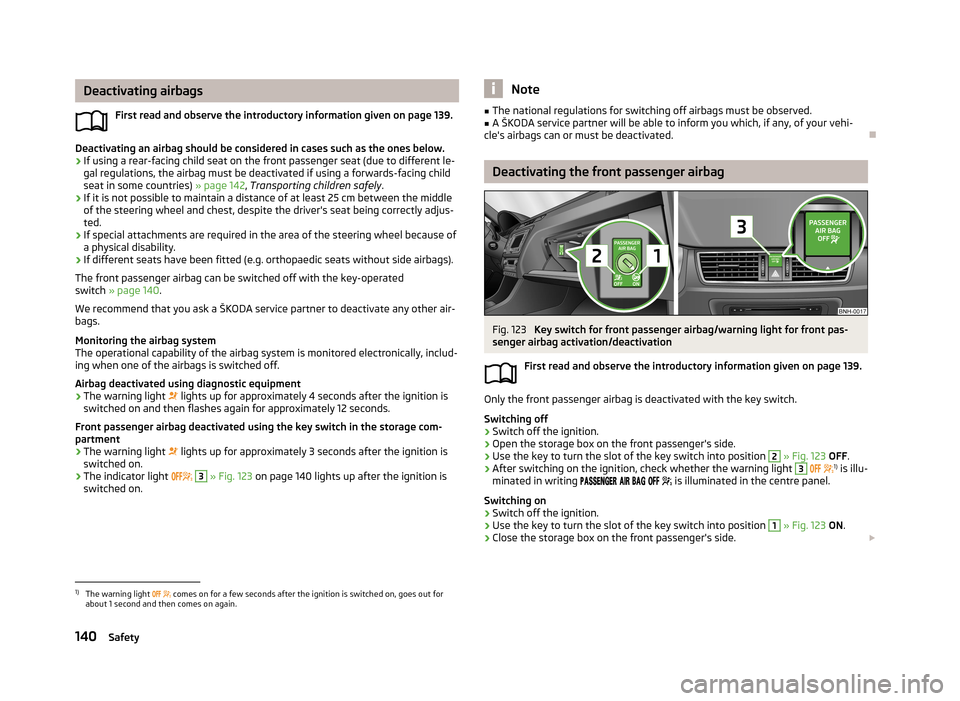
Fig. 123
Key switch for front passenger airbag/warning light for front pas-
senger airbag activation/deactivation
First read and observe the introductory information given on page 139.
Only the front passenger airbag is deactivated with the key switch.
Switching off
›
Switch off the ignition.
›
Open the storage box on the front passenger's side.
›
Use the key to turn the slot of the key switch into position
2
» Fig. 123 OFF .
›
After switching on the ignition, check whether the warning light
3
1)
is illu-
minated in writing
is illuminated in the centre panel.
Switching on
›
Switch off the ignition.
›
Use the key to turn the slot of the key switch into position
1
» Fig. 123 ON .
›
Close the storage box on the front passenger's side.
1)
The warning light
comes on for a few seconds after the ignition is switched on, goes out for
about 1 second and then comes on again.
140Safety
Page 144 of 226
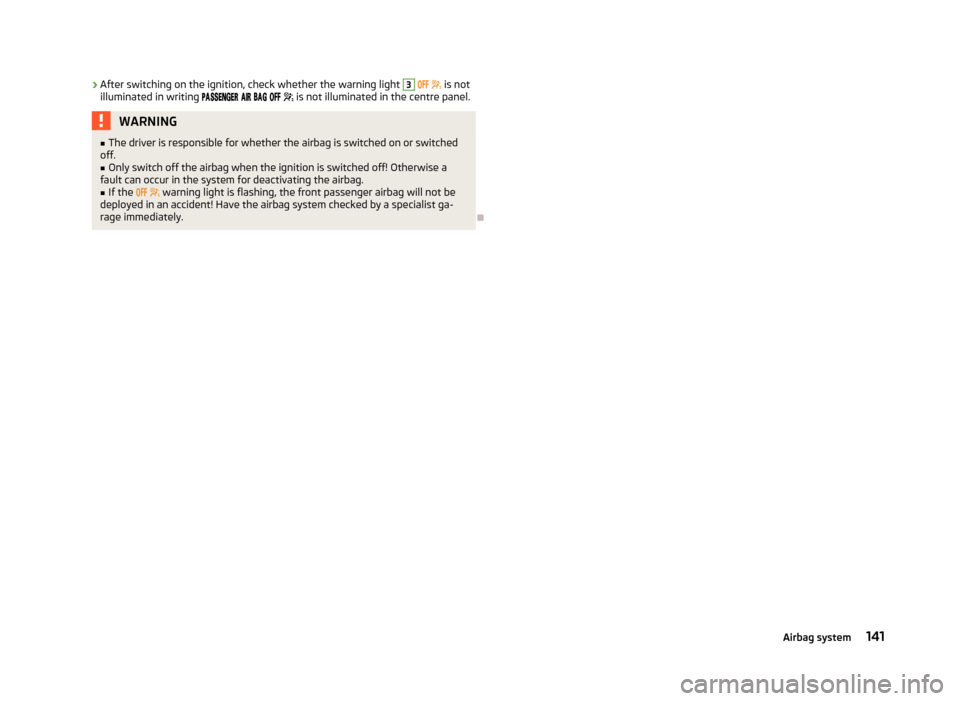
›After switching on the ignition, check whether the warning light 3
is not
illuminated in writing is not illuminated in the centre panel.WARNING■
The driver is responsible for whether the airbag is switched on or switched
off.■
Only switch off the airbag when the ignition is switched off! Otherwise a
fault can occur in the system for deactivating the airbag.
■
If the warning light is flashing, the front passenger airbag will not be
deployed in an accident! Have the airbag system checked by a specialist ga-
rage immediately.
141Airbag system
Page 150 of 226
General Maintenance
Vehicle care
Service intervals
Introduction
This chapter contains information on the following subjects:
Overview of service intervals
147
Fixed service intervals QI1 - QI4
148
Variable service interval QI6
148
Information about the ŠKODA service
148
The service interval display in the instrument cluster will remind you to carry out every service stipulated by the manufacturer at the right time in order to prevent you from forgetting any.
Timely and proper performance of servicing works is one of the requirements for the settlement of potential warranty claims.
The completion of services can be verified by the validated service certificate and the corresponding receipts.
The specified service intervals are tailored to normal operating conditions.
In the case of difficult operating conditions, it is necessary to have some service
work performed before the date of the next service or between the specified
service intervals. This applies mainly to the cleaning or the replacement of the air
filter insert in regions with heavy dust pollution as well as checking and replacing
the toothed belt, but also to vehicles with diesel particle filters, which can put
greater strain on the engine oil.
These difficult conditions are: › Fuel with sulphur content;
› Frequent short trips;
› Longer periods of engine idling (e.g. taxis);
› Operation in areas with heavy dust pollution;
› Frequent trailer operation;
›
Predominantly stop-and-go traffic as is often the case in city driving, for exam-
ple;
› Operation predominantly during winter.
A service consultant at the specialist garage will tell you whether the operating conditions of your vehicle may make it necessary for service work to be carried
out between the normal service intervals.
Different service charges may apply from the particular scope of work required,
depending on the vehicle type and equipment and the status of your vehicle.
Note
■ The customer is responsible for covering the cost of all services including
changing or replenishing the oil, even during the warranty period, unless stated otherwise in the ŠKODA AUTO a.s. warranty terms or other agreements.■
You will be informed about the current service scopes for the particular service
work by the specialist garage.
Overview of service intervals
Fig. 129
Vehicle data sticker: Service in-
terval
First read and observe the introductory information given on page 147.
The service interval specified by the manufacturer is indicated on the vehicle data sticker » Fig. 129 under the floor covering in the boot.
One of the following service intervals applies for your vehicle: › Fixed service interval QI1;
› Fixed service interval QI2;
› Fixed service interval QI3;
› Fixed service interval QI4;
› Variable service interval QI6.
147Vehicle care
Page 151 of 226
In order to operate a vehicle with a variable service interval, it must only be fil-
led and topped up with the prescribed engine oil.
If this engine oil is not available, the oil change is subject to a fixed service inter-
val. In this case, the vehicle must be changed to the fixed service interval.
Note
■
The corresponding motor oil specifications » page 167.■A specialist garage can perform the changeover from the variable service inter-
val to the fixed service interval, or from the fixed service interval to the variable
service interval.
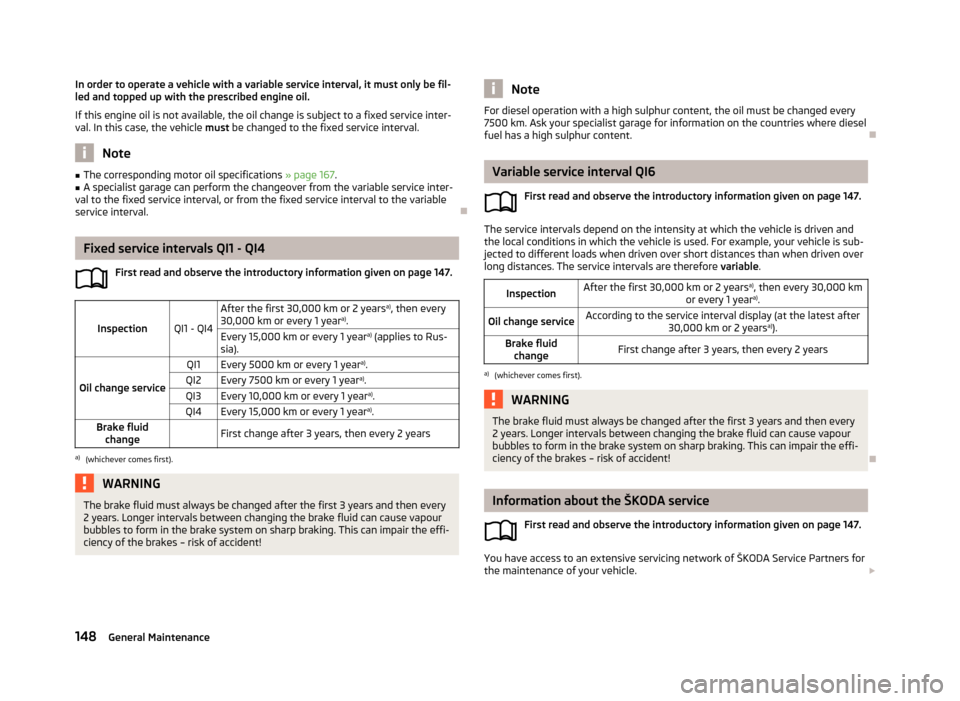
Fixed service intervals QI1 - QI4
First read and observe the introductory information given on page 147.
InspectionQI1 - QI4
After the first 30,000 km or 2 years a)
, then every
30,000 km or every 1 year a)
.Every 15,000 km or every 1 year a)
(applies to Rus-
sia).
Oil change service
QI1Every 5000 km or every 1 year a)
.QI2Every 7500 km or every 1 year a)
.QI3Every 10,000 km or every 1 year a)
.QI4Every 15,000 km or every 1 year a)
.Brake fluid
change First change after 3 years, then every 2 yearsa)
(whichever comes first).
WARNINGThe brake fluid must always be changed after the first 3 years and then every
2 years. Longer intervals between changing the brake fluid can cause vapour
bubbles to form in the brake system on sharp braking. This can impair the effi- ciency of the brakes – risk of accident!NoteFor diesel operation with a high sulphur content, the oil must be changed every
7500 km. Ask your specialist garage for information on the countries where diesel fuel has a high sulphur content.
Variable service interval QI6
First read and observe the introductory information given on page 147.
The service intervals depend on the intensity at which the vehicle is driven and
the local conditions in which the vehicle is used. For example, your vehicle is sub-
jected to different loads when driven over short distances than when driven over
long distances. The service intervals are therefore variable.
InspectionAfter the first 30,000 km or 2 years a)
, then every 30,000 km
or every 1 year a)
.Oil change serviceAccording to the service interval display (at the latest after
30,000 km or 2 years a)
).Brake fluid
changeFirst change after 3 years, then every 2 yearsa)
(whichever comes first).
WARNINGThe brake fluid must always be changed after the first 3 years and then every
2 years. Longer intervals between changing the brake fluid can cause vapour
bubbles to form in the brake system on sharp braking. This can impair the effi- ciency of the brakes – risk of accident!
Information about the ŠKODA service
First read and observe the introductory information given on page 147.
You have access to an extensive servicing network of ŠKODA Service Partners for
the maintenance of your vehicle.
148General Maintenance
Page 153 of 226
Tests required by lawFirst read and observe the introductory information and safety warn-ings
on page 149.
Many countries have legislation requiring the operational reliability and roadwor- thiness and/or exhaust gas properties of a vehicle to be tested at specific inter-
vals. These tests can be carried out by workshops or testing stations that have
been legally authorized for this purpose.
The ŠKODA Service Partners are up-to-date on the legally required tests and will
prepare the vehicle for the tests as part of a service operation if required, or will
be responsible for carrying out these tests. The specialist garages can carry out
the specified tests directly if required by the customer if they are authorised to do
so. This saves you time and money.
Even if you want to take your vehicle to an officially approved test centre for prior checking in preparation of a legally required test, we recommend that you consult
the service consultant of your ŠKODA Service Partner beforehand.
Based on their appraisal, the service consultant will tell you which areas you
should focus on in order to ensure that your vehicle will pass the technical test
without any problems. This allows you to avoid additional expenses resulting
from a possible subsequent test.
ŠKODA Service Partners
First read and observe the introductory information and safety warn-ings
on page 149.
ŠKODA Service Partners feature modern, specially developed tools and equip- ment. Here, trained specialists have access to a comprehensive range of ŠKODA
Original Parts and ŠKODA Original Accessories for carrying out modifications, re- pairs and technical alterations.
All ŠKODA service partners operate according to the most recent guidelines and instructions from ŠKODA AUTO a.s. All service and repair work is therefore carried
out on time and at the appropriate quality. Adhering to these instructions and
guidelines helps ensure road safety and helps keep your vehicle in a good techni-
cal condition.
ŠKODA Service Partners are therefore properly prepared to service your vehicle
and to provide quality work. We therefore advise you to have all modifications, re-
pairs and technical alterations to your vehicle carried out by a ŠKODA Service
Partner.
ŠKODA Genuine Parts
First read and observe the introductory information and safety warn-
ings
on page 149.
We recommend the use of ŠKODA Genuine Parts for your vehicle, as these parts
are approved by ŠKODA AUTO a.s.. They correspond precisely to the ŠKODA AUTO
a.s. regulations with regard to design, dimensional accuracy and material, and are
identical to the components used in series production.
ŠKODA AUTO a.s. is able to vouch for the safety, suitability and long service life ofthese products. We therefore recommend that you only use ŠKODA Genuine
Parts.
ŠKODA AUTO a.s. supplies the market with a complete range of ŠKODA Genuine
Parts - not only while the model is still in production but for at least 15 years after the end of series production for wear parts and at least 10 years after the end of
series production for all other vehicle parts.
ŠKODA Service Partners are liable for any defects of ŠKODA Genuine Parts for a
period of 2 years after sale in accordance with the materials defect liability, unless agreed otherwise in the purchase agreement. You should keep the approved war-ranty certificate and the invoices for these components for this period of time, so
that the commencement of the term can be verified.
Body repairs
ŠKODA vehicles are designed such that if any damage occurs to the body, it is on- ly necessary to replace those parts that are actually damaged.
However, before you decide to have damaged body parts replaced, you shouldfirst of all contact your specialist garage to determine whether or not the parts
can also be repaired. Repairs to body parts are usually cheaper.
150General Maintenance
Page 163 of 226
Inspecting and replenishing
Fuel
Introduction
This chapter contains information on the following subjects:
Refuelling
160
Unleaded petrol
161
Diesel fuel
162
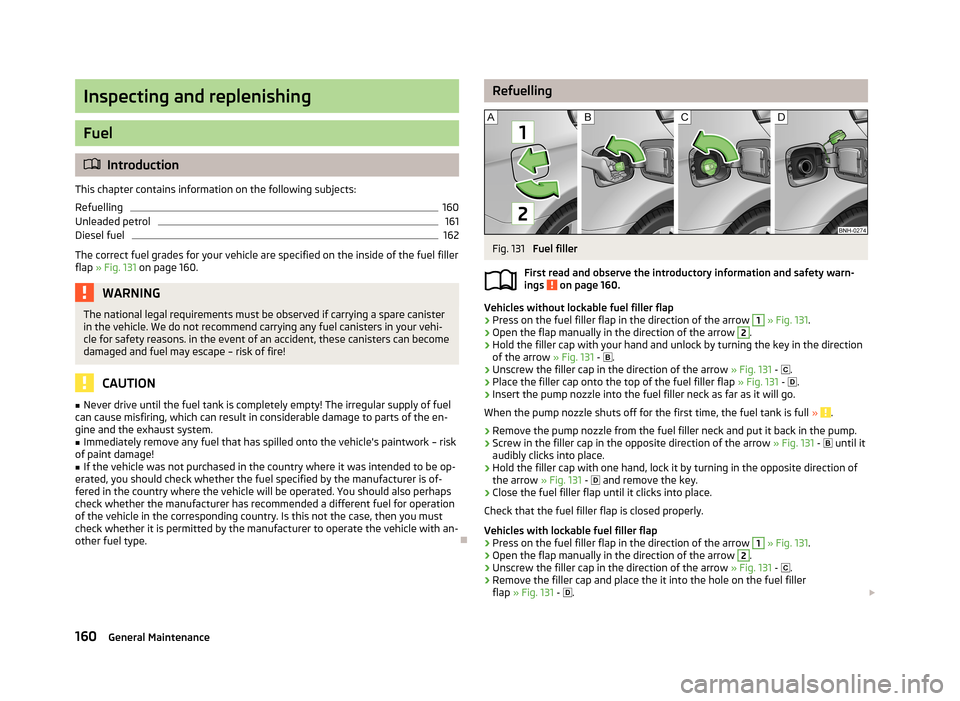
The correct fuel grades for your vehicle are specified on the inside of the fuel filler
flap » Fig. 131 on page 160.
WARNINGThe national legal requirements must be observed if carrying a spare canister
in the vehicle. We do not recommend carrying any fuel canisters in your vehi-
cle for safety reasons. in the event of an accident, these canisters can become
damaged and fuel may escape – risk of fire!
CAUTION
■ Never drive until the fuel tank is completely empty! The irregular supply of fuel
can cause misfiring, which can result in considerable damage to parts of the en-
gine and the exhaust system.■
Immediately remove any fuel that has spilled onto the vehicle's paintwork – risk
of paint damage!
■
If the vehicle was not purchased in the country where it was intended to be op-
erated, you should check whether the fuel specified by the manufacturer is of-
fered in the country where the vehicle will be operated. You should also perhaps
check whether the manufacturer has recommended a different fuel for operation
of the vehicle in the corresponding country. Is this not the case, then you must
check whether it is permitted by the manufacturer to operate the vehicle with an-
other fuel type.
RefuellingFig. 131
Fuel filler
First read and observe the introductory information and safety warn- ings
on page 160.
Vehicles without lockable fuel filler flap
›
Press on the fuel filler flap in the direction of the arrow
1
» Fig. 131 .
›
Open the flap manually in the direction of the arrow
2
.
›
Hold the filler cap with your hand and unlock by turning the key in the direction
of the arrow » Fig. 131 -
.
›
Unscrew the filler cap in the direction of the arrow » Fig. 131 -
.
›
Place the filler cap onto the top of the fuel filler flap » Fig. 131 -
.
›
Insert the pump nozzle into the fuel filler neck as far as it will go.
When the pump nozzle shuts off for the first time, the fuel tank is full »
.
›
Remove the pump nozzle from the fuel filler neck and put it back in the pump.
›
Screw in the filler cap in the opposite direction of the arrow » Fig. 131 -
until it
audibly clicks into place.
›
Hold the filler cap with one hand, lock it by turning in the opposite direction of the arrow » Fig. 131 -
and remove the key.
›
Close the fuel filler flap until it clicks into place.
Check that the fuel filler flap is closed properly.
Vehicles with lockable fuel filler flap
›
Press on the fuel filler flap in the direction of the arrow
1
» Fig. 131 .
›
Open the flap manually in the direction of the arrow
2
.
›
Unscrew the filler cap in the direction of the arrow » Fig. 131 -
.
›
Remove the filler cap and place the it into the hole on the fuel filler
flap » Fig. 131 -
.
160General Maintenance
Page 165 of 226
CAUTION■In no case may fuel additives with metal components be used, especially not
with manganese and iron content. LRP(lead replacement petrol) fuels with metal-
lic components may not be used. There is a risk of causing considerable damage
to parts of the engine or exhaust system!■
Fuels with metallic content may not be used. There is a risk of causing consider-
able damage to parts of the engine or exhaust system!
Note
■ Unleaded petrol that has a higher octane number than that required by the en-
gine can be used without limitations.■
On vehicles with prescribed unleaded petrol 95/91, 92 or 93 RON, the use of
petrol with a higher octane number than 95 RON does not result in a noticeable
power increase or a lower fuel consumption.
■
On vehicles using prescribed unleaded petrol of min. 95 RON, the use of petrol
with a higher octane number than 95 RON can increase the power and reduce
fuel consumption.
Diesel fuel
First read and observe the introductory information and safety warn-ings
on page 160.
Your vehicle can only be operated with diesel fuel that meets the EN 5901)
stand-
ard.
All diesel engines can be operated using diesel fuel with at most 7% biodiesel
(B7) 2)
.
Operation in winter – Winter-grade diesel fuel
In the cold season, only use “winter-grade diesel fuel” which will still operate properly even at a temperature of -20 °C.
It is often the case in countries with different climatic conditions that diesel fuels available have a different temperature characteristic. ŠKODA Partners and filling
stations in the relevant country will be able to provide you with information re-
garding the diesel fuels available.
Diesel fuel additives
Additives, so-called “flow improvers ” (petrol and similar agents) should not be
mixed with the diesel fuel. This can cause serious damage to engine or exhaust
system parts.
CAUTION
■ Just filling the tank once with diesel fuel that does not comply with the stand-
ard, can cause severe damage to parts of the engine, the fuel and exhaust sys-
tem!■
If a different fuel other than diesel fuel, which complies to the above mentioned
standards (e.g. petrol) is used by mistake do not start the engine or switch on the
ignition! Extensive damage to engine parts can occur! We recommend that you
have the fuel system cleaned by a specialist garage.
■
Water which has collected in the fuel filter can cause engine faults.
CAUTION
■ Your vehicle cannot be operated with biofuel RME, therefore this fuel must not
be refuelled and driven. The use of biofuel RME can cause considerable damage
to parts of the engine or fuel system.■
Do not mix any fuel additives, so-called “flow improvers” (petrol and similar
agents) into the diesel. This can result in considerable damage to parts of the en-
gine or the exhaust system.
Engine compartment
Introduction
This chapter contains information on the following subjects:
Opening and closing the bonnet
164
Engine compartment overview
165
Radiator fan
165
Windscreen washer system
165
1)
In Germany also DIN 51628, in Austria ÖNORM C 1590, in Russia GOST R 52368-2005 / EN 590:2004.
2)
In Germany according to the DIN 52638 standard, in Austria ÖNORM C 1590, in France EN 590.
162General Maintenance