child seat SKODA RAPID SPACEBACK 2014 1.G User Guide
[x] Cancel search | Manufacturer: SKODA, Model Year: 2014, Model line: RAPID SPACEBACK, Model: SKODA RAPID SPACEBACK 2014 1.GPages: 204, PDF Size: 27.11 MB
Page 26 of 204
Use of a child seat on the front passenger seat
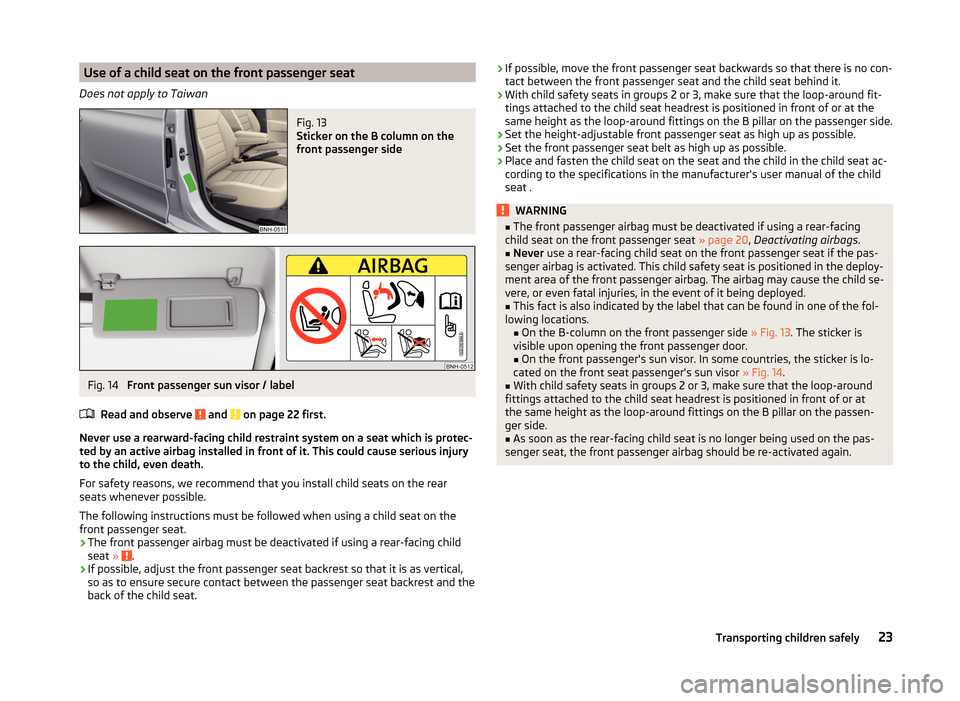
Does not apply to TaiwanFig. 13
Sticker on the B column on the
front passenger side
Fig. 14
Front passenger sun visor / label
Read and observe
and on page 22 first.
Never use a rearward-facing child restraint system on a seat which is protec-
ted by an active airbag installed in front of it. This could cause serious injury
to the child, even death.
For safety reasons, we recommend that you install child seats on the rear
seats whenever possible.
The following instructions must be followed when using a child seat on the
front passenger seat.
› The front passenger airbag must be deactivated if using a rear-facing child
seat »
.
› If possible, adjust the front passenger seat backrest so that it is as vertical,
so as to ensure secure contact between the passenger seat backrest and the
back of the child seat.
› If possible, move the front passenger seat backwards so that there is no con-
tact between the front passenger seat and the child seat behind it.
› With child safety seats in groups 2 or 3, make sure that the loop-around fit-
tings attached to the child seat headrest is positioned in front of or at the
same height as the loop-around fittings on the B pillar on the passenger side.
› Set the height-adjustable front passenger seat as high up as possible.
› Set the front passenger seat belt as high up as possible.
› Place and fasten the child seat on the seat and the child in the child seat ac-
cording to the specifications in the manufacturer's user manual of the child
seat .WARNING■ The front passenger airbag must be deactivated if using a rear-facing
child seat on the front passenger seat » page 20, Deactivating airbags .■
Never use a rear-facing child seat on the front passenger seat if the pas-
senger airbag is activated. This child safety seat is positioned in the deploy-
ment area of the front passenger airbag. The airbag may cause the child se-
vere, or even fatal injuries, in the event of it being deployed.
■
This fact is also indicated by the label that can be found in one of the fol-
lowing locations. ■ On the B-column on the front passenger side » Fig. 13. The sticker is
visible upon opening the front passenger door.
■ On the front passenger's sun visor. In some countries, the sticker is lo-
cated on the front seat passenger's sun visor » Fig. 14.
■
With child safety seats in groups 2 or 3, make sure that the loop-around
fittings attached to the child seat headrest is positioned in front of or at
the same height as the loop-around fittings on the B pillar on the passen-
ger side.
■
As soon as the rear-facing child seat is no longer being used on the pas-
senger seat, the front passenger airbag should be re-activated again.
23Transporting children safely
Page 27 of 204
Use of the child seat in the front passenger seat
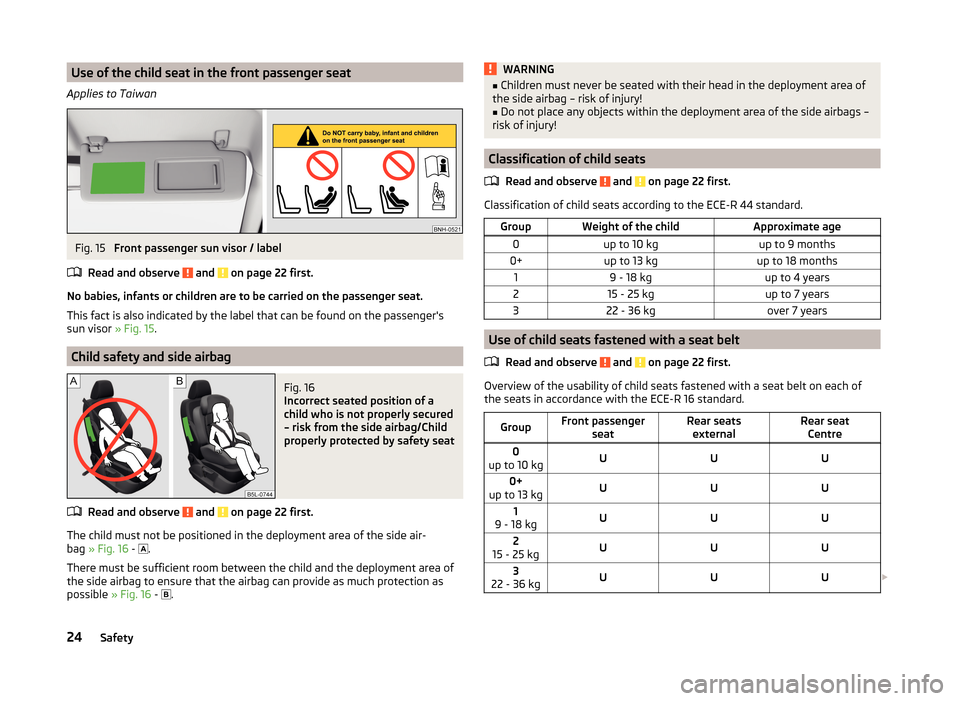
Applies to TaiwanFig. 15
Front passenger sun visor / label
Read and observe
and on page 22 first.
No babies, infants or children are to be carried on the passenger seat.
This fact is also indicated by the label that can be found on the passenger's sun visor » Fig. 15.
Child safety and side airbag
Fig. 16
Incorrect seated position of a
child who is not properly secured
– risk from the side airbag/Child
properly protected by safety seat
Read and observe and on page 22 first.
The child must not be positioned in the deployment area of the side air-
bag » Fig. 16 -
.
There must be sufficient room between the child and the deployment area of
the side airbag to ensure that the airbag can provide as much protection as
possible » Fig. 16 -
.
WARNING■
Children must never be seated with their head in the deployment area of
the side airbag – risk of injury!■
Do not place any objects within the deployment area of the side airbags –
risk of injury!
Classification of child seats
Read and observe
and on page 22 first.
Classification of child seats according to the ECE-R 44 standard.
GroupWeight of the childApproximate age0up to 10 kgup to 9 months0+up to 13 kgup to 18 months19 - 18 kgup to 4 years215 - 25 kgup to 7 years322 - 36 kgover 7 years
Use of child seats fastened with a seat belt Read and observe
and on page 22 first.
Overview of the usability of child seats fastened with a seat belt on each ofthe seats in accordance with the ECE-R 16 standard.
GroupFront passenger seatRear seatsexternalRear seat Centre0
up to 10 kgUUU0+
up to 13 kgUUU1
9 - 18 kgUUU2
15 - 25 kgUUU3
22 - 36 kgUUU 24Safety
Page 28 of 204
“Universal” child seat category - a child seat designed to be attached to
the seat using the seat belt.
Fastening systems
Introduction
This chapter contains information on the following subjects:
Attachment points of the
-system
25
Use of child seats with the
-system
25
Attachment points of the
-system
26
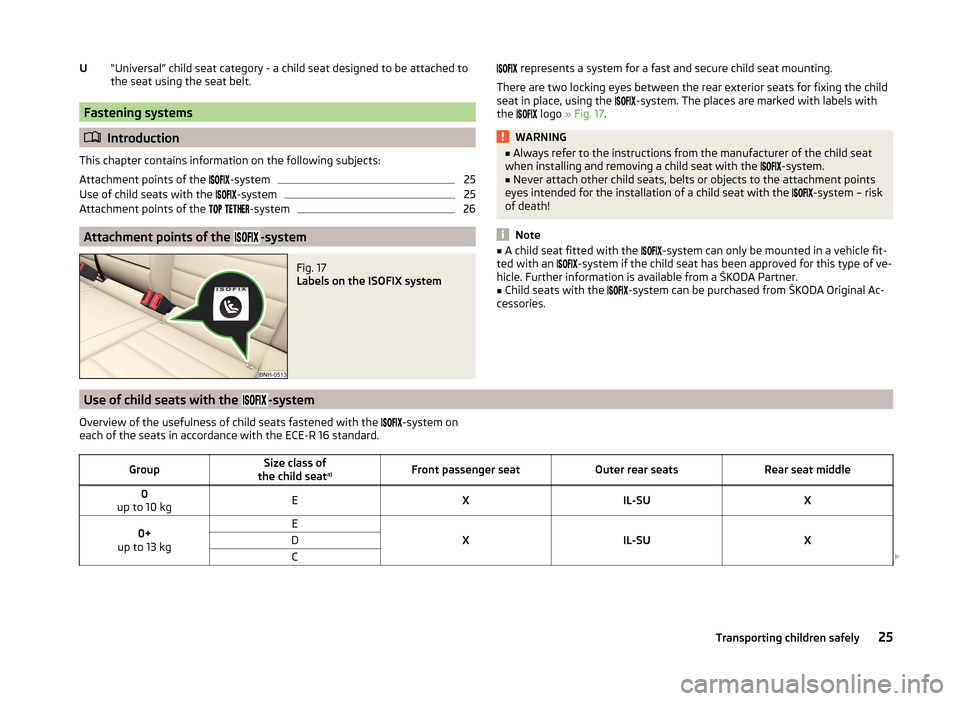
Attachment points of the -system
Fig. 17
Labels on the ISOFIX system
U represents a system for a fast and secure child seat mounting.
There are two locking eyes between the rear exterior seats for fixing the child seat in place, using the
-system. The places are marked with labels with
the
logo » Fig. 17 .WARNING■
Always refer to the instructions from the manufacturer of the child seat
when installing and removing a child seat with the -system.■
Never attach other child seats, belts or objects to the attachment points
eyes intended for the installation of a child seat with the
-system – risk
of death!
Note
■ A child seat fitted with the -system can only be mounted in a vehicle fit-
ted with an -system if the child seat has been approved for this type of ve-
hicle. Further information is available from a ŠKODA Partner.■
Child seats with the
-system can be purchased from ŠKODA Original Ac-
cessories.
Use of child seats with the -system
Overview of the usefulness of child seats fastened with the -system on
each of the seats in accordance with the ECE-R 16 standard.GroupSize class of
the child seat a)Front passenger seatOuter rear seatsRear seat middle0
up to 10 kgEXIL-SUX0+
up to 13 kgE
XIL-SUX
DC 25Transporting children safely
Page 29 of 204
GroupSize class of
the child seat a)Front passenger seatOuter rear seatsRear seat middle
1
9 - 18 kg
D
XIL-SU IUFX
CBB1A2
15 - 25 kg XIL-SUX3
22 - 36 kg XIL-SUXa)
The size category is shown on the label attached to the child seat.
The seat is suited for installation of a -child seat with the “Semi-
Universal” approval. The “Semi-Universal” category means that the child
seat with the
-system is approved for your vehicle. Observe the list
of vehicles that comes with the child seat.
The seat is suitable for the installation of a
-child seat with the ap-
proval “Universal” and attachment with the
-system belt.
The seat is not fitted with
-system attachment points.
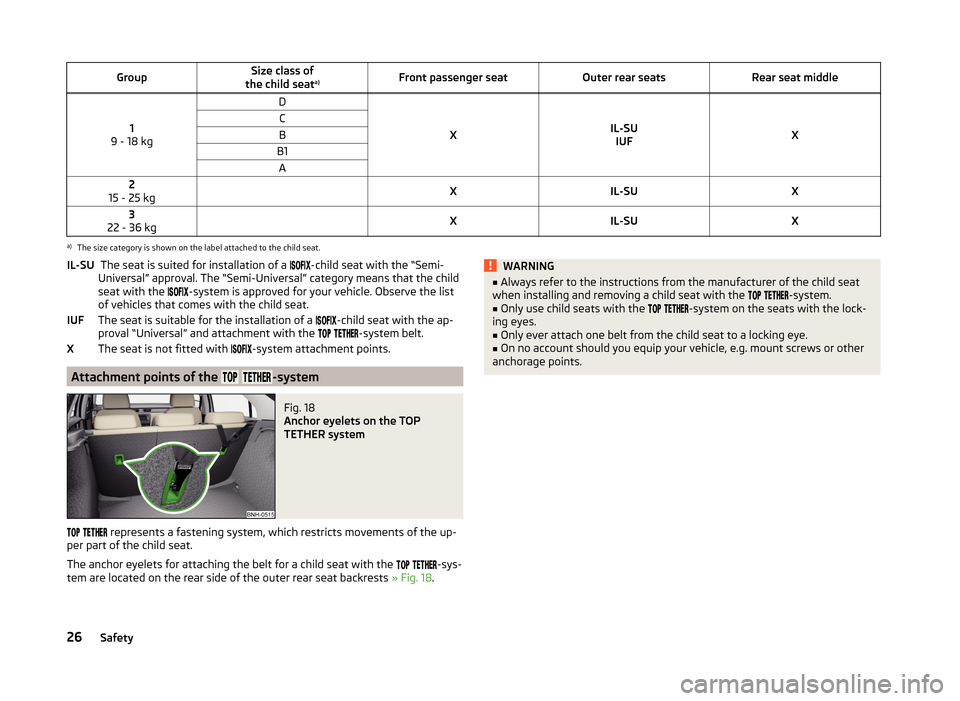
Attachment points of the -system
Fig. 18
Anchor eyelets on the TOP
TETHER system
represents a fastening system, which restricts movements of the up-
per part of the child seat.
The anchor eyelets for attaching the belt for a child seat with the
-sys-
tem are located on the rear side of the outer rear seat backrests » Fig. 18.
IL-SU
IUFXWARNING■
Always refer to the instructions from the manufacturer of the child seat
when installing and removing a child seat with the -system.■
Only use child seats with the
-system on the seats with the lock-
ing eyes.
■
Only ever attach one belt from the child seat to a locking eye.
■
On no account should you equip your vehicle, e.g. mount screws or other
anchorage points.
26Safety
Page 59 of 204
Note■When driving always use the existing heating, air conditioning and ventila-
tion system for ventilating the interior of the vehicle. If the windows are
opened, dust as well as other dirt can get into the vehicle and in addition the wind noise is more at certain speeds.■
The window lift mechanism is equipped with protection against overheating.
Repeated opening and closing of the window can cause this mechanism to
overheat. If this happens, it will not be possible to operate the window for a
short time. You will be able to operate the window again as soon as the over-
heating protection has cooled down.
Opening/closing the windows
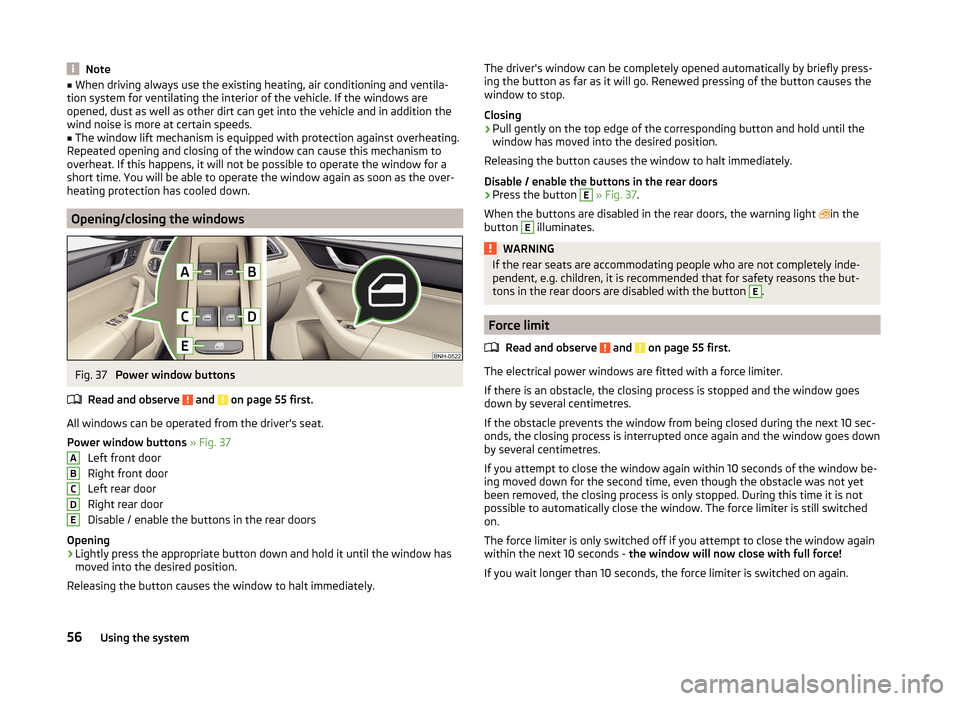
Fig. 37
Power window buttons
Read and observe
and on page 55 first.
All windows can be operated from the driver's seat.
Power window buttons » Fig. 37
Left front door
Right front door
Left rear door
Right rear door
Disable / enable the buttons in the rear doors
Opening
›
Lightly press the appropriate button down and hold it until the window has
moved into the desired position.
Releasing the button causes the window to halt immediately.
ABCDEThe driver's window can be completely opened automatically by briefly press-
ing the button as far as it will go. Renewed pressing of the button causes the
window to stop.
Closing›
Pull gently on the top edge of the corresponding button and hold until the
window has moved into the desired position.
Releasing the button causes the window to halt immediately.
Disable / enable the buttons in the rear doors
›
Press the button
E
» Fig. 37 .
When the buttons are disabled in the rear doors, the warning light
in the
button
E
illuminates.
WARNINGIf the rear seats are accommodating people who are not completely inde-
pendent, e.g. children, it is recommended that for safety reasons the but-
tons in the rear doors are disabled with the button E
.
Force limit
Read and observe
and on page 55 first.
The electrical power windows are fitted with a force limiter.
If there is an obstacle, the closing process is stopped and the window goes
down by several centimetres.
If the obstacle prevents the window from being closed during the next 10 sec-
onds, the closing process is interrupted once again and the window goes down
by several centimetres.
If you attempt to close the window again within 10 seconds of the window be-
ing moved down for the second time, even though the obstacle was not yet
been removed, the closing process is only stopped. During this time it is not
possible to automatically close the window. The force limiter is still switched
on.
The force limiter is only switched off if you attempt to close the window again
within the next 10 seconds - the window will now close with full force!
If you wait longer than 10 seconds, the force limiter is switched on again.
56Using the system
Page 72 of 204
Seats and head restraints
Seats and head restraints
Introduction
This chapter contains information on the following subjects:
Adjusting the front seats
69
Head restraints - adjusting height
70
Headrests - removing and installing
70
The driver's seat should be adjusted in such a way that the pedals can be fully
pressed to the floor with slightly bent legs.
The seat backrest on the driver's seat should be adjusted in such a way that the upper point of the steering wheel can be easily reached with slightly bent
arms.
Correct adjustment of the seats is particularly important for the following rea-
sons.
› Reaching the controls safely and quickly.
› A relaxed and fatigue-free body position.
› Achieving the maximum protection offered by the seat belts and the airbag
system.
WARNING■ Only adjust the driver's seat when the vehicle is stationary – risk of acci-
dent!■
Caution when adjusting the seat! You may suffer injuries or bruises as a
result of adjusting the seat without paying proper attention.
■
Never carry more people than the number of seats in the vehicle.
■
Do not carry any objects on the front passenger seat, except objects de-
signed for this purpose (e.g. child seats) – risk of accident!
Note
After a certain time, play can develop within the adjustment mechanism of the
backrest angle.Adjusting the front seatsFig. 52
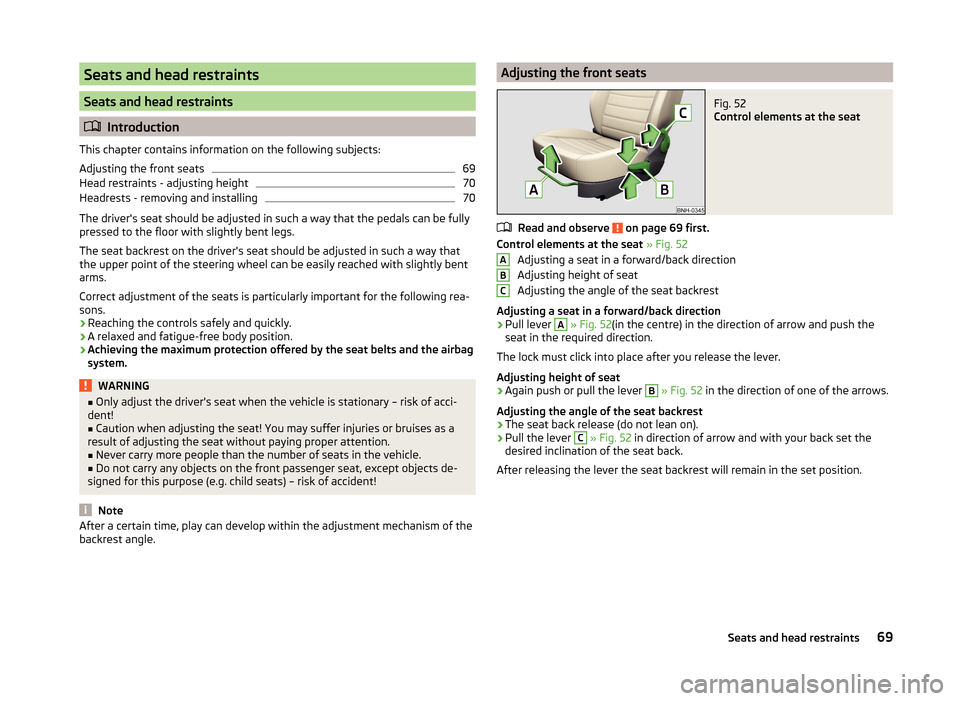
Control elements at the seat
Read and observe on page 69 first.
Control elements at the seat » Fig. 52
Adjusting a seat in a forward/back direction
Adjusting height of seat
Adjusting the angle of the seat backrest
Adjusting a seat in a forward/back direction
›
Pull lever
A
» Fig. 52 (in the centre) in the direction of arrow and push the
seat in the required direction.
The lock must click into place after you release the lever.
Adjusting height of seat
›
Again push or pull the lever
B
» Fig. 52 in the direction of one of the arrows.
Adjusting the angle of the seat backrest
›
The seat back release (do not lean on).
›
Pull the lever
C
» Fig. 52 in direction of arrow and with your back set the
desired inclination of the seat back.
After releasing the lever the seat backrest will remain in the set position.
ABC69Seats and head restraints
Page 74 of 204
›To re-insert the head restraint, push it far enough down in the direction of
arrow 7 into the seat backrest until the locking button clicks into place.WARNINGWith seats occupied, the respective head rests must be installed and adjus- ted correctly - there is a risk of fatal injury!
Note
For the sports seats, the head restraints are integrated into the front seat
backrests. These headrests cannot be removed.
Seat features
Introduction
This chapter contains information on the following subjects:
Front seat heating
71
Front armrest
72
Rear armrest
72
Seat backrests
72
Front seat heating
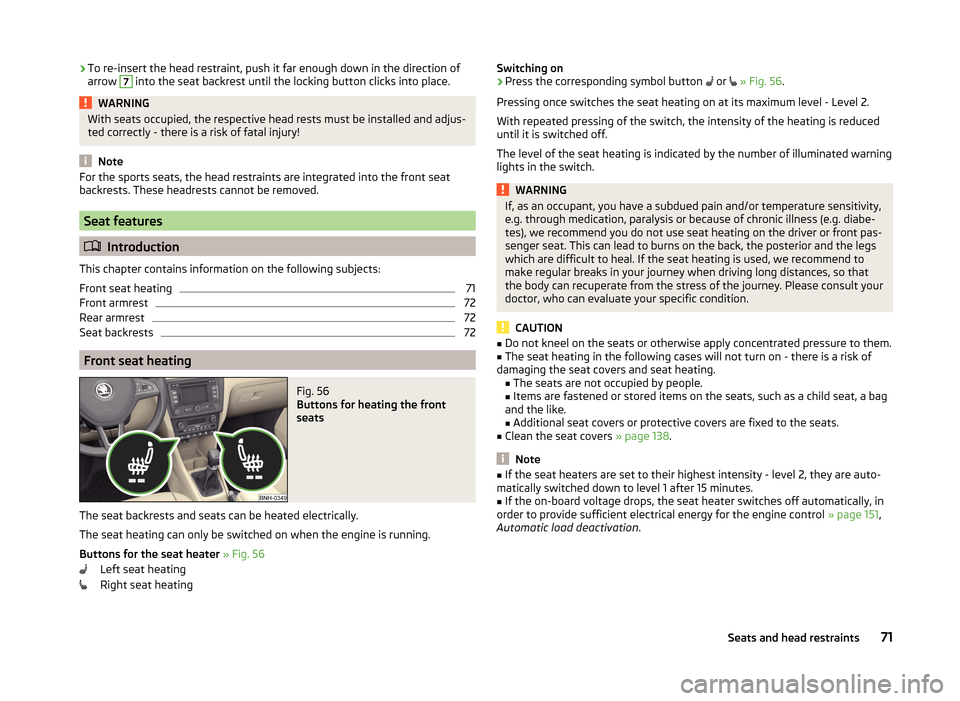
Fig. 56
Buttons for heating the front
seats
The seat backrests and seats can be heated electrically.
The seat heating can only be switched on when the engine is running.
Buttons for the seat heater » Fig. 56
Left seat heating
Right seat heating
Switching on›Press the corresponding symbol button or » Fig. 56 .
Pressing once switches the seat heating on at its maximum level - Level 2.
With repeated pressing of the switch, the intensity of the heating is reduced
until it is switched off.
The level of the seat heating is indicated by the number of illuminated warning
lights in the switch.WARNINGIf, as an occupant, you have a subdued pain and/or temperature sensitivity,
e.g. through medication, paralysis or because of chronic illness (e.g. diabe-
tes), we recommend you do not use seat heating on the driver or front pas-
senger seat. This can lead to burns on the back, the posterior and the legs
which are difficult to heal. If the seat heating is used, we recommend to
make regular breaks in your journey when driving long distances, so that
the body can recuperate from the stress of the journey. Please consult your
doctor, who can evaluate your specific condition.
CAUTION
■ Do not kneel on the seats or otherwise apply concentrated pressure to them.■The seat heating in the following cases will not turn on - there is a risk of
damaging the seat covers and seat heating. ■The seats are not occupied by people.
■ Items are fastened or stored items on the seats, such as a child seat, a bag
and the like.
■ Additional seat covers or protective covers are fixed to the seats.■
Clean the seat covers » page 138.
Note
■
If the seat heaters are set to their highest intensity - level 2, they are auto-
matically switched down to level 1 after 15 minutes.■
If the on-board voltage drops, the seat heater switches off automatically, in
order to provide sufficient electrical energy for the engine control » page 151,
Automatic load deactivation .
71Seats and head restraints
Page 78 of 204

Fig. 64
Cup holder in rear armrest
Read and observe on page 73 first.
Two beverage containers can be placed into the cup holder.
Placement of the cup holders » Fig. 63 and » Fig. 64
In the front centre console
In the rear centre console
In the rear armrest
WARNING■ Do not use any cups or beakers which are made of brittle material (e.g.
glass, porcelain). This could lead to injuries in the event of an accident.■
Never put hot cups in the cup holder. If the vehicle moves, they may spill –
risk of scalding!
■
No objects should be placed in the holders that might endanger the vehi-
cle's occupants if the vehicle brakes suddenly or the vehicle is in collision.
CAUTION
Do not leave open beverage containers in the cup holder during the journey.
There is a risk of spilling e.g. when braking which may cause damage to the
electrical components or seat upholstery.ABCCigarette lighterFig. 65
Cigarette lighter
Read and observe on page 73 first.
Using the system
›
Press in the button in the cigarette lighter » Fig. 65.
›
Wait until the button pops forward.
›
Remove the cigarette lighter immediately and use.
›
Place the cigarette lighter back into the socket.
The cigarette lighter also operates if the ignition is switched off »
.
WARNING■
When leaving the vehicle, never leave persons who are not completely in-
dependent, such as children, unattended in the vehicle. These could oper-
ate the lighter and get burned, start a fire or damage the interior.■
Take care when using the cigarette lighter! Improper usage can cause
burns.
Note
The cigarette lighter socket can also be used as a 12- volt socket for electrical
appliances » page 76, 12-Volt power outlet .75Transporting and practical equipment
Page 139 of 204
We recommend having the protective coating underneath the vehicle and the
chassis checked — preferably before the beginning of winter and at the end of
winter.WARNINGNever use additional under-body protection or anti-corrosion agents for ex-
haust pipes, catalytic converters, diesel particle filters or heat shields.
When the engine reaches its operating temperature, these substances may ignite - risk of fire!
Wiper blades
Read and observe
and on page 132 first.
Clean the wiper blades regularly with a glass cleaner. The wiper blades shouldbe cleaned with a sponge or cloth if they are heavily soiled by insect residues,
for example.
The wiper blades can become soiled with wax residues after washing in auto-
matic vehicle wash systems for example » page 132.
Interior care
Introduction
This chapter contains information on the following subjects:
Natural leather
136
Artificial leather, materials and Alcantara ®
137
Seat covers
138
Safety belts
138
We recommend using vehicle care products from ŠKODA Original Accessories.
These are available from ŠKODA Partners. The usage instructions on the pack-
age must be observed.
WARNING■ Vehicle care products may be harmful to your health if not used according
to the instructions.■
Always keep the vehicle care products safe from people who are not com-
pletely independent, e.g. children - there is a danger of poisoning!
■
Air fresheners and scents can be hazardous to heath when the tempera-
ture inside the vehicle is high.
CAUTION
■ Be sure to check clothing for colour fastness to avoid any damage or visible
stains on the material (leather), panels and textiles.■
Remove fresh stains such as those from ball-point pens, ink, lipstick, shoe
polish, etc., from the material (leather), panels and textiles as quickly as possi-
ble.
■
Do not attach scents or air fresheners to the dash panel – there is a risk of
damage to the dash panel.
■
Do not attach any stickers to the filaments or glass antenna - there is risk of
damage.
■
Do not clean the roof panelling with a brush – risk of damage to the surface
of the panelling.
■
Cleaners that contain solvents can damage the material being cleaned.
■
Apply only a small amount of the cleaning and care product.
For the sake of the environment
Used vehicle care product cans represent hazardous waste that is harmful to the environment. These must be disposed of in accordance with national legal
regulations.
Note
Due to the special tools and knowledge required, and to avoid any potential
problems with the cleaning and care of the interior of your vehicle, we recom-
mend that cleaning and care of the interior of your vehicle be carried out by a
ŠKODA service partner.
Natural leather
Read and observe
and on page 136 first.
The leather needs, depending on the strain placed on it, regular cleaning and
maintenance.
136General Maintenance
Page 193 of 204
BrakeWarning light35
Brake booster107
brake fluid specification
148
Brake fluid147
Checking148
Information messages35
brake pedal (automatic gearbox) indicator light
41
brakes Driving in
111
Brakes Brake booster
107
Brake fluid148
Braking and stabilisation systems113
Handbrake107
Information messages35
Brakes and parking106
Braking Information on braking
106
Bulb failure Warning light
38
Bulbs Warning light
38
Buttons in the door Power windows
55
C
Car care Jack
135
Car computer See multifunction display
43
Care and maintenance128
Cargo element84
Car park ticket holder74
Carrier Roof rack
88
Cavity protection135
Central locking49
Problems53
Central locking button52
Change Engine oil
144
light bulb in tail light179
Changing bulbs
176
Front turn signal bulb178
Wheels160
Changing a wheel Follow-up work
162
Preliminary work161
Removing and attaching a wheel162
Charging a vehicle battery150
Check Fit ball head properly
123
Checking Battery electrolyte level
150
Brake fluid148
Coolant147
Engine oil145
Oil level145
Windscreen washer fluid143
Checks Statutory checks
128
Children and safety22
Child safety Side airbag
24
Child safety lock53
Child seat Classification
24
ISOFIX25
on the front passenger seat23
TOP TETHER26
Use of child seats24
Use of ISOFIX child seats25
Chrome parts see vehicle care
133
Cigarette lighter75
cleaning chrome parts133
Cleaning Alcantara
137
and maintaining belts138
artificial leather137
headlight glasses134
materials137
natural leather136
plastic parts133
seats covers of the electrically heated seats138
wheels135
Cleaning safety belt
138
Cleaning seat covers
138
Cleaning the interior artificial leather
137
Seat covers138
Cleaning the outside of the vehicle Decorative films
134
Cleaning the vehicle exterior Cavity protection
135
Door locking cylinder135
Headlight glasses134
Towing device135
Under-body protection135
wheels135
Windows and external mirrors134
Cleaning vehicle131
Cleaning vehicle exterior132
Plastic parts133
Rubber seals133
Vehicle paint work133
Wiper blades136
Clean interior Safety belt
138
clean outside of vehicle chrome parts
133
190Index