mirror SKODA SUPERB 2008 2.G / (B6/3T) User Guide
[x] Cancel search | Manufacturer: SKODA, Model Year: 2008, Model line: SUPERB, Model: SKODA SUPERB 2008 2.G / (B6/3T)Pages: 272, PDF Size: 18.25 MB
Page 70 of 272

Lights and Visibility69
Using the systemSafetyDriving TipsGeneral MaintenanceBreakdown assistanceTechnical Data
Exterior mirror
You can adjust the exterior mirrors electrically*.
The exterior mirror heater only oper ates when the engine is running and
up to an outside temperature of +20 °C.
Heating of the external mirror
– Turn the rotary knob to position
⇒ fig. 61 .
Adjusting left and right exterior mirrors simultaneously
– Turn the rotary knob to position
. The movement of the mirror surface
is identical to the movement of the rotary knob.
Adjusting the right-hand exterior mirror
– Turn the rotary knob to position
. The movement of the mirror
surface is identical to the movement of the rotary knob.
Switching off operating control
– Turn the rotary knob to position
.
Folding in both exterior mirrors*
– Turn the rotary knob to position
. Lowerable exterior mirror* with the aid of the key for remote control
– If all the windows are closed, press the unlock button on the
remote control ⇒page 44, fig. 34 for approx. 2 seconds.
Tilting surface of front pa ssenger exterior mirror*
When the rotary knob is in position
⇒ fig. 61 and the reverse gear is engaged, the
s ur fa ce o f t h e m i rro r t i l ts d o w n s l i g h t l y. T h i s p ro v i d e s a n a i d i n s e e i n g th e ke r b o f t h e
pavement when parking the car.
The mirror returns back into its initial po sition, after the rotary knob is moved out
of the position
and put into another position or if the speed is more than 15 km/h.
Memory for exterior mirrors*
On vehicles fitted with a memory for the driver seat, the relevant setting of the exte-
rior mirror is also stored automatica lly when the seat position is stored.
WARNING
•Convex (curved outward) or a spherical exterior mirrors increase the
vision field. They do, however, make objects appear smaller in the mirror.
These mirrors are only of limited use, therefore, for estimating distances to
the following vehicles.
•Use whenever possible the interior rear mirror, for estimating the
distances to the following vehicles.
Note
•Do not touch the surfaces of the exterior mirrors if the exterior mirror heater is
switched on.
•You can set the exterior mirrors by hand, if the power setting function fails at any
time, by pressing on the ed ge of the mirror surface.
•Contact your specialist garage if a fault exists with the power setting of the exte-
rior mirrors.
Fig. 61 Inner part of door:
Rotary knob
A3
NKO B6 20.book Page 69 Wednesday, March 26, 2008 3:15 PM
Page 71 of 272

Lights and Visibility
70
Automatic dimming exterior mirror*
The exterior mirrors are dimmed together with the interior mirror. If the automatic
dimming is switched on, the mirror dims automatically depending on the light
striking the mirror from the rear.
When the interior lights are switched on or the reverse gear is engaged, the mirror
always moves back into the basic position (not dimmed).
Note
•Automatic mirror dimming operates only pr operly if the sun screen* for the rear
window is not in use or the li ght striking the rear of the interior rear-view mirror is
not affected by other objects.
•Do not affix any stickers in front of the li ght sensor, so that you do not impair the
automatic dimming function or put it out of operation.
•If you switch off the automatic dimming interior rear-view mirror, also the exte-
rior mirror dimming is switched off.
NKO B6 20.book Page 70 Wednesday, March 26, 2008 3:15 PM
Page 74 of 272

Seats and Stowage73
Using the systemSafetyDriving TipsGeneral MaintenanceBreakdown assistanceTechnical Data
WARNING
•Only adjust the driver seat when the ve hicle is stationary - risk of injury!
•Caution when adjusting the seat! You ma y suffer injuries or bruises as a
result of adjusting the seat without paying proper attention.
•In view of the fact that the seats can also be adjusted when the ignition is
switched off (even when ignition key withdrawn), you should never leave
children unattended in the car.
•The backrests must not be angled too far back when driving otherwise
this will affect proper operation of the seat belts and of the airbag system -
risk of injury!
Note
If the movement of the seat is inadvertentl y interrupted during an adjustment, once
again press the switch in the appropriate direction and continue with the adjust-
ment of the seat to the end.
Storing setting
Storing seat and exterior mirror settings for driving forward
– Switch on the ignition. – Adjust the seat
⇒page 72.
– Adjust both exterior mirrors ⇒page 69.
–Press button SET ⇒fig. 64 .
– Press one of the memory buttons within 10 seconds after pressing the button SET - an acknowledgement signal confirms that the seat
setting is stored.
Storing exterior mirror setting for reversing*
– Switch on the ignition.
– Turn the exterior mirror control to position
⇒ page 69.
– Engage reverse gear.
– Move the right exterior mirror into the desired position ⇒page 69.
– Take the vehicle out of gear. The set position of the exterior mirror is stored.
Memory buttons
Memory for the seat offers the possibility to store the individual driver seat and
external mirror position. An individual posi tion can be allocated to each of the three
memory buttons ⇒fig. 64 , that is three in total. After pressing the corre-
sponding memory button , the seat and the exterior mirror are automatically
moved into the positions which have been allocated to this button ⇒page 74.
Emergency Off
You can interrupt the setting operation at an y time, if you operate any button of the
driver seat.
Note
•When storing settings with the memory buttons, we recommend that you begin
with the front button and assign a memo ry button to each additional driver.
•Each new setting stored with the same button erases the previous setting.
Fig. 64 Driver seat: Memory
buttons and SET button
AA
AB
ABAB
NKO B6 20.book Page 73 Wednesday, March 26, 2008 3:15 PM
Page 75 of 272

Seats and Stowage
74
•Each time you store the seat and exterior mirror settings for driving forward you
also have to re-store the individual settin g of the exterior mirror on the passenger
side for reversing.
Assigning remote control to the memory buttons
After storing the settings of the seat and exterior mirrors, you have 10
seconds in order to assign the remote control to the appropriate memory
button.
– Withdraw the ignition key.
– Press the unlock button ⇒page 44, after the successful assignment
an audible confirmation will sound. The setting is stored with the
memory button which you have selected.
If you wish to be able to retrieve the settings which are stored in the memory by also
using the remote control, you have to assign the remote control to a memory
button in each case.
If you wish, you can obtain an additional key with radio remote control from a
Škoda dealer and then assign the radio remote control to another memory button.
Note
•If the remote control had previously been assigned to another memory button,
this setting is then erased by the new assignment.
•If you assign the remote control to a memory button which has already been
assigned to a remote control, the old assi gnment is also replaced by a new assign-
ment in this case.
•T h e a s s i g n m e n t o f t h e re m o te c o n tro l t o a m e m o r y b u tt o n i s re t a i n e d , h o w e v e r,
after reassigning the seats and exterior mirrors.
Retrieving settings of the seat and mirrors
You can retrieve the stored settings either with the memory buttons
or with the remote control*.
Retrieving settings with memory buttons
– In order to retrieve the stored setting, you have two possibilities:
– One-touch automatic memory: Briefly press the desired memory
button ⇒page 73, fig. 64 . The seat and exterior mirror are moved
automatically into the stored positions (this applies only if the ignition
is switched on and the speed is less than 5 km/h).
– Memory keying : Press and hold the desired memory button
pressed long enough until the seat and the exterior mirror are moved
into the stored positions.
Retrieving settings with remote control
– If the driver door is closed and the ignition is switched off, briefly press the unlock button of the remote control ⇒page 44 and then open the
driver door.
– The seat and exterior mirrors now move automatically into the stored
positions.
Retrieving setting of exterior mirror for reversing*
– Turn the rotary knob for the exterior mirror setting into the position
⇒ page 69 before engaging the reverse gear.
The mirror returns back into its initial position, after the rotary knob is moved out
of the position and put into another position or if the speed is more than 15 km/h.
Emergency Off
You can interrupt the setting operation at any time, if you operate any button of the
driver seat.
AB
AB
NKO B6 20.book Page 74 Wednesday, March 26, 2008 3:15 PM
Page 149 of 272

Passive Safety
150
Before setting off
The driver is always fully respon sible for his occupants and for the
operating safety of the vehicle.
For your own safety and the safety of the people travelling with you, please pay
attention to the following points before setting off.
•Ensure that the lighting and the turn signal system are functioning properly.
•Inspect the tyre inflation pressure.
•Ensure that all the windows offer a good visibility to the outside.
•Safely attach the items of luggage ⇒page 78, “Loading the luggage compart-
ment”.
•Ensure that no objects can obstruct the pedal.
•Adjust the mirror, the front seat and the head restraint to match your body size.
•Point out to your occupants that the head restraints must be adjusted to match
their body size.
•Protect the children in suitable child se ats with correctly fastened seat belts
⇒ page 171, “Transporting children safely”.
•Adopt the correct seated position ⇒page 150, “Correct seated position”. Also
inform your occupants to adopt the correct seated position.
•Fasten the seat belt correctly. Also inform your occupants to properly fasten the
seat belts ⇒page 156, “How are seat belts correctly fastened?”.
What influences the driving safety?
The driving safety is primarily dete rmined by the style of driving and
the personal behaviour of all the occupants.
The driver is fully responsible for himself and his occupants. If your driving safety is
effected, you place yourself and the oncomi ng traffic at risk. Please refer to the
following guidelines.
•Do not get distracted from concentrating on the traffic situation, e.g. by your
occupants or mobile phone calls.
•Never drive when your driving ability is impaired, e.g. through medication,
alcohol, drugs.
•Keep to the traffic regulations and the permissible speed limit.
•Adjust the driving speed at all times to the road condition as well as to the traffic
and weather conditions.
•Take regular breaks on long journe ys - at the latest every two hours.
Correct seated position
Correct seated position for the driver
Correct seated position for the driver is important for safe and
relaxed driving.
Fig. 145 The correct distance
of the driver from the
steering wheel
NKO B6 20.book Page 150 Wednesday, March 26, 2008 3:15 PM
Page 193 of 272

Towing a trailer
194
Towing a trailer
To w i n g a t r a i l e r
Technical requirements
The towing device must satisfy certain technical requirements.
Your vehicle is designed primarily for tr ansporting persons and luggage. It can,
however, also be used for towing a traile r - provided certain technical equipment is
fitted.
If your vehicle has already been supplied with a factory-fitted towing device then
everything that is necessary for towing a trailer in technical terms, and in terms of
the law, has already been taken into account.
Your vehicle is fitted with a 13-pin power socket for the electrical connection
between the vehicle and trailer. If th e trailer which you wish to tow has a 7-pin
connector, you can use a suitable adapter
14) from Škoda original accessories.
This work must be carried out in accordan ce with the manufacturer's specifications
if a towing device is retrofitted.
Škoda Service Partners are familiar with de tails relating to retrofitting a towing
device and for any necessary modi fications to the cooling system.
WARNING
We recommend that you have the towing device from Škoda original acces-
sories installed by a Škoda Service Partner. He is familiar with all the relevant
details relating to retrofitting such equi pment. There is a risk of an accident
if the towing device is not properly fitted!
General Maintenance
There are a number of points to pay attention to when towing a
trailer.
Trailer load
The permissible trailer load must on no account be exceeded.
You can negotiate appropriately steeper inclines and descents if you do not make
full use of the perm issible trailer load.
The trailer loads specified only apply for altitudes up to 1 000 metres above mean
sea level. The fact that the engine power ou tput drops with increasing height due to
a lowering of air pressure and thus the abil ity to climb, means that the towed weight
must be reduced by 10% for every further increase of 1 000 metres in height above
sea level. The towed weight is the weight of the (laden) vehicle and the (laden)
trailer together. One should take this into account before driving up to higher alti-
tudes.
The trailer and drawbar load information on the type plate of the towing
device are merely test data for the tow ing device The data relating to your
vehicle, which is often less than this test data, can be found in your vehicle
registration documents.
Distribution of the load
Distribute the load in the trailer in such a way that any heavy items are located as
close as possible to the axle. Secure the items to prevent them slipping.
Tyre inflation pressure
Select the tyre inflation pressure on your vehicle for that of “fully laden”,
⇒ page 222. The inflation pressure of the tyres fitted to the trailer adjust in accord-
ance with the manufacturer's recommendation.
Exterior mirrors
You have to have additional exterior mirrors fitted if you are not able to see the
traffic behind the trailer with the standard rear-view mirrors. Both exterior mirrors
14)In some countries the adapter is supplied with the towing device.
NKO B6 20.book Page 194 Wednesday, March 26, 2008 3:15 PM
Page 194 of 272

Towing a trailer195
Using the systemSafetyDriving TipsGeneral MaintenanceBreakdown assistanceTechnical Data
should be attached to folding arms. Adjust
the mirrors so that they provide you with
an adequate field of view to the rear.
Headlights
Before starting off with a hitched trailer, also check the setting of the headlights.
Alter the setting as necessary with th e aid of the headlight beam adjuster
⇒ page 59, “Headlamp range adjustment* ”.
Detachable ball head
The ball rod is detachable on vehicles which feature a factory-fitted towing device.
It is stowed together with separate fitting instructions in the spare wheel well in the
luggage compartment of the vehicle.
Further information on the towing device ⇒page 196.
Note
•We recommend that you also have yo ur vehicle inspected between service
intervals if you tow a trailer frequently.
•The handbrake on the towing vehicle must be put on when coupling and
decoupling the trailer.
Driving Tips
Particular caution is required when towing a trailer.
– Do not, as far as possible, drive with your vehicle unladen and the
trailer laden.
– Do not make full use of the legal maximum speeds. This applies in particular to downhill sections.
– Apply the brakes in good time.
– Keep a check on the coolant temperature gauge if the outside temper- ature is high.
Distribution of weight
The distribution of the weight is very poor if your vehicle is unladen and the trailer
is laden. Maintain a particularly low speed if you cannot avoid driving with this
combination.
Driving speed
Do not drive faster than 80 km/hour for safety reasons. This also applies for coun-
tries in which higher speeds are allowed.
The fact that the driving stability of the vehicle + trailer combination reduces with
increasing speed means that the legally allowed speed should not be used when
there are unfavourable road, weather or wind conditions, particularly near accident
black spots.
You must always reduce your speed immedi ately as soon as you detect even just
the slightest swaying of the trailer. On no account attempt to stop the trailer from
“swaying” by accelerating.
Apply the brakes in good time! If the trailer is fitted with a trailer brake, apply the
brakes gently at first and then brake firmly . This will avoid brake jolts resulting from
the trailer wheels locking. Shift down gears in good time before negotiating a down-
hill section to allow the engine to also act as a brake.
Engine overheating
Please keep a check on the coolant temperature gauge if you have to negotiate a
lengthy slope in a low gear at a high engine speed when the outside temperature is
very high ⇒page 11, “Coolant temperature gauge”.
If the needle of the coolant temperature gauge moves into the right-hand area or
even the red area of the scale, reduce yo ur speed immediately. Stop and switch off
the engine if the warning light
in the instrument cluste r begins flashing. Wait a
few minutes and check the level of coolant in the coolant expansion bottle
⇒ page 214, “Inspecting the coolant level”.
Please refer to the following guidelines ⇒page 31, “Coolant temperature/ Coolant
quantity ”.
The coolant temperature can be reduced by switching on the heating.
Any increase in the cooling effect of the coolant fan through shifting down a gear
and increasing the engine speed is not possible since the fan speed is independent
NKO B6 20.book Page 195 Wednesday, March 26, 2008 3:15 PM
Page 199 of 272

Taking care of your vehicle and cleaning the vehicle
200
Plastic parts
External plastic parts are cleaned by normal washing. Plastic parts and synthetic
leather can also be treated with special solvent-free plastic cleaning agents if a
damp cloth is not sufficient. Paint care pr oducts are not suitable for plastic parts.
Caution
Solvent-free cleaners attack the material and can damage it.
Windows
Only use a plastic ice scraper for removing snow and ice from the windows and
mirrors. You should not move the ice scraper forward and backward but in one
direction on the window which you are clea ning in order to avoid any damage to
the surface of the glass.
You can best remove residues of rubber, oil, grease, wax or silicone by using a
special window cleaner or a special silicone remover.
You should also clean the windows regularly from the inside.
Do not use window leathers which you have used to polish the vehicle body to dry
off the windows. Residues of preservati ves in the window leather can dirty the
window and reduce visibility.
Do not affix any stickers over the inside of the rear window to avoid damage to the
heating elements of the rear window heater .
We recommend using a preservative from Škoda genuine accessories offered by
your Škoda dealer.
Caution
Never remove snow or ice from the glass parts with warm or hot water - risk of
formation of cracks in the glass!
The headlight lenses
Please do not use any aggres sive cleaning or chemical solvent pr oducts - risk of
damage to the plastic lenses Please use soap and clean warm water.
Caution
Never wipe the headlights dry and do not use any sharp objects for cleaning the
plastic lenses, this may result in damage to the protective paintwork and conse-
quently in formation of cracks on the head light lenses, e.g through effect of chem-
ical products.
Door and window seals
The rubber seals on the doors, boot lid, bonnet and windows remain supple and
last longer if you treat them from time to time with a rubber care product (e.g. with
a spray with silicone-free oil). You also avoid premature wear of the seals and
prevent leakages in this way. It is also easier to open the doors. Rubber seals which
are well cared for also do not stick together in cold winter weather.
Locks
We recommend that you use the spray from Škoda original accessories with
regreasing and anticorrosive effect for de-icing locks.
Note
When washing your vehicle, ensure that as little water as possible gets into the
locks.
NKO B6 20.book Page 200 Wednesday, March 26, 2008 3:15 PM
Page 244 of 272
Fuses and light bulbs245
Using the systemSafetyDriving TipsGeneral MaintenanceBreakdown assistanceTechnical Data
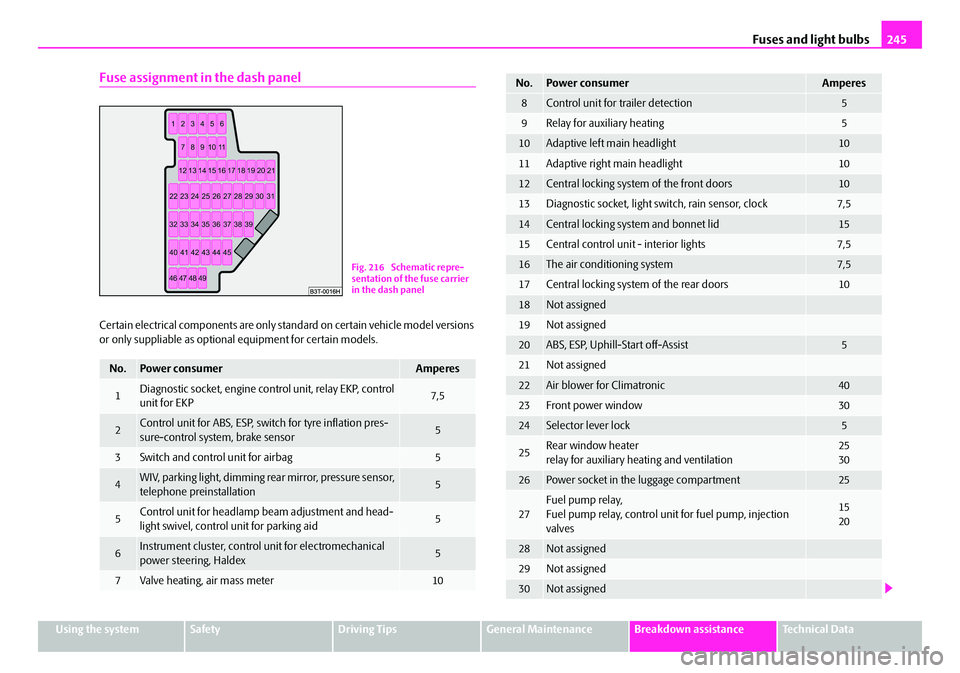
Fuse assignment in the dash panel
Certain electrical components are only standard on certain vehicle model versions
or only suppliable as optional equipment for certain models.
No.Power consumerAmperes
1Diagnostic socket, engine cont rol unit, relay EKP, control
unit for EKP7,5
2Control unit for ABS, ESP, swit ch for tyre inflation pres-
sure-control system, brake sensor5
3Switch and control unit for airbag5
4WIV, parking light, dimming rear mirror, pressure sensor,
telephone preinstallation5
5Control unit for headlamp beam adjustment and head-
light swivel, control unit for parking aid5
6Instrument cluster, control unit for electromechanical
power steering, Haldex5
7Valve heating, air mass meter10
Fig. 216 Schematic repre-
sentation of the fuse carrier
in the dash panel
8Control unit for trailer detection5
9Relay for auxiliary heating5
10Adaptive left main headlight10
11Adaptive right main headlight10
12Central locking system of the front doors10
13Diagnostic socket, light switch, rain sensor, clock7,5
14Central locking system and bonnet lid15
15Central control unit - interior lights7,5
16The air conditioning system7,5
17Central locking system of the rear doors10
18Not assigned
19Not assigned
20ABS, ESP, Uphill-Start off-Assist5
21Not assigned
22Air blower for Climatronic40
23Front power window30
24Selector lever lock5
25Rear window heater
relay for auxiliary heating and ventilation25
30
26Power socket in the luggage compartment25
27Fuel pump relay,
Fuel pump relay, control unit for fuel pump, injection
valves15
20
28Not assigned
29Not assigned
30Not assigned
No.Power consumerAmperes
NKO B6 20.book Page 245 Wednesday, March 26, 2008 3:15 PM
Page 246 of 272
Fuses and light bulbs247
Using the systemSafetyDriving TipsGeneral MaintenanceBreakdown assistanceTechnical Data
WARNING
•Bulbs H7 and H3 are pressurised and may burst when changing the bulb
- risk of injury!
•It is recommended to wear gloves and eye protection when changing a
light bulb.
•Gas discharge bulbs* (xenon bulbs) op erate with a high voltage, profes-
sional knowledge is required - danger to life!
Caution
Do not take hold of the glass bulb with naked fingers (even the smallest amount of
dirt reduces the working life of the light bu lb). Use a clean cloth, serviette or some-
thing similar.
Note
This Owner's Manual only describes the replacement of bulbs where it is assumed
that no major complications wi ll arise. Other light bulbs should be changed by your
specialist garage.
Front headlight
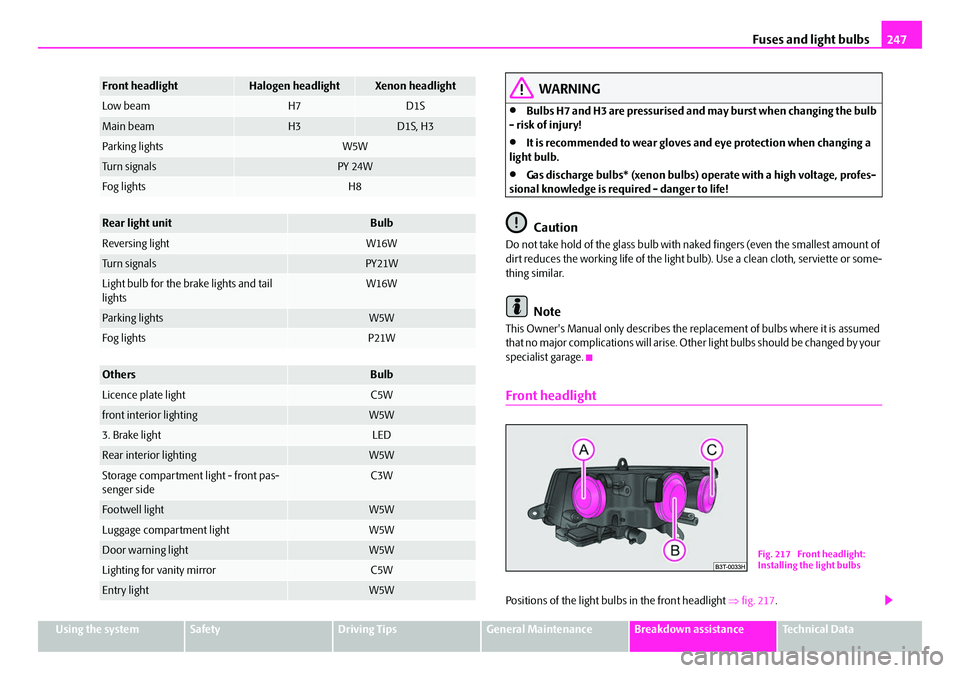
Positions of the light bulbs in the front headlight ⇒fig. 217 .
Front headlightHalogen headlightXenon headlight
Low beam H7D1S
Main beamH3D1S, H3
Parking lightsW5W
Tu r n s i g n a l sPY 24W
Fog lightsH8
Rear light unitBulb
Reversing lightW16W
Tu r n s i g n a l sPY21W
Light bulb for the brake lights and tail
lightsW16W
Parking lightsW5W
Fog lightsP21W
OthersBulb
Licence plate lightC5W
front interior lightingW5W
3. Brake lightLED
Rear interior lightingW5W
Storage compartment light - front pas-
senger sideC3W
Footwell lightW5W
Luggage compartment lightW5W
Door warning lightW5W
Lighting for vanity mirrorC5W
Entry lightW5W
Fig. 217 Front headlight:
Installing the light bulbs
NKO B6 20.book Page 247 Wednesday, March 26, 2008 3:15 PM