ECO mode SKODA SUPERB 2008 2.G / (B6/3T) Owner's Guide
[x] Cancel search | Manufacturer: SKODA, Model Year: 2008, Model line: SUPERB, Model: SKODA SUPERB 2008 2.G / (B6/3T)Pages: 272, PDF Size: 18.25 MB
Page 137 of 272

Communication
136
Universal telephone preinstallation GSM III*
Introduction
This enables you to make full use of the ad vantages of a normal carphone (“hands-
free system” using a microphone integrated in the vehicle, optimal transmission of
signals using an external aerial etc.). The equipment includes also the voice control.
The telephone is connected using the rSAP profile - Remote SIM access profile
(telecommunication of the SIM data) by means of Bluetooth
® technology, if your
telephone supports this profile. The equi pment includes the following functions:
•Display of the SMS text in the information display.
•Free talking in the vehicle interior.
•MUTE signal to the radio.
•Voice control (with the set-up possibility for “short and long dialogue”,
depending on the user's knowledge of the operating structure).
•Convenience mode with the multifunction steering wheel and the display in the
information display.
•Handsfree-system.
The voice control of the telephone is acti vated by pressing the button PTT on the
multifunction steering wheel ⇒page 139, fig. 142 .
A phone phonebook is part of the univers al telephone preinstallation GSM III with
voice control. In the phone phonebook there are 1 000 free memory locations
available. This phone phonebook is inde pendent of the appliance used for the
mobile phone.
Furthermore the volume can be changed indi vidually at any time with the button
for setting the radio or on vehicles fitted with multifunction steering wheel* with
function buttons on the steering wheel.
Dialogue
The period, in which the telephone system is ready to receive voice commands and
carry out the voice commands, is called DIALOGUE. The system gives audible feed-
back and guides you if nece ssary through the relevant functions. You can start or
end the dialogue at any time by pressing the PTT button. The dialogue is always automatically ended after carrying out an operation, e.g.
after erasing the name from the phonebook.
The dialogue of the incoming call is i
mmediately interrupted and you can accept
the call by pressing the button
.
If a voice command is not detected, the system answers with “ Sorry?” and a new
entry can be performed. After the 2nd error the system repeats the aid. After the 3rd
error the answer “ Cancel” is given and the dialogue is ended.
Optimum understanding of the voice commands depends on the following
factors:
•Speak with a normal tone of voice wi thout intonation and excessive voice
pauses.
•Avoid insufficient articulation.
•Close the doors, windows and sliding roof, in order to reduce or stop disturbing
exterior noise.
•It is recommended to speak louder at higher speeds, so that the tone of your
voice is louder than the increased surrounding noise.
•During the dialogue avoid additional nois e in the vehicle, e.g. simultaneously
talking occupants.
•Do not speak, if the system makes an announcement.
•The microphone for voice control is in serted in the moulded headliner and
directed to the driver and front passen ger. Therefore the driver and the front
passenger can operate the equipment.
WARNING
Pay attention primarily to the traffic si tuation! As the driver you are fully
responsible for road safety. Use the telephone system only to such an extent,
so that you are in full control of your vehicle at any time.
Note
•Please contact your Škoda Service Partne r if there are any points which are not
clear.
•Please also refer to the additional instructions ⇒page 145.
NKO B6 20.book Page 136 Wednesday, March 26, 2008 3:15 PM
Page 179 of 272

Intelligent Technology
180
•when driving with snow chains
•when driving in deep snow or on a loose surface
•when it is necessary to rock a ca r free when it has become stuck.
then you should switch on the ESP again.
WARNING
It is also not possible for the ESP to overcome the physical limits of the
vehicle. Even if a vehicle fitted with ESP you should still always adapt your
style of driving to the condition of the road surface and the traffic situation.
This particularly applies when driving on slippery and wet roads. The
increased safety offered must not tempt you to take greater risks than other-
wise - risk of an accident!
Note
•All four wheels must be fitted with the same tyres in order to achieve problem-
free operation of the ESP. Differing rolling circumferences of the tyres can lead to an
undesirable reduction in the engine output.
•Changes to vehicle (e.g. on engine, on the brakes, on chassis or other assign-
ment of tyres and wheels) can influence the function of the ESP ⇒page 228,
“Accessories, changes and replacement of parts”.
Electronic Differential Lock (EDS)*
The electronic differential lock pr events an individual wheel from
slipping.
Models fitted with ESP are equipped with electronic differential lock (EDL).
General
The EDL makes it much easier, and sometimes at all possible, to start off, accelerate
and climb a steep hill when the conditio ns of the road surface are unfavourable. Operating principle
The EDL is activated automatically, that is without any action on the part of the
driver. It monitors the speeds of the driven wheels with the aid of the ABS sensors.
Should only
one drive wheel begin spinning on a slippery surface there will be an
appreciable difference in the speed of the driven wheels. The EDL function brakes
the slipping wheel and the differential transmits a greater driving force to the other
driven wheel. This control proces s is also accompanied by noises.
Overheating of the brakes
The EDL switches off automatically if unusually severe stresses exist in order to
avoid excessive heat generation in the disc brake on the wheel which is being
braked. The vehicle can continue to be driven and has the same characteristics as a
vehicle not fitted with EDL.
The EDL switches on again automatically as soon as the brake has cooled down.
WARNING
•Depress the accelerator carefully when accelerating on uniformly slip-
pery road surfaces, such as ice and sn ow. The driven wheels might still spin
despite the EDL and affect the stability of the vehicle - risk of an accident!
•You should always adapt your style of driving to the condition of road
surface and to the traffic situation even when your vehicle is fitted with EDL.
The increased safety offered must not tempt you to take greater risks than
otherwise - risk of an accident!
Note
•If the ABS or ESP warning light comes on, this may also indicate a fault in the
EDL. Please have the car inspected as s oon as possible by a specialist garage.
•Changes to vehicle (e.g. on engine, on the brakes, on chassis or other assign-
ment of tyres and wheels) can in fluence the function of the EDL ⇒page 228,
“Accessories, changes and replacement of parts”.
NKO B6 20.book Page 180 Wednesday, March 26, 2008 3:15 PM
Page 210 of 272
Inspecting and Replenishing211
Using the systemSafetyDriving TipsGeneral MaintenanceBreakdown assistanceTechnical Data
Engine oil specifications for vehicles with fixed service intervals (QG2)
Engine oil specifications for models with flexible service intervals (QG1)
Caution
Only the above-mentioned oils
may be used on vehicles with flexible service inter-
vals (QG1). We recommend always refilling with oil of the same specification since
this will maintain the properties of the oil. In exceptional cases, you must top up
only once engine oil complying with Sp ecification VW 502 00 (only for petrol
engines) or Specification VW 505 01 (only for diesel engines) to maximum 0.5 litres.
You must not use other engine oi ls - risk of engine damage!
Note
•Before a long drive we recommend th at you purchase and carry with you
engine oil which complies with the specif ication for your vehicle. Consequently,
you will always have the correct engine oil for refilling.
•We recommend using a preservative from the Škoda original accessories
offered by your Škoda dealer.
•For further information - see Service shedule.
Check engine oil level
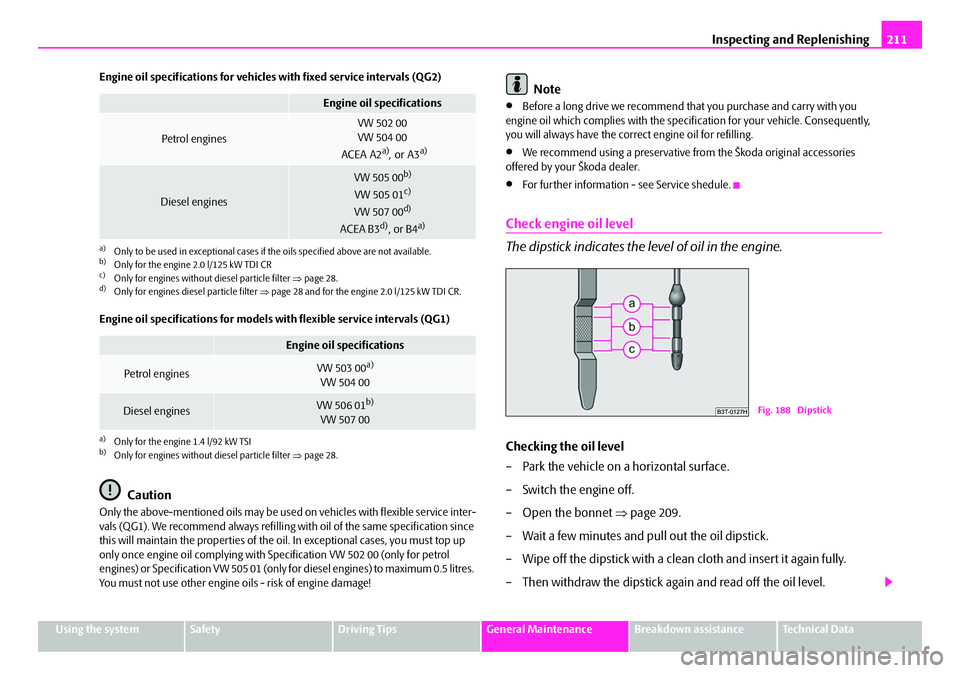
The dipstick indicates the le vel of oil in the engine.
Checking the oil level
– Park the vehicle on a horizontal surface.
– Switch the engine off.
– Open the bonnet ⇒page 209.
– Wait a few minutes and pull out the oil dipstick.
– Wipe off the dipstick with a clean cloth and insert it again fully.
– Then withdraw the dipstick again and read off the oil level.
Engine oil specifications
Petrol engines
VW 502 00
VW 504 00
ACEA A2
a), or A3a)
a)Only to be used in exceptional cases if the oils specified above are not available.
Diesel engines
VW 505 00b)
VW 505 01c)
VW 507 00d)
ACEA B3d), or B4a)
b)Only for the engine 2.0 l/125 kW TDI CRc)Only for engines without diesel particle filter ⇒page 28.d)Only for engines diesel particle filter ⇒page 28 and for the engine 2.0 l/125 kW TDI CR.
Engine oil specifications
Petrol enginesVW 503 00a)
VW 504 00
a)Only for the engine 1.4 l/92 kW TSI
Diesel enginesVW 506 01b)
VW 507 00
b)Only for engines without diesel particle filter ⇒page 28.
Fig. 188 Dipstick
NKO B6 20.book Page 211 Wednesday, March 26, 2008 3:15 PM
Page 224 of 272

Wheels and Tyres225
Using the systemSafetyDriving TipsGeneral MaintenanceBreakdown assistanceTechnical Data
The date of manufacture
is als o stated o n the tyre wa ll (pos si bl y only on the inside
of wheel):
DOT ... 20 08...
means, for example, that the tyre was ma nufactured in the 20th week of the year
2008.
Any spare wheel which differs from the tyres fitted to the vehicle (e.g. winter tyres
or low-profile tyres) should only be used only for a short time in the event of a
puncture and when adopting an appropriately cautious style of driving. It should be
replaced as quickly as possible by a normal wheel.
WARNING
•Only use those tyres or wheel rims which have been approved for your
model of Škoda Auto a.s. vehicle. Failure to observe this instruction will
adversely affect the road safety of your vehicle - risk of accident! Approval
and licencing of your vehicle on publ ic roads may also become void as a
result.
•You must on no account drive at a hi gher speed than is permissible for
your tyres - risk of an accident resulting from tyre damage and loss of control
over your vehicle.
•Tyres which are 6 years old or more should only be fitted in exceptional
cases and when adopting an appropriately cautious style of driving.
•Never fit tyres which have already be en used without having adequate
knowledge of their previous history. Tyres age even if they have not been
used at all or only very little. A spare tyre must only be used in exceptional
cases and only then when adopting an appropriately cautious style of
driving.
•Do not, where possible, replace indivi dual tyres but at least replace them
on both wheels of a given axle at the same time. Always fit the tyres with the
deeper tread depth to the front wheels.
For the sake of the environment
Old tyres must be disposed of in conf ormity with the appropriate regulations.
Note
It is not normally possible to fit wheels from other models of cars for technical
reasons. This may also apply in certain circumstances to the wheels of the same
type of vehicle.
Wheel bolts
Wheels and wheel bolts are matched to each other in terms of design. Each time
you fit other wheels - e.g. light alloy wheels or wheels with winter tyres - you must
therefore also use the matching wheel bolts of the correct length and shape of
spherical cap. This is essent ial to ensure that the wheels are tightly fitted and that
the brake system operates properly.
If you retrofit wheel trims (or have this done), please also ensure that an adequate
flow of air remains assured for cooling the brake system.
The Škoda Service Partners are instructed in the technical possibilities which exist
regarding converting or retrofitting wheels, tyres and wheel trim.
WARNING
•In case of incorrect treatment of th e wheel bolts, the wheel can loosen
when the car is moving - risk of accident!
•The wheel bolts must be clean and must turn easily. However, they must
never be treated with grease or oil.
•If the wheel bolts are tightened to a too low tightening torque, the rim
can lossen when the car is moving - risk of accident! A tightening torque
which is too high can damage the bolts and threads and this can result in
permanent deformation of the contact surfaces on the rims.
Caution
The prescribed tightening torque of the wheel bolts for steel and light alloy wheels
is 120 Nm.
NKO B6 20.book Page 225 Wednesday, March 26, 2008 3:15 PM
Page 265 of 272
Index
266
Changing bulbs . . . . . . . . . . . . . . . . . . . . . . . . . . . . . . 246
Changing the engine oil . . . . . . . . . . . . . . . . . . . . . . 212
Changing wheels around . . . . . . . . . . . . . . . . . . . . . 224
Charging the battery . . . . . . . . . . . . . . . . . . . . . . . . . 219
Warning light . . . . . . . . . . . . . . . . . . . . . . . . . . . . . 34
Check engine oil level . . . . . . . . . . . . . . . . . . . . . . . . 211
Child safety . . . . . . . . . . . . . . . . . . . . . . . . . . . . . . . . . 171 Side airbag . . . . . . . . . . . . . . . . . . . . . . . . . . . . . . 173
Child safety lock . . . . . . . . . . . . . . . . . . . . . . . . . . . . . . 37
Child safety seat on the front passenger seat . . . . . . . . . . . . . . . 172
Safety information . . . . . . . . . . . . . . . . . . . . . . . 171
Child seat . . . . . . . . . . . . . . . . . . . . . . . . . . . . . . . . . . . 174 Classification into groups . . . . . . . . . . . . . . . . . 174
ISOFIX system . . . . . . . . . . . . . . . . . . . . . . . . . . . . 177
Use of child safety seats . . . . . . . . . . . . . . . . . . 174
Children and safety . . . . . . . . . . . . . . . . . . . . . . . . . . 171
Chrome parts . . . . . . . . . . . . . . . . . . . . . . . . . . . . . . . 199
Cigarette lighter . . . . . . . . . . . . . . . . . . . . . . . . . . . . . . 86
Cleaning . . . . . . . . . . . . . . . . . . . . . . . . . . . . . . . . . . . . 197
Climatic Air outlet vents . . . . . . . . . . . . . . . . . . . . . . . . . . . . 99
Climatronic Air outlet vents . . . . . . . . . . . . . . . . . . . . . . . . . . . 105
Defrosting windows . . . . . . . . . . . . . . . . . . . . . . 105
Recirculated air mode . . . . . . . . . . . . . . . . . . . . 103
Climatronic (automatic air conditioning) . . . . . . 100
Clock . . . . . . . . . . . . . . . . . . . . . . . . . . . . . . . . . . . . . . . . 14
Clothes hooks . . . . . . . . . . . . . . . . . . . . . . . . . . . . . . . . 95
Cockpit General view . . . . . . . . . . . . . . . . . . . . . . . . . . . . . . . 8
Compartments . . . . . . . . . . . . . . . . . . . . . . . . . . . . . . . 87 Computer . . . . . . . . . . . . . . . . . . . . . . . . . . . . . . . . . . . . 14
Convenience operation . . . . . . . . . . . . . . . . . . . . . . . . 49
Converting/masking over headlights . . . . . . . . . . 192
Coolant . . . . . . . . . . . . . . . . . . . . . . . . . . . . . . . . . . . . 213
replenishing . . . . . . . . . . . . . . . . . . . . . . . . . . . . . 214
Warning light . . . . . . . . . . . . . . . . . . . . . . . . . . . . . . 31
Coolant level Warning light . . . . . . . . . . . . . . . . . . . . . . . . . . . . . . 31
Coolant quantity Warning light . . . . . . . . . . . . . . . . . . . . . . . . . . . . . . 31
Coolant temperature gauge . . . . . . . . . . . . . . . . . . . . 11
Coolant temperatur e/coolant level
Warning light . . . . . . . . . . . . . . . . . . . . . . . . . . . . . . 31
Correct seated position . . . . . . . . . . . . . . . . . . . . . . 150
Counter for distance driven . . . . . . . . . . . . . . . . . . . . 12
Cruise control system . . . . . . . . . . . . . . . . . . . . . . . . 120 Warning light . . . . . . . . . . . . . . . . . . . . . . . . . . . . . . 28
Cup holder front . . . . . . . . . . . . . . . . . . . . . . . . . . . . . . . . . . . . . . 84
rear . . . . . . . . . . . . . . . . . . . . . . . . . . . . . . . . . . . . . . . 84
D
Daylight driving lights . . . . . . . . . . . . . . . . . . . . . . . . . . 54
Deactivatingan airbag . . . . . . . . . . . . . . . . . . . . . . . . . . . . . . . . 168
Deactivating an airbag . . . . . . . . . . . . . . . . . . . . . . . 168
Defrosting rear window . . . . . . . . . . . . . . . . . . . . . . . . 63
De-icing the windows . . . . . . . . . . . . . . . . . . . . . . . 200
Detachable towing device . . . . . . . . . . . . . . . . . . . 196
Diesel . . . . . . . . . . . . . . . . . . . . . . . . . . . . . . . . . . . . . . 205 Diesel engines
Starting the engine . . . . . . . . . . . . . . . . . . . . . . . 112
Diesel particle filter . . . . . . . . . . . . . . . . . . . . . . . . . . 186 Warning light . . . . . . . . . . . . . . . . . . . . . . . . . . . . . 28
Digital clock . . . . . . . . . . . . . . . . . . . . . . . . . . . . . . . . . . 14
Direction indicators . . . . . . . . . . . . . . . . . . . . . . . . . . . 60 Warning light . . . . . . . . . . . . . . . . . . . . . . . . . . . . . 27
Display . . . . . . . . . . . . . . . . . . . . . . . . . . . . . . . . . . . . . . . 19
Distance driven . . . . . . . . . . . . . . . . . . . . . . . . . . . . . . . 12
Door Child safety lock . . . . . . . . . . . . . . . . . . . . . . . . . . . 37
Driver-steering recommendation . . . . . . . . . . . . . 181
Driving economically . . . . . . . . . . . . . . . . . . . . . . . . . 188
E
EDS . . . . . . . . . . . . . . . . . . . . . . . . . . . . . . . . . . . . . . . . . 180
Electric power-operated window Operational faults . . . . . . . . . . . . . . . . . . . . . . . . . 49
Electric sliding/tilting roof . . . . . . . . . . . . . . . . . . . . . 50
Electrically adjustable exterior mirror . . . . . . . . . . . 69
Electronic Differential Lock . . . . . . . . . . . . . . . . . . . 180
Electronic immobiliser . . . . . . . . . . . . . . . . . . . . . . . . 37
Electronic stability programme . . . . . . . . . . . . . . . . 179
Electronic stability programme (ESP) Warning light . . . . . . . . . . . . . . . . . . . . . . . . . . . . . 32
Engine starting . . . . . . . . . . . . . . . . . . . . . . . . . . . . . . . . . . 112
switching off . . . . . . . . . . . . . . . . . . . . . . . . . . . . . 113
Engine compartment Safety information . . . . . . . . . . . . . . . . . . . . . . . . 209
NKO B6 20.book Page 266 Wednesday, March 26, 2008 3:15 PM