height SKODA SUPERB 2010 2.G / (B6/3T) User Guide
[x] Cancel search | Manufacturer: SKODA, Model Year: 2010, Model line: SUPERB, Model: SKODA SUPERB 2010 2.G / (B6/3T)Pages: 287, PDF Size: 16.59 MB
Page 162 of 287

Passive Safety161
Using the system
Safety
Driving Tips
General Maintenance
Breakdown assistance
Technical Data
SafetyPassive SafetyBasic informationDriving the safe way
Passive safety measures reduce the risk of injury in accident situations.In this section you will find important info rmation, tips and notes on the subject of
passive safety in your vehicle. We have combined everything here which you should
be familiar with, for example, regarding seat belts, airbags, child seats and safety of
children. It is therefore important, in partic ular, to comply with the notes and warnings
in this section for your own interest and in the interest of those travelling with you.
WARNING
This chapter contains important information on how to use the vehicle for
the driver and his occupants. You will find further information on safety, which
concerns you and those travelling with you, in the following chapters of this
Owner's Manual.
The complete on-board literature should always be in the vehicle. This
applies in particular, if you rent out or sell the vehicle.
Safety equipment
The safety equipment is part of the occupant protection and it can
reduce the risk of injuries in accident situations.“Do not put at risk” your safety and the safety of those travelling with you . In the event
of an accident, the safety equipment can redu ce the risk of injuries. The following list
contains part of the safety equipment in your vehicle:
Three-point seat belts for all the seats,
belt force limiter for front and outer rear seats*,
belt tensioner for front and outer rear seats*,
seat belt height adjuster for front seats,
front airbag for the driver and front passenger,
driver's knee airbag*,
front side airbags,
rear side airbags*,
head airbags*,
anchoring points for child seat using the “ISOFIX” system,
anchoring points for child seat using the “Top Tether” system,
head restraint adjustable for height,
adjustable steering column.
The specified safety equipment works togeth er, in order to optimally protect you and
those travelling with you in accident situat ions. The safety equipment does not protect
you or the people travelling with you, if you or your occupants adopt an incorrect
seated position or the equipment is not correctly adjusted or used.
For this reason you will be provided with information on why this equipment is very
important, how it protects you and the occupants, what should be observed when
using the equipment and how you and the peop le travelling with you can make full use
of the existing safety equipment. This Owner's Manual contains important warning
notes, which you and those travelling with you should pay attention to in order to
reduce a risk of injury.
Safety concerns everybody!
Before setting off
The driver is always fully responsibl e for his occupants and for the oper-
ating safety of the vehicle.For your own safety and the safety of the pe ople travelling with you, please pay atten-
tion to the following points before setting off.
s3fg.2.book Page 161 Friday, April 30, 2010 12:17 PM
Page 168 of 287

Seat belts167
Using the system
Safety
Driving Tips
General Maintenance
Breakdown assistance
Technical Data
How are seat belts correctly fastened?Fastening three-point seat belts
Fasten your seat belt before starting!Fig. 150 Routing of belt webbing over the sh oulders and the lap belt / Routing of belt
webbing for an expectant mother– Correctly adjust the front seat and the head restraint before fastening your seat belt
page 84.
– Slowly pull the belt webbing at the tongue of the lock over your chest and pelvis
.
– Insert the tongue of the lock into the seat belt buckle belonging to the seat until it is heard to lock in place.
– Pull on the belt to check that it has also reliably engaged in the lock.
Each three-point seat belt is equipped with an inertia reel. This inertia reel offers you
complete freedom of movement if the belt is unreeled slowly. If the brakes are applied
suddenly, the inertia reel will block. It also blocks the belts when the car accelerates,
when driving uphill and when cornering.
Expectant mothers must also wear the seat belt .
WARNING
The shoulder part of the seat belt must never run across your neck but must
run approximately over the middle of the shoulder and fit snugly against the chest. The lap part of the belt must r
un across the hip and must never be routed
across the stomach. It must always fit snugly fig. 150 - left. Adjust the belt
webbing as required.
The lap part of the belt should be posi tioned as low as possible at the pelvis
of an expectant mother in order to avoid exerting any pressure on the lower
abdomen fig. 150 - right.
Always ensure that the webbing of the seat belts is properly routed. Seat
belts which are not correctl y adjusted can themselves cause injuries even in
minor accidents.
A seat belt which is hanging too loose can result in injuries as your body is
moved forward by the kinetic energy pr oduced in an accident and is then
suddenly held firm by the belt.
Only insert the lock tongue into the lock which is the correct one for your
seat. This will affect the protection which the belt offers and increase the risk of
an injury.
Seat belt height adjusterThe seat belt height adjuster makes it possible for you to adapt the routing of the three-
point seat belt in the area of the shoulder to match your body size.
– Move the height adjuster in the desired direction up or down fig. 151 .
– Then pull firmly on the belt to ensure that the seat belt height adjuster has correctly
locked in place.
WARNING (continued)
Fig. 151 Front seat: Seat belt height
adjuster
s3fg.2.book Page 167 Friday, April 30, 2010 12:17 PM
Page 169 of 287
Seat belts
168WARNING
Adjust the height of the belt in such a way that the shoulder part of the belt is
positioned approximately across the middle of your shoulder - on no account
across your neck.
Note
It is also possible to adapt the routing of the belt webbing at the front seats by adjusting
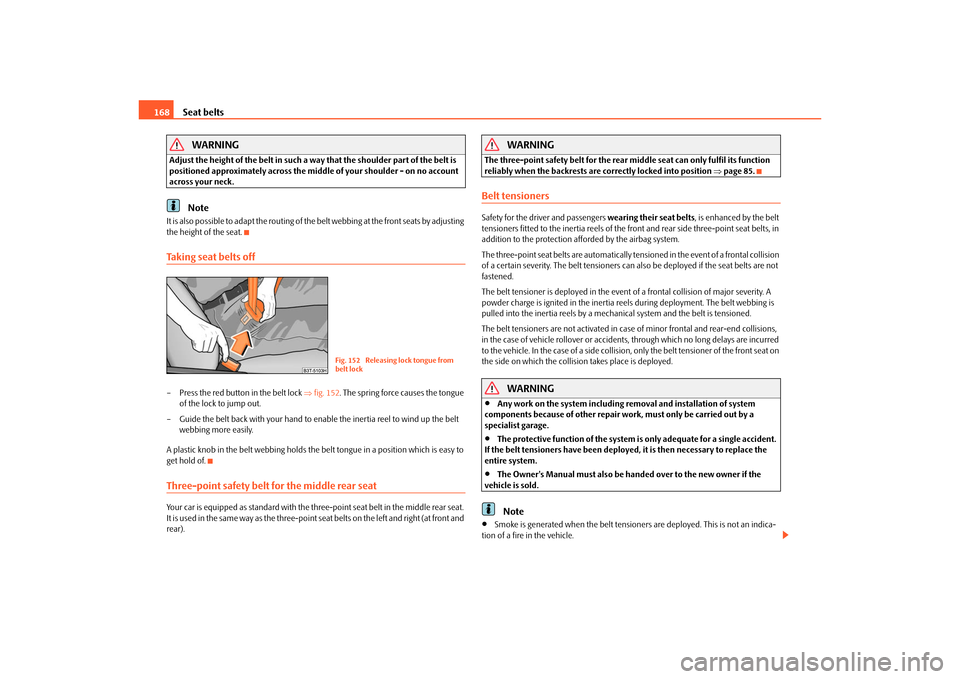
the height of the seat.Taking seat belts off– Press the red button in the belt lock fig. 152 . The spring force causes the tongue
of the lock to jump out.
– Guide the belt back with your hand to en able the inertia reel to wind up the belt
webbing more easily.
A plastic knob in the belt webbing holds the be lt tongue in a position which is easy to
get hold of.Three-point safety belt for the middle rear seatYour car is equipped as standard with the three-point seat belt in the middle rear seat.
It i s us ed i n the sam e way as the thre e-poi nt seat belts on the left and right (at front and
rear).
WARNING
The three-point safety belt for the rear middle seat can only fulfil its function
reliably when the backrests are correctly locked into position page 85.Belt tensionersSafety for the driver and passengers wearing their seat belts, is enhanced by the belt
tensioners fitted to the inertia reels of the front and rear side three-point seat belts, in
addition to the protection af forded by the airbag system.
The three-point seat belts are automatically te nsioned in the event of a frontal collision
of a certain severity. The belt tensioners can also be deployed if the seat belts are not
fastened.
The belt tensioner is deployed in the event of a frontal collision of major severity. A
powder charge is ignited in the inertia re els during deployment. The belt webbing is
pulled into the inertia reels by a mechanical system and the belt is tensioned.
The belt tensioners are not ac tivated in case of minor frontal and rear-end collisions,
in the case of vehicle rollover or accidents, through which no long delays are incurred
to the vehicle. In the case of a side collision, only the belt tensioner of the front seat on
the side on which the collision takes place is deployed.
WARNING
Any work on the system including removal and installation of system
components because of other repair work, must only be carried out by a
specialist garage.
The protective function of the system is only adequate for a single accident.
If the belt tensioners have been deployed, it is then necessary to replace the
entire system.
The Owner's Manual must also be handed over to the new owner if the
vehicle is sold.Note
Smoke is generated when the belt tensione rs are deployed. This is not an indica-
tion of a fire in the vehicle.
Fig. 152 Releasing lock tongue from
belt lock
s3fg.2.book Page 168 Friday, April 30, 2010 12:17 PM
Page 181 of 287
Transporting children safely
180
Transporting children safelyWhat you should know ab out transporting children!An introduction to the subject
Accident statistics have revealed that children are generally more safely
transported on the rear seats than on the front passenger seat.Children younger than 12 years of age should normally travel on the rear seat of the
vehicle (take note of any national legal provis ions which differ from this). They should
be secured there by means of a child restraint system or by using the existing seat belts
depending on their age, body size and we ight. The child seat should be mounted
behind the front passenger seat for safety reasons.
The physical principle of an accident does, of course, also apply to children
page 165, “The physical principle of a fronta l collision”. They differ from adults in
that their muscles and bone structure of children are not yet fully developed. Thus chil-
dren are exposed to increased risk of injury.
Children should be transporte d by using special child safety seats in order to reduce
this risk of injury!
Use only child safety seats which are officia lly approved and are suitable for children
and which comply with the ECE-R 44 standard, which classifies child safety seats into
5 groups page 182, “Classification of child seats into groups”. Child restraint systems
which have been tested for conformity to ECE-R 44 standard have a non-detachable
test seal (a large E within a circle and below this the test number) attached to the seat.
We recommend that you use child safety seats from the Škoda genuine accessories.
These child seats were developed and also tested for use in Škoda vehicles. They fulfil
the ECE-R 44 standard.
WARNING
Always comply with legal provisions and instructions from the relevant child
safety seat manufacturer when installing and using the child seat page 180,
“Important safety information regarding the use of child safety seats”.
Note
Any varying national legal regulations take priority over the information provided in
these instructions for use, or stated in this chapter.Important safety information regarding the use of child safety seats
Correct use of child safety seats considerably reduces the risk of injury!
WARNING
All the occupants of the car - in particular children - must wear a seat belt
when the car is moving!
Children, who are less than 1.50 m in height and who weigh less than 36 kg,
must not use a normal seat belt without a child restraint system otherwise this
may result in injuries to the stomach and neck areas. Comply with the national
legal requirements.
One should never carry children, and also not babies! - on one's lap.
You can transport a child safely in a suitable child safety seat page 182,
“Child seat”!
Only one child may be fastened with a seat belt into a child safety seat.
Never leave the child sitting unattended in the seat.
Certain outside climatic conditions can cause life-threatening tempera-
tures in the vehicle.
Never allow your child to be transported in a vehicle without the use of a
suitable restraint system.
Children should also never stand up in a vehicle or kneel on the seats when
the vehicle is moving. In the event of an accident the child will be thrown
through the vehicle and may as a result suffer fatal injuries, and also injure
other occupants.
Children are exposed to an increased risk of injury in the event of an acci-
dent if they lean forward or adopt an in correct seated position when the vehicle
is moving. This particularly applies to children who are transported on the front
s3fg.2.book Page 180 Friday, April 30, 2010 12:17 PM
Page 184 of 287

Transporting children safely183
Using the system
Safety
Driving Tips
General Maintenance
Breakdown assistance
Technical Data
Children of more than 150 cm in height may use the seat belts fitted to the vehicle
without a seat bolster.
Use of child safety seatsAn overview of the usefulness
of child seats on each of the seats according to the ECE-
R44 standard:
Universal category - seat is suitable for all approved types of child safety seats.
The seat can be fitted with fixing eyes for the “ISOFIX*”system.
The divided rear seat - seat can be fitt ed with fixing eyes for the system “To p
Te t h e r *” page 186, “Attaching child seat using the “Top Tether” system”.
Child seats of group 0/0+The optimal solution for babies of up to about 9 months old weighing up to 10 kg or
babies up to about 18 months old weighing up to 13 kg is a child safety seat which can
be adjusted into the reclining position fig. 164 .
In view of the fact that such child seats are installed that the child is seated with its back
facing the direction of travel, they mu st not be used on the front passenger
seat page 181, “Use of child safety se ats on the front passenger seat”.
WARNING
It is essential to always switch off th e front passenger airbag (airbags) when
attaching in exceptional circumstances a child safety seat on the front
passenger seat where the child is seated with its back facing in direction of
travel (in some countries also when the child is facing the direction of travel):
in a specialist garage
or by using the switch for the front passenger airbag* page 178,
“Switch for the front passenger airbag*”.
Please comply with any differing nati onal legal regulations regarding the
use of child safety seats.
If this is not done, a child seated on the front passenger seat may suffer
severe or even fatal injuries if the front passenger airbag or airbags are
deployed.
You should have the front passenger airbag (or airbags) reactivated just as
soon as you no longer use a child safe ty seat on the front passenger seat.
Group
Weight
0
0 - 10 kg
page 183
0+
up to 13 kg
page 183
1
9 - 18 kg
page 184
2
15 - 25 kg
page 184
3
22 - 36 kg
page 185
Child seat
of the group
Front passenger seat
Rear seat outside
Rear seat middle
0
0+
1
2 and 3
AUA+
AUA+AT
AU
AUA+
AUA+AT
AU
AUA+
AUA+AT
AU
AU
AU
AU
AUA+AT
Fig. 164 Child seats of group 0/0+
s3fg.2.book Page 183 Friday, April 30, 2010 12:17 PM
Page 186 of 287
Transporting children safely185
Using the system
Safety
Driving Tips
General Maintenance
Breakdown assistance
Technical Data
Child safety seats in Group 3For children of about 7 years of age weighing between 22 and 36 kg and of a height of
less than 150 cm, the optimal solution is a ch ild safety seat (seat bolster) in combina-
tion with the three-point seat belt fig. 167 .
Children of more than 150 cm in height may use the seat belts fitted to the vehicle
without a seat bolster.
WARNING
When transporting a child on the front passenger seat, please comply with
the appropriate national regu lations regarding the use of child safety seats. If
required, the airbag has to be deactivated:
in a specialist garage
or by using the switch for the front passenger airbag* page 178,
“Switch for the front passenger airbag*”.
The shoulder part of the seat belt mu st run approximately across the middle
of the shoulder and fit snugly against the chest. It must on no account run
across the neck. The lap part of the seat belt must run across the pelvis and fits
snugly; it must not run over the belly. Tighten the belt webbing over your hip if
necessary.
Please comply with any differing nati onal legal regulations regarding the
use of child safety seats.
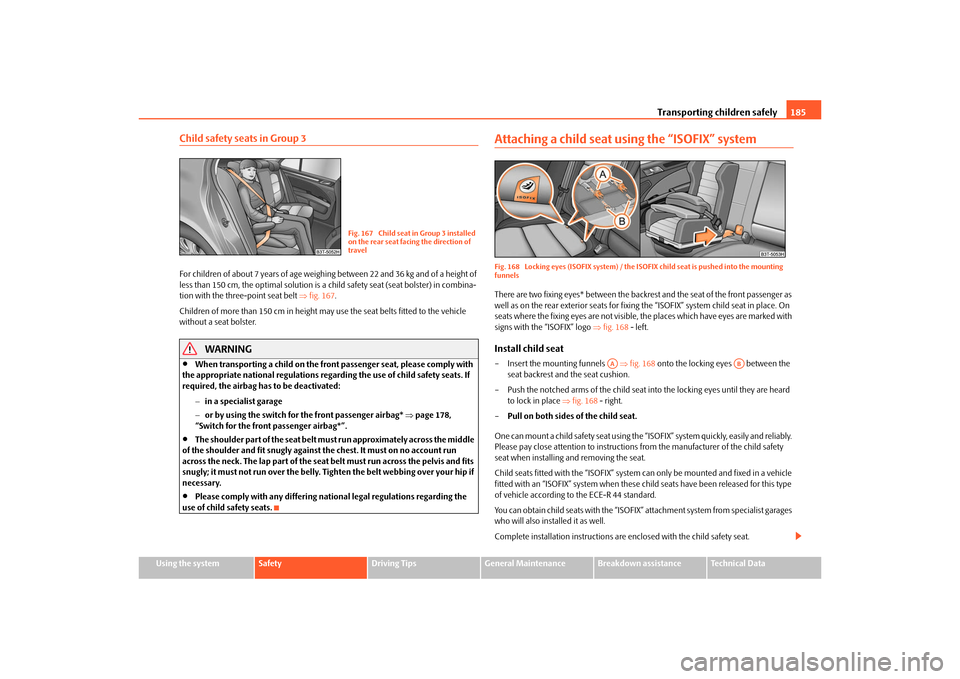
Attaching a child seat using the “ISOFIX” systemFig. 168 Locking eyes (ISOFIX system) / the IS OFIX child seat is pushed into the mounting
funnelsThere are two fixing eyes* between the backrest and the seat of the front passenger as
well as on the rear exterior seats for fixing the “ISOFIX” system child seat in place. On
seats where the fixing eyes are not visible, the places which have eyes are marked with
signs with the “ISOFIX” logo fig. 168 - left.Install child seat– Insert the mounting funnels fig. 168 onto the locking eyes between the
seat backrest and the seat cushion.
– Push the notched arms of the child seat into the locking eyes until they are heard to lock in place fig. 168 - right.
– Pull on both sides of the child seat.
One can mount a child safety seat using the “ISOFIX” system quickly, easily and reliably.
Please pay close attention to instructions from the manufa cturer of the child safety
seat when installing and removing the seat.
Child seats fitted with the “ISOFIX” system can only be mounted and fixed in a vehicle
fitted with an “ISOFIX” system when these child seats have been released for this type
of vehicle according to the ECE-R 44 standard.
You can obtain child seats with the “ISOFIX” attachment system from specialist garages
who will also installed it as well.
Complete installation instructions are enclosed with the child safety seat.
Fig. 167 Child seat in Group 3 installed
on the rear seat facing the direction of
travel
AA
AB
s3fg.2.book Page 185 Friday, April 30, 2010 12:17 PM
Page 203 of 287

Towing a trailer
202
Towing a trailerTo w i n g a t r a i l e rTechnical requirements
The towing device must satisfy certain technical requirements.Your vehicle is designed primarily for tr ansporting persons and luggage. It can,
however, also be used for towing a traile r - provided certain technical equipment is
fitted.
If your vehicle has already been supplied with a factory-fitted towing device then
everything that is nece ssary for towing a trailer in technical terms, and in terms of the
law, has already been taken into account.
Your vehicle is fitted with a 13-pin power socket for the electrical connection between
the vehicle and trailer. If the tr ailer which you wish to tow has a 7-pin connector, you
can use a suitable adapter
15) from Škoda original accessories.
This work must be carried out in accordance with the manufacturer's specifications if
a towing device is retrofitted.
Authorised Škoda Service Partners are familiar with details relating to retrofitting a
towing device and for any necessary modifications to the cooling system.
WARNING
We recommend that you have the towing device from Škoda original accesso-
ries installed by an authorised Škoda Service Partner. He is familiar with all the
relevant details relating to retrofitting such equipment. There is a risk of an
accident if the towing device is not properly fitted.
General Maintenance
There are a number of points to pay attention to when towing a trailer.Trailer load
The permissible trailer load must on no account be exceeded.
You can negotiate appropriately steeper inclin es and descents if you do not make full
use of the permissible trailer load.
The trailer loads specified only apply for altitudes up to 1 000 metres above mean sea
level. The fact that the engi ne power output drops with increasing height due to a
lowering of air pressure and thus the abil ity to climb, means that the towed weight
must be reduced by 10% for every further increase of 1 000 metres in height above sea
level. The towed weight is the weight of the (laden) vehicle and the (laden) trailer
together. One should take this into account before driving up to higher altitudes.
The trailer and drawbar load information on the type plate of the towing device
are merely test data for the towing device The data relating to your vehicle, which
is often less than this test data, can be found in your vehicle registration docu-
ments.
Distribution of the load
Distribute the load in the trailer in such a way that any heavy items are located as close
as possible to the axle. Secure th e items to prevent them slipping.
Tyre pressure
Correct the tyre inflation pressure on yo ur vehicle for that of “fully laden”, page 228.
The inflation pressure of the tyres fitted to the trailer adjust in accordance with the
manufacturer's recommendation.
Exterior mirrors
You have to have additional ex terior mirrors fitted if you are not able to see the traffic
behind the trailer with the standard rear-view mirrors. Both exterior mirrors should be
attached to folding arms. Adjust the mirrors so that they provide you with an adequate
field of view to the rear.
15)In some countries the adapter is supplied with the towing device.s3fg.2.book Page 202 Friday, April 30, 2010 12:17 PM
Page 216 of 287

Inspecting and replenishing215
Using the system
Safety
Driving Tips
General Maintenance
Breakdown assistance
Technical Data
Inspecting and replenishingEngine compartmentBonnet remote releaseBonnet remote release– Pull the unlocking lever below the dash panel on the driver's side fig. 180 .
The bonnet jumps out of its lock as a result of the spring force.Opening and closing the bonnet.Opening the bonnet– Unlock the bonnet fig. 180 . – Ensure that the arms of the windscreen wipers are correctly in place against the
windscreen before opening the bonnet otherwise damage could occur to the
paintwork.
– Pull on the locking lever fig. 181 , the bonnet is then unlocked.
– Grasp the bonnet at the bottom part of the radiator grille and lift it towards the top
so that it is held opened by the gas pressure support.
Closing the bonnet– You can overcome the force of the gas pressure support by pulling the bonnet
towards the bottom.
– Allow the bonnet to drop from a height of about 30 cm into the lock - bonnet do
not press down on it !
WARNING
Never open the bonnet if you see that steam or coolant is flowing out of the
engine compartment - risk of scalding! Wait long enough until the steam or
coolant has stopped escaping.
For safety reasons, the bonnet must always be properly closed when
driving. One should therefore check that the lock has in fact engaged properly
after closing the bonnet.
Stop your vehicle immediately while driving if you notice that the lock is not
properly engaged and close the bonnet properly - risk of an accident!Caution
Ensure that the arms of the windscreen wipers are correctly in place against the wind-
screen before opening the bonnet otherwise damage could occur to the paintwork.
Fig. 180 Bonnet release leverFig. 181 Radiator grille: Locking lever
s3fg.2.book Page 215 Friday, April 30, 2010 12:17 PM
Page 231 of 287

Wheels and Tyres
230
Changing wheels aroundIf significantly greater wear is present on the front tyres, we recommend changing the
front wheels around with the rear wheels as shown in the diagram fig. 191 . You will
then obtain approximately the same life for all the tyres.
It may be advantageous to swap the tyres ov er “crosswise” when certain types of wear
characteristic arise on the running surface of the tyres (but not in the case of unidirec-
tional tyres). The co-workers of the authorised Škoda Service Partners are extensively
familiar with the combination possibilites.
We recommend that you change the wheels around every 10 000 km in order to
achieve even wear on all wheels and to obtain optimal tyre life.New tyres and wheelsTyres and wheel rims are important design elements. One should therefore use the
tyres and wheel rims which have been releas ed for use by Škoda Auto. They are exactly
matched to the vehicle type and therefore contribute significantly to good road
holding and safe driving characteristics .
Only fit radial tyres of the same type on all 4 wheels, size (rolling circumference) and, if
possible, the same tread pattern on one axle.
The authorised Škoda Service Partners have access to the most current information
about which tyres we have released for use on your vehicle.
We recommend that you have any work relati ng to tyres or wheels carried out by an
authorised Škoda Service Partner . The authorised Škoda Service Partners have all of
the necessary special tools and replacement pa rts available plus the required specialist knowledge and are also in a position to pr
operly dispose of the old tyres. A large
number of authorised Škoda Service Partners also have an attractive range of tyres and
wheels available.
The tyre/wheel combinations which are appr oved for your vehicle are indicated in
your vehicle documents. Approval and licens ing may differ according to the legislation
prevailing in indi vidual countries.
Proper knowledge of the tyre data makes it ea sier for you to select the correct type of
tyre. Tyres do, for example, have the following inscription on their walls:
205 / 55 R 16 94 V
What this means is:
The following speed restrictions apply to tyres:
Fig. 191 Changing wheels around
205
Tyre wi dt h i n mm
55
Height/width ratio in %
R
Code letter for the type of tyre - R adial
16
Diameter of wheel in inches
94
Load index
V
Speed symbol
Speed symbol
Permissible maximum speed
S
180 km/h
T
190 km/h
U
200 km/h
H
210 km/h
V
240 km/h
W
270 km/h
Y
300 km/h
s3fg.2.book Page 230 Friday, April 30, 2010 12:17 PM
Page 260 of 287

Technical Data259
Using the system
Safety
Driving Tips
General Maintenance
Breakdown assistance
Technical Data
DimensionsDimensions (mm)
Superb
Combi
Length
4838/4849
a)
a)The value corresponds to the status with visual appearance package.
4838/4849
a)
Width
1817
1817
Width including exterior mirror
2009
2009
Height
1462/1482
b)/1447
c)
b)The value corresponds to the status with rough road package.c)The value corresponds to the status with sport chassis.
1510/1529
b)/1497
c)/1495
d)
d)The value corresponds to the status with sport chassis - valid for vehicles with 3.6 ltr./191 kW FSI engine.Clearance
139/158
b)/123
c)
141/159
b)/127
c) /126
d)
Wheel base
2761
2761
Track gauge front / rear
1545/1518
1537/1510
e)
e)Valid for vehicles with 3.6 ltr./191 kW FSI engine.
1545/1517
1537/1510
e)
s3fg.2.book Page 259 Friday, April 30, 2010 12:17 PM