winter tires SMART FORTWO COUPE ELECTRIC DRIVE 2014 User Guide
[x] Cancel search | Manufacturer: SMART, Model Year: 2014, Model line: FORTWO COUPE ELECTRIC DRIVE, Model: SMART FORTWO COUPE ELECTRIC DRIVE 2014Pages: 222, PDF Size: 16.17 MB
Page 148 of 222
Treadwear indicators
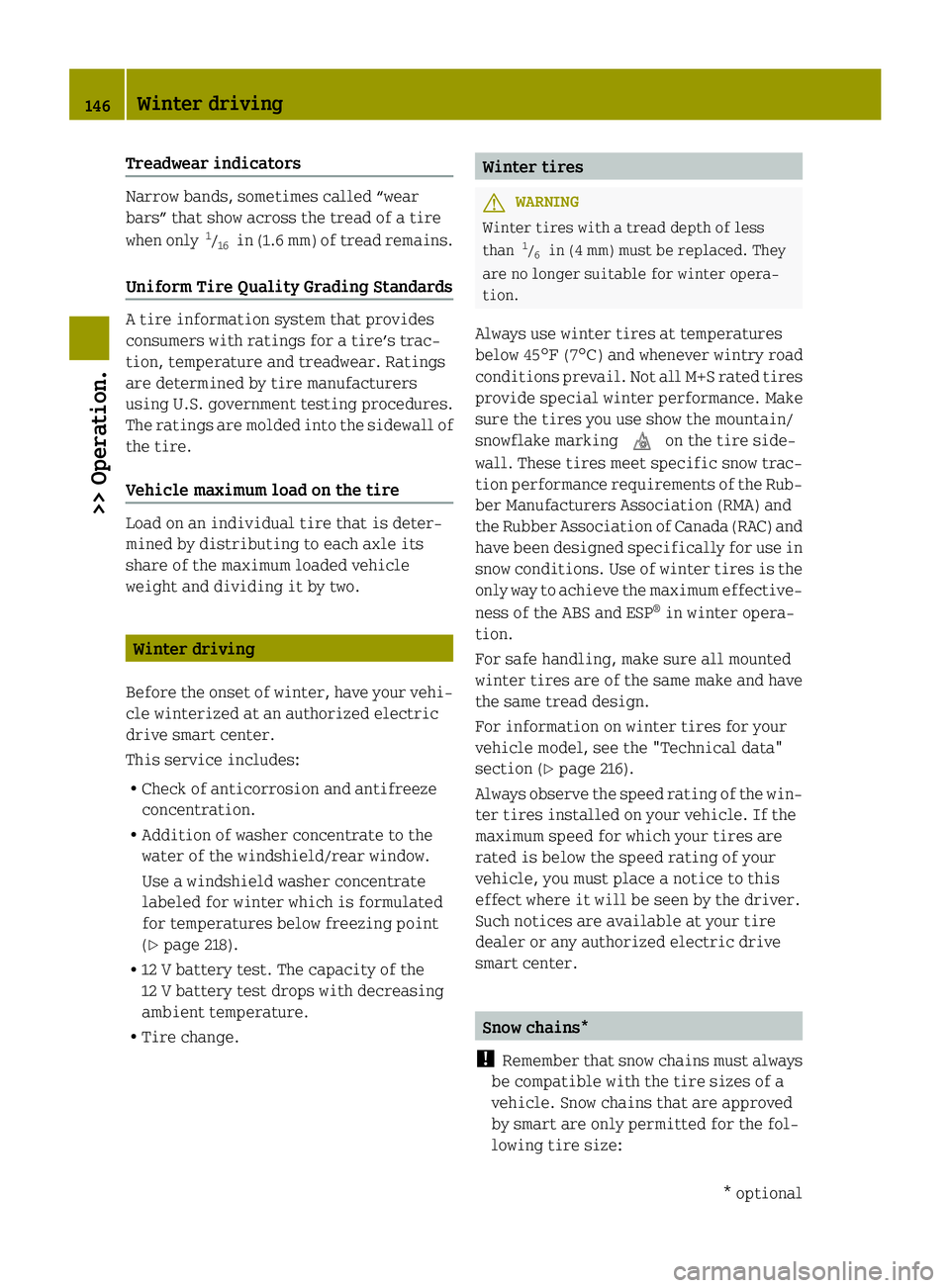
Narrow bands, sometimes called “wear
bars” that show across the tread of a tire
when only 1
/ 16 in (1.6 mm) of tread remains.
Uniform Tire Quality Grading Standards A tire information system that provides
consumers with ratings for a tire’s trac-
tion, temperature and treadwear. Ratings
are determined by tire manufacturers
using U.S. government testing procedures.
The ratings are molded into the sidewall of
the tire.
Vehicle maximum load on the tire Load on an individual tire that is deter-
mined by distributing to each axle its
share of the maximum loaded vehicle
weight and dividing it by two. Winter driving
Before the onset of winter, have your vehi-
cle winterized at an authorized electric
drive smart center.
This service includes:
R Check of anticorrosion and antifreeze
concentration.
R Addition of washer concentrate to the
water of the windshield/rear window.
Use a windshield washer concentrate
labeled for winter which is formulated
for temperatures below freezing point
(Y page 218).
R 12 V battery test. The capacity of the
12 V battery test drops with decreasing
ambient temperature.
R Tire change. Winter tires
G
WARNING
Winter tires with a tread depth of less
than 1
/ 6 in (4 mm) must be replaced. They
are no longer suitable for winter opera-
tion.
Always use winter tires at temperatures
below 45 ¦(7¥) and whenever wintry road
conditions prevail. Not all M+S rated tires
provide special winter performance. Make
sure the tires you use show the mountain/
snowflake marking 004Don the tire side-
wall. These tires meet specific snow trac-
tion performance requirements of the Rub-
ber Manufacturers Association (RMA) and
the Rubber Association of Canada (RAC) and
have been designed specifically for use in
snow conditions. Use of winter tires is the
only way to achieve the maximum effective-
ness of the ABS and ESP ®
in winter opera-
tion.
For safe handling, make sure all mounted
winter tires are of the same make and have
the same tread design.
For information on winter tires for your
vehicle model, see the "Technical data"
section (Y page 216).
Always observe the speed rating of the win-
ter tires installed on your vehicle. If the
maximum speed for which your tires are
rated is below the speed rating of your
vehicle, you must place a notice to this
effect where it will be seen by the driver.
Such notices are available at your tire
dealer or any authorized electric drive
smart center. Snow chains*
! Remember that snow chains must always
be compatible with the tire sizes of a
vehicle. Snow chains that are approved
by smart are only permitted for the fol-
lowing tire size: 146
Winter driving>> Operation.
* optional
Page 152 of 222
R
Remove unnecessary loads.
R Have all maintenance work performed at
the intervals specified in the Mainte-
nance Booklet and as required by the
Maintenance System. Contact an author-
ized electric drive smart center.
Energy consumption is also increased by
driving in stop-and-go traffic, on short
trips, and in hilly areas. Tires
G
WARNING
If you feel a sudden significant vibration
or ride disturbance, or you suspect that
possible damage to your vehicle has occur-
red, you should turn on the hazard warning
flashers, carefully slow down, and drive
with caution to an area which is a safe dis-
tance from the road.
Inspect the tires and the vehicle underbody
for possible damage. If the vehicle or tires
appear unsafe, have the vehicle towed to the
nearest smart center or tire dealer for
repairs.
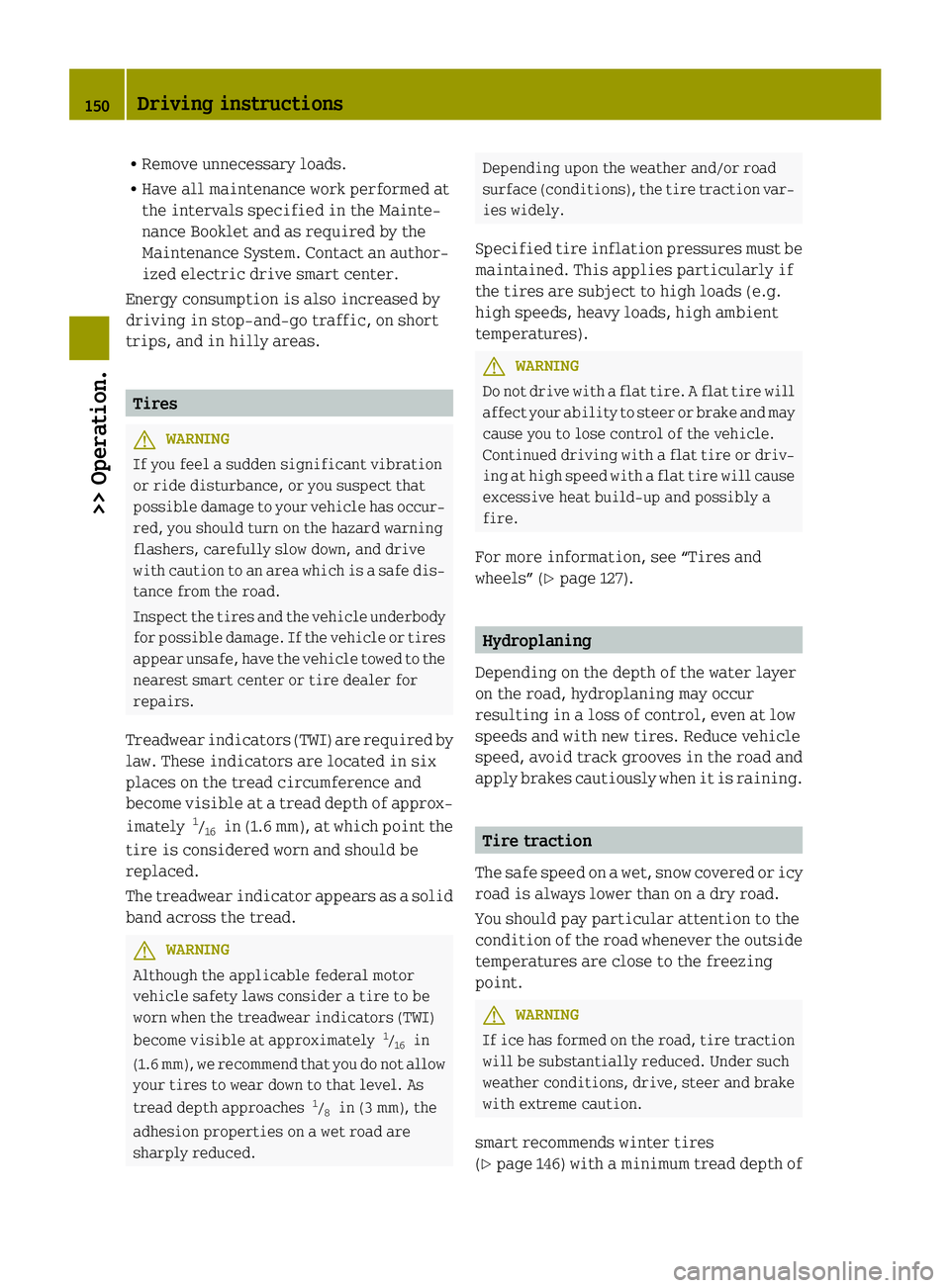
Treadwear indicators (TWI) are required by
law. These indicators are located in six
places on the tread circumference and
become visible at a tread depth of approx-
imately 1
/ 16 in (1.6 mm), at which point the
tire is considered worn and should be
replaced.
The treadwear indicator appears as a solid
band across the tread. G
WARNING
Although the applicable federal motor
vehicle safety laws consider a tire to be
worn when the treadwear indicators (TWI)
become visible at approximately 1
/ 16 in
(1.6 mm), we recommend that you do not allow
your tires to wear down to that level. As
tread depth approaches 1
/ 8 in (3 mm), the
adhesion properties on a wet road are
sharply reduced. Depending upon the weather and/or road
surface (conditions), the tire traction var-
ies widely.
Specified tire inflation pressures must be
maintained. This applies particularly if
the tires are subject to high loads (e.g.
high speeds, heavy loads, high ambient
temperatures). G
WARNING
Do not drive with a flat tire. A flat tire will
affect your ability to steer or brake and may
cause you to lose control of the vehicle.
Continued driving with a flat tire or driv-
ing at high speed with a flat tire will cause
excessive heat build-up and possibly a
fire.
For more information, see “Tires and
wheels” (Y page 127). Hydroplaning
Depending on the depth of the water layer
on the road, hydroplaning may occur
resulting in a loss of control, even at low
speeds and with new tires. Reduce vehicle
speed, avoid track grooves in the road and
apply brakes cautiously when it is raining. Tire traction
The safe speed on a wet, snow covered or icy
road is always lower than on a dry road.
You should pay particular attention to the
condition of the road whenever the outside
temperatures are close to the freezing
point. G
WARNING
If ice has formed on the road, tire traction
will be substantially reduced. Under such
weather conditions, drive, steer and brake
with extreme caution.
smart recommends winter tires
(Y page 146) with a minimum tread depth of 150
Driving instructions>> Operation.
Page 153 of 222

approximately
1
/ 6 in (4 mm) on all four
wheels for the winter season to ensure nor-
mal balanced handling characteristics. On
packed snow, they can reduce your stopping
distance compared to summer tires.
Stopping distance, however, is still con-
siderably greater than when the road is not
covered with snow or ice. Exercise appro-
priate caution.
! Avoid spinning of a drive wheel for an
extended period when driving off on
slippery road surfaces. Otherwise, the
drivetrain could be damaged, which is
not covered by the smart Limited War-
ranty. Tire speed rating
Regardless of the tire speed rating, local
speed limits should be obeyed. Use prudent
driving speeds appropriate to prevailing
conditions. G
WARNING
Even when permitted by law, never operate
a vehicle at speeds greater than the maxi-
mum speed rating of the tires.
Exceeding the maximum speed for which
tires are rated can lead to sudden tire fail-
ure, causing loss of vehicle control and
possibly resulting in an accident and/or
personal injury and possible death, for you
and for others.
Make sure your tires have the required tire
speed rating as specified for your vehicle
in the “Technical data section”
(Y page 216), for example when purchasing
new tires.
For information on how to identify the tire
speed rating on a tire’s sidewall, see “Tire
size designation, load and speed rating”
(Y page 140).
If you are uncertain about the correct read-
ing of the information given on a tire’s sidewall, any authorized electric drive
smart center will be glad to assist you.
i
For information on speed ratings for
winter tires, see “All-season and winter
tires” (Y page 141). Winter driving instructions
The most important rule for slippery or icy
roads is to drive sensibly and to avoid
abrupt acceleration, braking and steering
maneuvers.
For information on driving with snow
chains*, see “Snow chains*” (Y page 146).
Road salts and chemicals can adversely
affect braking efficiency. Increased pedal
force may become necessary to produce the
normal braking effect.
Depressing the brake pedal periodically
when traveling at length on salt-strewn
roads can bring road-salt-impaired brak-
ing efficiency back to normal.
If the vehicle is parked after being driven
on salt-treated roads, the braking effi-
ciency should be tested as soon as possible
after driving is resumed. G
WARNING
Make sure not to endanger any other road
users when carrying out these braking
maneuvers. G
WARNING
The outside temperature display is not
designed to serve as an ice-warning device
and is therefore unsuitable for that pur-
pose. Indicated temperatures just above
the freezing point do not guarantee that the
road surface is free of ice.
For more information, see “Winter driving”
(Y page 146). Driving instructions
151>> Operation.
* optional Z
Page 158 of 222
Exterior Special considera-
tions Lightly soiled
Hand-/Automatic
car washes Heavily soiled
Hand-/Automatic
car washes
Wheels and wheel
covers Two-layer metallic
paint (high-gloss) Car shampoo con-
centrate, rim care Car shampoo con-
centrate, rim care
Retractable soft top PAC fabric Car shampoo con-
centrate, soft top
cleaner, impregna-
tion spray Car shampoo con-
centrate, soft top
cleaner, impregna-
tion spray
Removing insects
Remove insect remains before you start to
wash the vehicle.
X
Spray insect remover on.
X Allow insect remover to work in briefly.
X Rub in gently with a soft cloth or sponge.
X Rinse with plenty of water.
X Treat the cleaned surface with hard wax.
Removing tar Remove any tar marks before washing the
vehicle.
X
Apply tar remover with a soft cloth.
X Allow tar remover to work in briefly.
X Rub in gently.
X Rinse with plenty of water.
X Treat the cleaned surface with hard wax.
Vehicle washing In the winter, thoroughly remove all traces
of road salt as soon as possible.
When washing the vehicle underbody, do not
forget to clean the inner sides of the
wheels.
Washing your vehicle by hand
X
Wash the vehicle using car shampoo con-
centrate and a sponge.
X Rinse with clean water.
X Towel dry the vehicle. !
Do not wash the vehicle in direct sun-
light. The body panel surfaces and paint
finish may be damaged.
Washing your vehicle in an automatic car
wash
i When running your vehicle through an
automatic car wash, water droplets can
run down the inside of the side windows.
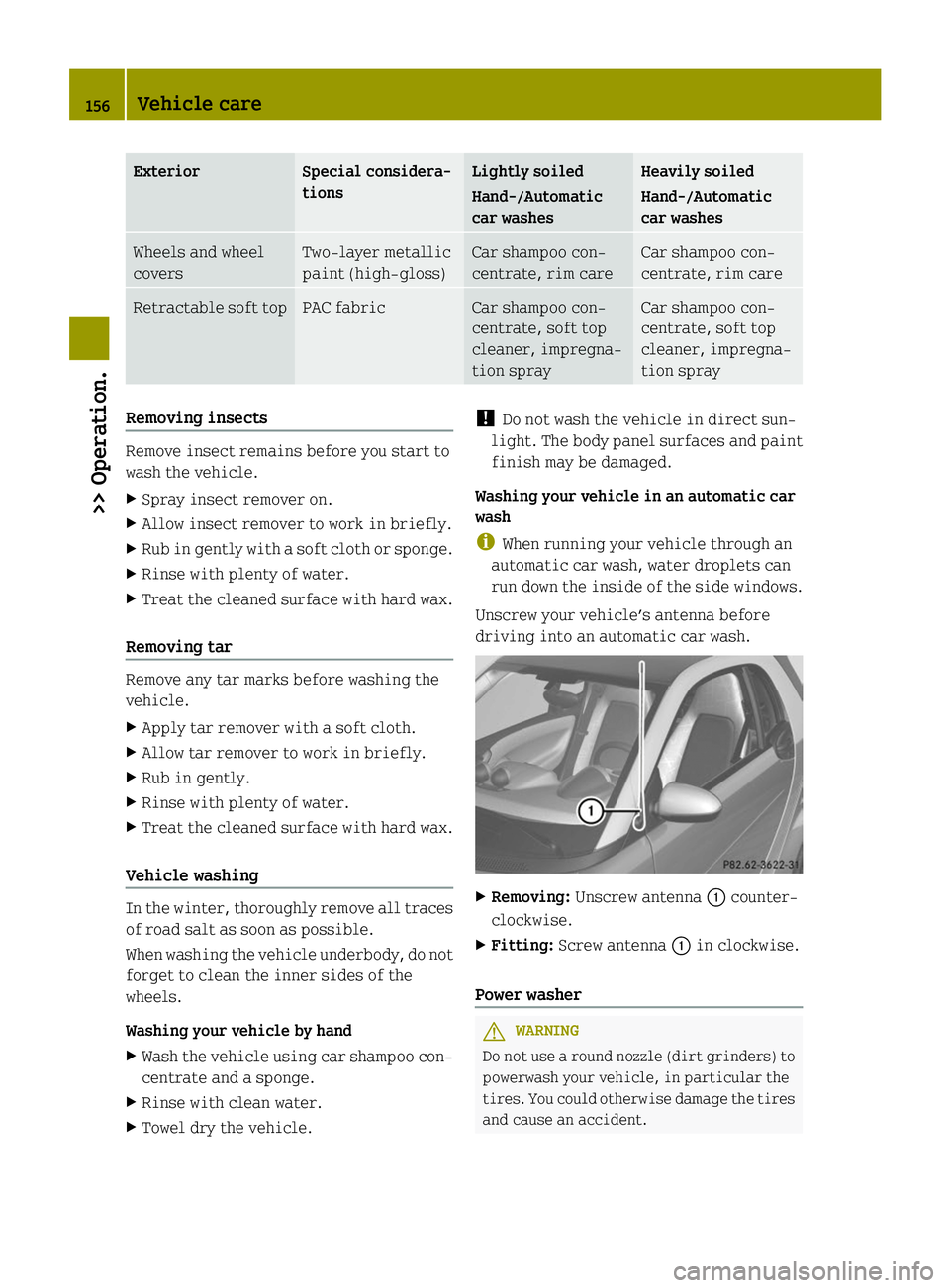
Unscrew your vehicle’s antenna before
driving into an automatic car wash. X
Removing: Unscrew antenna 0043counter-
clockwise.
X Fitting: Screw antenna 0043in clockwise.
Power washer G
WARNING
Do not use a round nozzle (dirt grinders) to
powerwash your vehicle, in particular the
tires. You could otherwise damage the tires
and cause an accident. 156
Vehicle care>> Operation.
Page 219 of 222
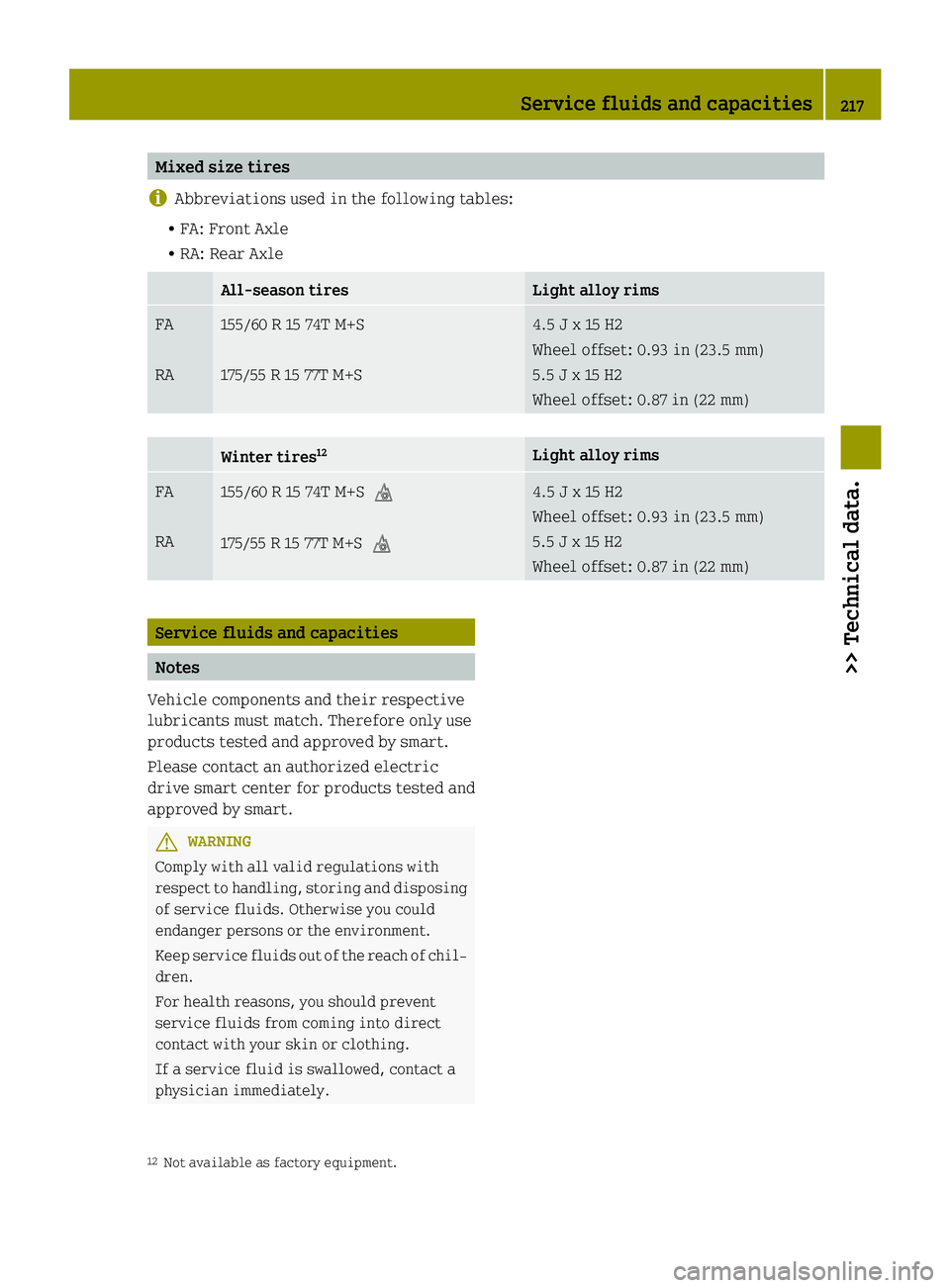
Mixed size tires
i Abbreviations used in the following tables:
R FA: Front Axle
R RA: Rear Axle All-season tires Light alloy rims
FA
RA 155/60 R 15 74T M+S
175/55 R 15 77T M+S 4.5 J x 15 H2
Wheel offset: 0.93 in (23.5 mm)
5.5 J x 15 H2
Wheel offset: 0.87 in (22 mm)
Winter tires
12 Light alloy rims
FA
RA 155/60 R 15 74T M+S004D
175/55 R 15 77T M+S004D 4.5 J x 15 H2
Wheel offset: 0.93 in (23.5 mm)
5.5 J x 15 H2
Wheel offset: 0.87 in (22 mm)
Service fluids and capacities
Notes
Vehicle components and their respective
lubricants must match. Therefore only use
products tested and approved by smart.
Please contact an authorized electric
drive smart center for products tested and
approved by smart. G
WARNING
Comply with all valid regulations with
respect to handling, storing and disposing
of service fluids. Otherwise you could
endanger persons or the environment.
Keep service fluids out of the reach of chil-
dren.
For health reasons, you should prevent
service fluids from coming into direct
contact with your skin or clothing.
If a service fluid is swallowed, contact a
physician immediately.
12 Not available as factory equipment. Service fluids and capacities
217>> Technical data. Z