transmission SSANGYONG KORANDO 1997 Service User Guide
[x] Cancel search | Manufacturer: SSANGYONG, Model Year: 1997, Model line: KORANDO, Model: SSANGYONG KORANDO 1997Pages: 2053, PDF Size: 88.33 MB
Page 138 of 2053
1D1 -- 2 M162 ENGINE COOLING
D AEW OO M Y_2000
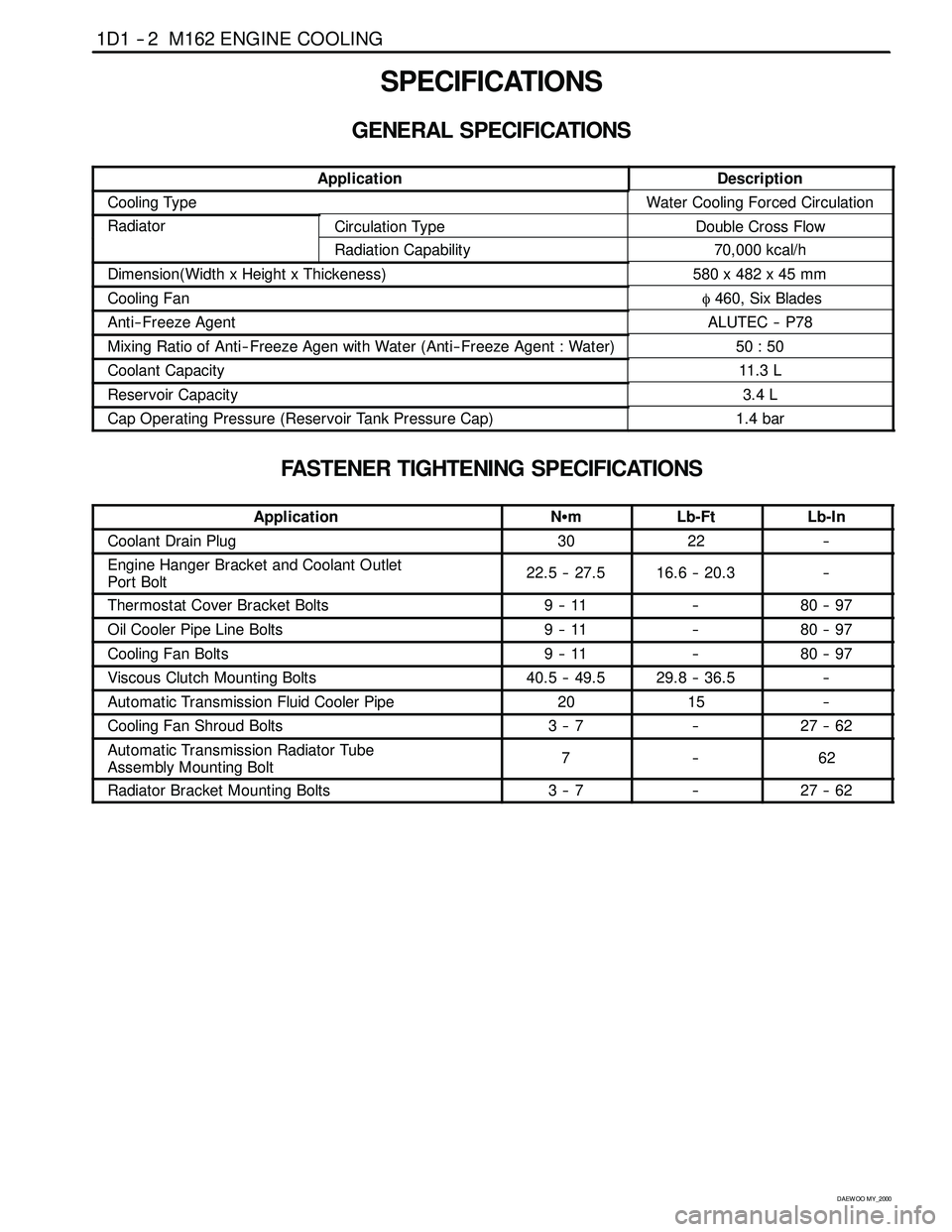
SPECIFICATIONS
GENERAL SPECIFICATIONS
ApplicationDescription
Cooling TypeWater Cooling Forced Circulation
RadiatorCirculation TypeDouble Cross Flow
Radiation Capability70,000 kcal/h
Dimension(Width x Height x Thickeness)580 x 482 x 45 mm
Cooling Fanφ460, Six Blades
Anti-- Freeze AgentALUTEC -- P78
Mixing Ratio of Anti-- Freeze Agen with Water (Anti-- Freeze Agent : Water)50 : 50
Coolant Capacity11. 3 L
Reservoir Capacity3.4 L
Cap Operating Pressure (Reservoir Tank Pressure Cap)1.4 bar
FASTENER TIGHTENING SPECIFICATIONS
ApplicationNSmLb-FtLb-In
Coolant Drain Plug3022--
Engine Hanger Bracket and Coolant Outlet
Port Bolt22.5 -- 27.516.6 -- 20.3--
Thermostat Cover Bracket Bolts9--11--80 -- 97
Oil Cooler Pipe Line Bolts9--11--80 -- 97
Cooling Fan Bolts9--11--80 -- 97
Viscous Clutch Mounting Bolts40.5 -- 49.529.8 -- 36.5--
Automatic Transmission Fluid Cooler Pipe2015--
Cooling Fan Shroud Bolts3--7--27 -- 62
Automatic Transmission Radiator Tube
Assembly Mounting Bolt7--62
Radiator Bracket Mounting Bolts3--7--27 -- 62
Page 151 of 2053
M162 ENGINE COOLING 1D1 -- 15
D AEW OO M Y_2000
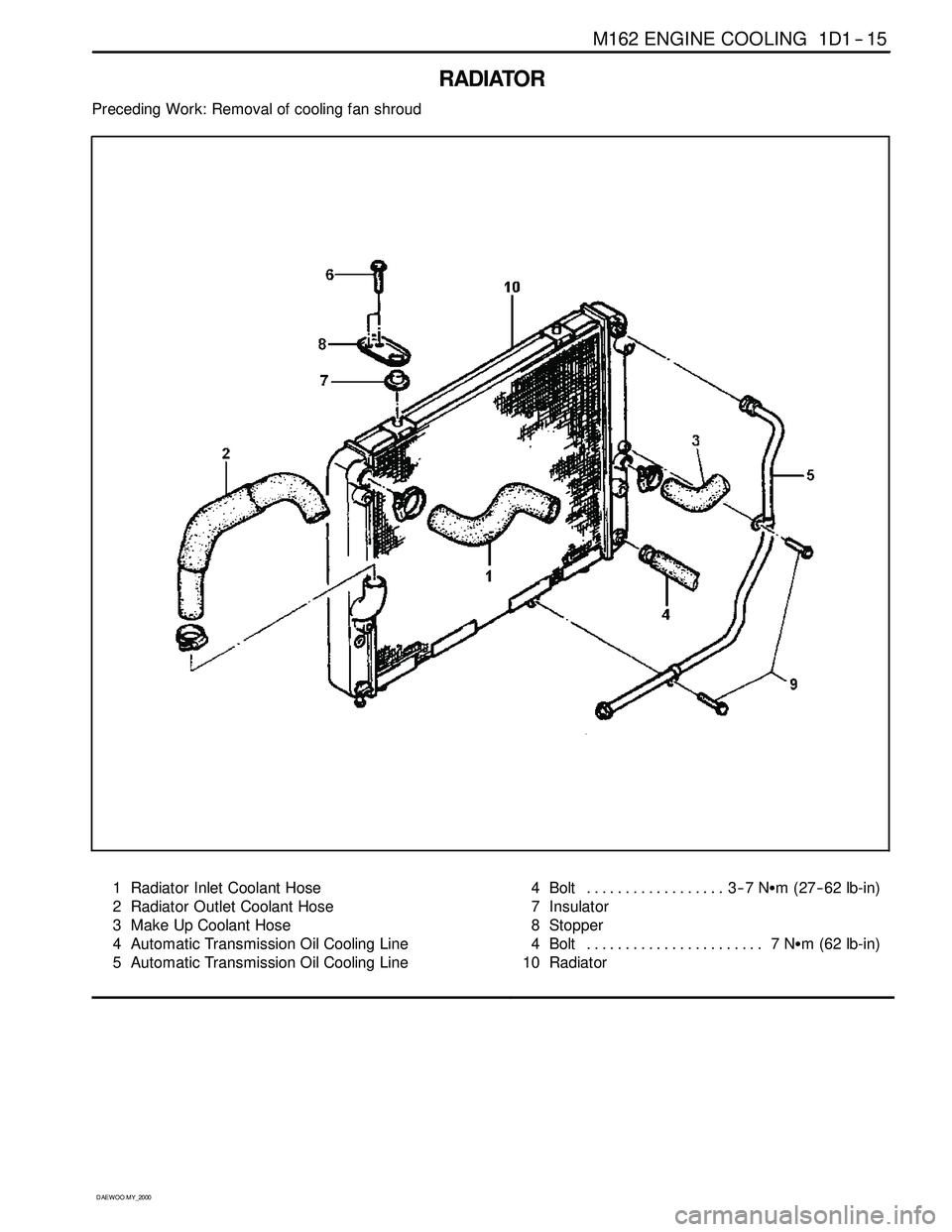
RADIATOR
Preceding Work: Removal of cooling fan shroud
1 Radiator Inlet Coolant Hose
2 Radiator Outlet Coolant Hose
3 Make Up Coolant Hose
4 Automatic Transmission Oil Cooling Line
5 Automatic Transmission Oil Cooling Line4Bolt 3--7NSm (27-- 62 lb-in) ..................
7 Insulator
8 Stopper
4Bolt 7NSm (62 lb-in) .......................
10 Radiator
Page 152 of 2053
1D1 -- 16 M162 ENGINE COOLING
D AEW OO M Y_2000
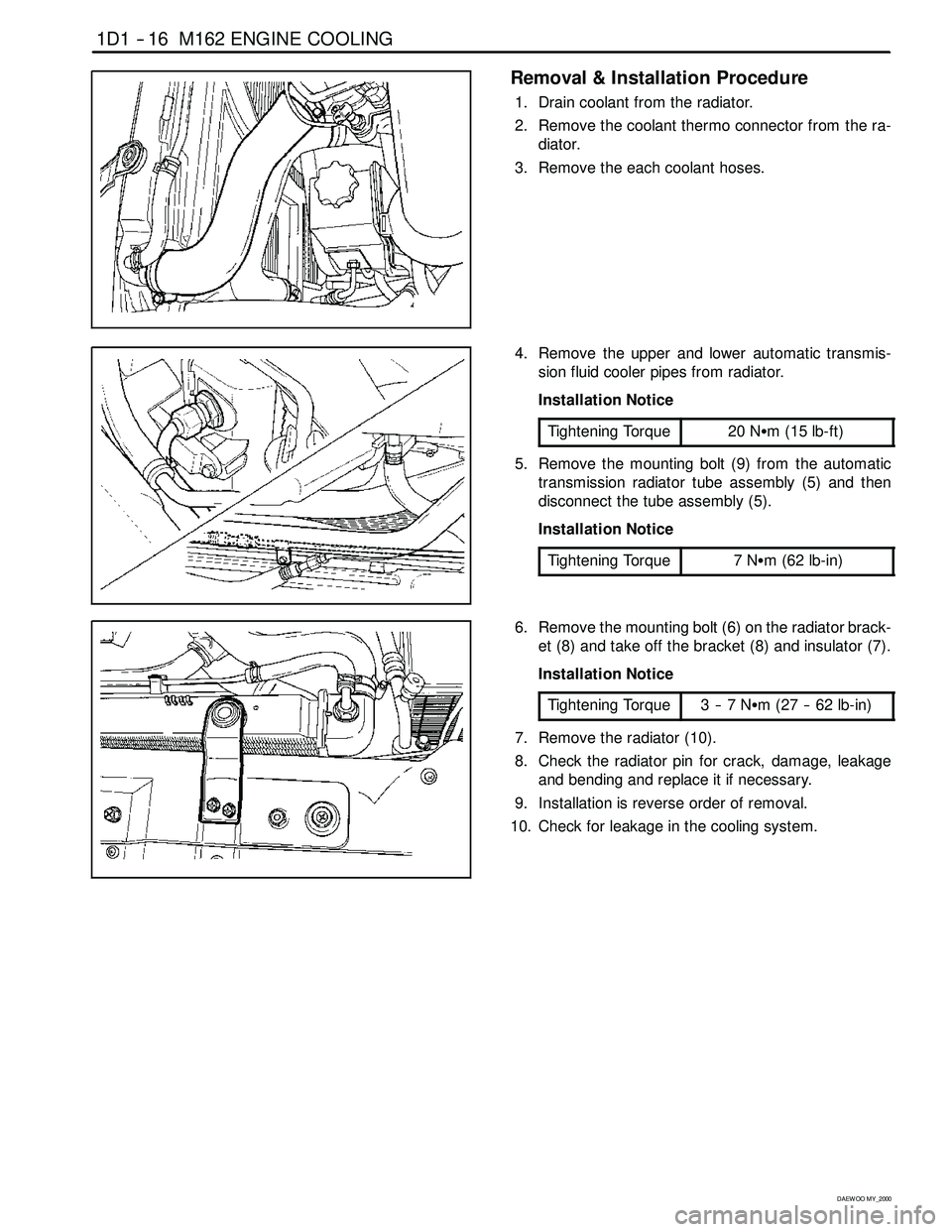
Removal & Installation Procedure
1. Drain coolant from the radiator.
2. Remove the coolant thermo connector from the ra-
diator.
3. Remove the each coolant hoses.
4. Remove the upper and lower automatic transmis-
sion fluid cooler pipes from radiator.
Installation Notice
Tightening Torque
20 NSm (15 lb-ft)
5. Remove the mounting bolt (9) from the automatic
transmission radiator tube assembly (5) and then
disconnect the tube assembly (5).
Installation Notice
Tightening Torque
7NSm(62lb-in)
6. Remove the mounting bolt (6) on the radiator brack-
et (8) and take off the bracket (8) and insulator (7).
Installation Notice
Tightening Torque
3--7NSm (27 -- 62 lb-in)
7. Remove the radiator (10).
8. Check the radiator pin for crack, damage, leakage
and bending and replace it if necessary.
9. Installation is reverse order of removal.
10. Check for leakage in the cooling system.
Page 177 of 2053

1F1 -- 14 M162 ENGINE CONTROLS
D AEW OO M Y_2000
DIAGNOSIS
FAILURE CODE DIAGNOSIS
CLEARING FAILURE CODES
Notice:To prevent Engine Control Module (ECM) damage, the key must be OFF when disconnecting or reconnecting
the power to the ECM (for example battery cable, ECM pigtail connector, ECM fuse, jumper cables, etc.)
Parameters listed in the table may not be exactly the same as your reading due to the type of instrument or other
factors. If a failure code is displayed during the “TROUBLE CODE” in scan tool check mode, check the circuit for the
code listed in the table below. For details of each code, turn to the page referred to under the “See Page” for the re-
spective “Failure Code” in the below table.
Failure codes should be cleared after repairs have been completed.
FAILURE CODES TABLE
Failure
codeSee
PageDescription
001F1 -- 66Engine coolant temperature sensor low voltage
011F1 -- 66Engine coolant temperature sensor high voltage
021F1 -- 66Engine coolant temperature sensor plausibility
031F1 -- 62Intake air temperature sensor low voltage
041F1 -- 62Intake air temperature sensor high voltage
051F1 -- 62Intake air temperature sensor plausibility
061F1 -- 66Engine coolant temperature insufficient for closed loop fuel control
081F1 -- 38System voltage too low
091F1 -- 62Mass air flow sensor plausibility
101F1 -- 62Mass air flow sensor low voltage
111F1 -- 62Mass air flow sensor high voltage
171F1 -- 23Crankshaft position sensor signal failure (no engine revolution signal)
181F1 -- 23Crankshaft position sensor signal failure (rpm > max. value)
191F1 -- 27Camshaft position senosr signal : No.1 cylinder recognition failure
201F1 -- 23Crankshaft position sensor signal failure (gap recognition failure)
211F1 -- 90Transmission coding failure
231F1 -- 88CAN communication failure : ASR/MSR
241F1 -- 88CAN communication failure : ABS
251F1 -- 94Communication with transponder missing
261F1 -- 88CAN communication failure : TCU (A/T only)
271F1 -- 88CAN communication failure : TOD (E32 only)
291F1 -- 89CAN communication failure : ID 200h not plausible
301F1 -- 89CAN communication failure : ID 208h not plausible
311F1 -- 89CAN communication failure : communication initialization failure
321F1 -- 78Engine rpm output circuit short circuit to battery
331F1 -- 78Engine rpm output circuit short circuit to ground or open
341F1 -- 43Fuel pump relay short circuit to battery
351F1 -- 43Fuel pump relay short circuit to ground or open
Page 178 of 2053

M162 ENGINE CONTROLS 1F1 -- 15
D AEW OO M Y_2000
FAILURE CODES TABLE (Cont’d)
Failure
codeSee
PageDescription
401F1 -- 51Purge control valve short circuit to battery
411F1 -- 51Purge control valve short circuit to ground or open
441F1 -- 72Cooling fan (HI) relay short circuit to power
451F1 -- 72Cooling fan (HI) relay short circuit to ground or open
541F1 -- 51Purge control circuit malfunction
561F1 -- 33No.1 knock sensor signal failure
571F1 -- 33No.2 knock sensor signal failure
581F1 -- 27Camshaft position sensor signal : No.1 cylinder synchronization failure
591F1 -- 89CAN communication failure : MSR data transmission not plausible
601F1 -- 89CAN communication failure : ASR data transmission not plausible
621F1 -- 71Clutch switch defective
641F1 -- 21No ignition voltage output (No.1 ignition coil)
651F1 -- 21No ignition voltage output (No.2 ignition coil)
661F1 -- 21No ignition voltage output (No.3 ignition coil)
671F1 -- 23Crankshaft position sensor adaptation failure
681F1 -- 35Random/Multiple Misfire
711F1 -- 39Starter signal recognition failure
721F1 -- 47No.1 injector short circuit to battery
731F1 -- 47No.1 injector short circuit to ground or open
741F1 -- 47No.2 injector short circuit to battery
751F1 -- 47No.2 injector short circuit to ground or open
761F1 -- 47No.3 injector short circuit to battery
771F1 -- 48No.3 injector short circuit to ground or open
781F1 -- 48No.4 injector short circuit to battery
791F1 -- 48No.4 injector short circuit to ground or open
801F1 -- 82Oxygen sensor high voltage
811F1 -- 83Bank 1 system short term fuel trim adaptation below lean threshold
821F1 -- 82Oxygen sensor no activity detected
831F1 -- 82Oxygen sensor not lean after overrun fuel shut -- off
841F1 -- 82Oxygen sensor slow response
851F1 -- 82Oxygen sensor heater failure
861F1 -- 82Oxygen sensor heater short circuit to battery
871F1 -- 82Oxygen sensor heater short circuit to ground or open
891F1 -- 82Oxygen sensor low voltage
931F1 -- 83Bank 1 system short term fuel trim adaptation above rich threshold
961F1 -- 83Bank 1 system short term fuel trim at rich stop
971F1 -- 83Bank 1 system short term fuel trim at lean stop
981F1 -- 83Bank 1 system idle adaptation failure (above rich threshold)
991F1 -- 83Bank 1 system idle adaptation failure (below lean threshold)
1001F1 -- 83Bank 1 system learning control failure (rich, low load)
1011F1 -- 83Bank 1 system learning control failure (lean, low load)
1021F1 -- 83Bank 1 system learning control failure (rich, high load)
Page 252 of 2053
M162 ENGINE CONTROLS 1F1 -- 89
D AEW OO M Y_2000
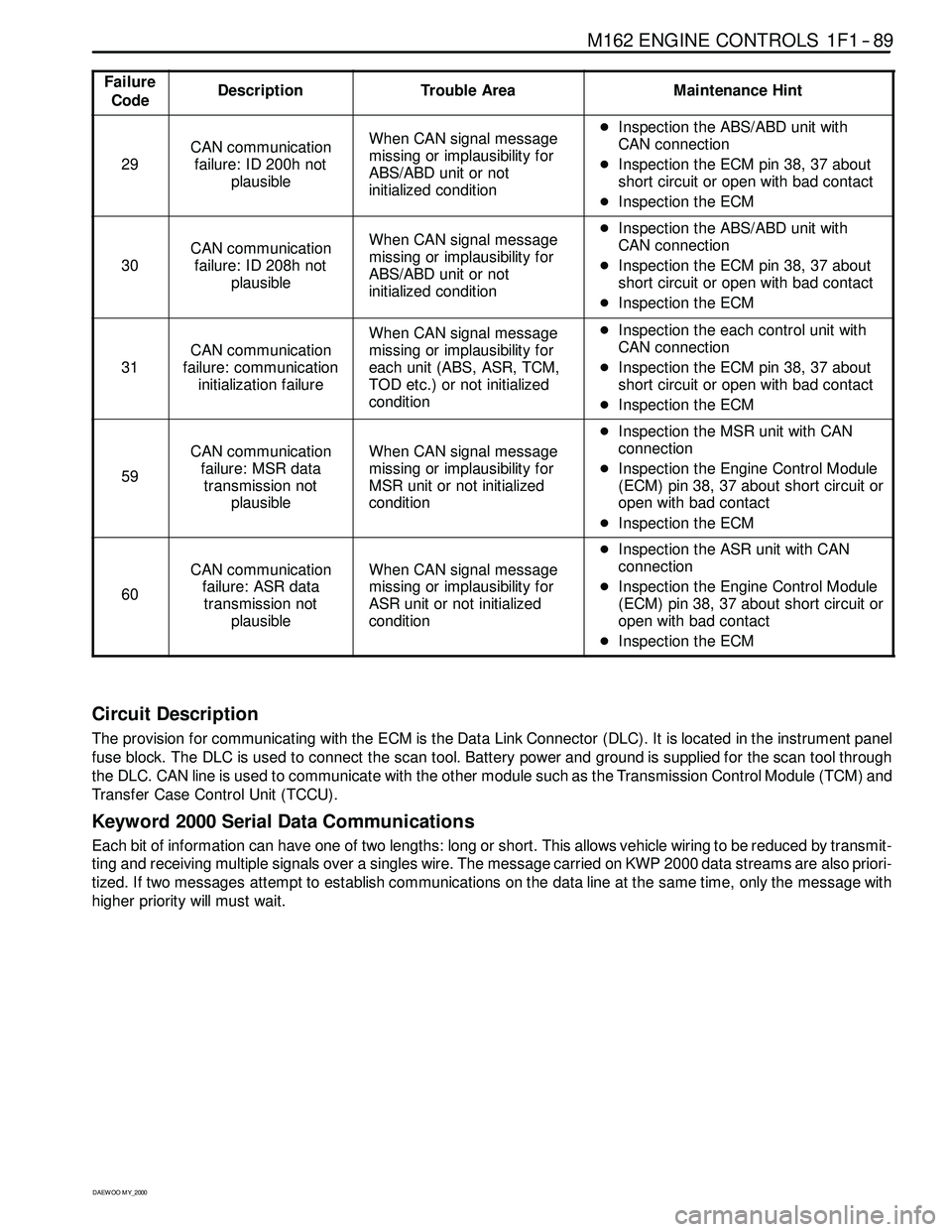
Failure
CodeDescriptionTrouble AreaMaintenance Hint
29
CAN communication
failure: ID 200h not
plausibleWhen CAN signal message
missing or implausibility for
ABS/ABD unit or not
initialized conditionDInspection the ABS/ABD unit with
CAN connection
DInspection the ECM pin 38, 37 about
short circuit or open with bad contact
DInspection the ECM
30
CAN communication
failure: ID 208h not
plausibleWhen CAN signal message
missing or implausibility for
ABS/ABD unit or not
initialized conditionDInspection the ABS/ABD unit with
CAN connection
DInspection the ECM pin 38, 37 about
short circuit or open with bad contact
DInspection the ECM
31
CAN communication
failure: communication
initialization failure
When CAN signal message
missing or implausibility for
each unit (ABS, ASR, TCM,
TOD etc.) or not initialized
conditionDInspection the each control unit with
CAN connection
DInspection the ECM pin 38, 37 about
short circuit or open with bad contact
DInspection the ECM
59
CAN communication
failure: MSR data
transmission not
plausibleWhen CAN signal message
missing or implausibility for
MSR unit or not initialized
condition
DInspection the MSR unit with CAN
connection
DInspection the Engine Control Module
(ECM) pin 38, 37 about short circuit or
open with bad contact
DInspection the ECM
60
CAN communication
failure: ASR data
transmission not
plausibleWhen CAN signal message
missing or implausibility for
ASR unit or not initialized
condition
DInspection the ASR unit with CAN
connection
DInspection the Engine Control Module
(ECM) pin 38, 37 about short circuit or
open with bad contact
DInspection the ECM
Circuit Description
The provision for communicating with the ECM is the Data Link Connector (DLC). It is located in the instrument panel
fuse block. The DLC is used to connect the scan tool. Battery power and ground is supplied for the scan tool through
the DLC. CAN line is used to communicate with the other module such as the Transmission Control Module (TCM) and
Transfer Case Control Unit (TCCU).
Keyword 2000 Serial Data Communications
Each bit of information can have one of two lengths: long or short. This allows vehicle wiring to be reduced by transmit-
ting and receiving multiple signals over a singles wire. The message carried on KWP 2000 data streams are also priori-
tized. If two messages attempt to establish communications on the data line at the same time, only the message with
higher prioritywill must wait.
Page 253 of 2053
1F1 -- 90 M162 ENGINE CONTROLS
D AEW OO M Y_2000
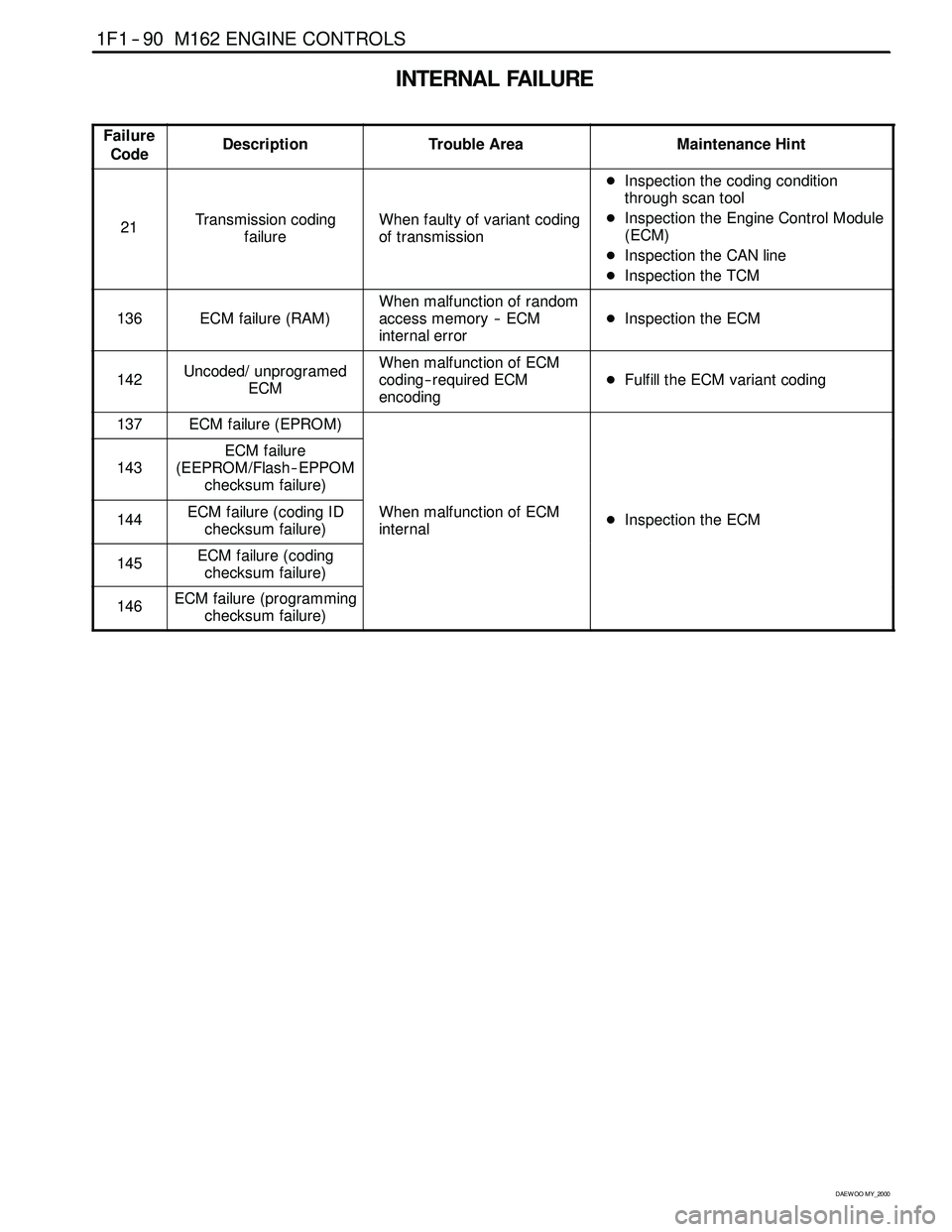
INTERNAL FAILURE
Failure
CodeDescriptionTrouble AreaMaintenance Hint
21Transmission coding
failureWhen faulty of variant coding
of transmission
DInspection the coding condition
through scan tool
DInspection the Engine Control Module
(ECM)
DInspection the CAN line
DInspection the TCM
136ECM failure (RAM)
When malfunction of random
access memory -- ECM
internal error
DInspection the ECM
142Uncoded/ unprogramed
ECMWhen malfunction of ECM
coding-- required ECM
encoding
DFulfill the ECM variant coding
137ECM failure (EPROM)
143
ECM failure
(EEPROM/Flash -- EPPOM
checksum failure)
144ECM failure (coding ID
checksum failure)When malfunction of ECM
internalDInspection the ECM
145ECM failure (coding
checksum failure)
146ECM failure (programming
checksum failure)
Page 291 of 2053
GENERAL ENGINE INFORMATION 1A2 -- 7
D AEW OO M Y_2000
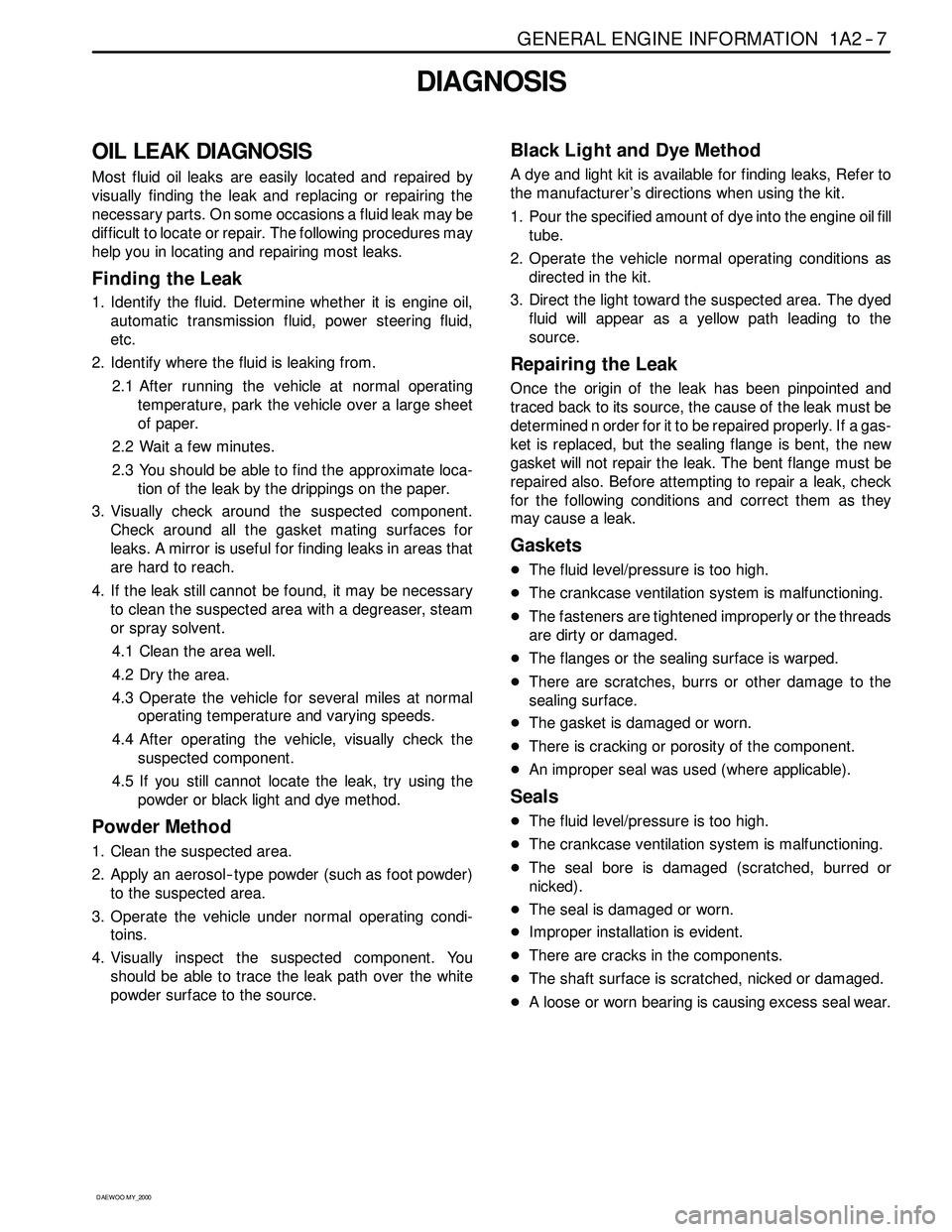
DIAGNOSIS
OIL LEAK DIAGNOSIS
Most fluid oil leaks are easily located and repaired by
visually finding the leak and replacing or repairing the
necessary parts. On some occasions a fluid leak may be
difficult to locate or repair. The following procedures may
help you in locating and repairing most leaks.
Finding the Leak
1. Identify the fluid. Determine whether it is engine oil,
automatic transmission fluid, power steering fluid,
etc.
2. Identify where the fluid is leaking from.
2.1 After running the vehicle at normal operating
temperature, park the vehicle over a large sheet
of paper.
2.2 Wait a few minutes.
2.3 You should be able to find the approximate loca-
tion of the leak by the drippings on the paper.
3. Visually check around the suspected component.
Check around all the gasket mating surfaces for
leaks. A mirror is useful for finding leaks in areas that
are hard to reach.
4. If the leak still cannot be found, it may be necessary
to clean the suspected area with a degreaser, steam
or spray solvent.
4.1 Clean the area well.
4.2 Dry the area.
4.3 Operate the vehicle for several miles at normal
operating temperature and varying speeds.
4.4 After operating the vehicle, visually check the
suspected component.
4.5 If you still cannot locate the leak, try using the
powder or black light and dye method.
Powder Method
1. Clean the suspected area.
2. Apply an aerosol-- type powder (such as foot powder)
to the suspected area.
3. Operate the vehicle under normal operating condi-
toins.
4. Visually inspect the suspected component. You
should be able to trace the leak path over the white
powder surface to the source.
Black Light and Dye Method
A dye and light kit is available for finding leaks, Refer to
the manufacturer ’s directions when using the kit.
1. Pour the specified amount of dye into the engine oil fill
tube.
2. Operate the vehicle normal operating conditions as
directed in the kit.
3. Direct the light toward the suspected area. The dyed
fluid willappear as a yellow path leading to the
source.
Repairing the Leak
Once the origin of the leak has been pinpointed and
traced back to its source, the cause of the leak must be
determined n order for it to be repaired properly. If a gas-
ket is replaced, but the sealing flange is bent, the new
gasket will not repair the leak. Thebent flange must be
repaired also. Before attempting to repair a leak, check
for the following conditions and correct them as they
may cause a leak.
Gaskets
DThe fluid level/pressure is too high.
DThe crankcase ventilation system is malfunctioning.
DThe fasteners are tightened improperly or the threads
are dirty or damaged.
DThe flanges or the sealing surface is warped.
DThere are scratches, burrs or other damage to the
sealing surface.
DThe gasket is damaged or worn.
DThere is cracking or porosity of the component.
DAn improper seal was used (where applicable).
Seals
DThe fluid level/pressure is too high.
DThe crankcase ventilation system is malfunctioning.
DThe seal bore is damaged (scratched, burred or
nicked).
DThe seal is damaged or worn.
DImproper installation is evident.
DThere are cracks in the components.
DThe shaft surface is scratched, nicked or damaged.
DA loose or worn bearing is causing excess seal wear.
Page 305 of 2053

1B2 -- 12 M161 ENGINE MECHANICAL
D AEW OO M Y_2000
21. Separate the hose toward engine from canister
purge solenoid valve and canister. Refer toSection
1F2, Engine Control.
22. Remove the automatic transmission oil cooler line
retaining bolts from the automatic transmission side
and oil pan side.
23. Remove the automatic transmission oil cooler line
retaining bolts from engine side and oil pan side.
24. Separate the vacuum hose for brake booster.
25. Separate the other vacuum hoses.
26. By rotating the crankshaft from the front of engine,
remove the 6 torque converter mounting bolts from
the engine ring gear plate.
Installation Notice
Tightening Torque
42 NSm (31 lb-ft)
Page 306 of 2053

M161 ENGINE MECHANICAL 1B2 -- 13
D AEW OO M Y_2000
27. Remove the exhaust manifold and exhaust pipe.
Installation Notice
Tightening Torque
30 NSm (22 lb-ft)
28. Remove the transmission. Refer toSection 5A, Au -
tomatic Transmission.
29. Install a chain to the bracket of engine, by using a
hoist or crane.
30. Remove the engine mount nuts.
Installation Notice
Tightening Torque
70 NSm (52 lb-ft)
31. Carefully separate the engine assembly from the ve-
hicle.
32. Installation should follow the removal procedure in
the reverse order.