ignition SSANGYONG KORANDO 1997 Service Workshop Manual
[x] Cancel search | Manufacturer: SSANGYONG, Model Year: 1997, Model line: KORANDO, Model: SSANGYONG KORANDO 1997Pages: 2053, PDF Size: 88.33 MB
Page 240 of 2053

M162 ENGINE CONTROLS 1F1 -- 77
D AEW OO M Y_2000
STOP LAMP SWITCH
KAB1F320
Failure
CodeDescriptionTrouble AreaMaintenance Hint
135Stop lamp switch failure
When malfunction of stop
lamp switch – implausible
condition of stop lamp signal
input
DMonitoring the actual operational
status and vehicle speed signal
through scan tool
DInspection the Engine Control Module
(ECM) pin 49 about short circuit or
open with bad contact
DInspection the contact condition of
stop lamp switch
DInspection the ECM
Circuit Description
The stop lamp switch is normally opened. When the ignition switch ON and brake ON, the battery voltage is supplied to
the ECM. A scan tool should display ON when brake pedal is depressed and should read OFF with brake pedal rele-
ased.
Page 247 of 2053
1F1 -- 84 M162 ENGINE CONTROLS
D AEW OO M Y_2000
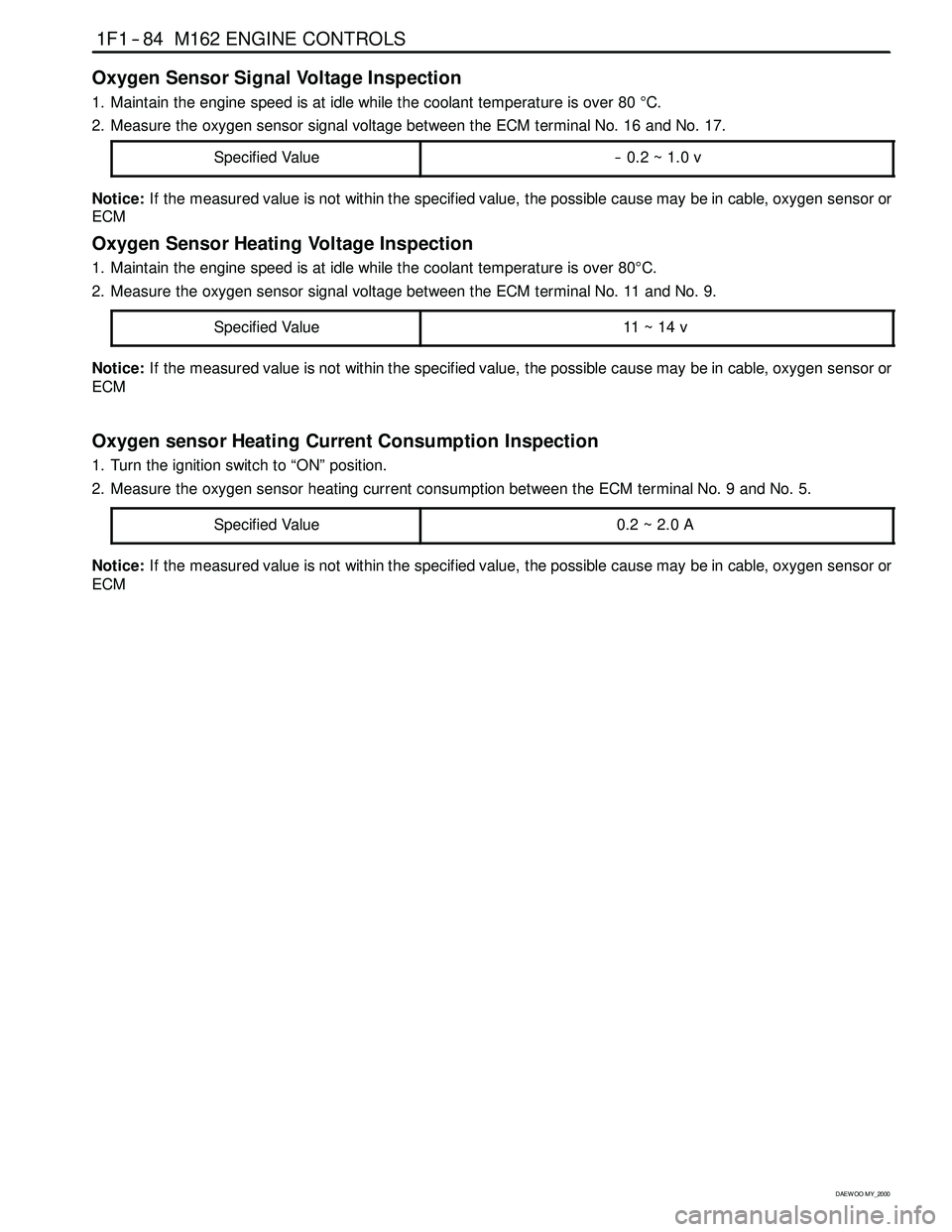
Oxygen Sensor Signal Voltage Inspection
1. Maintain the engine speed is at idle while the coolant temperature is over 80°C.
2. Measure the oxygen sensor signal voltage between the ECM terminal No. 16 and No. 17.
Specified Value
-- 0.2 ~ 1.0 v
Notice:If the measured value is not within the specified value, the possible cause may be in cable, oxygen sensor or
ECM
Oxygen Sensor Heating Voltage Inspection
1. Maintain the engine speed is at idle while the coolant temperature is over 80°C.
2. Measure the oxygen sensor signal voltage between the ECM terminal No. 11 and No. 9.
Specified Value
11 ~ 14 v
Notice:If the measured value is not within the specified value, the possible cause may be in cable, oxygen sensor or
ECM
Oxygen sensor Heating Current Consumption Inspection
1. Turn the ignition switch to “ON” position.
2. Measure the oxygen sensor heating current consumption between the ECM terminal No. 9 and No. 5.
Specified Value
0.2~2.0A
Notice:If the measured value is not within the specified value, the possible cause may be in cable, oxygen sensor or
ECM
Page 249 of 2053
1F1 -- 86 M162 ENGINE CONTROLS
D AEW OO M Y_2000
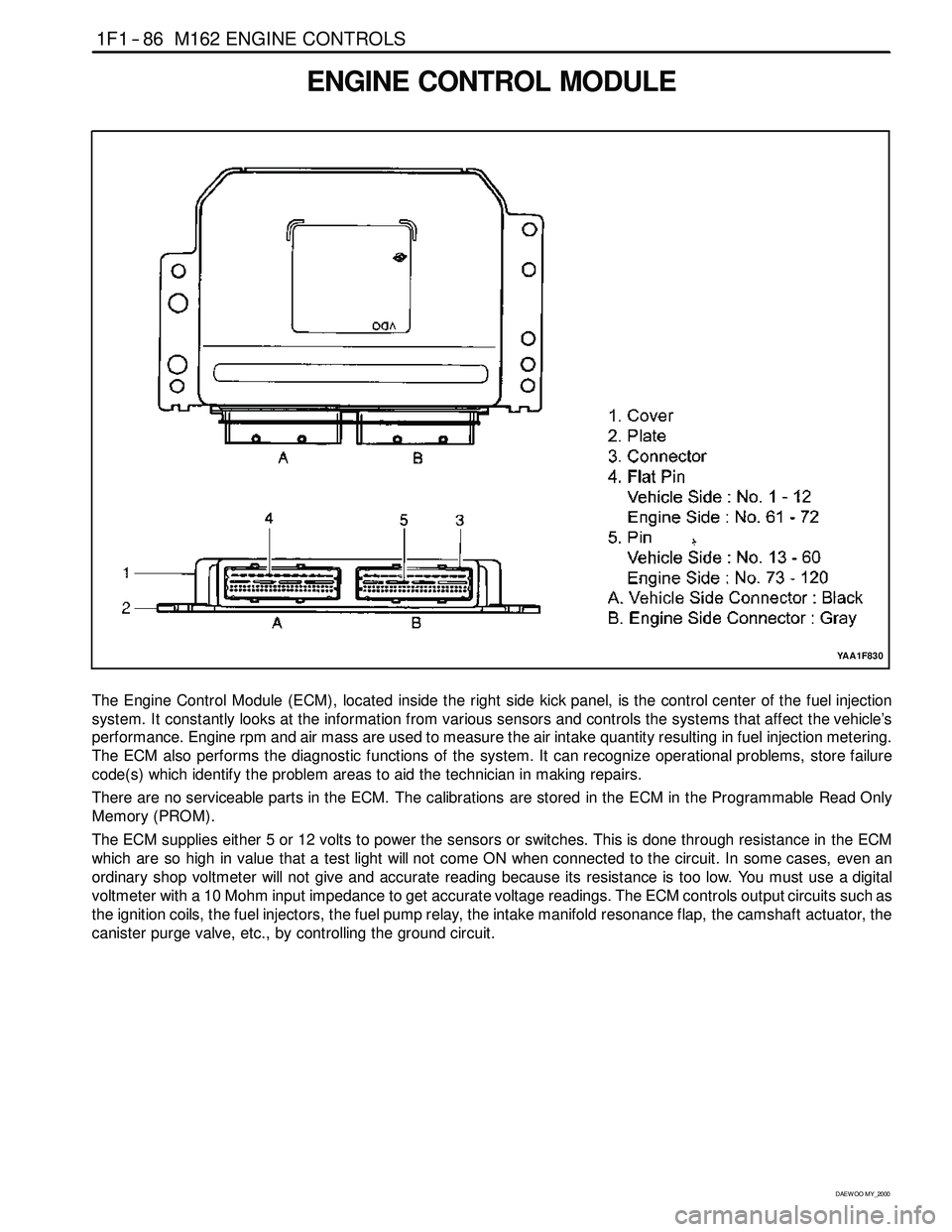
ENGINE CONTROL MODULE
YAA1F830
The Engine Control Module (ECM), located inside the right side kick panel, is the control center of the fuel injection
system. It constantly looks at the information from various sensors and controls the systems that affect the vehicle’s
performance. Engine rpm and air mass are used to measure the air intake quantity resulting in fuel injection metering.
The ECM also performs the diagnostic functions of the system. It can recognize operational problems, store failure
code(s) which identify the problem areas to aid the technician in making repairs.
There are no serviceable parts in the ECM. The calibrations are stored in the ECM in the Programmable Read Only
Memory (PROM).
The ECM supplies either 5 or 12 volts to power the sensors or switches. This is done through resistance in the ECM
which are so high in value that a test light will not come ON when connected to the circuit. In some cases, even an
ordinary shop voltmeter will not give and accurate reading because its resistance is too low. You must use a digital
voltmeter with a 10 Mohm input impedance to get accurate voltage readings. The ECM controls output circuits such as
the ignition coils, the fuel injectors, the fuel pump relay, the intake manifold resonance flap, the camshaft actuator, the
canister purge valve, etc., by controlling the ground circuit.
Page 257 of 2053
1F1 -- 94 M162 ENGINE CONTROLS
D AEW OO M Y_2000
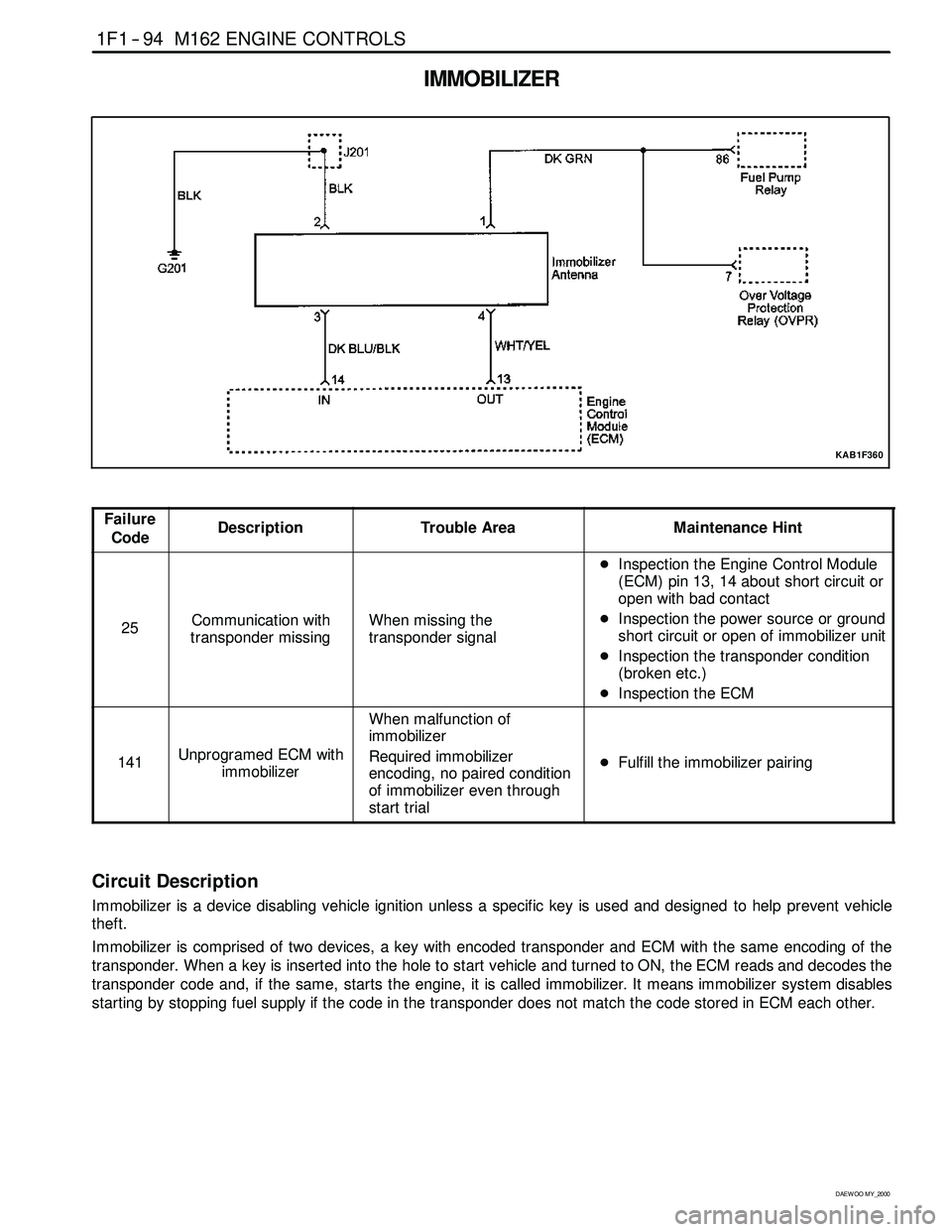
IMMOBILIZER
KAB1F360
Failure
CodeDescriptionTrouble AreaMaintenance Hint
25Communication with
transponder missingWhen missing the
transponder signal
DInspection the Engine Control Module
(ECM) pin 13, 14 about short circuit or
open with bad contact
DInspection the power source or ground
short circuit or open of immobilizer unit
DInspection the transponder condition
(broken etc.)
DInspection the ECM
141Unprogramed ECM with
immobilizer
When malfunction of
immobilizer
Required immobilizer
encoding, no paired condition
of immobilizer even through
start trial
DFulfill the immobilizer pairing
Circuit Description
Immobilizer is a device disabling vehicle ignition unless a specific key is used and designed to help prevent vehicle
theft.
Immobilizer is comprised of two devices, a key with encoded transponder and ECM with the same encoding of the
transponder. When a key is inserted into the hole to start vehicle and turned to ON, the ECM reads and decodes the
transponder code and, if the same, starts the engine, it is called immobilizer. It means immobilizersystem disables
starting by stopping fuel supply if the code in the transponder does not match the code stored in ECM each other.
Page 261 of 2053
1F1 -- 98 M162 ENGINE CONTROLS
D AEW OO M Y_2000
YAA1F180
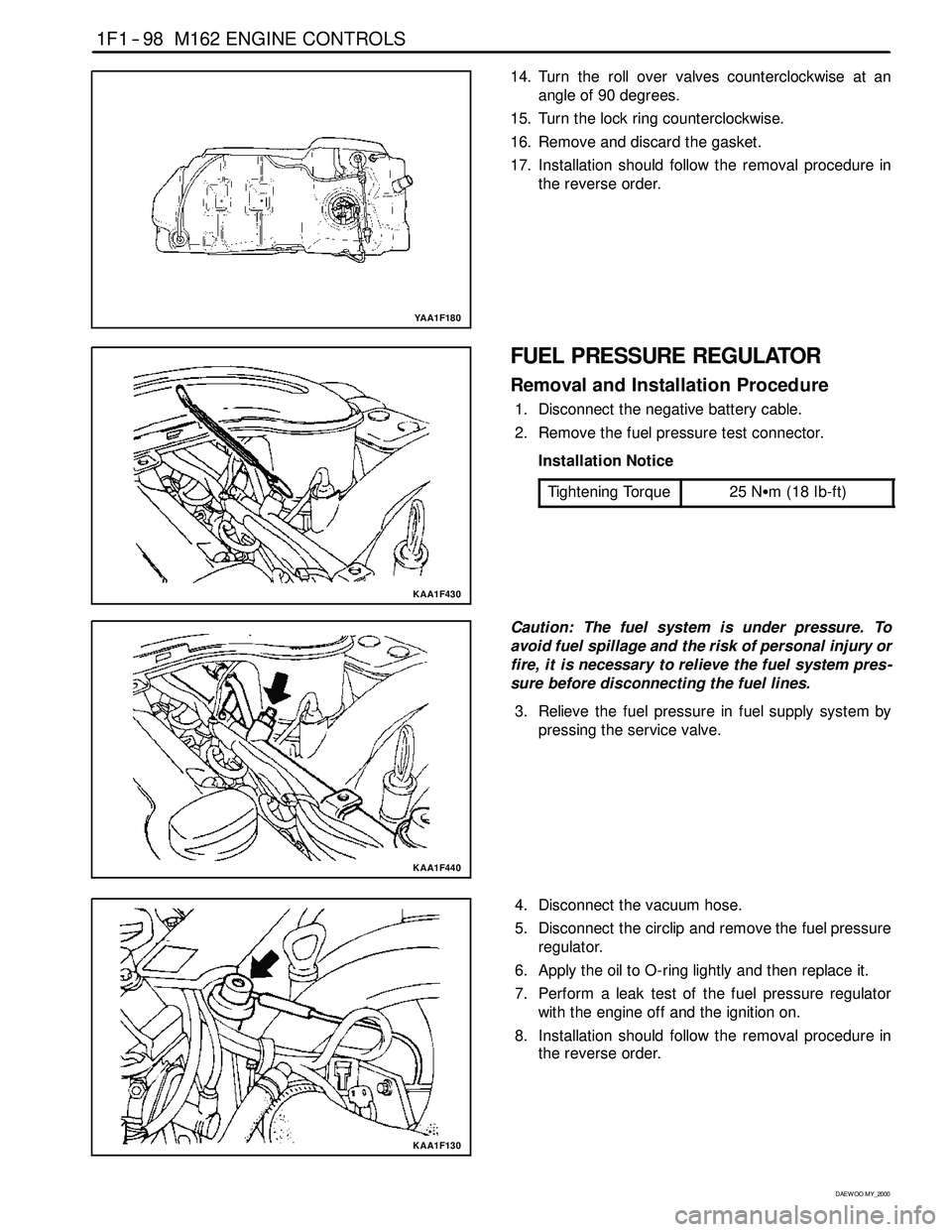
14. Turn the roll over valves counterclockwise at an
angle of 90 degrees.
15. Turn the lock ring counterclockwise.
16. Remove and discard the gasket.
17. Installation should follow the removal procedure in
the reverse order.
KAA1F430
FUEL PRESSURE REGULATOR
Removal and Installation Procedure
1. Disconnect the negative battery cable.
2. Remove the fuel pressure test connector.
Installation Notice
Tightening Torque
25 NSm (18 Ib-ft)
KAA1F440
Caution: The fuel system is under pressure. To
avoid fuel spillage and the risk of personal injury or
fire, it is necessary to relieve the fuel system pres -
sure before disconnecting the fuel lines.
3. Relieve the fuel pressure in fuel supply system by
pressing the service valve.
KAA1F130
4. Disconnect the vacuum hose.
5. Disconnect the circlip and remove the fuel pressure
regulator.
6. Apply the oil to O-ring lightly and then replace it.
7. Perform a leak test of the fuel pressure regulator
with the engine off and the ignition on.
8. Installation should follow the removal procedure in
the reverse order.
Page 269 of 2053
D AEW OO M Y_2000
SECTION 1G1
M162 ENGINE INTAKE & EXHAUST
CAUTION: Disconnect the negative battery cable before removing or installing any electrical unit or when a
tool or equipment could easily come in contact with exposed electrical terminals. Disconnecting this cable
will help prevent personal injury and damage to the vehicle. The ignition must also be in LOCK unless other -
wise noted.
TABLE OF CONTENTS
Specifications 1G1 -- 2...........................
Fastener Tightening Specifications 1G1 -- 2.........
Maintenance and Repair 1G1 -- 3..................
On-- Vehicle Service 1G1-- 3........................
Air Cleaner 1G1-- 3.............................Intake Air Duct 1G1--5..........................
Intake Manifold 1G1--7.........................
Resonance Flap 1G1-- 9.........................
Exhaust Manifold 1G1-- 11.......................
Page 285 of 2053
GENERAL ENGINE INFORMATION 1A2 -- 13
D AEW OO M Y_2000
GENERAL INFORMATION
CLEANLINESS AND CARE
An automobile engine is a combination of many ma-
chined, honed, polished and lapped surfaces with toler-
ances that are measured in the ten-thousandths of an
inch. When any internal engine parts are serviced, care
and cleanliness are important. A liberal coating of enigne
oil should be applied to friction areas during assembly, to
protect and lubricate the surfaces on initial operation.
Proper cleaning and protection of machined surfaces and
friction areas is part of the repair procedure. This is con-
sidered standard shop practice even if not specifically
stated.
Whenever valve train components are removed for ser-
vice, they should be kept in order. They should be
installed in the same locations, and with the same mating
surfaces, as when they were removed.
Battery cables should be disconnected before any major
work is performed on the engine. Failure to disconnect
cables may result in damage to wire harness or other
electrical parts.
ON-ENGINE SERVICE
Caution: Disconnect the negative battery cable be -
fore removing or installing any electrical unit, or
when a tool or equipment could easily come in con-
tact with exposed electrical terminals. Disconnect -
ing this cable will help prevent personal injury and
damage to the vehicle. The ignition must also be in
LOCK unless otherwise noted.
Notice:Any time the air cleaner is removed, the intake
opening should be covered. Thiswill protect against ac-
cidental entrance of foreign material, which could follow
the intake passage into the cylinder and cause exten-
sive damage when the engine is started.
Page 286 of 2053
1A2 -- 2 GENERAL ENGINE INFORMATION
D AEW OO M Y_2000
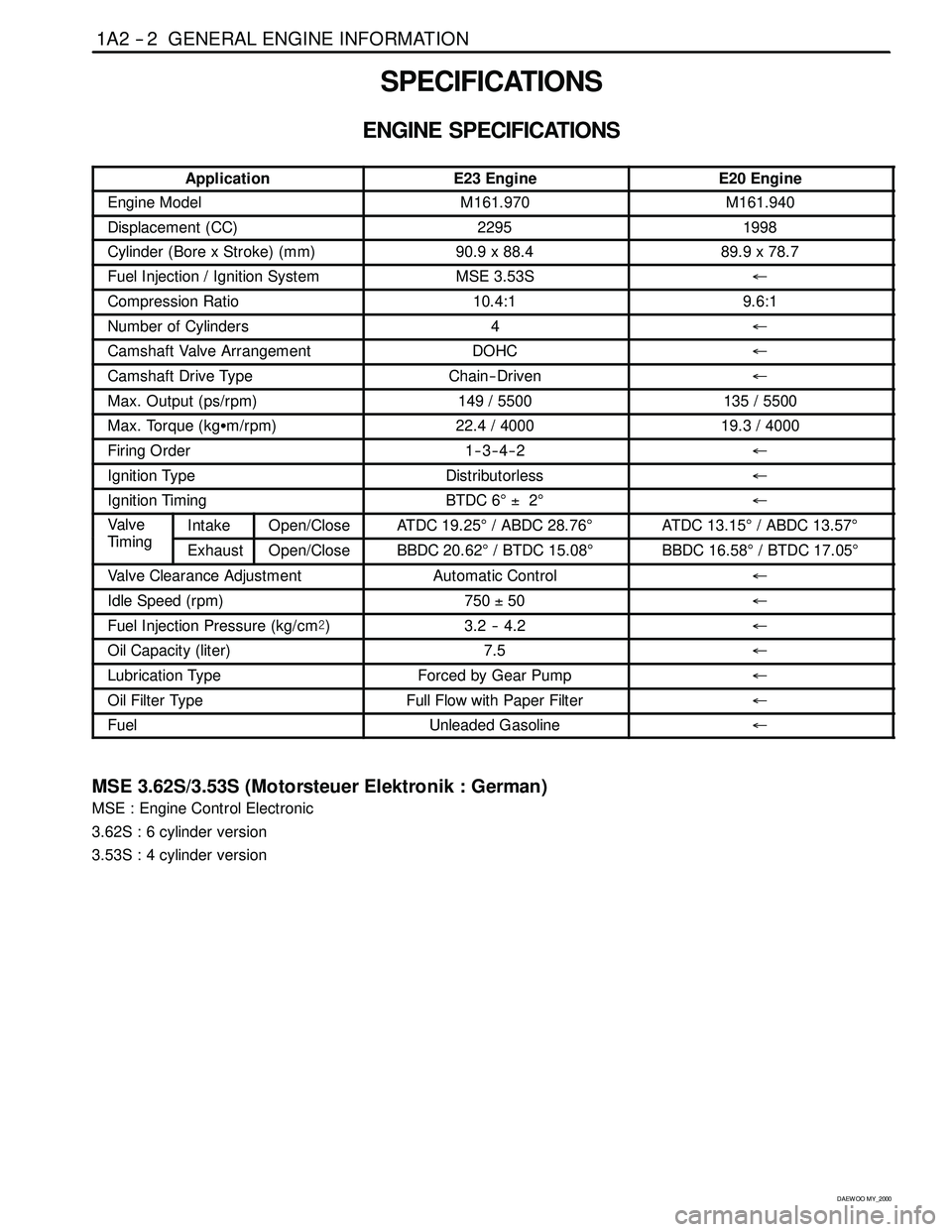
SPECIFICATIONS
ENGINE SPECIFICATIONS
ApplicationE23 EngineE20 Engine
Engine ModelM161.970M161.940
Displacement (CC)22951998
Cylinder (Bore x Stroke)(mm)90.9 x 88.489.9 x 78.7
Fuel Injection / Ignition SystemMSE 3.53S←
Compression Ratio10.4:19.6:1
Number of Cylinders4←
Camshaft Valve ArrangementDOHC←
Camshaft Drive TypeChain-- Driven←
Max. Output (ps/rpm)149 / 5500135 / 5500
Max. Torque (kgSm/rpm)22.4 / 400019.3 / 4000
Firing Order1--3--4--2←
Ignition TypeDistributorless←
Ignition TimingBTDC 6°±2°←
Va lv e
Tii
IntakeOpen/CloseATDC 19.25°/ ABDC 28.76°ATDC 13.15°/ ABDC 13.57°
Tim in gExhaustOpen/CloseBBDC 20.62°/ BTDC 15.08°BBDC 16.58°/ BTDC 17.05°
Valve Clearance AdjustmentAutomatic Control←
Idle Speed (rpm)750±50←
Fuel Injection Pressure (kg/cm@)3.2 -- 4.2←
Oil Capacity (liter)7.5←
Lubrication TypeForced by Gear Pump←
Oil Filter TypeFull Flow with Paper Filter←
FuelUnleaded Gasoline←
MSE 3.62S/3.53S (Motorsteuer Elektronik : German)
MSE : Engine Control Electronic
3.62S : 6 cylinder version
3.53S : 4 cylinder version
Page 287 of 2053
GENERAL ENGINE INFORMATION 1A2 -- 3
D AEW OO M Y_2000
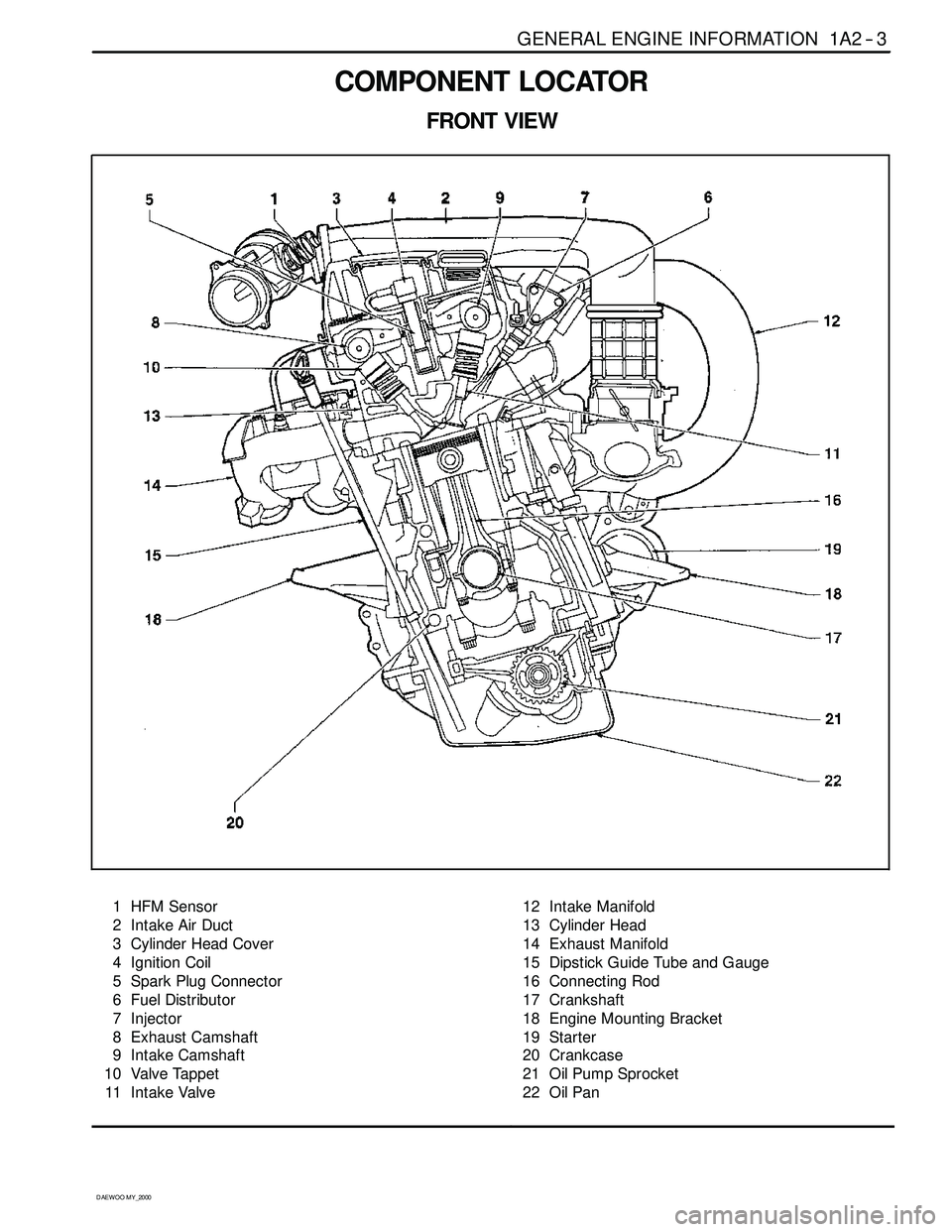
COMPONENT LOCATOR
FRONT VIEW
1 HFM Sensor
2 Intake Air Duct
3 Cylinder Head Cover
4 Ignition Coil
5 Spark Plug Connector
6 Fuel Distributor
7 Injector
8 Exhaust Camshaft
9 Intake Camshaft
10 Valve Tappet
11 Intake Valve12 Intake Manifold
13 Cylinder Head
14 Exhaust Manifold
15 Dipstick Guide Tube and Gauge
16 Connecting Rod
17 Crankshaft
18 Engine Mounting Bracket
19 Starter
20 Crankcase
21 Oil Pump Sprocket
22 Oil Pan
Page 294 of 2053
D AEW OO M Y_2000
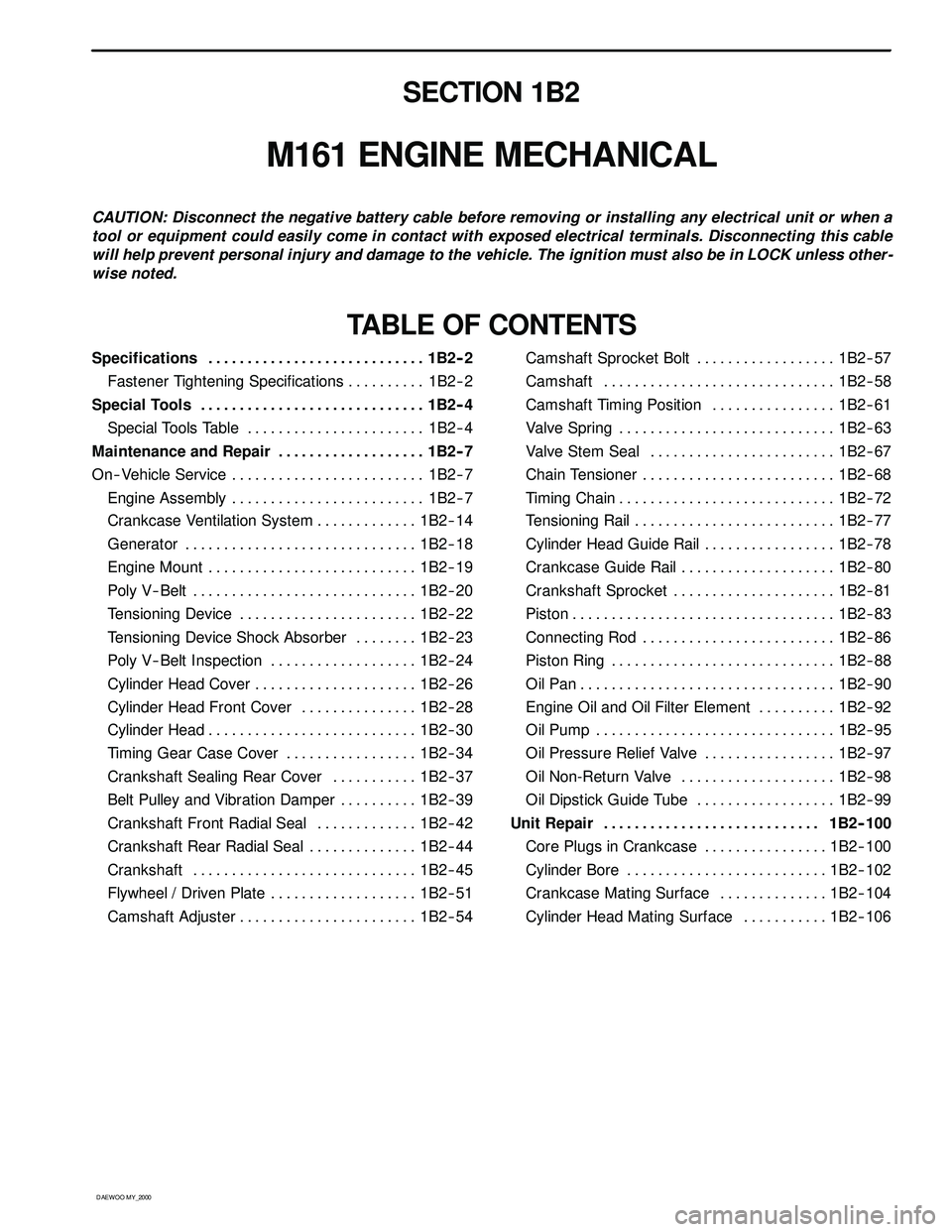
SECTION 1B2
M161 ENGINE MECHANICAL
CAUTION: Disconnect the negative battery cable before removing or installing any electrical unit or when a
tool or equipment could easily come in contact with exposed electrical terminals. Disconnecting this cable
will help prevent personal injury and damage to the vehicle. The ignition must also be in LOCK unless other -
wise noted.
TABLE OF CONTENTS
Specifications 1B2 -- 2............................
Fastener Tightening Specifications 1B2 -- 2..........
Special Tools 1B2 -- 4.............................
Special Tools Table 1B2-- 4.......................
Maintenance and Repair 1B2 -- 7...................
On-- Vehicle Service 1B2-- 7.........................
Engine Assembly 1B2-- 7.........................
Crankcase Ventilation System 1B2-- 14.............
Generator 1B2-- 18..............................
Engine Mount 1B2-- 19...........................
Poly V-- Belt 1B2 -- 20.............................
Tensioning Device 1B2-- 22.......................
Tensioning Device Shock Absorber 1B2-- 23........
Poly V-- Belt Inspection 1B2-- 24...................
Cylinder Head Cover 1B2-- 26.....................
Cylinder Head Front Cover 1B2 -- 28...............
Cylinder Head 1B2-- 30...........................
Timing Gear Case Cover 1B2-- 34.................
Crankshaft Sealing Rear Cover 1B2-- 37...........
Belt Pulley and Vibration Damper 1B2-- 39..........
Crankshaft Front Radial Seal 1B2-- 42.............
Crankshaft Rear Radial Seal 1B2-- 44..............
Crankshaft 1B2-- 45.............................
Flywheel / Driven Plate 1B2 -- 51...................
Camshaft Adjuster 1B2-- 54.......................Camshaft Sprocket Bolt 1B2-- 57..................
Camshaft 1B2-- 58..............................
Camshaft Timing Position 1B2 -- 61................
Valve Spring 1B2 -- 63............................
Valve Stem Seal 1B2-- 67........................
Chain Tensioner 1B2-- 68.........................
Timing Chain 1B2-- 72............................
Tensioning Rail 1B2-- 77..........................
Cylinder Head Guide Rail 1B2-- 78.................
Crankcase Guide Rail 1B2-- 80....................
Crankshaft Sprocket 1B2-- 81.....................
Piston 1B2-- 83..................................
Connecting Rod 1B2-- 86.........................
Piston Ring 1B2 -- 88.............................
Oil Pan 1B2-- 90.................................
Engine Oil and Oil Filter Element 1B2-- 92..........
Oil Pump 1B2-- 95...............................
Oil Pressure Relief Valve 1B2-- 97.................
Oil Non-Return Valve 1B2-- 98....................
Oil Dipstick Guide Tube 1B2-- 99..................
Unit Repair 1B2 -- 100............................
Core Plugs in Crankcase 1B2-- 100................
Cylinder Bore 1B2-- 102..........................
Crankcase Mating Surface 1B2-- 104..............
Cylinder Head Mating Surface 1B2-- 106...........