manual transmission SSANGYONG NEW ACTYON SPORTS 2012 Service Manual
[x] Cancel search | Manufacturer: SSANGYONG, Model Year: 2012, Model line: NEW ACTYON SPORTS, Model: SSANGYONG NEW ACTYON SPORTS 2012Pages: 828, PDF Size: 91.28 MB
Page 120 of 828

02-110000-00
3160-01 Manual transmission
Added 5 and 6-speed transmission
3680-01 Automatic transmission
Changed the torque conver & torque converter housing due to new engine
OldNew
OldNew
2412-02 CDPF
Introduced CDPF to meet EURO-5
regulation
2411-01 DOC
Introduced DOC to meet EURO III or
EURO IV regulation.
G23D
D20DTR
Page 497 of 828

04-6
Connector Pin Arrangement ▶
The connector pin sections illustrated below are viewed from the front of the instrument
cluster. The arrangement of the pins is the same for both the main connector and the sub
connector.
Main connector - 20-pin (white)
Sub connector - 20-pin (gray)
1. -
2. Hood open
3. Seat belt - passenger's seat
4. -
5. -
6. Front fog lamp
7. -
8. Engine CHECK warning light
9. Charge
10. IGN 2
11. -
12. Air bag
13. Seat belt - driver's seat
14. High beam (-)
15. Right turn signal lamp (+)
16. High beam (+)
17. Left turn signal lamp (+)
18. Oil pressure
19. Parking brake signal input (STICS)
20. - 1. -
2. -
3. 4P output
4. Buzzer output
5. Illumination (+)
6. -
7. -
8. Door open
9. -
10. Battery
11. -
12. Fuel input signal
13. TRIP mode/reset switch
14. Manual transmission N (neutral)
input
15. Manual transmission R (reverse)
input
16. CAN LOW
17. CAN HIGH
18. AGND (fuel -)
19. MICOM ground
20. IGN 1
Page 559 of 828
01-153680-01
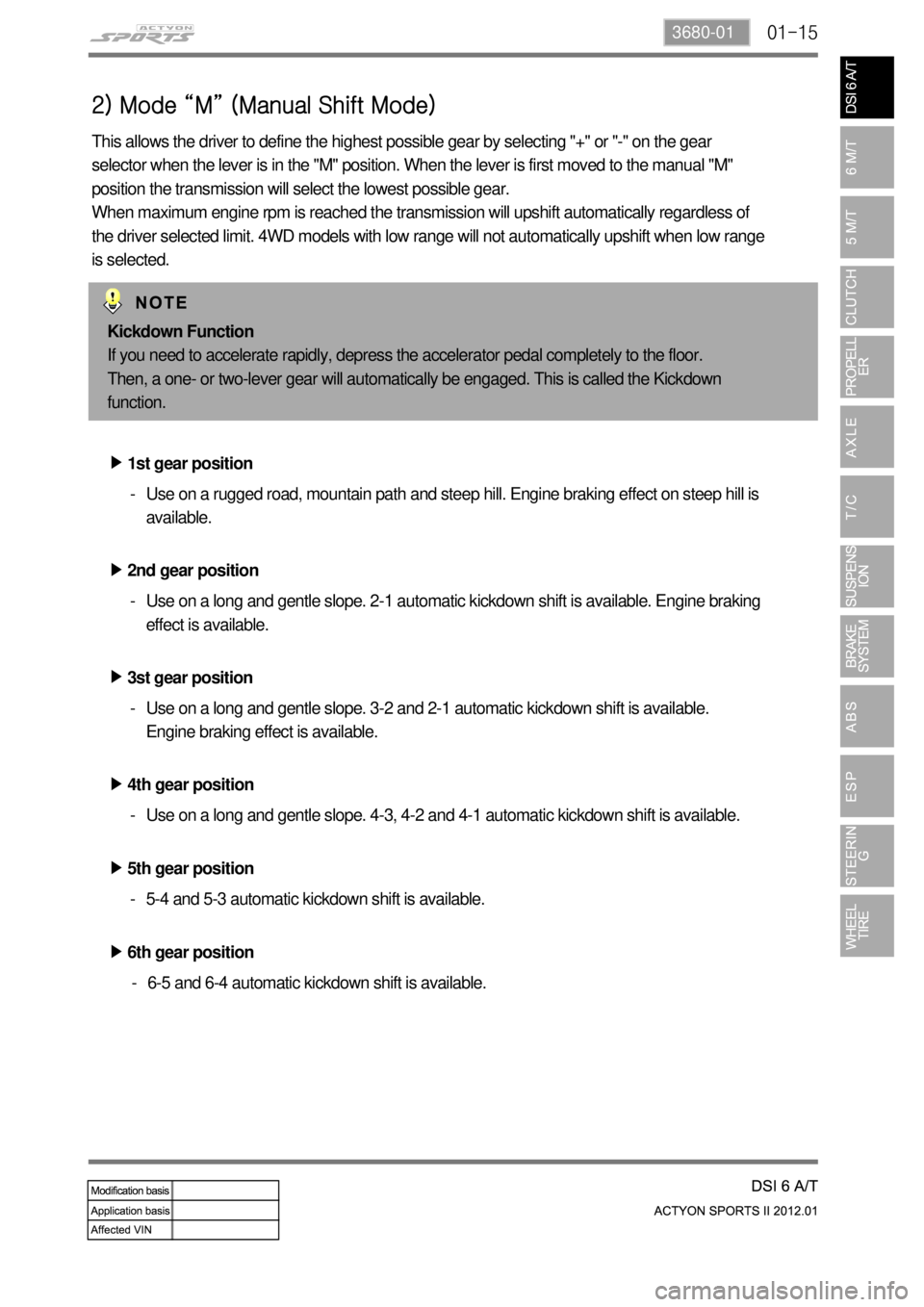
2) Mode “M” (Manual Shift Mode)
This allows the driver to define the highest possible gear by selecting "+" or "-" on the gear
selector when the lever is in the "M" position. When the lever is first moved to the manual "M"
position the transmission will select the lowest possible gear.
When maximum engine rpm is reached the transmission will upshift automatically regardless of
the driver selected limit. 4WD models with low range will not automatically upshift when low range
is selected.
1st gear position ▶
2nd gear position ▶
3st gear position ▶
4th gear position ▶
5th gear position ▶
6th gear position ▶Use on a rugged road, mountain path and steep hill. Engine braking effect on steep hill is
available. -
Use on a long and gentle slope. 2-1 automatic kickdown shift is available. Engine braking
effect is available. -
Use on a long and gentle slope. 3-2 and 2-1 automatic kickdown shift is available.
Engine braking effect is available. -
Use on a long and gentle slope. 4-3, 4-2 and 4-1 automatic kickdown shift is available. -
5-4 and 5-3 automatic kickdown shift is available. -
6-5 and 6-4 automatic kickdown shift is available. -
Kickdown Function
If you need to accelerate rapidly, depress the accelerator pedal completely to the floor.
Then, a one- or two-lever gear will automatically be engaged. This is called the Kickdown
function.
Page 611 of 828

03-33170-01
1. OVERVIEW AND CHARACTERISTICS OF MANUAL
TRANSMISSION
1) System Components
Inside
Front View
(1) Features
All gears use the helical type and high strength materials. 1.
The helical type gear prevents the axial gear missing and provides less noise. -
The semi-remote control type gear shift mechanism is used to prevent incorrect shifting.
To improve the shifting performance, 3-piece double cone is used for 1/2 shift. 2.
3.
The synchronizing devices are installed in 1/2, 3/4, 5/R gears. To prevent the double
engagement, the independent interlock devices are installed. 4.TSM54/52 transmission uses the inertia lock type key to make smooth gear engagement and
to provide silent gear engagement. -
The clutch release system is available to use CSC (Concentric Slave Cylinder) or Fork type
according to the vehicle model. 5.
Page 612 of 828

03-4
2. SPECIFICATIONS AND TIGHTENING TORQUE OF
MANUAL TRANSMISSION
1) Specifications
Page 614 of 828
03-6
Inside N Switch
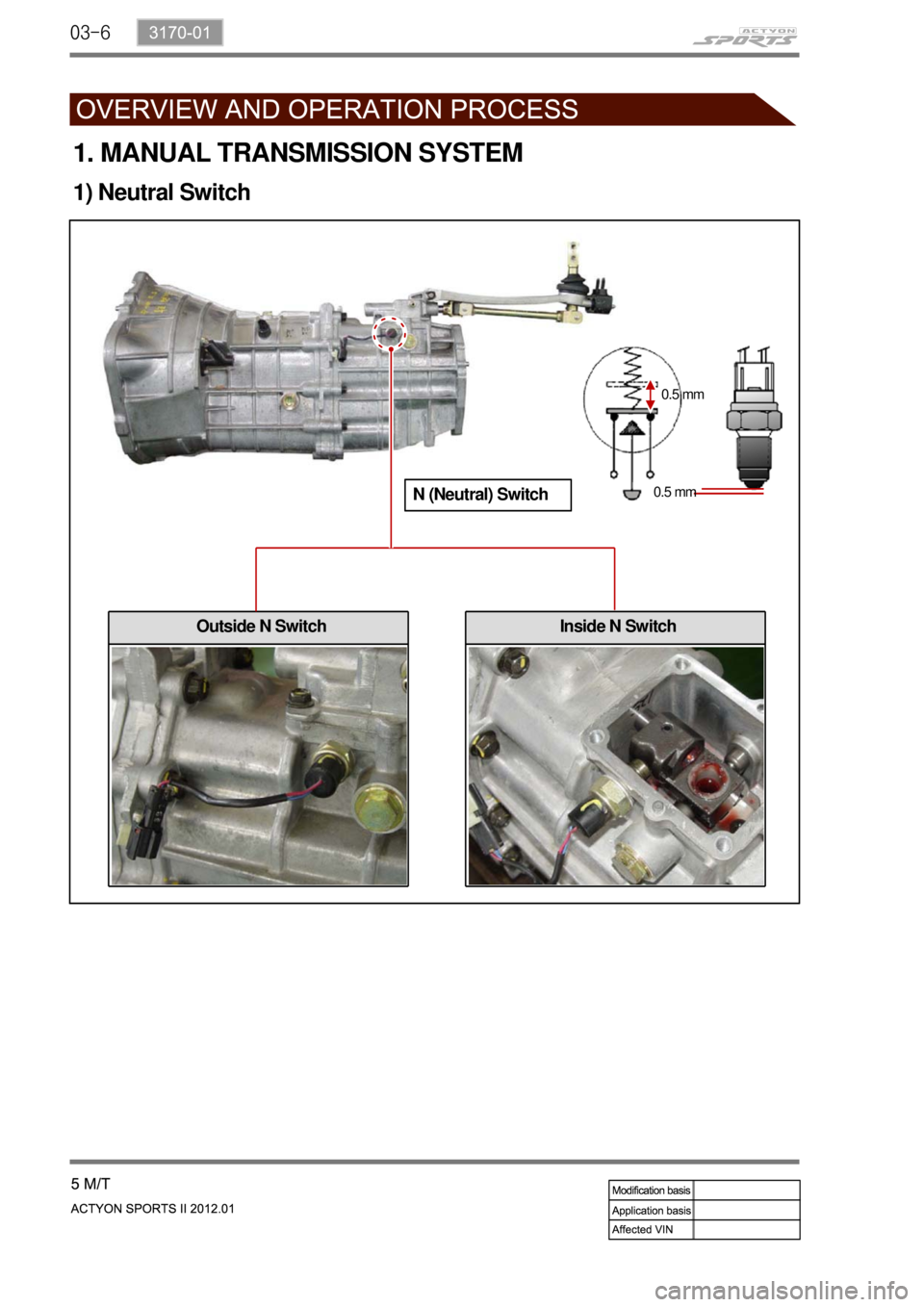
1. MANUAL TRANSMISSION SYSTEM
1) Neutral Switch
Outside N Switch
N (Neutral) Switch
0.5 mm
0.5 mm
Page 616 of 828

03-8
Variant Coding Options
(2) Detects the position of the shifting lever for the HDC operation
among ABS functions.
The HDC function operates only if the M/T shift lever is in forward or reverse position. Please refer
to the ABS section for the specific information related to the HDC.
Variant Coding Related to N Switch ▶
The N switch transmits information to the ECU through the CAN communication while New Rexton
is connected to the ECU through wires. Thus, if you set the variant coding in the engine ECU, you
must do it differently, and you must set the variant coding differently according to the vehicle
category and specification as below.
Neutral Signal Input None / Wire / CANWire /
Actyon & Kyron models with
manual transmission
New Rexton model with manual
transmission Manufactured
after 04.09.15
BODY IN: after 154600
Automatic transmission & Rodius
model with automatic
transmission before 2006
Page 626 of 828

06-2
1. SPECIFICATIONS
Location Front Axle Rear Axle
Type Manual
transmissionAuto
transmissionManual
transmissionAuto
transmission
Torque----
Gear ratio 4.55R 3.91R 4.55R 3.91R
GearType Hypoid←←←
SizeØ182.8 mm ← Ø228.6 mm ←
Offset28.58 mm
(DYMOS)
35 mm (Tongil)←30 mm -
Housing Steel←Steel casting←
OilTypeSAE 80W/90 - GL5
←SAE 80W/90 - GL5
←
Capacity 1.4 L 1.4 LGSL = 1.9 L,
DSL = 2.0 L←
Length 448.0 mm←469.0 mm←
Witdh 681.9 mm←1,717.7 mm←
Weight 45 kg←90 kg←
Page 629 of 828

07-53240-01
Operation ▶
Description Mode Conditions
Driving
mode2H 2 Wheel drive
(rear wheel)Rear-wheel drive mode. This is used under
normal or high-speed driving conditions on
public roads or highways.
4H 4 Wheel drive
(high speed)This is used under sandy, muddy or snow-
covered road conditions
4L 4 Wheel drive
(low speed)This is used for maximum traction.
When cornering with low speed in 4WD
condition, there could be tire dragging, some
mechanical shocks and resistances in
vehicle’s drive train. These are normal
conditions due to internal resistance in the
drive train when the 4WD system is properly
working
Mode change2H←4H2 Wheel drive
↔4 Wheel driveShifting is possible while driving at the speed
of 70 km/h or less
2H,
4H↔4L2 Wheel drive,
4 Wheel drive (high
speed)
↔4 Wheel drive
(low speed)For Automatic Transmission:
For Manual Transmission:
Stop the vehicle on level ground and
move the gear selector lever into the
“N” position. Turn the switch to the
desired position. ·
Stop the vehicle on level ground and
move the gear selector lever into the
“N” position. Then turn the switch to
the desired position while depressing
the clutch pedal. ·
To make the mode change easily, stop
the vehicle on level ground and turn the
mode switch to the desired position and
move the shift lever to "N"-"R"-"N" while
depressing the brake pedal.
Page 658 of 828

09-10
This section describes the noise phenomena occurred possibly in the brake system operation.
Distinguish between the information given below and the actual problems and then, inspect the
vehicle and take appropriate measures.
Noise symptoms and Causes -
Symptom 1. If depressing the brake pedal when the engine is cold, "screeching" sound always
occurs and, after driving for a while, the sound disappears..
This usually occurs in the morning. When the temperature goes down, the dew condensation
phenomenon sets moisture on the brake disc as the window frost forms. Due to this moisture, the
iron within the brake disc and pad oxidizes, forming undetectable micro-rusts on the disc
surface. When starting the engine under this condition, noise may sound due to the friction of
micro-rusts. When operating the brake several times, the disc temperature goes up and the
micro-rusts come off and the noise goes away. Depending on the driving conditions, noise gets
louder when slightly depressing the brake pedal and oppositely, noise is smaller when deeply
depressing the brake pedal. This is simply a physical phenomenon, called "morning effect" in
professional terms, and does not imply any problems with the brake system.
Symptom 2. Slip or screech after the brake pad replacement.
This usually occurs when the bed-in is not made between the disc and the pad's friction material.
The bed-in is a state that the brake system normally works and gives no noise out, when, after
about 300 km city driving, the contact area of the pad friction material is enlarged and the disk is
in complete contact with the pad's friction material. Therefore, for some time after the brake
disk/pad replacement, the brake system poorly operates or noise (abnormal sound) occurs due
to the partial contact.
Symptom 3. "Groaning" sound occurs in the automatic transmission vehicle when slightly taking
the foot off the brake pedal to slowly start after waiting for the signal, or slightly depressing the
brake pedal.
This is the noise "Creep groan" that occurs when, in both the automatic and manual transmission,
slightly releasing the brake pedal in the neutral gear at downhill roads.
It frequently occurs at the low braking power and low speed, through the following process. When
operating the brake system at low speed and low pressure, adhesion and slip repeatedly take
place between the brake disk and the friction material, and this makes the braking power
inconstant, instantly increasing or decreasing, and gives out the brake noise.
It is also a physical phenomenon and has no relation with the brake performance.BRAKE OPERATION AND NOISE ▶