ABS SSANGYONG NEW ACTYON SPORTS 2013 Service Manual
[x] Cancel search | Manufacturer: SSANGYONG, Model Year: 2013, Model line: NEW ACTYON SPORTS, Model: SSANGYONG NEW ACTYON SPORTS 2013Pages: 751, PDF Size: 72.63 MB
Page 31 of 751
01-14
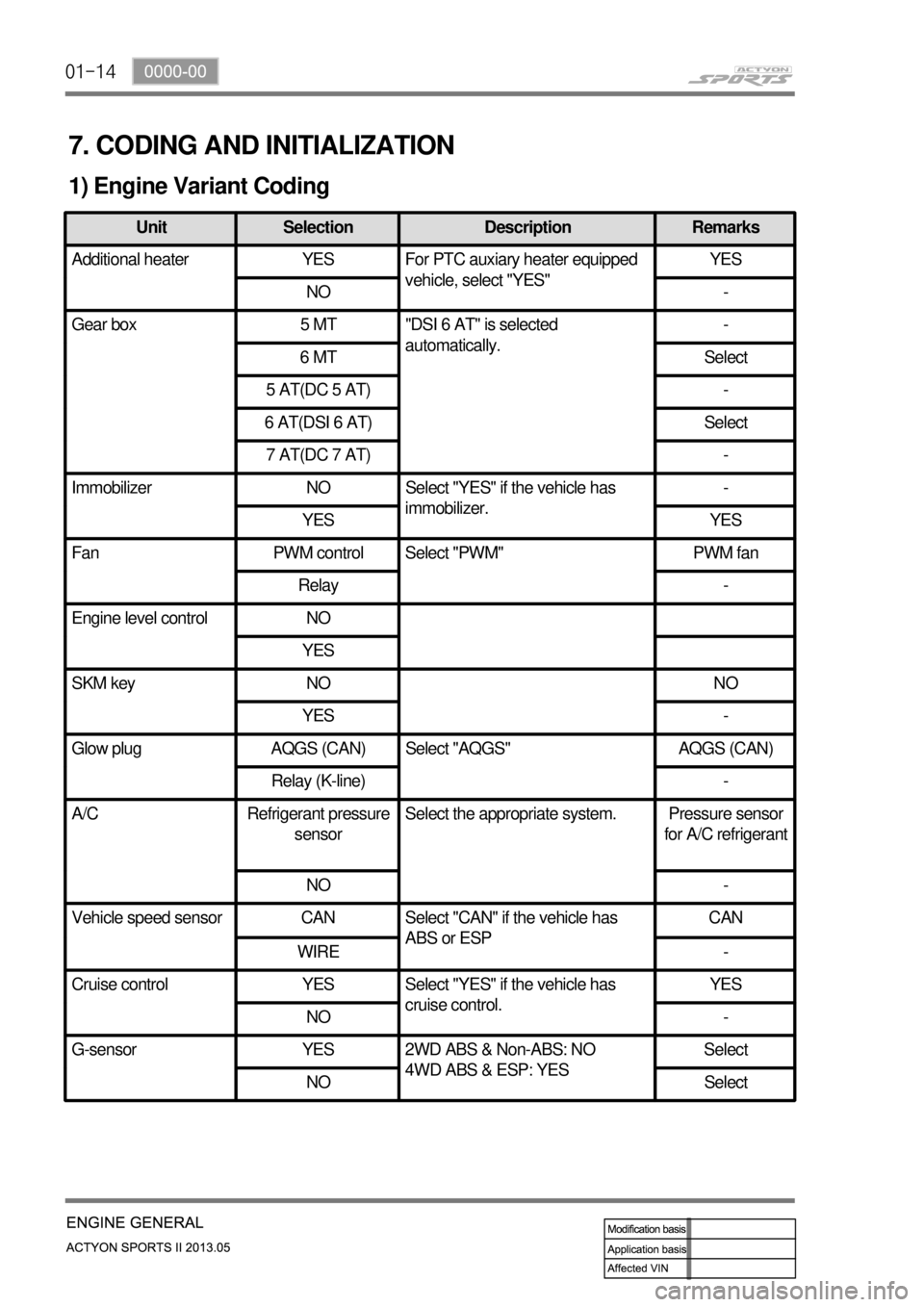
7. CODING AND INITIALIZATION
1) Engine Variant Coding
Unit Selection Description Remarks
Additional heater YES For PTC auxiary heater equipped
vehicle, select "YES"YES
NO -
Gear box 5 MT "DSI 6 AT" is selected
automatically.-
6 MT Select
5 AT(DC 5 AT) -
6 AT(DSI 6 AT) Select
7 AT(DC 7 AT) -
Immobilizer NO Select "YES" if the vehicle has
immobilizer.-
YES YES
Fan PWM control Select "PWM" PWM fan
Relay -
Engine level control NO
YES
SKM key NO NO
YES -
Glow plug AQGS (CAN) Select "AQGS" AQGS (CAN)
Relay (K-line) -
A/C Refrigerant pressure
sensorSelect the appropriate system. Pressure sensor
for A/C refrigerant
NO -
Vehicle speed sensor CAN Select "CAN" if the vehicle has
ABS or ESPCAN
WIRE -
Cruise control YES Select "YES" if the vehicle has
cruise control.YES
NO -
G-sensor YES 2WD ABS & Non-ABS: NO
4WD ABS & ESP: YESSelect
NO Select
Page 33 of 751
01-16
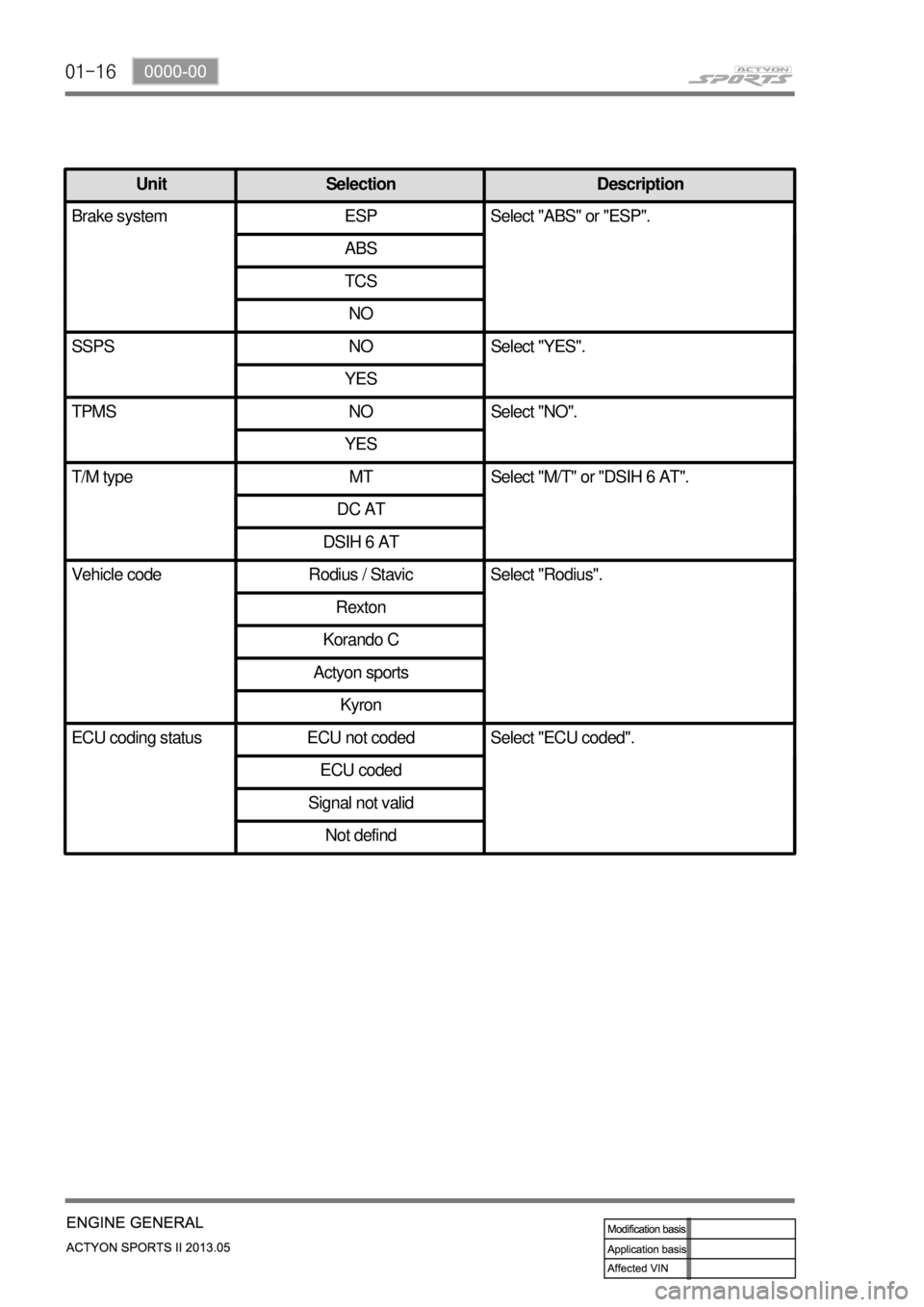
Unit Selection Description
Brake system ESP Select "ABS" or "ESP".
ABS
TCS
NO
SSPS NO Select "YES".
YES
TPMS NO Select "NO".
YES
T/M type MT Select "M/T" or "DSIH 6 AT".
DC AT
DSIH 6 AT
Vehicle code Rodius / Stavic Select "Rodius".
Rexton
Korando C
Actyon sports
Kyron
ECU coding status ECU not coded Select "ECU coded".
ECU coded
Signal not valid
Not defind
Page 61 of 751

02-30
2) Timing Chain and Gear
(1) Timing chain
Simple layout: optimized timing, enhanced
NVH
Single stage layout: minimized chain load -
-
Chain upper bush
- Single bush type (112 EA)
Chain lower bush
- Single bush type (60 EA)
(2) Tensioner
Tensioner adjusts the chain tension to keep it tight during engine running. This reduces the wear in
guide rail and spoke.
Operating principle
- Use the spring tension in tensioner and hydraulic pressure
Tensioner type
- Compensation and impact absorbing
Static and dynamic force
- Spring + Hydraulic pressure 1.
2.
3.
Plunger
HousingSpring
Check valve
Hydraulic tensioner assembly ▶
Page 62 of 751
02-310000-00
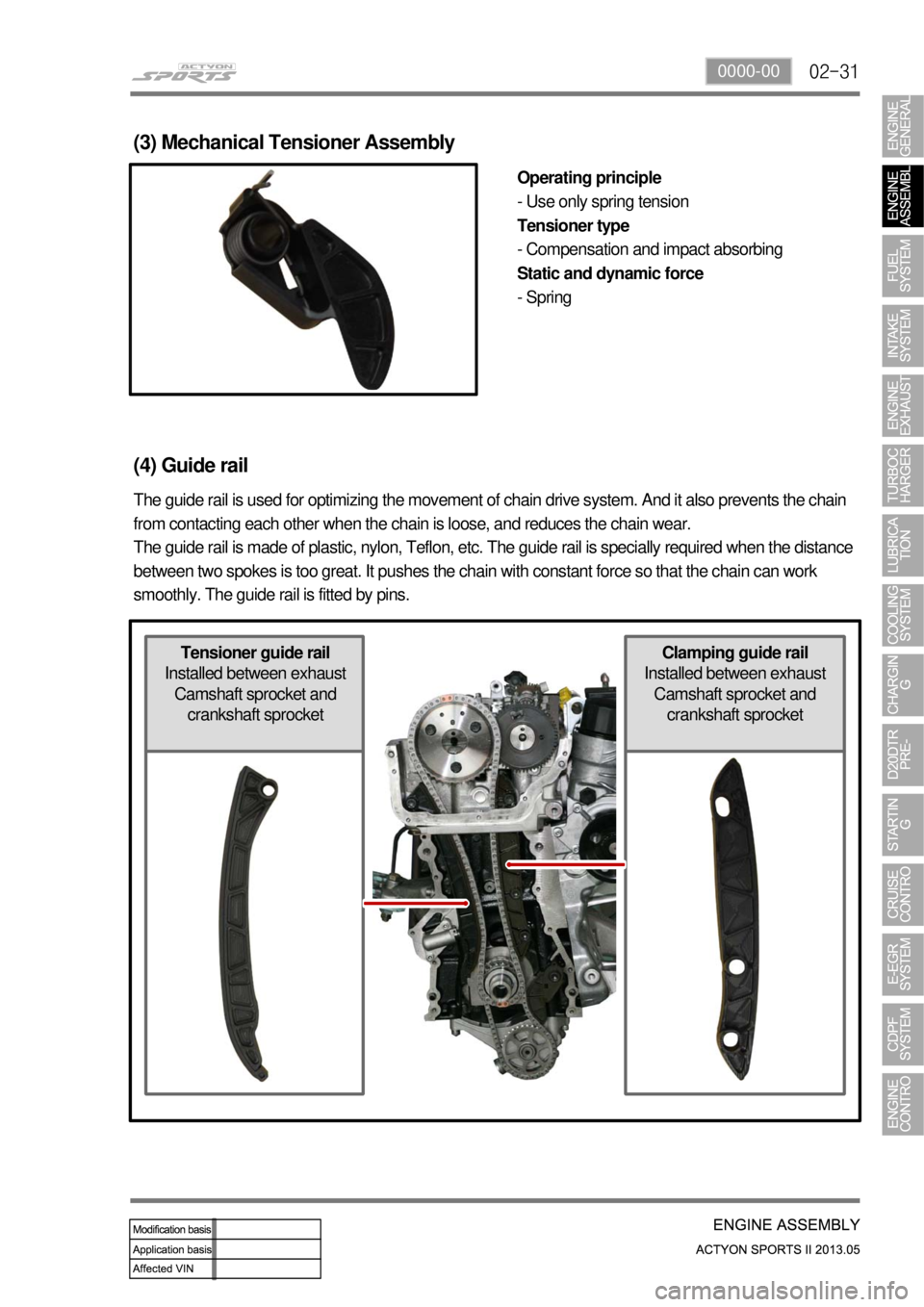
Clamping guide rail
Installed between exhaust
Camshaft sprocket and
crankshaft sprocketTensioner guide rail
Installed between exhaust
Camshaft sprocket and
crankshaft sprocket
(3) Mechanical Tensioner Assembly
Operating principle
- Use only spring tension
Tensioner type
- Compensation and impact absorbing
Static and dynamic force
- Spring
(4) Guide rail
The guide rail is used for optimizing the movement of chain drive system. And it also prevents the chain
from contacting each other when the chain is loose, and reduces the chain wear.
The guide rail is made of plastic, nylon, Teflon, etc. The guide rail is specially required when the distance
between two spokes is too great. It pushes the chain with constant force so that the chain can work
smoothly. The guide rail is fitted by pins.
Page 67 of 751
02-36
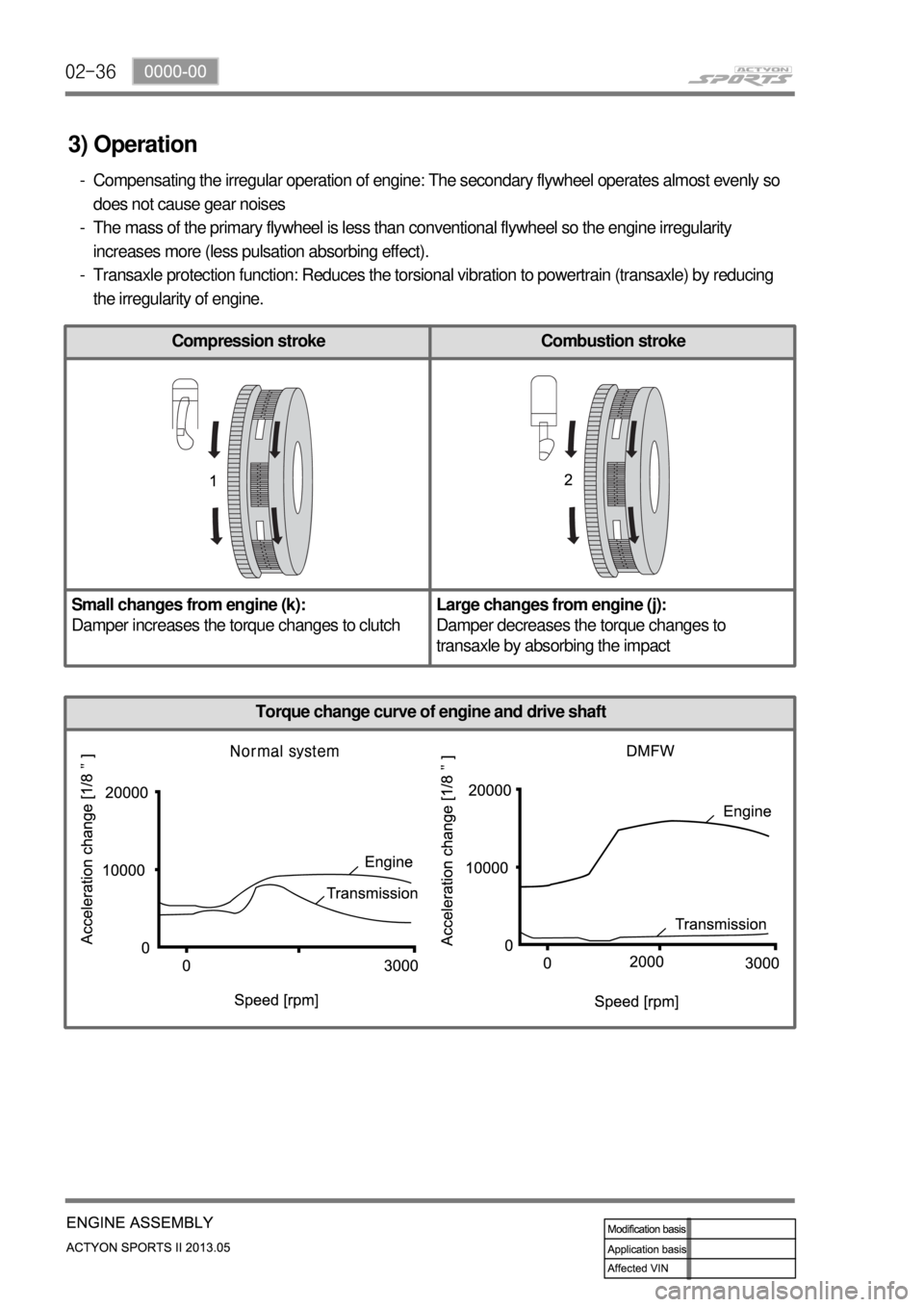
Torque change curve of engine and drive shaft
Compression stroke Combustion stroke
Small changes from engine (k):
Damper increases the torque changes to clutchLarge changes from engine (j):
Damper decreases the torque changes to
transaxle by absorbing the impact
3) Operation
Compensating the irregular operation of engine: The secondary flywheel operates almost evenly so
does not cause gear noises
The mass of the primary flywheel is less than conventional flywheel so the engine irregularity
increases more (less pulsation absorbing effect).
Transaxle protection function: Reduces the torsional vibration to powertrain (transaxle) by reducing
the irregularity of engine. -
-
-
Page 120 of 751
06-6
3) Inspection of Turbine
Thoroughly check the followings.
Must absolutely not operate the turbocharger with the compressor outlet and inlet opened as it could
damage the turbocharger or be hazardous during inspection.
Interference: In case where is trace of interference or smallest damage on the compressor wheel
means, most of times, that abrasion has occurred on the journal bearing. Must inspect after the
overhaul.
Oil Leakage: The reason for oil leakage at the compressor section is the air cleaner, clogged by
substances such as dust, causes the compressor inlet negative pressure. -
-
Rotating in high speed at no-load for extended period of time can cause oil leakage to the
compressor section as oil pressure within the center housing gets higher than pressure within the
compressor housing.
Overuse of engine break (especially in low gear) in down hill makes significantly low exhaust gas
energy compared to the time where great amount of air is required during idling conditions of the
engine. Therefore, amount of air in the compressor inlet increases but the turbocharge pressure is
not high, which makes negative a.
b.
No problem will occur with the turbocharger if above conditions are found in early stage but oil
leaked over long period of time will solidify at each section causing to breakout secondary defects.
Damages by foreign materials: In case where the compressor wheel is damaged by foreign materials
requires having an overhaul. At this time, it's necessary to check whether the foreign materials have
contaminated intake/exhaust manifold or inside of engine.
Page 209 of 751
15-90000-00
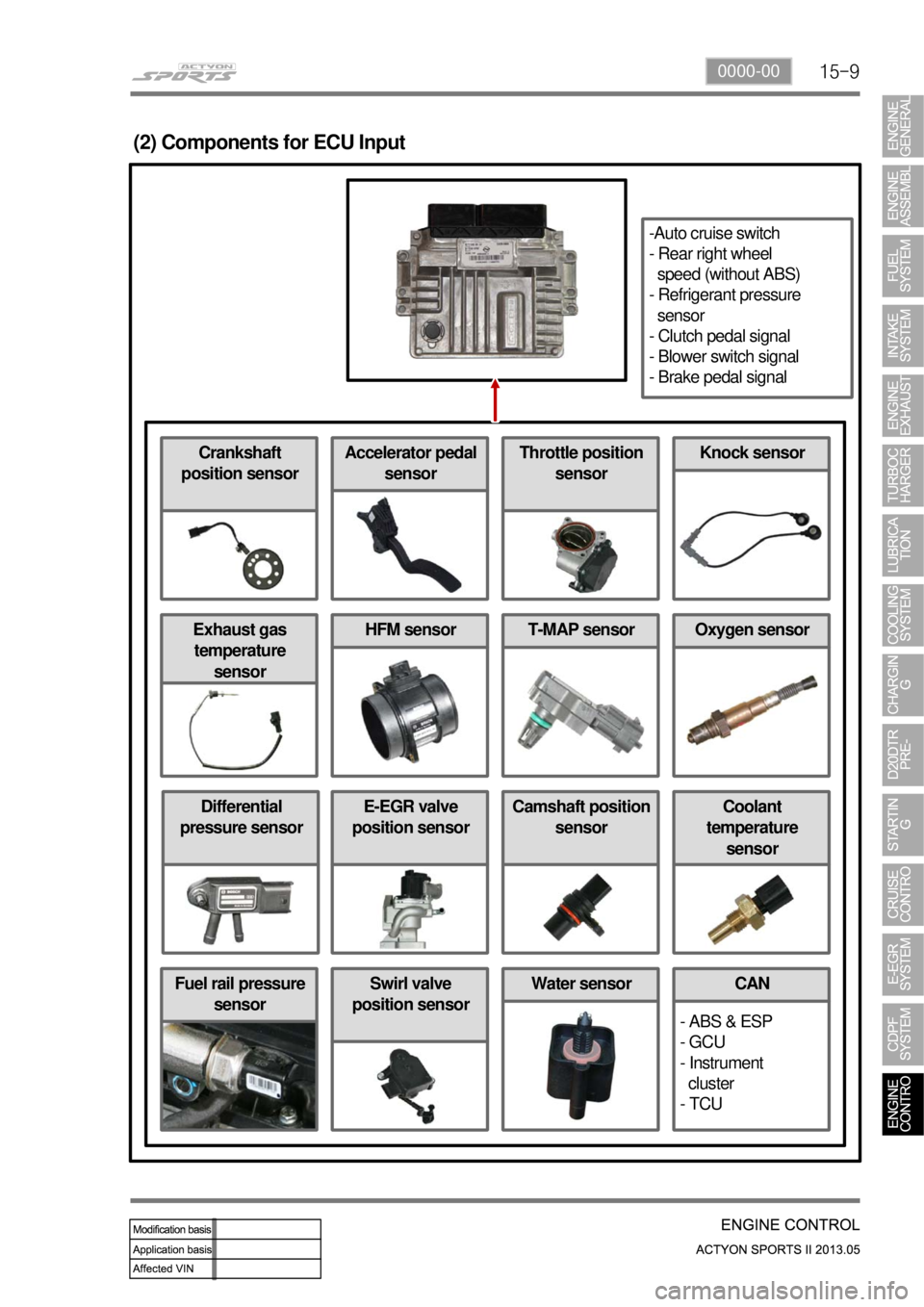
Fuel rail pressure
sensor
(2) Components for ECU Input
CAN
- ABS & ESP
- GCU
- Instrument
cluster
- TCUSwirl valve
position sensor
Differential
pressure sensorE-EGR valve
position sensorCamshaft position
sensorCoolant
temperature
sensor
Exhaust gas
temperature
sensorHFM sensorOxygen sensorT-MAP sensor
Crankshaft
position sensorAccelerator pedal
sensorThrottle position
sensorKnock sensor
-Auto cruise switch
- Rear right wheel
speed (without ABS)
- Refrigerant pressure
sensor
- Clutch pedal signal
- Blower switch signal
- Brake pedal signal
Water sensor
Page 210 of 751
15-10
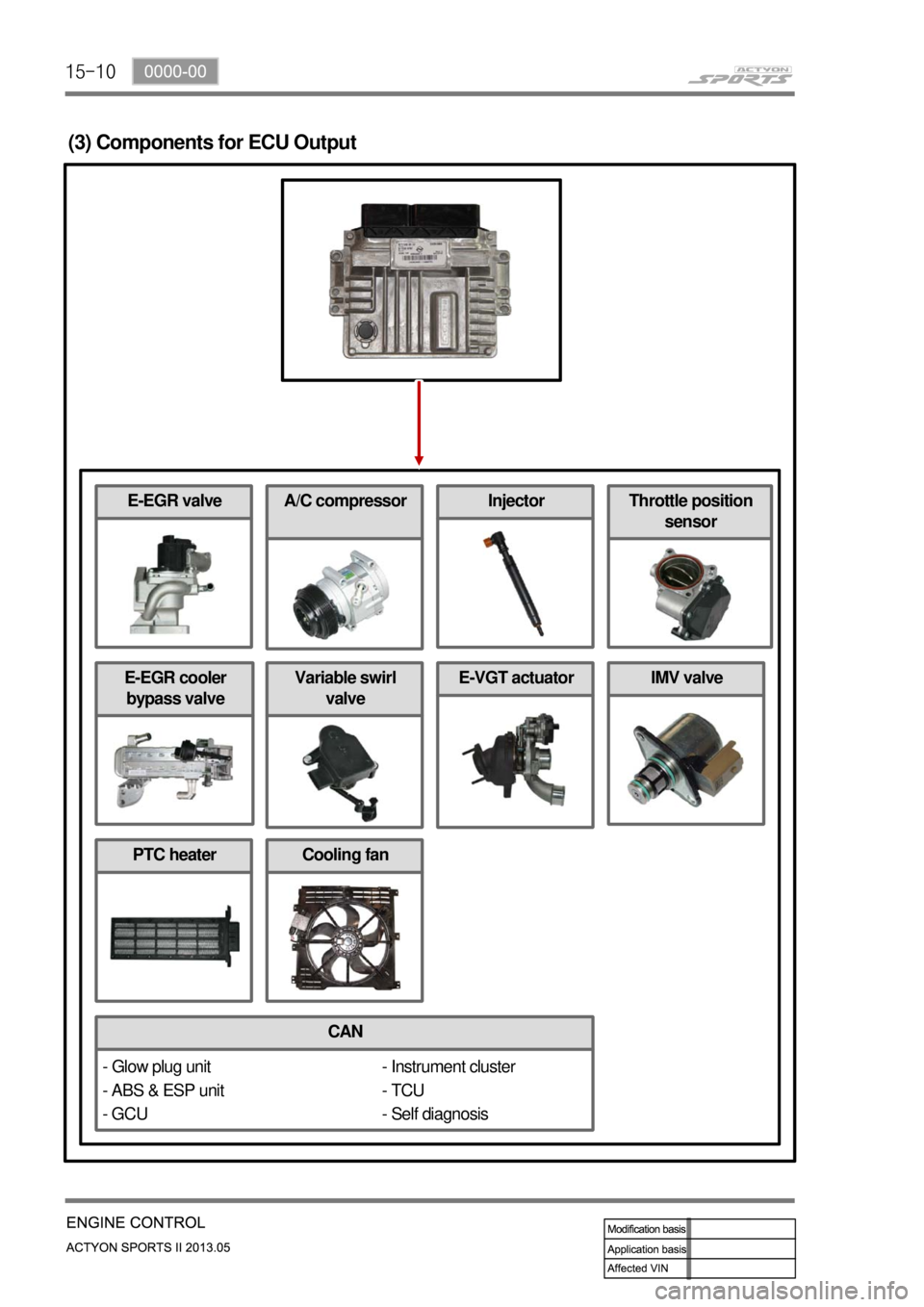
(3) Components for ECU Output
CAN
E-EGR cooler
bypass valve
- Instrument cluster
- TCU
- Self diagnosis
PTC heaterCooling fan
E-EGR valve
Variable swirl
valveE-VGT actuatorIMV valve
A/C compressorInjectorThrottle position
sensor
- Glow plug unit
- ABS & ESP unit
- GCU
Page 274 of 751
02-52211-06
1. FUEL SYSTEM
The function of the fuel metering system is to deliver the correct amount of fuel to the engine under all
operating conditions.
The fuel is delivered to the engine by the individual fuel injectors mounted into the intake manifold nea
r
each cylinder.
The main fuel control sensors are the Mass Air Flow (MAF) sensor and the oxygen (O2) sensors.
The MAF sensor monitors the mass flow of the air being drawn into the engine. An electrically heated
element is mounted in the intake air stream, where it is cooled by the flow of incoming air. Engine Control
Module (ECM) modulates the flow of heating current to maintain the temperature differential between the
heated film and the intake air at a constant level. The amount of heating current required to maintain the
temperature thus provides an index for the mass air flow. This
concept automatically compensates for variations in air density, as this is one of the factors that
determines the amount of warmth that the surrounding air absorbs from the heated element. MAF
sensor is located between the air filter and the throttle valve.
Under high fuel demands, the MAF sensor reads a high mass flow condition, such as wide open throttle.
The ECM uses this information to enrich the mixture, thus increasing the fuel injector on-time, to provide
the correct amount of fuel. When decelerating, the mass flow decreases. This mass flow change is
sensed by the MAF sensor and read by the ECM, which then decreases the fuel injector on-time due to
the low fuel demand conditions.
The O2 sensors are located in the exhaust pipe before catalytic converter. The O2 sensors indicate to
the ECM the amount of oxygen in the exhaust gas, and the ECM changes the air/fuel ratio to the engine
by controlling the fuel injectors. The best air/fuel ratio to minimize exhaust emissions is 14.7 to 1, which
allows the catalytic converter to operate most efficiently. Because
of the constant measuring and adjusting of the air/fuel ratio, the fuel injection system is called a "closed
loop" system.
The ECM uses voltage inputs from several sensors to determine how much fuel to provide to the engine.
The fuel is delivered under one of several conditions, called "modes".
Page 388 of 751
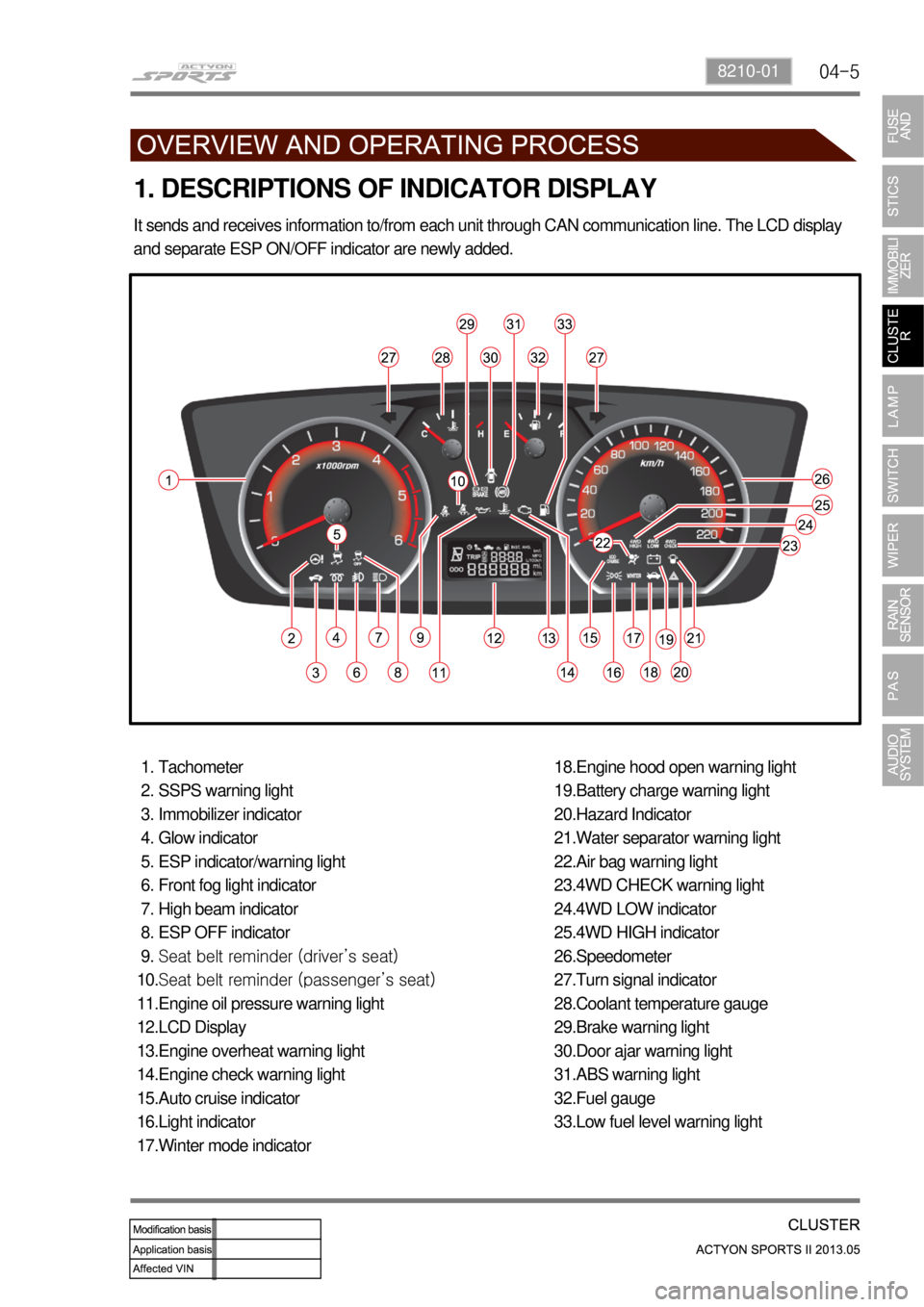
04-58210-01
1. DESCRIPTIONS OF INDICATOR DISPLAY
Tachometer
SSPS warning light
Immobilizer indicator
Glow indicator
ESP indicator/warning light
Front fog light indicator
High beam indicator
ESP OFF indicator
Seat belt reminder (driver’s seat)
Seat belt reminder (passenger’s seat)
Engine oil pressure warning light
LCD Display
Engine overheat warning light
Engine check warning light
Auto cruise indicator
Light indicator
Winter mode indicator 1.
2.
3.
4.
5.
6.
7.
8.
9.
10.
11.
12.
13.
14.
15.
16.
17.Engine hood open warning light
Battery charge warning light
Hazard Indicator
Water separator warning light
Air bag warning light
4WD CHECK warning light
4WD LOW indicator
4WD HIGH indicator
Speedometer
Turn signal indicator
Coolant temperature gauge
Brake warning light
Door ajar warning light
ABS warning light
Fuel gauge
Low fuel level warning light 18.
19.
20.
21.
22.
23.
24.
25.
26.
27.
28.
29.
30.
31.
32.
33. It sends and receives information to/from each unit through CAN communication line. The LCD display
and separate ESP ON/OFF indicator are newly added.