roof SUBARU OUTBACK 2005 4.G Owner's Manual
[x] Cancel search | Manufacturer: SUBARU, Model Year: 2005, Model line: OUTBACK, Model: SUBARU OUTBACK 2005 4.GPages: 627, PDF Size: 6.42 MB
Page 348 of 627
6-31
Interior equipment
– CONTINUED –
!Station wagon
Hang the hook provided on the underside of the lid on
the rear edge of the roof to keep the lid open. HomeLink® Wireless Control System
(if equipped)
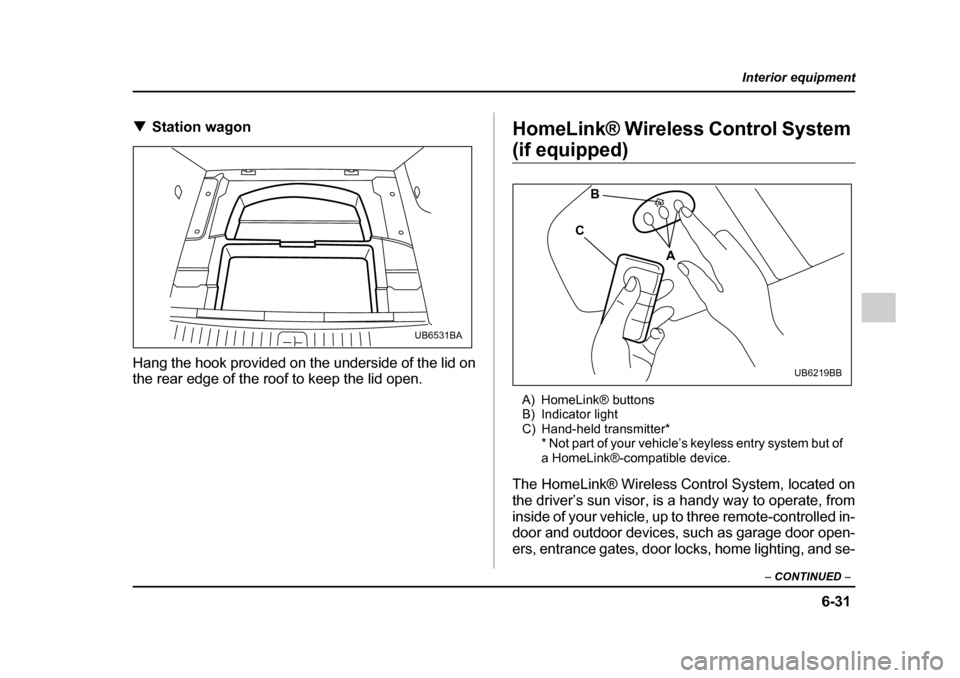
A) HomeLink® buttons
B) Indicator light
C) Hand-held transmitter* * Not part of your vehicle’s keyless entry system but of
a HomeLink®-compatible device.
The HomeLink® Wireless Control System, located on
the driver’s sun visor, is a handy way to operate, from
inside of your vehicle, up to three remote-controlled in-
door and outdoor devices, such as garage door open-
ers, entrance gates, door locks, home lighting, and se-
UB6531BA
A
B
C
UB6219BB
Page 414 of 627

8-1
8
Driving tips
New vehicle break-in driving – the first 1,000 miles (1,600 km) ................ 8-2
Fuel economy hints ...................................... 8-2
Engine exhaust gas (Carbon monoxide) .... 8-3
Catalytic converter ....................................... 8-4
Periodic inspections .................................... 8-6
Driving in foreign countries ......................... 8-7
Driving tips for AWD vehicles ..................... 8-7
Off road driving ............................................ 8-9
Winter driving ............................................... 8-12 Operation during cold weather ........................ 8-12
Driving on snowy and icy roads ...................... 8-13
Corrosion protection ........................................ 8-14
Snow tires .......................................................... 8-15
Tire chains ......................................................... 8-17
Rocking the vehicle .......................................... 8-17
Loading your vehicle ................................... 8-18 Vehicle capacity weight .................................... 8-19
GVWR and GAWR (Gross Vehicle Weight Rating and Gross Axle Weight Rating) ........ 8-20
Roof rail and crossbar (if equipped) ............... 8-21
Trailer hitch (if equipped) ............................ 8-27 Connecting a trailer .......................................... 8-27
When you do not tow a trailer .......................... 8-30
Trailer towing ................................................ 8-31 Warranties and maintenance ........................... 8-31
Maximum load limits ......................................... 8-31
Trailer hitches ................................................... 8-37
Connecting a trailer .......................................... 8-38 Trailer towing tips ............................................. 8-40
Page 424 of 627

8-11
Driving tips
– CONTINUED –
"Always check your brakes for effectiveness immedi-
ately after driving in sand, mud or water. Do this by
driving slowly and stepping on the brake pedal. Re-
peat that process several times to dry out the brake
discs and brake pads." Do not drive or park over or near flammable materi-
als such as dry grass or fallen leaves, as they may
burn easily. The exhaust system is very hot while the
engine is running and right after engine stops. This
could create a fire hazard. " After driving through tall grass, mud, rocks, sand,
rivers, etc., check that there is no grass, bush, paper,
rags, stones, sand, etc. adhering to or trapped on the
underbody. Clear off any such matter from the under-
body. If the vehicle is used with these materials
trapped or adhering to the underbody, a mechanical
breakdown or fire could occur." Secure all cargo carried inside the vehicle and make
certain that it is not piled higher than the seatbacks.
During sudden stops or jolts, unsecured cargo could
be thrown around in the vehicle and cause injury. Do
not pile heavy loads on the roof. Those loads raise the
vehicle’s center of gravity and make it more prone to
tip over. " If you must rock the vehicle to free it from sand or
mud, depress the accelerator pedal slightly and move
the selector lever back and forth between “D” and “R” repeatedly. Do not race the engine. For the best pos-
sible traction, avoid spinning the wheels when trying to
free the vehicle. "
When the road surface is extremely slippery, you
can obtain better traction by starting the vehicle with
the transmission in 2nd than 1st (both for MT and AT). " Never equip your vehicle with tires larger than those
specified in this manual. " Wash the vehicle’s underbody after off-road driving.
Suspension components are particularly prone to dirt
buildup, so they need to be washed thoroughly." Frequent driving of an AWD vehicle under hard-driv-
ing conditions such as rough roads or off roads will ne-
cessitate more frequent replacement of engine oil,
brake fluid and transmission oil than that specified in
the maintenance schedule described in the “Warranty
and Maintenance Booklet”.
Remember that damage done to your SUBARU while
operating it off-road and not using common sense pre-
cautions such as those listed above is not eligible forwarranty coverage.
Page 431 of 627
8-18
Driving tips
Loading your vehicle
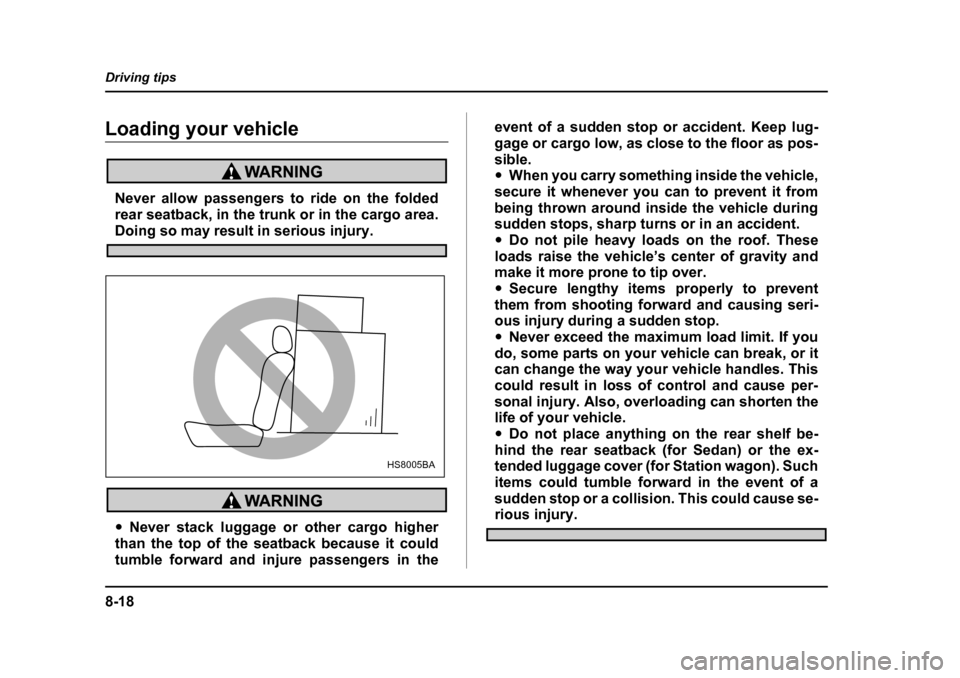
Never allow passengers to ride on the folded
rear seatback, in the trunk or in the cargo area.
Doing so may result in serious injury.
"
Never stack luggage or other cargo higher
than the top of the seatback because it could
tumble forward and injure passengers in the event of a sudden stop or accident. Keep lug-
gage or cargo low, as close to the floor as pos-
sible. "
When you carry something inside the vehicle,
secure it whenever you can to prevent it from
being thrown around inside the vehicle during
sudden stops, sharp turns or in an accident. " Do not pile heavy loads on the roof. These
loads raise the vehicle’s center of gravity and
make it more prone to tip over. " Secure lengthy items properly to prevent
them from shooting forward and causing seri-
ous injury during a sudden stop. " Never exceed the maximum load limit. If you
do, some parts on your vehicle can break, or it
can change the way your vehicle handles. This
could result in loss of control and cause per-
sonal injury. Also, overloading can shorten the
life of your vehicle. " Do not place anything on the rear shelf be-
hind the rear seatback (for Sedan) or the ex-
tended luggage cover (for Station wagon). Such
items could tumble forward in the event of a
sudden stop or a collision. This could cause se-rious injury.
HS8005BA
Page 432 of 627
8-19
Driving tips
– CONTINUED –
Do not carry spray cans, containers with flam-
mable or corrosive liquids or any other danger-
ous items inside the vehicle.
NOTE
For better fuel economy, do not carry unneeded
cargo. !Vehicle capacity weight
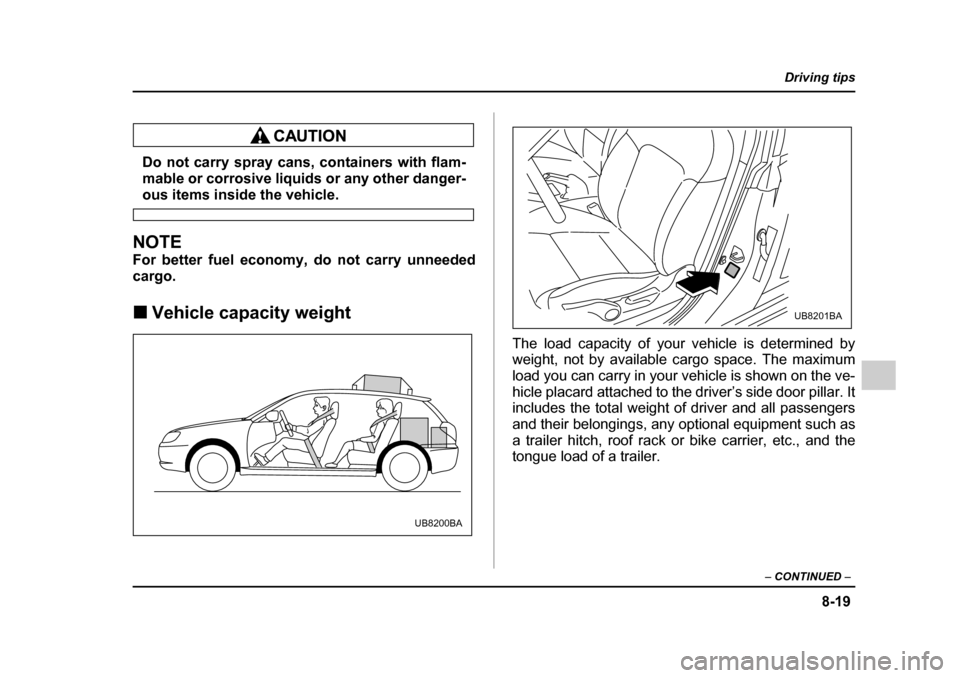
The load capacity of your vehicle is determined by
weight, not by available cargo space. The maximum
load you can carry in your vehicle is shown on the ve-
hicle placard attached to the driver’s side door pillar. It
includes the total weight of driver and all passengers
and their belongings, any optional equipment such as
a trailer hitch, roof rack or bike carrier, etc., and the
tongue load of a trailer.
UB8200BA
UB8201BA
Page 434 of 627
8-21
Driving tips
– CONTINUED –
!Roof rail and crossbar (if equipped)
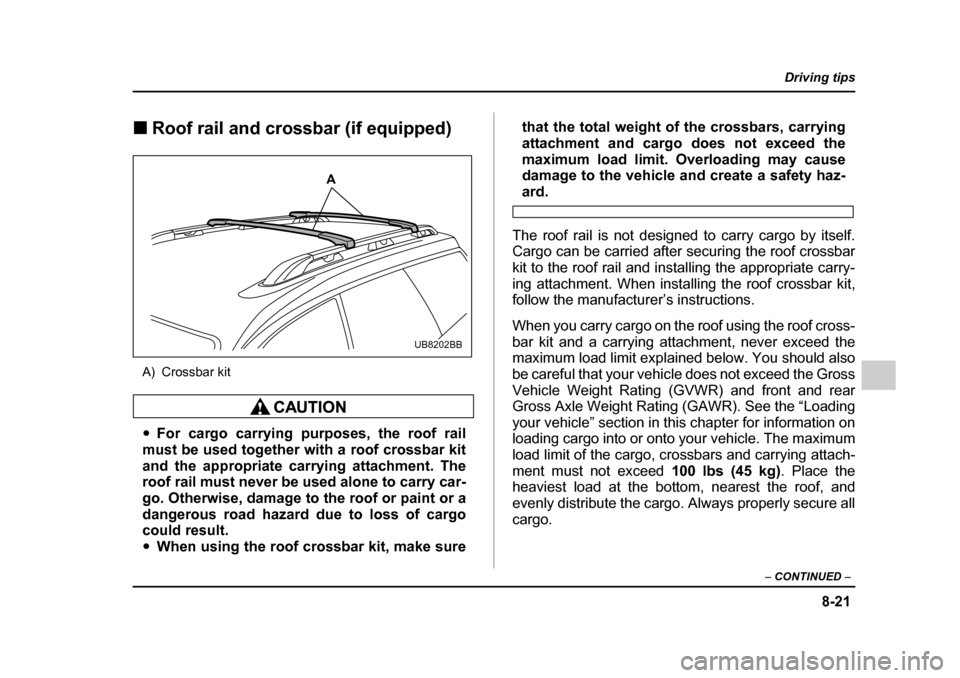
A) Crossbar kit
" For cargo carrying purposes, the roof rail
must be used together with a roof crossbar kit
and the appropriate carrying attachment. The
roof rail must never be used alone to carry car-
go. Otherwise, damage to the roof or paint or a
dangerous road hazard due to loss of cargo
could result. " When using the roof crossbar kit, make sure that the total weight of the crossbars, carrying
attachment and cargo does not exceed the
maximum load limit. Overloading may cause
damage to the vehicle and create a safety haz-
ard.
The roof rail is not designed to carry cargo by itself.
Cargo can be carried after securing the roof crossbar
kit to the roof rail and installing the appropriate carry-
ing attachment. When installing the roof crossbar kit,
follow the manufacturer’s instructions.
When you carry cargo on the roof using the roof cross-
bar kit and a carrying attachment, never exceed the
maximum load limit explained below. You should also
be careful that your vehicle does not exceed the Gross
Vehicle Weight Rating (GVWR) and front and rear
Gross Axle Weight Rating (GAWR). See the “Loading
your vehicle” section in this chapter for information on
loading cargo into or onto your vehicle. The maximum
load limit of the cargo, crossbars and carrying attach-
ment must not exceed 100 lbs (45 kg). Place the
heaviest load at the bottom, nearest the roof, and
evenly distribute the cargo. Always properly secure all cargo.A
UB8202BB
Page 435 of 627
8-22
Driving tips
!
Installing carrying attachments on the cross-
bars
When installing any carrying attachment such as a
bike carrier, ski carrier, kayak carrier, cargo basket,
etc. on the crossbars, follow the manufacturer’s in-
structions and make sure that the attachment is se-
curely fixed to the crossbars. Use only attachments
designed specifically for the crossbars. A set of the
crossbars is designed to carry loads (cargo and at-tachment) of not more than 100 lbs (45 kg). Before
operating the vehicle, make sure that the cargo is
properly secured on the attachment.
NOTE
Remember that the vehicle’s center of gravity is al-
tered with the weight of the load on the roof, thus
affecting the driving characteristics.
Drive carefully. Avoid rapid starts, hard cornering
and abrupt stops. Crosswind effects will be in-
creased. ! Removal and installation of the crossbars
The crossbars can be removed when you do not use the roof to carry cargo. "
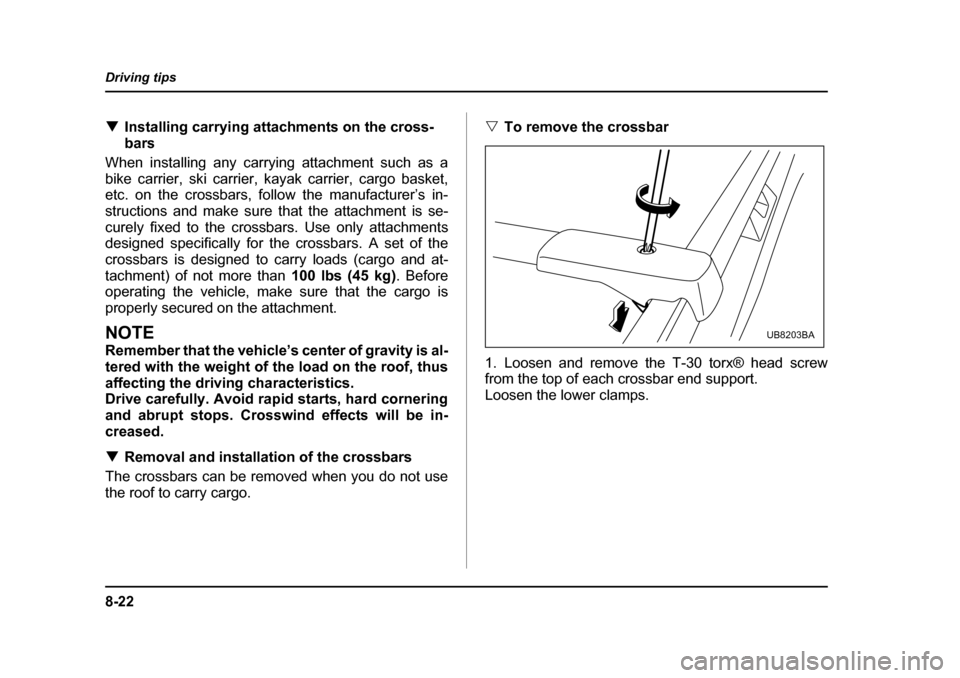
To remove the crossbar
1. Loosen and remove the T-30 torx® head screw
from the top of each crossbar end support.
Loosen the lower clamps.UB8203BA
Page 436 of 627
8-23
Driving tips
– CONTINUED –
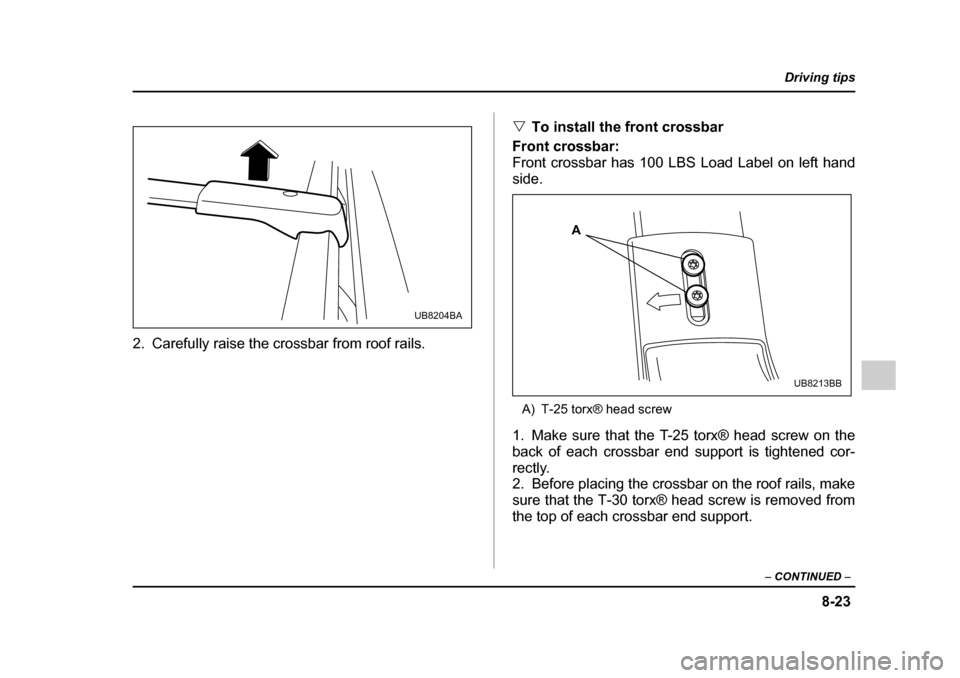
2. Carefully raise the crossbar from roof rails. "
To install the front crossbar
Front crossbar:
Front crossbar has 100 LBS Load Label on left handside.
A) T-25 torx® head screw
1. Make sure that the T-25 torx® head screw on the
back of each crossbar end support is tightened cor-
rectly.
2. Before placing the crossbar on the roof rails, make
sure that the T-30 torx® head screw is removed from
the top of each crossbar end support.
UB8204BA
A
UB8213BB
Page 437 of 627
8-24
Driving tips
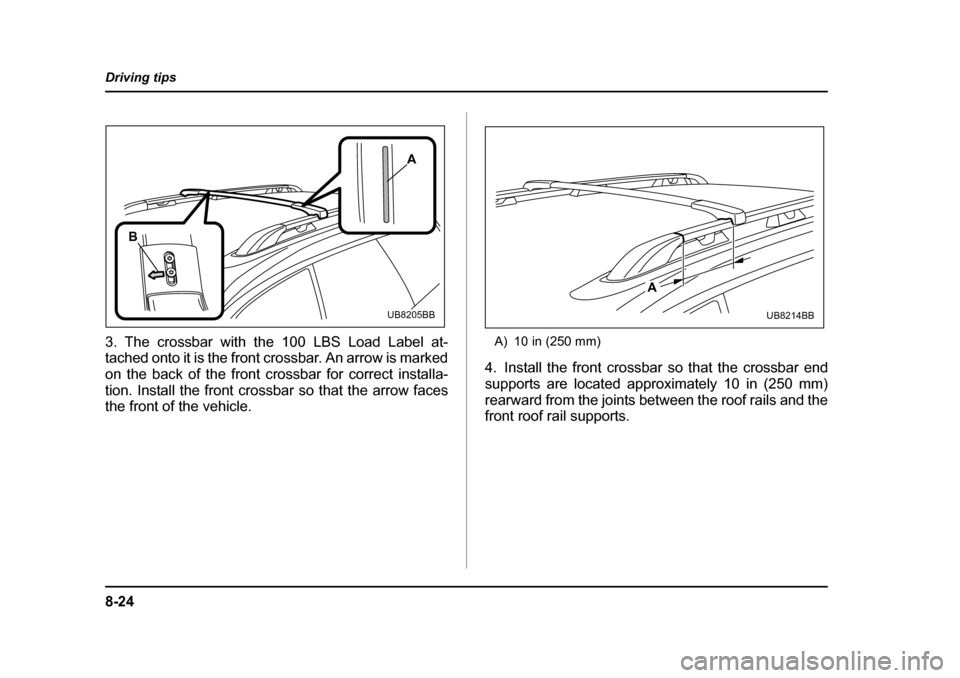
3. The crossbar with the 100 LBS Load Label at-
tached onto it is the front crossbar. An arrow is marked
on the back of the front crossbar for correct installa-
tion. Install the front crossbar so that the arrow faces
the front of the vehicle.
A) 10 in (250 mm)
4. Install the front crossbar so that the crossbar end
supports are located approximately 10 in (250 mm)
rearward from the joints between the roof rails and the
front roof rail supports.
B A
UB8205BB
A
UB8214BB
Page 438 of 627
8-25
Driving tips
– CONTINUED –
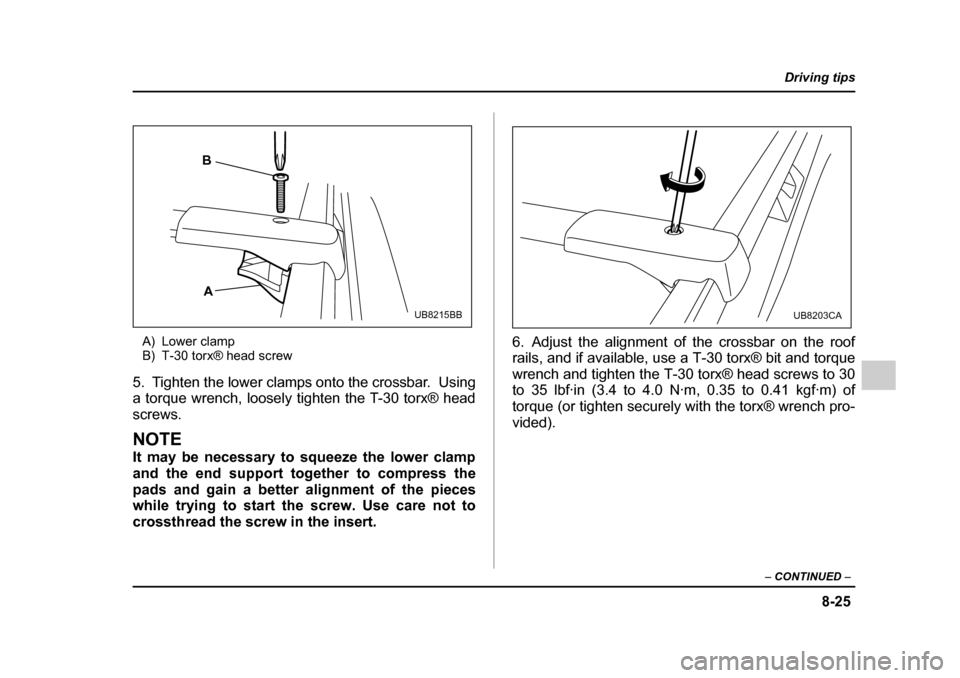
A) Lower clamp
B) T-30 torx® head screw
5. Tighten the lower clamps onto the crossbar. Using
a torque wrench, loosely tighten the T-30 torx® head
screws.
NOTE
It may be necessary to squeeze the lower clamp
and the end support together to compress the
pads and gain a better alignment of the pieces
while trying to start the screw. Use care not to
crossthread the screw in the insert. 6. Adjust the alignment of the crossbar on the roof
rails, and if available, use a T-30 torx® bit and torque
wrench and tighten the T-30 torx® head screws to 30
to 35 lbf·in (3.4 to 4.0 N·m, 0.35 to 0.41 kgf·m) of
torque (or tighten securely with the torx® wrench pro-
vided).
A
B
UB8215BBUB8203CA