automatic transmission fluid SUBARU OUTBACK 2005 4.G Owners Manual
[x] Cancel search | Manufacturer: SUBARU, Model Year: 2005, Model line: OUTBACK, Model: SUBARU OUTBACK 2005 4.GPages: 627, PDF Size: 6.42 MB
Page 198 of 627
3-27
Instruments and controls
– CONTINUED –
lubricating system is not working properly.
If the light comes on while driving or does not go out
after the engine starts, stop the engine at the first safe
opportunity and check the engine oil level. If the oil lev-
el is low, add oil immediately. If the engine oil is at the
proper level but the light remains on, contact your
nearest SUBARU dealer immediately. !AT OIL TEMPerature warning
light (AT vehicles)
The AT oil temperature warning light comes on when
the ignition switch is turned to the “ON” position and
goes out after about two seconds.
If this light comes on when the engine is running, it
may indicate that the automatic transmission fluid tem-
perature is too hot.
If the light comes on while driving, it is unnecessary to
stop the vehicle, but avoid driving up steep grades or
in stop and go traffic. ! Automatic transmission control system warn- ing
If the light flashes after the engine starts, it may indi-cate that the automatic transmission control system is
not working properly. Contact your nearest SUBARU
dealer for service immediately. !
Low tire pressure warning light (if
equipped)
When the ignition switch is turned to the “ON” position,
the low tire pressure warning light will come on for
about 2 seconds to check that the tire pressure moni-
toring system (TPMS) is functioning properly. If there
is no problem and all tires are properly inflated, the
light will go out.
When the tire pressure monitoring system warning
light is lit, one or more of your tires is significantly un-
der-inflated. You should stop and check your tires as
soon as possible, and inflate them to the proper pres-
sure as indicated on the vehicle’s tire information plac- ard.
Driving on a significantly under-inflated tire causes the
tire to overheat and can lead to tire failure. Under-in-
flation also reduces fuel efficiency and tire tread life,
and may affect the vehicle’s handling and stopping
ability. Each tire, including the spare, should be
checked monthly when cold and set to the recom-
mended inflation pressure as specified in the vehicle
placard and owner’s manual.
If this light does not come on briefly after the ig-
nition switch is turned ON or the light is flash-
Page 226 of 627
3-55
Instruments and controls
– CONTINUED –
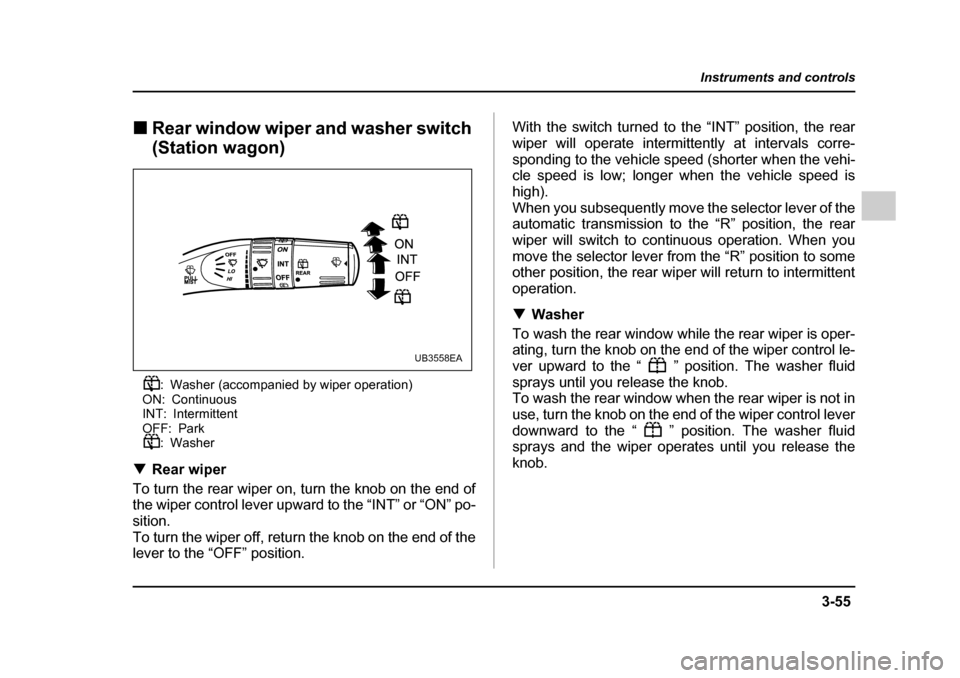
!Rear window wiper and washer switch
(Station wagon)
: Washer (accompanied by wiper operation)
ON: Continuous
INT: Intermittent
OFF: Park : Washer
! Rear wiper
To turn the rear wiper on, turn the knob on the end of
the wiper control lever upward to the “INT” or “ON” po- sition.
To turn the wiper off, return the knob on the end of the
lever to the “OFF” position. With the switch turned to the “INT” position, the rear
wiper will operate intermittently at intervals corre-
sponding to the vehicle speed (shorter when the vehi-
cle speed is low; longer when the vehicle speed is
high).
When you subsequently move the selector lever of the
automatic transmission to the “R” position, the rear
wiper will switch to continuous operation. When you
move the selector lever from the “R” position to some
other position, the rear wiper will return to intermittent
operation. !
Washer
To wash the rear window while the rear wiper is oper-
ating, turn the knob on the end of the wiper control le-
ver upward to the “ ” position. The washer fluid
sprays until you release the knob.
To wash the rear window when the rear wiper is not in
use, turn the knob on the end of the wiper control lever
downward to the “ ” position. The washer fluid
sprays and the wiper operates until you release the
knob.
UB3558EA
Page 371 of 627
7-16
Starting and operating
Automatic transmission – 4 speed
The automatic transmission is electronically controlled
and provides 4 forward speeds and 1 reverse speed.
Also, it has a manual mode and a SPORT mode.
Do not shift from the “P” or “N” position into
the “D” or “R” position while depressing the ac-
celerator pedal. This may cause the vehicle to
jump forward or backward.
"
Shift into the “P” or “R” position only after
the vehicle is completely stopped. Shifting
while the vehicle is moving may cause damage
to the transmission. " Do not race the engine for more than five sec-
onds in any position except the “N” or “P” po-
sition when the brake is set or when wheels are
used blocks. This may cause the automatic
transmission fluid to overheat." Avoid shifting from one of the forward driving
positions into the “R” position or vice versa un- til the vehicle has completely stopped. Such
shifting may cause damage to the transmis-
sion.
NOTE
Immediately after ATF (automatic transmission
fluid) is replaced, you may feel that the automatic
transmission operation is somewhat unusual.
This results from invalidation of data which the
on-board computer has collected and stored inmemory to allow the transmission to shift at the
most appropriate times for the current condition
of your vehicle. Optimized shifting will be restored
as the vehicle continues to be driven for a while.
Page 373 of 627
7-18
Starting and operating
the selector lever to the “P” position.
Do not drive the vehicle with the selector lever
in the “N” (neutral) position. Engine braking
has no effect in this condition and the risk of an
accident is consequently increased.
! D (Drive)
This position is for normal driving.
The transmission automatically shifts into a suitable
gear from 1st to 4th according to the vehicle speed
and the acceleration you require.
When more acceleration is required in this position,
press the accelerator pedal fully to the floor and hold
that position. The transmission will automatically
downshift to 3rd, 2nd or 1st gear. When you release
the pedal, the transmission will return to the original
gear position.
To use the “SPORT” mode, move the lever from this
position into the manual gate.
To use the manual mode, move the lever from this po-
sition into the manual gate then move it toward the “+”
and “–” ends. "
While climbing a grade
When driving up a hill, undesired upshift to 4th gear is
prevented from taking place when the accelerator is
released. This minimizes the chance of subsequent
downshifting to a lower gear when accelerating again.
This prevents repeated upshifting and downshifting re-
sulting in a smoother operation of the vehicle.
NOTE
The transmission may downshift to 2nd or 1st
gear, depending on the way the accelerator pedal
is pressed to accelerate the vehicle again. " While going down a hill
When descending a steep hill, depressing the brake
pedal will cause the transmission to downshift to 3rd or
2nd gear, thus applying engine braking. Reaccelera-
tion for a short time will cause the transmission to up-shift normally.
NOTE
In some cases, depressing the brake pedal on a
downhill grade does not result in an automatic
downshift to 3rd or 2nd gear. This can happen
when the automatic transmission fluid tempera-
ture is very low, for example, during driving short-
ly after the vehicle has been parked for an extend-
ed period of time. When the ATF temperature has
Page 376 of 627
7-21
Starting and operating
– CONTINUED –
goes off.
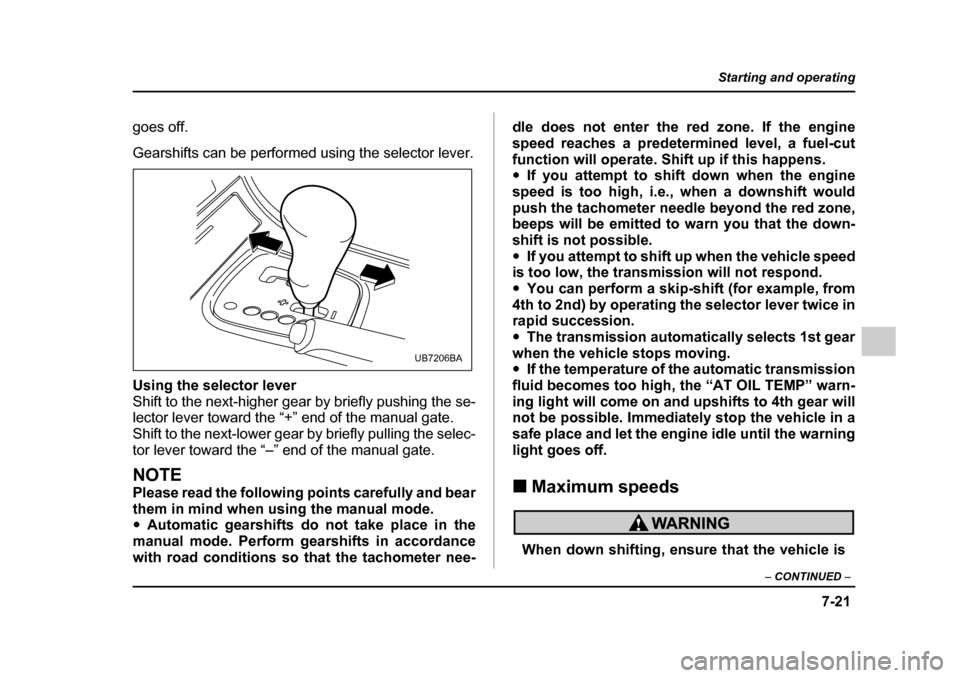
Gearshifts can be performed using the selector lever.
Using the selector lever
Shift to the next-higher gear by briefly pushing the se-
lector lever toward the “+” end of the manual gate.
Shift to the next-lower gear by briefly pulling the selec-
tor lever toward the “–” end of the manual gate.
NOTE
Please read the following points carefully and bear
them in mind when using the manual mode. "Automatic gearshifts do not take place in the
manual mode. Perform gearshifts in accordance
with road conditions so that the tachometer nee- dle does not enter the red zone. If the engine
speed reaches a predetermined level, a fuel-cut
function will operate. Shift up if this happens. "
If you attempt to shift down when the engine
speed is too high, i.e., when a downshift would
push the tachometer needle beyond the red zone,
beeps will be emitted to warn you that the down-
shift is not possible." If you attempt to shift up when the vehicle speed
is too low, the transmission will not respond." You can perform a skip-shift (for example, from
4th to 2nd) by operating the selector lever twice in
rapid succession. " The transmission automatically selects 1st gear
when the vehicle stops moving. " If the temperature of the automatic transmission
fluid becomes too high, the “AT OIL TEMP” warn-
ing light will come on and upshifts to 4th gear will
not be possible. Immediately stop the vehicle in a
safe place and let the engine idle until the warning
light goes off. ! Maximum speeds
When down shifting, ensure that the vehicle is
UB7206BA
Page 380 of 627
7-25
Starting and operating
– CONTINUED –
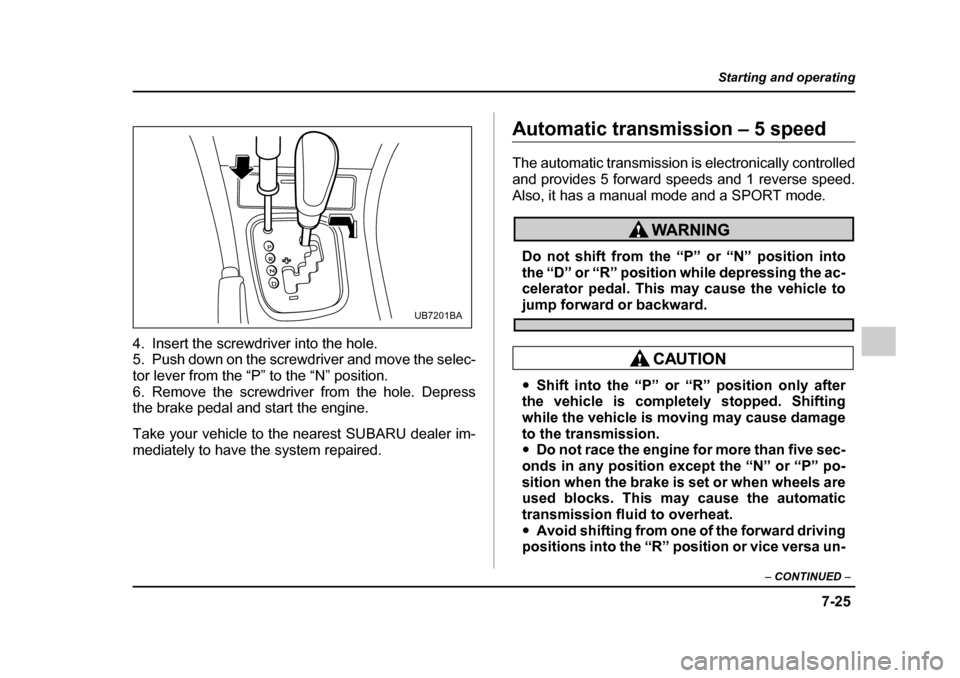
4. Insert the screwdriver into the hole.
5. Push down on the screwdriver and move the selec-
tor lever from the “P” to the “N” position.
6. Remove the screwdriver from the hole. Depress
the brake pedal and start the engine.
Take your vehicle to the nearest SUBARU dealer im-
mediately to have the system repaired.
Automatic transmission – 5 speed
The automatic transmission is electronically controlled
and provides 5 forward speeds and 1 reverse speed.
Also, it has a manual mode and a SPORT mode.
Do not shift from the “P” or “N” position into
the “D” or “R” position while depressing the ac-
celerator pedal. This may cause the vehicle to
jump forward or backward.
"Shift into the “P” or “R” position only after
the vehicle is completely stopped. Shifting
while the vehicle is moving may cause damage
to the transmission. " Do not race the engine for more than five sec-
onds in any position except the “N” or “P” po-
sition when the brake is set or when wheels are
used blocks. This may cause the automatic
transmission fluid to overheat." Avoid shifting from one of the forward driving
positions into the “R” position or vice versa un-
UB7201BA
Page 381 of 627
7-26
Starting and operating
til the vehicle has completely stopped. Such
shifting may cause damage to the transmis-
sion.
NOTE
Immediately after ATF (automatic transmission
fluid) is replaced, you may feel that the automatic
transmission operation is somewhat unusual.
This results from invalidation of data which the
on-board computer has collected and stored inmemory to allow the transmission to shift at the
most appropriate times for the current condition
of your vehicle. Optimized shifting will be restored
as the vehicle continues to be driven for a while.
!
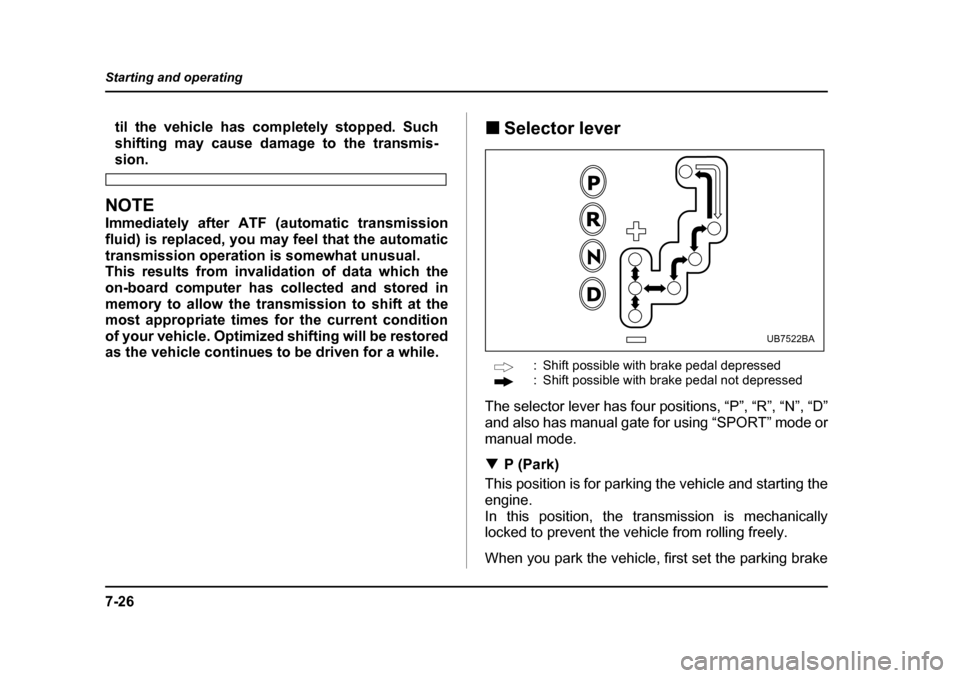
Selector lever
: Shift possible with brake pedal depressed
: Shift possible with brake pedal not depressed
The selector lever has four positions, “P”, “R”, “N”, “D”
and also has manual gate for using “SPORT” mode or manual mode. ! P (Park)
This position is for parking the vehicle and starting the
engine.
In this position, the transmission is mechanically
locked to prevent the vehicle from rolling freely.
When you park the vehicle, first set the parking brake
UB7522BA
Page 383 of 627
7-28
Starting and operating
When more acceleration is required in this position,
press the accelerator pedal fully to the floor and hold
that position. The transmission will automatically
downshift to 4th, 3rd, 2nd or 1st gear. When you re-
lease the pedal, the transmission will return to the orig-
inal gear position.
To use the SPORT mode, move the lever from this po-
sition into the manual gate.
To use the manual mode, move the lever from this po-
sition into the manual gate then move it toward the “+”
and “–” ends. "
While climbing a grade
When driving up a hill, undesired upshift to 4th or 5th
gear is prevented from taking place when the acceler-
ator is released. This minimizes the chance of subse-
quent downshifting to a lower gear when accelerating
again. This prevents repeated upshifting and down-
shifting resulting in a smoother operation of the vehi-cle.
NOTE
The transmission may downshift to 2nd or 1st
gear, depending on the way the accelerator pedal
is pressed to accelerate the vehicle again. " While going down a hill
When descending a steep hill, depressing the brake pedal will cause the transmission to downshift to 4th or
3rd gear, thus applying engine braking. Reaccelera-
tion for a short time will cause the transmission to up- shift normally.
NOTE
In some cases, depressing the brake pedal on a
downhill grade does not result in an automatic
downshift to 4th or 3rd gear. This can happen
when the automatic transmission fluid tempera-
ture is very low, for example, during driving short-
ly after the vehicle has been parked for an extend-
ed period of time. When the ATF temperature has
risen to a certain level, automatic downshift nor-
mally takes place. In the meantime, downshift
manually for engine braking as required.
Also, downshifting when braking downhill will not
occur at speeds above approximately 50 mph (80
km/h). !
Selector lever reverse inhibiting func- tion
This function prevents accidental movement of the se-
lector lever to the “R” position while the vehicle is mov-
ing.
The function becomes operational when the vehicle
reaches a speed of approximately 6 mph (10 km/h).
Page 387 of 627
7-32
Starting and operating
If you subsequently ease off the accelerator pedal and
then accelerate again, the transmission will automati-
cally switch back from manual mode to normal mode.
NOTE
Please read the following points carefully and bear
them in mind when using the manual mode. "
When the temperature of the automatic trans-
mission fluid is higher than normal, warning
beeps are emitted and the shift position indicator
shows “–”. If these warnings are issued, deselect
the manual mode to protect the automatic trans-
mission from damage. " When the temperature of the engine oil is higher
than normal, warning beeps are emitted and the
shift position indicator shows “–”. If these warn-
ings are issued, deselect the manual mode to pro-
tect the engine from damage. (3.0-liter models
only) " Automatic gearshifts do not take place in the
manual mode. Perform gearshifts in accordance
with road conditions so that the tachometer nee-
dle does not enter the red zone. If the engine
speed reaches a predetermined level, a fuel-cut
function will operate. Shift up if this happens. " If you attempt to shift down when the engine
speed is too high, i.e., when a downshift would
push the tachometer needle beyond the red zone, beeps will be emitted to warn you that the down-
shift is not possible."
If you attempt to shift up when the vehicle speed
is too low, the transmission will not respond." You can perform a skip-shift (for example, from
4th to 2nd) by operating the selector lever or a
steering-wheel switch twice in rapid succession. " The transmission automatically selects 1st gear
when the vehicle stops moving. " If the temperature of the automatic transmission
fluid becomes too high, the “AT OIL TEMP” warn-
ing light will come on and upshifts to 5th gear will
not be possible. Immediately stop the vehicle in a
safe place and let the engine idle until the warning
light goes off. ! Maximum speeds
When down shifting, ensure that the vehicle is
not travelling at a speed exceeding the Maxi-
mum Allowable Speed for the gear which is
about to be selected. Failure to observe this
precaution can lead to engine over-revving and
this in turn can result in engine damage.
In addition, sudden application of engine brak-
Page 455 of 627
8-42
Driving tips
!
Driving on grades
" Before going down a steep hill, slow down and shift
into lower gear (if necessary, use 1st gear) in order to
utilize the engine braking effect and prevent overheat-
ing of your vehicle’s brakes. Do not make sudden
downshifts." When driving uphill in hot weather, the air condition-
er may turn off automatically to protect the engine from
overheating." When driving uphill in hot weather, pay attention to
the water temperature gauge pointer (for all vehicles)
and AT OIL TEMP warning light (for AT vehicles) since
the engine and transmission are relatively prone to
overheating under these conditions. If the water tem-
perature gauge pointer approaches the OVERHEAT
zone or the AT OIL TEMP warning light illuminates,
immediately switch off the air conditioner and stop the
vehicle at the nearest safe place. Refer to the “Engine
overheating” section in chapter 9, and “Warning and
indicator lights” section in chapter 3.
NOTE
With AT vehicles, the temperature of engine cool-
ant is less likely to rise to the OVERHEAT zone in
the “D” position than in the manual mode position. " If your vehicle has an automatic transmission, avoid
using the accelerator pedal to stay stationary on an uphill slope instead of using the parking brake or foot
brake. That may cause the transmission fluid to over-
heat. !
Parking on a grade
Always block the wheels under both vehicle and trailer
when parking. Apply the parking brake firmly. You
should not park on a hill or slope. But if parking on a
hill or slope cannot be avoided, you should take the
following steps:
1. Apply the brakes and hold the pedal down.
2. Have someone place wheel blocks under both the
vehicle and trailer wheels.
3. When the wheel blocks are in place, release the
regular brakes slowly until the blocks absorb the load.
4. Apply the regular brakes and then apply the park-
ing brake; slowly release the regular brakes.
5. Shift into 1st or reverse gear (manual transmission)
or “P” (automatic transmission) and shut off the en-
gine.