fuel cap SUBARU OUTBACK 2012 5.G User Guide
[x] Cancel search | Manufacturer: SUBARU, Model Year: 2012, Model line: OUTBACK, Model: SUBARU OUTBACK 2012 5.GPages: 474, PDF Size: 17.45 MB
Page 329 of 474
8-14Driving tips
side door pillar. It includes the total weight
of the driver and all passengers and their
belongings, any optional equipment such
as a trailer hitch, roof rack or bike carrier,
etc., and the tongue load of a trailer. &GVWR and GAWR (Gross
Vehicle Weight Rating and
Gross Axle Weight Rating)
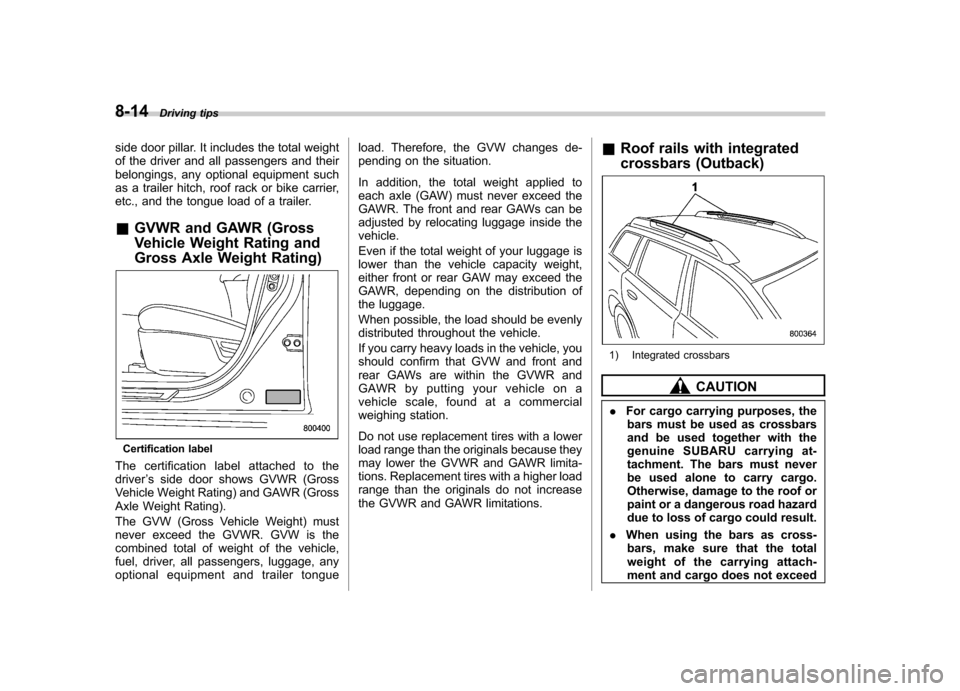
Certification label
The certification label attached to the driver ’s side door shows GVWR (Gross
Vehicle Weight Rating) and GAWR (Gross
Axle Weight Rating).
The GVW (Gross Vehicle Weight) must
never exceed the GVWR. GVW is the
combined total of weight of the vehicle,
fuel, driver, all passengers, luggage, any
optional equipment and trailer tongue load. Therefore, the GVW changes de-
pending on the situation.
In addition, the total weight applied to
each axle (GAW) must never exceed the
GAWR. The front and rear GAWs can be
adjusted by relocating luggage inside the vehicle.
Even if the total weight of your luggage is
lower than the vehicle capacity weight,
either front or rear GAW may exceed the
GAWR, depending on the distribution of
the luggage.
When possible, the load should be evenly
distributed throughout the vehicle.
If you carry heavy loads in the vehicle, you
should confirm that GVW and front and
rear GAWs are within the GVWR and
GAWR by putting your vehicle on a
vehicle scale, found at a commercial
weighing station.
Do not use replacement tires with a lower
load range than the originals because they
may lower the GVWR and GAWR limita-
tions. Replacement tires with a higher load
range than the originals do not increase
the GVWR and GAWR limitations.
&
Roof rails with integrated
crossbars (Outback)
1) Integrated crossbars
CAUTION
. For cargo carrying purposes, the
bars must be used as crossbars
and be used together with the
genuine SUBARU carrying at-
tachment. The bars must never
be used alone to carry cargo.
Otherwise, damage to the roof or
paint or a dangerous road hazard
due to loss of cargo could result.
. When using the bars as cross-
bars, make sure that the total
weight of the carrying attach-
ment and cargo does not exceed
Page 334 of 474
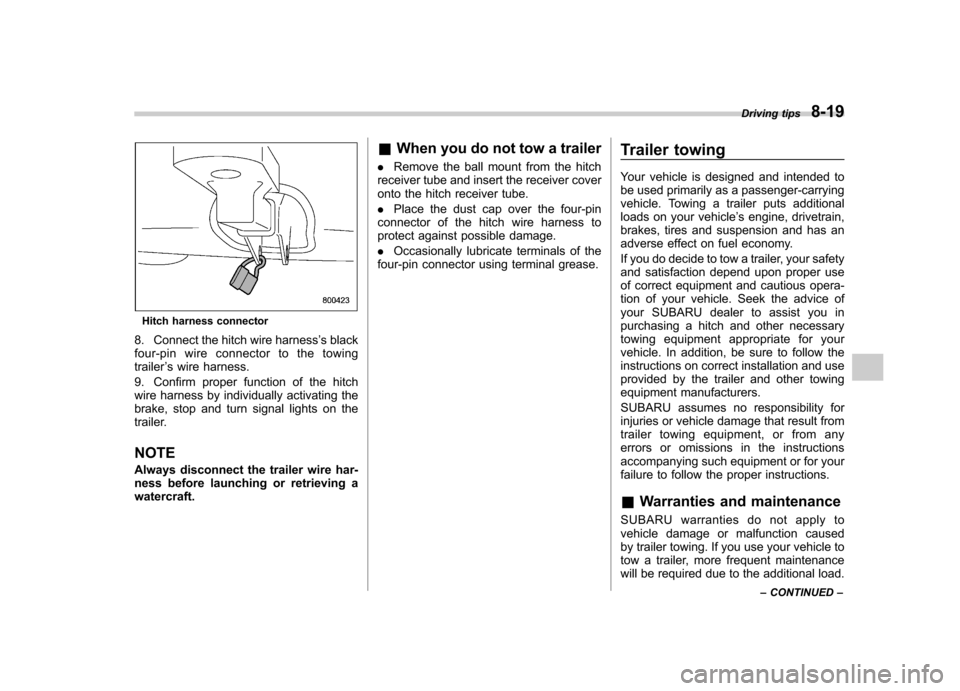
Hitch harness connector
8. Connect the hitch wire harness ’s black
four-pin wire connector to the towing trailer ’s wire harness.
9. Confirm proper function of the hitch
wire harness by individually activating the
brake, stop and turn signal lights on the
trailer. NOTE
Always disconnect the trailer wire har-
ness before launching or retrieving awatercraft. &
When you do not tow a trailer
. Remove the ball mount from the hitch
receiver tube and insert the receiver cover
onto the hitch receiver tube. . Place the dust cap over the four-pin
connector of the hitch wire harness to
protect against possible damage. . Occasionally lubricate terminals of the
four-pin connector using terminal grease. Trailer towing
Your vehicle is designed and intended to
be used primarily as a passenger-carrying
vehicle. Towing a trailer puts additional
loads on your vehicle
’s engine, drivetrain,
brakes, tires and suspension and has an
adverse effect on fuel economy.
If you do decide to tow a trailer, your safety
and satisfaction depend upon proper use
of correct equipment and cautious opera-
tion of your vehicle. Seek the advice of
your SUBARU dealer to assist you in
purchasing a hitch and other necessary
towing equipment appropriate for your
vehicle. In addition, be sure to follow the
instructions on correct installation and use
provided by the trailer and other towing
equipment manufacturers.
SUBARU assumes no responsibility for
injuries or vehicle damage that result from
trailer towing equipment, or from any
errors or omissions in the instructions
accompanying such equipment or for your
failure to follow the proper instructions.
& Warranties and maintenance
SUBARU warranties do not apply to
vehicle damage or malfunction caused
by trailer towing. If you use your vehicle to
tow a trailer, more frequent maintenance
will be required due to the additional load. Driving tips
8-19
– CONTINUED –
Page 387 of 474
11-16Maintenance and service
12. Start the engine and make sure that no
oil leaks appear around the filter ’s rubber
seal and drain plug.
13. Keep the engine idling until the engine
reaches the normal operating temperature
range, as indicated by the temperature
gauge on the combination meter. After
that, check the engine oil level again. For
further details about the check procedure,
refer to “Checking the oil level ”F 11-12.
& Recommended grade and viscosity
CAUTION
Use only engine oil with the recom-
mended grade and viscosity.
Refer to “Engine oil ”F 12-4.
NOTE
Engine oil viscosity (thickness) affects
fuel economy. Oils of lower viscosity
provide better fuel economy. However,
in hot weather, oil of higher viscosity is
required to properly lubricate the en- gine. & Synthetic oil
You should use synthetic engine oil that
meets the same requirements given for conventional engine oil. When using
synthetic oil, you must use oil of the same
classification, viscosity and grade shown
in this Owner
’s Manual. Refer to “Engine
oil ”F 12-4. Also, you must follow the oil
and filter changing intervals shown in the
Warranty and Maintenance booklet.
NOTE
Synthetic oil of the grade and viscosity
noted in chapter 12 is the recom-
mended engine oil for optimum engine
performance. Conventional oil may be
used if synthetic oil is unavailable. Cooling system
WARNING
Never attempt to remove the radia-
tor cap until the engine has been
shut off and has cooled down
completely. Since the coolant is
under pressure, you may suffer
serious burns from a spray of boil-
ing hot coolant when the cap isremoved.
CAUTION
. Vehicles are filled at the factory
with SUBARU Super Coolant that
does not require the first change
for 11 years/137,500 miles (11
years/220,000 km). This coolant
should not be mixed with any
other brand or type of coolant
during this period. Mixing with a
different coolant will reduce the
life of the coolant. Should it be
necessary to top off the coolant
for any reason, use only
SUBARU Super Coolant.
If the SUBARU Super Coolant is
diluted with another brand or
type, the maintenance interval is
Page 388 of 474
shortened to that of the mixing coolant.
. Do not splash the engine coolant
over painted parts. The alcohol
contained in the engine coolant
may damage the paint surface.
& Cooling fan, hose and con- nections
Your vehicle employs an electric cooling
fan which is thermostatically controlled to
operate when the engine coolant reaches
a specific temperature.
If the radiator cooling fan does not operate
even when the coolant temperature high
warning light illuminates, the cooling fan
circuit may be defective. Check the fuse
and replace it if necessary. Refer to“ Fuses ”F 11-44 and “Fuses and circuits ”
F 12-10. If the fuse is not blown, have the
cooling system checked by your SUBARU
dealer.
If frequent addition of coolant is neces-
sary, there may be a leak in the engine
cooling system. It is recommended that
the cooling system and connections be
checked for leaks, damage, or looseness. &
Engine coolant
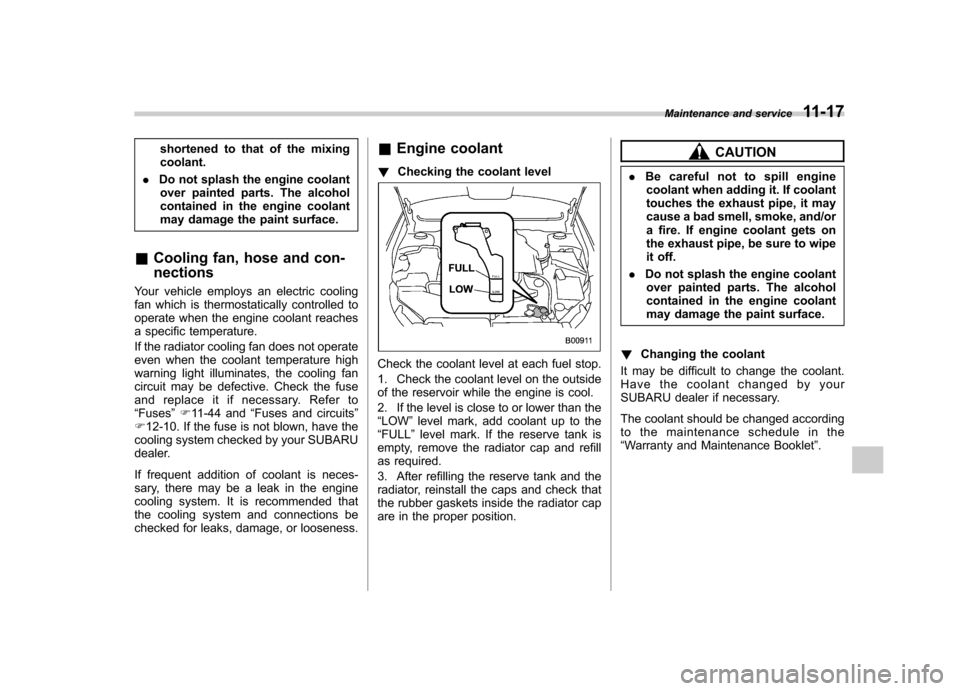
! Checking the coolant level
Check the coolant level at each fuel stop.
1. Check the coolant level on the outside
of the reservoir while the engine is cool.
2. If the level is close to or lower than the “LOW ”level mark, add coolant up to the
“ FULL ”level mark. If the reserve tank is
empty, remove the radiator cap and refill
as required.
3. After refilling the reserve tank and the
radiator, reinstall the caps and check that
the rubber gaskets inside the radiator cap
are in the proper position.
CAUTION
. Be careful not to spill engine
coolant when adding it. If coolant
touches the exhaust pipe, it may
cause a bad smell, smoke, and/or
a fire. If engine coolant gets on
the exhaust pipe, be sure to wipe
it off.
. Do not splash the engine coolant
over painted parts. The alcohol
contained in the engine coolant
may damage the paint surface.
! Changing the coolant
It may be difficult to change the coolant.
Have the coolant changed by your
SUBARU dealer if necessary.
The coolant should be changed according
to the maintenance schedule in the“ Warranty and Maintenance Booklet ”.
Maintenance and service
11-17
Page 430 of 474

&Engine
Engine model EJ253
(2.5 L, SOHC, non-turbo) EJ255
(2.5 L, DOHC, turbo) EZ36D
(3.6 L, DOHC, non-turbo)
Engine type Horizontally opposed, liquid cooled 4 cylinder,
4 stroke gasoline engine Horizontally opposed, liquid cooled 6 cylinder,
4 stroke gasoline engine
Displacement cu-in (cc) 149.9 (2,457) 221.5 (3,630)
Bore 6Stroke in (mm) 3.92 63.11 (99.5 679.0) 3.62 63.58 (92.0 691.0)
Compression ratio 10.0 : 1 8.4 : 1 10.5 : 1
Firing order 1– 3–2 – 4 1
–6– 3–2– 5–4
& Fuel
Vehicle model Fuel requirementFuel tank capacity
Non-turbo models Unleaded gasoline with 87 AKI (90 RON) or higher
18.5 US gal (70 liters, 15.4 Imp gal)
Turbo models Premium unleaded gasoline with 93 AKI (98 RON) or higher*
1
*1: If 93 AKI (98 RON) fuel is not available, refer to “Fuel requirements ”F 7-2. Specifications
12-3
– CONTINUED –
Page 451 of 474

13-6Consumer information and Reporting safety defects
rubber compounds. . Cracking
Any parting within the tread, side-
wall, or inner liner of the tire
extending to cord material. . Curb weight
The weight of a motor vehicle with
standard equipment including the
maximum capacity of fuel, oil and
coolant, and if so equipped, air
conditioning and additional weight
optional engine. . Extra load tire
A tire designed to operate at higher
loads and higher inflation pressure
than the corresponding standardtire. . Groove
The space between two adjacent
tread ribs.. Innerliner
The layer(s) forming the inside sur-
face of a tubeless tire that contains
the inflating medium within the tire.. Innerliner separation
The parting of the innerliner from
cord material in the carcass. .
Intended outboard sidewall
(1) The sidewall that contains a
whitewall, bears white lettering
or bears manufacturer, brand,
and/or model name molding that
is higher or deeper than the
same molding on the other side-
wall of the tire, or (2) The outward facing sidewall
of an asymmetrical tire that has
a particular side that must al-
ways face outward when mount-
ing on a vehicle.
. Light truck (LT) tire
A tire designated by its manufac-
turer as primarily intended for use
on lightweight trucks or multipur-
pose passenger vehicles. . Load rating
The maximum load that a tire is
rated to carry for a given inflation pressure. . Maximum inflation pressure
The maximum cold inflation pres-
sure to which a tire may be inflated.. Maximum load rating
The load rating for a tire at the maximum permissible inflation
pressure for that tire. .
Maximum loaded vehicle weight
The sum of: (a) Curb weight
(b) Accessory weight
(c) Vehicle capacity weight
(d) Production options weight
. Maximum permissible inflation
pressure
The maximum cold inflation pres-
sure to which a tire may be inflated.. Measuring rim
The rim on which a tire is fitted for
physical dimension requirements.. Normal occupant weight
150 lbs (68 kg) times the number of
occupants specified in the second
column of Table 1 that is appended
to the end of this section. . Occupant distribution
Distribution of occupants in a vehi-
cle as specified in the third column
of Table 1 that is appended to the
end of this section. . Open splice
Any parting at any junction of tread,
Page 466 of 474

Warning........................................................ 3-18, 7-34
Emergency Locking Retractor (ELR) ............................. 1-13
Engine
Compartment overview ........................................... 11-9
Coolant ........................................................ 11-17, 12-8
Exhaust gas (carbon monoxide) ............................. 6, 8-2
Hood .................................................................... 11-7
Low oil level warning light ....................................... 3-14
Oil............................................................... 11-12, 12-4 Overheating .......................................................... 9-13
Starting ................................................................... 7-8
Stopping ............................................................... 7-10
Exterior care .............................................................. 10-2
F
Flat tires ..................................................................... 9-6
Floor mat .................................................................. 6-14
Fluid level Automatic transmission .......................................... 11-21
Brake .................................................................. 11-25
Clutch .................................................................. 11-26
Power steering ..................................................... 11-24
Fog light
Bulb .................................................................... 11-48
Indicator light ......................................................... 3-23
Switch .................................................................. 3-30
Folding mirror switch .................................................. 3-51
Front Differential gear oil ........................................ 11-23, 12-7
Fog light ...................................................... 3-30, 11-48
Fog light indicator light ............................................ 3-23 Position light
........................................................ 11-48
Seatbelt pretensioners ............................................ 1-21
Turn signal light .................................................... 11-48
Front fog light ........................................................... 11-48
Front seats ................................................................. 1-2
Forward and backward adjustment ............................ 1-3
Head restraint adjustment ......................................... 1-6
Power seat ............................................................. 1-4
Reclining ................................................................ 1-3
Seat height adjustment (driver ’s seat) ........................ 1-4
Fuel ........................................................................... 7-2
Economy hints ........................................................ 8-2
Filler lid and cap ...................................................... 7-3
Gauge .................................................................... 3-7
Requirements ................................................. 7-2, 12-3
Fuses ..................................................................... 11-44
Fuses and circuits .................................................... 12-10
G
GAWR (Gross Axle Weight Rating) .. ............................. 8-14
Glove box ................................................................... 6-6
GVWR (Gross Vehicle Weight Rating) ........................... 8-14
H
Hands-free system. ..................................................... 5-49
Hazard warning flasher .......................................... 3-5, 9-2
Head restraint adjustment Front seat ............................................................... 1-6
Rear seat .............................................................. 1-10
Headlight ......................................................... 3-27, 11-45
Bulb wattage ........................................................ 12-14 Index
14-5
Page 472 of 474

V
Valet mode................................................................ 2-18
Vanity mirror ...................................................... 6-5, 11-54
Light .................................................................... 11-54
Vehicle Capacity weight ..................................................... 8-13
Identification ........................................................ 12-17
Symbols .................................................................... 3
Vehicle Dynamics Control
OFF indicator light .................................................. 3-21
OFF switch ........................................................... 7-28
Operation indicator light .......................................... 3-20
System ................................................................. 7-26
Warning light ......................................................... 3-20
W
Warning and indicator lights .......................................... 3-9
Warning chimes Seatbelt .................................................................. 3-9
Warning light ABS ..................................................................... 3-16
All-Wheel Drive ...................................................... 3-20
AT OIL TEMP ........................................................ 3-14
Brake system ........................................................ 3-17
Charge ................................................................. 3-14
CHECK ENGINE ................................................... 3-12
Coolant temperature high ........................................ 3-13
Engine low oil level ................................................ 3-14
Low fuel ................................................................ 3-19
Low tire pressure ................................................... 3-15
Oil pressure .......................................................... 3-14 Seatbelt.
................................................................. 3-9
SRS airbag system ................................................. 3-11
Vehicle Dynamics Control ........................................ 3-20
Windshield washer fluid ........................................... 3-19
Warranties ..................................................................... 1
Warranties and maintenance ........................................ 8-19
Washing .................................................................... 10-2
Waxing and polishing .................................................. 10-3
Wear indicators ........................................................ 11-35
Wheel Aluminum ............................................................ 11-37
Balance ............................................................... 11-34
Nut tightening torque ........................................ 9-6, 12-9
Replacement. ....................................................... 11-37
Windows ................................................................... 2-20
Windshield
Washer fluid. ........................................................ 11-37
Wiper and washer switches ..................................... 3-32
Wiper blades ........................................................ 11-39
Wiper deicer .......................................................... 3-34
Winter Driving ................................................................... 8-8
Tires ........................................................... 8-11, 11-30
Wiper and washer ...................................................... 3-30
Wiper deicer .............................................................. 3-34 Index
14-11
Page 474 of 474

GAS STATION REFERENCE
& Fuel:
! Non-turbo models
Use only unleaded gasoline with an octane rating of 87 AKI (90
RON) or higher .
! Turbo models
Use premium unleaded gasoline with an octane rating of 93
AKI (98 RON) or higher .
If 93 AKI (98 RON) fuel is not readily available in your area,
refer to “Fuel requirements ”F 7-2.
& Fuel octane rating
This octane rating is the average of the Research Octane and
Motor Octane numbers and is commonly referred to as the Anti
Knock Index (AKI). Refer to “Fuel ”F 7-2.
& Fuel capacity:
18.5 US gal (70 liters, 15.4 Imp gal) &
Engine oil:
Use only the following oils.. API classification SM or SN with the words “ENERGY
CONSERVING ”or “RESOURCE CONSERVING ”
. or ILSAC GF-4 or GF-5, which can be identified with the
ILSAC certification mark (Starburst mark)
For the complete viscosity requirements, refer to “Engine oil ”
F 12-4.
& Engine oil capacity:
2.5 L non-turbo models: 4.4 US qt (4.2 liters, 3.7 Imp qt)
2.5 L turbo models: 4.5 US qt (4.3 liters, 3.8 Imp qt)
3.6 L models: 6.9 US qt (6.5 liters, 5.7 Imp qt)
The indicated oil quantity is only a guideline and is estimated
based on a case when the engine oil is changed with an oil
filter. After refilling the engine with oil, the oil level should be
checked using an oil level gauge. For more details about
maintenance and service, refer to “Engine oil ”F 11-12.
& Cold tire pressure:
Refer to “Tires ”F 12-9.