SPEED SUZUKI GRAND VITARA 2012 Workshop Manual
[x] Cancel search | Manufacturer: SUZUKI, Model Year: 2012, Model line: GRAND VITARA, Model: SUZUKI GRAND VITARA 2012Pages: 337, PDF Size: 6.21 MB
Page 244 of 337
6-7VEHICLE LOADING AND TOWING
79K21-03E
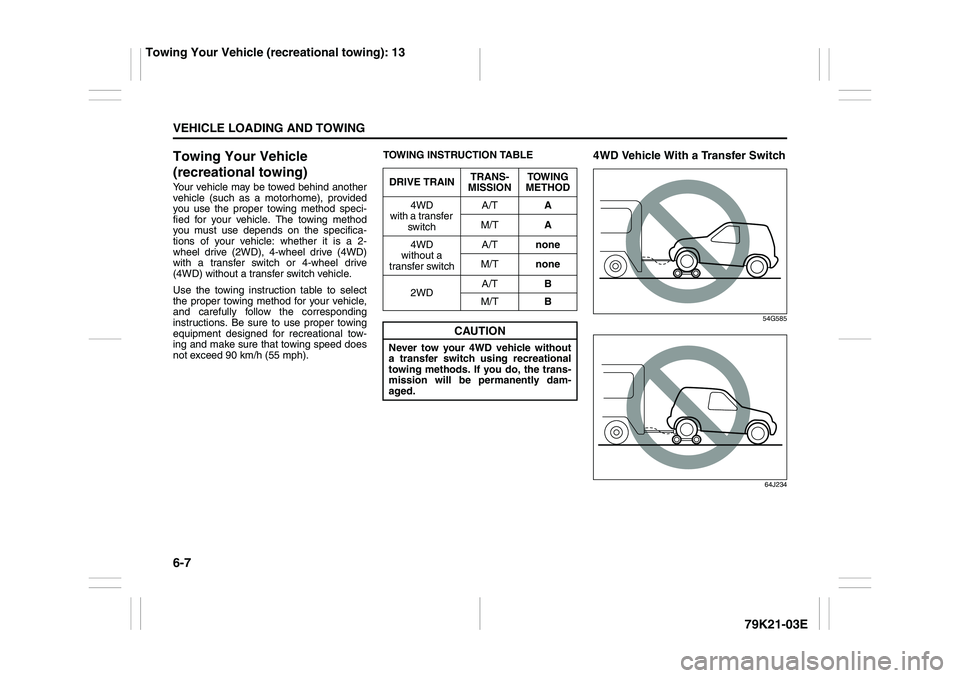
Towing Your Vehicle
(recreational towing)Your vehicle may be towed behind another
vehicle (such as a motorhome), provided
you use the proper towing method speci-
fied for your vehicle. The towing method
you must use depends on the specifica-
tions of your vehicle: whether it is a 2-
wheel drive (2WD), 4-wheel drive (4WD)
with a transfer switch or 4-wheel drive
(4WD) without a transfer switch vehicle.
Use the towing instruction table to select
the proper towing method for your vehicle,
and carefully follow the corresponding
instructions. Be sure to use proper towing
equipment designed for recreational tow-
ing and make sure that towing speed does
not exceed 90 km/h (55 mph).TOWING INSTRUCTION TABLE
4WD Vehicle With a Transfer Switch
54G585
64J234
DRIVE TRAINTRANS-
MISSIONTOWING
METHOD
4WD
with a transfer
switchA/TA
M/TA
4WD
without a
transfer switchA/Tnone
M/Tnone
2WDA/TB
M/TB
CAUTION
Never tow your 4WD vehicle without
a transfer switch using recreational
towing methods. If you do, the trans-
mission will be permanently dam-
aged.
Towing Your Vehicle (recreational towing): 13
Page 245 of 337
6-8
VEHICLE LOADING AND TOWING
79K21-03E
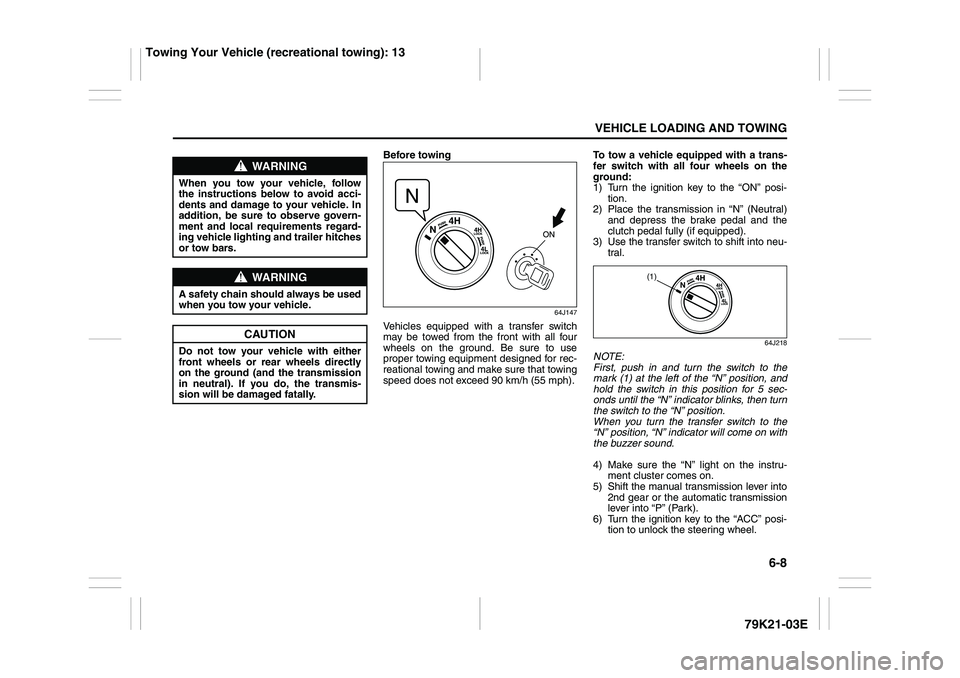
Before towing
64J147
Vehicles equipped with a transfer switch
may be towed from the front with all four
wheels on the ground. Be sure to use
proper towing equipment designed for rec-
reational towing and make sure that towing
speed does not exceed 90 km/h (55 mph).To tow a vehicle equipped with a trans-
fer switch with all four wheels on the
ground:
1) Turn the ignition key to the “ON” posi-
tion.
2) Place the transmission in “N” (Neutral)
and depress the brake pedal and the
clutch pedal fully (if equipped).
3) Use the transfer switch to shift into neu-
tral.
64J218
NOTE:
First, push in and turn the switch to the
mark (1) at the left of the “N” position, and
hold the switch in this position for 5 sec-
onds until the “N” indicator blinks, then turn
the switch to the “N” position.
When you turn the transfer switch to the
“N” position, “N” indicator will come on with
the buzzer sound.
4) Make sure the “N” light on the instru-
ment cluster comes on.
5) Shift the manual transmission lever into
2nd gear or the automatic transmission
lever into “P” (Park).
6) Turn the ignition key to the “ACC” posi-
tion to unlock the steering wheel.
WARNING
When you tow your vehicle, follow
the instructions below to avoid acci-
dents and damage to your vehicle. In
addition, be sure to observe govern-
ment and local requirements regard-
ing vehicle lighting and trailer hitches
or tow bars.
WARNING
A safety chain should always be used
when you tow your vehicle.
CAUTION
Do not tow your vehicle with either
front wheels or rear wheels directly
on the ground (and the transmission
in neutral). If you do, the transmis-
sion will be damaged fatally.
(1)
Towing Your Vehicle (recreational towing): 13
Page 254 of 337
7-5INSPECTION AND MAINTENANCE
79K21-03E
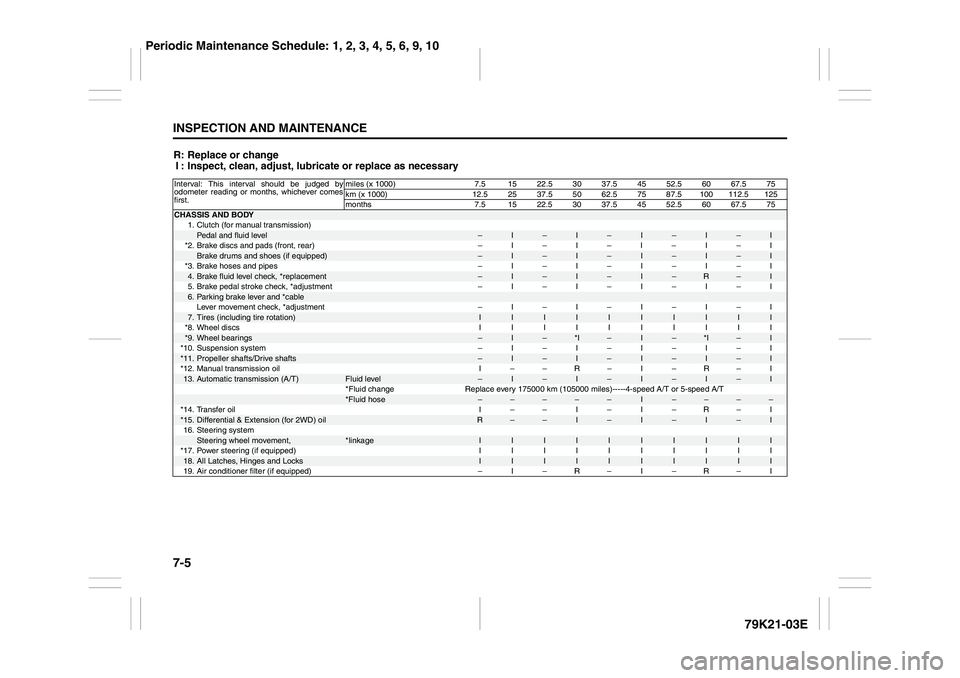
R: Replace or change
I : Inspect, clean, adjust, lubricate or replace as necessaryInterval: This interval should be judged by
odometer reading or months, whichever comes
first.miles (x 1000) 7.5 15 22.5 30 37.5 45 52.5 60 67.5 75
km (x 1000) 12.5 25 37.5 50 62.5 75 87.5 100 112.5 125
months 7.5 15 22.5 30 37.5 45 52.5 60 67.5 75CHASSIS AND BODY
1. Clutch (for manual transmission)
Pedal and fluid level
–
I
–
I
–
I
–
I
–
I
*2. Brake discs and pads (front, rear) – I – I – I – I – I
Brake drums and shoes (if equipped)
–
I
–
I
–
I
–
I
–
I
*3. Brake hoses and pipes – I – I – I – I – I
4.Brake fluid level check, *replacement
–
I
–
I
–
I
–
R
–
I
5. Brake pedal stroke check, *adjustment – I – I – I – I – I
6.Parking brake lever and *cableLever movement check, *adjustment – I – I – I – I – I7.Tires (including tire rotation)
I
I
I
I
I
I
I
I
I
I
*8. Wheel discs I I I I I I I I I I
*9.
Wheel bearings
–
I
–
*I
–
I
–
*I
–
I
*10. Suspension system – I – I – I – I – I
*11.
Propeller shafts/Drive shafts
–
I
–
I
–
I
–
I
–
I
*12. Manual transmission oil I – – R – I – R – I
13.
Automatic transmission (A/T)
Fluid level
–
I
–
I
–
I
–
I
–
I
*Fluid change Replace every 175000 km (105000 miles)-----4-speed A/T or 5-speed A/T
*Fluid hose
–
–
–
–
–
I
–
–
–
–
*14. Transfer oil I – – I – I – R – I
*15.
Differential & Extension (for 2WD) oil
R
–
–
I
–
I
–
I
–
I
16. Steering system
Steering wheel movement,
*linkage
I
I
I
I
I
I
I
I
I
I
*17. Power steering (if equipped) I I I I I I I I I I
18.
All Latches, Hinges and Locks
I
I
I
I
I
I
I
I
I
I
19. Air conditioner filter (if equipped) – I – R – I – R – I
Periodic Maintenance Schedule: 1, 2, 3, 4, 5, 6, 9, 10
Page 255 of 337
7-6
INSPECTION AND MAINTENANCE
79K21-03E
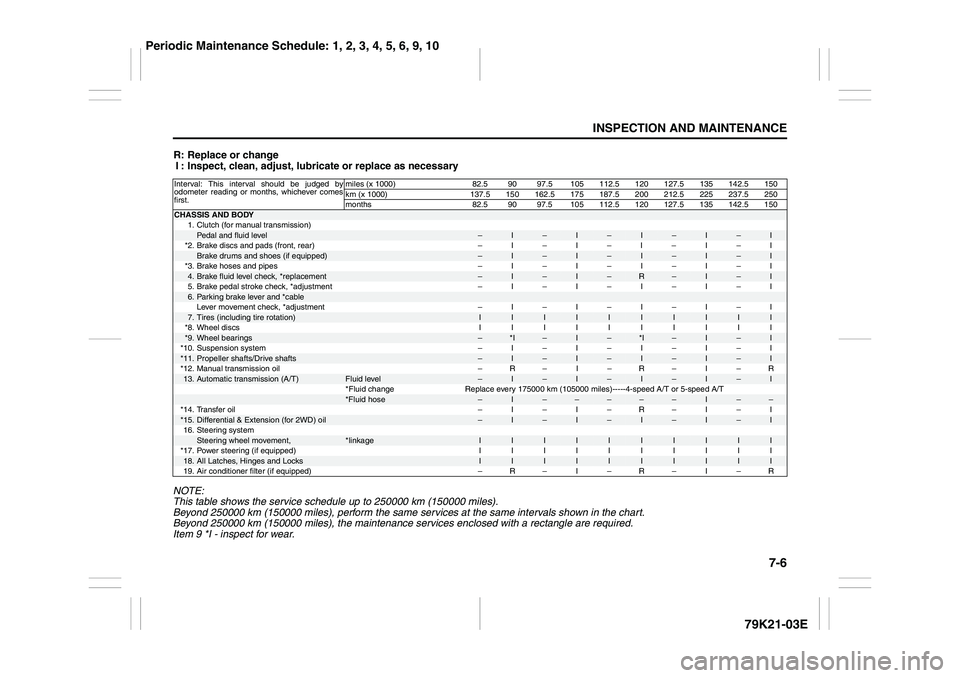
R: Replace or change
I : Inspect, clean, adjust, lubricate or replace as necessary
NOTE:
This table shows the service schedule up to 250000 km (150000 miles).
Beyond 250000 km (150000 miles), perform the same services at the same intervals shown in the chart.
Beyond 250000 km (150000 miles), the maintenance services enclosed with a rectangle are required.
Item 9 *I - inspect for wear.Interval: This interval should be judged by
odometer reading or months, whichever comes
first.miles (x 1000) 82.5 90 97.5 105 112.5 120 127.5 135 142.5 150
km (x 1000) 137.5 150 162.5 175 187.5 200 212.5 225 237.5 250
months 82.5 90 97.5 105 112.5 120 127.5 135 142.5 150CHASSIS AND BODY
1. Clutch (for manual transmission)
Pedal and fluid level
–
I
–
I
–
I
–
I
–
I
*2. Brake discs and pads (front, rear) – I – I – I – I – I
Brake drums and shoes (if equipped)
–
I
–
I
–
I
–
I
–
I
*3. Brake hoses and pipes – I – I – I – I – I
4.Brake fluid level check, *replacement
–
I
–
I
–
R
–
I
–
I
5. Brake pedal stroke check, *adjustment – I – I – I – I – I
6.Parking brake lever and *cableLever movement check, *adjustment – I – I – I – I – I7.Tires (including tire rotation)
I
I
I
I
I
I
I
I
I
I
*8. Wheel discs I I I I I I I I I I
*9.
Wheel bearings
–
*I
–
I
–
*I
–
I
–
I
*10. Suspension system – I – I – I – I – I
*11.
Propeller shafts/Drive shafts
–
I
–
I
–
I
–
I
–
I
*12. Manual transmission oil – R – I – R – I – R
13.
Automatic transmission (A/T)
Fluid level
–
I
–
I
–
I
–
I
–
I
*Fluid change Replace every 175000 km (105000 miles)-----4-speed A/T or 5-speed A/T
*Fluid hose
–
I
–
–
–
–
–
I
–
–
*14. Transfer oil – I – I – R – I – I
*15.
Differential & Extension (for 2WD) oil
–
I
–
I
–
I
–
I
–
I
16. Steering system
Steering wheel movement,
*linkage
I
I
I
I
I
I
I
I
I
I
*17. Power steering (if equipped) I I I I I I I I I I
18.
All Latches, Hinges and Locks
I
I
I
I
I
I
I
I
I
I
19. Air conditioner filter (if equipped) – R – I – R – I – R
Periodic Maintenance Schedule: 1, 2, 3, 4, 5, 6, 9, 10
Page 261 of 337
7-12
INSPECTION AND MAINTENANCE
79K21-03E
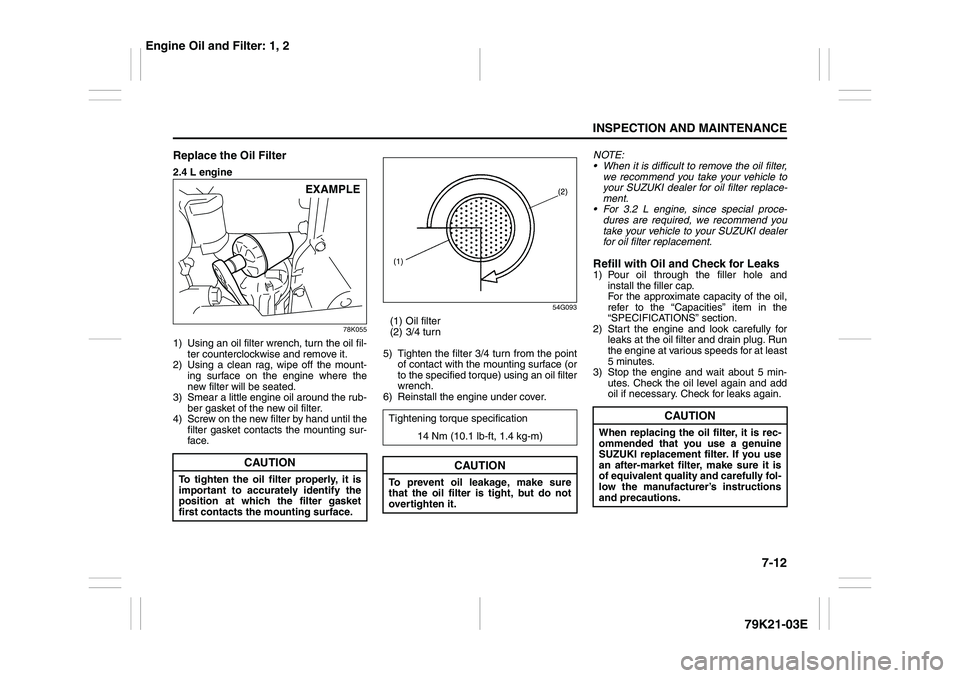
Replace the Oil Filter2.4 L engine
78K055
1) Using an oil filter wrench, turn the oil fil-
ter counterclockwise and remove it.
2) Using a clean rag, wipe off the mount-
ing surface on the engine where the
new filter will be seated.
3) Smear a little engine oil around the rub-
ber gasket of the new oil filter.
4) Screw on the new filter by hand until the
filter gasket contacts the mounting sur-
face.
54G093
(1) Oil filter
(2) 3/4 turn
5) Tighten the filter 3/4 turn from the point
of contact with the mounting surface (or
to the specified torque) using an oil filter
wrench.
6) Reinstall the engine under cover.NOTE:
When it is difficult to remove the oil filter,
we recommend you take your vehicle to
your SUZUKI dealer for oil filter replace-
ment.
For 3.2 L engine, since special proce-
dures are required, we recommend you
take your vehicle to your SUZUKI dealer
for oil filter replacement.
Refill with Oil and Check for Leaks1) Pour oil through the filler hole and
install the filler cap.
For the approximate capacity of the oil,
refer to the “Capacities” item in the
“SPECIFICATIONS” section.
2) Start the engine and look carefully for
leaks at the oil filter and drain plug. Run
the engine at various speeds for at least
5 minutes.
3) Stop the engine and wait about 5 min-
utes. Check the oil level again and add
oil if necessary. Check for leaks again.
CAUTION
To tighten the oil filter properly, it is
important to accurately identify the
position at which the filter gasket
first contacts the mounting surface.
EXAMPLE
Tightening torque specification
14 Nm (10.1 lb-ft, 1.4 kg-m)
CAUTION
To prevent oil leakage, make sure
that the oil filter is tight, but do not
overtighten it.
CAUTION
When replacing the oil filter, it is rec-
ommended that you use a genuine
SUZUKI replacement filter. If you use
an after-market filter, make sure it is
of equivalent quality and carefully fol-
low the manufacturer’s instructions
and precautions.
Engine Oil and Filter: 1, 2
Page 270 of 337
7-21INSPECTION AND MAINTENANCE
79K21-03E
NOTE:
Do not check the fluid level if you have just
driven the vehicle for a long time at high
speed, if you have driven in city traffic in
hot weather, or if the vehicle has been pull-
ing a trailer. Wait until the fluid cools down
(about 30 minutes), or the fluid level indica-
tion will not be correct.
3) Park your vehicle on level ground.
4) Apply the parking brake and then start
the engine in “P” (Park). Let it idle for
two minutes and keep it running during
the fluid level check.
5) With your foot on the brake pedal, move
the gearshift lever through each gear,
pausing for about three seconds in
each range. Then move it back to the
“P” (Park) position.
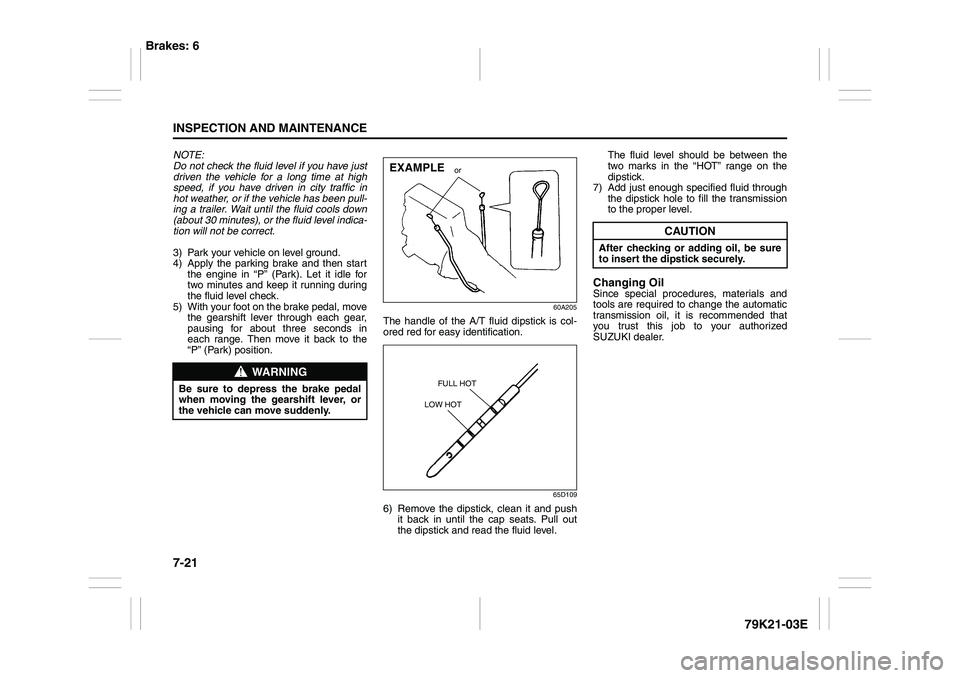
60A205
The handle of the A/T fluid dipstick is col-
ored red for easy identification.
65D109
6) Remove the dipstick, clean it and push
it back in until the cap seats. Pull out
the dipstick and read the fluid level. The fluid level should be between the
two marks in the “HOT” range on the
dipstick.
7) Add just enough specified fluid through
the dipstick hole to fill the transmission
to the proper level.
Changing OilSince special procedures, materials and
tools are required to change the automatic
transmission oil, it is recommended that
you trust this job to your authorized
SUZUKI dealer.
WARNING
Be sure to depress the brake pedal
when moving the gearshift lever, or
the vehicle can move suddenly.
EXAMPLE
or
FULL HOT
LOW HOT
CAUTION
After checking or adding oil, be sure
to insert the dipstick securely.
Brakes: 6
Page 274 of 337
7-25INSPECTION AND MAINTENANCE
79K21-03E
TiresFor safe operation of your vehicle, it is
important that the tires be the correct
type and size, in good condition, and
properly inflated. Be sure to follow the
requirements and recommendations in
this section.Tire Sidewall LabelingUseful information about a tire is
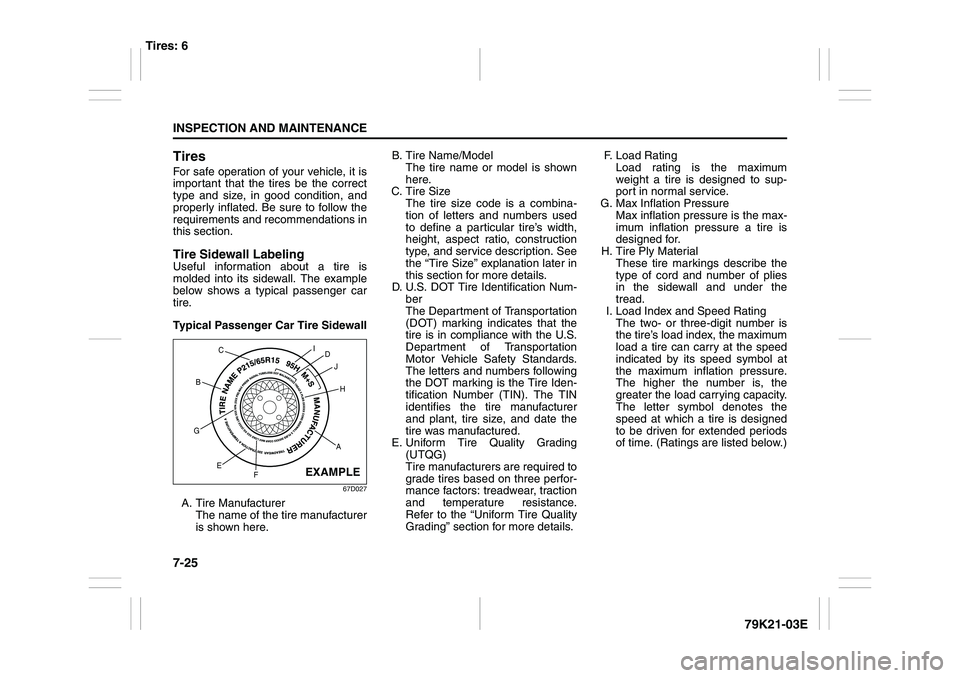
molded into its sidewall. The example
below shows a typical passenger car
tire.
Typical Passenger Car Tire Sidewall
67D027
A. Tire Manufacturer
The name of the tire manufacturer
is shown here.B. Tire Name/Model
The tire name or model is shown
here.
C. Tire Size
The tire size code is a combina-
tion of letters and numbers used
to define a particular tire’s width,
height, aspect ratio, construction
type, and service description. See
the “Tire Size” explanation later in
this section for more details.
D. U.S. DOT Tire Identification Num-
ber
The Department of Transportation
(DOT) marking indicates that the
tire is in compliance with the U.S.
Department of Transportation
Motor Vehicle Safety Standards.
The letters and numbers following
the DOT marking is the Tire Iden-
tification Number (TIN). The TIN
identifies the tire manufacturer
and plant, tire size, and date the
tire was manufactured.
E. Uniform Tire Quality Grading
(UTQG)
Tire manufacturers are required to
grade tires based on three perfor-
mance factors: treadwear, traction
and temperature resistance.
Refer to the “Uniform Tire Quality
Grading” section for more details.F. Load Rating
Load rating is the maximum
weight a tire is designed to sup-
port in normal service.
G. Max Inflation Pressure
Max inflation pressure is the max-
imum inflation pressure a tire is
designed for.
H. Tire Ply Material
These tire markings describe the
type of cord and number of plies
in the sidewall and under the
tread.
I. Load Index and Speed Rating
The two- or three-digit number is
the tire’s load index, the maximum
load a tire can carry at the speed
indicated by its speed symbol at
the maximum inflation pressure.
The higher the number is, the
greater the load carrying capacity.
The letter symbol denotes the
speed at which a tire is designed
to be driven for extended periods
of time. (Ratings are listed below.)
AH B
G
E
FD
J I
C
EXAMPLE
Tires: 6
Page 275 of 337
7-26
INSPECTION AND MAINTENANCE
79K21-03E
*The letters ZR may be used on tires
with a maximum speed capability over
149 mph and will always be used on
tires with a maximum speed capability
over 186 mph.
J. M+S Marking
This marking indicates the tire
has some mud and snow capabili-
ties and is designed for all-season
use.
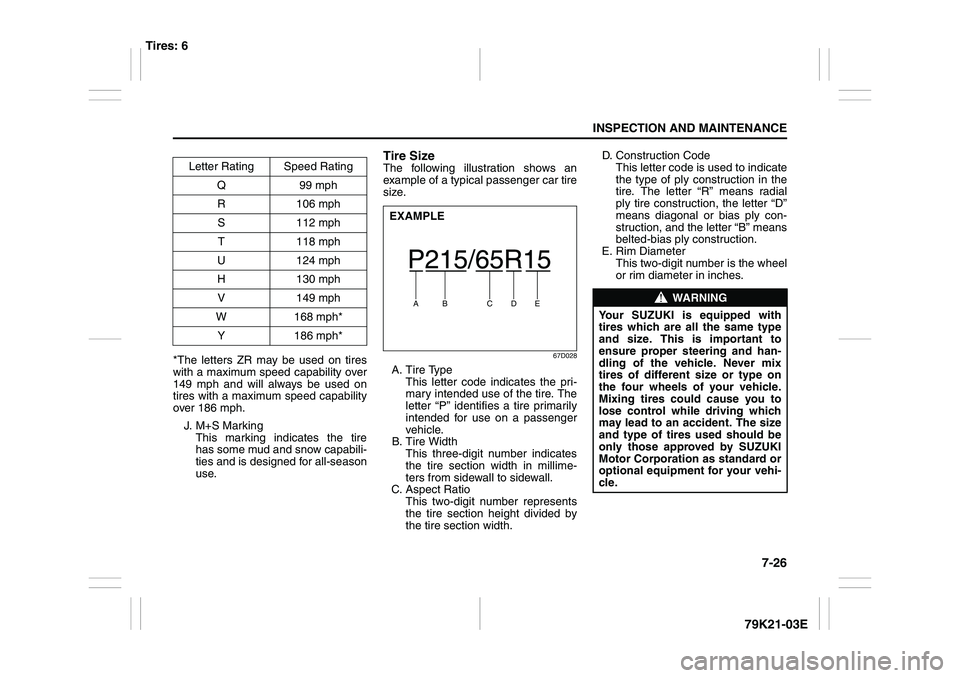
Tire SizeThe following illustration shows an
example of a typical passenger car tire
size.
67D028
A. Tire Type
This letter code indicates the pri-
mary intended use of the tire. The
letter “P” identifies a tire primarily
intended for use on a passenger
vehicle.
B. Tire Width
This three-digit number indicates
the tire section width in millime-
ters from sidewall to sidewall.
C. Aspect Ratio
This two-digit number represents
the tire section height divided by
the tire section width.D. Construction Code
This letter code is used to indicate
the type of ply construction in the
tire. The letter “R” means radial
ply tire construction, the letter “D”
means diagonal or bias ply con-
struction, and the letter “B” means
belted-bias ply construction.
E. Rim Diameter
This two-digit number is the wheel
or rim diameter in inches. Letter Rating Speed Rating
Q99 mph
R 106 mph
S 112 mph
T 118 mph
U 124 mph
H 130 mph
V 149 mph
W 168 mph*
Y 186 mph*
A
B
C
D
E
EXAMPLE
WARNING
Your SUZUKI is equipped with
tires which are all the same type
and size. This is important to
ensure proper steering and han-
dling of the vehicle. Never mix
tires of different size or type on
the four wheels of your vehicle.
Mixing tires could cause you to
lose control while driving which
may lead to an accident. The size
and type of tires used should be
only those approved by SUZUKI
Motor Corporation as standard or
optional equipment for your vehi-
cle.
Tires: 6
Page 278 of 337
7-29INSPECTION AND MAINTENANCE
79K21-03E
1.6 mm (0.06 in.) or less and the
tire should be replaced.
3) Check for abnormal wear, cracks
and damage. Any tires with cracks
or other damage should be
replaced. If any tires show abnor-
mal wear, have them inspected by
your SUZUKI dealer.
4) Check for loose wheel nuts.
5) Check that there are no nails,
stones or other objects sticking into
the tires.
WARNING
Hitting curbs and running over
rocks can damage tires and affect
wheel alignment. Be sure to have
tires and wheel alignment
checked periodically by your
SUZUKI dealer.
WARNING
Your SUZUKI is equipped with
tires which are all the same type
and size. This is important to
ensure proper steering and han-
dling of the vehicle. Never mix
tires of different size or type on
the four wheels of your vehicle.
The size and type of tires used
should be only those approved by
SUZUKI Motor Corporation as
standard or optional equipment
for your vehicle.
WARNING
Replacing the wheels and tires
equipped on your vehicle with
certain combinations of aftermar-
ket wheels and tires can signifi-
cantly change the steering and
handling characteristics of your
vehicle. Oversized tires may also
rub against the fender over
bumps, causing vehicle damage
or tire failure. Therefore, use only
those wheel and tire combina-
tions approved by SUZUKI Motor
Corporation as standard or
optional equipment for your vehi-
cle. For information regarding the
specified tires, refer to the Tire
Information Label located on the
driver’s side door pillar or the
“SPECIFICATIONS” section.
CAUTION
Replacing the original tires with
tires of a different size may result
in false speedometer or odometer
readings. Check with your
SUZUKI dealer before purchas-
ing replacement tires that differ in
size from the original tires.
Tires: 6
Page 279 of 337
7-30
INSPECTION AND MAINTENANCE
79K21-03E Uniform Tire Quality Grading
The U.S. National Highway Traffic
Safety Administration has developed a
grading system for evaluating the per-
formance of passenger car tires. The
following information will help you
understand the grading system, which
applies to vehicles sold in the U.S.
Consult your SUZUKI dealer or tire
retailer for help in choosing the correct
replacement tires for your vehicle.
Quality grades can be found where
applicable on the tire sidewall between
tread shoulder and maximum section
width. For example:
Treadwear 200 Traction AA Tempera-
ture ADOT Quality Grades
Treadwear
Traction AA A B C
Temperature A B CAll Passenger Car Tires Must Conform
To Federal Safety Requirements in
Addition To These Grades
Treadwear
The treadwear grade is a comparative
rating based on the wear rate of the
tire when tested under controlled con-
ditions on a specified government testcourse. For example, a tire graded 150
would wear one and one-half (1 1/2)
times as well on the government
course as a tire graded 100. The rela-
tive performance of tires depends
upon the actual conditions of their use,
however and may depart significantly
from the norm due to variations in driv-
ing habits, service practices and differ-
ences in road characteristics and
climate.
Traction – AA, A, B, C
The traction grades, from highest to
lowest, are AA, A, B and C. Those
grades represent the tire’s ability to
stop on wet pavement as measured
under controlled conditions on speci-
fied government test surfaces of
asphalt and concrete. A tire marked C
may have poor traction performance.Temperature – A, B, C
The temperature grades are A (the
highest), B and C, representing the
tire’s resistance to the generation of
heat and its ability to dissipate heat
when tested under controlled condi-
tions on a specified indoor laboratory
test wheel. Sustained high tempera-
ture can cause the material of the tire
to degenerate and reduce tire life, and
excessive temperature can lead to
sudden tire failure. The grade C corre-
sponds to a level of performance
which all passenger car tires must
meet under the Federal Motor Vehicle
Safety Standard No. 109. Grades B
and A represent higher levels of per-
formance on the laboratory test wheel
than the minimum required by law.
WARNING
The traction grade assigned to
this tire is based on straight-
ahead braking traction tests, and
does not include acceleration,
cornering, hydroplaning or peak
traction characteristics.
WARNING
The temperature grade for this
tire is established for a tire that is
properly inflated and not over-
loaded. Excessive speed, under-
inflation or excessive loading,
either separately or in combina-
tion, can cause heat buildup and
possible tire failure.
Tires: 6