tyre pressure SUZUKI JIMNY 2020 Owner's Manual
[x] Cancel search | Manufacturer: SUZUKI, Model Year: 2020, Model line: JIMNY, Model: SUZUKI JIMNY 2020Pages: 421, PDF Size: 6.35 MB
Page 219 of 421

TPMS limitations
The tyre pressure monitoring system may not function properly under certain circumstances. In the following situations, the low tyre pressure warning light may come on and remain on or may blink. When you replace a flat tyre with the spare tyre. When you include a spare tyre during a tyre rotation. When the TPMS sensor is damaged during a tyre replacement or liquid sealants are used to repair a flat tyre. When the electronic signal of TPMS sensor is disturbed in one of the following ways: -Electric devices or facilities using similar radio wave frequencies are nearby. -A metallic film that may cause radio wave interference is attached on the window. -A lot of snow or ice covers the vehicle, in particular, around the wheels or wheel housings. -Snow tyres that are not installed with genuine TPMS sensors or snow chains are used.
When you use non-genuine SUZUKI wheels or tyres. When the pressure of any tyre is too high. When there is a problem with the receiver of the TPMS controller.
TPMS setting (For instrument cluster -Type A)
You can set one of the initial value of tyre pressure below that is indicated on the tyre information label. -Comfort Mode -Load Mode
For details on how to set the mode, refer to "Setting mode" in "BEFORE DRIVING" section.
A WARNING
If the loading weight has changed, adjust the tyre pressure according to the tyre information label and set the initial value via the information display. If the loading weight, tyre pressure and initial value do not match, the tyre pressure monitoring system will not function properly.
OPERATING YOUR VEHICLE
TPMS setting (For instrument clus
ter• Type B)
• You can check the current tyre pressure on the information display. • You can set one of the initial value of tyre pressure below that is indicated on the tyre information label. -Comfort Mode
-Load Mode
A WARNING
If the loading weight has changed, adjust the tyre pressure according to the tyre information label and set the initial value via the information display. If the loading weight, tyre pressure and initial value do not nJatch, the tyre pressure monitoring system will not function properly.
3-68
Page 220 of 421

OPERATING YOUR VEHICLE
To check the current tyre pressure
(1)
78RB03016
1) When the ignition switch is turned to "ON" and the vehicle is stationary, push and hold the indicator selector knob (1) on the instrument cluster for a while to change the information display to the setting mode.
Setting mode
78RB03017
3-69
2) Turn the indicator selector knob (1) left or right to select "TPMS" and push the indicator selector knob.
NOTE: If you exit the setting mode, select "Back" and push the indicator selector knob (1 ).
TPMS
78RB03018
3) Turn the indicator selector knob (1) left or right to select "Tyre Press" and push the indicator selector knob.
78RB03019
4) The display shows current tyre pressure. NOTE: If the low tyre pressure warning light comes on, the information display will be switched to "Tyre Press" display and the corresponding tyre pressure indication blinks to alert you which tyre(s) is(are) low pressure. The display may not show the tyre pressure for about 10 minutes after the vehicle begins to move. This is because the TPMS system learns the tyre pressure within this 10 minutes. The display will show the tyre pressure after 10 minutes pass.
Page 221 of 421
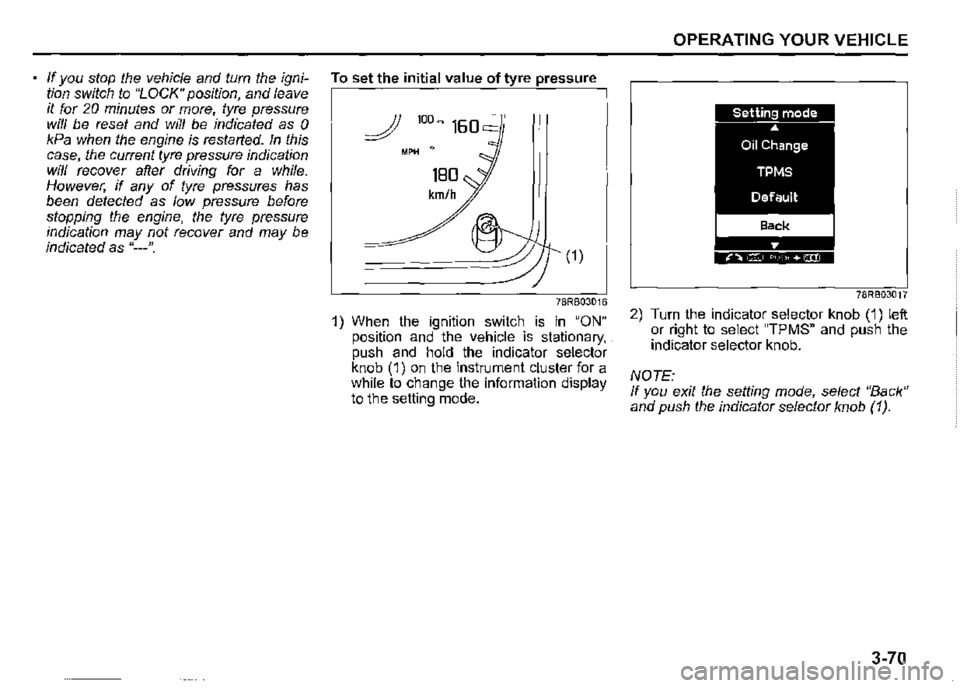
If you stop the vehicle and turn the ignition switch to "LOCK" position, and leave it for 20 minutes or more, tyre pressure wi/1 be reset and will be indicated as 0 kPa when the engine is restarted. In this case, the current tyre pressure indication will recover after driving for a while. However, if any of tyre pressures has been detected as low pressure before stopping the engine, the tyre pressure indication may not recover and may be indicated as "---".
To set the initial value of tyre pressure
(1)
78RB03016
1) When the ignition switch is in "ON" position and the vehicle is stationary, . push and hold the indicator selector knob (1) on the instrument cluster for a while to change the information display to the setting mode.
OPERATING YOUR VEHICLE
78RB03017
2) Turn the indicator selector knob (1) left or right to select "TPMS" and push the indicator selector knob.
NOTE: If you exit the setting mode, select "Back" and push the indicator selector knob (1 ).
3-70
Page 229 of 421
A WARNING
In addition to following the driving tips in this section, it is important to observe the following precautions. • Check that your tyres are in good condition and always maintain the specified tyre pressure. Refer to "Tyres" in "INSPECTION AND MAINTENANCE" section for details. (Continued)
A WARNING
(Continued) Do not use tyres other than those specified by SUZUKI. Never use different sizes or types of tyres on the front and rear wheels. For information regarding the specified tyres, refer to the tyre information label located on the driver's door lock pillar. Never use oversized tyres or spe~ cial shock absorbers and springs to raise uack up) your vehicle. This will change the handling characteristics. Oversized tyres may also rub against the fender over bumps, causing vehicle damage, drive train damage or tyre failure. After driving through water, test the brakes while driving at a slow speed to see if they have maintained their normal effectiveness. If the brakes are less effective than normal, dry them by repeatedly applying the brakes while driving slowly until the brakes have regained their normal effectiveness.
DRIVING TIPS
When encountering a flooded area
80J042
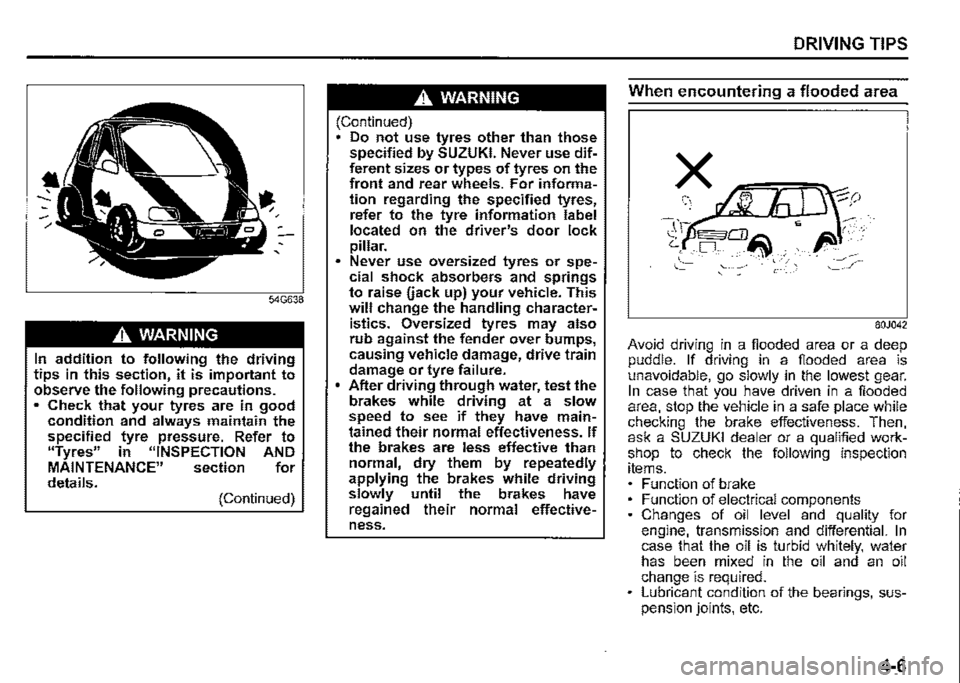
Avoid driving in a flooded area or a deep puddle. If driving in a flooded area is unavoidable, go slowly in the lowest gear. In case that you have driven in a flooded area, stop the vehicle in a safe place while checking the brake effectiveness. Then, ask a SUZUKI dealer or a qualified workshop to check the following inspection items. Function of brake Function of electrical components Changes of oil level and quality for engine, transmission and differential. In case that the oil is turbid whitely, water has been mixed in the oil and an oil change is required. Lubricant condition of the bearings, suspension joints, etc.
4-6
Page 231 of 421

A WARNING
In addition to following the driving tips in this section, it is important to observe the following precautions for on-road and off-road driving. Driver and passengers should wear seat belts at all times. Do not let anyone else drive your vehicle unless they are also aware of the vehicle characteristics and handling differences described in this section. Avoid loaning your vehicle to any• one unless you accompany them. Make sure your tyres are in good condition and always maintain the specified tyre pressure. Refer to "Tyres" in the "INSPECTION AND MAINTENANCE" section for details. Do not use tyres other than those specified by SUZUKI. Never use dif• ferent sizes or types of tyres on the front and rear wheels. For informa• lion regarding the specified tyres, refer to the "SPECIFICATIONS" section. Never use oversized tyres or special shock absorbers and springs to raise uack up) your vehicle. This will raise the center of gravity of the vehicle and change its handling characteristics. (Continued)
A WARNING
(Continued) After driving through water, mud, or sandy ground, test the brakes while driving at a slow speed to see if they have maintained their nor• mal effectiveness. If the brakes are less effective than normal, dry them by repeatedly applying the brakes while driving slowly until the brakes have regained their nor• mal effectiveness. After extended operation in mud, sand, or water, have the brakes, bearings and joint parts etc. inspected by a SUZUKI dealer as soon as possible.
DRIVING TIPS
Running-in
NOTICE
The future performance and reliabil• ity of the engine depends on the care and restraint exercised during its early life. It is especially important to observe the following precautions during the first 960 km (600 miles) of vehicle operation. • After starting, do not race the engine. Warm ii up gradually. • Avoid prolonged vehicle operation at a constant speed. Moving parts will break in better if you vary your speed. Start off from a stop slowly. Avoid full throttle starts. Avoid hard braking, especially during the first 320 km (200 miles) of driving. Do not drive slowly with the !rans• mission in a high gear. Drive the vehicle at moderate engine speeds. Do not tow a trailer during the first 960 km (600 miles) of vehicle oper• ation.
4-8
Page 233 of 421
Improving fuel economy
The following instructions will help you improve fuel economy.
Avoid excessive idling If you park your vehicle for more than one minute, stop the engine and start it again later. When warming up a cold engine, do not allow the engine to idle or apply full throttle until the engine has reached operating temperature. Allow the engine to warm up by driving.
Avoid fast starts F~st starts away from lights or stop signs will consume fuel unnecessarily and shorten engine life. Start off slowly.
Avoid unnecessary stops Avoid unnecessary deceleration and stopping. Try to maintain a moderate, steady speed whenever possible. Slowing down and then accelerating again uses more fuel.
Keep a steady cruising speed Drive at a constant speed that road and traffic conditions will permit.
Keep the air cleaner clean
EXAMPLE
60A183
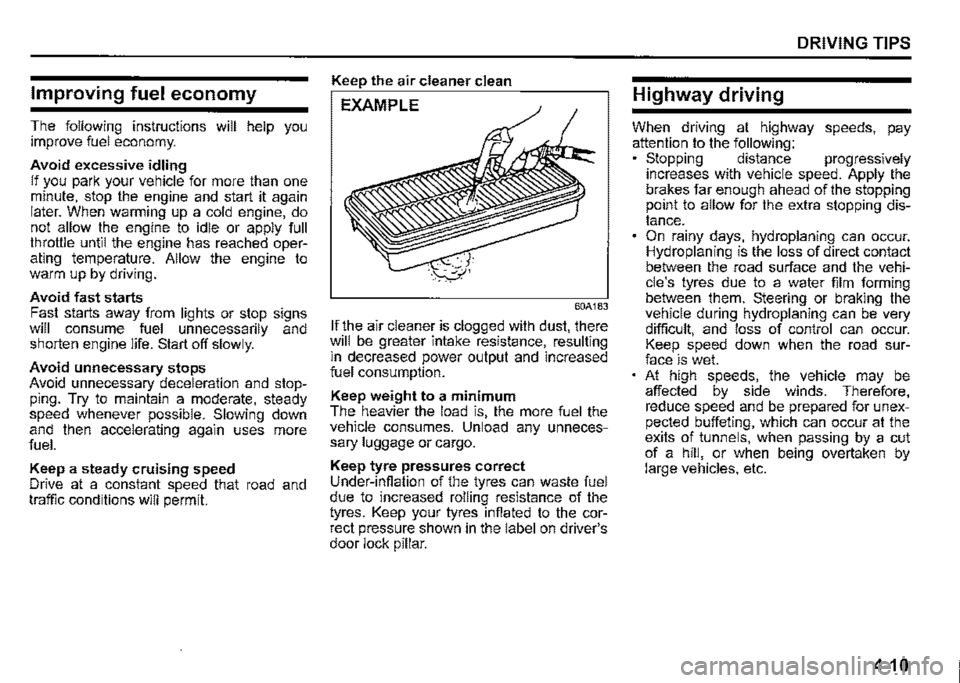
If the air cleaner is clogged with dust, there will be greater intake resistance, resulting m decreased power output and increased fuel consumption.
Keep weight to a minimum The heavier the load is, the more fuel the vehicle consumes. Unload any unnecessary luggage or cargo.
Keep tyre pressures correct Under-infiation of the tyres can waste fuel due to increased rolling resistance of the tyres. Keep your tyres infiated to the correct pressure shown in the label on driver's door lock pillar.
DRIVING TIPS
Highway driving
When driving at highway speeds, pay attention to the following: • Stopping distance progressively increases with vehicle speed. Apply the brakes far enough ahead of the stopping prnnt to allow for the extra stopping distance. On rainy days, hydroplaning can occur. Hydroplaning is the loss of direct contact between the road surface and the vehicle's tyres due to a water film forming between them. Steering or braking the vehicle during hydroplaning can be very difficult, and loss of control can occur. Keep speed down when the road surface is wet. At high speeds, the vehicle may be affected by side winds. Therefore, reduce speed and be prepared for unexpected buffeting, which can occur at the exits of tunnels, when passing by a cut of a hill, or when being overtaken by large vehicles, etc.
4-10
Page 323 of 421
INSPECTION AND MAINTENANCE
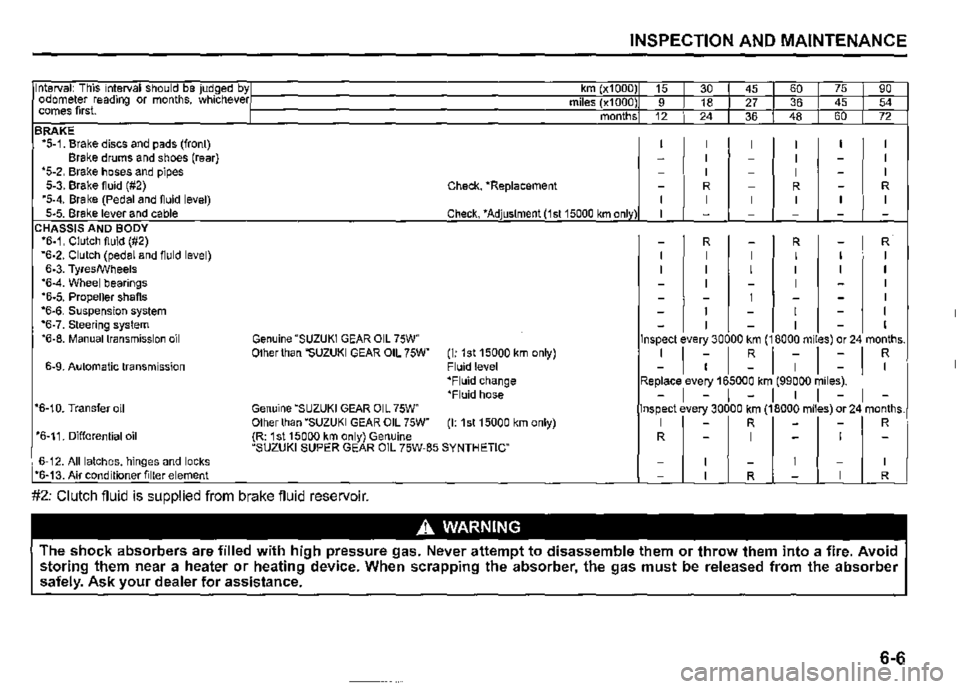
Interval: This interval should be judged byI km (x1000)I 15 I 30 I 45 I 60 I 75 90 odometer reading or months, whichever, miles (x1000)I 9 I 18 I 27 I 36 I 45 54 comes first. 1 monthsI 12 I 24 I 36 I 48 I 60 I 72 BRAKE *5-1. Brake discs and pads (front) I I I I I I Brake drums and shoes (rear) -I -I -I *5-2. Brake hoses and pipes -I -I -I 5-3. Brake fluid (#2) Check, *Replacement -R -R -R *5-4. Brake (Pedal and fluid level) I I I I I I 5-5. Brake lever and cable Check, *Adjustment (1st 15000 km only) I -----CHASSIS AND BODY *6-1. Clutch fluid (#2) -R -R -R *6-2. Clutch (pedal and fluid level) I I I I I I 6-3. Tyres/Wheels I I I I I I *6-4. Wheel bearings -I -I -I *6-5. Propeller shafts --I --I *6-6. Suspension system -I -I -I "6-7. Steering system -I -I -I *6-8. Manual transmission oil Genuine "SUZUKI GEAR OIL 75W" Inspect every 30000 km (18000 miles) or 24 months. Other than "SUZUKI GEAR OIL 75W" (1: 1st 15000 km only) I
I -I
R
I
-
I
-
I
R 6-9. Automatic transmission Fluid level -I -I -I *Fluid change Replace every 165000 km (99000 miles). *Fluid hose -I -I -I I I -I -*6-10. Transfer oil Genuine "SUZUKI GEAR OIL 75W" Inspect every 30000 km (18000 miles) or 24 months. Other than "SUZUKI GEAR OIL 75W" (I: 1st 15000 km only) I -R --R *6-11. Differential oil (R: 1 st 15000 km only) Genuine "SUZUKI SUPER GEAR OIL 75W-85 SYNTHETIC" R -I -I -
6-12. All latches, hinges and locks -I -I -I *6-13. Air conditioner filter element -I R -I R
#2: Clutch fluid is supplied from brake fluid reservoir.
A WARNING
The shock absorbers are filled with high pressure gas. Never attempt to disassemble them or throw them into a fire. Avoid storing them near a heater or heating device. When scrapping the absorber, the gas must be released from the absorber safely. Ask your dealer for assistance.
6-6
Page 328 of 421
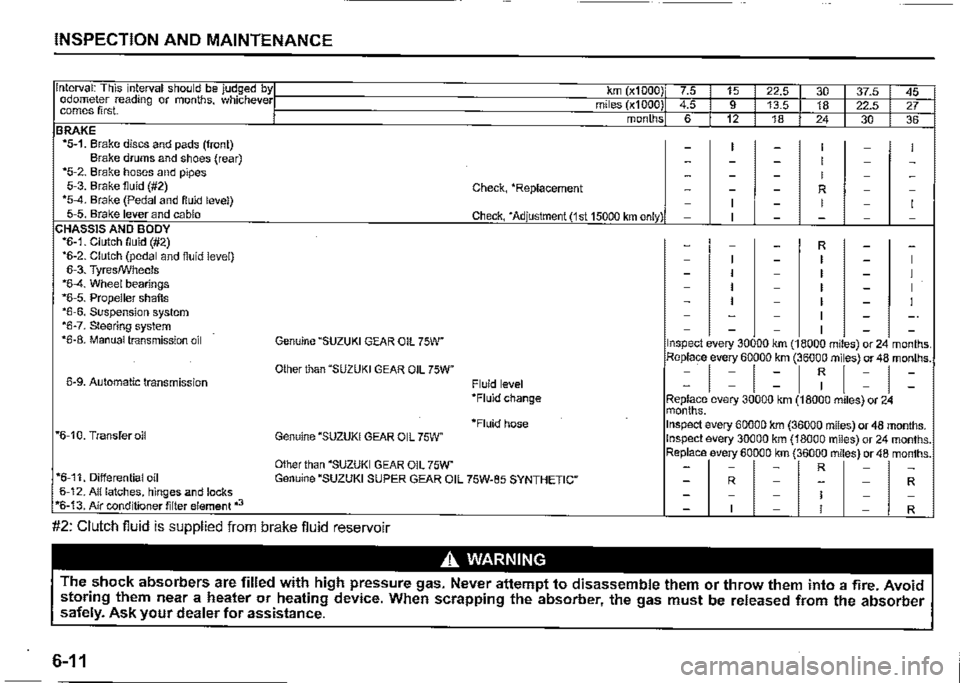
INSPECTION AND MAINTENANCE
Interval: This interval should be judged by1l--------------------=cic-c+T.C~~,'-,--+----,i'--+ odometer reading or months, whicheverI km (x1000) 7.5 I 15 I 22.5 I 30 I 37.5 45 miles (x1000) 4.5 I 9 I 13.5 I 18 I 22.5 27 comes first. 11-------------------~='---'c=cc=l-";c--+----.,,-+ months 6 I 12 I 18 I 24 I 30 36 BRAKE *5-1. Brake discs and pads (front) Brake drums and shoes (rear) *5-2. Brake hoses and pipes 5-3. Brake fluid (#2) *5-4. Brake (Pedal and fluid level) 5-5. Brake lever and cable CHASSIS AND BODY "6-1. Clutch fluid (#2) *6-2. Clutch (pedal and fluid level) 6-3. Tyres/Wheels *6-4. Wheel bearings *6-5. Propeller shafts *6-6. Suspension system *6-7. Steering system *6-8. Manual transmission oil
6-9. Automatic transmission
*6-10. Transfer oil
*6-11. Differential oil 6-12. All latches, hinges and locks *6-13. Air conditioner filter element •3
Genuine "SUZUKI GEAR OIL 75W"
Other than "SUZUKI GEAR OIL 75W"
Genuine "SUZUKI GEAR OIL 75W"
Other than "SUZUKI GEAR OIL 75W"
Check, *Replacement
Check, *Adjustment (1st 15000 km only)
Flu!d level *Fluid change
*Fluid hose
Genuine "SUZUKI SUPER GEAR OIL 75W-85 SYNTHETIC"
#2: Clutch fiuid is supplied from brake fiuid reservoir
A WARNING
-I -I -I ---I -----I -----R ---I -I -I -I ----
---R ---I -I -I -I -I -I -I -I -I -I -I -I ---I --· ---I --Inspect every 30000 km (18000 miles) or 24 months. Replace every 60000 km (36000 miles) or 48 months.
= I = I = I 7 I = I = Replace every 30000 km (18000 miles) or 24 months. Inspect every 60000 km (36000 miles) or 48 months. Inspect every 30000 km (18000 miles) or 24 months. Replace every 60000 km (36000 m!les) or 48 months. ---R --R R
R
The shock absorbers are filled with high pressure gas. Never attempt to disassemble them or throw them into a fire. Avoid storing them near a heater or heating device. When scrapping the absorber, the gas must be released from the absorber safely. Ask your dealer for assistance.
6-11
Page 333 of 421
INSPECTION AND MAINTENANCE
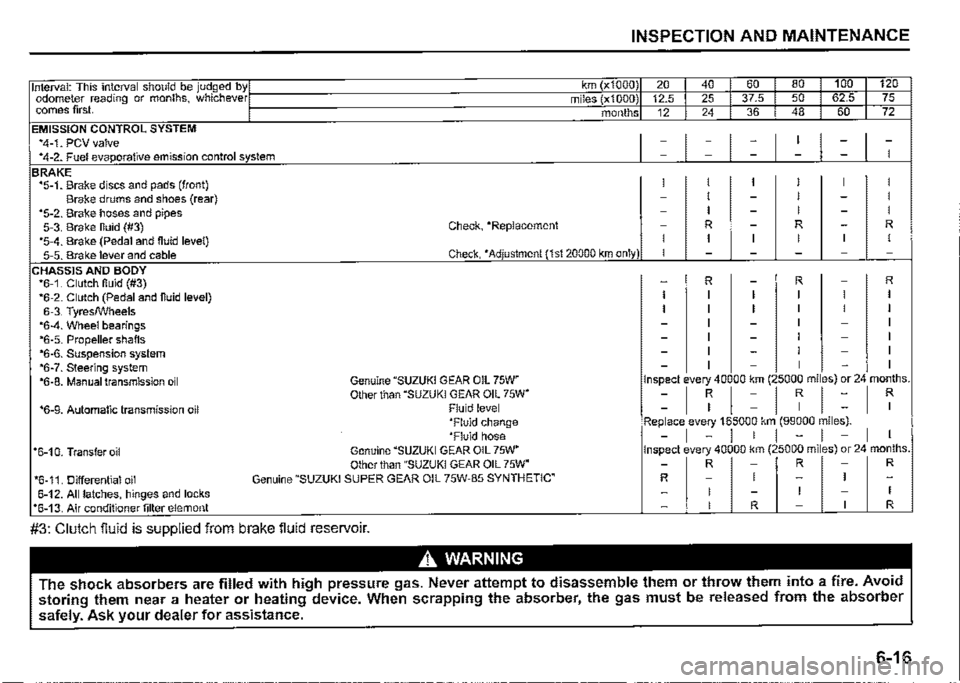
Interval: This interval should be judged bylf---------------------a"'-<"~ccfl---c~+--,;;;.-+~ odometer reading or months, whichever1 km (x1000)I 20 I 40 I 60 I 80 I 100 I 120 miles (x1000)I 12.5 I 25 I 37.5 I 50 I 62.5 I 75 comes first. If-----------------------"='-"'-'-=-;?l----'-~+---:a,;-+~ months! 12 24 I 36 I 48 I 60 I 72
EMISSION CONTROL SYSTEM •4-1. PCV valve •4-2. Fuel evaporative emission control system BRAKE *5-1. Brake discs and pads (front) Brake drums and shoes (rear) *5-2. Brake hoses and pipes 5-3. Brake fluid (#3) *5-4. Brake (Pedal and fluid level) 5-5. Brake lever and cable CHASSIS AND BODY *6-1. Clutch fluid (#3) *6-2. Clutch (Pedal and fluid level) 6-3. Tyres/Wheels *6-4. Wheel bearings •6-5. Propeller shafts *6-6. Suspension system *6-7. Steering system *6-8. Manual transmission oil
*6-9. Automatic transmission oil
*6-10. Transfer oil
*6-11. Differential oil 6-12. All latches, hinges and locks *6-13. Air conditioner filter element
Check, *Replacement
Check, *Adjustment (1st 20000 km only)
Genuine "SUZUKI GEAR OIL 75W" Other than "SUZUKI GEAR OIL 75W" Fluid level *Fluid change *Fluid hose Genuine "SUZUKI GEAR OIL 75W" Other than "SUZUKI GEAR OIL 75W" Genuine "SUZUKI SUPER GEAR OIL 75W-85 SYNTHETIC"
#3: Clutch fluid is supplied from brake fluid reservoir.
A WARNING
I
-I -I -I I I -I ------I
I I I I I I -I -I -I -I -I -I -R -R -R I I I I I I I -----
-R -R -R I I I I I I I I I I I I
-I -I -I -I -I -I -I -I -I -I -I -I Inspect every 40000 km (25000 miles) or 24 months.
= I 7 I = I 7 I = I 7 Replace every 165000 km (99000 miles). -I -I I I -I -I I Inspect every 40000 km (25000 miles) or 24 months. -R -R -R R
R I R
The shock absorbers are filled with high pressure gas. Never attempt to disassemble them or throw them into a fire. Avoid storing them near a heater or heating device. When scrapping the absorber, the gas must be released from the absorber
safely. Ask your dealer for assistance.
6-16
Page 338 of 421
INSPECTION AND MAINTENANCE
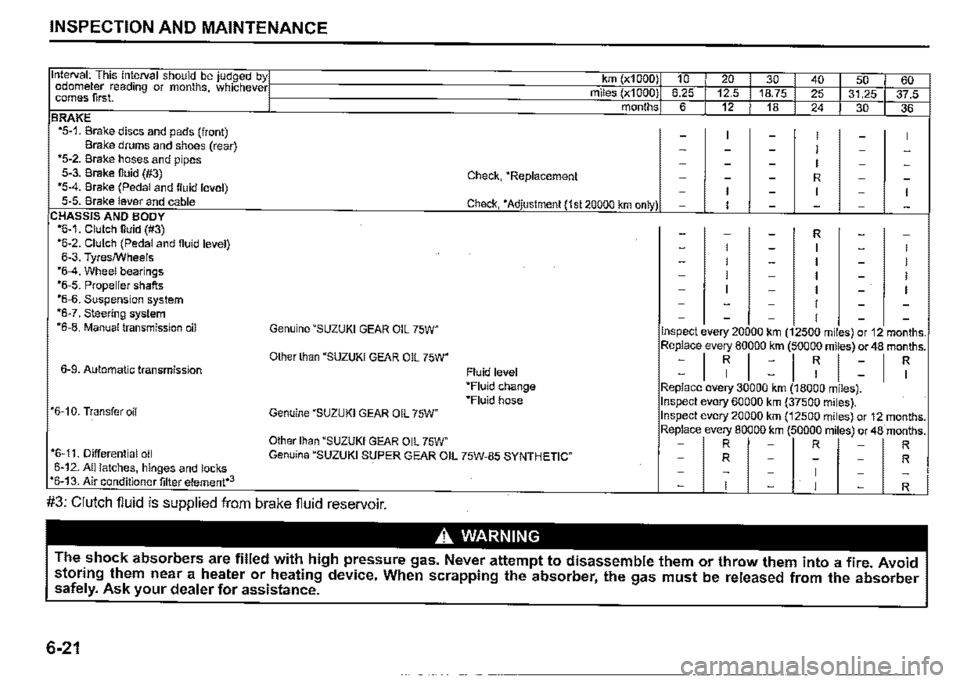
Interval: This interval should be judged byl, -----------------------=~"-f""'~----a'ica-l--i;ee+ odometer reading or months, whicheveq,r ___________________ =='='c~:,f-"'ii"-+-:;;;'----!-km (x100D) 10 I 20 I 30 I 40 I 50 I 60 miles (x1000) 6.25 I 12.5 I 18.75 I 25 I 31,25 I 37.5 comes first. I
BRAKE *5-1. Brake discs and pads (front) Brake drums and shoes (rear) *5-2. Brake hoses and pipes 5-3. Brake fluid (#3)
months
Check, *Replacement *5-4. Brake (Pedal and fluid level) 5-5. Brake lever and cable Check, *Adjustment (1st 20000 km only) CHASSIS ANO BODY *6-1. Clutch fluid (#3) *6-2. Clutch (Pedal and fluid level) 6-3. Tyres/Wheels *6-4. Wheel bearings *6-5. Propeller shafts *6-6. Suspension system *6-7. Steering system *6-8. Manual transmission oil
6-9. Automatic transmission
*6-10. Transfer oil
*6-11. Differential all 6-12. All latches, hinges and locks *6-13. Air conditioner filter elemenr·3
Genuine "SUZUKI GEAR OIL 75W"
Other than "SUZUKI GEAR OIL 75W"
Genuine "SUZUKI GEAR OIL 75W"
Other than "SUZUKI GEAR OIL 75W"
Fluid level *Fluid change *Fluid hose
Genuine "SUZUKI SUPER GEAR OIL 75W-85 SYNTHETIC"
#3: Clutch fiuid is supplied from brake fiuid reservoir.
A WARNING
6 I 12 I 18 I 24 I 30 I 36
-I -I -I ---I -----I -----R ---I -I -I -I ----
---R ---I -I -I -I -I -I -I -I -I -I -I -I ---I -----I --Inspect every 20000 km (12500 miles) or 12 months. Replace every 80000 km (50000 miles) or 48 months.
= I ~ I = I ~ I = I ~ Replace every 30000 km (18000 miles). Inspect every 60000 km (37500 miles). Inspect every 20000 km (12500 miles) or 12 months. Replace every 80000 km (50000 miles) or 48. months. -R -R -R -R ---R
R
The shock absorbers are filled with high pressure gas. Never attempt to disassemble them or throw them into a fire. Avoid storing them near a heater or heating device. When scrapping the absorber, the gas must be released from the absorber safely. Ask your dealer for assistance.
6-21