brake fluid SUZUKI SX4 2006 1.G Service Owner's Manual
[x] Cancel search | Manufacturer: SUZUKI, Model Year: 2006, Model line: SX4, Model: SUZUKI SX4 2006 1.GPages: 1556, PDF Size: 37.31 MB
Page 579 of 1556
Downloaded from www.Manualslib.com manuals search engine Brake Control System and Diagnosis: 4A-8
Brake Fluid Level InspectionS6RW0D4106004
CAUTION!
Do not use shock absorber fluid or any other
fluid which contains mineral oil. Do not use a
container which has been used for mineral oil
or a container which is wet from water.
Mineral oil will cause swelling and distortion
of rubber parts in hydraulic brake system and
water mixed into brake fluid will lower fluid
boiling point. Keep all fluid containers
capped to prevent contamination.
NOTE
Be sure to use particular brake fluid either as
indicated on reservoir cap of that vehicle or
recommended in owner’s manual which
comes along with that vehicle. Use of any
other fluid is strictly prohibited.
Fluid level should be between MIN and MAX
lines marked on reservoir.
When brake warning light lights sometimes
during driving, replenish fluid to MAX level.
When fluid decreases quickly, inspect brake
system for leakage. Correct leaky points and
then refill to specified level.
1) Check master cylinder, reservoir and reservoir hose
(if equipped) for crack, damage and brake fluid
leakage. If any faulty condition exists, correct or
replace.
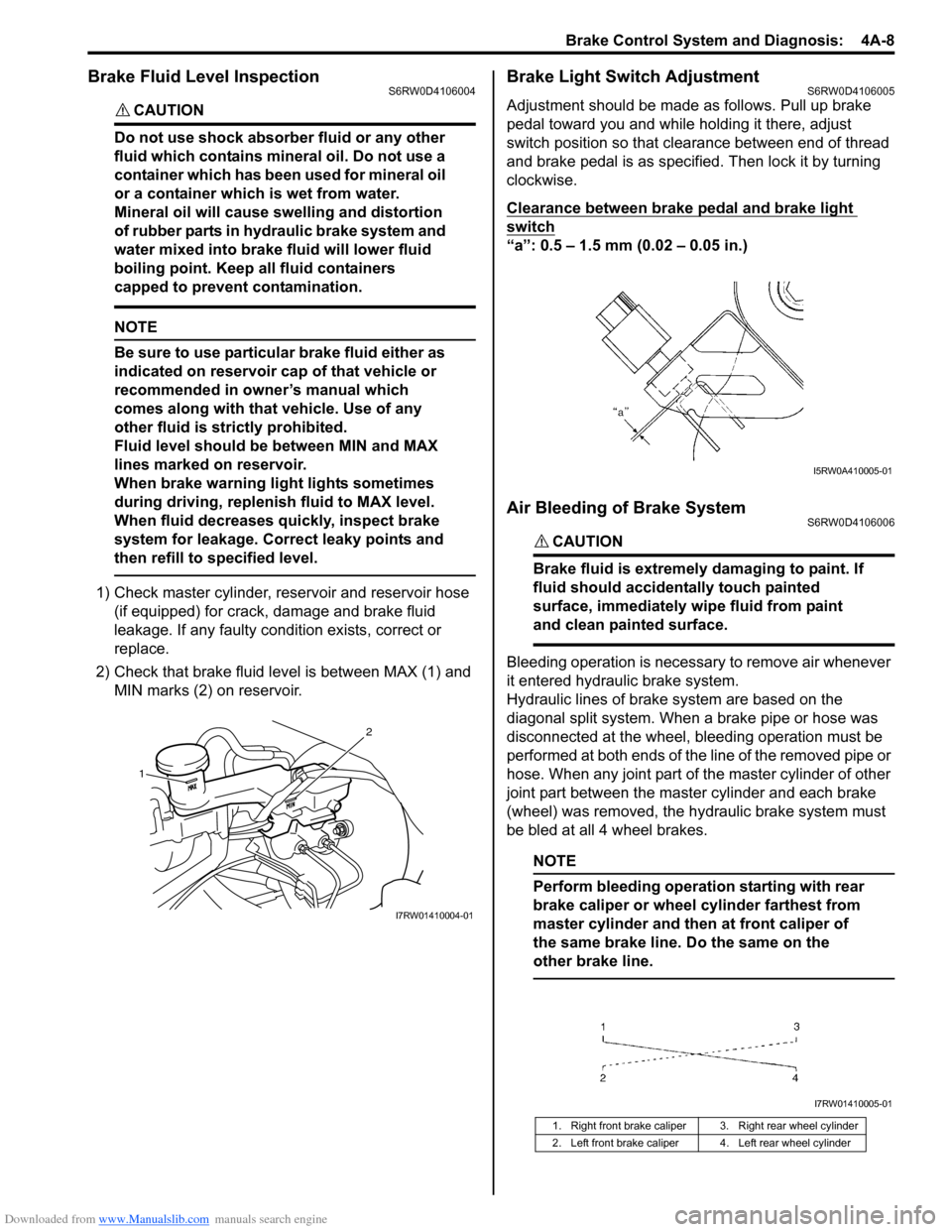
2) Check that brake fluid level is between MAX (1) and
MIN marks (2) on reservoir.
Brake Light Switch AdjustmentS6RW0D4106005
Adjustment should be made as follows. Pull up brake
pedal toward you and while holding it there, adjust
switch position so that clearance between end of thread
and brake pedal is as specified. Then lock it by turning
clockwise.
Clearance between brake pedal and brake light
switch
“a”: 0.5 – 1.5 mm (0.02 – 0.05 in.)
Air Bleeding of Brake SystemS6RW0D4106006
CAUTION!
Brake fluid is extremely damaging to paint. If
fluid should accidentally touch painted
surface, immediately wipe fluid from paint
and clean painted surface.
Bleeding operation is necessary to remove air whenever
it entered hydraulic brake system.
Hydraulic lines of brake system are based on the
diagonal split system. When a brake pipe or hose was
disconnected at the wheel, bleeding operation must be
performed at both ends of the line of the removed pipe or
hose. When any joint part of the master cylinder of other
joint part between the master cylinder and each brake
(wheel) was removed, the hydraulic brake system must
be bled at all 4 wheel brakes.
NOTE
Perform bleeding operation starting with rear
brake caliper or wheel cylinder farthest from
master cylinder and then at front caliper of
the same brake line. Do the same on the
other brake line.
1
2
I7RW01410004-01
1. Right front brake caliper 3. Right rear wheel cylinder
2. Left front brake caliper 4. Left rear wheel cylinder
I5RW0A410005-01
I7RW01410005-01
Page 580 of 1556
Downloaded from www.Manualslib.com manuals search engine 4A-9 Brake Control System and Diagnosis:
1) Fill master cylinder reservoir with specified brake
fluid and keep at least one-half full of fluid during
bleeding operation.
Brake fluid
: Refer to reservoir cap
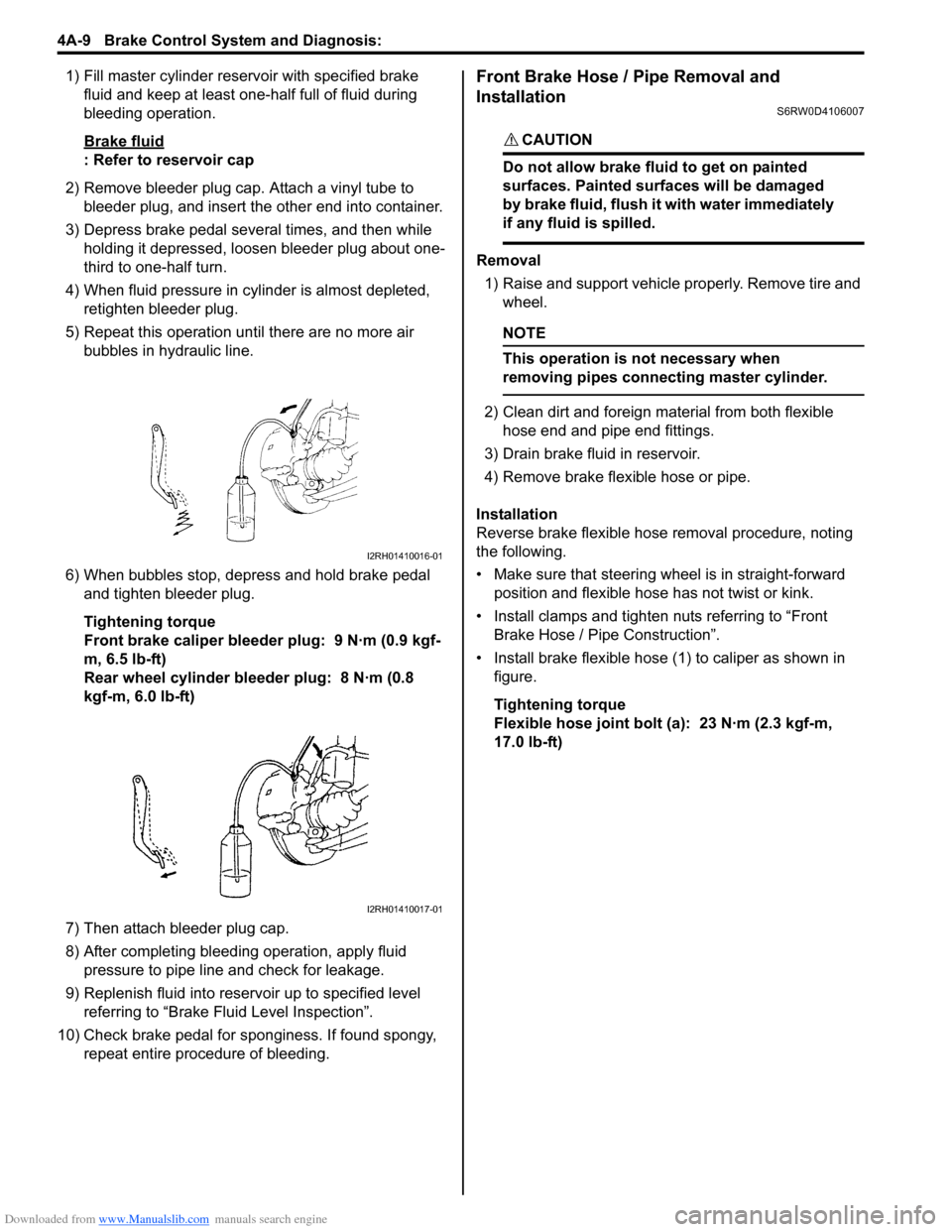
2) Remove bleeder plug cap. Attach a vinyl tube to
bleeder plug, and insert the other end into container.
3) Depress brake pedal several times, and then while
holding it depressed, loosen bleeder plug about one-
third to one-half turn.
4) When fluid pressure in cylinder is almost depleted,
retighten bleeder plug.
5) Repeat this operation until there are no more air
bubbles in hydraulic line.
6) When bubbles stop, depress and hold brake pedal
and tighten bleeder plug.
Tightening torque
Front brake caliper bleeder plug: 9 N·m (0.9 kgf-
m, 6.5 lb-ft)
Rear wheel cylinder bleeder plug: 8 N·m (0.8
kgf-m, 6.0 lb-ft)
7) Then attach bleeder plug cap.
8) After completing bleeding operation, apply fluid
pressure to pipe line and check for leakage.
9) Replenish fluid into reservoir up to specified level
referring to “Brake Fluid Level Inspection”.
10) Check brake pedal for sponginess. If found spongy,
repeat entire procedure of bleeding.
Front Brake Hose / Pipe Removal and
Installation
S6RW0D4106007
CAUTION!
Do not allow brake fluid to get on painted
surfaces. Painted surfaces will be damaged
by brake fluid, flush it with water immediately
if any fluid is spilled.
Removal
1) Raise and support vehicle properly. Remove tire and
wheel.
NOTE
This operation is not necessary when
removing pipes connecting master cylinder.
2) Clean dirt and foreign material from both flexible
hose end and pipe end fittings.
3) Drain brake fluid in reservoir.
4) Remove brake flexible hose or pipe.
Installation
Reverse brake flexible hose removal procedure, noting
the following.
• Make sure that steering wheel is in straight-forward
position and flexible hose has not twist or kink.
• Install clamps and tighten nuts referring to “Front
Brake Hose / Pipe Construction”.
• Install brake flexible hose (1) to caliper as shown in
figure.
Tightening torque
Flexible hose joint bolt (a): 23 N·m (2.3 kgf-m,
17.0 lb-ft)
I2RH01410016-01
I2RH01410017-01
Page 581 of 1556
Downloaded from www.Manualslib.com manuals search engine Brake Control System and Diagnosis: 4A-10
• Check to make sure that flexible hose doesn’t contact
any part of suspension, both in extreme right and
extreme left turn conditions. If it does at any point,
remove and correct. Fill and maintain brake fluid level
in reservoir.
• Bleed brake system. Refer to “Air Bleeding of Brake
System”.
• Perform brake test and check installed part for fluid
leakage.
Rear Brake Hose / Pipe Removal and
Installation
S6RW0D4106008
CAUTION!
Do not allow brake fluid to get on painted
surfaces. Painted surfaces will be damaged
by brake fluid, flush it with water immediately
if any fluid is spilled.
Removal
1) Raise and support vehicle properly. Remove tire and
wheel.
2) Clean dirt and foreign material from both flexible
hose end and pipe end fittings.
3) Drain brake fluid in reservoir.
4) Remove brake flexible hose or pipe.
Installation
Reverse brake flexible hose removal procedure, noting
the following.
• Install clamps and tighten nuts referring to “Rear
Brake Hose / Pipe Construction”.
• Fill and maintain brake fluid level in reservoir.
• Bleed brake system. Refer to “Air Bleeding of Brake
System”.
• Perform brake test and check each installed part for
fluid leakage.
• When installing hose, make sure that it has no twist or
kink.
Brake Hose and Pipe InspectionS6RW0D4106009
Hose
The brake hose assembly should be checked for road
hazard damage, for cracks and chafing of outer cover,
for leaks and blisters. A light and mirror may be needed
for an adequate inspection. If any above conditions are
observed on brake hose, it is necessary to replace it.
Pipe
Inspect the pipe for damage, cracks, dents and
corrosion. If any defect is found, replace it.
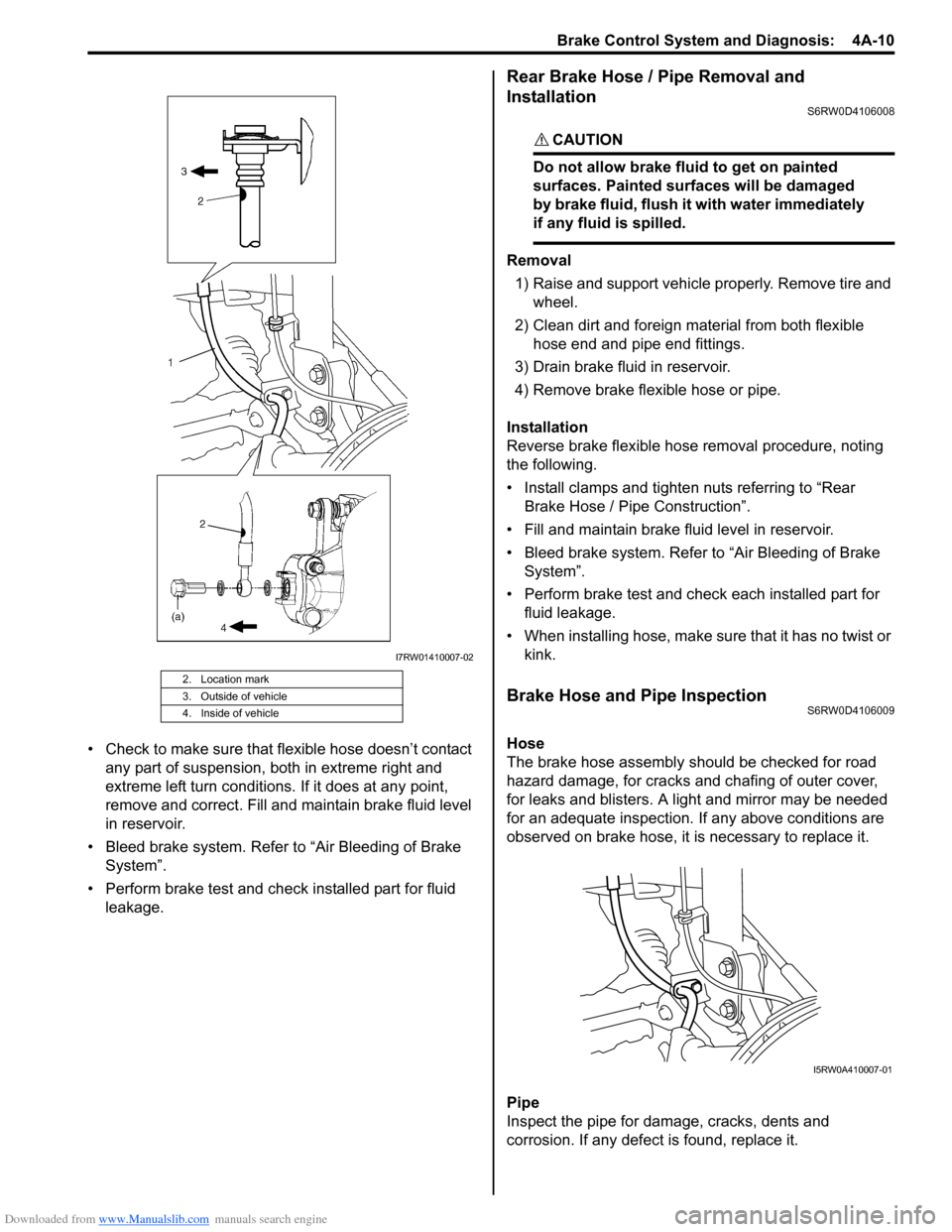
2. Location mark
3. Outside of vehicle
4. Inside of vehicle
I7RW01410007-02
I5RW0A410007-01
Page 582 of 1556
Downloaded from www.Manualslib.com manuals search engine 4A-11 Brake Control System and Diagnosis:
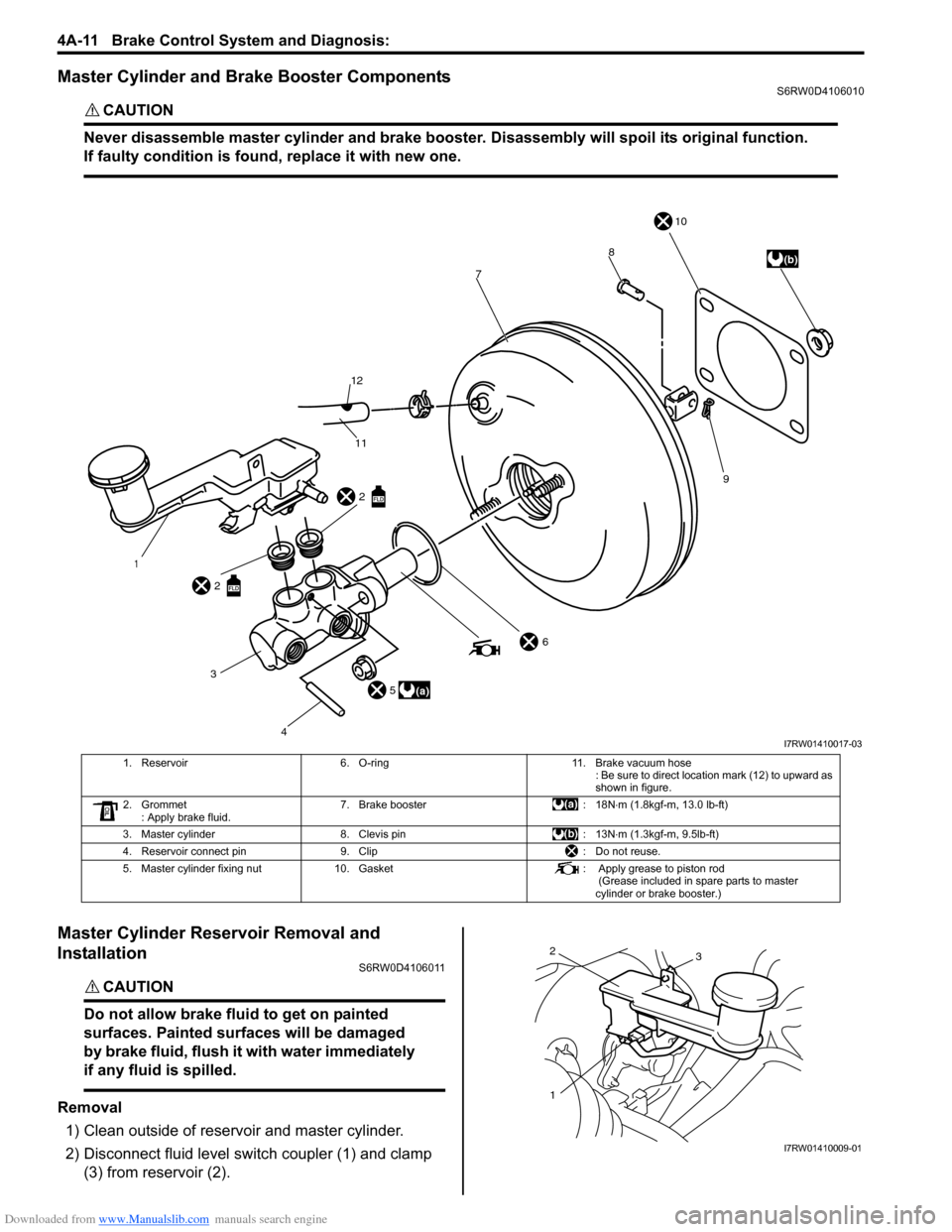
Master Cylinder and Brake Booster ComponentsS6RW0D4106010
CAUTION!
Never disassemble master cylinder and brake booster. Disassembly will spoil its original function.
If faulty condition is found, replace it with new one.
Master Cylinder Reservoir Removal and
Installation
S6RW0D4106011
CAUTION!
Do not allow brake fluid to get on painted
surfaces. Painted surfaces will be damaged
by brake fluid, flush it with water immediately
if any fluid is spilled.
Removal
1) Clean outside of reservoir and master cylinder.
2) Disconnect fluid level switch coupler (1) and clamp
(3) from reservoir (2).
4 2
2
1
(b) 10
9 8
7
11 12
6
3
5(a)
I7RW01410017-03
1. Reservoir 6. O-ring 11. Brake vacuum hose
: Be sure to direct location mark (12) to upward as
shown in figure.
2. Grommet
: Apply brake fluid. 7. Brake booster : 18N⋅m (1.8kgf-m, 13.0 lb-ft)
3. Master cylinder 8. Clevis pin : 13N⋅m (1.3kgf-m, 9.5lb-ft)
4. Reservoir connect pin 9. Clip : Do not reuse.
5. Master cylinder fixing nut 10. Gasket : Apply grease to piston rod
(Grease included in spare parts to master
cylinder or brake booster.)
2
13
I7RW01410009-01
Page 583 of 1556
Downloaded from www.Manualslib.com manuals search engine Brake Control System and Diagnosis: 4A-12
3) Drain brake fluid in reservoir.
4) Disconnect clutch reservoir hose from reservoir (M/T
model).
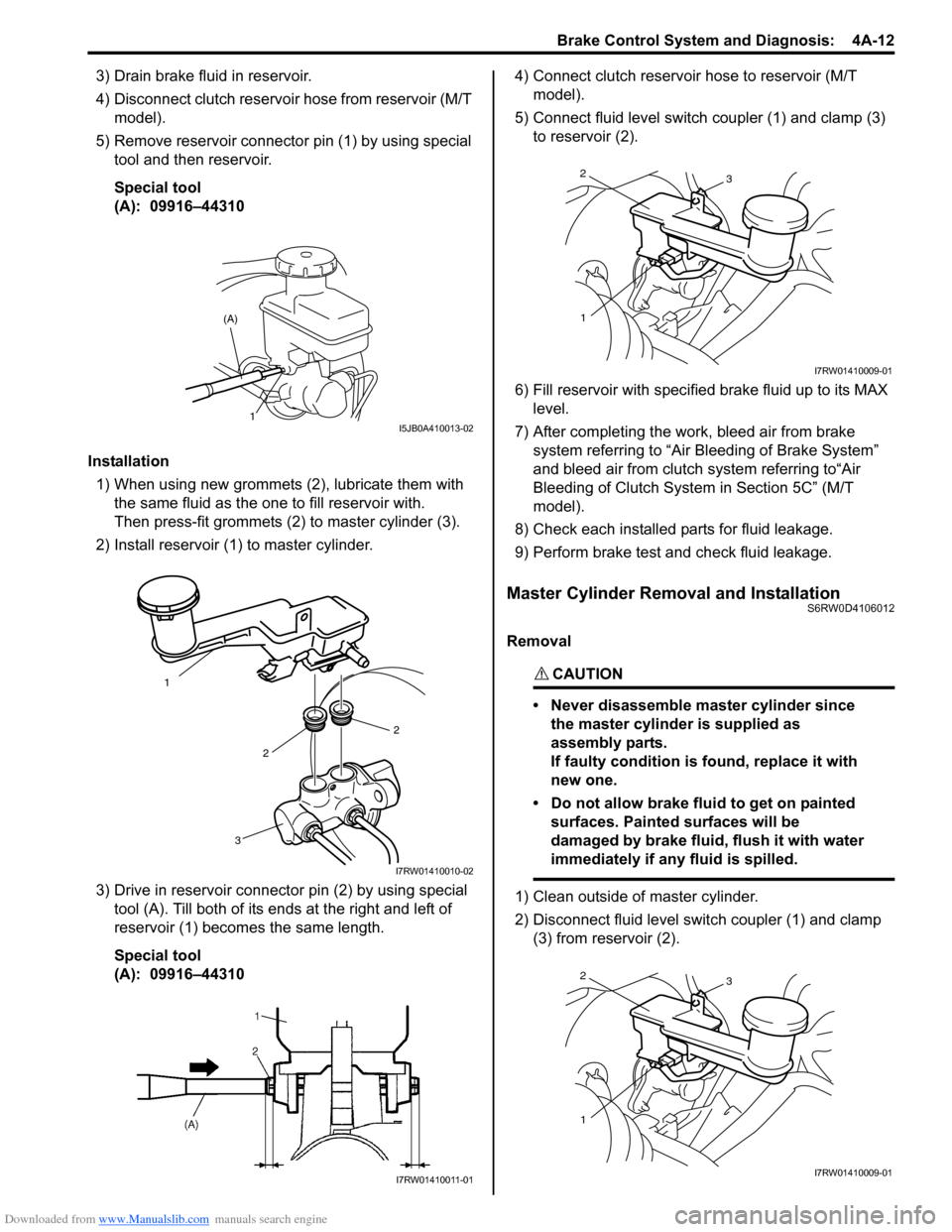
5) Remove reservoir connector pin (1) by using special
tool and then reservoir.
Special tool
(A): 09916–44310
Installation
1) When using new grommets (2), lubricate them with
the same fluid as the one to fill reservoir with.
Then press-fit grommets (2) to master cylinder (3).
2) Install reservoir (1) to master cylinder.
3) Drive in reservoir connector pin (2) by using special
tool (A). Till both of its ends at the right and left of
reservoir (1) becomes the same length.
Special tool
(A): 09916–44310 4) Connect clutch reservoir hose to reservoir (M/T
model).
5) Connect fluid level switch coupler (1) and clamp (3)
to reservoir (2).
6) Fill reservoir with specified brake fluid up to its MAX
level.
7) After completing the work, bleed air from brake
system referring to “Air Bleeding of Brake System”
and bleed air from clutch system referring to“Air
Bleeding of Clutch System in Section 5C” (M/T
model).
8) Check each installed parts for fluid leakage.
9) Perform brake test and check fluid leakage.
Master Cylinder Removal and InstallationS6RW0D4106012
Removal
CAUTION!
• Never disassemble master cylinder since
the master cylinder is supplied as
assembly parts.
If faulty condition is found, replace it with
new one.
• Do not allow brake fluid to get on painted
surfaces. Painted surfaces will be
damaged by brake fluid, flush it with water
immediately if any fluid is spilled.
1) Clean outside of master cylinder.
2) Disconnect fluid level switch coupler (1) and clamp
(3) from reservoir (2).
1 (A)I5JB0A410013-02
1
2
2
3
I7RW01410010-02
I7RW01410011-01
2
13
I7RW01410009-01
2
13
I7RW01410009-01
Page 584 of 1556
Downloaded from www.Manualslib.com manuals search engine 4A-13 Brake Control System and Diagnosis:
3) Drain brake fluid in reservoir.
4) Disconnect clutch reservoir hose from reservoir (M/T
model).
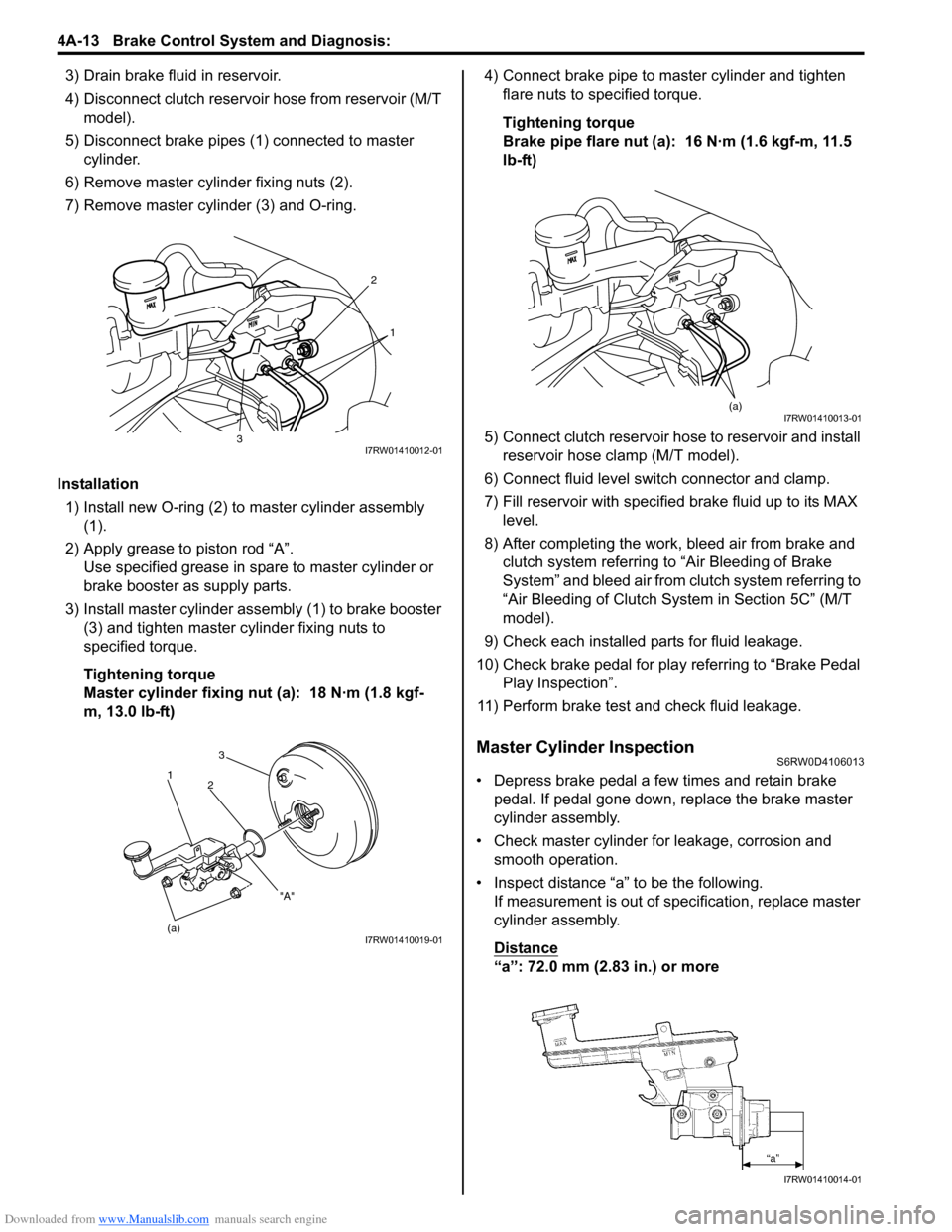
5) Disconnect brake pipes (1) connected to master
cylinder.
6) Remove master cylinder fixing nuts (2).
7) Remove master cylinder (3) and O-ring.
Installation
1) Install new O-ring (2) to master cylinder assembly
(1).
2) Apply grease to piston rod “A”.
Use specified grease in spare to master cylinder or
brake booster as supply parts.
3) Install master cylinder assembly (1) to brake booster
(3) and tighten master cylinder fixing nuts to
specified torque.
Tightening torque
Master cylinder fixing nut (a): 18 N·m (1.8 kgf-
m, 13.0 lb-ft)4) Connect brake pipe to master cylinder and tighten
flare nuts to specified torque.
Tightening torque
Brake pipe flare nut (a): 16 N·m (1.6 kgf-m, 11.5
lb-ft)
5) Connect clutch reservoir hose to reservoir and install
reservoir hose clamp (M/T model).
6) Connect fluid level switch connector and clamp.
7) Fill reservoir with specified brake fluid up to its MAX
level.
8) After completing the work, bleed air from brake and
clutch system referring to “Air Bleeding of Brake
System” and bleed air from clutch system referring to
“Air Bleeding of Clutch System in Section 5C” (M/T
model).
9) Check each installed parts for fluid leakage.
10) Check brake pedal for play referring to “Brake Pedal
Play Inspection”.
11) Perform brake test and check fluid leakage.
Master Cylinder InspectionS6RW0D4106013
• Depress brake pedal a few times and retain brake
pedal. If pedal gone down, replace the brake master
cylinder assembly.
• Check master cylinder for leakage, corrosion and
smooth operation.
• Inspect distance “a” to be the following.
If measurement is out of specification, replace master
cylinder assembly.
Distance
“a”: 72.0 mm (2.83 in.) or more
2
1
3I7RW01410012-01
(a)3
2
1
"A"
I7RW01410019-01
(a)I7RW01410013-01
I7RW01410014-01
Page 586 of 1556
Downloaded from www.Manualslib.com manuals search engine 4A-15 Brake Control System and Diagnosis:
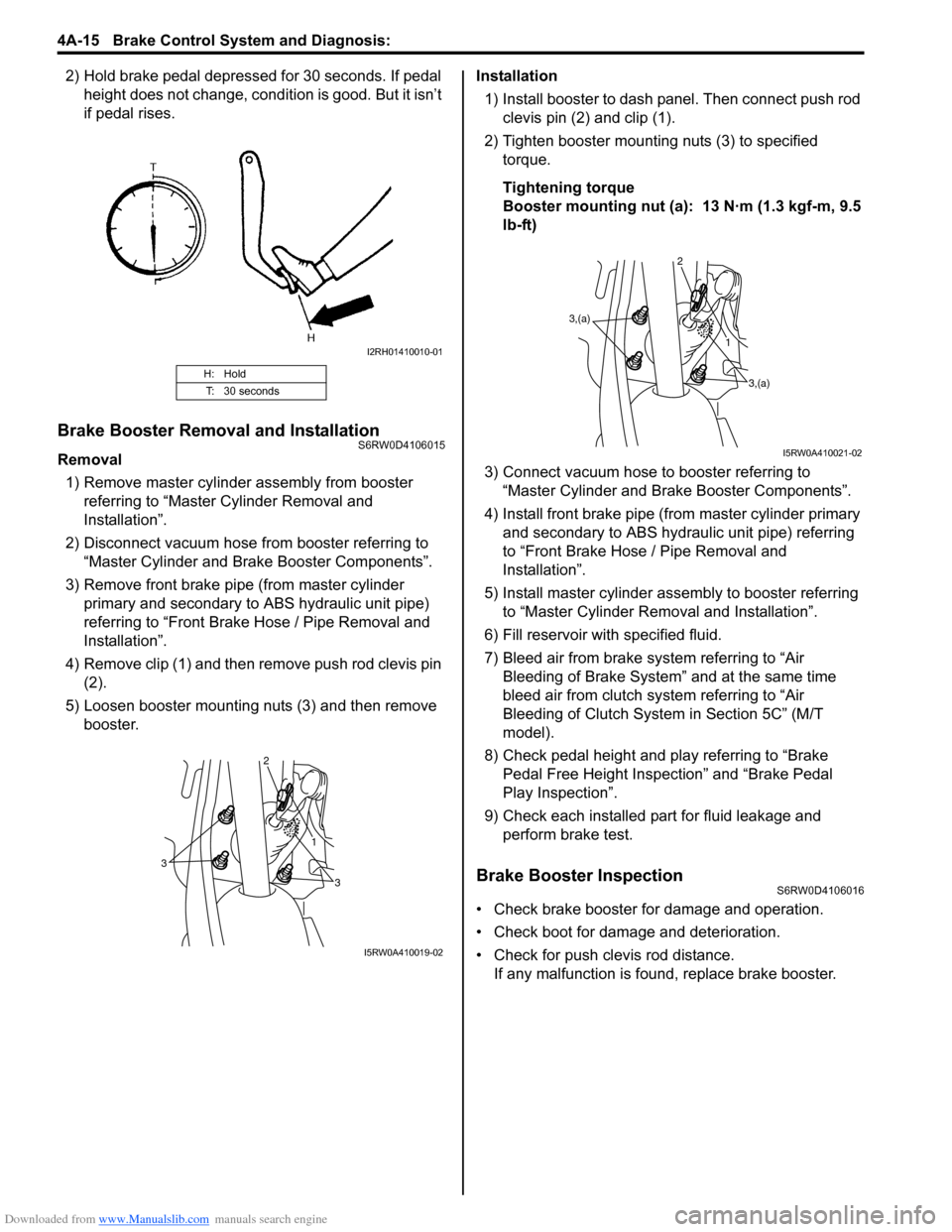
2) Hold brake pedal depressed for 30 seconds. If pedal
height does not change, condition is good. But it isn’t
if pedal rises.
Brake Booster Removal and InstallationS6RW0D4106015
Removal
1) Remove master cylinder assembly from booster
referring to “Master Cylinder Removal and
Installation”.
2) Disconnect vacuum hose from booster referring to
“Master Cylinder and Brake Booster Components”.
3) Remove front brake pipe (from master cylinder
primary and secondary to ABS hydraulic unit pipe)
referring to “Front Brake Hose / Pipe Removal and
Installation”.
4) Remove clip (1) and then remove push rod clevis pin
(2).
5) Loosen booster mounting nuts (3) and then remove
booster.Installation
1) Install booster to dash panel. Then connect push rod
clevis pin (2) and clip (1).
2) Tighten booster mounting nuts (3) to specified
torque.
Tightening torque
Booster mounting nut (a): 13 N·m (1.3 kgf-m, 9.5
lb-ft)
3) Connect vacuum hose to booster referring to
“Master Cylinder and Brake Booster Components”.
4) Install front brake pipe (from master cylinder primary
and secondary to ABS hydraulic unit pipe) referring
to “Front Brake Hose / Pipe Removal and
Installation”.
5) Install master cylinder assembly to booster referring
to “Master Cylinder Removal and Installation”.
6) Fill reservoir with specified fluid.
7) Bleed air from brake system referring to “Air
Bleeding of Brake System” and at the same time
bleed air from clutch system referring to “Air
Bleeding of Clutch System in Section 5C” (M/T
model).
8) Check pedal height and play referring to “Brake
Pedal Free Height Inspection” and “Brake Pedal
Play Inspection”.
9) Check each installed part for fluid leakage and
perform brake test.
Brake Booster InspectionS6RW0D4106016
• Check brake booster for damage and operation.
• Check boot for damage and deterioration.
• Check for push clevis rod distance.
If any malfunction is found, replace brake booster.
H: Hold
T: 30 seconds
I2RH01410010-01
3
3 1 2
I5RW0A410019-02
3,(a)
3,(a) 1 2
I5RW0A410021-02
Page 588 of 1556
Downloaded from www.Manualslib.com manuals search engine 4B-1 Front Brakes:
Brakes
Front Brakes
Repair Instructions
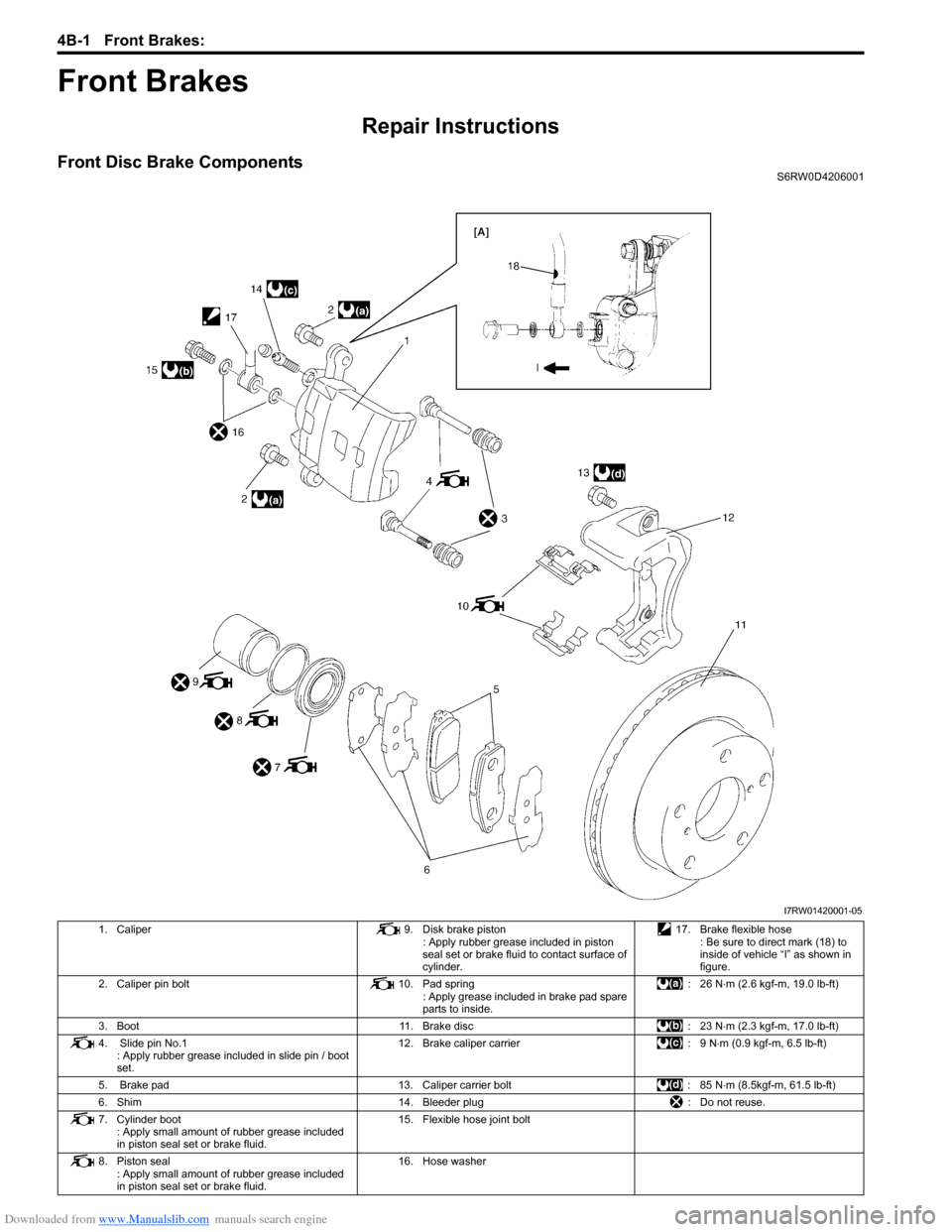
Front Disc Brake ComponentsS6RW0D4206001
I7RW01420001-05
1. Caliper 9. Disk brake piston
: Apply rubber grease included in piston
seal set or brake fluid to contact surface of
cylinder.17. Brake flexible hose
: Be sure to direct mark (18) to
inside of vehicle “I” as shown in
figure.
2. Caliper pin bolt 10. Pad spring
: Apply grease included in brake pad spare
parts to inside.: 26 N⋅m (2.6 kgf-m, 19.0 lb-ft)
3. Boot 11. Brake disc : 23 N⋅m (2.3 kgf-m, 17.0 lb-ft)
4. Slide pin No.1
: Apply rubber grease included in slide pin / boot
set.12. Brake caliper carrier : 9 N⋅m (0.9 kgf-m, 6.5 lb-ft)
5. Brake pad 13. Caliper carrier bolt : 85 N⋅m (8.5kgf-m, 61.5 lb-ft)
6. Shim 14. Bleeder plug : Do not reuse.
7. Cylinder boot
: Apply small amount of rubber grease included
in piston seal set or brake fluid.15. Flexible hose joint bolt
8. Piston seal
: Apply small amount of rubber grease included
in piston seal set or brake fluid.16. Hose washer
Page 590 of 1556
Downloaded from www.Manualslib.com manuals search engine 4B-3 Front Brakes:
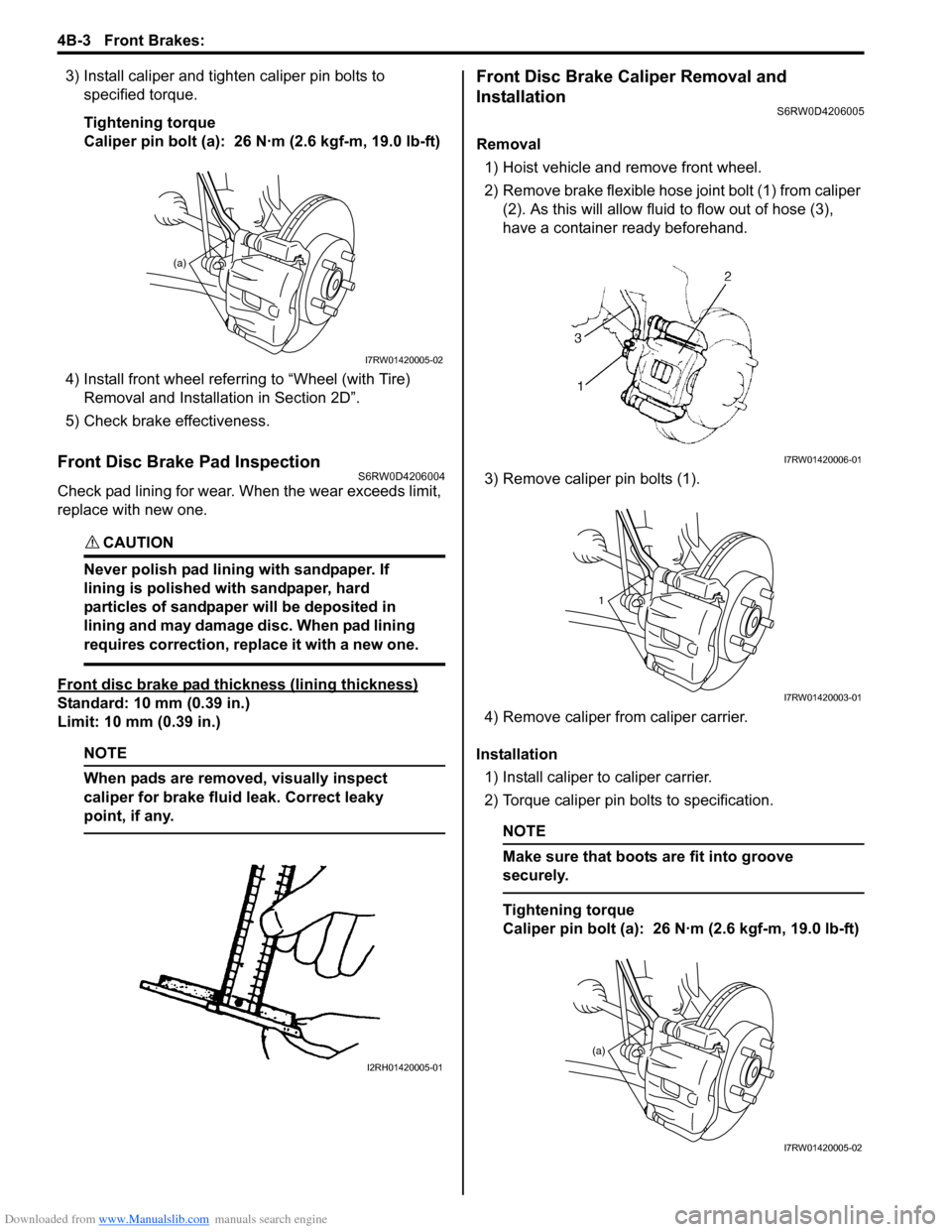
3) Install caliper and tighten caliper pin bolts to
specified torque.
Tightening torque
Caliper pin bolt (a): 26 N·m (2.6 kgf-m, 19.0 lb-ft)
4) Install front wheel referring to “Wheel (with Tire)
Removal and Installation in Section 2D”.
5) Check brake effectiveness.
Front Disc Brake Pad InspectionS6RW0D4206004
Check pad lining for wear. When the wear exceeds limit,
replace with new one.
CAUTION!
Never polish pad lining with sandpaper. If
lining is polished with sandpaper, hard
particles of sandpaper will be deposited in
lining and may damage disc. When pad lining
requires correction, replace it with a new one.
Front disc brake pad thickness (lining thickness)
Standard: 10 mm (0.39 in.)
Limit: 10 mm (0.39 in.)
NOTE
When pads are removed, visually inspect
caliper for brake fluid leak. Correct leaky
point, if any.
Front Disc Brake Caliper Removal and
Installation
S6RW0D4206005
Removal
1) Hoist vehicle and remove front wheel.
2) Remove brake flexible hose joint bolt (1) from caliper
(2). As this will allow fluid to flow out of hose (3),
have a container ready beforehand.
3) Remove caliper pin bolts (1).
4) Remove caliper from caliper carrier.
Installation
1) Install caliper to caliper carrier.
2) Torque caliper pin bolts to specification.
NOTE
Make sure that boots are fit into groove
securely.
Tightening torque
Caliper pin bolt (a): 26 N·m (2.6 kgf-m, 19.0 lb-ft)
(a)
I7RW01420005-02
I2RH01420005-01
I7RW01420006-01
1
I7RW01420003-01
(a)
I7RW01420005-02
Page 591 of 1556
Downloaded from www.Manualslib.com manuals search engine Front Brakes: 4B-4
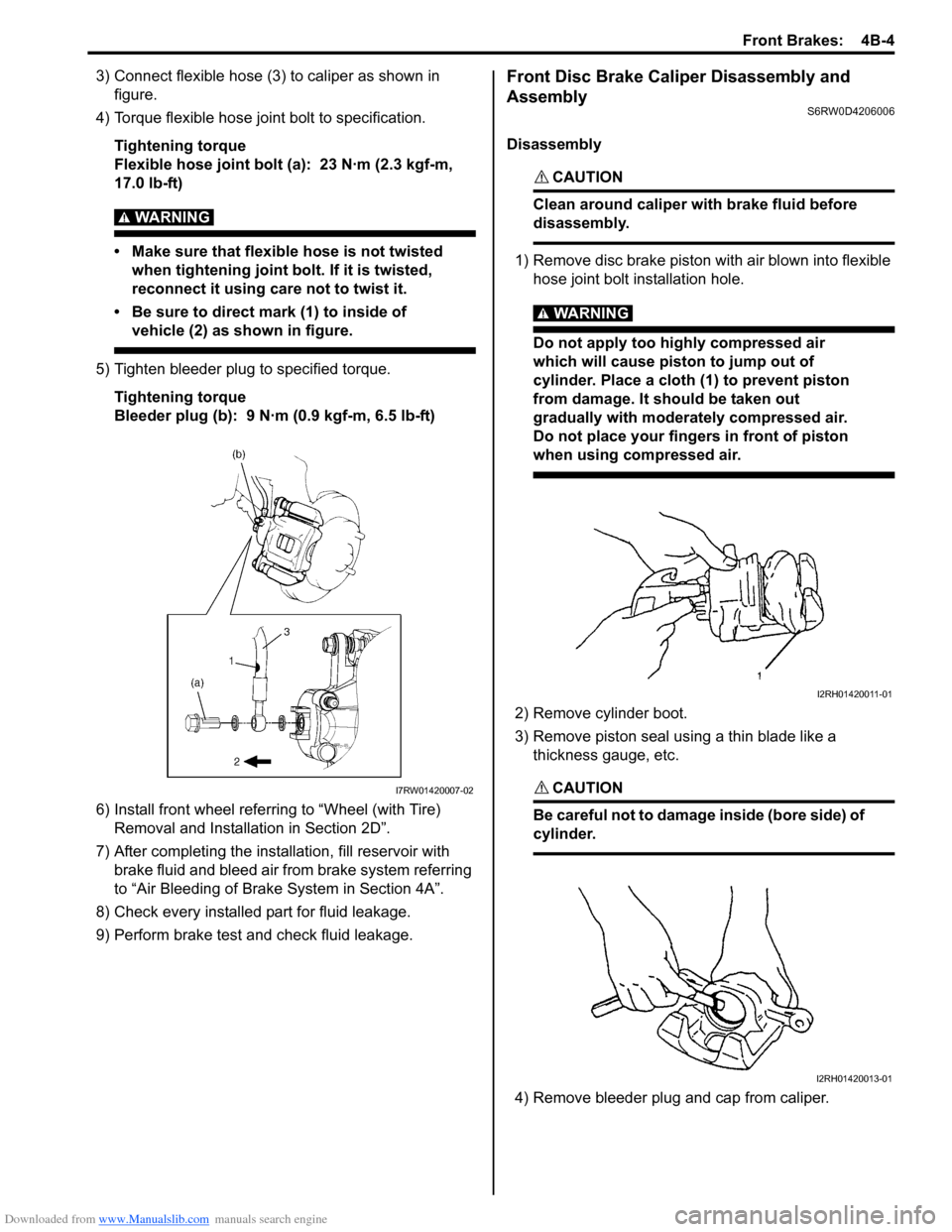
3) Connect flexible hose (3) to caliper as shown in
figure.
4) Torque flexible hose joint bolt to specification.
Tightening torque
Flexible hose joint bolt (a): 23 N·m (2.3 kgf-m,
17.0 lb-ft)
WARNING!
• Make sure that flexible hose is not twisted
when tightening joint bolt. If it is twisted,
reconnect it using care not to twist it.
• Be sure to direct mark (1) to inside of
vehicle (2) as shown in figure.
5) Tighten bleeder plug to specified torque.
Tightening torque
Bleeder plug (b): 9 N·m (0.9 kgf-m, 6.5 lb-ft)
6) Install front wheel referring to “Wheel (with Tire)
Removal and Installation in Section 2D”.
7) After completing the installation, fill reservoir with
brake fluid and bleed air from brake system referring
to “Air Bleeding of Brake System in Section 4A”.
8) Check every installed part for fluid leakage.
9) Perform brake test and check fluid leakage.
Front Disc Brake Caliper Disassembly and
Assembly
S6RW0D4206006
Disassembly
CAUTION!
Clean around caliper with brake fluid before
disassembly.
1) Remove disc brake piston with air blown into flexible
hose joint bolt installation hole.
WARNING!
Do not apply too highly compressed air
which will cause piston to jump out of
cylinder. Place a cloth (1) to prevent piston
from damage. It should be taken out
gradually with moderately compressed air.
Do not place your fingers in front of piston
when using compressed air.
2) Remove cylinder boot.
3) Remove piston seal using a thin blade like a
thickness gauge, etc.
CAUTION!
Be careful not to damage inside (bore side) of
cylinder.
4) Remove bleeder plug and cap from caliper.
I7RW01420007-02
I2RH01420011-01
I2RH01420013-01