wheel TOYOTA AYGO 2013 (in English) Owner's Guide
[x] Cancel search | Manufacturer: TOYOTA, Model Year: 2013, Model line: AYGO, Model: TOYOTA AYGO 2013Pages: 372, PDF Size: 14.28 MB
Page 127 of 372
127 2-1. Driving procedures
2
When driving
AYGO_WE_99G80E
If the engine does not start
The engine immobilizer system may not have been deactivated. (P. 73)
Contact any authorized Toyota dealer or repairer, or another duly qualified
and equipped professional.
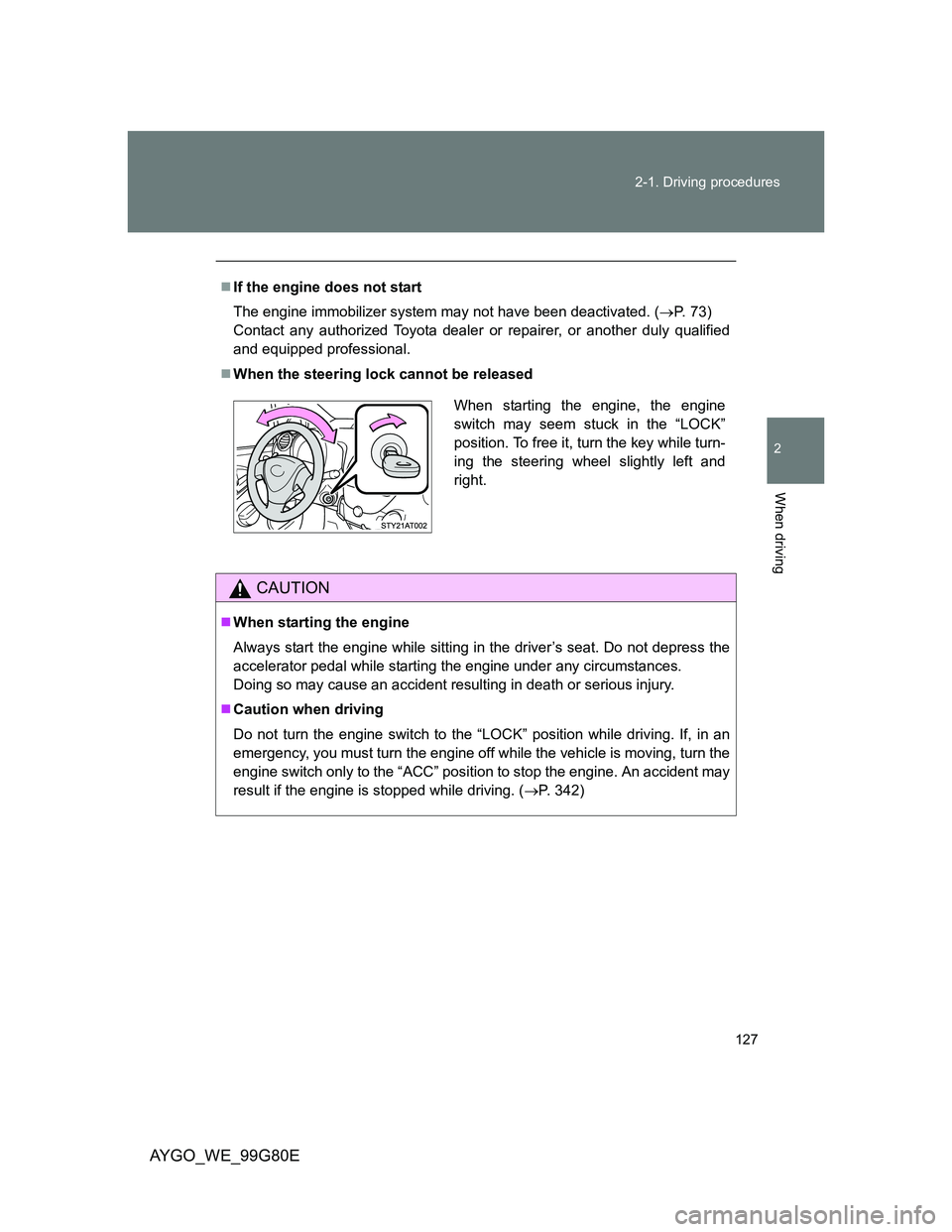
When the steering lock cannot be released
CAUTION
When starting the engine
Always start the engine while sitting in the driver’s seat. Do not depress the
accelerator pedal while starting the engine under any circumstances.
Doing so may cause an accident resulting in death or serious injury.
Caution when driving
Do not turn the engine switch to the “LOCK” position while driving. If, in an
emergency, you must turn the engine off while the vehicle is moving, turn the
engine switch only to the “ACC” position to stop the engine. An accident may
result if the engine is stopped while driving. (P. 342)
When starting the engine, the engine
switch may seem stuck in the “LOCK”
position. To free it, turn the key while turn-
ing the steering wheel slightly left and
right.
Page 138 of 372
138
2-1. Driving procedures
AYGO_WE_99G80E
Horn
After adjusting the steering wheel
Make sure that the steering wheel is securely locked.
The horn may not sound if the steering wheel is not securely locked.
(P. 63)
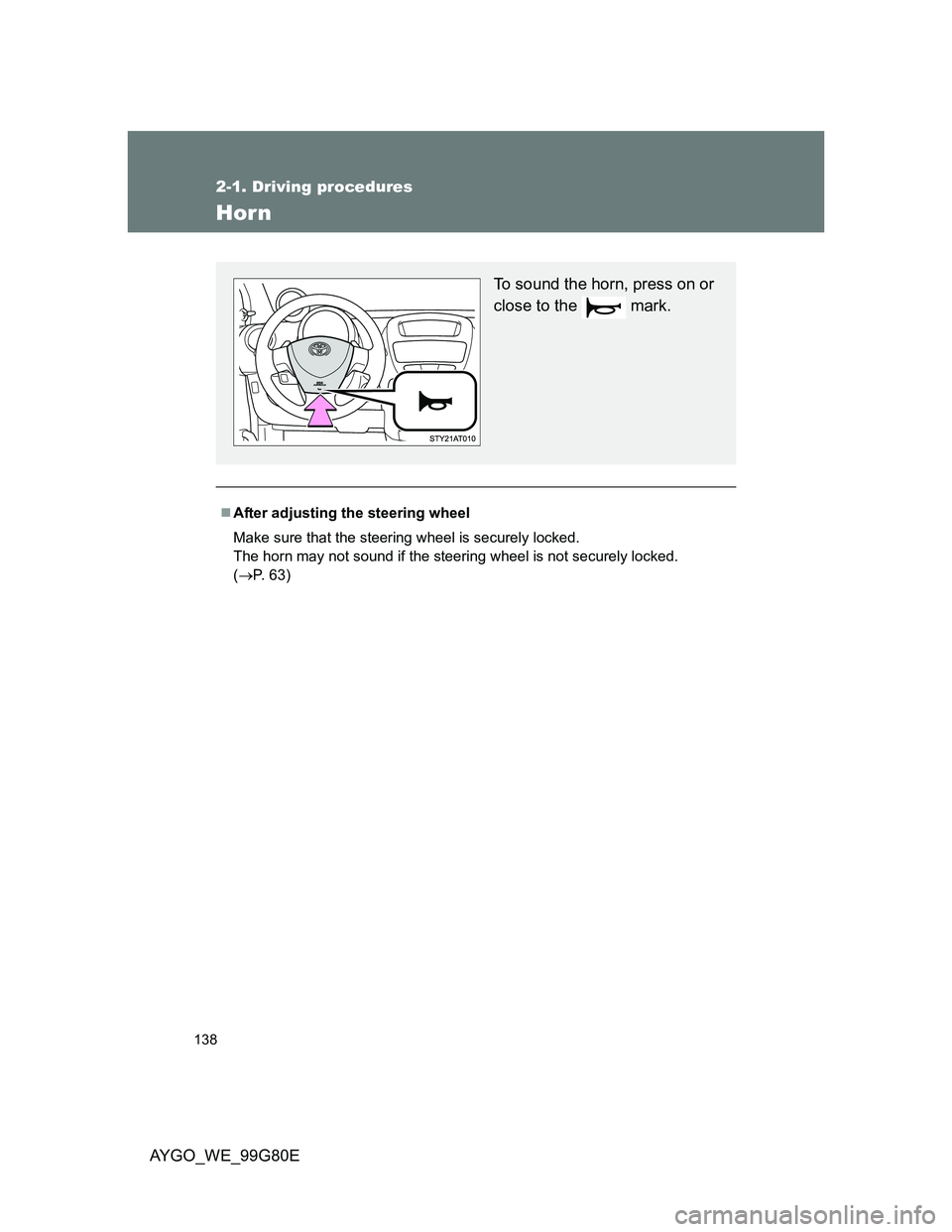
To sound the horn, press on or
close to the mark.
Page 154 of 372
154
AYGO_WE_99G80E
2-4. Using other driving systems
Driving assist systems
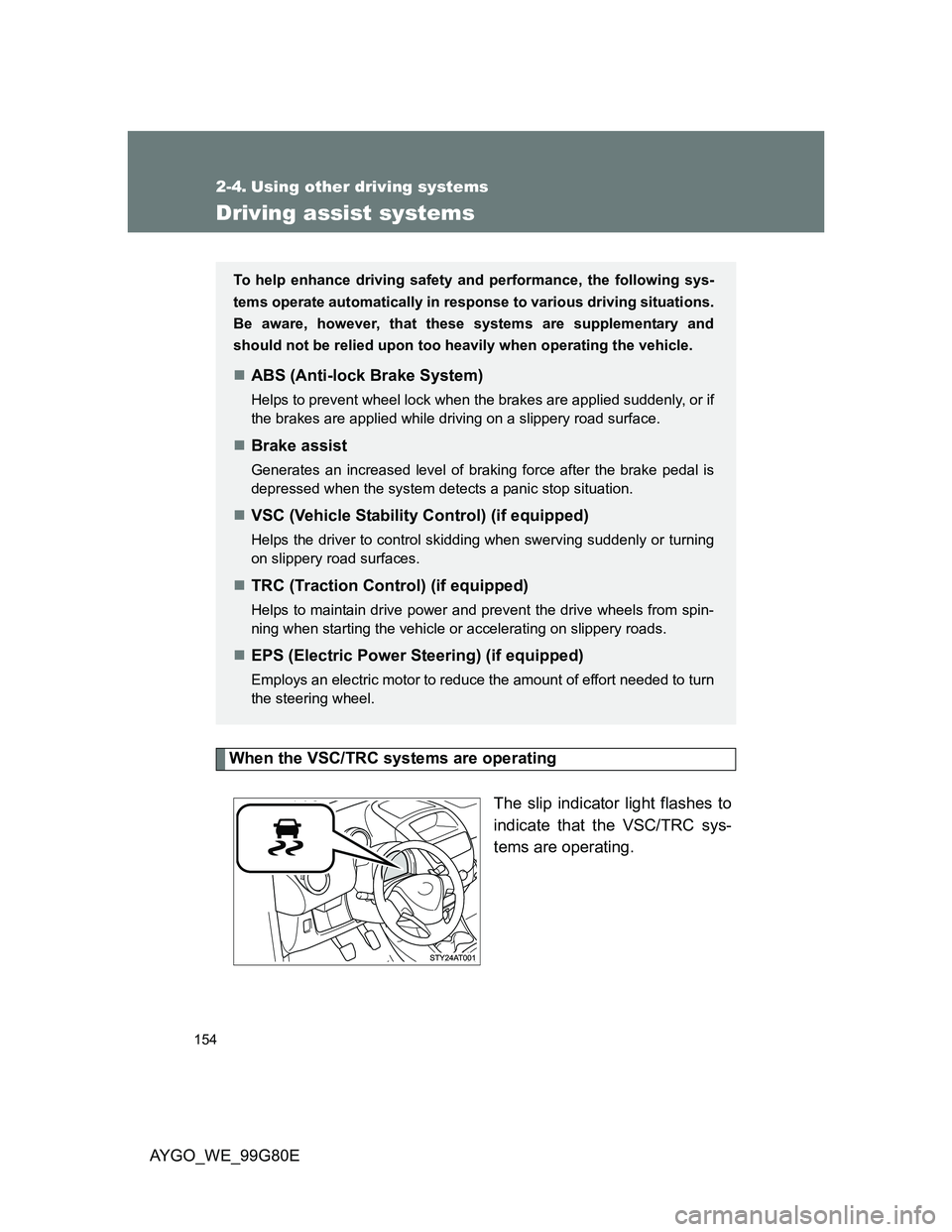
When the VSC/TRC systems are operating
The slip indicator light flashes to
indicate that the VSC/TRC sys-
tems are operating.
To help enhance driving safety and performance, the following sys-
tems operate automatically in response to various driving situations.
Be aware, however, that these systems are supplementary and
should not be relied upon too heavily when operating the vehicle.
ABS (Anti-lock Brake System)
Helps to prevent wheel lock when the brakes are applied suddenly, or if
the brakes are applied while driving on a slippery road surface.
Brake assist
Generates an increased level of braking force after the brake pedal is
depressed when the system detects a panic stop situation.
VSC (Vehicle Stability Control) (if equipped)
Helps the driver to control skidding when swerving suddenly or turning
on slippery road surfaces.
TRC (Traction Control) (if equipped)
Helps to maintain drive power and prevent the drive wheels from spin-
ning when starting the vehicle or accelerating on slippery roads.
EPS (Electric Power Steering) (if equipped)
Employs an electric motor to reduce the amount of effort needed to turn
the steering wheel.
Page 155 of 372
155 2-4. Using other driving systems
2
When driving
AYGO_WE_99G80E
Sounds and vibrations caused by the ABS, brake assist, VSC and TRC
systems
A sound may be heard from the engine compartment when the engine is
started or just after the vehicle begins to move. This sound does not indi-
cate that a malfunction has occurred in any of these systems.
Any of the following conditions may occur when the above systems are
operating. None of these indicates that a malfunction has occurred.
• Vibrations may be felt through the vehicle body and steering.
• A motor sound may be heard after the vehicle comes to a stop.
• The brake pedal may pulsate slightly while the ABS is operating.
• The brake pedal may move down slightly after the ABS is activated.
EPS operation sound
When the steering wheels is operated, a motor sound (whirring sound) may
be heard. This does not indicate a malfunction.
Reduced effectiveness of the EPS system
The effectiveness of the EPS system is reduced to prevent the system from
overheating when there is frequent steering input over an extended period of
time. The steering wheel may feel heavy as a result. Should this occur,
refrain from excessive steering input or stop the vehicle and turn the engine
off. The EPS system should return to normal within 10 minutes.
CAUTION
The ABS does not operate effectively when
The limits of tire gripping performance have been exceeded (such as
excessively worn tires on a snow covered road).
The vehicle hydroplanes while driving at high speed on wet or slick roads.
Page 156 of 372
156 2-4. Using other driving systems
AYGO_WE_99G80E
CAUTION
Stopping distance when the ABS is operating may exceed that of nor-
mal conditions
The ABS is not designed to shorten the vehicle’s stopping distance. Always
maintain a safe distance from the vehicle in front of you, especially in the fol-
lowing situations:
When driving on dirt, gravel or snow-covered roads
When driving with tire chains
When driving over bumps in the road
When driving over roads with potholes or roads with uneven surfaces
TRC may not operate effectively when
Directional control and power may not be achievable while driving on slip-
pery road surfaces, even if the TRC system is operating.
Drive the vehicle carefully in conditions where stability and power may be
lost.
When the VSC is activated
The slip indicator light flashes. Always drive carefully. Reckless driving may
cause an accident. Exercise particular care when the indicator light flashes.
Replacing tires
Observe the following precautions.
Failure to do so may cause the ABS, VSC and TRC systems not to function
correctly.
Make sure that all tires are of the specified size, brand, tread pattern and
total load capacity.
Do not use tires of noticeably different wear level.
Make sure that the tires are inflated to the recommended tire inflation
pressure level. (P. 355)
Contact any authorized Toyota dealer or repairer, or another duly qualified
and equipped professional for further information when replacing tires or
wheels.
Handling of tires and the suspension
Using tires with any kind of problem or modifying the suspension will affect
the driving assist systems, and may cause a system to malfunction.
Page 160 of 372
160 2-5. Driving information
AYGO_WE_99G80E
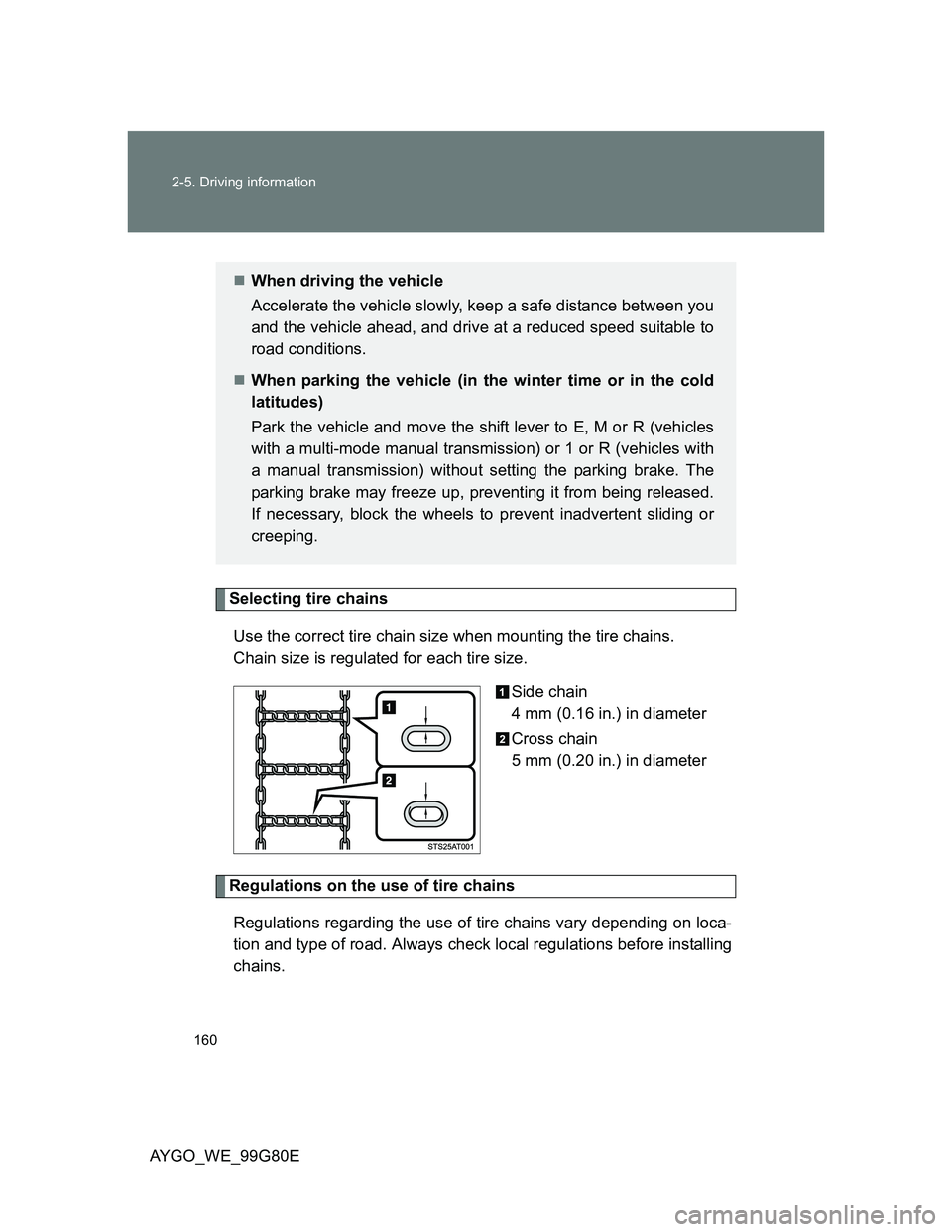
Selecting tire chains
Use the correct tire chain size when mounting the tire chains.
Chain size is regulated for each tire size.
Side chain
4 mm (0.16 in.) in diameter
Cross chain
5 mm (0.20 in.) in diameter
Regulations on the use of tire chains
Regulations regarding the use of tire chains vary depending on loca-
tion and type of road. Always check local regulations before installing
chains.
When driving the vehicle
Accelerate the vehicle slowly, keep a safe distance between you
and the vehicle ahead, and drive at a reduced speed suitable to
road conditions.
When parking the vehicle (in the winter time or in the cold
latitudes)
Park the vehicle and move the shift lever to E, M or R (vehicles
with a multi-mode manual transmission) or 1 or R (vehicles with
a manual transmission) without setting the parking brake. The
parking brake may freeze up, preventing it from being released.
If necessary, block the wheels to prevent inadvertent sliding or
creeping.
Page 161 of 372
161 2-5. Driving information
2
When driving
AYGO_WE_99G80E
Tire chain installation
Observe the following precautions when installing and removing chains:
Install and remove tire chains in a safe location.
Install tire chains on the front tires only. Do not install tire chains on the
rear tires.
Install tire chains on front tires as tightly as possible. Retighten chains
after driving 0.5 1.0 km (1/4 1/2 mile).
Install tire chains following the instructions provided with the tire chains.
If wheel ornaments are used, they will be scratched by the chain band,
so remove the ornaments before putting on the chains. (P. 321)
CAUTION
Driving with snow tires
Observe the following precautions to reduce the risk of accidents.
Failure to do so may result in a loss of vehicle control and cause death or
serious injury.
Use tires of the specified size.
Maintain the recommended level of air pressure.
Do not drive at speeds in excess of the speed limit or the speed limit spec-
ified for the snow tires being used.
Use snow tires on all, not just some wheels.
Do not use tires of noticeably different wear level.
Page 163 of 372
163
2-5. Driving information
2
When driving
AYGO_WE_99G80E
Trailer towing
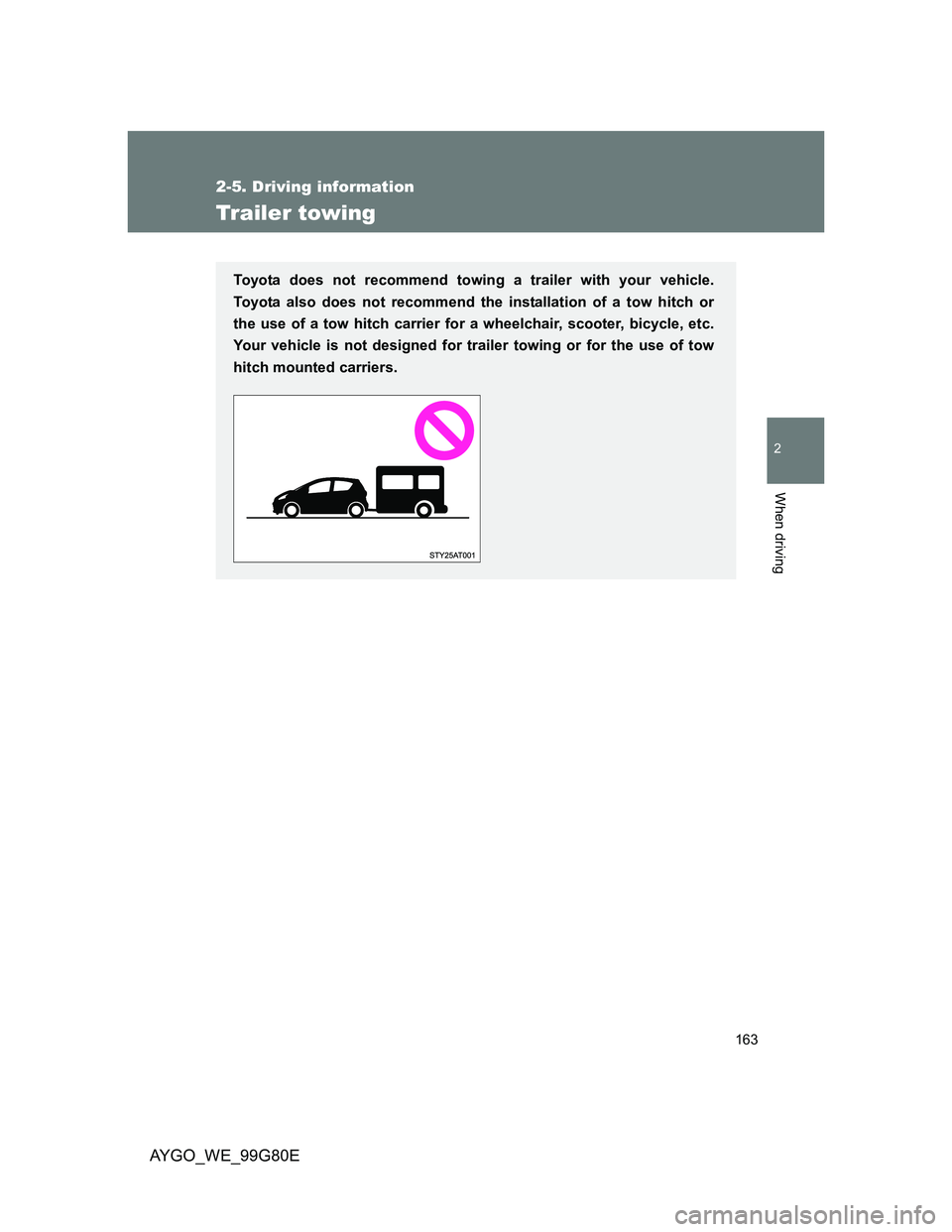
Toyota does not recommend towing a trailer with your vehicle.
Toyota also does not recommend the installation of a tow hitch or
the use of a tow hitch carrier for a wheelchair, scooter, bicycle, etc.
Your vehicle is not designed for trailer towing or for the use of tow
hitch mounted carriers.
Page 241 of 372
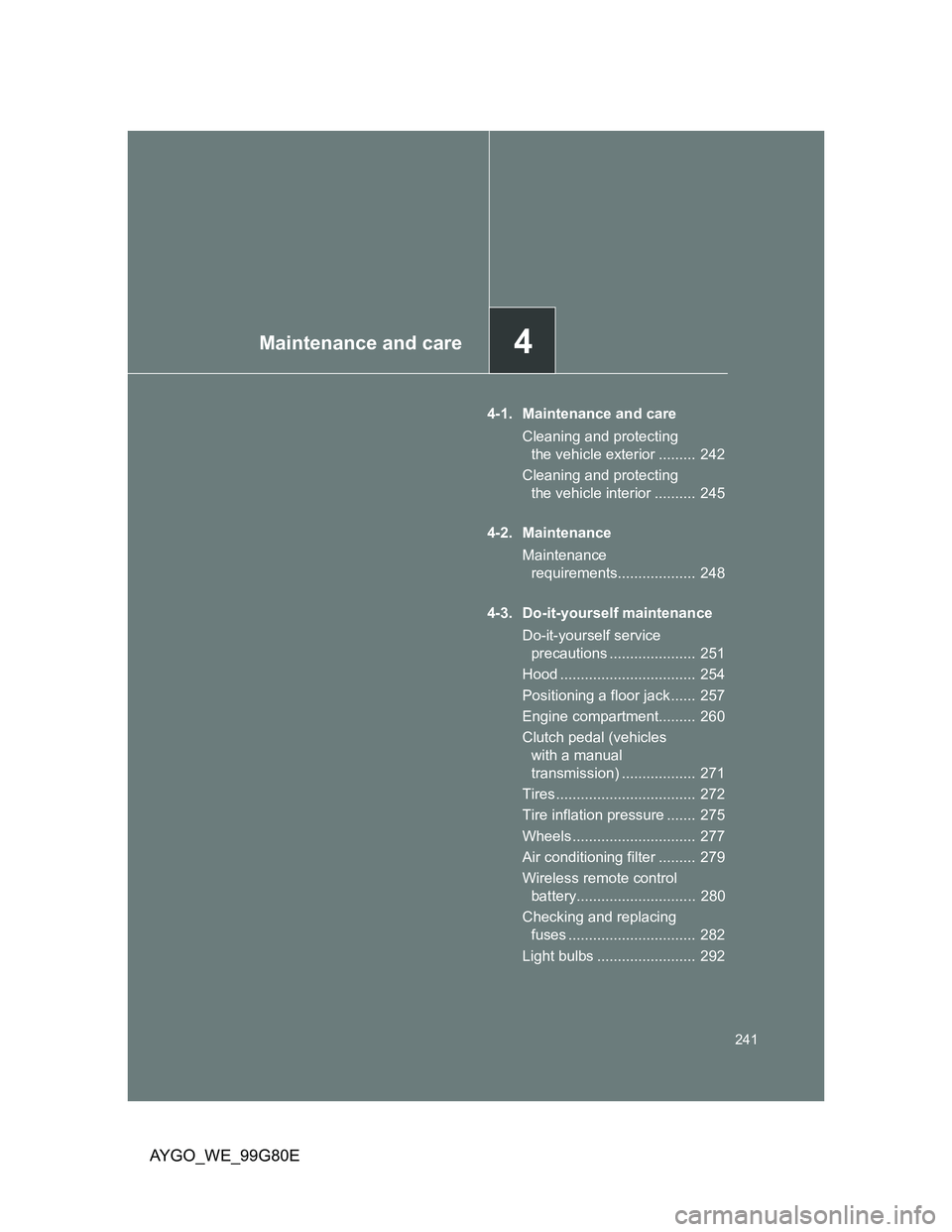
4Maintenance and care
241
AYGO_WE_99G80E
4-1. Maintenance and care
Cleaning and protecting
the vehicle exterior ......... 242
Cleaning and protecting
the vehicle interior .......... 245
4-2. Maintenance
Maintenance
requirements................... 248
4-3. Do-it-yourself maintenance
Do-it-yourself service
precautions ..................... 251
Hood ................................. 254
Positioning a floor jack ...... 257
Engine compartment......... 260
Clutch pedal (vehicles
with a manual
transmission) .................. 271
Tires .................................. 272
Tire inflation pressure ....... 275
Wheels .............................. 277
Air conditioning filter ......... 279
Wireless remote control
battery............................. 280
Checking and replacing
fuses ............................... 282
Light bulbs ........................ 292
Page 242 of 372
242
AYGO_WE_99G80E
4-1. Maintenance and care
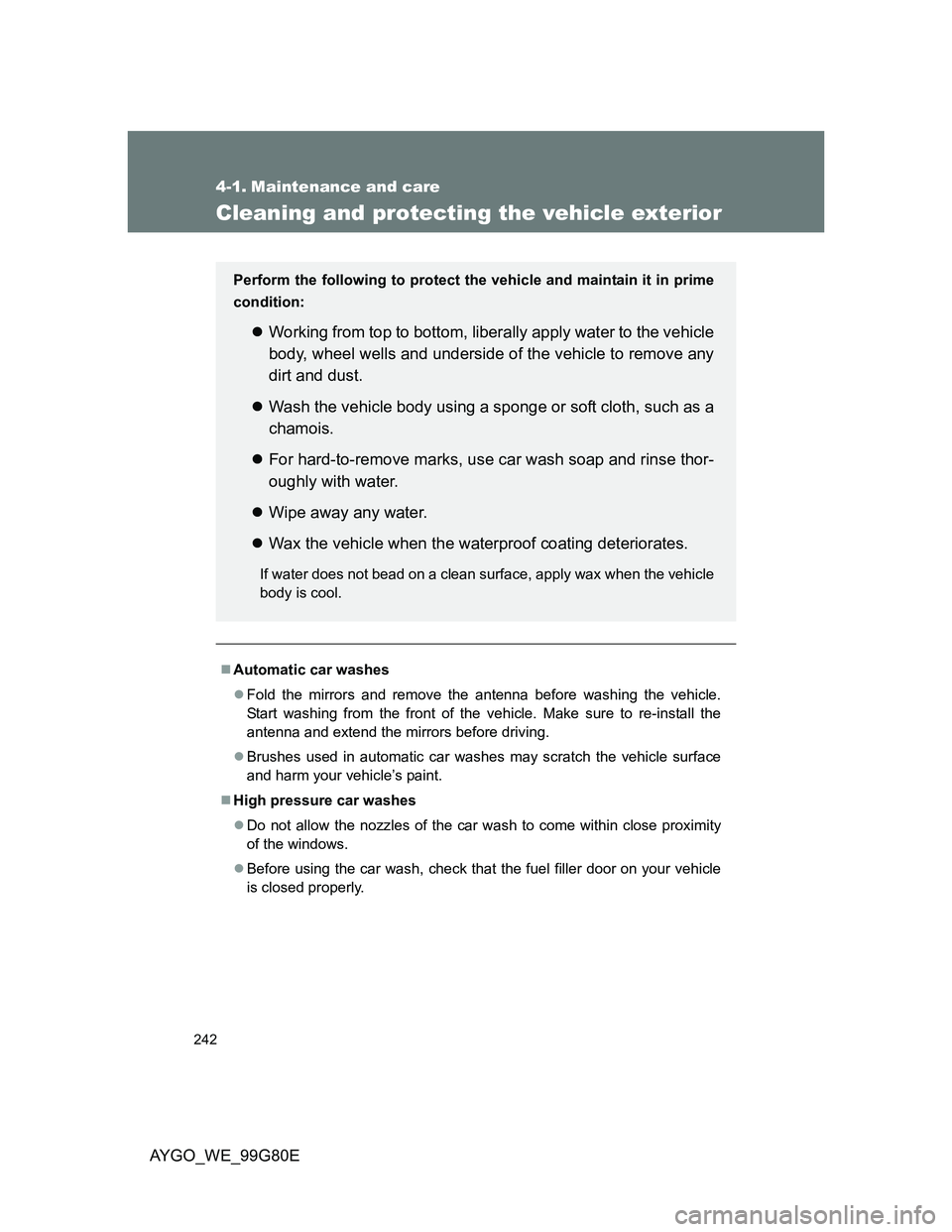
Cleaning and protecting the vehicle exterior
Automatic car washes
Fold the mirrors and remove the antenna before washing the vehicle.
Start washing from the front of the vehicle. Make sure to re-install the
antenna and extend the mirrors before driving.
Brushes used in automatic car washes may scratch the vehicle surface
and harm your vehicle’s paint.
High pressure car washes
Do not allow the nozzles of the car wash to come within close proximity
of the windows.
Before using the car wash, check that the fuel filler door on your vehicle
is closed properly.
Perform the following to protect the vehicle and maintain it in prime
condition:
Working from top to bottom, liberally apply water to the vehicle
body, wheel wells and underside of the vehicle to remove any
dirt and dust.
Wash the vehicle body using a sponge or soft cloth, such as a
chamois.
For hard-to-remove marks, use car wash soap and rinse thor-
oughly with water.
Wipe away any water.
Wax the vehicle when the waterproof coating deteriorates.
If water does not bead on a clean surface, apply wax when the vehicle
body is cool.