flat tire TOYOTA BZ4X 2022 (in English) User Guide
[x] Cancel search | Manufacturer: TOYOTA, Model Year: 2022, Model line: BZ4X, Model: TOYOTA BZ4X 2022Pages: 674, PDF Size: 120.02 MB
Page 336 of 674
334
Owners Manual_Europe_M42D76_en
5-4. Using the driving support systems
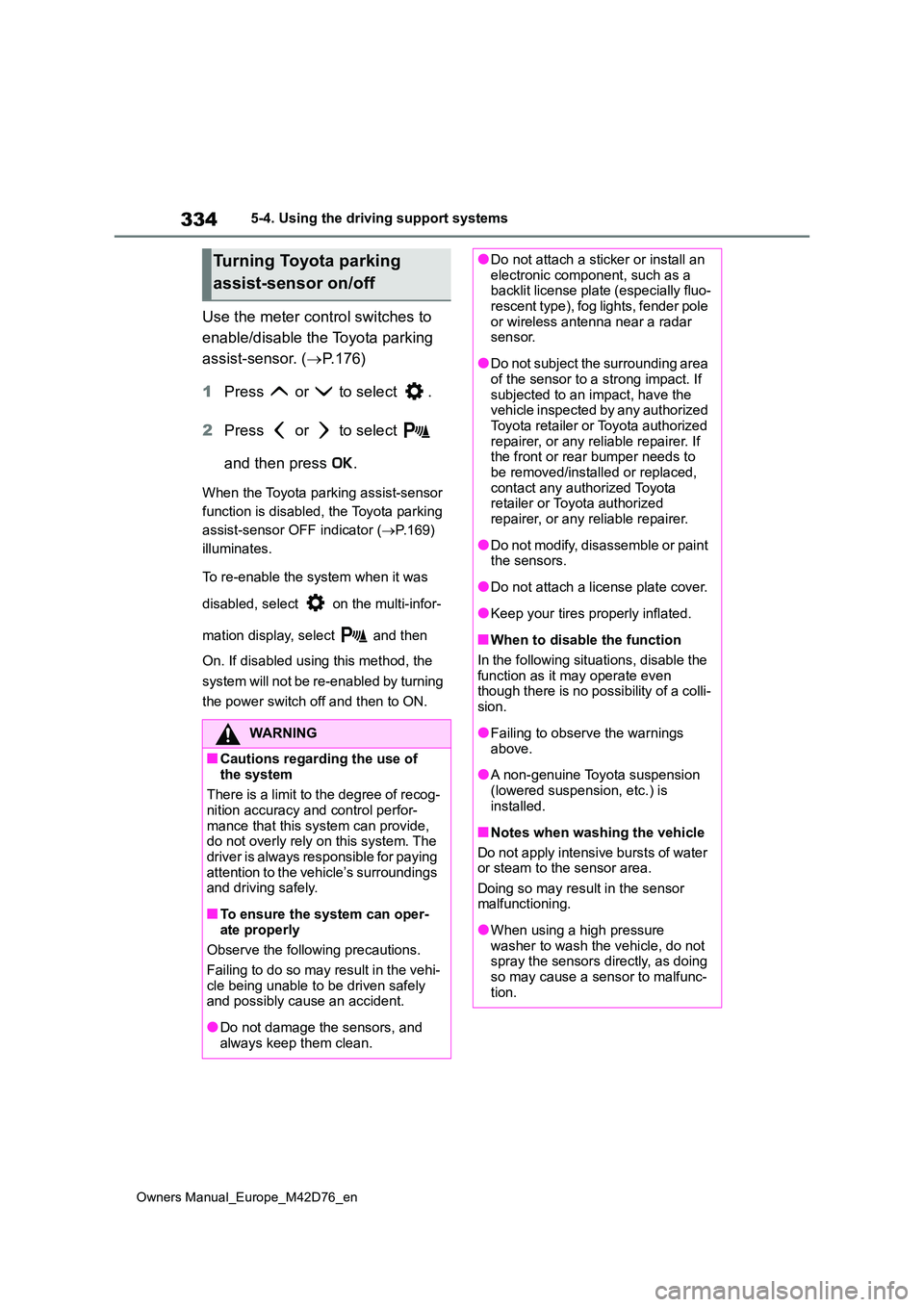
Use the meter control switches to
enable/disable the Toyota parking
assist-sensor. ( P. 1 7 6 )
1 Press or to select .
2 Press or to select
and then press .
When the Toyota parking assist-sensor
function is disabled, the Toyota parking
assist-sensor OFF indicator ( P.169)
illuminates.
To re-enable the system when it was
disabled, select on the multi-infor-
mation display, select and then
On. If disabled using this method, the
system will not be re-enabled by turning
the power switch off and then to ON.
Turning Toyota parking
assist-sensor on/off
WARNING
■Cautions regarding the use of
the system
There is a limit to the degree of recog- nition accuracy and control perfor-
mance that this system can provide, do not overly rely on this system. The driver is always responsible for paying
attention to the vehicle’s surroundings and driving safely.
■To ensure the system can oper-ate properly
Observe the following precautions.
Failing to do so may result in the vehi- cle being unable to be driven safely and possibly cause an accident.
●Do not damage the sensors, and always keep them clean.
●Do not attach a sticker or install an electronic component, such as a backlit license plate (especially fluo-
rescent type), fog lights, fender pole or wireless antenna near a radar sensor.
●Do not subject the surrounding area of the sensor to a strong impact. If
subjected to an impact, have the vehicle inspected by any authorized Toyota retailer or Toyota authorized
repairer, or any reliable repairer. If the front or rear bumper needs to be removed/installed or replaced,
contact any authorized Toyota retailer or Toyota authorized repairer, or any reliable repairer.
●Do n ot m od i fy, d is a sse mb l e o r p ai n t the sensors.
●Do not attach a license plate cover.
●Keep your tires properly inflated.
■When to disable the function
In the following situations, disable the function as it may operate even though there is no possibility of a colli-
sion.
●Failing to observe the warnings
above.
●A non-genuine Toyota suspension
(lowered suspension, etc.) is installed.
■Notes when washing the vehicle
Do not apply intensive bursts of water or steam to the sensor area.
Doing so may result in the sensor malfunctioning.
●When using a high pressure washer to wash the vehicle, do not spray the sensors directly, as doing
so may cause a sensor to malfunc- tion.
Page 355 of 674
353
5
Owners Manual_Europe_M42D76_en
5-4. Using the driving support systems
Driving
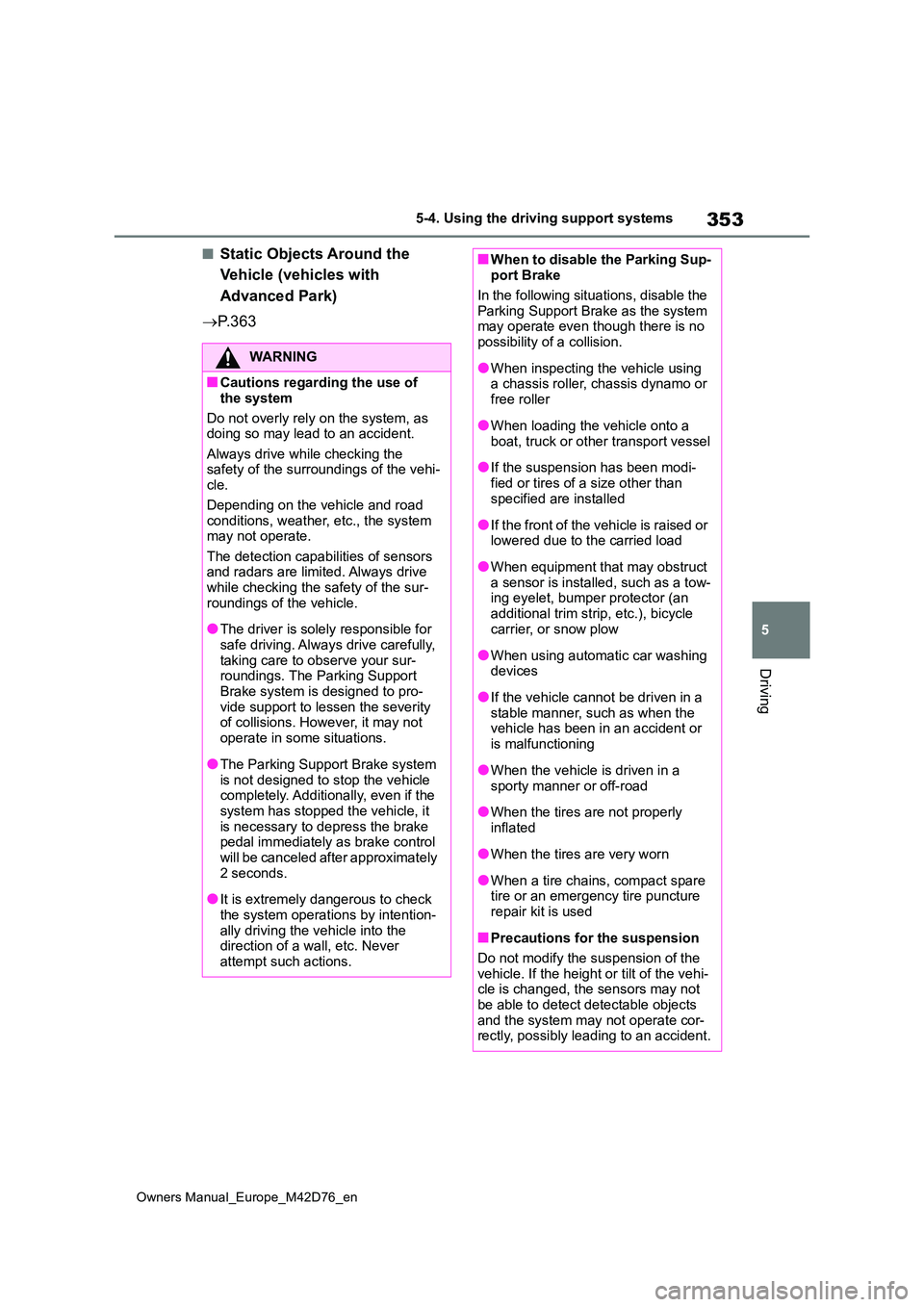
■Static Objects Around the
Vehicle (vehicles with
Advanced Park)
P. 3 6 3
WARNING
■Cautions regarding the use of
the system
Do not overly rely on the system, as doing so may lead to an accident.
Always drive while checking the safety of the surroundings of the vehi-cle.
Depending on the vehicle and road conditions, weather, etc., the system may not operate.
The detection capabilities of sensors and radars are limited. Always drive while checking the safety of the sur-
roundings of the vehicle.
●The driver is solely responsible for
safe driving. Always drive carefully, taking care to observe your sur-roundings. The Parking Support
Brake system is designed to pro- vide support to lessen the severity of collisions. However, it may not
operate in some situations.
●The Parking Support Brake system
is not designed to stop the vehicle completely. Additionally, even if the system has stopped the vehicle, it
is necessary to depress the brake pedal immediately as brake control will be canceled after approximately
2 seconds.
●It is extremely dangerous to check
the system operations by intention- ally driving the vehicle into the direction of a wall, etc. Never
attempt such actions.
■When to disable the Parking Sup- port Brake
In the following situations, disable the
Parking Support Brake as the system may operate even though there is no possibility of a collision.
●When inspecting the vehicle using a chassis roller, chassis dynamo or
free roller
●When loading the vehicle onto a
boat, truck or other transport vessel
●If the suspension has been modi-
fied or tires of a size other than specified are installed
●If the front of the vehicle is raised or lowered due to the carried load
●When equipment that may obstruct a sensor is installed, such as a tow-ing eyelet, bumper protector (an
additional trim strip, etc.), bicycle carrier, or snow plow
●When using automatic car washing devices
●If the vehicle cannot be driven in a stable manner, such as when the vehicle has been in an accident or
is malfunctioning
●When the vehicle is driven in a
sporty manner or off-road
●When the tires are not properly
inflated
●When the tires are very worn
●When a tire chains, compact spare tire or an emergency tire puncture
repair kit is used
■Precautions for the suspension
Do not modify the suspension of the vehicle. If the height or tilt of the vehi-cle is changed, the sensors may not
be able to detect detectable objects and the system may not operate cor-rectly, possibly leading to an accident.
Page 412 of 674
410
Owners Manual_Europe_M42D76_en
5-4. Using the driving support systems
WARNING
●Unlike the parking brake, hill-start assist control is not intended to hold
the vehicle stationary for an extended period of time. Do not attempt to use hill-start assist con-
trol to hold the vehicle on an incline, as doing so may lead to an acci-dent.
■When the TRC/ABS/VSC/Trailer Sway Control is activated
The slip indicator light flashes. Always drive carefully. Reckless driving may cause an accident. Exercise particular
care when the indicator light flashes.
■When the TRC/VSC/Trailer Sway
Control systems are turned off
Be especially careful and drive at a speed appropriate to the road condi-
tions. As these are the systems to help ensure vehicle stability and driv-ing force, do not turn the
TRC/VSC/Trailer Sway Control sys- tems off unless necessary.Trailer Sway Control is part of the
VSC system and will not operate if VSC is turned off or experiences a malfunction.
■Replacing tires
Make sure that all tires are of the
specified size, brand, tread pattern and total load capacity. In addition, make sure that the tires are inflated to
the recommended tire inflation pres- sure level.The ABS, TRC, VSC and Trailer
Sway Control systems will not func- tion correctly if different tires are installed on the vehicle.
Contact any authorized Toyota retailer or Toyota authorized repairer, or any reliable repairer for further information
when replacing tires or wheels.
■Handling of tires and the suspen- sion
Using tires with any kind of problem
or modifying the suspension will affect the driving assist systems, and may cause a system to malfunction.
■Trailer Sway Control precaution
The Trailer Sway Control system is
not able to reduce trailer sway in all situations. Depending on many fac-tors such as the conditions of the
vehicle, trailer, road surface and driv- ing environment, the Trailer Sway Control system may not be effective.
Refer to your trailer owner’s manual for information on how to tow your trailer properly.
■If trailer sway occurs
Observe the following precautions.
Failing to do so may cause death or serious injury.
●Firmly grip the steering wheel. Steer straight ahead. Do not try to control trailer swaying by turning
the steering wheel.
●Begin releasing the accelerator
pedal immediately but very gradu- ally to reduce speed. Do not increase speed. Do not apply vehi-
cle brakes. If you make no extreme correction with the steering or brakes, your
vehicle and trailer should stabilize. ( P.237)
■Secondary Collision Brake
Do not rely solely upon the Secondary Collision Brake. This system is
designed to help reduce the possibil- ity of further damage due to a second-ary collision, however, that effect
changes according to various condi- tions. Overly relying on the system may result in death or serious injury.
Page 457 of 674
7
455
Owners Manual_Europe_M42D76_en
7
Maintenance and care
Maintenance and care
7-1. Maintenance and care
Cleaning and protecting the
vehicle exterior ............... 456
Cleaning and protecting the
vehicle interior ................ 459
7-2. Maintenance
Maintenance requirements 463
7-3. Do-it-yourself maintenance
Do-it-yourself service precau-
tions ................................ 465
Hood ................................. 467
Positioning a floor jack...... 468
Motor compartment .......... 470
Tires .................................. 476
Replacing the tire.............. 488
Tire inflation pressure ....... 494
Wheels.............................. 495
Air conditioning filter ......... 496
Electronic key battery ....... 499
Checking and replacing fuses
....................................... 501
Light bulbs ........................ 504
Page 466 of 674
464
Owners Manual_Europe_M42D76_en
7-2. Maintenance
request that a record of maintenance
be kept.
■Does your vehicle need repairs?
Be on the alert for changes in perfor- mance and sounds, and visual tip-offs
that indicate service is needed. Some important clues are:
●Appreciable loss of power
●Strange noises
●A fluid leak under the vehicle (How-ever, water dripping from the air con-
ditioning system after use is normal.)
●Flat-looking tires, excessive tire
squeal when cornering, uneven tire wear
●Vehicle pulls to one side when driven straight on a level road
●Strange noises related to suspension movement
●Loss of brake effectiveness, spongy feeling brake pedal, pedal almost touches the floor, vehicle pulls to one
side when braking
If you notice any of these clues, take your vehicle to any authorized Toyota
retailer or Toyota authorized repairer, or any reliable repairer as soon as possi-ble. Your vehicle may need adjustment
or repair.
Page 467 of 674
465
7
Owners Manual_Europe_M42D76_en
7-3. Do-it-yourself maintenance
Maintenance and care
7-3.Do-it-y ours elf main ten ance
Do-it-yourself ser vice
precautions
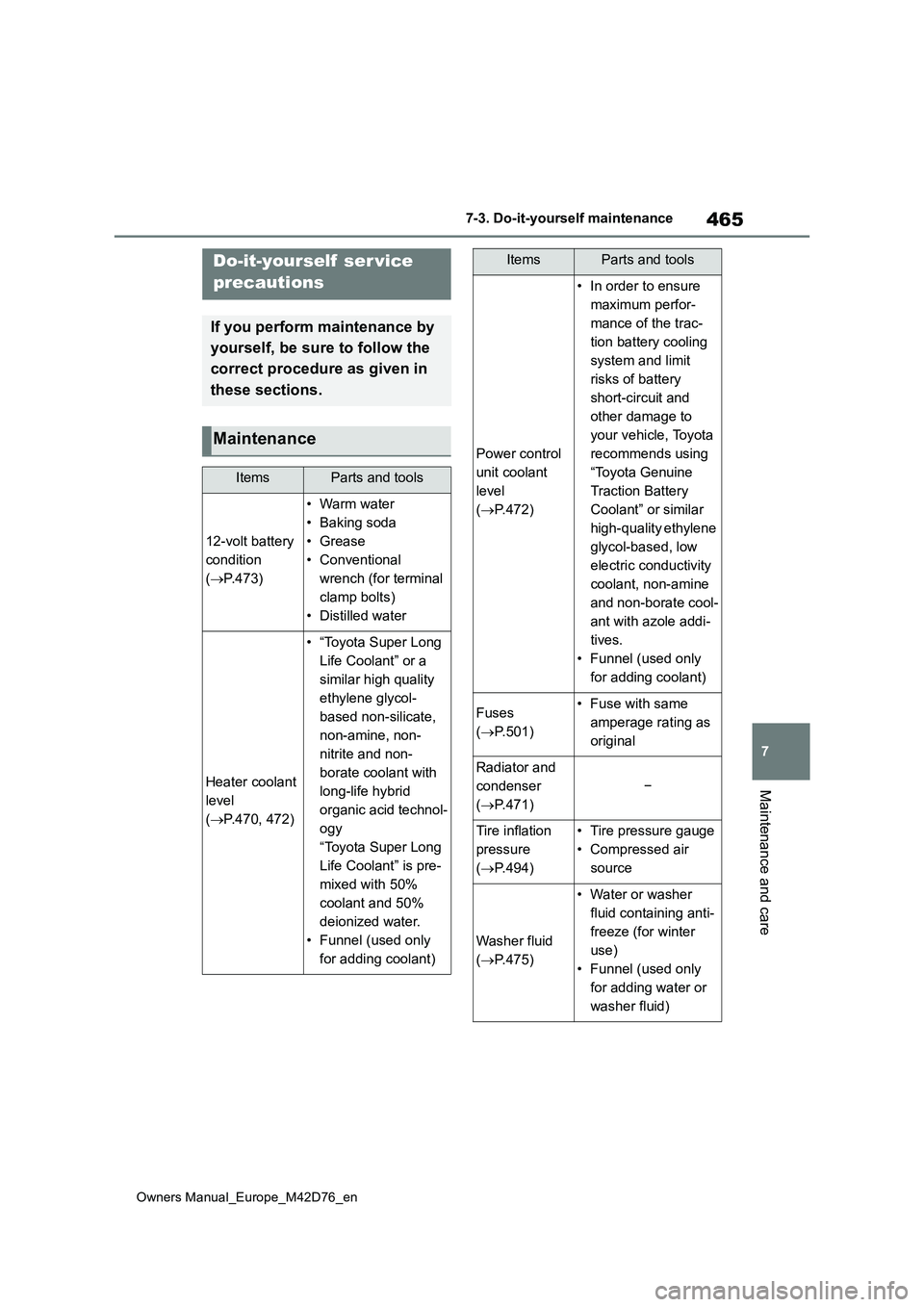
If you perform maintenance by
yourself, be sure to follow the
correct procedure as given in
these sections.
Maintenance
ItemsParts and tools
12-volt battery
condition
( P.473)
•Warm water
• Baking soda
•Grease
• Conventional
wrench (for terminal
clamp bolts)
• Distilled water
Heater coolant
level
( P.470, 472)
• “Toyota Super Long
Life Coolant” or a
similar high quality
ethylene glycol-
based non-silicate,
non-amine, non-
nitrite and non-
borate coolant with
long-life hybrid
organic acid technol-
ogy
“Toyota Super Long
Life Coolant” is pre-
mixed with 50%
coolant and 50%
deionized water.
• Funnel (used only
for adding coolant)
Power control
unit coolant
level
( P.472)
• In order to ensure
maximum perfor-
mance of the trac-
tion battery cooling
system and limit
risks of battery
short-circuit and
other damage to
your vehicle, Toyota
recommends using
“Toyota Genuine
Traction Battery
Coolant” or similar
high-quality ethylene
glycol-based, low
electric conductivity
coolant, non-amine
and non-borate cool-
ant with azole addi-
tives.
• Funnel (used only
for adding coolant)
Fuses
( P.501)
• Fuse with same
amperage rating as
original
Radiator and
condenser
( P.471)
−
Tire inflation
pressure
( P.494)
• Tire pressure gauge
• Compressed air
source
Washer fluid
( P.475)
• Water or washer
fluid containing anti-
freeze (for winter
use)
• Funnel (used only
for adding water or
washer fluid)
ItemsParts and tools
Page 478 of 674
476
Owners Manual_Europe_M42D76_en
7-3. Do-it-yourself maintenance
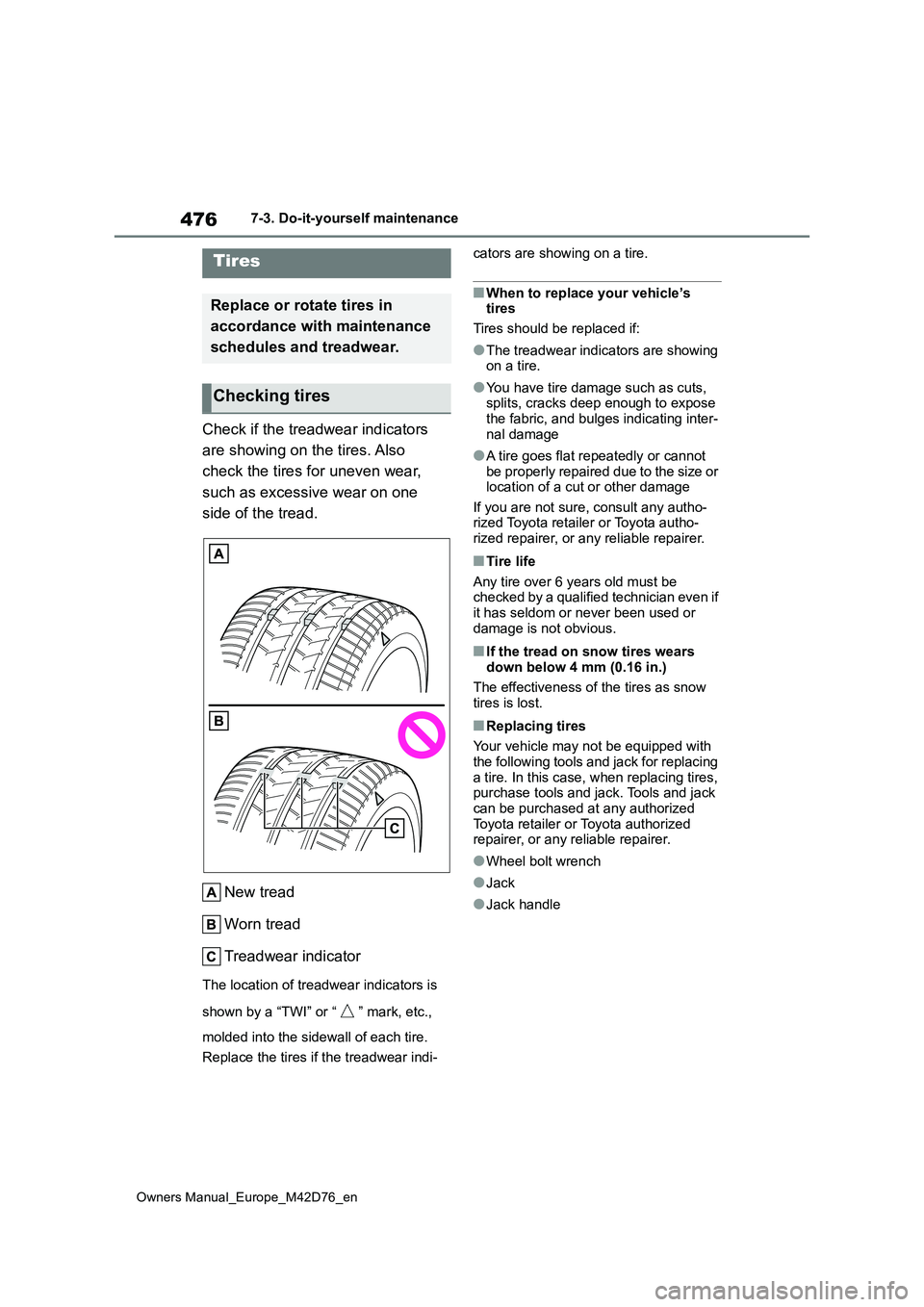
Check if the treadwear indicators
are showing on the tires. Also
check the tires for uneven wear,
such as excessive wear on one
side of the tread.
New tread
Worn tread
Treadwear indicator
The location of treadwear indicators is
shown by a “TWI” or “ ” mark, etc.,
molded into the sidewall of each tire.
Replace the tires if the treadwear indi-
cators are showing on a tire.
■When to replace your vehicle’s tires
Tires should be replaced if:
●The treadwear indicators are showing on a tire.
●You have tire damage such as cuts, splits, cracks deep enough to expose
the fabric, and bulges indicating inter- nal damage
●A tire goes flat repeatedly or cannot be properly repaired due to the size or location of a cut or other damage
If you are not sure, consult any autho- rized Toyota retailer or Toyota autho-rized repairer, or any reliable repairer.
■Tire life
Any tire over 6 years old must be checked by a qualified technician even if it has seldom or never been used or
damage is not obvious.
■If the tread on snow tires wears down below 4 mm (0.16 in.)
The effectiveness of the tires as snow
tires is lost.
■Replacing tires
Your vehicle may not be equipped with the following tools and jack for replacing
a tire. In this case, when replacing tires, purchase tools and jack. Tools and jack
can be purchased at any authorized Toyota retailer or Toyota authorized repairer, or any reliable repairer.
●Wheel bolt wrench
●Jack
●Jack handle
Tires
Replace or rotate tires in
accordance with maintenance
schedules and treadwear.
Checking tires
Page 479 of 674
477
7
Owners Manual_Europe_M42D76_en
7-3. Do-it-yourself maintenance
Maintenance and care
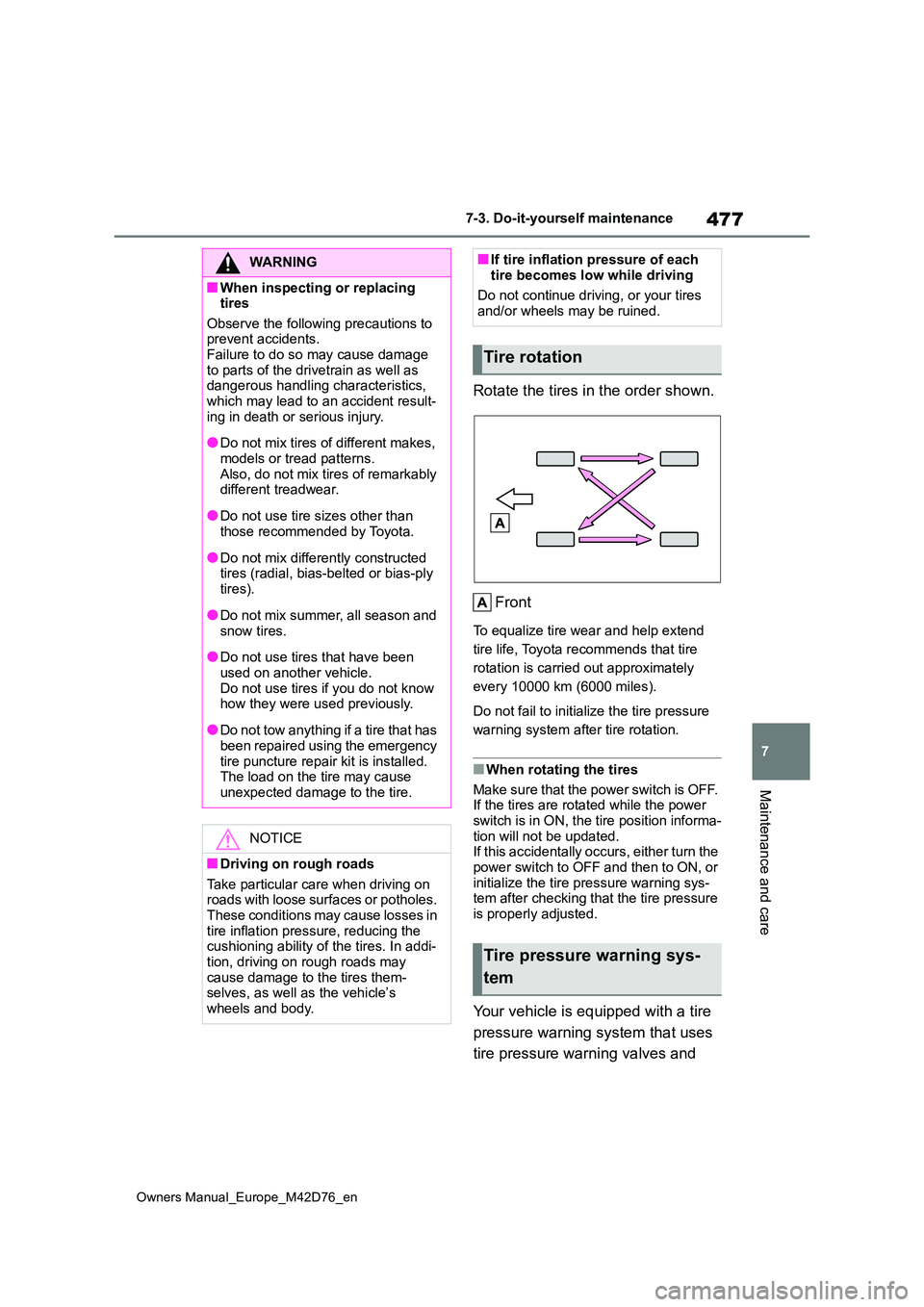
Rotate the tires in the order shown.
Front
To equalize tire wear and help extend
tire life, Toyota recommends that tire
rotation is carried out approximately
every 10000 km (6000 miles).
Do not fail to initialize the tire pressure
warning system after tire rotation.
■When rotating the tires
Make sure that the power switch is OFF. If the tires are rotated while the power
switch is in ON, the tire position informa- tion will not be updated. If this accidentally occurs, either turn the
power switch to OFF and then to ON, or initialize the tire pressure warning sys-tem after checking that the tire pressure
is properly adjusted.
Your vehicle is equipped with a tire
pressure warning system that uses
tire pressure warning valves and
WARNING
■When inspecting or replacing tires
Observe the following precautions to prevent accidents. Failure to do so may cause damage
to parts of the drivetrain as well as dangerous handling characteristics, which may lead to an accident result-
ing in death or serious injury.
●Do not mix tires of different makes,
models or tread patterns. Also, do not mix tires of remarkably different treadwear.
●Do not use tire sizes other than those recommended by Toyota.
●Do not mix differently constructed tires (radial, bias-belted or bias-ply
tires).
●Do not mix summer, all season and
snow tires.
●Do not use tires that have been
used on another vehicle. Do not use tires if you do not know how they were used previously.
●Do not tow anything if a tire that has been repaired using the emergency
tire puncture repair kit is installed. The load on the tire may cause unexpected damage to the tire.
NOTICE
■Driving on rough roads
Take particular care when driving on roads with loose surfaces or potholes. These conditions may cause losses in
tire inflation pressure, reducing the cushioning ability of the tires. In addi-tion, driving on rough roads may
cause damage to the tires them- selves, as well as the vehicle’s wheels and body.
■If tire inflation pressure of each tire becomes low while driving
Do not continue driving, or your tires
and/or wheels may be ruined.
Tire rotation
Tire pressure warning sys-
tem
Page 480 of 674
478
Owners Manual_Europe_M42D76_en
7-3. Do-it-yourself maintenance
transmitters to detect low tire infla-
tion pressure before serious prob-
lems arise.
The tire pressure warning system
of this vehicle adopts a 2-type
warning system.
When “Adjust Pressure” is dis-
played (Normal Warning)
A warning with the tire pressure warn-
ing light and warning buzzer when
there is an unknown level of low tire
pressure with the appearance of the tire
due to natural air leakage as well as the
pressure lowering due to changes in
the pressure according to the outside
temperature.
When “Immediately Check tyre
when Safe” is displayed (Emer-
gency Warning)
A warning with the tire pressure warn-
ing light and warning buzzer when
there is a known level of low tire pres-
sure with the appearance of the tire due
to pressure suddenly lowering.
However, the system may not be able
to detect sudden tire ruptures (bursting,
etc.).
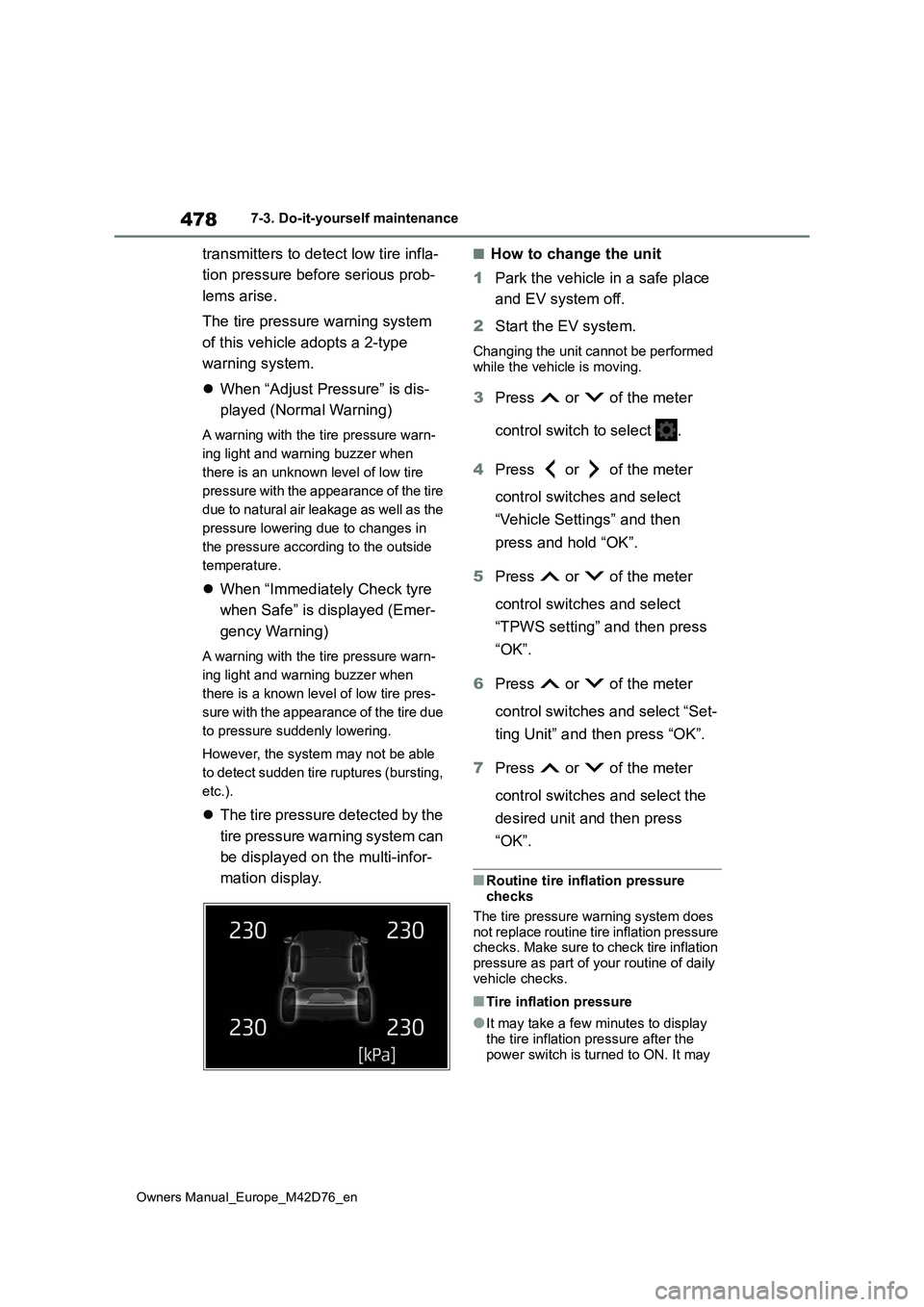
The tire pressure detected by the
tire pressure warning system can
be displayed on the multi-infor-
mation display.
■How to change the unit
1 Park the vehicle in a safe place
and EV system off.
2 Start the EV system.
Changing the unit cannot be performed
while the vehicle is moving.
3 Press or of the meter
control switch to select .
4 Press or of the meter
control switches and select
“Vehicle Settings” and then
press and hold “OK”.
5 Press or of the meter
control switches and select
“TPWS setting” and then press
“OK”.
6 Press or of the meter
control switches and select “Set-
ting Unit” and then press “OK”.
7 Press or of the meter
control switches and select the
desired unit and then press
“OK”.
■Routine tire inflation pressure checks
The tire pressure warning system does
not replace routine tire inflation pressure checks. Make sure to check tire inflation pressure as part of your routine of daily
vehicle checks.
■Tire inflation pressure
●It may take a few minutes to display
the tire inflation pressure after the power switch is turned to ON. It may
Page 481 of 674
479
7
Owners Manual_Europe_M42D76_en
7-3. Do-it-yourself maintenance
Maintenance and care
also take a few minutes to display the
tire inflation pressure after inflation pressure has been adjusted.
●Tire inflation pressure changes with temperature.The displayed values may also be dif-
ferent from the values measured using a tire pressure gauge.
■Situations in which the tire pres-sure warning system may not oper-
ate properly
●In the following cases, the tire pres-
sure warning system may not operate properly.• If non-genuine Toyota wheels are
used. • A tire has been replaced with a tire that is not an OE (Original Equipment)
tire. • A tire has been replaced with a tire that is not of the specified size.
• Tire chains etc. are equipped. • If a window tint that affects the radio wave signals is installed.
• If there is a lot of snow or ice on the vehicle, particularly around the wheels or wheel housings.
• If the tire inflation pressure is extremely higher than the specified level.
• If wheels without tire pressure warning valves and transmitters are used.• If the ID code on the tire pressure
warning valves and transmitters is not registered in the tire pressure warning computer.
●Performance may be affected in the following situations.
• Near a TV tower, electric power plant, gas station, radio station, large dis-play, airport or other facility that gen-
erates strong radio waves or electrical noise• When carrying a portable radio, cellu-
lar phone, cordless phone or other wireless communication device
If tire position information is not correctly
displayed due to the radio wave condi-
tions, the display may be corrected by
driving and changing the radio wave
conditions.
●When the vehicle is parked, the time taken for the warning to start or go off could be extended.
●When tire inflation pressure declines rapidly for example when a tire has
burst, the warning may not function.
When replacing tires or wheels, tire
pressure warning valves and trans-
mitters must also be installed.
When new tire pressure warning valves
and transmitters are installed, new ID
codes must be registered in the tire
pressure warning computer and the tire
pressure warning system must be ini-
tialized. ( P.484)
■When replacing the tires and wheels
If the ID code of the tire pressure warn-
ing valve and transmitter is not regis- tered, the tire pressure warning system will not work properly. After driving for
about 10 minutes, the tire pressure warning light blinks for 1 minute and
stays on to indicate a system malfunc- tion.
Installing tire pressure warn-
ing valves and transmitters