towing TOYOTA C-HR 2020 Owners Manual (in English)
[x] Cancel search | Manufacturer: TOYOTA, Model Year: 2020, Model line: C-HR, Model: TOYOTA C-HR 2020Pages: 536, PDF Size: 11.99 MB
Page 3 of 536
3
1
8 7 5 4
3
2
9
C-HR_OM_USA_OM10634U
6
4-1. Before drivingDriving the vehicle ............. 162
Cargo and luggage............ 172
Vehicle load limits ............. 175
Trailer towing..................... 176
Dinghy towing.................... 177
4-2. Driving procedures Engine (ignition) switch (vehicles without
a smart key system) ........ 178
Engine (ignition) switch (vehicles with
a smart key system) ........ 181
Continuously variable transmission .................... 188
Turn signal lever................ 193
Parking brake .................... 194
Brake Hold ........................ 199
4-3. Operating the lights and wipers
Headlight switch ................ 202
Automatic High Beam ....... 207
Fog light switch ................. 212
Windshield wipers and washer ............................ 213
Rear window wiper and washer ............................ 216 4-4. Refueling
Opening the fuel tank cap................................... 218
4-5. Using the driving support systems
Toyota Safety Sense P ...... 222
PCS (Pre-Collision System) ........................... 228
LDA (Lane Departure Alert with steering
control) ............................ 242
Dynamic radar cruise control with full-speed
range ............................... 252
Driving mode select ........... 267
BSM (Blind Spot Monitor) ........................... 269
RCTA (Rear Cross Traffic Alert) ..................... 278
Driving assist systems ....... 286
4-6. Driving tips Winter driving tips .............. 292
4Driving
Page 14 of 536
14Pictorial index
C-HR_OM_USA_OM10634U
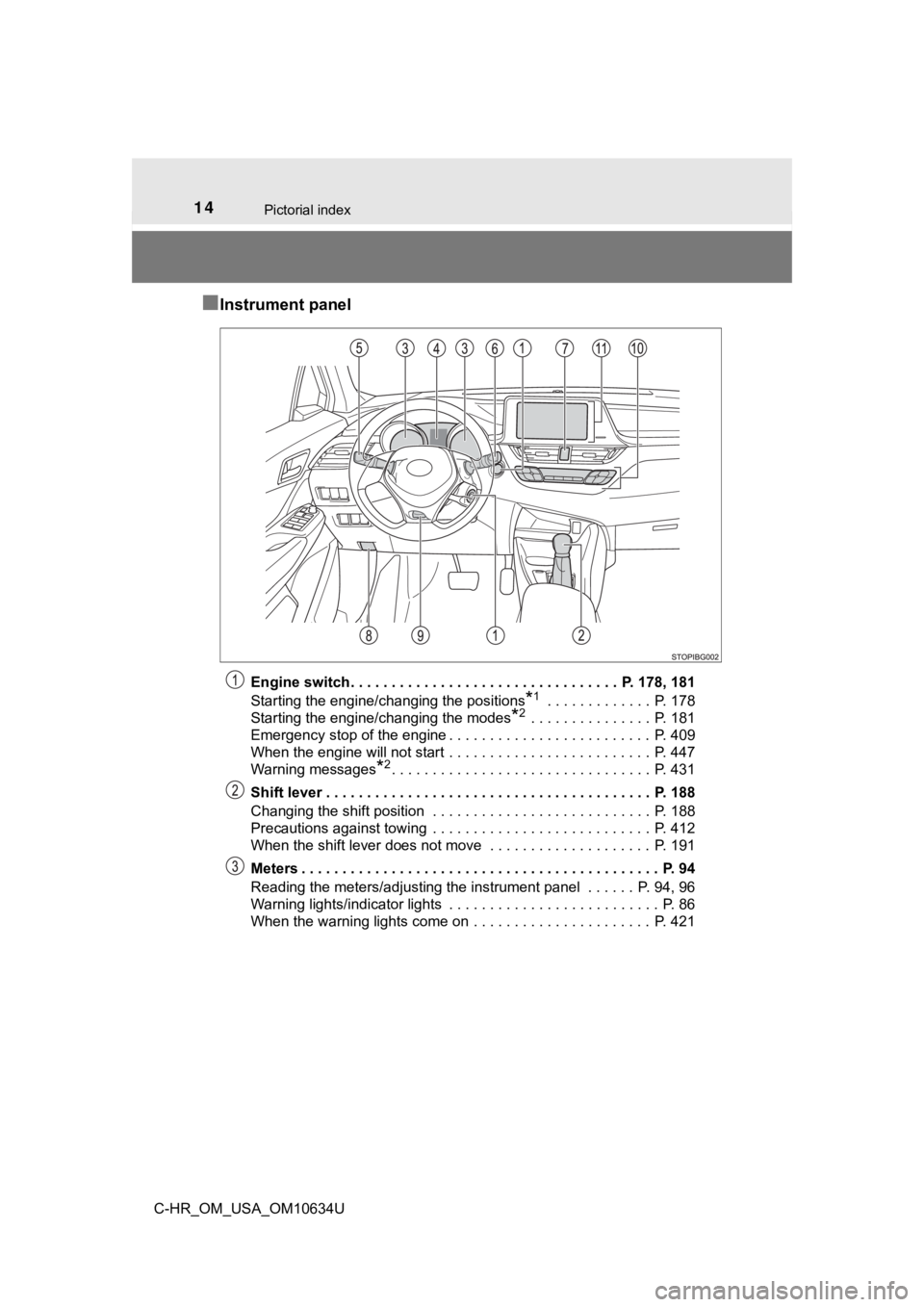
■Instrument panel
Engine switch . . . . . . . . . . . . . . . . . . . . . . . . . . . . . . . . . P. 178, 181
Starting the engine/changing the positions
*1 . . . . . . . . . . . . . P. 178
Starting the engine/changing the modes
*2 . . . . . . . . . . . . . . . P. 181
Emergency stop of the engine . . . . . . . . . . . . . . . . . . . . . . . . . P. 409
When the engine will not start . . . . . . . . . . . . . . . . . . . . . . . . . P. 447
Warning messages
*2. . . . . . . . . . . . . . . . . . . . . . . . . . . . . . . . P. 431
Shift lever . . . . . . . . . . . . . . . . . . . . . . . . . . . . . . . . . . . . . . . . P. 188
Changing the shift position . . . . . . . . . . . . . . . . . . . . . . . . . . . P. 188
Precautions against towing . . . . . . . . . . . . . . . . . . . . . . . . . . . P. 412
When the shift lever does not move . . . . . . . . . . . . . . . . . . . . P. 191
Meters . . . . . . . . . . . . . . . . . . . . . . . . . . . . . . . . . . . . . . . . . . . . P. 94
Reading the meters/adjusting the instrument panel . . . . . . P. 94, 96
Warning lights/indicator lights . . . . . . . . . . . . . . . . . . . . . . . . . . P. 86
When the warning lights come on . . . . . . . . . . . . . . . . . . . . . . P. 421
Page 65 of 536
651-2. Child safety
1
For safety and security
C-HR_OM_USA_OM10634U
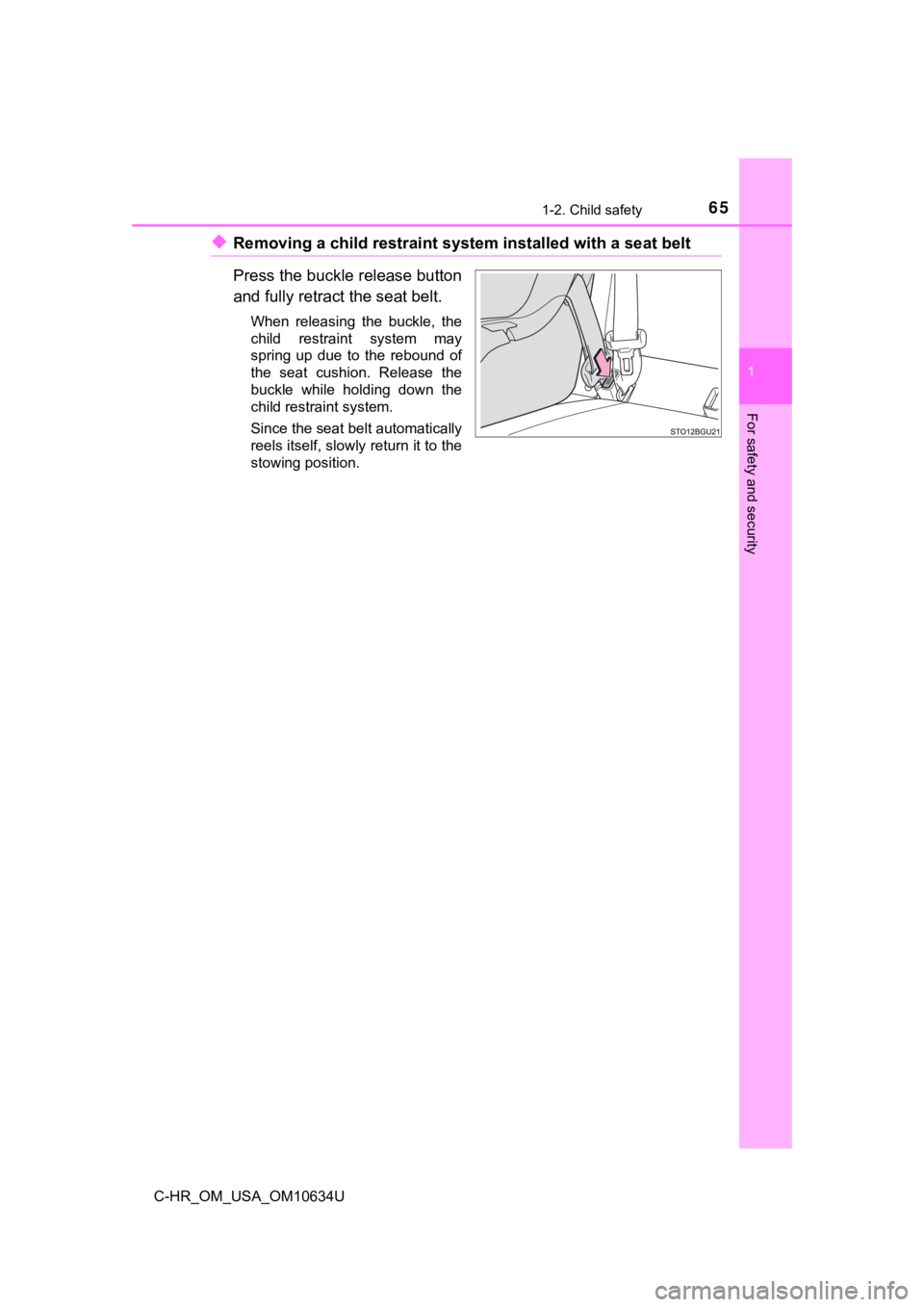
◆Removing a child restraint system installed with a seat belt
Press the buckle release button
and fully retract the seat belt.
When releasing the buckle, the
child restraint system may
spring up due to the rebound of
the seat cushion. Release the
buckle while holding down the
child restraint system.
Since the seat belt automatically
reels itself, slowly return it to the
stowing position.
Page 78 of 536

781-3. Emergency assistance
C-HR_OM_USA_OM10634U■
Stolen Vehicle Location
If your vehicle is stolen, Safety
Connect can work with local author-
ities to assist them in locating and recovering the vehicle. Af ter filing
a police report, call the Safety Connect response center at 1-8 00-
331-4331 in the United States, 1-877-855-8377 in Puerto Rico or 1-
888-869-6828 in Canada, and follow the prompts for Safety Con-
nect to initiate this service.
In addition to assisting law enforcement with recovery of a sto len
vehicle, Safety-Connect-equipped vehicle location data may, und er
certain circumstances, be shared with third parties to locate y our
vehicle. Further information is a vailable at Toyota.com in the United
States, Toyotapr.com in Puerto Rico and Toyota.ca in Canada.
■Emergency Assistance Button (“SOS”)
In the event of an emergency on t he road, push the “SOS” button to
reach the Safety Connect respons e center. The answering agent
will determine your vehicle’s loca tion, assess the emergency, and
dispatch the necessary assistanc e required.
If you accidentally press the “SOS” button, tell the response-c enter
agent that you are not experiencing an emergency.
■
Enhanced Roadside Assistance
Enhanced Roadside As sistance adds GPS data to the already
included warranty-based Toyota roadside service.
Subscribers can press the “SOS” button to reach a Safety Connec t
response-center agent, who can he lp with a wide range of needs,
such as: towing, flat tire, fuel delivery, etc. For a description of the
Enhanced Roadside Assistance se rvices and their limitations,
please see the Safety Connect Te rms and Conditions, which are
available at Toyota.com in the United States, Toyotapr.com in
Puerto Rico and Toyota.ca in Canada.
Page 161 of 536
161
4Driving
C-HR_OM_USA_OM10634U4-1. Before driving
Driving the vehicle ............. 162
Cargo and luggage ........... 172
Vehicle load limits ............. 175
Trailer towing..................... 176
Dinghy towing ................... 177
4-2. Driving procedures Engine (ignition) switch (vehicles without
a smart key system) ........ 178
Engine (ignition) switch (vehicles with
a smart key system) ........ 181
Continuously variable transmission .................... 188
Turn signal lever................ 193
Parking brake .................... 194
Brake Hold ........................ 199
4-3. Operating the lights and wipers
Headlight switch ................ 202
Automatic High Beam ....... 207
Fog light switch ................. 212
Windshield wipers and washer ............................ 213
Rear window wiper and washer ............................ 216 4-4. Refueling
Opening the fuel tank cap .................................. 218
4-5. Using the driving support systems
Toyota Safety Sense P ..... 222
PCS (Pre-Collision System)........................... 228
LDA (Lane Departure Alert with steering
control) ............................ 242
Dynamic radar cruise control with full-speed
range............................... 252
Driving mode select .......... 267
BSM (Blind Spot Monitor)........................... 269
RCTA (Rear Cross Traffic Alert) .................... 278
Driving assist systems ...... 286
4-6. Driving tips Winter driving tips ............. 292
Page 172 of 536
1724-1. Before driving
C-HR_OM_USA_OM10634U
Cargo and luggage
Cargo capacity depends on the total weight of the occupants.
(Cargo capacity) = (Total load capacity) — (Total weight of occ upants)
Toyota does not recommend towing a trailer with your vehicle. Y our
vehicle is not desig ned for trailer towing.
Take notice of the following information about storage precau-
tions, cargo capacity and load:
Capacity and distribution
Steps for Determining Correct Load Limit —
(1) Locate the statement “The c ombined weight of occupants and
cargo should never exceed XXX kg or XXX lbs.” on your vehicle’s
placard.
(2) Determine the combined weight of the driver and passengers t hat
will be riding in your vehicle.
(3) Subtract the combined weight of the driver and passengers fr om
XXX kg or XXX lbs.
(4) The resulting figure equals th e available amount of cargo and lug-
gage load capacity.
For example, if the “XXX” amount equals 1400 lbs. and there wil l
be five 150 lb passengers in your vehicle, the amount of available
cargo and luggage load capacity is 650 lbs. (1400 750 (5 150) =
650 lbs.)
(5) Determine the combined weight of luggage and cargo being loa ded
on the vehicle. That weight may n ot safely exceed the available
cargo and luggage load capacity calculated in Step 4.
(6) If your vehicle will be towing a trailer, load from your tra iler will be
transferred to your vehicle. Consult this manual to determine h ow
this reduces the available cargo and luggage load capacity of y our
vehicle. (
P. 175)
Page 175 of 536
1754-1. Before driving
4
Driving
C-HR_OM_USA_OM10634U
Vehicle load limits
◆Total load capacity (vehicle capacity weight): (P. 4 6 4 )
Total load capacity means the co mbined weight of occupants, cargo
and luggage.
◆Seating capacity: 5 occupants (Front 2, Rear 3)
Seating capacity means the max imum number of occupants whose
estimated average weight is 1 50 lb. (68 kg) per person.
◆Towing capacity
Toyota does not recommend towing a trailer with your vehicle.
◆Cargo capacity
Cargo capacity may increase or decrease depending on the weight
and the number of occupants.
■Total load capacity and seating capacity
These details are also described on the tire and loading inform ation label.
( P. 372)
Vehicle load limits include total load capacity, seating capaci ty,
towing capacity and cargo capacity.
WARNING
■Overloading the vehicle
Do not overload the vehicle.
It may not only cause damage to the tires, but also degrade steering
and braking ability, res ulting in an accident.
Page 176 of 536
1764-1. Before driving
C-HR_OM_USA_OM10634U
Trailer towing
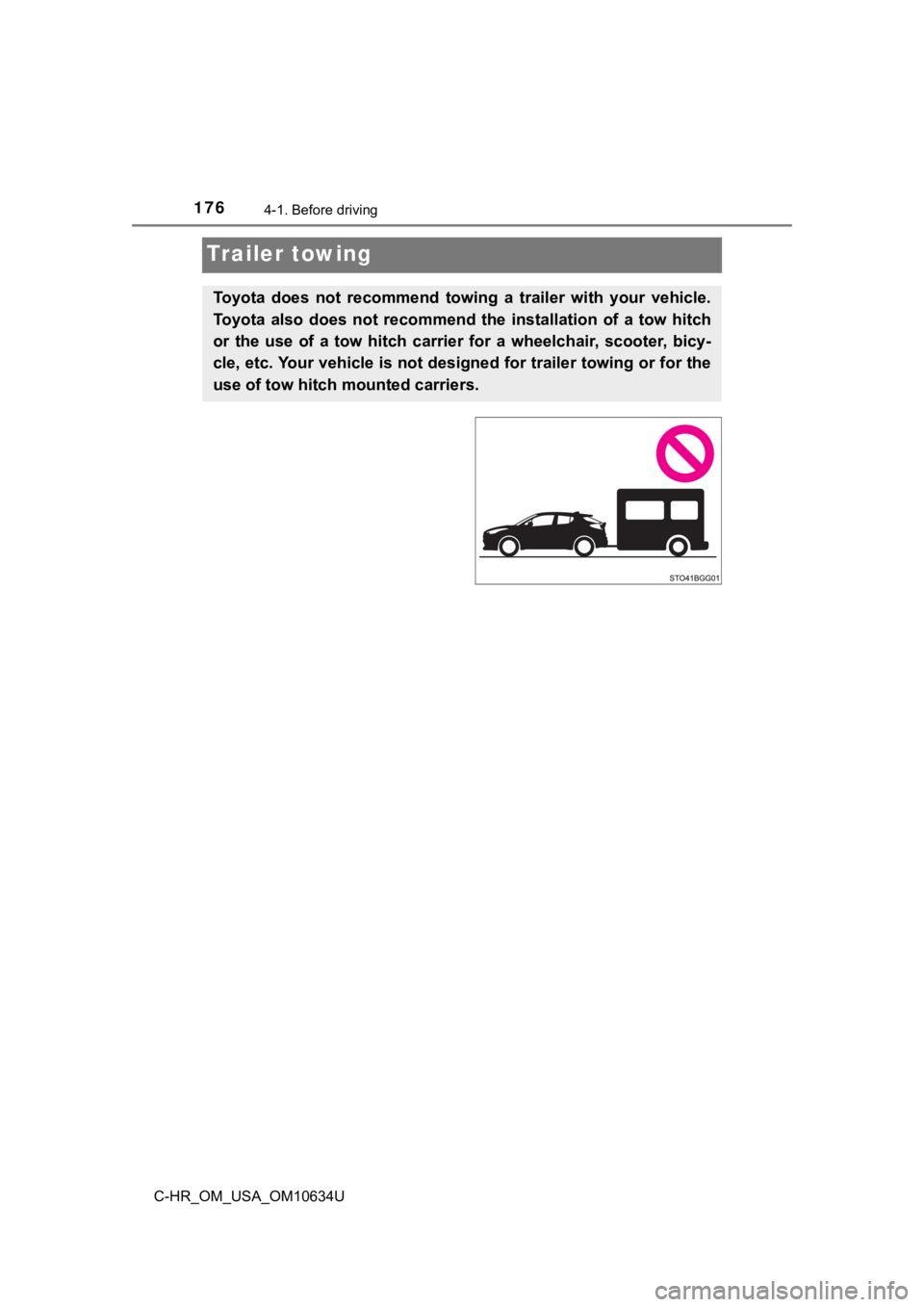
Toyota does not recommend towing a trailer with your vehicle.
Toyota also does not recommend the installation of a tow hitch
or the use of a tow hitch carrier for a wheelchair, scooter, bi cy-
cle, etc. Your vehicle is not des igned for trailer towing or for the
use of tow hitch mounted carriers.
Page 177 of 536
1774-1. Before driving
4
Driving
C-HR_OM_USA_OM10634U
Dinghy towing
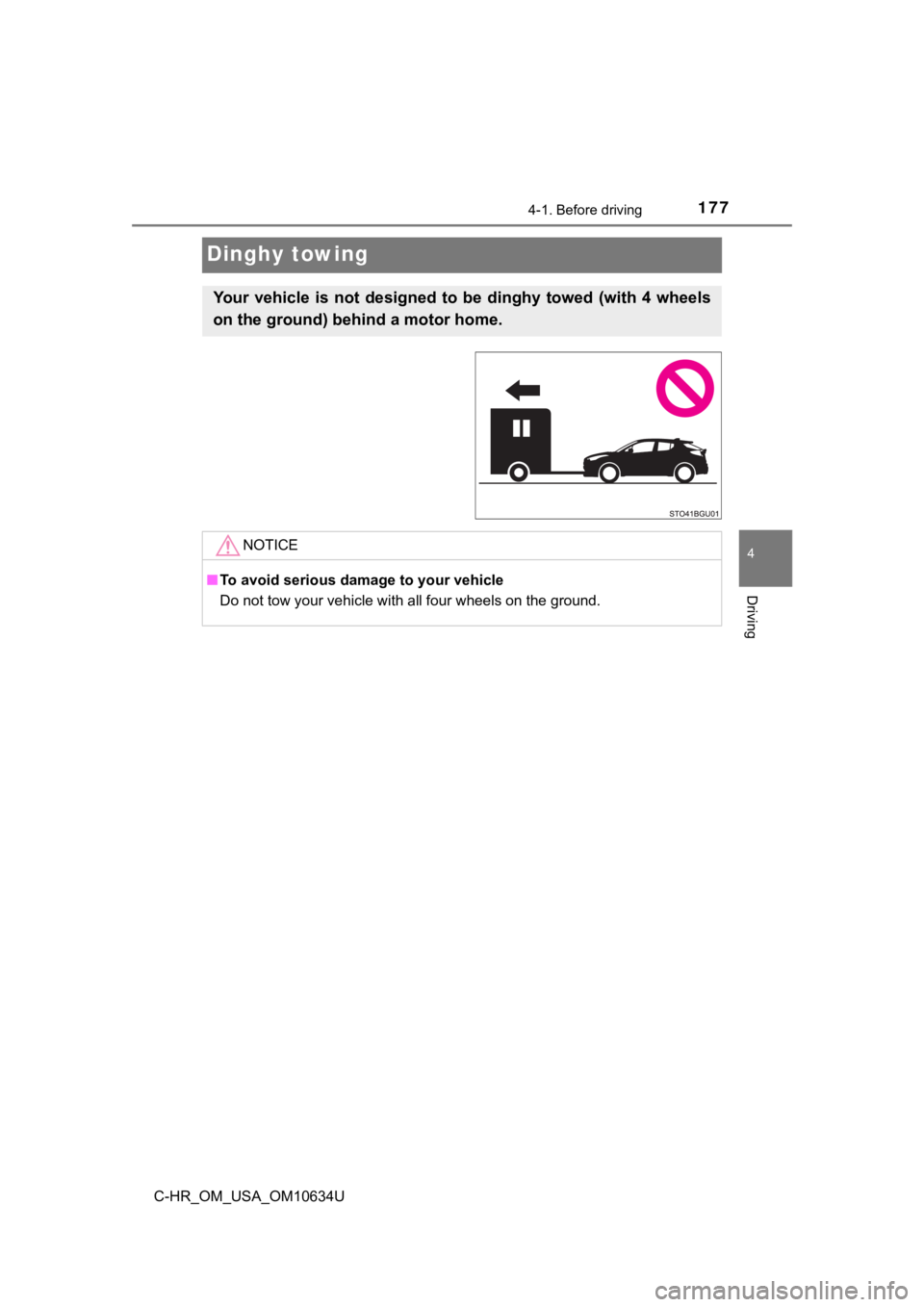
Your vehicle is not designed to be dinghy towed (with 4 wheels
on the ground) behind a motor home.
NOTICE
■To avoid serious damage to your vehicle
Do not tow your vehicle with all four wheels on the ground.
Page 231 of 536

2314-5. Using the driving support systems
4
Driving
C-HR_OM_USA_OM10634U
WARNING
■When to disable the pre-collision system
In the following situations, disable the system, as it may not operate prop-
erly, possibly leading to an accident resulting in death or ser ious injury:
● When the vehicle is being towed
● When your vehicle is towing another vehicle
● When transporting the vehicle via truck, boat, train or similar means of
transportation
● When the vehicle is raised on a lift with the engine running an d the tires
are allowed to rotate freely
● When inspecting the vehicle using a drum tester such as a chass is dyna-
mometer or speedometer tester, or when using an on vehicle whee l bal-
ancer
● When a strong impact is applied to the front bumper or front gr ille, due to
an accident or other reasons
● If the vehicle cannot be driven in a stable manner, such as when the vehi-
cle has been in an accident or is malfunctioning
● When the vehicle is driven in a sporty manner or off-road
● When the tires are not properly inflated
● When the tires are very worn
● When tires of a size other than specified are installed
● When tire chains are installed
● When a compact spare tire or an emergency tire puncture repair kit is used
● If equipment (snow plow, etc.) that may obstruct the radar sens or or cam-
era sensor is temporarily installed to the vehicle