brakes TOYOTA CAMRY 1999 Service Owner's Guide
[x] Cancel search | Manufacturer: TOYOTA, Model Year: 1999, Model line: CAMRY, Model: TOYOTA CAMRY 1999Pages: 4592, PDF Size: 55.16 MB
Page 3762 of 4592
Toyota Supports ASE CertificationPage 1 of 1
BR004±99
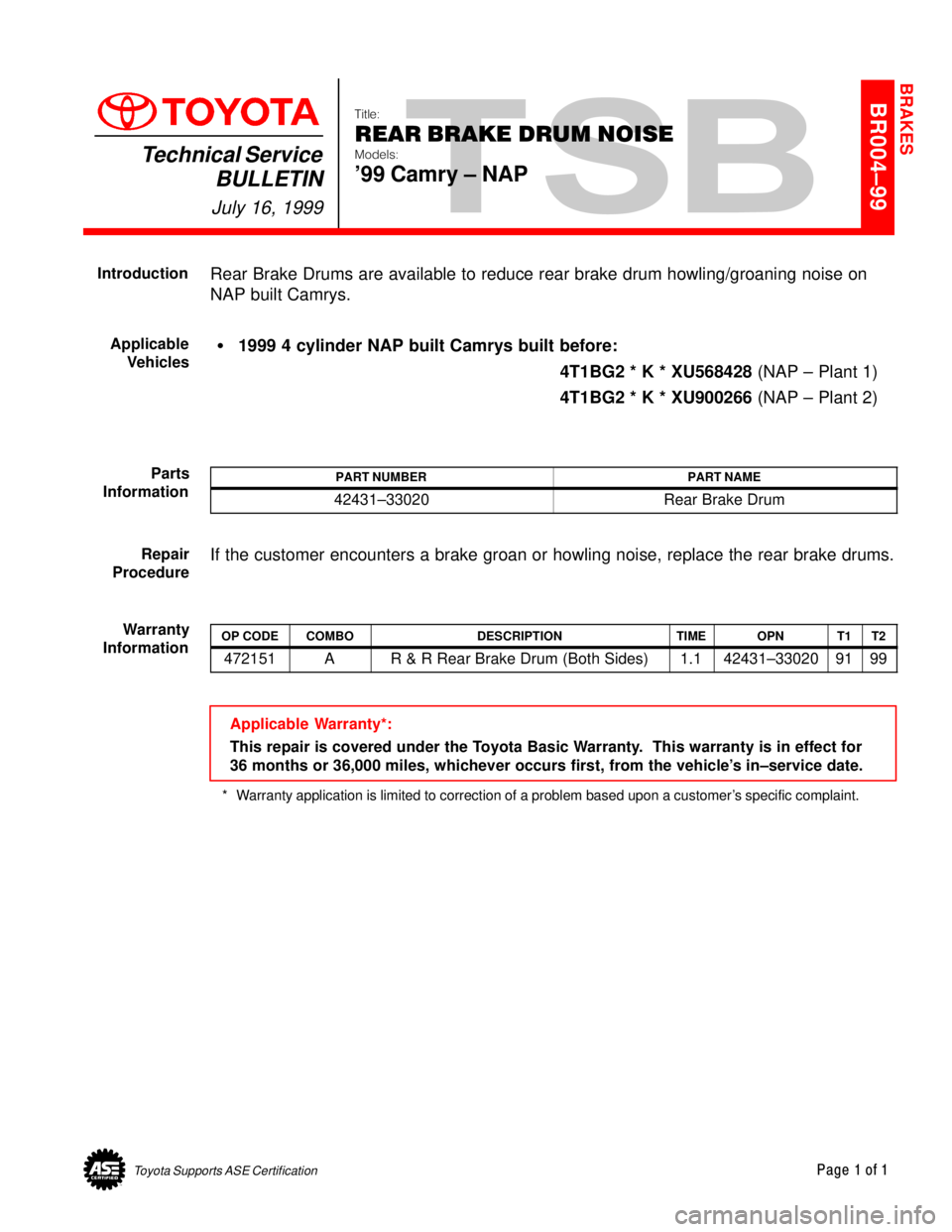
Title:
REAR BRAKE DRUM NOISE
Models:
'99 Camry ± NAP
Technical Service
BULLETIN
July 16, 1999
Rear Brake Drums are available to reduce rear brake drum howling/groaning noise on
NAP built Camrys.
1999 4 cylinder NAP built Camrys built before:
4T1BG2 * K * XU568428 (NAP ± Plant 1)
4T1BG2 * K * XU900266 (NAP ± Plant 2)
PART NUMBERPART NAME
42431±33020Rear Brake Drum
If the customer encounters a brake groan or howling noise, replace the rear brake drums.
OP CODECOMBODESCRIPTIONTIMEOPNT1T2
472151AR & R Rear Brake Drum (Both Sides)1.142431±330209199
Applicable Warranty*:
This repair is covered under the Toyota Basic Warranty. This warranty is in effect for
36 months or 36,000 miles, whichever occurs first, from the vehicle's in±service date.
* Warranty application is limited to correction of a problem based upon a customer's specific complaint.
BRAKES
Introduction
Applicable
Vehicles
Parts
Information
Repair
Procedure
Warranty
Information
Page 3763 of 4592

Toyota Supports ASE CertificationPage 1 of 4
BR004±00
Title:
BRAKE PAD CLICKING NOISE
Models:
'90 ± '00 All Models
Technical Service
BULLETIN
October 20, 2000
A clicking type noise may be noticed when first applying the brakes after changing
vehicle travel direction (
Drive/Forward to Reverse, Reverse to Drive/Forward). This is a
normal noise caused by the required brake pad±to±caliper clearances. When the
direction of travel is changed, the brake pads may ªshiftº towards the new direction of
travel. When the brake pad contacts the caliper, a clicking noise may be heard.
To minimize this clicking noise, a disc brake caliper grease has been made available for
use during brake service/maintenance operations. Under normal usage conditions this
grease should be effective for a period of 6 months to 1 year.
1990 ± 2000 model year Toyota vehicles, all models.
PREVIOUS PART NUMBERCURRENT PART NUMBERPART NAME
N/A08887±80609Disc Brake Caliper Grease (50 g tube)
OP CODEDESCRIPTIONTIMEOPNT1T2
N/ANot Applicable to Warranty ±±±±
BRAKES
Introduction
Applicable
Vehicles
Parts
Information
Warranty
Information
Page 4121 of 4592
ABS
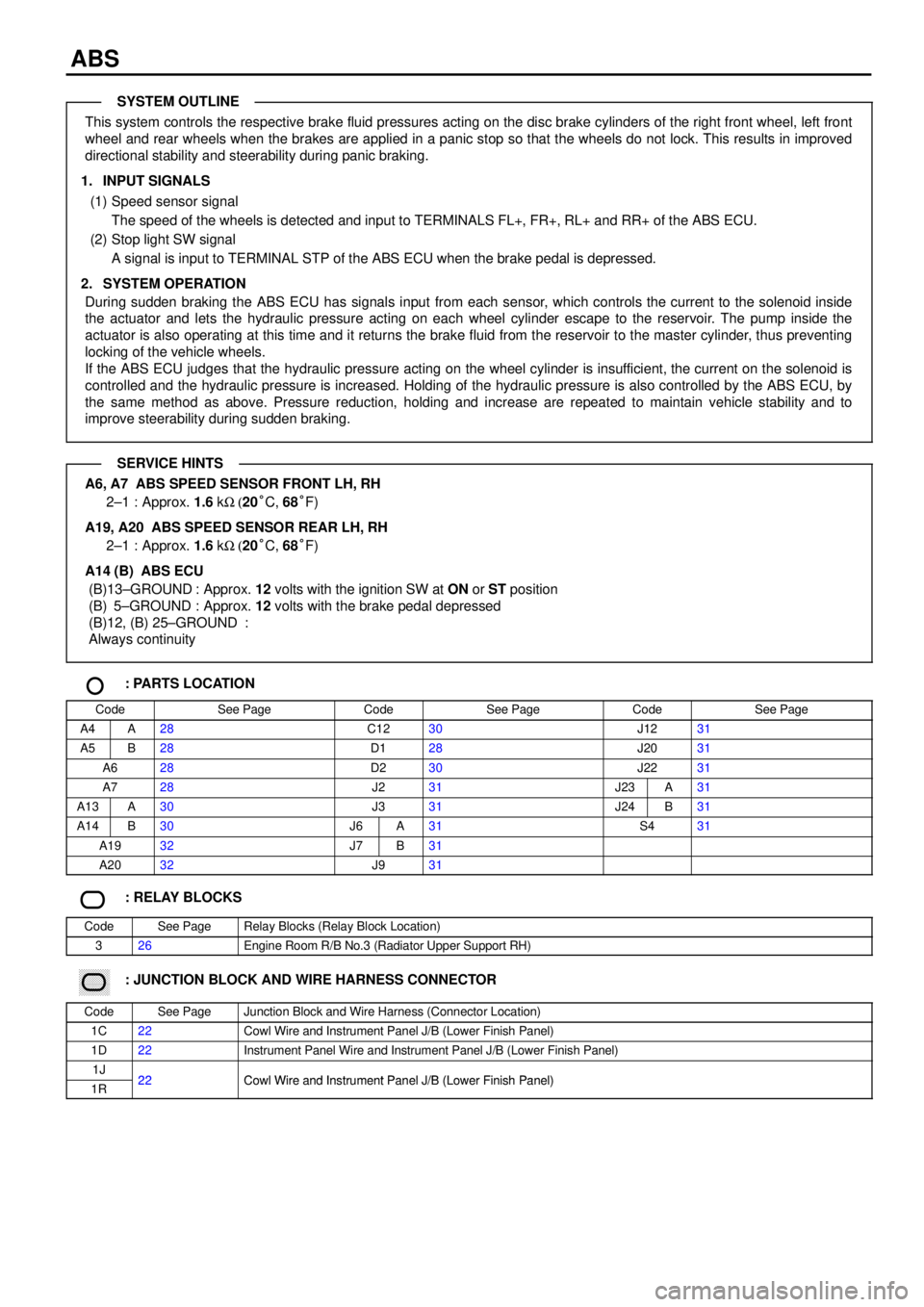
This system controls the respective brake fluid pressures acting on the disc brake cylinders of the right front wheel, left front
wheel and rear wheels when the brakes are applied in a panic stop so that the wheels do not lock. This results in improved
directional stability and steerability during panic braking.
1. INPUT SIGNALS
(1) Speed sensor signal
The speed of the wheels is detected and input to TERMINALS FL+, FR+, RL+ and RR+ of the ABS ECU.
(2) Stop light SW signal
A signal is input to TERMINAL STP of the ABS ECU when the brake pedal is depressed.
2. SYSTEM OPERATION
During sudden braking the ABS ECU has signals input from each sensor, which controls the current to the solenoid inside
the actuator and lets the hydraulic pressure acting on each wheel cylinder escape to the reservoir. The pump inside the
actuator is also operating at this time and it returns the brake fluid from the reservoir to the master cylinder, thus preventing
locking of the vehicle wheels.
If the ABS ECU judges that the hydraulic pressure acting on the wheel cylinder is insufficient, the current on the solenoid is
controlled and the hydraulic pressure is increased. Holding of the hydraulic pressure is also controlled by the ABS ECU, by
the same method as above. Pressure reduction, holding and increase are repeated to maintain vehicle stability and to
improve steerability during sudden braking.
A6, A7 ABS SPEED SENSOR FRONT LH, RH
2±1 : Approx. 1.6 kW (20°C, 68°F)
A19, A20 ABS SPEED SENSOR REAR LH, RH
2±1 : Approx. 1.6 kW (20°C, 68°F)
A14 (B) ABS ECU
(B)13±GROUND : Approx. 12 volts with the ignition SW at ON or ST position
(B) 5±GROUND : Approx. 12 volts with the brake pedal depressed
(B)12, (B) 25±GROUND :
Always continuity
: PARTS LOCATION
CodeSee PageCodeSee PageCodeSee Page
A4A28C1230J1231
A5B28D128J2031
A628D230J2231
A728J231J23A31
A13A30J331J24B31
A14B30J6A31S431
A1932J7B31
A2032J931
: RELAY BLOCKS
CodeSee PageRelay Blocks (Relay Block Location)
326Engine Room R/B No.3 (Radiator Upper Support RH)
: JUNCTION BLOCK AND WIRE HARNESS CONNECTOR
CodeSee PageJunction Block and Wire Harness (Connector Location)
1C22Cowl Wire and Instrument Panel J/B (Lower Finish Panel)
1D22Instrument Panel Wire and Instrument Panel J/B (Lower Finish Panel)
1J22Cowl Wire and Instrument Panel J/B (Lower Finish Panel)1R22Cowl Wire and Instrument Panel J/B (Lower Finish Panel)
SYSTEM OUTLINE
SERVICE HINTS
Page 4461 of 4592
ABS (TMC MADE)
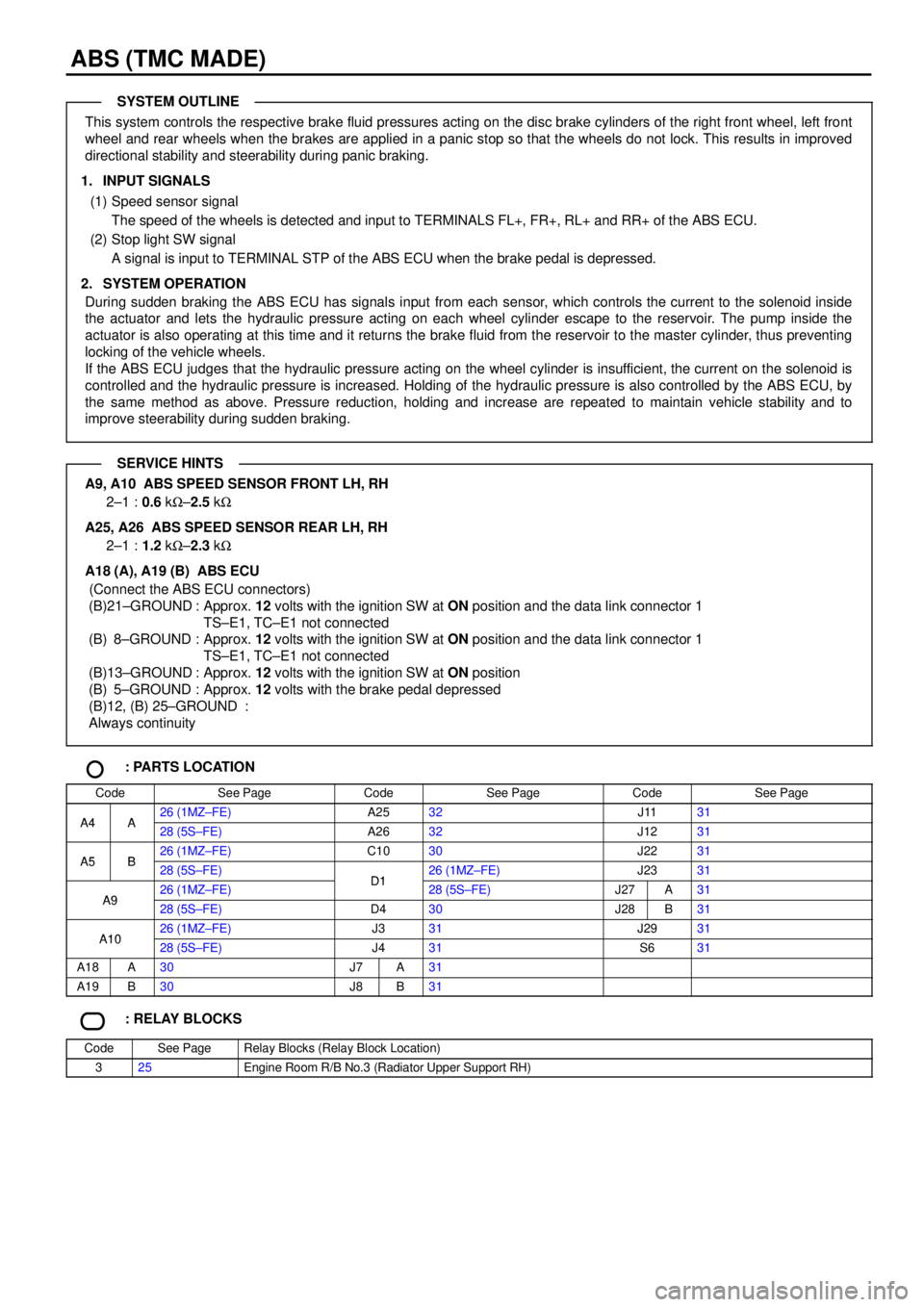
This system controls the respective brake fluid pressures acting on the disc brake cylinders of the right front wheel, left front
wheel and rear wheels when the brakes are applied in a panic stop so that the wheels do not lock. This results in improved
directional stability and steerability during panic braking.
1. INPUT SIGNALS
(1) Speed sensor signal
The speed of the wheels is detected and input to TERMINALS FL+, FR+, RL+ and RR+ of the ABS ECU.
(2) Stop light SW signal
A signal is input to TERMINAL STP of the ABS ECU when the brake pedal is depressed.
2. SYSTEM OPERATION
During sudden braking the ABS ECU has signals input from each sensor, which controls the current to the solenoid inside
the actuator and lets the hydraulic pressure acting on each wheel cylinder escape to the reservoir. The pump inside the
actuator is also operating at this time and it returns the brake fluid from the reservoir to the master cylinder, thus preventing
locking of the vehicle wheels.
If the ABS ECU judges that the hydraulic pressure acting on the wheel cylinder is insufficient, the current on the solenoid is
controlled and the hydraulic pressure is increased. Holding of the hydraulic pressure is also controlled by the ABS ECU, by
the same method as above. Pressure reduction, holding and increase are repeated to maintain vehicle stability and to
improve steerability during sudden braking.
A9, A10 ABS SPEED SENSOR FRONT LH, RH
2±1 :0.6 kW±2.5 kW
A25, A26 ABS SPEED SENSOR REAR LH, RH
2±1 :1.2 kW±2.3 kW
A18 (A), A19 (B) ABS ECU
(Connect the ABS ECU connectors)
(B)21±GROUND : Approx. 12 volts with the ignition SW at ON position and the data link connector 1
TS±E1, TC±E1 not connected
(B) 8±GROUND : Approx. 12 volts with the ignition SW at ON position and the data link connector 1
TS±E1, TC±E1 not connected
(B)13±GROUND : Approx. 12 volts with the ignition SW at ON position
(B) 5±GROUND : Approx. 12 volts with the brake pedal depressed
(B)12, (B) 25±GROUND :
Always continuity
: PARTS LOCATION
CodeSee PageCodeSee PageCodeSee Page
A4A26 (1MZ±FE)A2532J1131A4A28 (5S±FE)A2632J1231
A5B26 (1MZ±FE)C1030J2231A5B28 (5S±FE)D126 (1MZ±FE)J2331
A926 (1MZ±FE)D128 (5S±FE)J27A31A928 (5S±FE)D430J28B31
A1026 (1MZ±FE)J331J2931A1028 (5S±FE)J431S631
A18A30J7A31
A19B30J8B31
: RELAY BLOCKS
CodeSee PageRelay Blocks (Relay Block Location)
325Engine Room R/B No.3 (Radiator Upper Support RH)
SYSTEM OUTLINE
SERVICE HINTS
Page 4467 of 4592
ABS (TMMK MADE)
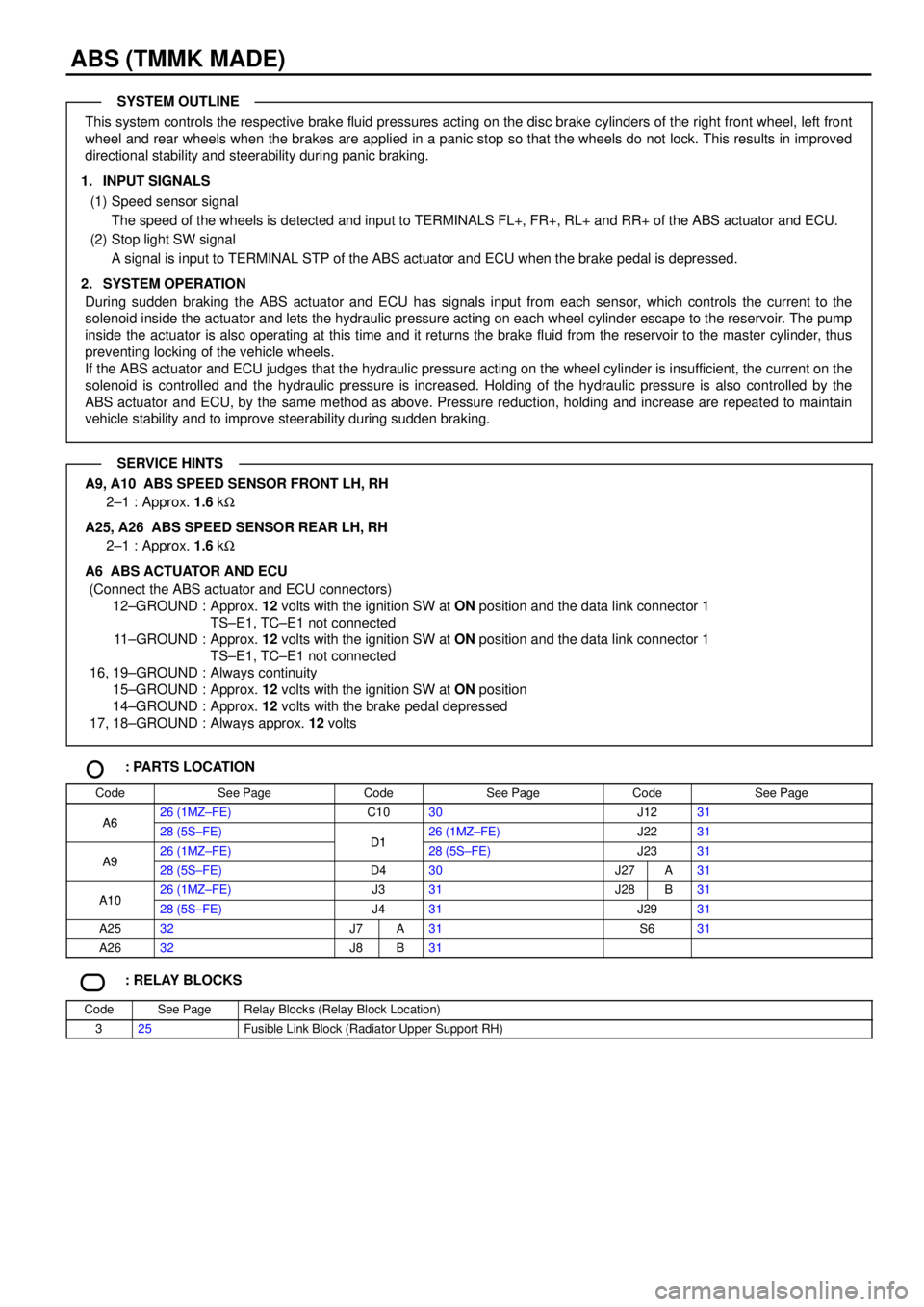
This system controls the respective brake fluid pressures acting on the disc brake cylinders of the right front wheel, left front
wheel and rear wheels when the brakes are applied in a panic stop so that the wheels do not lock. This results in improved
directional stability and steerability during panic braking.
1. INPUT SIGNALS
(1) Speed sensor signal
The speed of the wheels is detected and input to TERMINALS FL+, FR+, RL+ and RR+ of the ABS actuator and ECU.
(2) Stop light SW signal
A signal is input to TERMINAL STP of the ABS actuator and ECU when the brake pedal is depressed.
2. SYSTEM OPERATION
During sudden braking the ABS actuator and ECU has signals input from each sensor, which controls the current to the
solenoid inside the actuator and lets the hydraulic pressure acting on each wheel cylinder escape to the reservoir. The pump
inside the actuator is also operating at this time and it returns the brake fluid from the reservoir to the master cylinder, thus
preventing locking of the vehicle wheels.
If the ABS actuator and ECU judges that the hydraulic pressure acting on the wheel cylinder is insufficient, the current on the
solenoid is controlled and the hydraulic pressure is increased. Holding of the hydraulic pressure is also controlled by the
ABS actuator and ECU, by the same method as above. Pressure reduction, holding and increase are repeated to maintain
vehicle stability and to improve steerability during sudden braking.
A9, A10 ABS SPEED SENSOR FRONT LH, RH
2±1 : Approx. 1.6 kW
A25, A26 ABS SPEED SENSOR REAR LH, RH
2±1 : Approx. 1.6 kW
A6 ABS ACTUATOR AND ECU
(Connect the ABS actuator and ECU connectors)
12±GROUND : Approx. 12 volts with the ignition SW at ON position and the data link connector 1
TS±E1, TC±E1 not connected
11±GROUND : Approx. 12 volts with the ignition SW at ON position and the data link connector 1
TS±E1, TC±E1 not connected
16, 19±GROUND : Always continuity
15±GROUND : Approx. 12 volts with the ignition SW at ON position
14±GROUND : Approx. 12 volts with the brake pedal depressed
17, 18±GROUND : Always approx. 12 volts
: PARTS LOCATION
CodeSee PageCodeSee PageCodeSee Page
A626 (1MZ±FE)C1030J1231A628 (5S±FE)D126 (1MZ±FE)J2231
A926 (1MZ±FE)D128 (5S±FE)J2331A928 (5S±FE)D430J27A31
A1026 (1MZ±FE)J331J28B31A1028 (5S±FE)J431J2931
A2532J7A31S631
A2632J8B31
: RELAY BLOCKS
CodeSee PageRelay Blocks (Relay Block Location)
325Fusible Link Block (Radiator Upper Support RH)
SYSTEM OUTLINE
SERVICE HINTS