airbag TOYOTA CAMRY 2013 XV50 / 9.G Owner's Manual
[x] Cancel search | Manufacturer: TOYOTA, Model Year: 2013, Model line: CAMRY, Model: TOYOTA CAMRY 2013 XV50 / 9.GPages: 540, PDF Size: 7 MB
Page 112 of 540
112 1-7. Safety information
CAUTION
■SRS airbag precautions
●If breathing becomes difficult after the SRS airbags have deployed, open a
door or window to allow fresh air in, or leave the vehicle if it is safe to do
so. Wash off any residue as soon as possible to prevent skin irritation.
● If the areas where the SRS airbags are stored, such as the steering wheel
pad and front and rear pillar garnishes, are damaged or cracked, have
them replaced by your Toyota dealer.
■ Modification and disposal of SRS airbag system components
Do not dispose of your vehicle or perform any of the following modifications
without consulting your Toyota dealer. The SRS airbags may malfunction or
deploy (inflate) accidentally, causing death or serious injury.
● Installation, removal, disassembly and repair of the SRS airbags
● Repairs, modifications, removal or replacement of the steering wheel,
instrument panel, dashboard, seats or seat upholstery, front, side and rear
pillars or roof side rails
● Repairs or modifications of the front fender, front bumper, or side of the
occupant compartment
● Installation of snow plows, winches, etc. to the front grille (bull bars or\
kan-
garoo bar etc.)
● Modifications to the vehicle's suspension system
● Installation of electronic devices such as mobile two-way radios and CD
players
● Modifications to your vehicle for a person with a physical disability
Page 114 of 540

114 1-7. Safety information
Condition and operation in the front passenger occupant
classification system■ Adult
*1
■Child restraint system with infant*5
Indicator/
warning light “AIR BAG ON” and “AIR BAG OFF” indi-
cator lights “AIR BAG
ON”
SRS warning light Off
Seat belt reminder light Off
*2 or
flashing
*3
Devices Front passenger airbag
Activated
Side airbag on the front
passenger seat
Curtain shield airbag in the front passenger side
Front passenger knee airbag
Front passenger’s seat belt pretensioner
Indicator/
warning light “AIR BAG ON” and “AIR BAG OFF” indi-
cator lights “AIR BAG
OFF”
*6
SRS warning light Off
Seat belt reminder light Off
*2 or
flashing
*3
Devices Front passenger airbag Deactivated
Side airbag on the front passenger seat Activated
Curtain shield airbag in the front
passenger side
Front passenger knee airbag Deactivated
Front passenger’s seat belt pretensioner Activated
Page 115 of 540

115
1-7. Safety information
1
Before driving
■
Child*4
■Unoccupied
Indicator/
warning light “AIR BAG ON” and “AIR BAG OFF”
indicator lights “AIR BAG
OFF” or
“AIR BAG ON”*4
SRS warning light Off
Seat belt reminder light Off
*2 or
flashing
*3
Devices Front passenger airbag
Deactivated
or activated
*4
Side airbag on the front passenger seat Activated
Curtain shield airbag in the front
passenger side
Front passenger knee airbag Deactivated
or activated
*4
Front passenger’s seat belt pretensioner Activated
Indicator/
warning light “AIR BAG ON” and “AIR BAG OFF”
indicator lights “AIR BAG
OFF”
SRS warning light Off
Seat belt reminder light
Devices Front passenger airbag Deactivated
Side airbag on the front passenger seat Activated
Curtain shield airbag in the front
passenger side
Front passenger knee airbag Deactivated
Front passenger’s seat belt pretensioner Activated
Page 116 of 540

116 1-7. Safety information
■There is a malfunction in the system
*1: The system judges a person of adult size as an adult. When a
smaller adult sits in the front passenger seat, the system may not
recognize him/her as an adult depending on his/her physique and
posture.
*2: In the event the front passen ger is wearing a seat belt.
*3: In the event the front passenger does not wear a seat belt.
*4: For some children, child in seat, child in booster seat or child in
convertible seat, the system may not recognize him/her as a
child. Factors which may affect this can be the physique or pos-
ture.
*5: Never install a rear-facing child restraint system on the front pas- senger seat. A forward-facing ch ild restraint system should only
be installed on the front passenger seat when it is unavoidable.
( P. 11 9 )
*6: In case the indicator light is not illuminated, consult this manual
on how to install the child restraint system properly. ( P. 123)
Indicator/
warning light “AIR BAG ON” and “AIR BAG OFF”
indicator lights “AIR BAG
OFF”
SRS warning light On
Seat belt reminder light
Devices Front passenger airbag Deactivated
Side airbag on the front passenger seats Activated
Curtain shield airbag in the front
passenger side
Front passenger knee airbag Deactivated
Front passenger’s seat belt pretensioner Activated
Page 117 of 540
117
1-7. Safety information
1
Before driving
CAUTION
■
Front passenger occupant cl assification system precautions
Observe the following precautions regarding the front passenger occupant
classification system.
Failure to do so may cause death or serious injury.
● Wear the seat belt properly.
● Make sure the front passenger’s seat belt plate has not been left inserted
into the buckle before someone sits in the front passenger seat.
● Make sure the “AIR BAG OFF” indicator light is not illuminated when using
the seat belt extender for the front passenger seat. If the “AIR BAG OFF”
indicator light is illuminated, disconnect the extender tongue from the seat
belt buckle, and reconnect the seat belt. Reconnect the seat belt extender
after making sure the “AIR BAG ON” indicator light is illuminated. If you
use the seat belt extender while the “AIR BAG OFF” indicator light is illumi-
nated, the SRS airbags for the passenger may not activate correctly,
which could cause death or serious injury in the event of a collision.
● Do not apply a heavy load to the front passenger seat or equipment.
● Do not put weight on the front passenger seat by putting your hands or
feet on the front passenger seat seatback from the rear passenger seat.
● Do not let a rear passenger lift the front passenger seat with their feet or
press on the seatback with their legs.
● Do not put objects under the front passenger seat.
● Do not recline the front passenger seatback so far that it touches a rear
seat. This may cause the “AIR BAG OFF” indicator light to be illuminated,
which indicates that the passenger’s airbags will not deploy in the event of
a severe accident. If the seatback touches the rear seat, return the seat-
back to a position where it does not touch the rear seat. Keep the front\
passenger seatback as upright as possible when the vehicle is moving.
Reclining the seatback excessively may lessen the effectiveness of the
seat belt system.
Page 121 of 540

121
1-7. Safety information
1
Before driving
■
Selecting an appropriat e child restraint system
● Use a child restraint system appropriate for the child until the child
becomes large enough to properly wear the vehicle’s seat belt.
● If the child is too large for a child restraint system, sit the child on a rear
seat and use the vehicle's seat belt. ( P. 69)
CAUTION
■Child restraint precautions
●For effective protection in automobile accidents and sudden stops, a child
must be properly restrained, using a seat belt or child restraint system
depending on the age and size of the child. Holding a child in your arms is
not a substitute for a child restraint system. In an accident, the child can be
crushed against the windshield, or between you and the vehicle's interior.
● Toyota strongly urges the use of a proper child restraint system that con-
forms to the size of the child, installed on the rear seat. According to acci-
dent statistics, the child is safer when properly restrained in the rear seat
than in the front seat.
● Never install a rear-facing child restraint system on the front passenger
seat even if the “AIR BAG OFF” indicator light is illuminated. In the event
of an accident, the force of the rapid inflation of the front passenger airbag
can cause death or serious injury to the child if the rear-facing child
restraint system is installed on the front passenger seat.
● A forward-facing child restraint system may be installed on the front pas-
senger seat only when it is unavoidable. A child restraint system that
requires a top tether strap should not be used in the front passenger seat
since there is no top tether strap anchor for the front passenger seat.
Adjust the seatback as upright as possible and always move the seat as
far back as possible even if the “AIR BAG OFF” indicator light is illumi-
nated, because the front passenger airbag could inflate with considerable
speed and force. Otherwise, the child may be killed or seriously injured.
Page 122 of 540

122 1-7. Safety information
CAUTION
■Child restraint precautions
●Do not use the seat belt extender when installing a child restraint system
on the front or rear passenger seat. If installing a child restraint system
with the seat belt extender connected to the seat belt, the seat belt will not
securely hold the child restraint system, which could cause death or seri-
ous injury to the child or other passengers in the event of a sudden stop,
sudden swerve or accident.
● Do not allow the child to lean his/her head or any part of his/her body
against the door or the area of the sea t, front and rear pillars or roof side
rails from which the SRS side airbags or SRS curtain shield airbags deploy
even if the child is seated in the child restraint system. It is dangerous if
the SRS side airbags and curtain shield airbags inflate, and the impact
could cause death or serious injury to the child.
● Make sure you have complied with all installation instructions provided by
the child restraint manufacturer and that the system is properly secured. If
it is not secured properly, it may cause death or serious injury to the child
in the event of a sudden stop, sudden swerve or an accident.
■ When children are in the vehicle
Do not allow children to play with the seat belt. If the seat belt becomes
twisted around a child’s neck, it may lead to choking or other serious injuries
that could result in death.
If this occurs and the buckle cannot be unfastened, scissors should be used
to cut the belt.
■ When the child restrain t system is not in use
● Keep the child restraint system properly secured on the seat even if it is
not in use.
Do not store the child restraint system unsecured in the passenger com-
partment.
● If it is necessary to detach the child restraint system, remove it from the
vehicle or store it securely in the trunk. This will prevent it from injuring
passengers in the event of a sudden stop, sudden swerve or accident.
Page 130 of 540
130 1-7. Safety information
■Laws and regulations pertaining to anchorages
The LATCH system conforms to FMVSS225 or CMVSS210.2.
Child restraint systems conforming to FMVSS213 or CMVSS213 specifica-
tions can be used.
This vehicle is designed to conform to SAE J1819.
CAUTION
■When installing a booster seat
To prevent the belt from going into ALR lock mode, do not fully extend the
shoulder belt. ALR mode causes the belt to tighten only. This could cause
injury or discomfort to the child. ( P. 71)
■ When installing a child restraint system
Follow the directions given in the child restraint system installation manual
and fix the child restraint system securely in place.
If the child restraint system is not correctly fixed in place, the child or other
passengers may be seriously injured or even killed in the event of sudden
braking, sudden swerving or an accident.
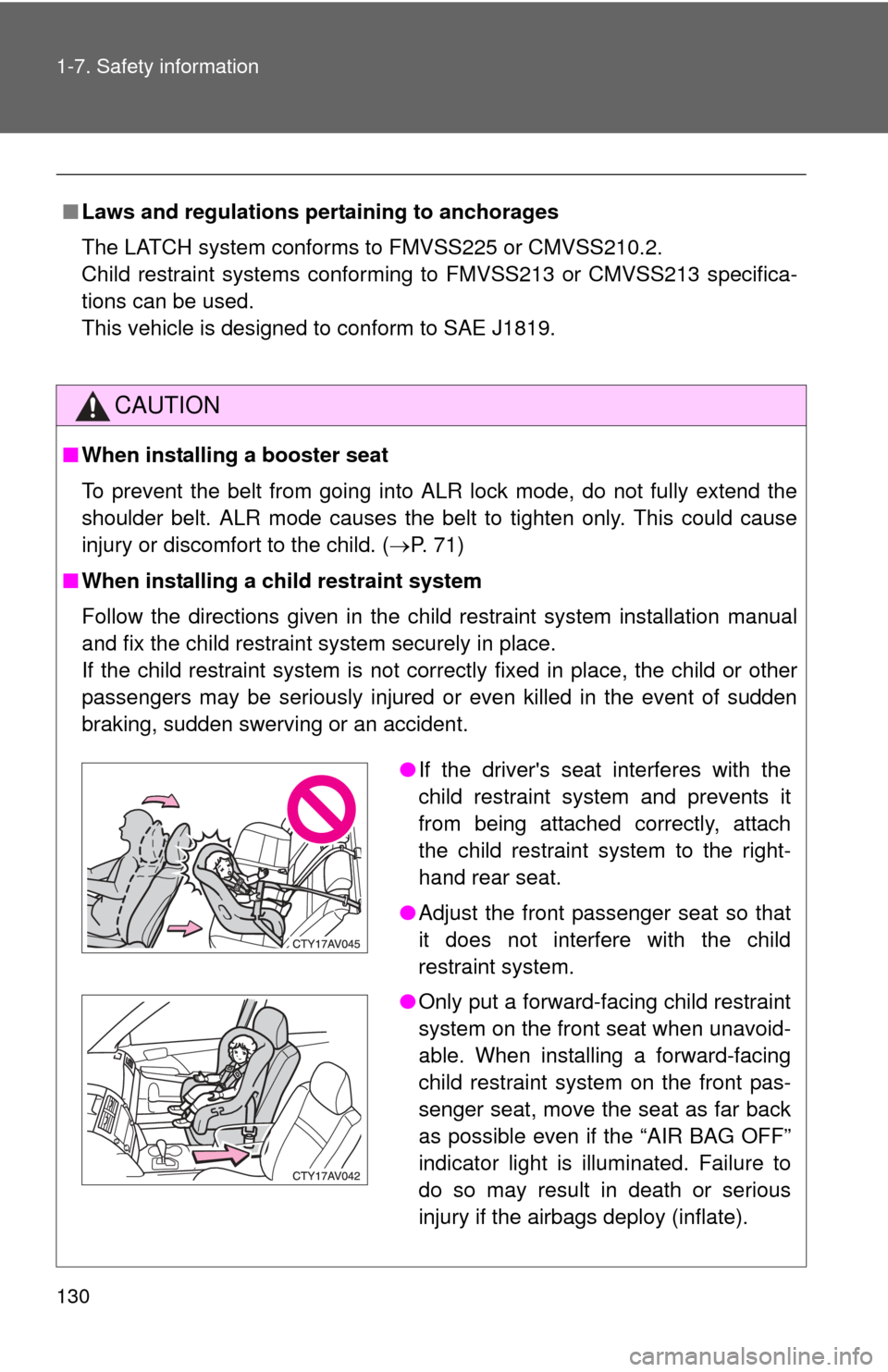
●If the driver's seat interferes with the
child restraint system and prevents it
from being attached correctly, attach
the child restraint system to the right-
hand rear seat.
● Adjust the front passenger seat so that
it does not interfere with the child
restraint system.
● Only put a forward-facing child restraint
system on the front seat when unavoid-
able. When installing a forward-facing
child restraint system on the front pas-
senger seat, move the seat as far back
as possible even if the “AIR BAG OFF”
indicator light is illuminated. Failure to
do so may result in death or serious
injury if the airbags deploy (inflate).
Page 182 of 540
182 2-2. Instrument cluster
■Indicators
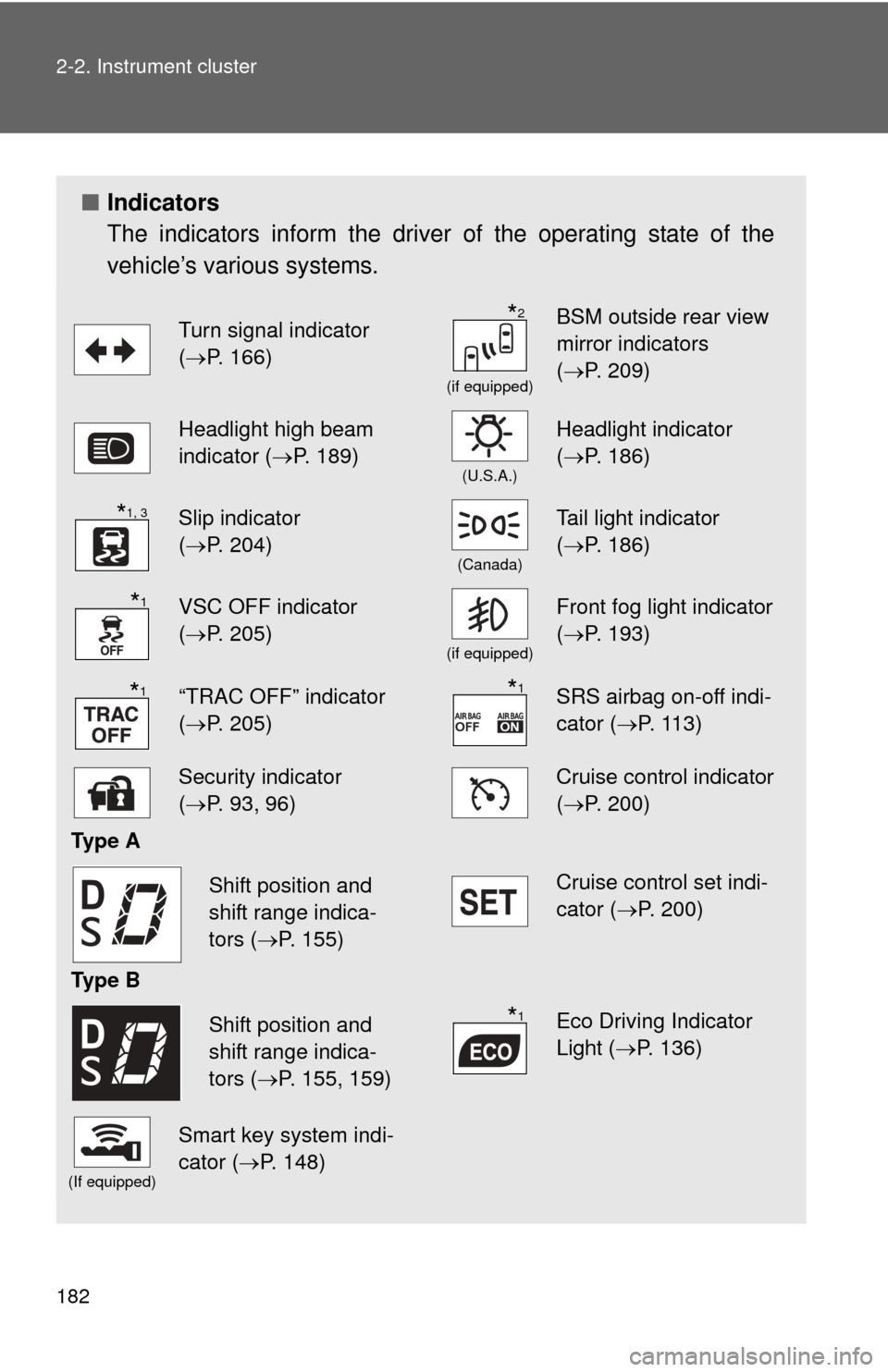
The indicators inform the driver of the operating state of the
vehicle’s various systems.
Turn signal indicator
(P. 166)
(if equipped)
BSM outside rear view
mirror indicators
( P. 209)
Headlight high beam
indicator ( P. 189)
(U.S.A.)
Headlight indicator
(P. 186)
Slip indicator
(P. 204)
(Canada)
Tail light indicator
( P. 186)
VSC OFF indicator
(P. 205)
(if equipped)
Front fog light indicator
( P. 193)
“TRAC OFF” indicator
(P. 205)SRS airbag on-off indi-
cator (P. 113)
Security indicator
(P. 93, 96)Cruise control indicator
( P. 200)
Ty p e A
Cruise control set indi-
cator (P. 200)
Ty p e B
Eco Driving Indicator
Light ( P. 136)
(If equipped)
Smart key system indi-
cator ( P. 148)
*2
*1, 3
*1
*1*1
Shift position and
shift range indica-
tors (P. 155)
Shift position and
shift range indica-
tors (P. 155, 159)*1
Page 318 of 540
318
3-5. Other interior features
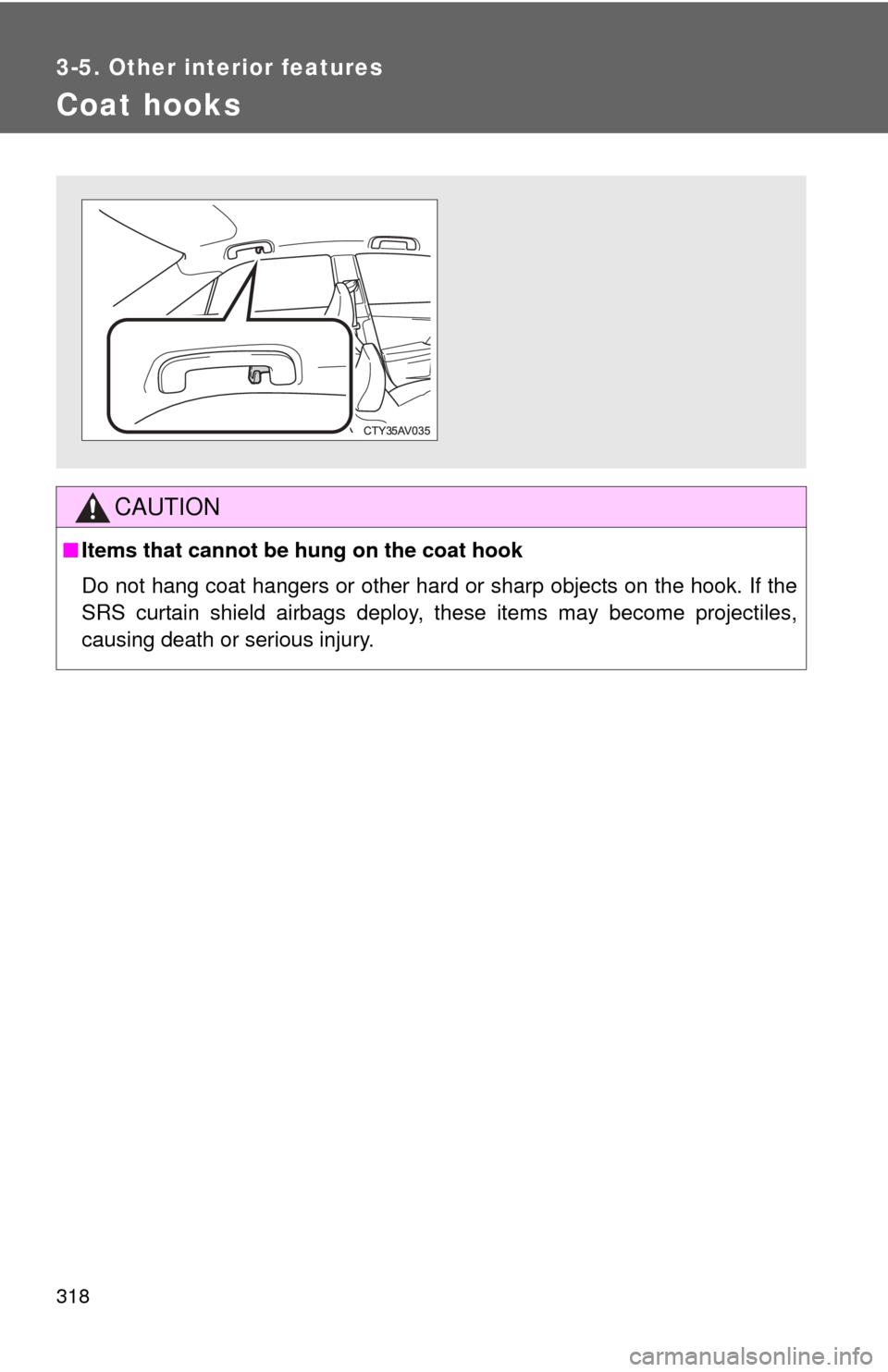
Coat hooks
CAUTION
■Items that cannot be hung on the coat hook
Do not hang coat hangers or other hard or sharp objects on the hook. If the
SRS curtain shield airbags deploy, these items may become projectiles,
causing death or serious injury.