suspension TOYOTA CAMRY HYBRID 2020 (in English) User Guide
[x] Cancel search | Manufacturer: TOYOTA, Model Year: 2020, Model line: CAMRY HYBRID, Model: TOYOTA CAMRY HYBRID 2020Pages: 592, PDF Size: 12.13 MB
Page 336 of 592
3364-5. Using the driving support systems
■Situations in which the Rear Cross Traffic Auto Brake function may not
operate properly
In some situations such as the following, this function may not operate prop-
erly.
● Objects and vehicles which the radar sensors are not designed t o detect
• Stationary objects
• Vehicles which are moving away from your vehicle
• Pedestrians, motorcycles, bicycles, etc.
*
• Objects which are extremely close to a radar sensor
• Vehicles which are approaching from the right or left at the r ear of the
vehicle at a traveling speed of less than approximately 5 mph ( 8 km/h)
• Vehicles which are approaching from the right or left at the r ear of the
vehicle at a traveling speed of more than approximately 15 mph (24 km/h)
*: Depending on conditions, detection of a vehicle and/or object may occur.
● Situations in which the radar sensors may not be able to detect an object
• When a sensor or the area around a sensor is extremely hot or cold
• If the rear bumper is covered with ice, snow, dirt, etc.
• If heavy rain or water strikes the vehicle
• When the detection area of a radar sensor is obstructed by an adjacent
vehicle
• If the vehicle is significantly tilted
• When equipment that may obstruct a sensor is installed, such a s a towing
eyelet, bumper protector (an additional trim strip, etc.), bicy cle carrier, or
snow plow
• If the suspension has been modified or tires of a size other than specified
are installed
• If the front of the vehicle is raised or lowered due to the ca rried load
• If a sticker or an electronic component, such as a backlit license plate
(especially fluorescent type), fog lights, a fender pole or wir eless antenna
is installed near a radar sensor
• If the orientation of a radar sensor has been changed due to a collision or
other impact or removal and installation
• When multiple vehicles are approaching with only a small gap between each vehicle
• When a vehicle is approaching at high speed
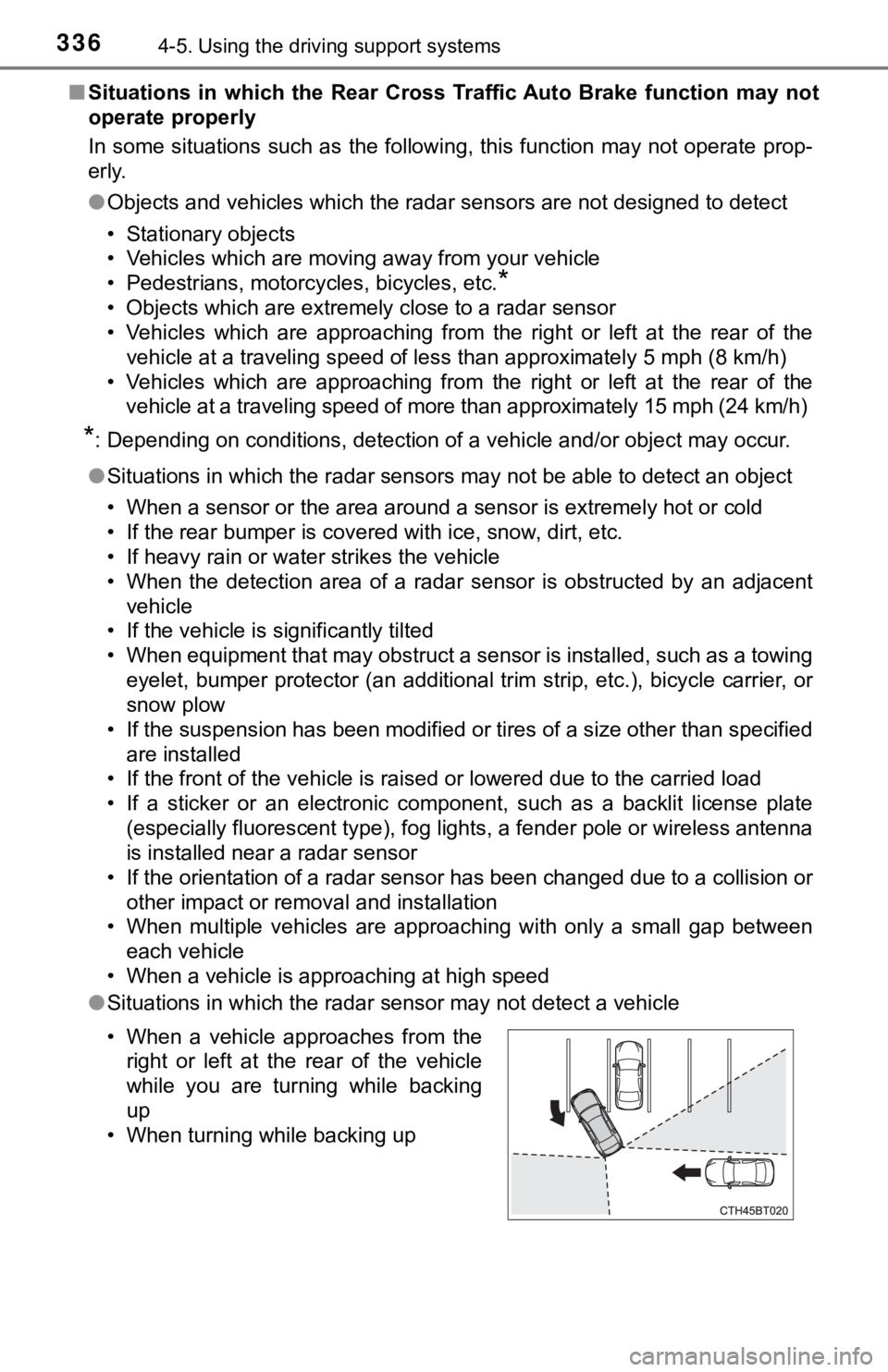
● Situations in which the radar sensor may not detect a vehicle
• When a vehicle approaches from the
right or left at the rear of the vehicle
while you are turning while backing
up
• When turning while backing up
Page 394 of 592
3946-1. Maintenance and care
NOTICE
■To prevent paint deterioration an d corrosion on the body and compo-
nents (aluminum wheels, etc.)
● Wash the vehicle immediately in the following cases:
• After driving near the sea coast
• After driving on salted roads
• If coal tar or tree sap is present on the paint surface
• If dead insects, insect droppings or bird droppings are presen t on the
paint surface
• After driving in an area contaminated with soot, oily smoke, mine dust,
iron powder or chemical substances
• If the vehicle becomes heavily soiled with dust or mud
• If liquids such as benzene and gasoline are spilled on the paint surface
● If the paint is chipped or scratched, have it repaired immediat ely.
● To prevent the wheels from corroding, remove any dirt and store in a place
with low humidity when storing the wheels.
■ Cleaning the exterior lights
● Wash carefully. Do not use organic substances or scrub with a h ard brush.
This may damage the surfaces of the lights.
● Do not apply wax to the surfaces of the lights.
Wax may cause damage to the lenses.
■ When using a high pressure car wash
● Do not bring the nozzle tip close to boots (rubber or resin man ufactured
cover), connectors or the following parts. The parts may be dam aged if
they come into contact with high-pressure water.
• Traction related parts
• Steering parts
• Suspension parts
• Brake parts
● Keep the cleaning nozzle at least 11.9 in. (30 cm) away from th e vehicle
body. Otherwise resin section, such as moldings and bumpers, ma y be
deformed and damaged. Also, do not continuously hold the nozzle in the
same place.
● Do not spray the lower part of the windshield continuously.
If water enters the air conditioning system intake located near the lower
part of the windshield, the air conditioning system may not ope rate cor-
rectly.
● Do not wash the underside of the vehicle using a high-pressure car
washer.
Page 472 of 592
4727-2. Steps to take in an emergency
The following may indicate a problem with your transmission. Contact
your Toyota dealer or commercial towing service before towing.
● The hybrid system warning message is shown on the multi-informa -
tion display and the vehicle does not move.
● The hybrid system warning light turns on and the vehicle does n ot
move.
● The vehicle makes an abnormal sound.
NOTICE
■To prevent damage to the vehicle when towing using a wheel-lift type
truck
● Do not tow the vehicle from the rear when the power switch is o ff. The
steering lock mechanism is not strong enough to hold the front wheels
straight.
● When raising the vehicle, ensure adequate ground clearance for towing at
the opposite end of the raised vehicle. Without adequate clearance, the
vehicle could be damaged while being towed.
■ To prevent damage to the vehicle when towing with a sling-type truck
Do not tow with a sling-type truck, either from the front or re ar.
■ To prevent damage to the vehic le during emergency towing
Do not secure cables or chains to the suspension components.
■ Recreational towing (beh ind motor home, etc.)
P. 207
Situations when it is necessary to contact dealers before towing
Page 474 of 592
4747-2. Steps to take in an emergency
●Fluid leaks un der the vehicle.
(Water dripping from the air conditioning a fter use is normal.)
● Flat-looking tires or uneven tire wear
● Engine coolant temperature gauge needle continually points high er
than normal
● Changes in exhaust sound
● Excessive tire squeal when cornering
● Strange noises related to the suspension system
● Pinging or other noises related to the hybrid system
● Engine missing, stumb ling or running roughly
● Appreciable loss of power
● Vehicle pulls heavily to one side when braking
● Vehicle pulls heavily to one s ide when driving on a level road
● Loss of brake effectiveness, spongy feeling, pedal almost touch es
the floor
If you think something is wrong
If you notice any of the followi ng symptoms, your vehicle proba -
bly needs adjustment or repair. Contact your Toyota dealer as
soon as possible.
Visible symptoms
Audible symptoms
Operational symptoms
Page 569 of 592
569
9
For owners
AVERTISSEMENT
■Modification et mise au rebut d es composants du système de cous sins
gonflables SRS
Ne mettez pas votre véhicule au rebut et ne procédez à aucune d es modifi-
cations suivantes sans consulter votre concessionnaire Toyota. Les cous-
sins gonflables SRS peuvent ne pas fonctionner correctement ou se
déployer (se gonfler) accidentellement, provoquant la mort ou d e graves
blessures.
● Installation, dépose, démontage et réparation des coussins gonf lables
SRS
● Réparations, modifications, démontage ou remplacement du volant, du
tableau de bord, de la planche de bord, des sièges ou de leur garnissage,
des montants avant, latéraux et arrière, des rails latéraux de toit, des pan-
neaux de porte avant, des garnitures de porte avant ou des haut -parleurs
de porte avant
● Modifications du panneau de porte avant (par exemple, perçage d 'un trou
dans le panneau)
● Réparations ou modifications des ailes avant, du pare-chocs ava nt ou des
flancs de l'habitacle
● Installation d'un protège-calandre (pare-buffle, pare-kangourou , etc.), de
chasse-neige, de treuils ou d'un porte-bagages de toit
● Modifications du système de suspension du véhicule
● Installation d'appareils électroniques tels que les émetteurs/r écepteurs
radios mobiles et les lecteurs CD
● Modifications de votre véhicule pour une personne atteinte d'un handicap
physique