brake TOYOTA CAMRY V20 1986 Service Information
[x] Cancel search | Manufacturer: TOYOTA, Model Year: 1986, Model line: CAMRY V20, Model: TOYOTA CAMRY V20 1986Pages: 2389, PDF Size: 84.44 MB
Page 458 of 2389
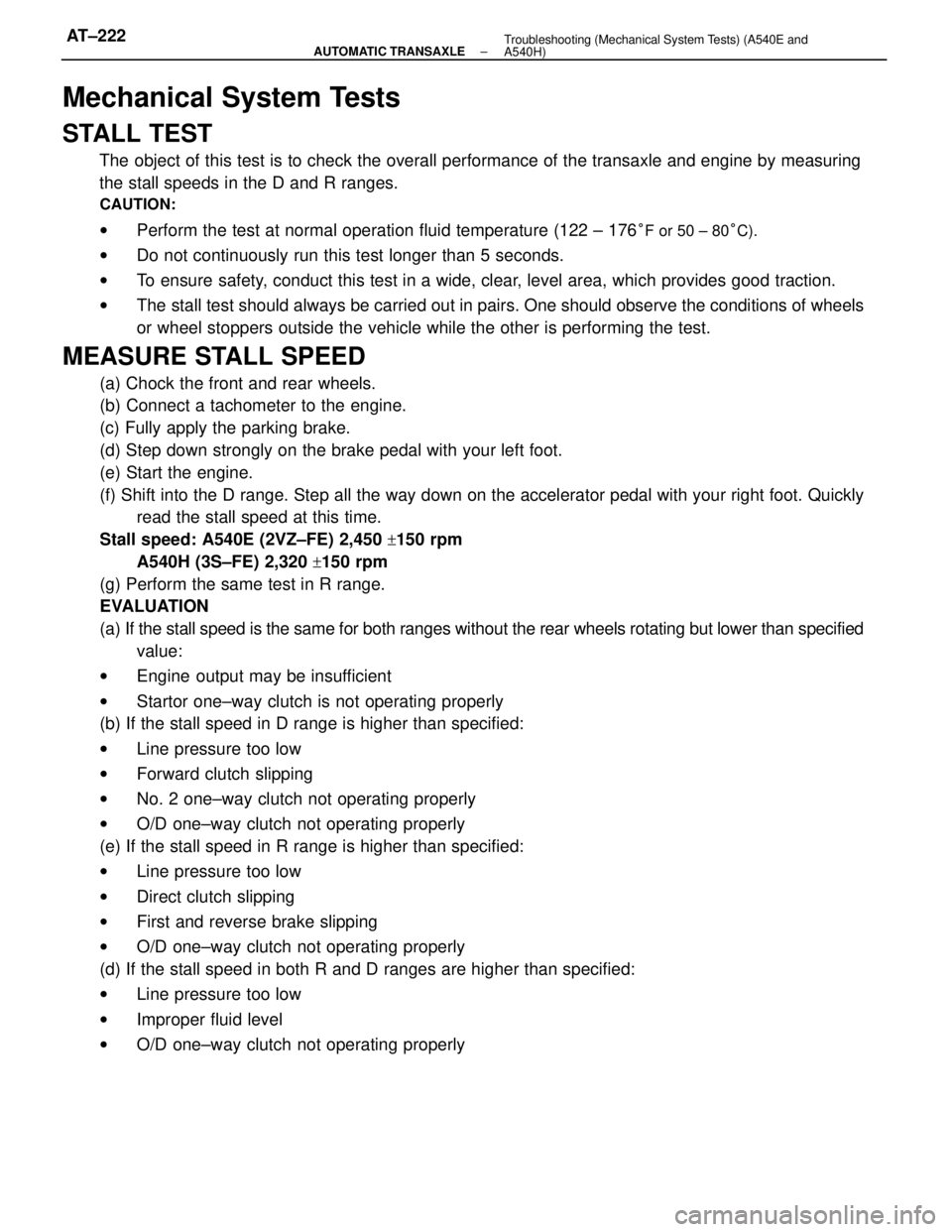
Mechanical System Tests
STALL TEST
The object of this test is to check the overall performance of the transaxle and engine by measuring
the stall speeds in the D and R ranges.
CAUTION:
wPerform the test at normal operation fluid temperature (122 ± 176°F or 50 ± 80°C).
wDo not continuously run this test longer than 5 seconds.
wTo ensure safety, conduct this test in a wide, clear, level area, which provides good traction.
wThe stall test should always be carried out in pairs. One should observe the conditions of wheels
or wheel stoppers outside the vehicle while the other is performing the test.
MEASURE STALL SPEED
(a) Chock the front and rear wheels.
(b) Connect a tachometer to the engine.
(c) Fully apply the parking brake.
(d) Step down strongly on the brake pedal with your left foot.
(e) Start the engine.
(f) Shift into the D range. Step all the way down on the accelerator pedal with your right foot. Quickly
read the stall speed at this time.
Stall speed: A540E (2VZ±FE) 2,450
+150 rpm
A540H (3S±FE) 2,320
+150 rpm
(g) Perform the same test in R range.
EVALUATION
(a) If the stall speed is the same for both ranges without the rear wheels rotating but lower than specified
value:
wEngine output may be insufficient
wStartor one±way clutch is not operating properly
(b) If the stall speed in D range is higher than specified:
wLine pressure too low
wForward clutch slipping
wNo. 2 one±way clutch not operating properly
wO/D one±way clutch not operating properly
(e) If the stall speed in R range is higher than specified:
wLine pressure too low
wDirect clutch slipping
wFirst and reverse brake slipping
wO/D one±way clutch not operating properly
(d) If the stall speed in both R and D ranges are higher than specified:
wLine pressure too low
wImproper fluid level
wO/D one±way clutch not operating properly
± AUTOMATIC TRANSAXLETroubleshooting (Mechanical System Tests) (A540E and
A540H)AT±222
Page 459 of 2389
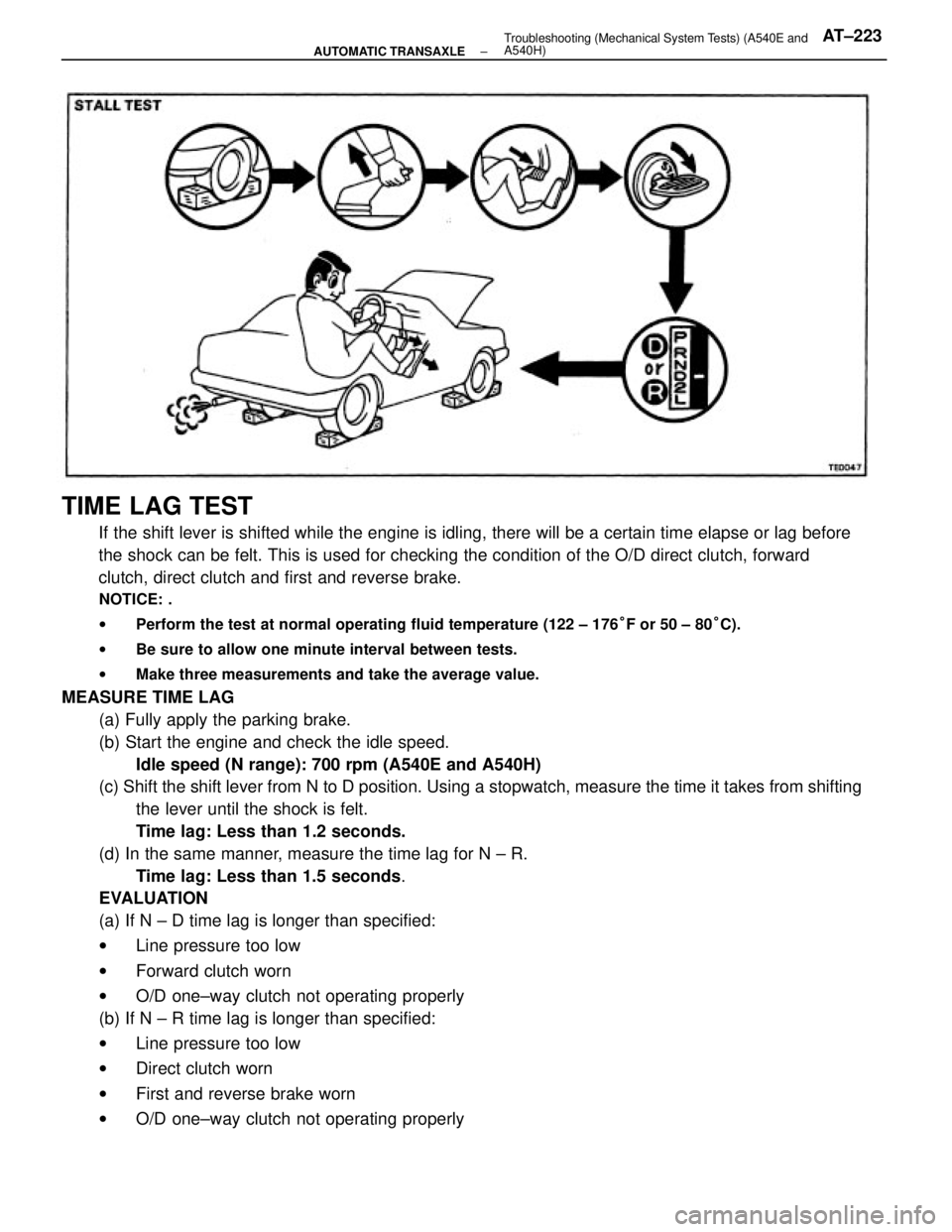
TIME LAG TEST
If the shift lever is shifted while the engine is idling, there will be a certain time elapse or lag before
the shock can be felt. This is used for checking the condition of the O/D direct clutch, forward
clutch, direct clutch and first and reverse brake.
NOTICE: .
wPerform the test at normal operating fluid temperature (122 ± 176°F or 50 ± 80°C).
wBe sure to allow one minute interval between tests.
wMake three measurements and take the average value.
MEASURE TIME LAG
(a) Fully apply the parking brake.
(b) Start the engine and check the idle speed.
Idle speed (N range): 700 rpm (A540E and A540H)
(c) Shift the shift lever from N to D position. Using a stopwatch, measure the time it takes from shifting
the lever until the shock is felt.
Time lag: Less than 1.2 seconds.
(d) In the same manner, measure the time lag for N ± R.
Time lag: Less than 1.5 seconds.
EVALUATION
(a) If N ± D time lag is longer than specified:
wLine pressure too low
wForward clutch worn
wO/D one±way clutch not operating properly
(b) If N ± R time lag is longer than specified:
wLine pressure too low
wDirect clutch worn
wFirst and reverse brake worn
wO/D one±way clutch not operating properly
± AUTOMATIC TRANSAXLETroubleshooting (Mechanical System Tests) (A540E and
A540H)AT±223
Page 460 of 2389
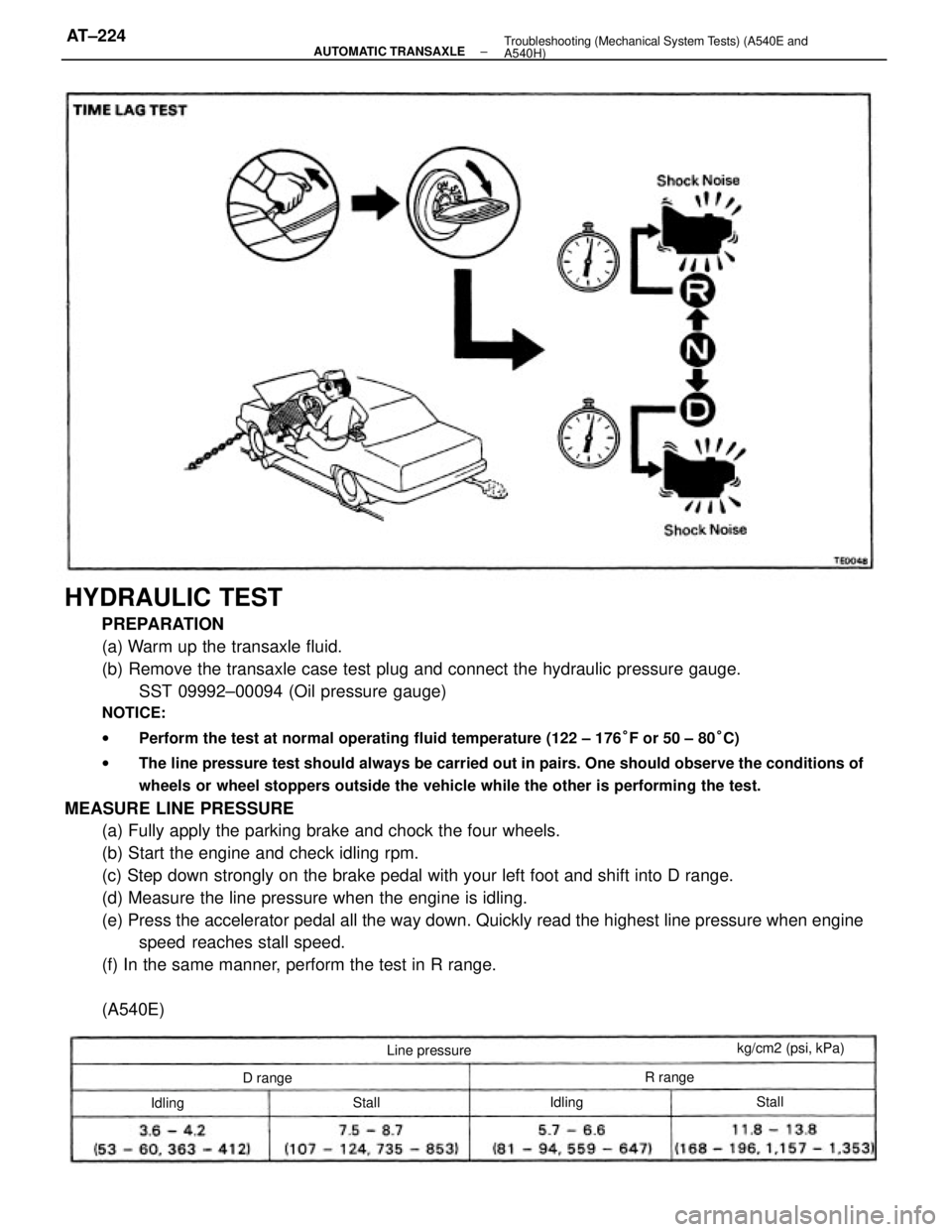
HYDRAULIC TEST
PREPARATION
(a) Warm up the transaxle fluid.
(b) Remove the transaxle case test plug and connect the hydraulic pressure gauge.
SST 09992±00094 (Oil pressure gauge)
NOTICE:
wPerform the test at normal operating fluid temperature (122 ± 176°F or 50 ± 80°C)
wThe line pressure test should always be carried out in pairs. One should observe the conditions of
wheels or wheel stoppers outside the vehicle while the other is performing the test.
MEASURE LINE PRESSURE
(a) Fully apply the parking brake and chock the four wheels.
(b) Start the engine and check idling rpm.
(c) Step down strongly on the brake pedal with your left foot and shift into D range.
(d) Measure the line pressure when the engine is idling.
(e) Press the accelerator pedal all the way down. Quickly read the highest line pressure when engine
speed reaches stall speed.
(f) In the same manner, perform the test in R range.
(A540E)
kg/cm2 (psi, kPa)
Line pressure
D rangeR range
Idling
IdlingStallStall
± AUTOMATIC TRANSAXLETroubleshooting (Mechanical System Tests) (A540E and
A540H)AT±224
Page 461 of 2389
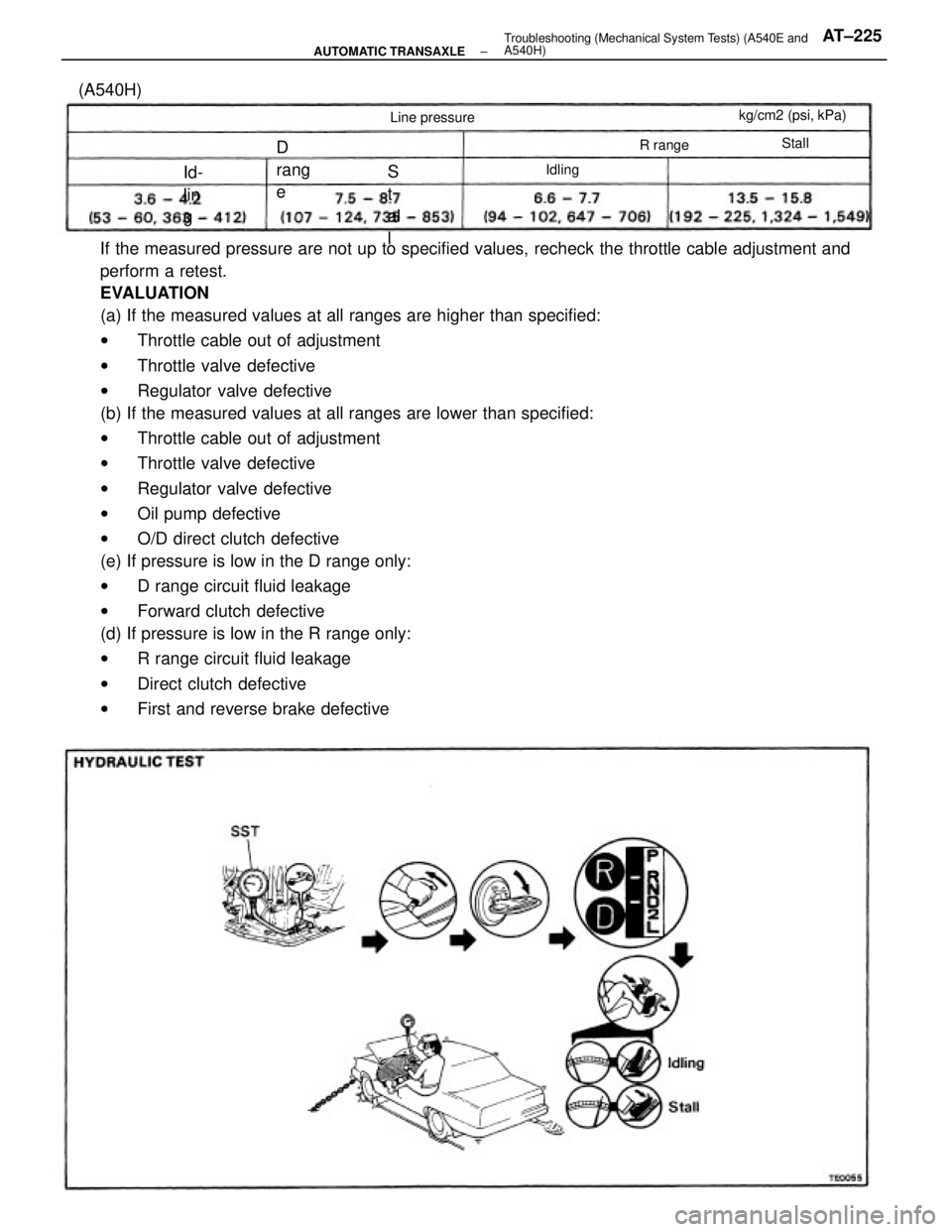
If the measured pressure are not up to specified values, recheck the throttle cable adjustment and
perform a retest.
EVALUATION
(a) If the measured values at all ranges are higher than specified:
wThrottle cable out of adjustment
wThrottle valve defective
wRegulator valve defective
(b) If the measured values at all ranges are lower than specified:
wThrottle cable out of adjustment
wThrottle valve defective
wRegulator valve defective
wOil pump defective
wO/D direct clutch defective
(e) If pressure is low in the D range only:
wD range circuit fluid leakage
wForward clutch defective
(d) If pressure is low in the R range only:
wR range circuit fluid leakage
wDirect clutch defective
wFirst and reverse brake defective
kg/cm2 (psi, kPa)
Line pressure
(A540H)
R rangeD
rang
e Id-
lin
g
IdlingS
t
al
l
Stall
± AUTOMATIC TRANSAXLETroubleshooting (Mechanical System Tests) (A540E and
A540H)AT±225
Page 462 of 2389
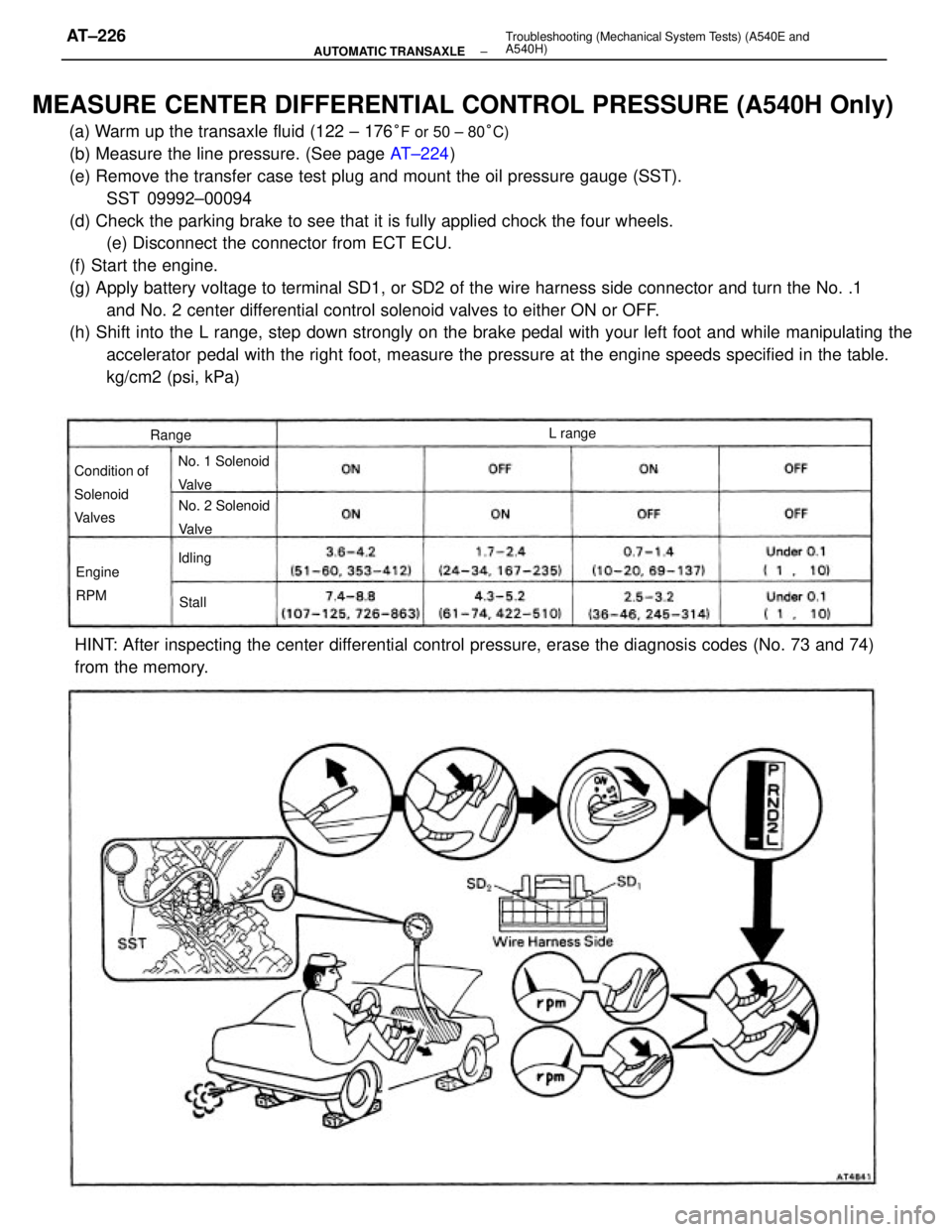
MEASURE CENTER DIFFERENTIAL CONTROL PRESSURE (A540H Only)
(a) Warm up the transaxle fluid (122 ± 176°F or 50 ± 80°C)
(b) Measure the line pressure. (See page AT±224)
(e) Remove the transfer case test plug and mount the oil pressure gauge (SST).
SST 09992±00094
(d) Check the parking brake to see that it is fully applied chock the four wheels.
(e) Disconnect the connector from ECT ECU.
(f) Start the engine.
(g) Apply battery voltage to terminal SD1, or SD2 of the wire harness side connector and turn the No. .1
and No. 2 center differential control solenoid valves to either ON or OFF.
(h) Shift into the L range, step down strongly on the brake pedal with your left foot and while manipulating the
accelerator pedal with the right foot, measure the pressure at the engine speeds specified in the table.
kg/cm2 (psi, kPa)
HINT: After inspecting the center differential control pressure, erase the diagnosis codes (No. 73 and 74)
from the memory.
Condition of
Solenoid
ValvesNo. 1 Solenoid
Valve
No. 2 Solenoid
Valve
Engine
RPML range
Range
Idling
Stall
± AUTOMATIC TRANSAXLETroubleshooting (Mechanical System Tests) (A540E and
A540H)AT±226
Page 464 of 2389
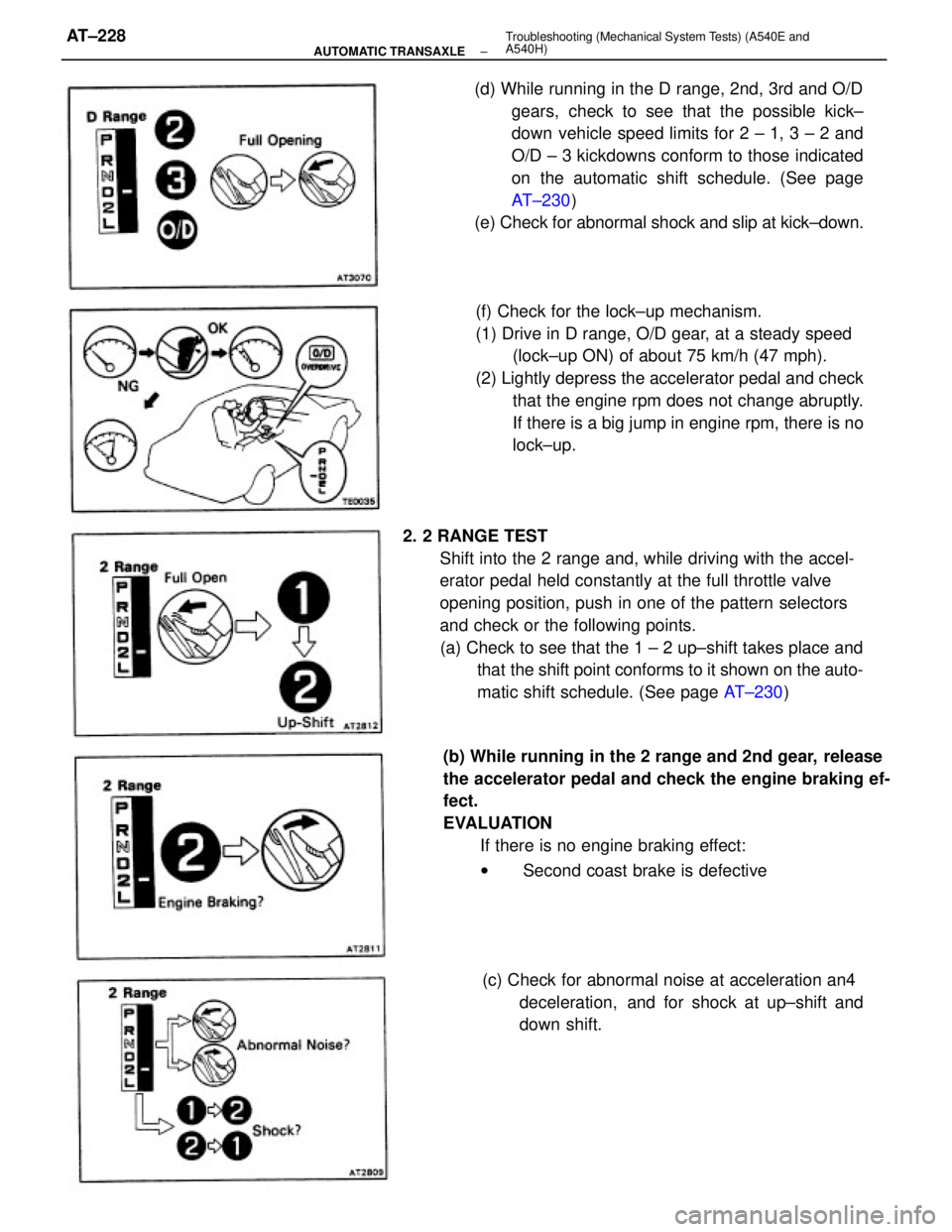
2. 2 RANGE TEST
Shift into the 2 range and, while driving with the accel-
erator pedal held constantly at the full throttle valve
opening position, push in one of the pattern selectors
and check or the following points.
(a) Check to see that the 1 ± 2 up±shift takes place and
that the shift point conforms to it shown on the auto-
matic shift schedule. (See page AT±230)
(b) While running in the 2 range and 2nd gear, release
the accelerator pedal and check the engine braking ef-
fect.
EVALUATION
If there is no engine braking effect:
w Second coast brake is defective (f) Check for the lock±up mechanism.
(1) Drive in D range, O/D gear, at a steady speed
(lock±up ON) of about 75 km/h (47 mph).
(2) Lightly depress the accelerator pedal and check
that the engine rpm does not change abruptly.
If there is a big jump in engine rpm, there is no
lock±up. (d) While running in the D range, 2nd, 3rd and O/D
gears, check to see that the possible kick±
down vehicle speed limits for 2 ± 1, 3 ± 2 and
O/D ± 3 kickdowns conform to those indicated
on the automatic shift schedule. (See page
AT±230)
(e) Check for abnormal shock and slip at kick±down.
(c) Check for abnormal noise at acceleration an4
deceleration, and for shock at up±shift and
down shift.
± AUTOMATIC TRANSAXLETroubleshooting (Mechanical System Tests) (A540E and
A540H)AT±228
Page 465 of 2389
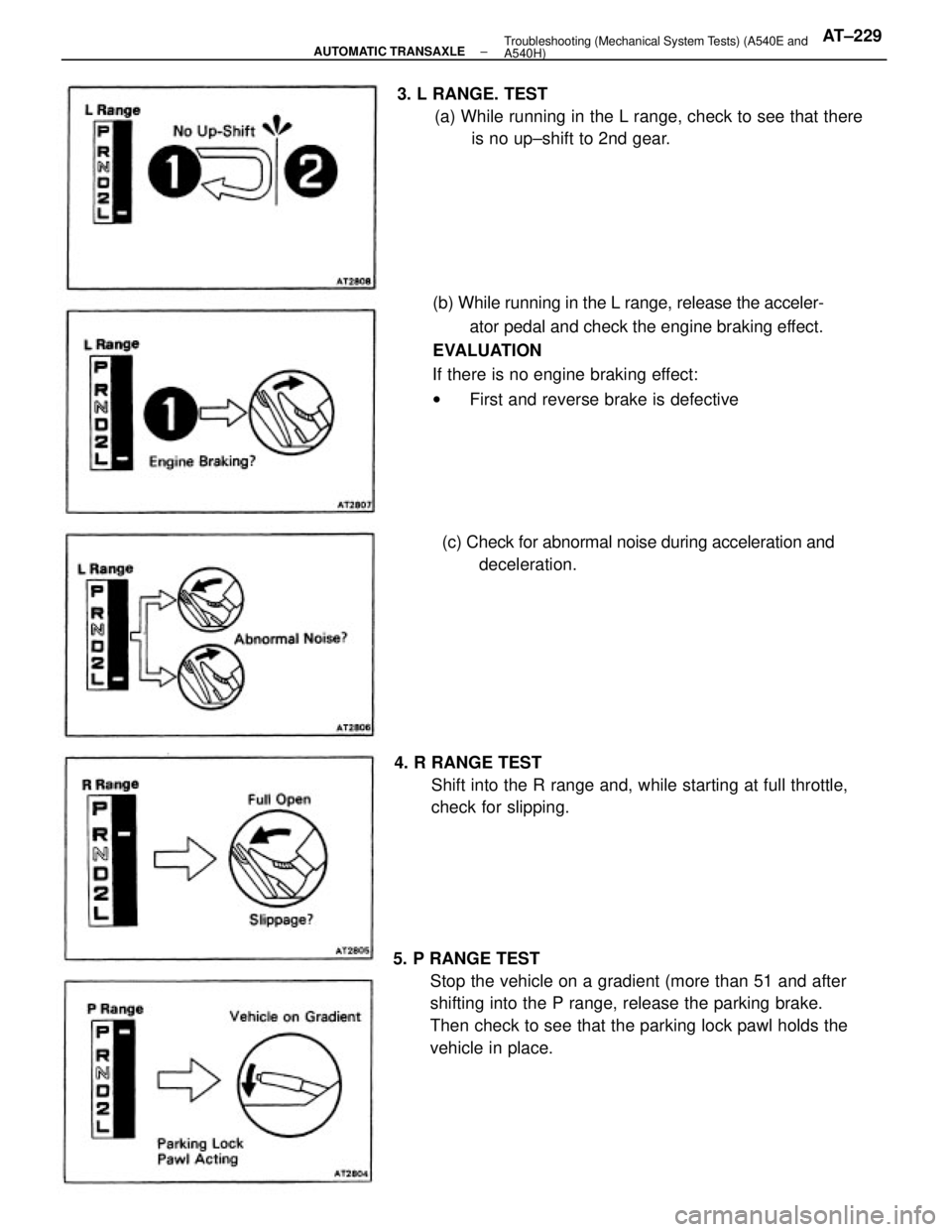
5. P RANGE TEST
Stop the vehicle on a gradient (more than 51 and after
shifting into the P range, release the parking brake.
Then check to see that the parking lock pawl holds the
vehicle in place.(b) While running in the L range, release the acceler-
ator pedal and check the engine braking effect.
EVALUATION
If there is no engine braking effect:
wFirst and reverse brake is defective 3. L RANGE. TEST
(a) While running in the L range, check to see that there
is no up±shift to 2nd gear.
4. R RANGE TEST
Shift into the R range and, while starting at full throttle,
check for slipping.(c) Check for abnormal noise during acceleration and
deceleration.
± AUTOMATIC TRANSAXLETroubleshooting (Mechanical System Tests) (A540E and
A540H)AT±229
Page 466 of 2389
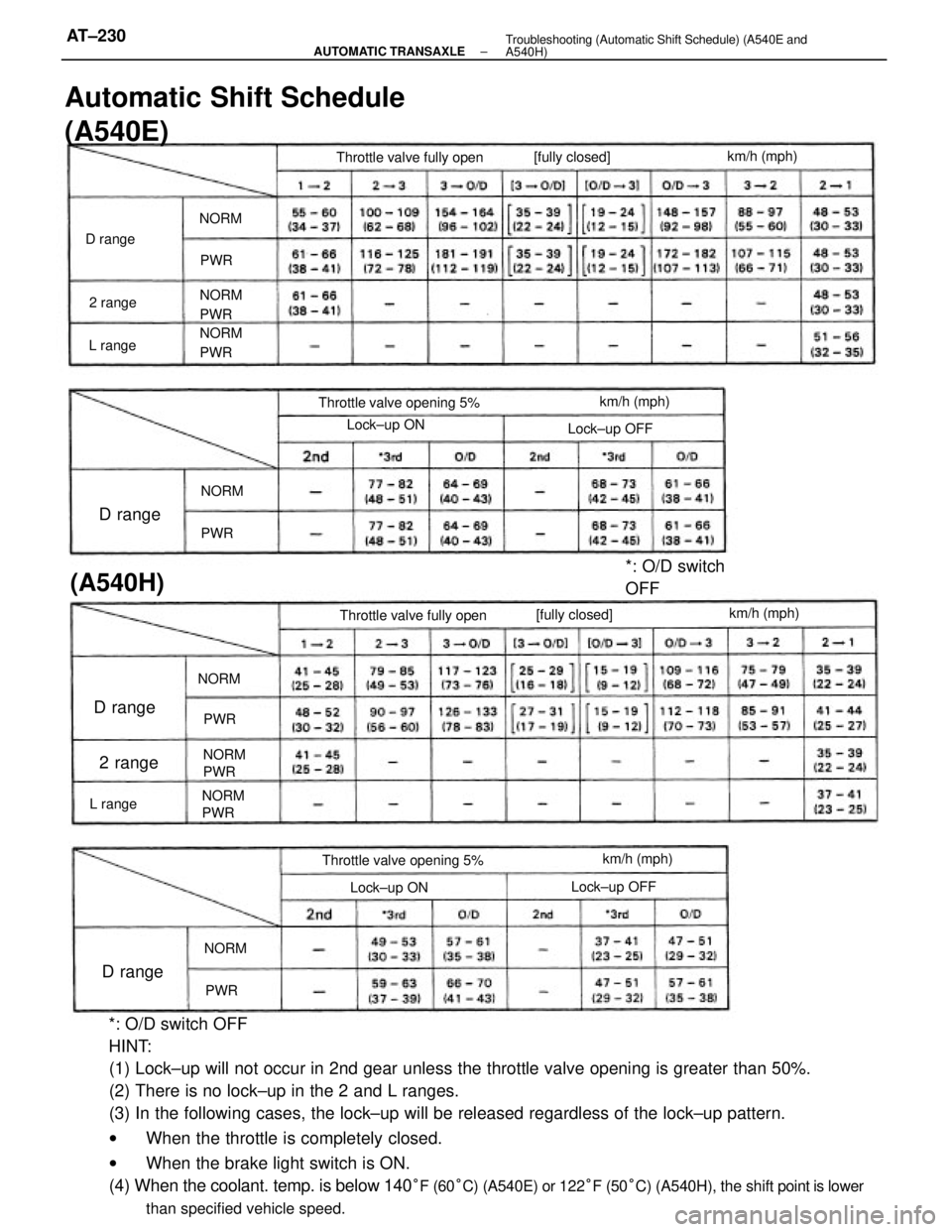
*: O/D switch OFF
HINT:
(1) Lock±up will not occur in 2nd gear unless the throttle valve opening is greater than 50%.
(2) There is no lock±up in the 2 and L ranges.
(3) In the following cases, the lock±up will be released regardless of the lock±up pattern.
wWhen the throttle is completely closed.
wWhen the brake light switch is ON.
(4) When the coolant. temp. is below 140
°F (60°C) (A540E) or 122°F (50°C) (A540H), the shift point is lower
than specified vehicle speed.
Automatic Shift Schedule
(A540E)
Throttle valve opening 5%
Throttle valve opening 5%Throttle valve fully open
Throttle valve fully open
*: O/D switch
OFF
(A540H)
Lock±up ON[fully closed]
Lock±up OFFkm/h (mph) Lock±up OFFkm/h (mph)
[fully closed]
km/h (mph)
Lock±up ONkm/h (mph) NORM
PWR NORM
PWR
NORM
PWRNORM
PWR
D range D range
D range
2 range
D range
2 range
L range
L rangeNORM
NORM NORM
NORM
PWR PWR PWR
PWR
± AUTOMATIC TRANSAXLETroubleshooting (Automatic Shift Schedule) (A540E and
A540H)AT±230
Page 471 of 2389
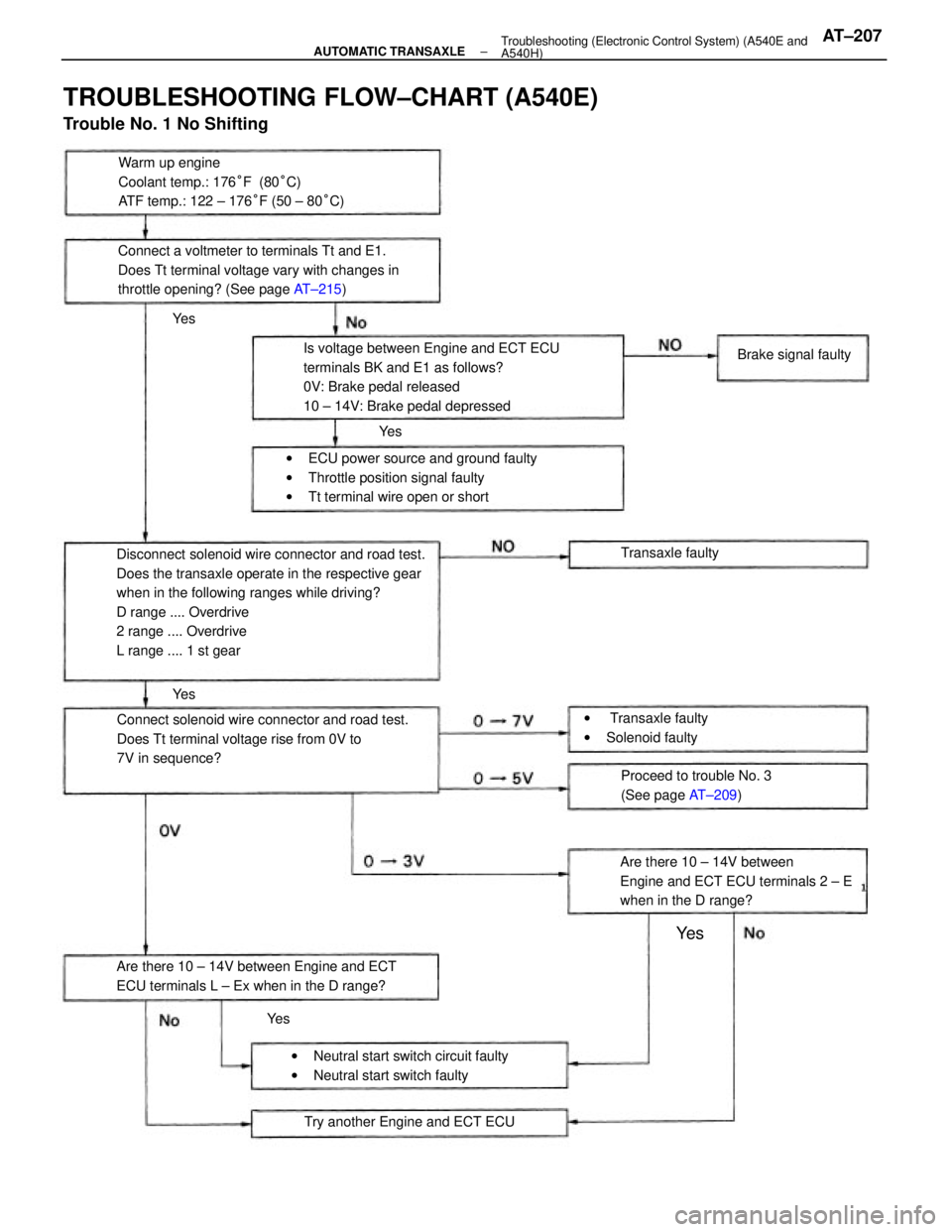
Disconnect solenoid wire connector and road test.
Does the transaxle operate in the respective gear
when in the following ranges while driving?
D range .... Overdrive
2 range .... Overdrive
L range .... 1 st gear
TROUBLESHOOTING FLOW±CHART (A540E)
Trouble No. 1 No Shifting
Is voltage between Engine and ECT ECU
terminals BK and E1 as follows?
0V: Brake pedal released
10 ± 14V: Brake pedal depressed
Connect solenoid wire connector and road test.
Does Tt terminal voltage rise from 0V to
7V in sequence?Warm up engine
Coolant temp.: 176°F (80°C)
ATF temp.: 122 ± 176°F (50 ± 80°C)
Connect a voltmeter to terminals Tt and E1.
Does Tt terminal voltage vary with changes in
throttle opening? (See page AT±215)
wECU power source and ground faulty
wThrottle position signal faulty
wTt terminal wire open or short
Are there 10 ± 14V between
Engine and ECT ECU terminals 2 ± E
when in the D range?
Are there 10 ± 14V between Engine and ECT
ECU terminals L ± Ex when in the D range?
wNeutral start switch circuit faulty
wNeutral start switch faultyProceed to trouble No. 3
(See page AT±209)
Try another Engine and ECT ECUw Transaxle faulty
wSolenoid faultyBrake signal faulty
Transaxle faulty
Ye s
Ye s
Ye s
Ye s Ye s
± AUTOMATIC TRANSAXLETroubleshooting (Electronic Control System) (A540E and
A540H)AT±207
Page 472 of 2389
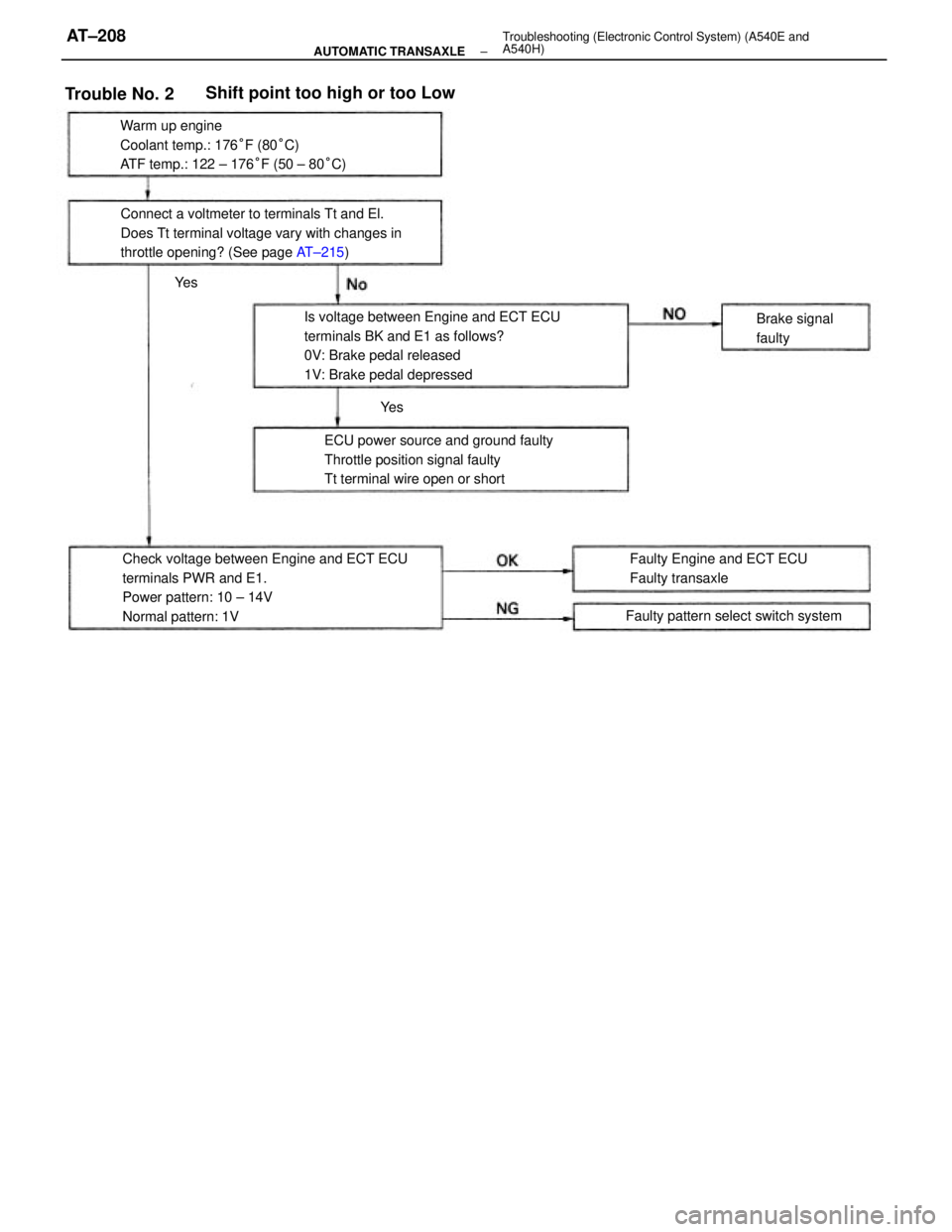
Check voltage between Engine and ECT ECU
terminals PWR and E1.
Power pattern: 10 ± 14V
Normal pattern: 1VIs voltage between Engine and ECT ECU
terminals BK and E1 as follows?
0V: Brake pedal released
1V: Brake pedal depressed Warm up engine
Coolant temp.: 176°F (80°C)
ATF temp.: 122 ± 176°F (50 ± 80°C)
Connect a voltmeter to terminals Tt and El.
Does Tt terminal voltage vary with changes in
throttle opening? (See page AT±215)
ECU power source and ground faulty
Throttle position signal faulty
Tt terminal wire open or short
Faulty Engine and ECT ECU
Faulty transaxle
Shift point too high or too Low
Faulty pattern select switch systemBrake signal
faulty
Trouble No. 2
Ye s Ye s
± AUTOMATIC TRANSAXLETroubleshooting (Electronic Control System) (A540E and
A540H)AT±208