oil level TOYOTA CAMRY V20 1986 Service Information
[x] Cancel search | Manufacturer: TOYOTA, Model Year: 1986, Model line: CAMRY V20, Model: TOYOTA CAMRY V20 1986Pages: 2389, PDF Size: 84.44 MB
Page 1229 of 2389
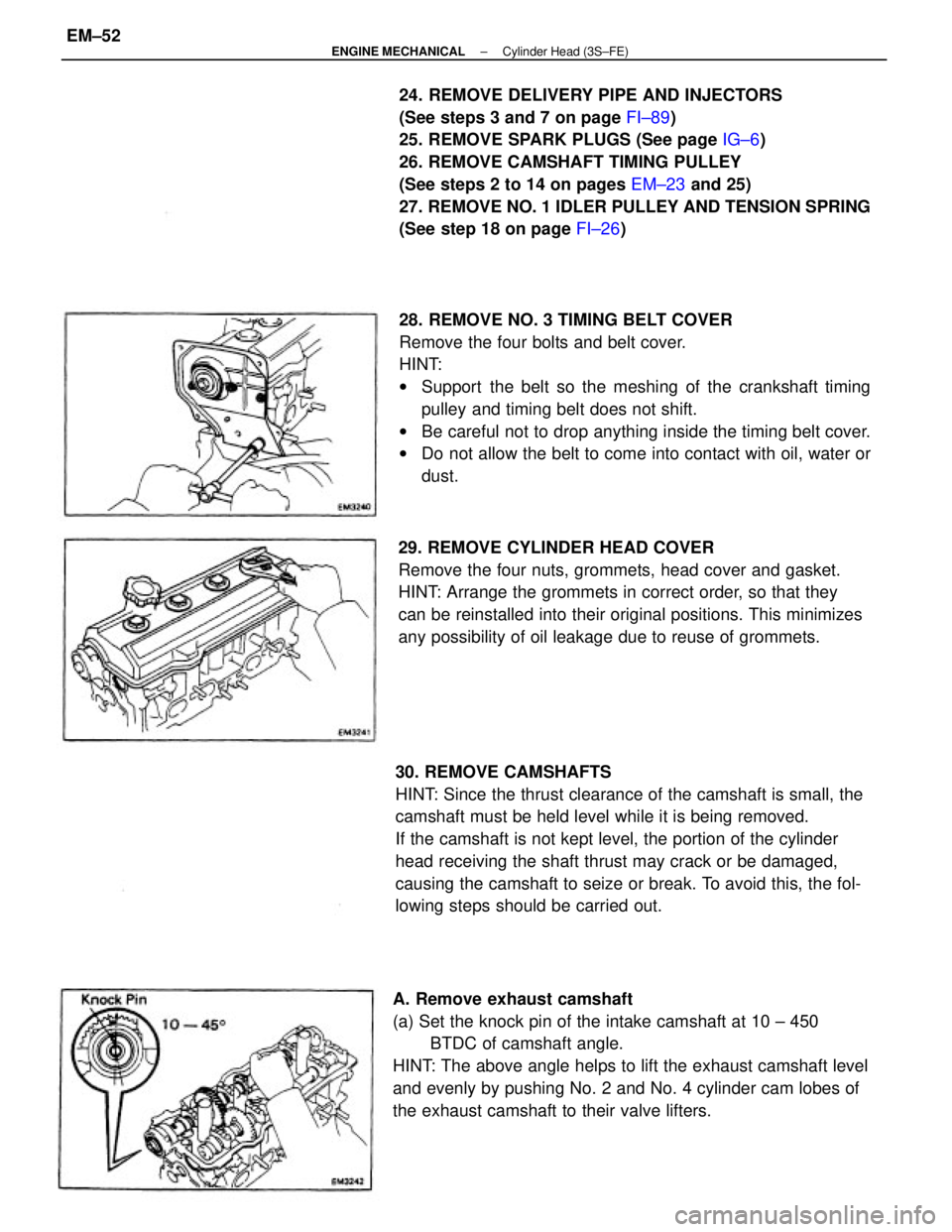
28. REMOVE NO. 3 TIMING BELT COVER
Remove the four bolts and belt cover.
HINT:
wSupport the belt so the meshing of the crankshaft timing
pulley and timing belt does not shift.
wBe careful not to drop anything inside the timing belt cover.
wDo not allow the belt to come into contact with oil, water or
dust. 24. REMOVE DELIVERY PIPE AND INJECTORS
(See steps 3 and 7 on page FI±89)
25. REMOVE SPARK PLUGS (See page IG±6)
26. REMOVE CAMSHAFT TIMING PULLEY
(See steps 2 to 14 on pages EM±23 and 25)
27. REMOVE NO. 1 IDLER PULLEY AND TENSION SPRING
(See step 18 on page FI±26)
30. REMOVE CAMSHAFTS
HINT: Since the thrust clearance of the camshaft is small, the
camshaft must be held level while it is being removed.
If the camshaft is not kept level, the portion of the cylinder
head receiving the shaft thrust may crack or be damaged,
causing the camshaft to seize or break. To avoid this, the fol-
lowing steps should be carried out.
A. Remove exhaust camshaft
(a) Set the knock pin of the intake camshaft at 10 ± 450
BTDC of camshaft angle.
HINT: The above angle helps to lift the exhaust camshaft level
and evenly by pushing No. 2 and No. 4 cylinder cam lobes of
the exhaust camshaft to their valve lifters.29. REMOVE CYLINDER HEAD COVER
Remove the four nuts, grommets, head cover and gasket.
HINT: Arrange the grommets in correct order, so that they
can be reinstalled into their original positions. This minimizes
any possibility of oil leakage due to reuse of grommets.
± ENGINE MECHANICALCylinder Head (3S±FE)EM±52
Page 1231 of 2389
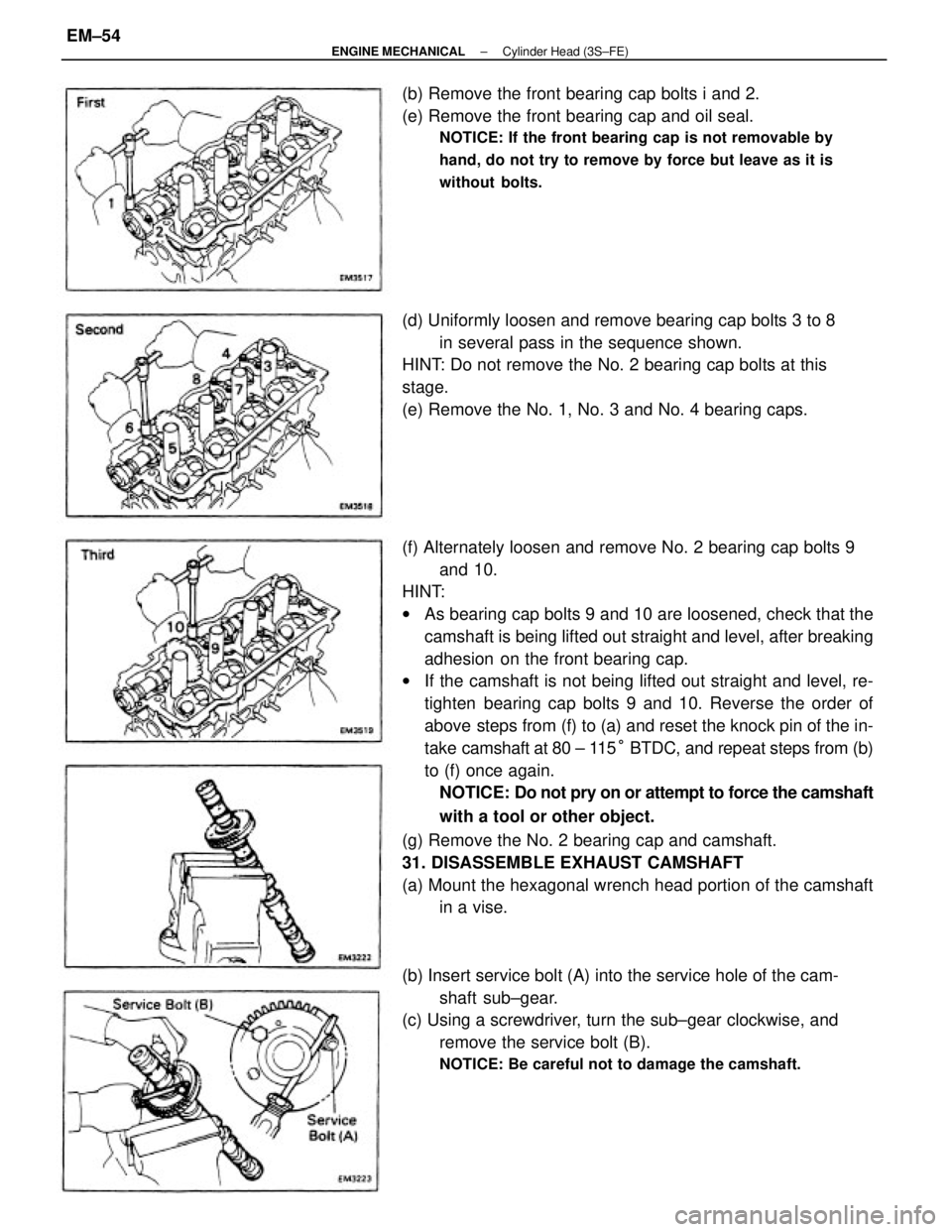
(f) Alternately loosen and remove No. 2 bearing cap bolts 9
and 10.
HINT:
wAs bearing cap bolts 9 and 10 are loosened, check that the
camshaft is being lifted out straight and level, after breaking
adhesion on the front bearing cap.
wIf the camshaft is not being lifted out straight and level, re-
tighten bearing cap bolts 9 and 10. Reverse the order of
above steps from (f) to (a) and reset the knock pin of the in-
take camshaft at 80 ± 115° BTDC, and repeat steps from (b)
to (f) once again.
NOTICE: Do not pry on or attempt to force the camshaft
with a tool or other object.
(g) Remove the No. 2 bearing cap and camshaft.
31. DISASSEMBLE EXHAUST CAMSHAFT
(a) Mount the hexagonal wrench head portion of the camshaft
in a vise.
(b) Insert service bolt (A) into the service hole of the cam-
shaft sub±gear.
(c) Using a screwdriver, turn the sub±gear clockwise, and
remove the service bolt (B).
NOTICE: Be careful not to damage the camshaft.
(d) Uniformly loosen and remove bearing cap bolts 3 to 8
in several pass in the sequence shown.
HINT: Do not remove the No. 2 bearing cap bolts at this
stage.
(e) Remove the No. 1, No. 3 and No. 4 bearing caps. (b) Remove the front bearing cap bolts i and 2.
(e) Remove the front bearing cap and oil seal.
NOTICE: If the front bearing cap is not removable by
hand, do not try to remove by force but leave as it is
without bolts.
± ENGINE MECHANICALCylinder Head (3S±FE)EM±54
Page 1245 of 2389
.
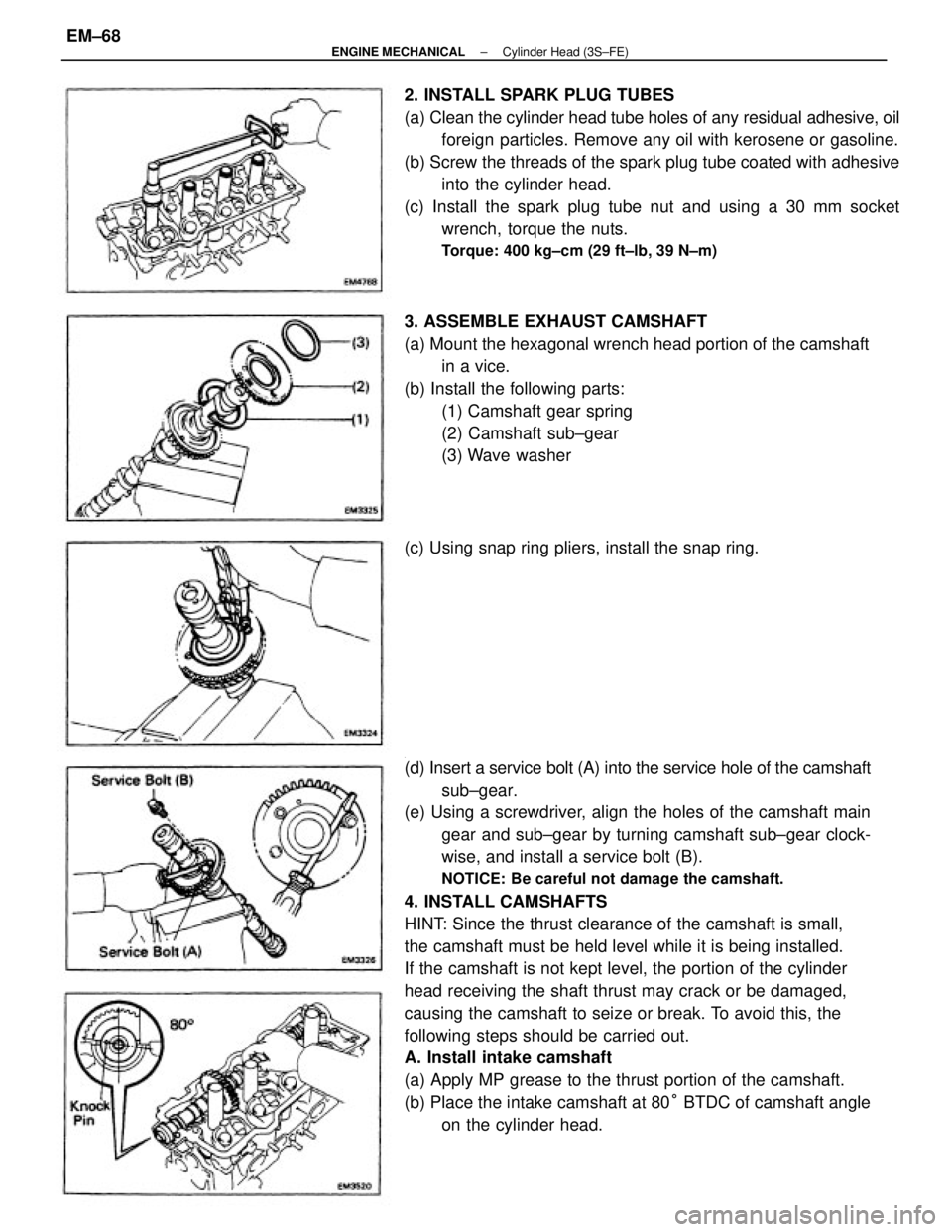
(d) Insert a service bolt (A) into the service hole of the camshaft
sub±gear.
(e) Using a screwdriver, align the holes of the camshaft main
gear and sub±gear by turning camshaft sub±gear clock-
wise, and install a service bolt (B).
NOTICE: Be careful not damage the camshaft.
4. INSTALL CAMSHAFTS
HINT: Since the thrust clearance of the camshaft is small,
the camshaft must be held level while it is being installed.
If the camshaft is not kept level, the portion of the cylinder
head receiving the shaft thrust may crack or be damaged,
causing the camshaft to seize or break. To avoid this, the
following steps should be carried out.
A. Install intake camshaft
(a) Apply MP grease to the thrust portion of the camshaft.
(b) Place the intake camshaft at 80° BTDC of camshaft angle
on the cylinder head. 2. INSTALL SPARK PLUG TUBES
(a) Clean the cylinder head tube holes of any residual adhesive, oil
foreign particles. Remove any oil with kerosene or gasoline.
(b) Screw the threads of the spark plug tube coated with adhesive
into the cylinder head.
(c) Install the spark plug tube nut and using a 30 mm socket
wrench, torque the nuts.
Torque: 400 kg±cm (29 ft±lb, 39 N±m)
3. ASSEMBLE EXHAUST CAMSHAFT
(a) Mount the hexagonal wrench head portion of the camshaft
in a vice.
(b) Install the following parts:
(1) Camshaft gear spring
(2) Camshaft sub±gear
(3) Wave washer
(c) Using snap ring pliers, install the snap ring.
± ENGINE MECHANICALCylinder Head (3S±FE)EM±68
Page 1251 of 2389
26. INSTALL OIL PRESSURE SWITCH, ENGINE HANGERS
AND ALTERNATOR BRACKET
Torque the bolts.
Torque: 500 kg±cm (37 ft±Ib, 48 N±m)
27. INSTALL ALTERNATOR (See page CH±14)
28. INSTALL AIR CLEANER HOSE
29. INSTALL CRUISE CONTROL ACTUATOR
(See step 26 on page EM±137)
30. INSTALL RADIATOR RESERVOIR TANK
31. INSTALL ACCELERATOR CABLE, AND ADJUST IT
32. (A/T)
CONNECT THROTTLE CABLE, AND ADJUST IT
33. FILL WITH ENGINE COOLANT (See page CO±5)
Capacity (w/ Heater):
M/T 6.4 liters (6.8 US qts, 5.6 Imp. qts)
A/T (2WD) 6.3 liters (6.7 US qts, 5.5 Imp. qts)
A/T (4WD) 6.8 liters (7.2 US qts, 6.0 Imp. qts)
34. CONNECT CABLE TO NEGATIVE TERMINAL OF
BATTERY
35. START ENGINE AND CHECK FOR LEAKS
36. PERFORM ENGINE ADJUSTMENT
(a) Adjust the valve clearance. (See page EM±11)
Valve clearance (Cold):
Intake 0.19 ± 0.29 mm (0.007 ± 0.011 in.)
Exhaust 0.28 ± 0.38 mm (0.011 ± 0.015 in.)
(b) Adjust the ignition timing.
(See steps 7 to 10 on pages IG±16 and 17)
Ignition timing:
10° BTDC @ idle
(w/ Terminals TE 1 and E 1 connected)
37. CHECK TOE±IN (See page FA±5)
38. PERFORM ROAD TEST
Check for abnormal noise, shock, slippage, correct shift
points and smooth operation.
39. RECHECK ENGINE COOLANT LEVEL AND OIL LEVEL
± ENGINE MECHANICALCylinder Head (3S±FE)EM±74
Page 1283 of 2389
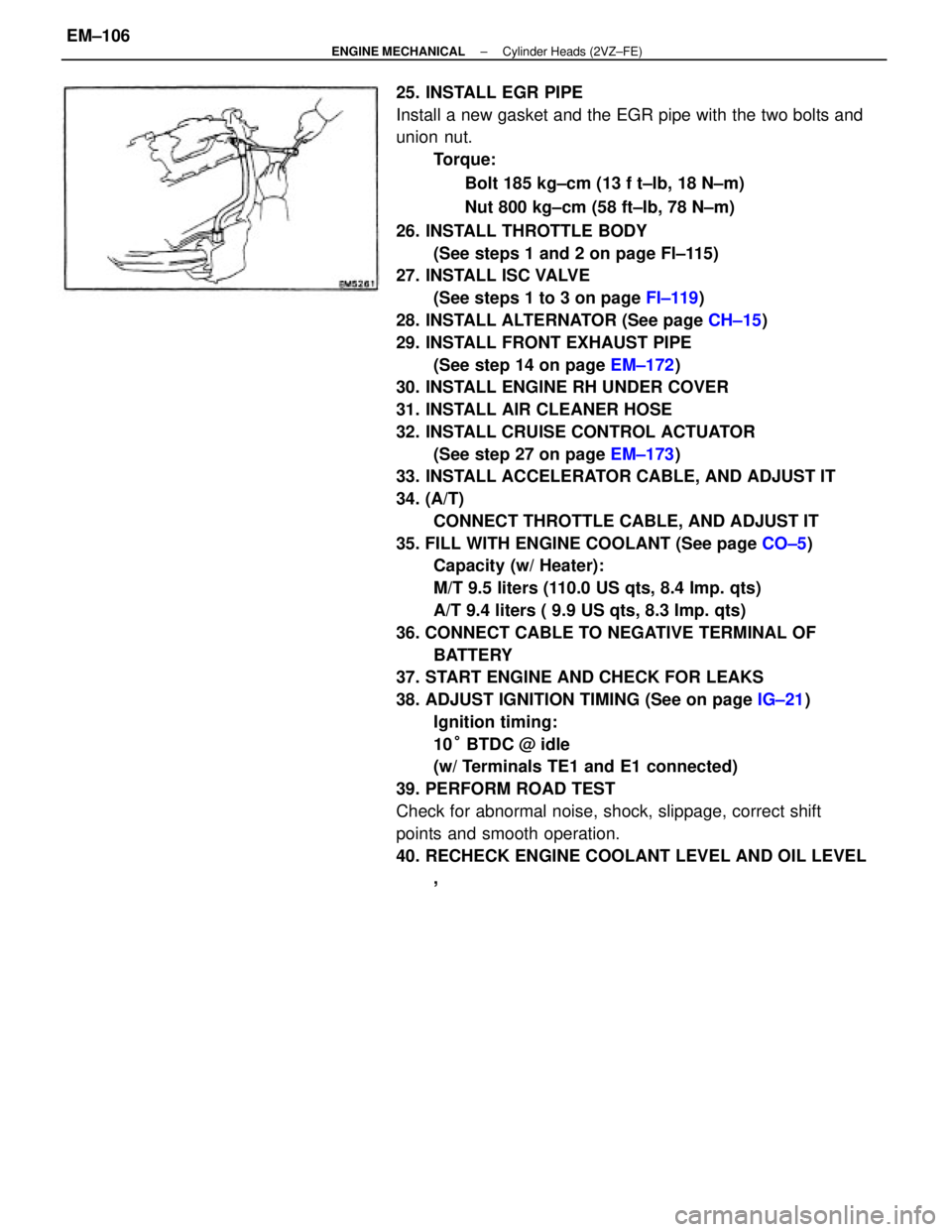
25. INSTALL EGR PIPE
Install a new gasket and the EGR pipe with the two bolts and
union nut.
Torque:
Bolt 185 kg±cm (13 f t±lb, 18 N±m)
Nut 800 kg±cm (58 ft±Ib, 78 N±m)
26. INSTALL THROTTLE BODY
(See steps 1 and 2 on page Fl±115)
27. INSTALL ISC VALVE
(See steps 1 to 3 on page FI±119)
28. INSTALL ALTERNATOR (See page CH±15)
29. INSTALL FRONT EXHAUST PIPE
(See step 14 on page EM±172)
30. INSTALL ENGINE RH UNDER COVER
31. INSTALL AIR CLEANER HOSE
32. INSTALL CRUISE CONTROL ACTUATOR
(See step 27 on page EM±173)
33. INSTALL ACCELERATOR CABLE, AND ADJUST IT
34. (A/T)
CONNECT THROTTLE CABLE, AND ADJUST IT
35. FILL WITH ENGINE COOLANT (See page CO±5)
Capacity (w/ Heater):
M/T 9.5 liters (110.0 US qts, 8.4 Imp. qts)
A/T 9.4 liters ( 9.9 US qts, 8.3 Imp. qts)
36. CONNECT CABLE TO NEGATIVE TERMINAL OF
BATTERY
37. START ENGINE AND CHECK FOR LEAKS
38. ADJUST IGNITION TIMING (See on page IG±21)
Ignition timing:
10° BTDC @ idle
(w/ Terminals TE1 and E1 connected)
39. PERFORM ROAD TEST
Check for abnormal noise, shock, slippage, correct shift
points and smooth operation.
40. RECHECK ENGINE COOLANT LEVEL AND OIL LEVEL
,
± ENGINE MECHANICALCylinder Heads (2VZ±FE)EM±106
Page 1315 of 2389
32. INSTALL BATTERY
33. FILL WITH ENGINE COOLANT (See page CO±5)
Capacity (w/ Heater):
M/T 6.4 liters (6.8 US qts, 5.6 Imp. qts)
A/T (2WD) 6.3 liters (6.7 US qts, 5.5 Imp. qts)
A/T (4WD) 6.8 liters (7.2 US qts, 6.0 Imp. qts)
34. FILL WITH ENGINE OIL (See page LU±8)
Capacity:
Drain and refill
w/ Oil filter change
3.9 liters (4.1 US qts, 3.4 Imp. qts)
w/o Oil filter change
3.7 liters (3.9 US qts, 3.3 Imp. qts)
Dry fill 4.3 liters (4.5 US qts, 3.8 Imp. qts)
35. START ENGINE AND CHECK FOR LEAKS
36. PERFORM ENGINE ADJUSTMENT
(a) Adjust the alternator drive belt.
(See page CH±3)
Drive belt tension:
w/ A/C New belt 175 + 5 lb
Used belt 130 + 10 lb
w/o A/C New belt 125 + 25 lb
Used belt 95 + 20 lb
(b) Adjust the PS drive belt.
Drive belt tension: New belt 125 + 25 lb
Used belt 80 + 20 lb
(c) Adjust the ignition timing.
(See steps 7 to 10 on pages IG±16 and 17)
Ignition timing:
10° BTDC @ idle
(w/ Terminals TE 1 and E1 connected)
(d) Adjust the valve. clearance. (See page EM±11)
Valve clearance:
Intake 0.19 ± 0.29 mm (0.007 ± 0.011 in.)
Exhaust 0.28 ± 0.38 mm (0.011 ± 0.015 in.)
37. INSTALL HOOD
38. PERFORM ROAD TEST
Check for abnormal noise, shock, slippage, correct shift
points and smooth operation.
39. RECHECK ENGINE COOLANT AND ENGINE OIL
LEVELS
± ENGINE MECHANICALCylinder Block (3S±FE)EM±138
Page 1352 of 2389
39. PERFORM ENGINE ADJUSTMENT
(a) Adjust the alternator drive belt.
(See page CH±3)
Drive belt tension: New belt 175 + 5 Ib
Used belt 115 + 20 Ib
(b) Adjust PS pump drive belt.
Drive belt tension: New belt 125 + 25 Ib
Used belt 80 + 20 lb
(c) Adjust the ignition timing.
(See page IG±21 )
Ignition timing:
10°BTDC @ idle
(w/ Terminals TE1 and E1 connected)
(d) Adjust the valve clearance.
Valve clearance:
Intake 0.13 ± 0.23 mm (0. 005 ± 0.009 in.)
Exhaust 0.27 ± 0.37 mm l0.011 ± 0.015 in.)
40. INSTALL HOOD
41. PERFORM ROAD TEST
Check for abnormal noise, shock, slippage, correct shift
points and smooth operation.
42. RECHECK ENGINE COOLANT AND ENGINE OIL
LEVELS
± ENGINE MECHANICALCylinder Block (2VZ±FE)EM±175
Page 1889 of 2389
A pressure feeding lubrication system has been adopted to supply oil to the moving parts of this engine.
The lubrication system consists of an oil pan, oil pump, oil filter and other external parts which supply oil
to the moving parts in the engine block The oil circuit is shown in the illustration at the top of the pre-
vious page. Oil from the oil pan is pumped up by the oil pump. After it passes through the oil filter, it is
fed through the various oil holes in the crankshaft and cylinder block. After passing through the cylinder
block and performing its lubricating function, the oil is returned by gravity to the oil pan. A dipstick on the
center left side of the cylinder block is provided to check the oil level.
OIL PUMP
The oil pump pumps up oil from the oil pan and sends it under pressure to the various parts of the en-
gine.
An oil strainer is mounted in front of the inlet to the oil pump. The oil pump itself is a trochoid±type
pump, inside of which is a drive rotor and a driven rotor. 'When the drive rotor rotates, the driven rotor
rotates in the same direction, and since the axis of the driven rotor shaft is different from the center of
the driven rotor, the space between the two rotors is changed as they rotate. Oil is drawn in when the
space is wide and is discharged when the space in narrow.
OIL PRESSURE REGULATOR (RELIEF VALVE)
At high engine speeds, the engine oil supplied by the oil pump exceeds the capacity of the engine to
utilize it.
For that reason, the oil pressure regulator works to prevent an oversupply of oil. During normal oil sup-
ply, a coil spring and valve keep the by±pass closed, but when too much oil is being fed, the pressure
become extremely high, overpowering the force of the spring and opening the valves. This allows the
excess oil to flow through the valve and return to the oil pan.
OIL FILTER
The oil filter is a full flow type filter with a built±in paper filter element, Particles of metal from wear, air-
born dirt, carbon and other impurities can get in the oil during use and could cause accelerated wear or
seizing if allowed to circulate through the engine. The oil filter, integrated into the oil line, removes these
impurities as the oil passes through it. The filter is mounted outside the engine to simplify replacement of
the filter element.
A relief valve is also included ahead of the filter element to relieve the high oil pressure in case the filter
element becomes clogged with impurities. The relief valve opens when the oil pressure overpowers the
force of the spring. Oil passing through the relief valve by±passes the oil filter and flows directly into the
main oil hole in the engine.
± LUBRICATION SYSTEMDescriptionLU±4
Page 1891 of 2389
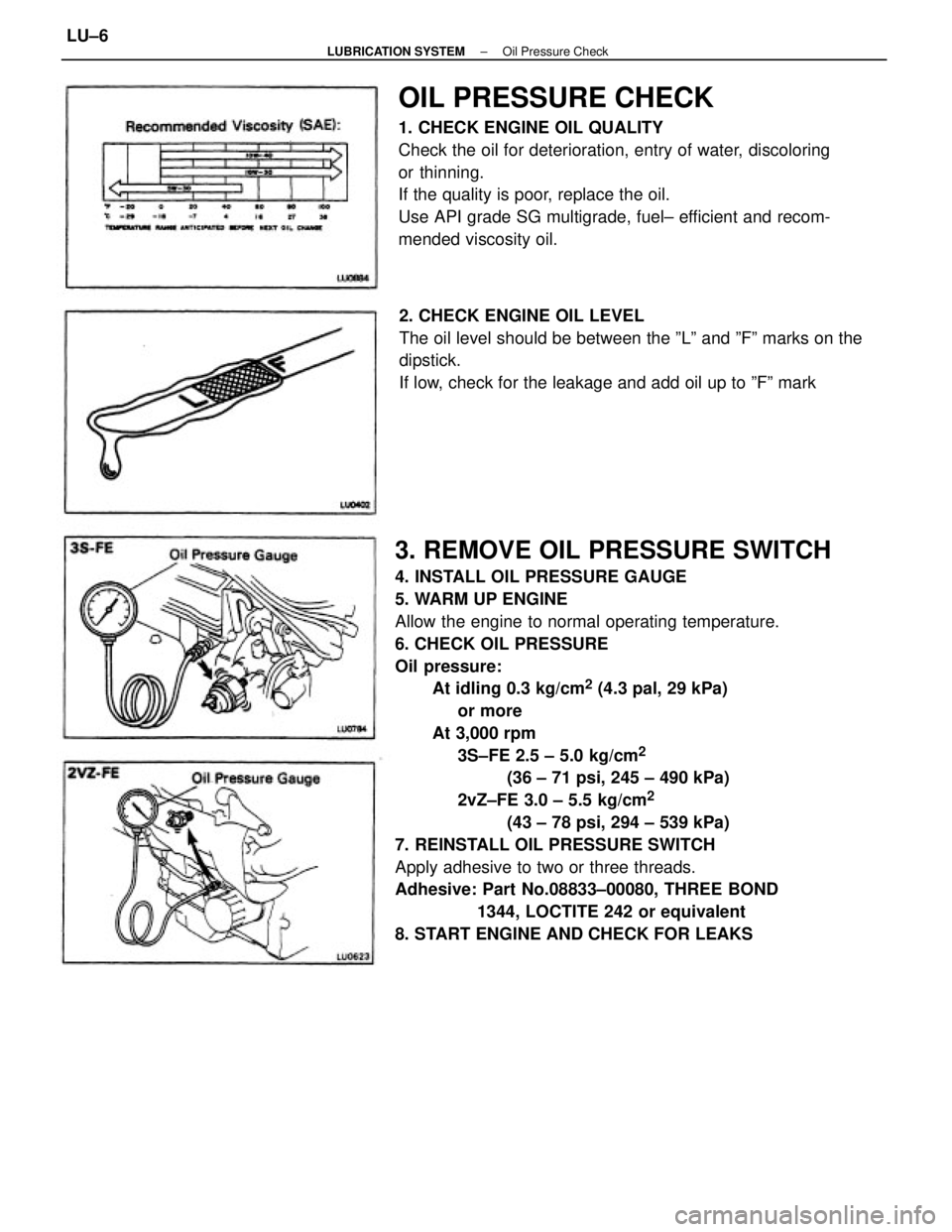
3. REMOVE OIL PRESSURE SWITCH
4. INSTALL OIL PRESSURE GAUGE
5. WARM UP ENGINE
Allow the engine to normal operating temperature.
6. CHECK OIL PRESSURE
Oil pressure:
At idling 0.3 kg/cm
2 (4.3 pal, 29 kPa)
or more
At 3,000 rpm
3S±FE 2.5 ± 5.0 kg/cm
2
(36 ± 71 psi, 245 ± 490 kPa)
2vZ±FE 3.0 ± 5.5 kg/cm
2
(43 ± 78 psi, 294 ± 539 kPa)
7. REINSTALL OIL PRESSURE SWITCH
Apply adhesive to two or three threads.
Adhesive: Part No.08833±00080, THREE BOND
1344, LOCTITE 242 or equivalent
8. START ENGINE AND CHECK FOR LEAKS
OIL PRESSURE CHECK
1. CHECK ENGINE OIL QUALITY
Check the oil for deterioration, entry of water, discoloring
or thinning.
If the quality is poor, replace the oil.
Use API grade SG multigrade, fuel± efficient and recom-
mended viscosity oil.
2. CHECK ENGINE OIL LEVEL
The oil level should be between the ºLº and ºFº marks on the
dipstick.
If low, check for the leakage and add oil up to ºFº mark
± LUBRICATION SYSTEMOil Pressure CheckLU±6
Page 1893 of 2389
3. FILL WITH ENGINE OIL
(a) Clean and install the oil drain plug with a new gasket.
Torque: 2VZ±FE 3S±FE 400 kg±cm (29 ft±lb, 39 N±m)
(b) Fill with new engine oil (API grade SG muitigrade,
fuel±efficient and recommended viscosity oil).
Capacity (3S±FE):
Drain and refill
w/ Oil filter change
4.1 liters (4.3 U S qts, 3.6 Imp. qts)
w/o Oil filter change
3.7 liters (3.9 US qts, 3.3 Imp. qts)
Dry fill 4.5 liters (4.8 U S qts, 4.4 Imp. qts)
Capacity (2VZ±FE):
Drain and refill
w/ Oil filter change
3.9 liters (4.1 US qts, 3.4 Imp. qts)
w/o Oil filter change
3.7 liters (3.9 US qts, 3.3 Imp. qts)
Dry fill 4.6 liters (4.8 US qts, 4.4 Imp. qts)
(c) Install the oil filler cap.
4. START ENGINE AND CHECK FOR LEAKS
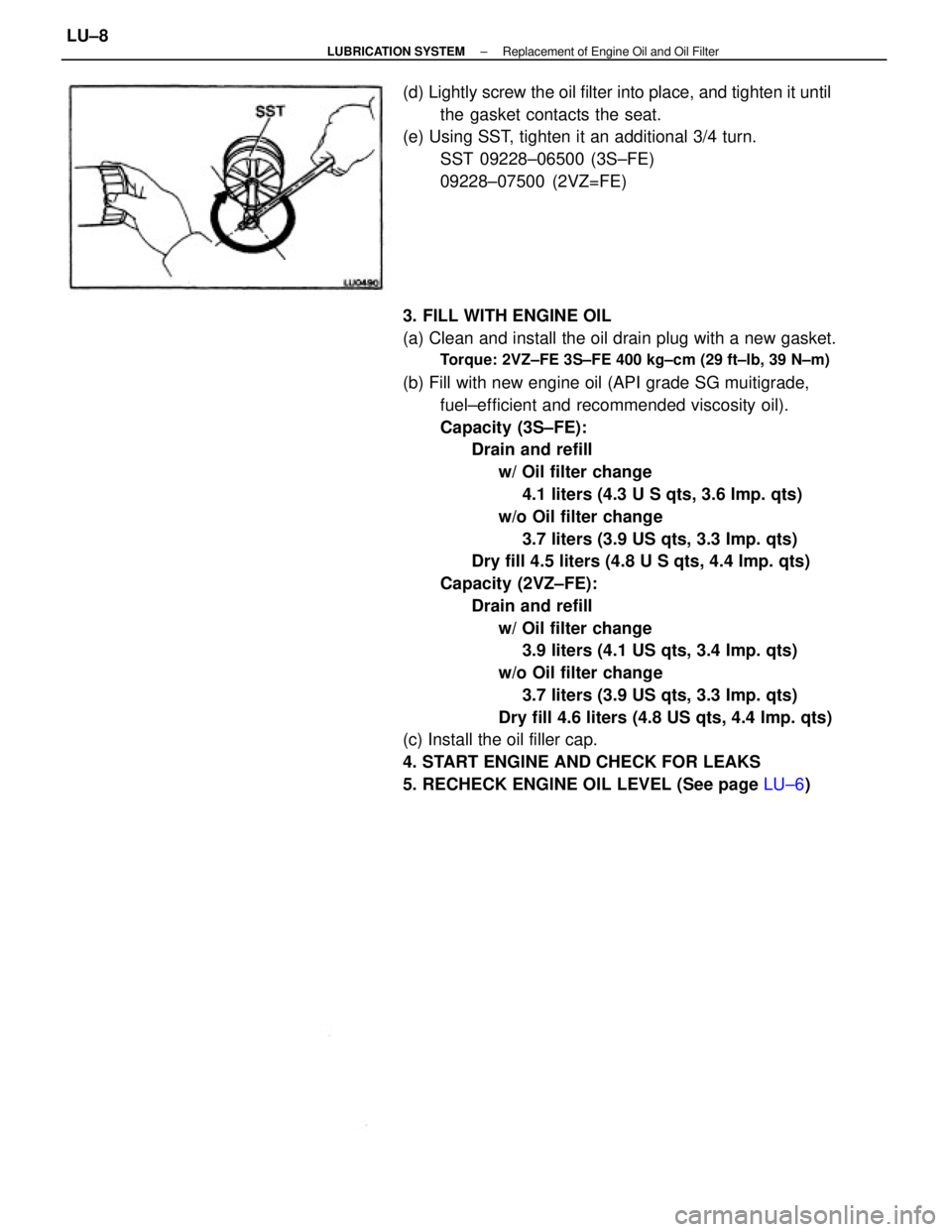
5. RECHECK ENGINE OIL LEVEL (See page LU±6) (d) Lightly screw the oil filter into place, and tighten it until
the gasket contacts the seat.
(e) Using SST, tighten it an additional 3/4 turn.
SST 09228±06500 (3S±FE)
09228±07500 (2VZ=FE)
± LUBRICATION SYSTEMReplacement of Engine Oil and Oil FilterLU±8