transmission TOYOTA CAMRY V20 1986 Service Information
[x] Cancel search | Manufacturer: TOYOTA, Model Year: 1986, Model line: CAMRY V20, Model: TOYOTA CAMRY V20 1986Pages: 2389, PDF Size: 84.44 MB
Page 1197 of 2389
IDLE AND OR 2,500 RPM HC CO
CONCENTRATION CHECK
METHOD
HINT: This check is used only to determine whether or not
the idle HC/CO complies with regulations.
1. INITIAL CONDITIONS
(b) Engine at normal operating temperature
(b) Air cleaner installed
(e) All pipes and hoses of air induction system connected
(d) All operating accessories switched OFF
(e) All vacuum lines properly connected
HINT: All vacuum hoses for EGR systems, etc. should be
properly connected.
(f) EFI system wiring connectors fully plugged
(g) Ignition timing set correctly
(h) Transmission in N range
(i) Tachometer and HC/CO meter calibrated and at hand
2. START ENGINE
3. RACE ENGINE AT 2,500 RPM FOR APPROX. 2
MINUTES
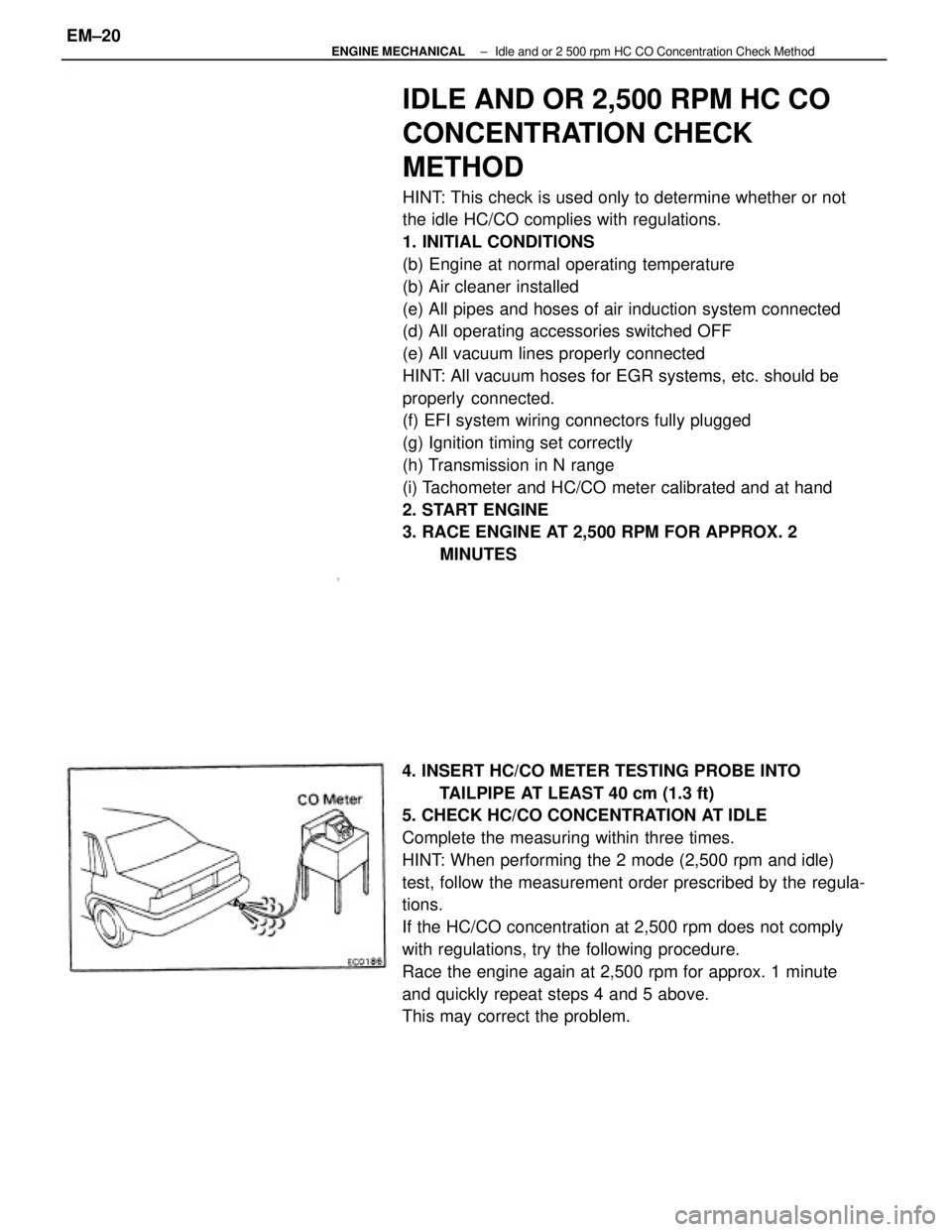
4. INSERT HC/CO METER TESTING PROBE INTO
TAILPIPE AT LEAST 40 cm (1.3 ft)
5. CHECK HC/CO CONCENTRATION AT IDLE
Complete the measuring within three times.
HINT: When performing the 2 mode (2,500 rpm and idle)
test, follow the measurement order prescribed by the regula-
tions.
If the HC/CO concentration at 2,500 rpm does not comply
with regulations, try the following procedure.
Race the engine again at 2,500 rpm for approx. 1 minute
and quickly repeat steps 4 and 5 above.
This may correct the problem.
± ENGINE MECHANICALIdle and or 2 500 rpm HC CO Concentration Check MethodEM±20
Page 1850 of 2389
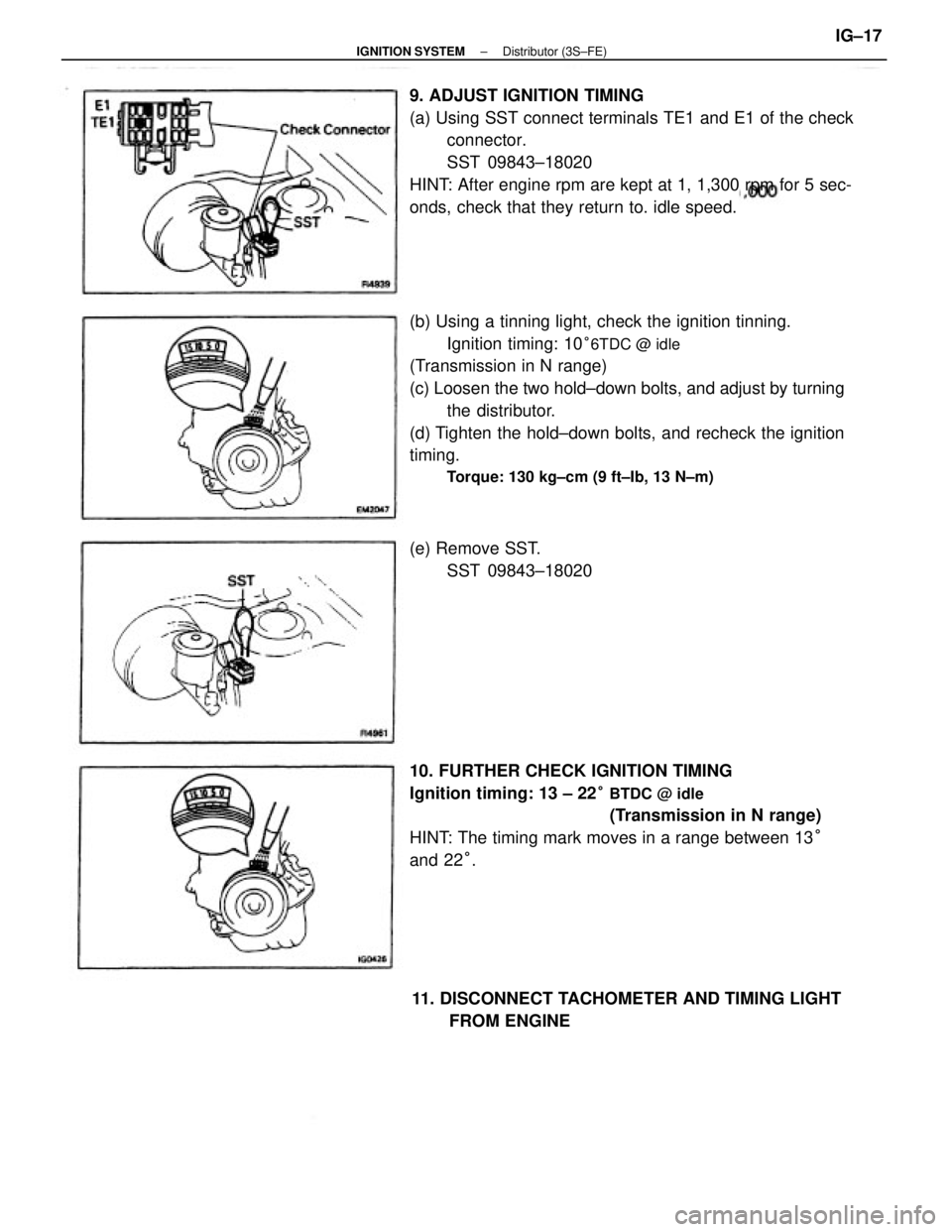
(b) Using a tinning light, check the ignition tinning.
Ignition timing: 10
°6TDC @ idle
(Transmission in N range)
(c) Loosen the two hold±down bolts, and adjust by turning
the distributor.
(d) Tighten the hold±down bolts, and recheck the ignition
timing.
Torque: 130 kg±cm (9 ft±Ib, 13 N±m)
9. ADJUST IGNITION TIMING
(a) Using SST connect terminals TE1 and E1 of the check
connector.
SST 09843±18020
HINT: After engine rpm are kept at 1, 1,300 rpm for 5 sec-
onds, check that they return to. idle speed.
10. FURTHER CHECK IGNITION TIMING
Ignition timing: 13 ± 22
° BTDC @ idle
(Transmission in N range)
HINT: The timing mark moves in a range between 13°
and 22°.
11. DISCONNECT TACHOMETER AND TIMING LIGHT
FROM ENGINE (e) Remove SST.
SST 09843±18020
± IGNITION SYSTEMDistributor (3S±FE)IG±17
Page 1854 of 2389
![TOYOTA CAMRY V20 1986 Service Information 6. WARM UP ENGINE
Allow the engine to normal operating temperature.
7. CONNECT TACHOMETER AND TIMING LIGHT TO
ENGINE
Connect the tachometer test probe to terminal IG [±] of the
check connector.
NOTIC](/img/14/57449/w960_57449-1853.png "TOYOTA CAMRY V20 1986 Service Information 6. WARM UP ENGINE
Allow the engine to normal operating temperature.
7. CONNECT TACHOMETER AND TIMING LIGHT TO
ENGINE
Connect the tachometer test probe to terminal IG [±] of the
check connector.
NOTIC")
6. WARM UP ENGINE
Allow the engine to normal operating temperature.
7. CONNECT TACHOMETER AND TIMING LIGHT TO
ENGINE
Connect the tachometer test probe to terminal IG [±] of the
check connector.
NOTICE:
wNEVER allow the tachometer test probe to touch ground
as it could result in damage to the igniter
and/or ignition coil.
wAs some tachometers are not compatible with this igni-
tion system, we recommended that you confirm the
compatibility of your unit before use.
8. ADJUST IGNITION TIMING
(a) Check the idle speed.
Idle speed: 700
+ 50 rpm
(b) Using SST connect terminals TE1 and E1 of the check con-
nector.
SST 09843±18020
(c) Using a timing light, check the ignition timing.
Ignition timing: 10°6TDC @ idle
(Transmission in N range)
(d) Loosen the two hold±down bolts, and adjust by turning the
distributor.
(e) Tighten the hold±down bolts, and recheck the ignition timing.
Torque: 185 kg±cm (13 ft±Ib, 18 N±m)
9. FURTHER CHECK IGNITION TIMING
Ignition timing: 10°BTDC @ idle
(Transmission in N range)
HINT: The timing mark moves in a range between 13°
and 27°.
10. DISCONNECT TACHOMETER AND TIMING LIGHT
FROM ENGINE (f) Remove SST.
SST 09843±18020
± IGNITION SYSTEMDistributor (2VZ±FE)IG±21
Page 1864 of 2389
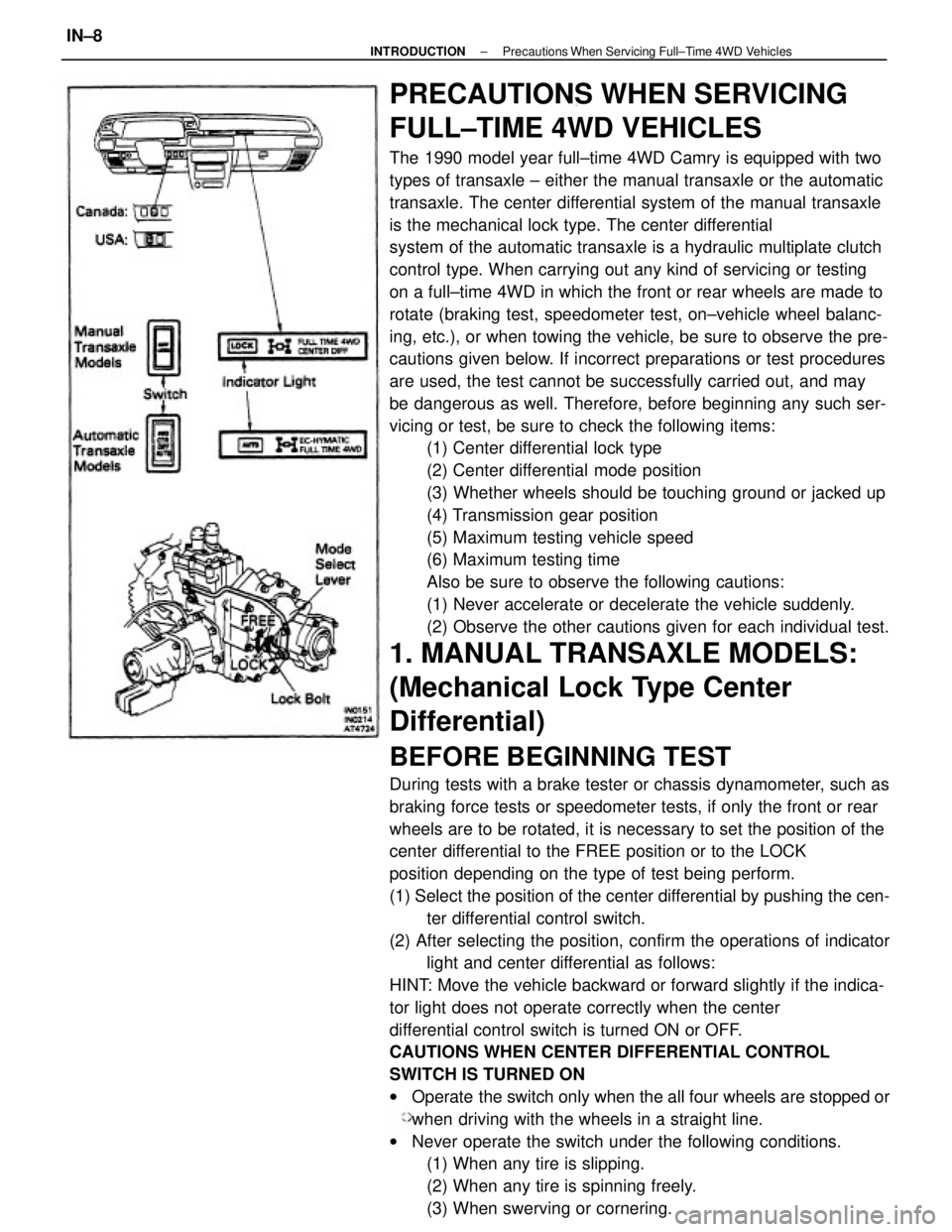
PRECAUTIONS WHEN SERVICING
FULL±TIME 4WD VEHICLES
The 1990 model year full±time 4WD Camry is equipped with two
types of transaxle ± either the manual transaxle or the automatic
transaxle. The center differential system of the manual transaxle
is the mechanical lock type. The center differential
system of the automatic transaxle is a hydraulic multiplate clutch
control type. When carrying out any kind of servicing or testing
on a full±time 4WD in which the front or rear wheels are made to
rotate (braking test, speedometer test, on±vehicle wheel balanc-
ing, etc.), or when towing the vehicle, be sure to observe the pre-
cautions given below. If incorrect preparations or test procedures
are used, the test cannot be successfully carried out, and may
be dangerous as well. Therefore, before beginning any such ser-
vicing or test, be sure to check the following items:
(1) Center differential lock type
(2) Center differential mode position
(3) Whether wheels should be touching ground or jacked up
(4) Transmission gear position
(5) Maximum testing vehicle speed
(6) Maximum testing time
Also be sure to observe the following cautions:
(1) Never accelerate or decelerate the vehicle suddenly.
(2) Observe the other cautions given for each individual test.
1. MANUAL TRANSAXLE MODELS:
(Mechanical Lock Type Center
Differential)
BEFORE BEGINNING TEST
During tests with a brake tester or chassis dynamometer, such as
braking force tests or speedometer tests, if only the front or rear
wheels are to be rotated, it is necessary to set the position of the
center differential to the FREE position or to the LOCK
position depending on the type of test being perform.
(1) Select the position of the center differential by pushing the cen-
ter differential control switch.
(2) After selecting the position, confirm the operations of indicator
light and center differential as follows:
HINT: Move the vehicle backward or forward slightly if the indica-
tor light does not operate correctly when the center
differential control switch is turned ON or OFF.
CAUTIONS WHEN CENTER DIFFERENTIAL CONTROL
SWITCH IS TURNED ON
wOperate the switch only when the all four wheels are stopped or
when driving with the wheels in a straight line.
wNever operate the switch under the following conditions.
(1) When any tire is slipping.
(2) When any tire is spinning freely.
(3) When swerving or cornering.
± INTRODUCTIONPrecautions When Servicing Full±Time 4WD VehiclesIN±8
Page 1865 of 2389
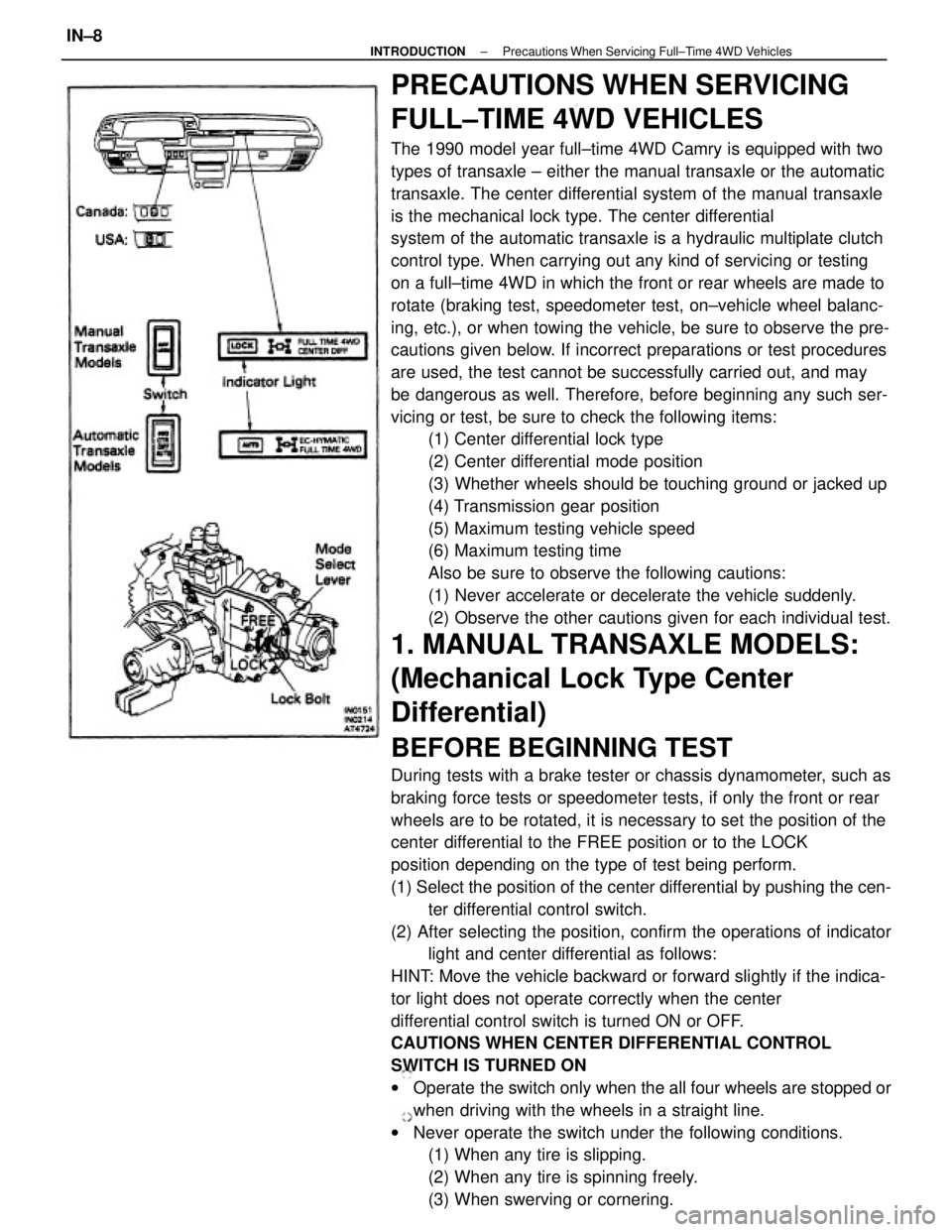
PRECAUTIONS WHEN SERVICING
FULL±TIME 4WD VEHICLES
The 1990 model year full±time 4WD Camry is equipped with two
types of transaxle ± either the manual transaxle or the automatic
transaxle. The center differential system of the manual transaxle
is the mechanical lock type. The center differential
system of the automatic transaxle is a hydraulic multiplate clutch
control type. When carrying out any kind of servicing or testing
on a full±time 4WD in which the front or rear wheels are made to
rotate (braking test, speedometer test, on±vehicle wheel balanc-
ing, etc.), or when towing the vehicle, be sure to observe the pre-
cautions given below. If incorrect preparations or test procedures
are used, the test cannot be successfully carried out, and may
be dangerous as well. Therefore, before beginning any such ser-
vicing or test, be sure to check the following items:
(1) Center differential lock type
(2) Center differential mode position
(3) Whether wheels should be touching ground or jacked up
(4) Transmission gear position
(5) Maximum testing vehicle speed
(6) Maximum testing time
Also be sure to observe the following cautions:
(1) Never accelerate or decelerate the vehicle suddenly.
(2) Observe the other cautions given for each individual test.
1. MANUAL TRANSAXLE MODELS:
(Mechanical Lock Type Center
Differential)
BEFORE BEGINNING TEST
During tests with a brake tester or chassis dynamometer, such as
braking force tests or speedometer tests, if only the front or rear
wheels are to be rotated, it is necessary to set the position of the
center differential to the FREE position or to the LOCK
position depending on the type of test being perform.
(1) Select the position of the center differential by pushing the cen-
ter differential control switch.
(2) After selecting the position, confirm the operations of indicator
light and center differential as follows:
HINT: Move the vehicle backward or forward slightly if the indica-
tor light does not operate correctly when the center
differential control switch is turned ON or OFF.
CAUTIONS WHEN CENTER DIFFERENTIAL CONTROL
SWITCH IS TURNED ON
wOperate the switch only when the all four wheels are stopped or
when driving with the wheels in a straight line.
wNever operate the switch under the following conditions.
(1) When any tire is slipping.
(2) When any tire is spinning freely.
(3) When swerving or cornering.
± INTRODUCTIONPrecautions When Servicing Full±Time 4WD VehiclesIN±8
Page 1866 of 2389
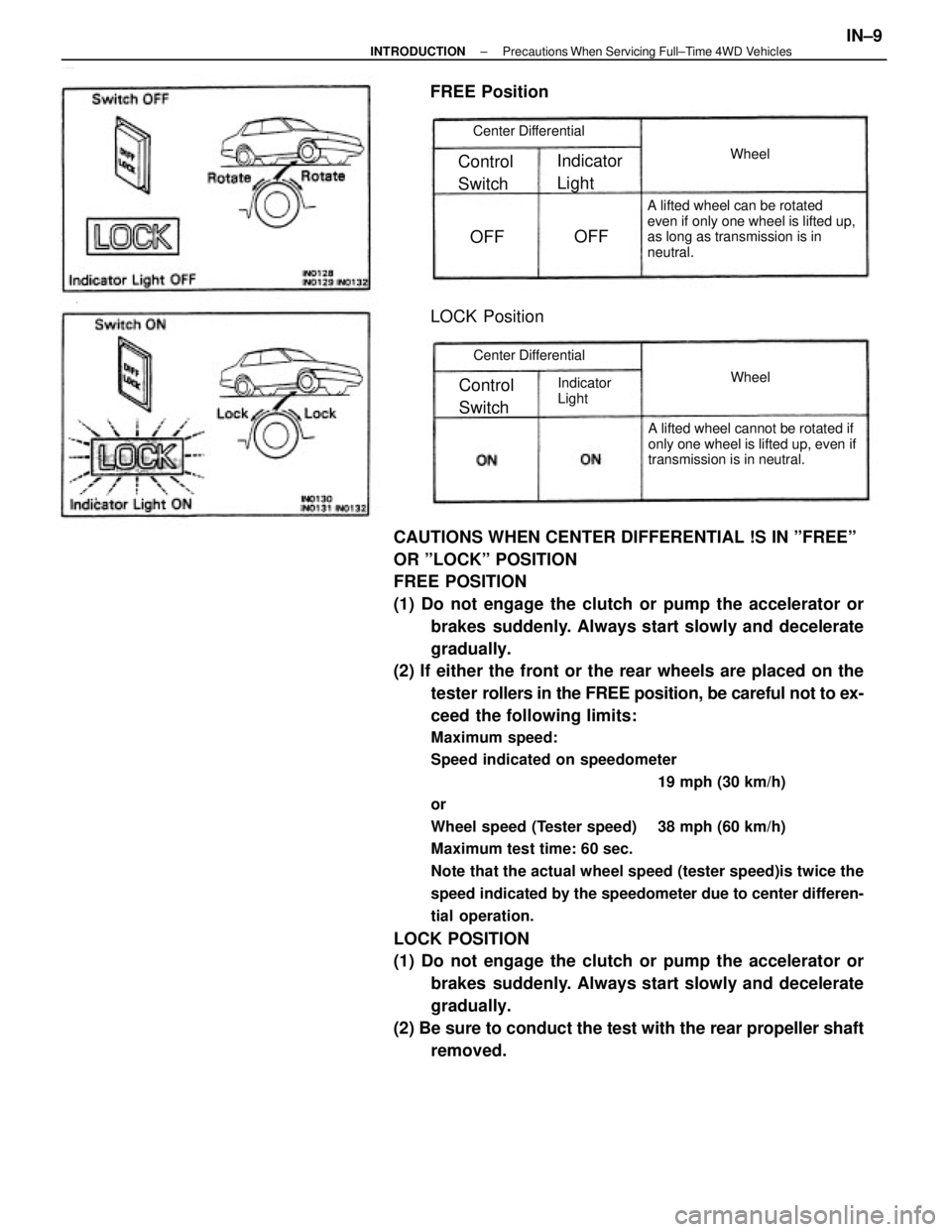
CAUTIONS WHEN CENTER DIFFERENTIAL !S IN ºFREEº
OR ºLOCKº POSITION
FREE POSITION
(1) Do not engage the clutch or pump the accelerator or
brakes suddenly. Always start slowly and decelerate
gradually.
(2) If either the front or the rear wheels are placed on the
tester rollers in the FREE position, be careful not to ex-
ceed the following limits:
Maximum speed:
Speed indicated on speedometer
19 mph (30 km/h)
or
Wheel speed (Tester speed) 38 mph (60 km/h)
Maximum test time: 60 sec.
Note that the actual wheel speed (tester speed)is twice the
speed indicated by the speedometer due to center differen-
tial operation.
LOCK POSITION
(1) Do not engage the clutch or pump the accelerator or
brakes suddenly. Always start slowly and decelerate
gradually.
(2) Be sure to conduct the test with the rear propeller shaft
removed.
A lifted wheel can be rotated
even if only one wheel is lifted up,
as long as transmission is in
neutral.
A lifted wheel cannot be rotated if
only one wheel is lifted up, even if
transmission is in neutral.
LOCK Position
Center Differential
Center Differential
Indicator
Light
Indicator
Light
FREE Position
Control
Switch Control
Switch
Wheel Wheel
OFFOFF
± INTRODUCTIONPrecautions When Servicing Full±Time 4WD VehiclesIN±9
Page 1867 of 2389
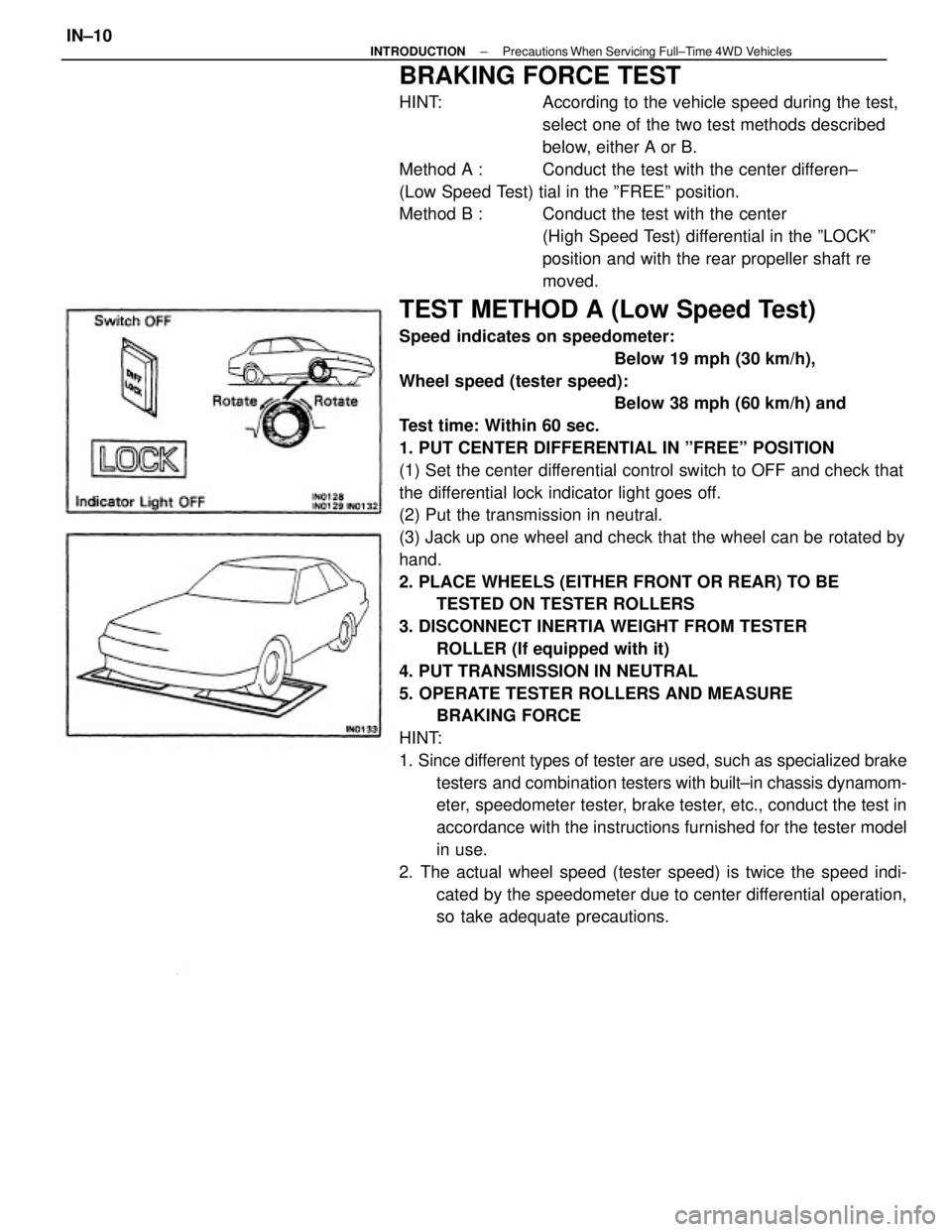
BRAKING FORCE TEST
HINT: According to the vehicle speed during the test,
select one of the two test methods described
below, either A or B.
Method A : Conduct the test with the center differen±
(Low Speed Test) tial in the ºFREEº position.
Method B : Conduct the test with the center
(High Speed Test) differential in the ºLOCKº
position and with the rear propeller shaft re
moved.
TEST METHOD A (Low Speed Test)
Speed indicates on speedometer:
Below 19 mph (30 km/h),
Wheel speed (tester speed):
Below 38 mph (60 km/h) and
Test time: Within 60 sec.
1. PUT CENTER DIFFERENTIAL IN ºFREEº POSITION
(1) Set the center differential control switch to OFF and check that
the differential lock indicator light goes off.
(2) Put the transmission in neutral.
(3) Jack up one wheel and check that the wheel can be rotated by
hand.
2. PLACE WHEELS (EITHER FRONT OR REAR) TO BE
TESTED ON TESTER ROLLERS
3. DISCONNECT INERTIA WEIGHT FROM TESTER
ROLLER (If equipped with it)
4. PUT TRANSMISSION IN NEUTRAL
5. OPERATE TESTER ROLLERS AND MEASURE
BRAKING FORCE
HINT:
1. Since different types of tester are used, such as specialized brake
testers and combination testers with built±in chassis dynamom-
eter, speedometer tester, brake tester, etc., conduct the test in
accordance with the instructions furnished for the tester model
in use.
2. The actual wheel speed (tester speed) is twice the speed indi-
cated by the speedometer due to center differential operation,
so take adequate precautions.
± INTRODUCTIONPrecautions When Servicing Full±Time 4WD VehiclesIN±10
Page 1868 of 2389
![TOYOTA CAMRY V20 1986 Service Information TEST METHOD B (High Speed Test)
[Vehicle speed: Over 38 mph (60 km/h)]
1. PUT CENTER DIFFERENTIAL IN ºLOCKº POSITION
(1) Set the center differential control switch to ON and
check that the different](/img/14/57449/w960_57449-1867.png "TOYOTA CAMRY V20 1986 Service Information TEST METHOD B (High Speed Test)
[Vehicle speed: Over 38 mph (60 km/h)]
1. PUT CENTER DIFFERENTIAL IN ºLOCKº POSITION
(1) Set the center differential control switch to ON and
check that the different")
TEST METHOD B (High Speed Test)
[Vehicle speed: Over 38 mph (60 km/h)]
1. PUT CENTER DIFFERENTIAL IN ºLOCKº POSITION
(1) Set the center differential control switch to ON and
check that the differential lock indicator light goes on.
HINT: If the indicator light does not go on when the
center differential control switch is turned on, move
the vehicle backward or forward slightly.
(2) Put the transmission in neutral.
(3) Jack up one wheel and check that the wheel cannot be
rotated by hand.
2. REMOVE REAR PROPELLER SHAFT
Make matching marks on each end of the rear propeller
shaft, then remove it.
3. PLACE WHEELS (EITHER FRONT OR REAR) TO BE
TESTED ON TESTER ROLLERS
4. DISCONNECT INERTIA WEIGHT FROM TESTER\ROLL-
ER (If equipped with it)
5. PUT TRANSMISSION IN NEUTRAL
6. OPERATE TESTER ROLLERS AND MEASURE
BRAKING FORCE
HINT: Since different types of tester are used, such as spe-
cialized brake testers and combination testers with
built±in chassis dynamometer, speedometer tester, brake
tester, etc., conduct the test in accordance with the instruc-
tions furnished for± the tester model in use.
7. INSTALL REAR PROPELLER SHAFT
Align the matching marks made on the rear propeller shaft
before removal, then install it.
8. SET CENTER DIFFERENTIAL CONTROL SWITCH TO
OFF
NOTE: If the indicator light does not go off when the center
differential control switch is turned off, move the vehicle
backward or forward slightly and check that the indicator light
goes off.
± INTRODUCTIONPrecautions When Servicing Full±Time 4WD VehiclesIN±11
Page 1869 of 2389
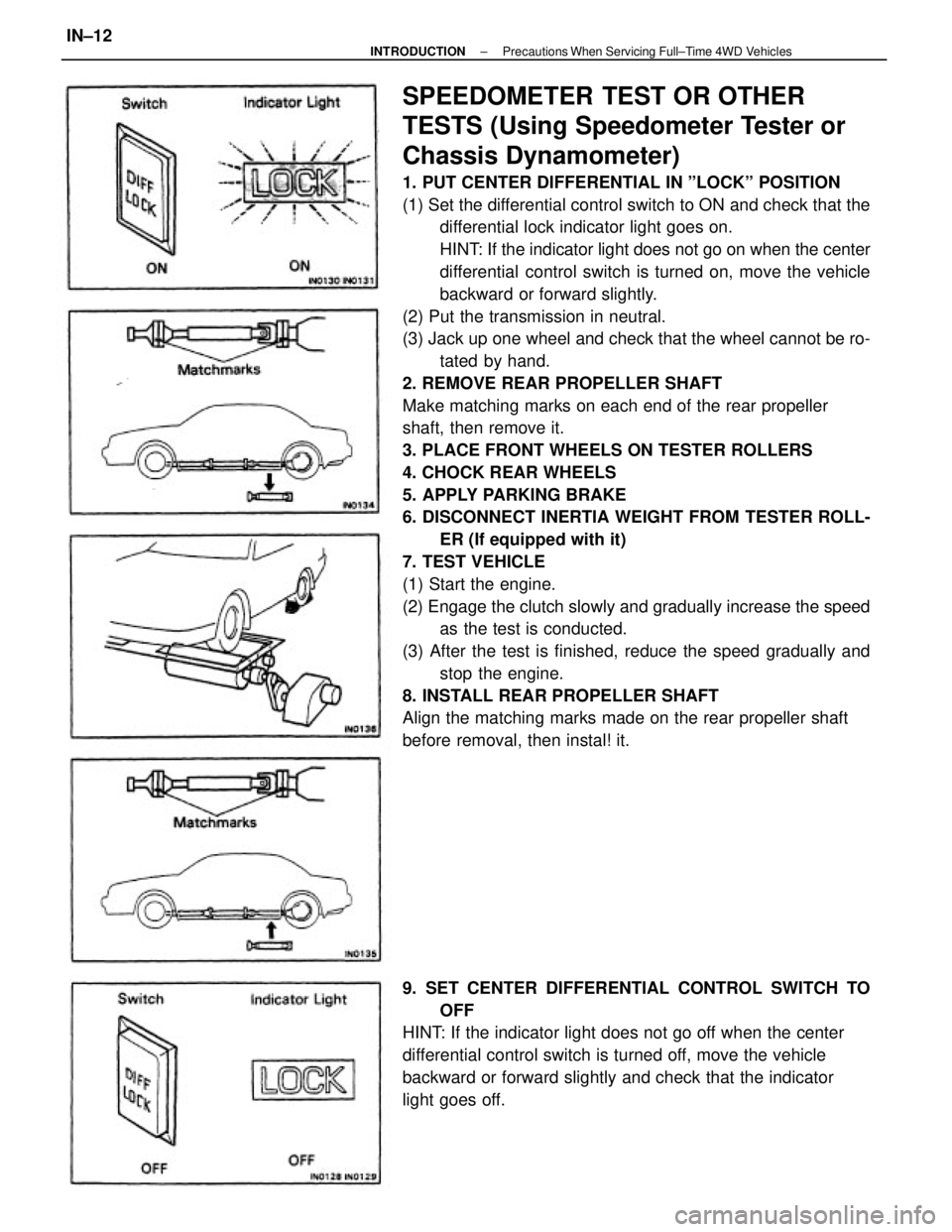
SPEEDOMETER TEST OR OTHER
TESTS (Using Speedometer Tester or
Chassis Dynamometer)
1. PUT CENTER DIFFERENTIAL IN ºLOCKº POSITION
(1) Set the differential control switch to ON and check that the
differential lock indicator light goes on.
HINT: If the indicator light does not go on when the center
differential control switch is turned on, move the vehicle
backward or forward slightly.
(2) Put the transmission in neutral.
(3) Jack up one wheel and check that the wheel cannot be ro-
tated by hand.
2. REMOVE REAR PROPELLER SHAFT
Make matching marks on each end of the rear propeller
shaft, then remove it.
3. PLACE FRONT WHEELS ON TESTER ROLLERS
4. CHOCK REAR WHEELS
5. APPLY PARKING BRAKE
6. DISCONNECT INERTIA WEIGHT FROM TESTER ROLL-
ER (If equipped with it)
7. TEST VEHICLE
(1) Start the engine.
(2) Engage the clutch slowly and gradually increase the speed
as the test is conducted.
(3) After the test is finished, reduce the speed gradually and
stop the engine.
8. INSTALL REAR PROPELLER SHAFT
Align the matching marks made on the rear propeller shaft
before removal, then instal! it.
9. SET CENTER DIFFERENTIAL CONTROL SWITCH TO
OFF
HINT: If the indicator light does not go off when the center
differential control switch is turned off, move the vehicle
backward or forward slightly and check that the indicator
light goes off.
± INTRODUCTIONPrecautions When Servicing Full±Time 4WD VehiclesIN±12
Page 1870 of 2389
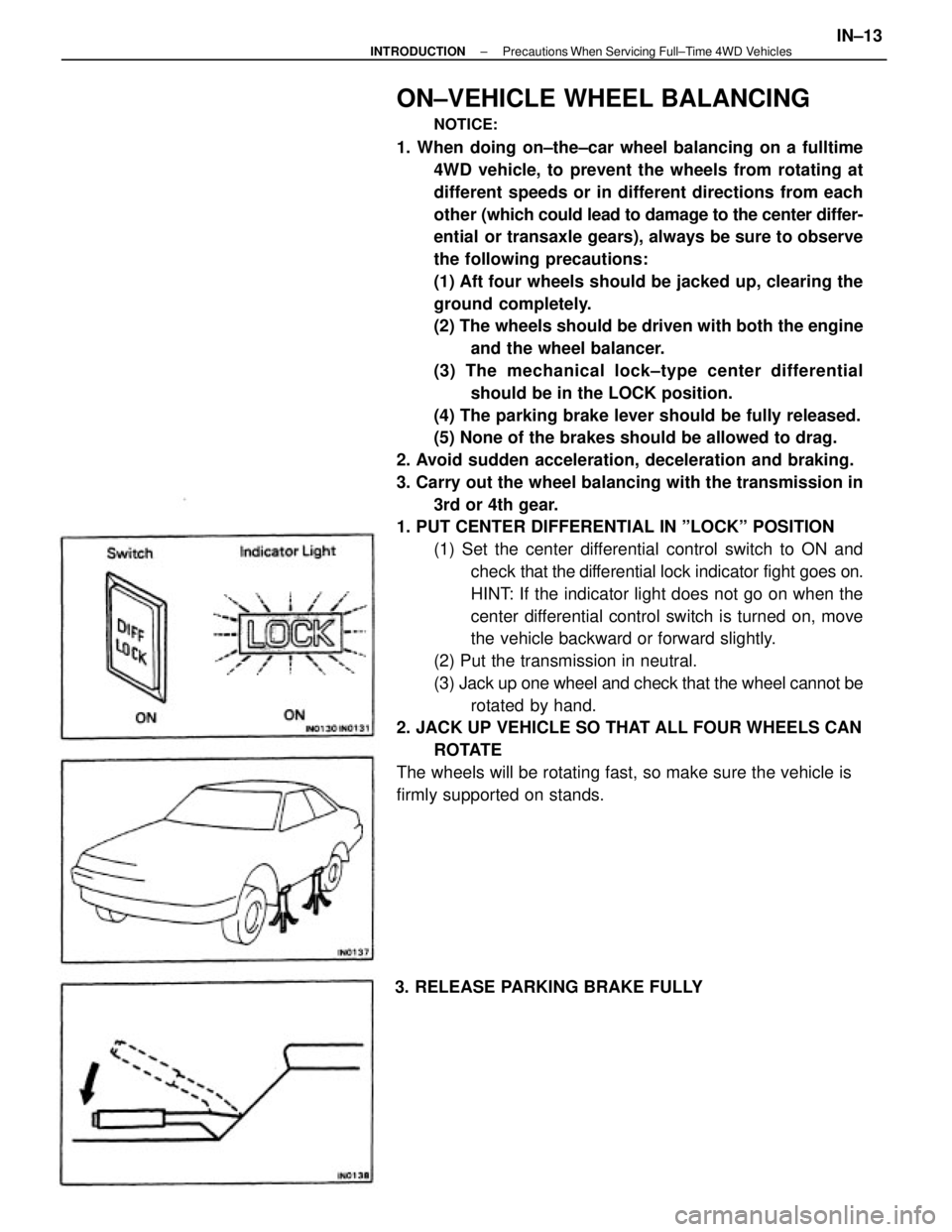
ON±VEHICLE WHEEL BALANCING
NOTICE:
1. When doing on±the±car wheel balancing on a fulltime
4WD vehicle, to prevent the wheels from rotating at
different speeds or in different directions from each
other (which could lead to damage to the center differ-
ential or transaxle gears), always be sure to observe
the following precautions:
(1) Aft four wheels should be jacked up, clearing the
ground completely.
(2) The wheels should be driven with both the engine
and the wheel balancer.
(3) The mechanical lock±type center differential
should be in the LOCK position.
(4) The parking brake lever should be fully released.
(5) None of the brakes should be allowed to drag.
2. Avoid sudden acceleration, deceleration and braking.
3. Carry out the wheel balancing with the transmission in
3rd or 4th gear.
1. PUT CENTER DIFFERENTIAL IN ºLOCKº POSITION
(1) Set the center differential control switch to ON and
check that the differential lock indicator fight goes on.
HINT: If the indicator light does not go on when the
center differential control switch is turned on, move
the vehicle backward or forward slightly.
(2) Put the transmission in neutral.
(3) Jack up one wheel and check that the wheel cannot be
rotated by hand.
2. JACK UP VEHICLE SO THAT ALL FOUR WHEELS CAN
ROTATE
The wheels will be rotating fast, so make sure the vehicle is
firmly supported on stands.
3. RELEASE PARKING BRAKE FULLY
± INTRODUCTIONPrecautions When Servicing Full±Time 4WD VehiclesIN±13