heating TOYOTA CAMRY V20 1986 Service Information
[x] Cancel search | Manufacturer: TOYOTA, Model Year: 1986, Model line: CAMRY V20, Model: TOYOTA CAMRY V20 1986Pages: 2389, PDF Size: 84.44 MB
Page 989 of 2389
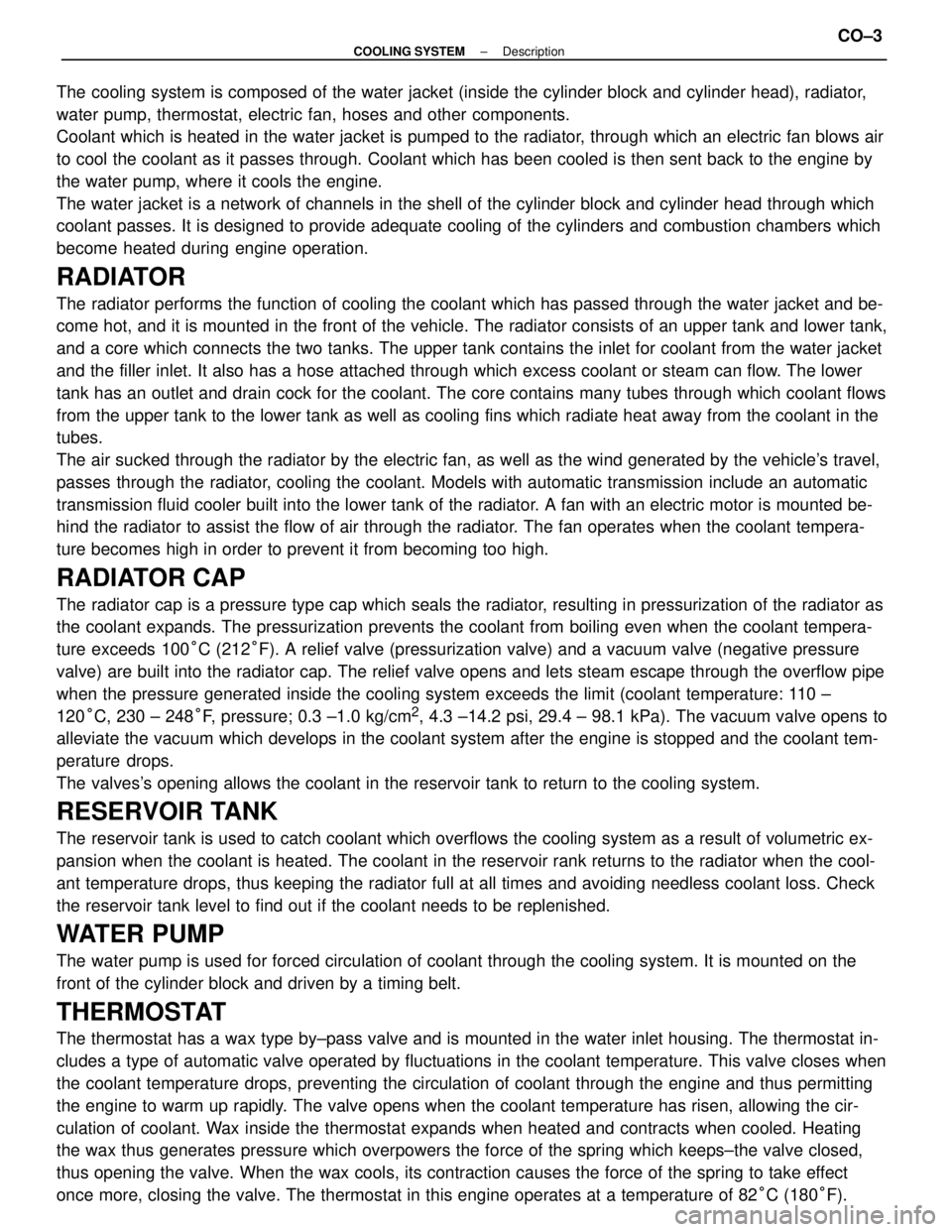
The cooling system is composed of the water jacket (inside the cylinder block and cylinder head), radiator,
water pump, thermostat, electric fan, hoses and other components.
Coolant which is heated in the water jacket is pumped to the radiator, through which an electric fan blows air
to cool the coolant as it passes through. Coolant which has been cooled is then sent back to the engine by
the water pump, where it cools the engine.
The water jacket is a network of channels in the shell of the cylinder block and cylinder head through which
coolant passes. It is designed to provide adequate cooling of the cylinders and combustion chambers which
become heated during engine operation.
RADIATOR
The radiator performs the function of cooling the coolant which has passed through the water jacket and be-
come hot, and it is mounted in the front of the vehicle. The radiator consists of an upper tank and lower tank,
and a core which connects the two tanks. The upper tank contains the inlet for coolant from the water jacket
and the filler inlet. It also has a hose attached through which excess coolant or steam can flow. The lower
tank has an outlet and drain cock for the coolant. The core contains many tubes through which coolant flows
from the upper tank to the lower tank as well as cooling fins which radiate heat away from the coolant in the
tubes.
The air sucked through the radiator by the electric fan, as well as the wind generated by the vehicle's travel,
passes through the radiator, cooling the coolant. Models with automatic transmission include an automatic
transmission fluid cooler built into the lower tank of the radiator. A fan with an electric motor is mounted be-
hind the radiator to assist the flow of air through the radiator. The fan operates when the coolant tempera-
ture becomes high in order to prevent it from becoming too high.
RADIATOR CAP
The radiator cap is a pressure type cap which seals the radiator, resulting in pressurization of the radiator as
the coolant expands. The pressurization prevents the coolant from boiling even when the coolant tempera-
ture exceeds 100°C (212°F). A relief valve (pressurization valve) and a vacuum valve (negative pressure
valve) are built into the radiator cap. The relief valve opens and lets steam escape through the overflow pipe
when the pressure generated inside the cooling system exceeds the limit (coolant temperature: 110 ±
120°C, 230 ± 248°F, pressure; 0.3 ±1.0 kg/cm
2, 4.3 ±14.2 psi, 29.4 ± 98.1 kPa). The vacuum valve opens to
alleviate the vacuum which develops in the coolant system after the engine is stopped and the coolant tem-
perature drops.
The valves's opening allows the coolant in the reservoir tank to return to the cooling system.
RESERVOIR TANK
The reservoir tank is used to catch coolant which overflows the cooling system as a result of volumetric ex-
pansion when the coolant is heated. The coolant in the reservoir rank returns to the radiator when the cool-
ant temperature drops, thus keeping the radiator full at all times and avoiding needless coolant loss. Check
the reservoir tank level to find out if the coolant needs to be replenished.
WATER PUMP
The water pump is used for forced circulation of coolant through the cooling system. It is mounted on the
front of the cylinder block and driven by a timing belt.
THERMOSTAT
The thermostat has a wax type by±pass valve and is mounted in the water inlet housing. The thermostat in-
cludes a type of automatic valve operated by fluctuations in the coolant temperature. This valve closes when
the coolant temperature drops, preventing the circulation of coolant through the engine and thus permitting
the engine to warm up rapidly. The valve opens when the coolant temperature has risen, allowing the cir-
culation of coolant. Wax inside the thermostat expands when heated and contracts when cooled. Heating
the wax thus generates pressure which overpowers the force of the spring which keeps±the valve closed,
thus opening the valve. When the wax cools, its contraction causes the force of the spring to take effect
once more, closing the valve. The thermostat in this engine operates at a temperature of 82°C (180°F).
± COOLING SYSTEMDescriptionCO±3
Page 1183 of 2389
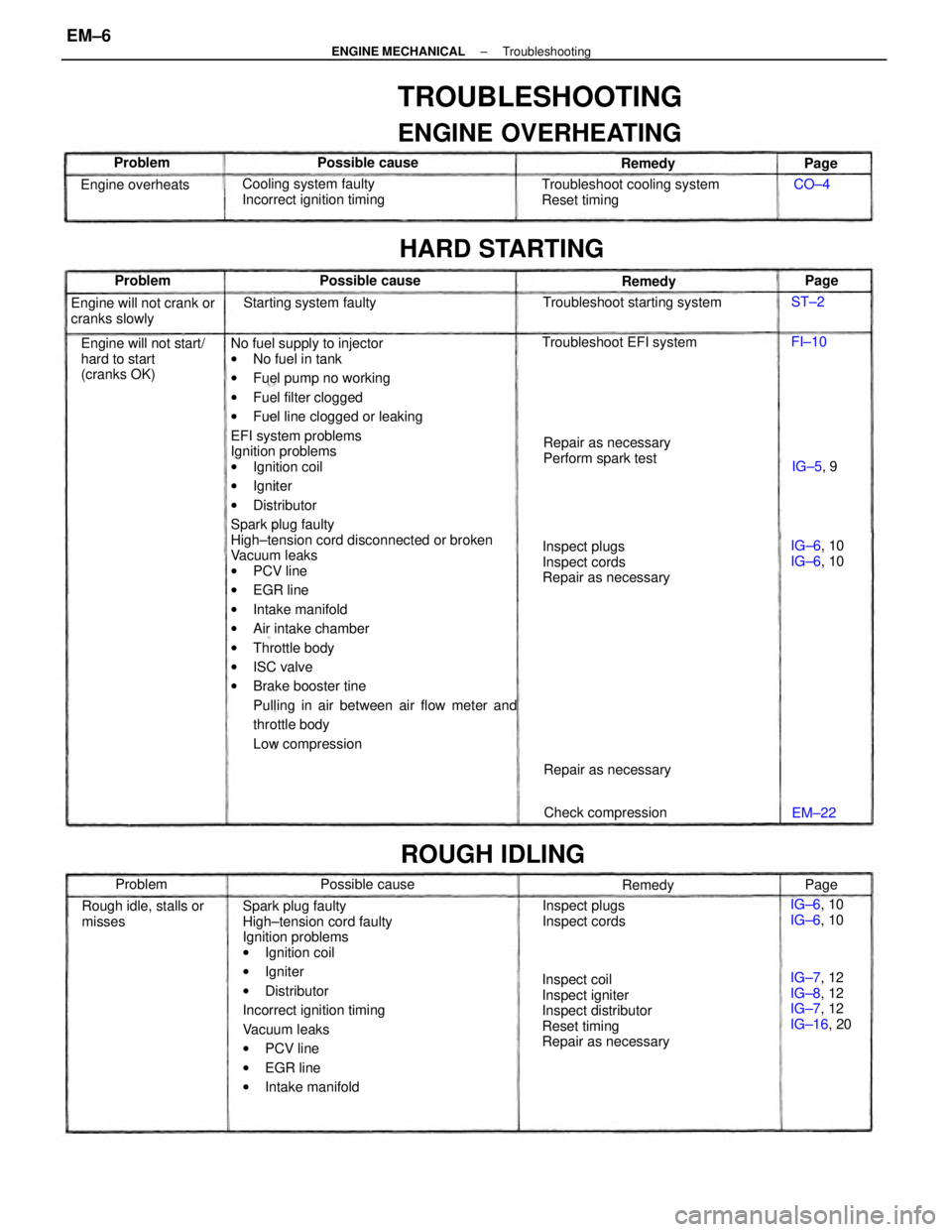
No fuel supply to injector
wNo fuel in tank
wFuel pump no working
wFuel filter clogged
wFuel line clogged or leaking
EFI system problems
Ignition problems
wIgnition coil
wIgniter
wDistributor
Spark plug faulty
High±tension cord disconnected or broken
Vacuum leaks
wPCV line
wEGR line
wIntake manifold
wAir intake chamber
wThrottle body
wISC valve
wBrake booster tine
Pulling in air between air flow meter and
throttle body
Low compression
Spark plug faulty
High±tension cord faulty
Ignition problems
wIgnition coil
wIgniter
wDistributor
Incorrect ignition timing
Vacuum leaks
wPCV line
wEGR line
wIntake manifold
TROUBLESHOOTING
ENGINE OVERHEATING
Inspect coil
Inspect igniter
Inspect distributor
Reset timing
Repair as necessaryInspect plugs
Inspect cords
Repair as necessary Troubleshoot cooling system
Reset timing
Engine will not start/
hard to start
(cranks OK)Cooling system faulty
Incorrect ignition timing
Repair as necessary
Perform spark test Engine will not crank or
cranks slowly
IG±7, 12
IG±8, 12
IG±7, 12
IG±16, 20 Rough idle, stalls or
misses
HARD STARTING
Troubleshoot starting system
Inspect plugs
Inspect cords Troubleshoot EFI system
ROUGH IDLING
Starting system faulty
Check compression Repair as necessary Engine overheats
IG±6, 10
IG±6, 10 IG±6, 10
IG±6, 10 Possible cause
Possible cause Possible cause
Remedy Remedy
Problem
Remedy Problem Problem
IG±5, 9
EM±22Page
Page
Page CO±4
FI±10 ST±2
± ENGINE MECHANICALTroubleshootingEM±6
Page 1883 of 2389
![TOYOTA CAMRY V20 1986 Service Information PRECAUTIONS WHEN TOWING
FULL±TIME 4WD VEHICLES
1. Use one of the methods shown below to tow the vehicle.
2. When there is trouble with the chassis and drivetrain, use
method [1] (flat bed truck) or m](/img/14/57449/w960_57449-1882.png "TOYOTA CAMRY V20 1986 Service Information PRECAUTIONS WHEN TOWING
FULL±TIME 4WD VEHICLES
1. Use one of the methods shown below to tow the vehicle.
2. When there is trouble with the chassis and drivetrain, use
method [1] (flat bed truck) or m")
PRECAUTIONS WHEN TOWING
FULL±TIME 4WD VEHICLES
1. Use one of the methods shown below to tow the vehicle.
2. When there is trouble with the chassis and drivetrain, use
method [1] (flat bed truck) or method T (sling type tow
truck with doilies)
3. Recommended Methods: No. [1], [2], or [3]
Emergency Method: No. [4]
During towing with this towing method, there is a danger of the drivetrain
heating up and causing breakdown, or of the front wheels flying off the dolly.
HINT: Do not use any towing methods other than those shown above.
For example, the towing method shown below is dangerous, so do not use it
HINT: Do not tow the vehicle at a speed
faster than 18 mph (30 km/h) or a distance
greater than 50 miles (80 km). Free or
Lock
Center
Differential
Control
Switch
ºONº or
ªOFFªFree
(Normal
Driving)
No
Special
Operation
Necessary
Free
Center
Differential
Control
Switch
ªOFFº Free
Center
Differential
Control
Switch
ºOFFºMode
Select
Lever on
Transaxle T/M Shift
Lever
PositionT/M Shift
Lever
PositionCenter
Diff.
Control
Switch Automatic Transaxle Type of Transaxle
ºAUTOº
or
ºOFFº Manual Transaxle
Towing MethodParking
BrakeParking
Brake Center
Diff.
ºNº range ºNº range ºPº range
Released1 st Gear
Released
ReleasedApplied Applied
Release
Neutral NeutralºOFFº
ºOFFº
± INTRODUCTIONPrecautions When Servicing Full±Time 4WD VehiclesIN±26