fuel TOYOTA COROLLA CROSS 2022 Service Manual
[x] Cancel search | Manufacturer: TOYOTA, Model Year: 2022, Model line: COROLLA CROSS, Model: TOYOTA COROLLA CROSS 2022Pages: 612, PDF Size: 17.18 MB
Page 514 of 612
5148-2. Steps to take in an emergency
WARNING
●Avoid abrupt maneuvering and
braking.
If the vehicle tires deteriorate,
you could lose control of the
steering wheel or the brakes.
■If a blowout or sudden air
leakage should occur
The tire pressure warning system
may not activate immediately.
■Maintenance of the tires
Each tire, including the spare (if
provided), should be checked
monthly when cold and inflated to
the inflation pressure recom-
mended by the vehicle manufac-
turer on the vehicle placard or tire
inflation pressure label (tire and
load information la bel). (If your
vehicle has tires of a different size
than the size indicated on the
vehicle placard or tire inflation
pressure label [tire and load infor-
mation label], you should deter-
mine the proper tire inflation
pressure for those tires.)
As an added safety feature, your
vehicle has been equipped with a
tire pressure monitoring system
(TPMS-tire pressure warning sys-
tem) that illuminates a low tire
pressure telltale (tire pressure
warning light) when one or more
of your tires is significantly
under-inflated. Accordingly, when
the low tire pressure telltale (tire
pressure warning light) illumi-
nates, you should stop and check
your tires as soon as possible,
and inflate them to the proper
pressure. Driving on a signifi-
cantly under-inflated tire causes
the tire to overheat and can lead
to tire failure. Un der-inflation also
reduces fuel efficiency and tire
tread life, and may affect the vehi-
cle’s handling and stopping ability.
Please note that the TPMS (tire
pressure warning system) is not a
substitute for proper tire mainte-
nance, and it is the driver’s
responsibility to maintain correct
tire pressure, even if under-infla-
tion has not reached the level to
trigger illumination of the TPMS
low tire pressure telltale (tire pres-
sure warning light).
Your vehicle has also been
equipped with a TPMS (tire pres-
sure warning system) malfunc-
tion indicator to indicate when the
system is not operating properly.
The TPMS (tire pressure warning
system) malfunction indicator is
combined with the low tire pres-
sure telltale (tire pressure warning
light). When the system detects a
malfunction, the telltale will flash
for approximately one minute and
then remain continuously illumi-
nated. This sequence will con-
tinue upon subsequent vehicle
start-ups as long as the malfunc-
tion exists. When the malfunction
indicator is illuminated, the sys-
tem may not be able to detect or
signal low tire pressure as
intended.
TPMS (tire pressure warning sys-
tem) malfunctions may occur for a
variety of reasons, including the
installation of replacement or
alternate tires or wheels on the
vehicle that pr event the TPMS
(tire pressure warning system)
from functioning properly. Always
check the TPMS (tire pressure
warning system) malfunction tell-
tale after replacing one or more
tires or wheels on your vehicle to
ensure that the replacement or
alternate tires and wheels allow
the TPMS (tire pressure warning
system) to continue to function
properly.
Page 528 of 612
5288-2. Steps to take in an emergency
One of the following may be the
cause of the problem:
There may not be sufficient
fuel in the vehicle’s tank.
Refuel the vehicle.
The engine may be flooded.
Try to restart the engine again
following correct starting pro-
cedures. ( P.162, 163)
There may be a malfunction
in the engine immobilizer sys-
tem. ( P.71)
One of the following may be the
cause of the problem:
The battery may be dis-
charged. ( P.532)
NOTICE
■When replacing the tires
When removing or fitting the
wheels, tires or t he tire pressure
warning valve and transmitter,
contact your Toyota dealer as the
tire pressure warning valve and
transmitter may be damaged if not
handled correctly.
■To avoid damage to the tire
pressure warning valves and
transmitters
When a tire is repaired with liquid
sealants, the tire pressure warn-
ing valve and transmitter may not
operate properly. If a liquid seal-
ant is used, contact your Toyota
dealer or other qualified service
shop as soon as possible. Make
sure to replace the tire pressure
warning valve and transmitter
when replacing the tire.
If the engine will not
star t
If the engine will not start
even though correct starting
procedures are being fol-
lowed ( P.162, 163), con-
sider each of the following
points:
The engine will not start
even though the starter
motor operates normally.
The starter motor turns
over slowly, the interior
lights and headlights are
dim, or the horn does not
sound or sounds at a low
volume.
Page 541 of 612
541
9
9
Vehicle specifications
Vehicle specifications
.9-1. SpecificationsMaintenance data (fuel, oil level, etc.) .................. 542
Fuel information .......... 550
Tire information ........... 552
9-2. Customization Customizable features.................................. 563
9-3. Initialization Items to initialize ......... 572
Page 542 of 612
5429-1. Specifications
9-1.Specifications
*1: Unladen vehicles
*2: Vehicles with 215/65R17 tires
*3: Vehicles with 225/55R18 tires
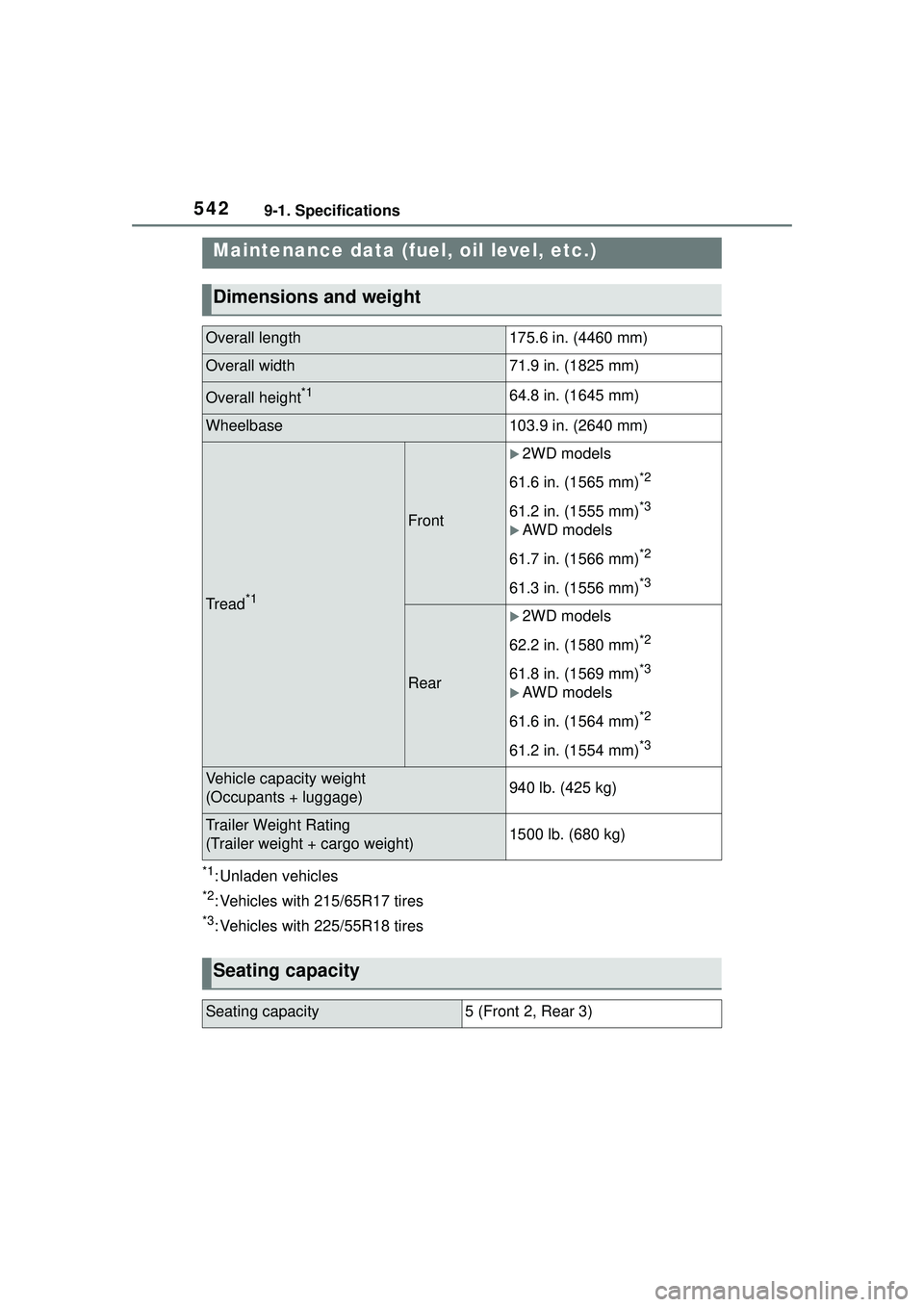
Maintenance data (fuel, oil level, etc.)
Dimensions and weight
Overall length175.6 in. (4460 mm)
Overall width71.9 in. (1825 mm)
Overall height*164.8 in. (1645 mm)
Wheelbase103.9 in. (2640 mm)
Tread*1
Front
2WD models
61.6 in. (1565 mm)
*2
61.2 in. (1555 mm)*3
AWD models
61.7 in. (1566 mm)
*2
61.3 in. (1556 mm)*3
Rear
2WD models
62.2 in. (1580 mm)
*2
61.8 in. (1569 mm)*3
AWD models
61.6 in. (1564 mm)
*2
61.2 in. (1554 mm)*3
Vehicle capacity weight
(Occupants + luggage)940 lb. (425 kg)
Trailer Weight Rating
(Trailer weight + cargo weight)1500 lb. (680 kg)
Seating capacity
Seating capacity5 (Front 2, Rear 3)
Page 544 of 612
![TOYOTA COROLLA CROSS 2022 Service Manual 5449-1. Specifications
■Oil capacity (Drain and refill
[Reference
*])
*: The engine oil capacity is a refer-ence quantity to be used when
changing the engine oil. Warm up
and turn off the engine,](/img/14/66990/w960_66990-543.png "TOYOTA COROLLA CROSS 2022 Service Manual 5449-1. Specifications
■Oil capacity (Drain and refill
[Reference
*])
*: The engine oil capacity is a refer-ence quantity to be used when
changing the engine oil. Warm up
and turn off the engine,")
5449-1. Specifications
■Oil capacity (Drain and refill
[Reference
*])
*: The engine oil capacity is a refer-ence quantity to be used when
changing the engine oil. Warm up
and turn off the engine, wait more
than 5 minutes, and check the oil
level on the dipstick.
■Engine oil selection
“Toyota Genuine Motor Oil” is
used in your Toyota vehicle. Use
Toyota approved “Toyota Genu-
ine Motor Oil” or equivalent to
satisfy the following grade and
viscosity.
Oil grade: ILSAC GF-6B multi-
grade engine oil
Recommended viscosity: SAE
0W-16 Outside temperature
SAE 0W-16 is the best choice
for good fuel economy and good
starting in cold weather.
If SAE 0W-16 is not available,
SAE 0W-20 oil may be used.
However, it must be replaced
with SAE 0W-16 at the next oil
change.
Oil viscosity (0W-16 is explained
here as an example):
• The 0W in 0W-16 indicates the characteristic of the oil
which allows cold startability.
Oils with a lower value before
the W allow for easier starting
of the engine in cold weather.
• The 16 in 0W-16 indicates the viscosity characteristic of the
Fuel
Fuel typeUnleaded gasoline only
Octane Rating87 (Research Octane Number 91) or
higher
Fuel tank capacity
(Reference)
2WD models
12.4 gal. (47.0 L, 10.3 Imp. gal.)
AWD models
13.2 gal. (50.0 L, 11.0 Imp. gal.)
Lubrication system
With filter4.9 qt. (4.6 L, 4.0 Imp.
qt.)
Without filter4.5 qt. (4.3 L, 3.8 Imp.
qt.)
Page 550 of 612
5509-1. Specifications
■Gasoline quality
In very few cases, driveability prob-
lems may be caused by the brand of
gasoline you are usin g. If driveability
problems persist, try changing the
brand of gasoline. If this does not
correct the problem, consult your
Toyota dealer.
■Recommendation of the use of
gasoline containing detergent
additives
●Toyota recommends the use of
gasoline that contains detergent
additives to avoid the build-up of
engine deposits.
●All gasoline sold in the U.S.A. con-
tains minimum detergent additives
to clean and/or keep clean intake
systems, per EPA’s lowest addi-
tives concentration program.
●Toyota strongly recommends the
use of Top Tier Detergent Gaso-
line. For more in formation on Top
Tier Detergent Gasoline and a list
of marketers, please go to the offi-
cial website www. toptiergas.com.
■Recommendation of the use of
low emissions gasoline
Gasolines containing oxygenates
such as ethers and ethanol, as well
as reformulated gasolines, are avail-
able in some cities. These fuels are
typically acceptable for use, provid-
ing they meet other fuel require-
ments.
Toyota recommends these fuels,
since the formulations allow for
reduced vehicle emissions.
■Non-recommendation of the
use of blended gasoline
●Use only gasoline containing up to
15% ethanol.
DO NOT use any flex-fuel or gas-
oline that could contain more than
15% ethanol, including from any
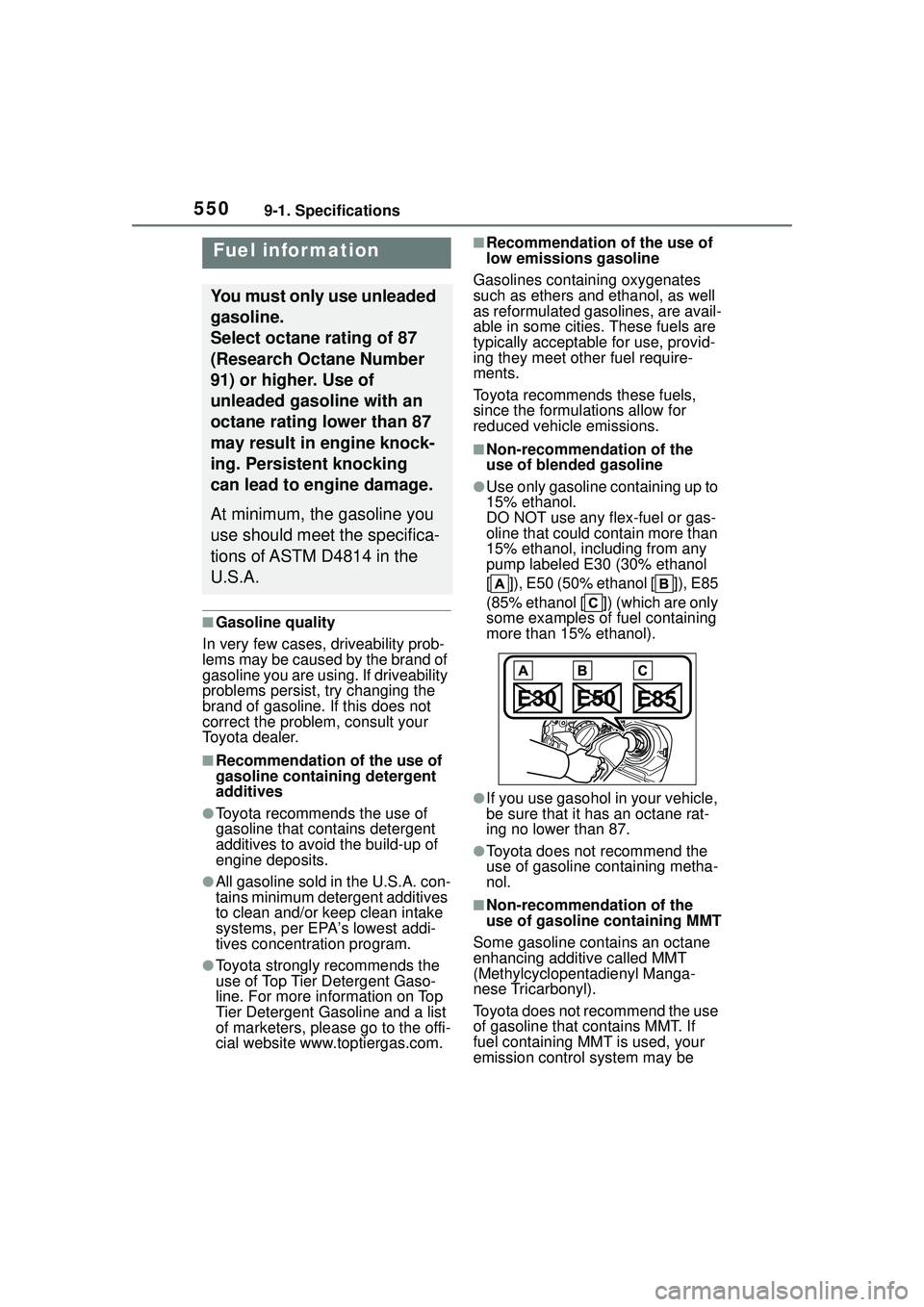
pump labeled E30 (30% ethanol
[ ]), E50 (50% ethanol [ ]), E85
(85% ethanol [ ]) (which are only
some examples of fuel containing
more than 15% ethanol).
●If you use gasohol in your vehicle,
be sure that it has an octane rat-
ing no lower than 87.
●Toyota does not recommend the
use of gasoline containing metha-
nol.
■Non-recommendation of the
use of gasoline containing MMT
Some gasoline contains an octane
enhancing additive called MMT
(Methylcyclopentadienyl Manga-
nese Tricarbonyl).
Toyota does not recommend the use
of gasoline that c ontains MMT. If
fuel containing MMT is used, your
emission control system may be
Fuel infor mation
You must only use unleaded
gasoline.
Select octane rating of 87
(Research Octane Number
91) or higher. Use of
unleaded gasoline with an
octane rating lower than 87
may result in engine knock-
ing. Persistent knocking
can lead to engine damage.
At minimum, the gasoline you
use should meet the specifica-
tions of ASTM D4814 in the
U.S.A.
Page 551 of 612
5519-1. Specifications
9
Vehicle specifications
adversely affected.
The malfunction indicator lamp on
the instrument cluster may come on.
If this happens, contact your Toyota
dealer for service.
■If your engine knocks
●Consult your Toyota dealer.
●You may occasionally notice light
knocking for a short time while
accelerating or driving uphill. This
is normal and there is no need for
concern.
NOTICE
■Notice on fuel quality
●Do not use improper fuels. If
improper fuels are used, the
engine will be damaged.
●Do not use leaded gasoline.
Leaded gasoline can cause
damage to your vehicle’s
three-way catalytic converters
causing the emission control
system to malfunction.
●Do not use gasohol other than
the type previously stated.
Other gasohol may cause fuel
system damage or vehicle per-
formance problems.
●Using unleaded gasoline with
an octane number or rating
lower than the level previously
stated will cause persistent
heavy knocking.
At worst, this will lead to engine
damage.
■Fuel-related poor driveability
If poor driveability (poor hot start-
ing, vaporization, engine knock-
ing, etc.) is encountered after
using a different type of fuel, dis-
continue the use of that type of
fuel.
■When refueling with gasohol
Take care not to spill gasohol. It
can damage your vehicle’s paint.
Page 557 of 612
5579-1. Specifications
9
Vehicle specifications
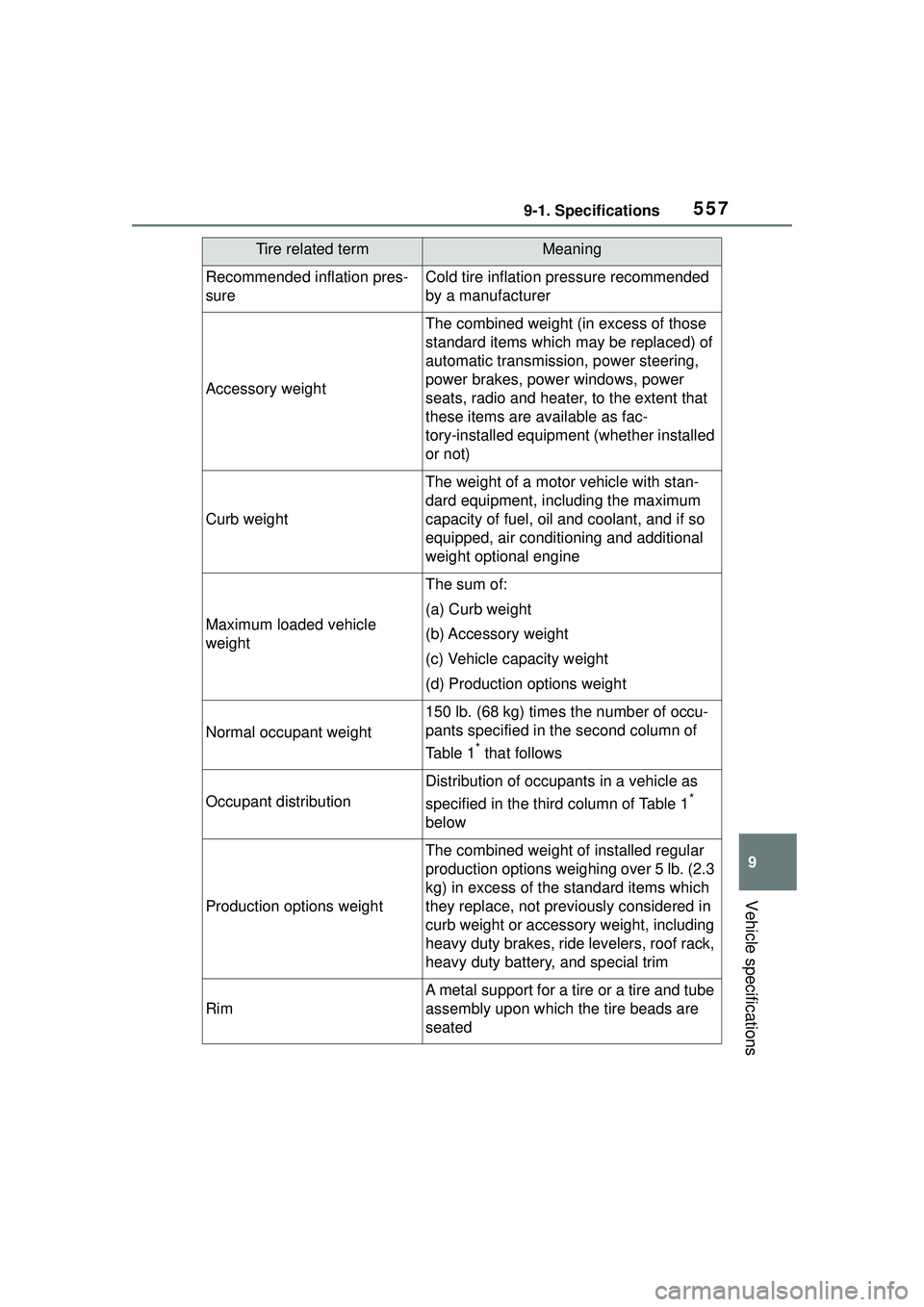
Recommended inflation pres-
sureCold tire inflation pressure recommended
by a manufacturer
Accessory weight
The combined weight (in excess of those
standard items which may be replaced) of
automatic transmission, power steering,
power brakes, power windows, power
seats, radio and heater, to the extent that
these items are available as fac-
tory-installed equipment (whether installed
or not)
Curb weight
The weight of a motor vehicle with stan-
dard equipment, including the maximum
capacity of fuel, oil and coolant, and if so
equipped, air conditioning and additional
weight optional engine
Maximum loaded vehicle
weight
The sum of:
(a) Curb weight
(b) Accessory weight
(c) Vehicle capacity weight
(d) Production options weight
Normal occupant weight
150 lb. (68 kg) times the number of occu-
pants specified in the second column of
Table 1
* that follows
Occupant distribution
Distribution of occupants in a vehicle as
specified in the third column of Table 1
*
below
Production options weight
The combined weight of installed regular
production options weighing over 5 lb. (2.3
kg) in excess of the standard items which
they replace, not previously considered in
curb weight or accessory weight, including
heavy duty brakes, ride levelers, roof rack,
heavy duty battery, and special trim
Rim
A metal support for a tire or a tire and tube
assembly upon which the tire beads are
seated
Tire related termMeaning
Page 564 of 612
5649-2. Customization
Settings that can be changed by your Toyota dealer
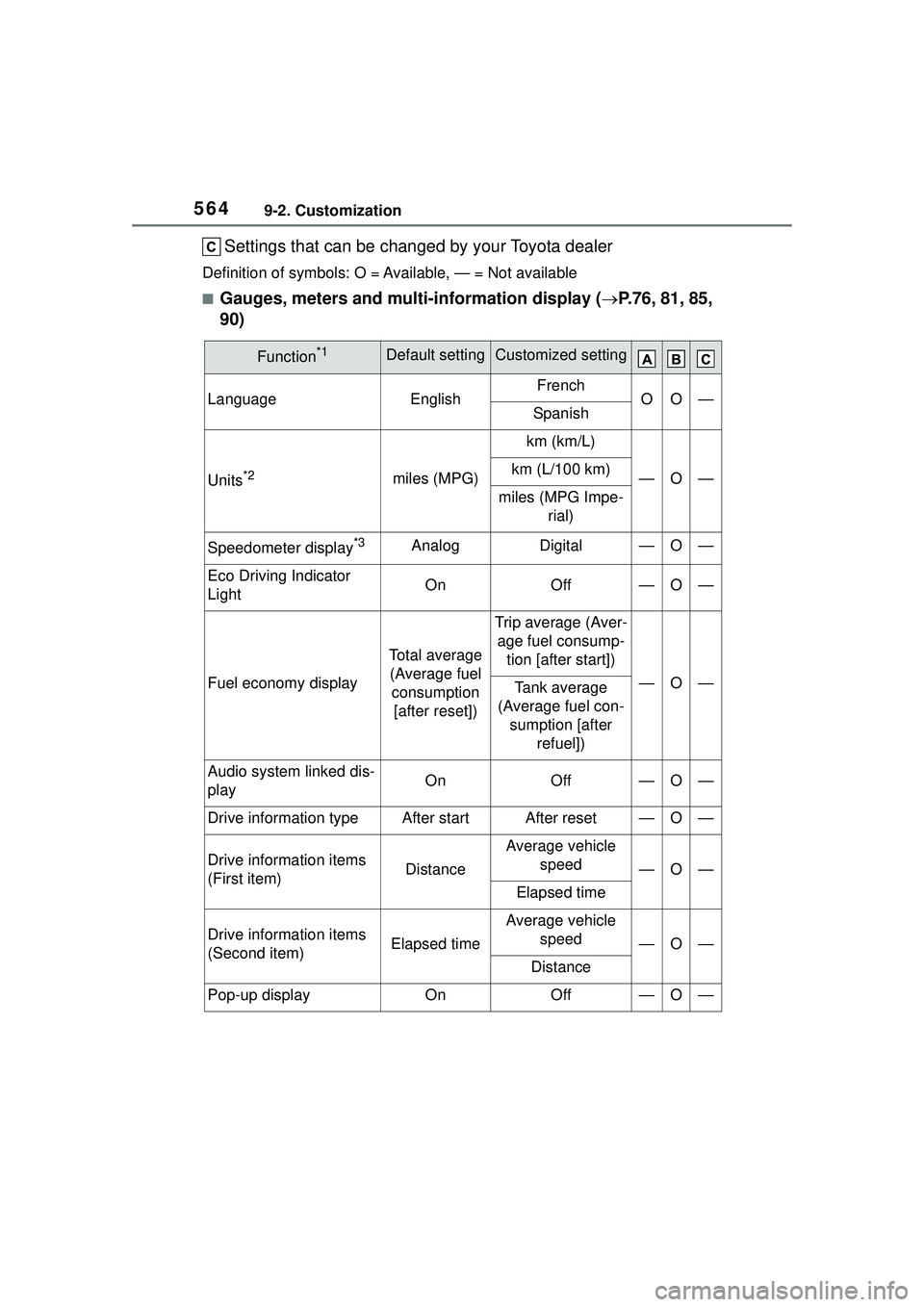
Definition of symbols: O = Available, — = Not available
■Gauges, meters and multi-information display (P.76, 81, 85,
90)
Function*1Default settingCustomized setting
LanguageEnglishFrenchOO—Spanish
Units*2miles (MPG)
km (km/L)
—O—km (L/100 km)
miles (MPG Impe- rial)
Speedometer display*3AnalogDigital—O—
Eco Driving Indicator
LightOnOff—O—
Fuel economy display
Total average (Average fuel consumption [after reset])
Trip average (Aver- age fuel consump- tion [after start])
—O—Tank average
(Average fuel con- sumption [after refuel])
Audio system linked dis-
playOnOff—O—
Drive information typeAfter startAfter reset—O—
Drive information items
(First item)Distance
Average vehicle speed
—O—
Elapsed time
Drive information items
(Second item)Elapsed time
Average vehicle speed
—O—
Distance
Pop-up displayOnOff—O—
Page 588 of 612
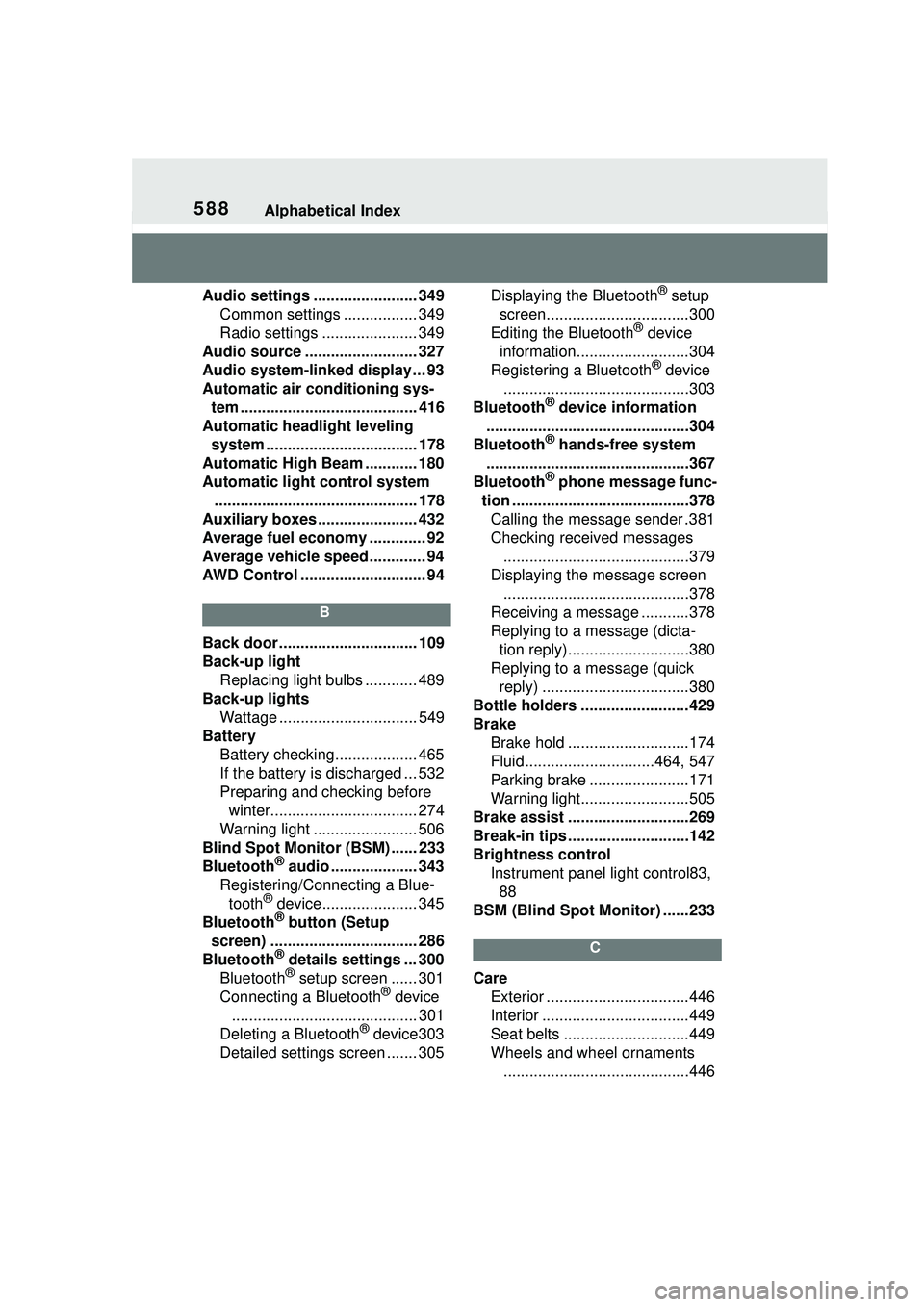
588Alphabetical Index
Audio settings ........................ 349Common settings ................. 349
Radio settings ...................... 349
Audio source .......................... 327
Audio system-linked display ... 93
Automatic air conditioning sys- tem ......................................... 416
Automatic headlight leveling system ................................... 178
Automatic High Beam ............ 180
Automatic light control system ............................................... 178
Auxiliary boxes ....................... 432
Average fuel economy ............. 92
Average vehicle speed............. 94
AWD Control ............................. 94
B
Back door ................................ 109
Back-up light Replacing light bulbs ............ 489
Back-up lights Wattage ................................ 549
Battery Battery checking................... 465
If the battery is discharged ... 532
Preparing and checking before winter.................................. 274
Warning light ........................ 506
Blind Spot Monitor (BSM) ...... 233
Bluetooth
® audio .................... 343
Registering/Connecting a Blue- tooth
® device...................... 345
Bluetooth® button (Setup
screen) .................................. 286
Bluetooth
® details settings ... 300
Bluetooth® setup screen ...... 301
Connecting a Bluetooth® device
........................................... 301
Deleting a Bluetooth
® device303
Detailed settings screen ....... 305 Displaying the Bluetooth
® setup
screen.................................300
Editing the Bluetooth
® device
information..........................304
Registering a Bluetooth
® device
...........................................303
Bluetooth
® device information
...............................................304
Bluetooth
® hands-free system
...............................................367
Bluetooth
® phone message func-
tion .........................................378 Calling the message sender .381
Checking received messages ...........................................379
Displaying the message screen ...........................................378
Receiving a mess age ...........378
Replying to a message (dicta- tion reply)............................380
Replying to a message (quick reply) ..................................380
Bottle holders .........................429
Brake Brake hold ............................174
Fluid..............................464, 547
Parking brake .......................171
Warning light.........................505
Brake assist ............................269
Break-in tips ............................142
Brightness control Instrument panel light control83, 88
BSM (Blind Spot Monitor) ......233
C
Care Exterior .................................446
Interior ..................................449
Seat belts .............................449
Wheels and wheel ornaments...........................................446