warning TOYOTA FJ CRUISER 2011 1.G User Guide
[x] Cancel search | Manufacturer: TOYOTA, Model Year: 2011, Model line: FJ CRUISER, Model: TOYOTA FJ CRUISER 2011 1.GPages: 528, PDF Size: 10.93 MB
Page 94 of 528

94 1-7. Safety information
■There is a malfunction in the system
*1:The system judges a person of adult size as an adult. When a
smaller adult sits in the front pa ssenger seat, the system may rec-
ognize him/her as a child dependi ng on his/her physique and pos-
ture.
*2:In the event the front passenge r does not wear a seat belt.
*3:When a larger child who has outgrown a child restraint system sits
in the front passenger seat, the system may recognize him/her as
an adult depending on his/her physique or posture.
*4:Never install a rear-facing child restraint system on the front pas-
senger seat. A forward-facing child restraint system should only be
installed on the front passenger seat when it is unavoidable.
( P. 9 7 )
*5:In case the indicator is not illumi nated, consult this manual as for
installing the child restraint system properly. ( P. 101)
Indicator/
warning light AIR BAG ON and AIR BAG OFF indicator
lights AIR BAG
OFF
SRS warning light On
Front passenger’s seat belt reminder light Off
Devices Front passenger airbag
Deactivated
Side airbag on the front passenger seat
Curtain shield airbag in the front passenger side Activated
Front passenger’s seat belt pretensioner
Page 96 of 528
96 1-7. Safety information
CAUTION
■Front passenger occupant cl assification system precautions
● If an adult sits in the front passenger seat, the AIR BAG ON indicator light
is illuminated. If the AIR BAG OFF indicator is illuminated, ask the passen-
ger to sit up straight, well back in the seat, feet on the floor, and with the
seat belt worn correctly. If the AIR BAG OFF indicator still remain illumi-
nated, either ask the passenger to move to the rear seat, or if that is not
possible, move the front passenger seat fully rearward.
● When it is unavoidable to install the forward-facing child restraint system
on the front passenger seat, install the child restraint system on the front
passenger seat in the proper order. (P. 101)
● Do not modify or remove the front seats.
● Do not kick the front passenger seat or subject it to severe impact. Other-
wise, the SRS warning light may come on to indicate a malfunction of the
detection system. In this case, contact your Toyota dealer immediately.
● Child restraint systems installed on the rear seat should not contact the
front seatbacks.
● Do not use a seat accessory, such as a cushion or seat cover, that covers
the seat cushion surface.
● Do not attach a commercial seatback table or other heavy item to the back
of the front passenger seat.
● Do not modify or replace the upholstery of the front seat.
Page 113 of 528
When driving2
113
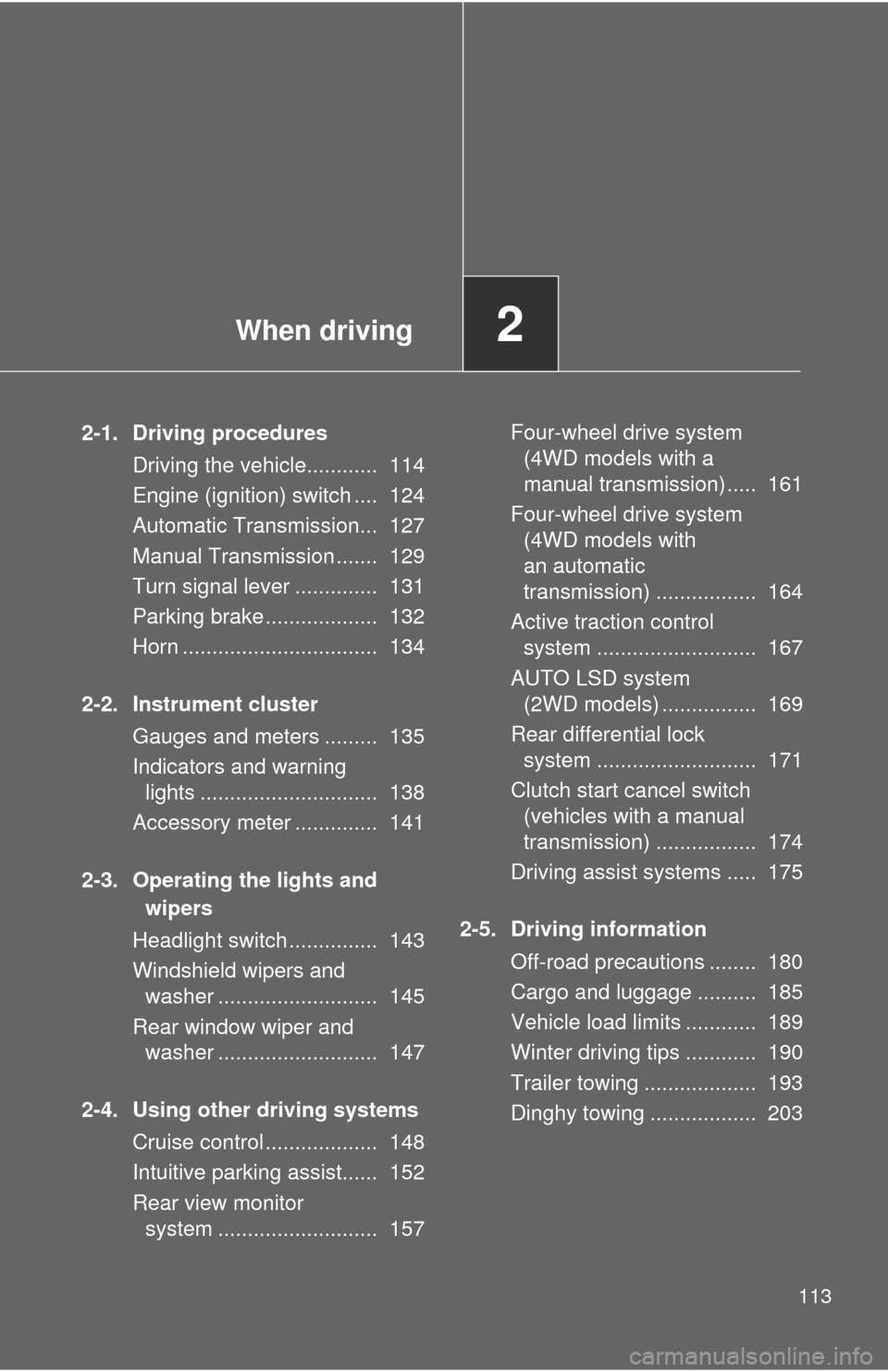
2-1. Driving proceduresDriving the vehicle............ 114
Engine (ignition) switch .... 124
Automatic Transmission... 127
Manual Transmission ....... 129
Turn signal lever .............. 131
Parking brake ................... 132
Horn ................................. 134
2-2. Instrument cluster Gauges and meters ......... 135
Indicators and warning lights .............................. 138
Accessory meter .............. 141
2-3. Operating the lights and wipers
Headlight switch ............... 143
Windshield wipers and washer ........................... 145
Rear window wiper and washer ........................... 147
2-4. Using other driving systems Cruise control ................... 148
Intuitive parking assist...... 152
Rear view monitor system ........................... 157 Four-wheel drive system
(4WD models with a
manual transmission) ..... 161
Four-wheel drive system (4WD models with
an automatic
transmission) ................. 164
Active traction control system ........................... 167
AUTO LSD system (2WD models) ................ 169
Rear differential lock system ........................... 171
Clutch start cancel switch (vehicles with a manual
transmission) ................. 174
Driving assist systems ..... 175
2-5. Driving information Off-road precautions ........ 180
Cargo and luggage .......... 185
Vehicle load limits ............ 189
Winter driving tips ............ 190
Trailer towing ................... 193
Dinghy towing .................. 203
Page 130 of 528
130 2-1. Driving procedures
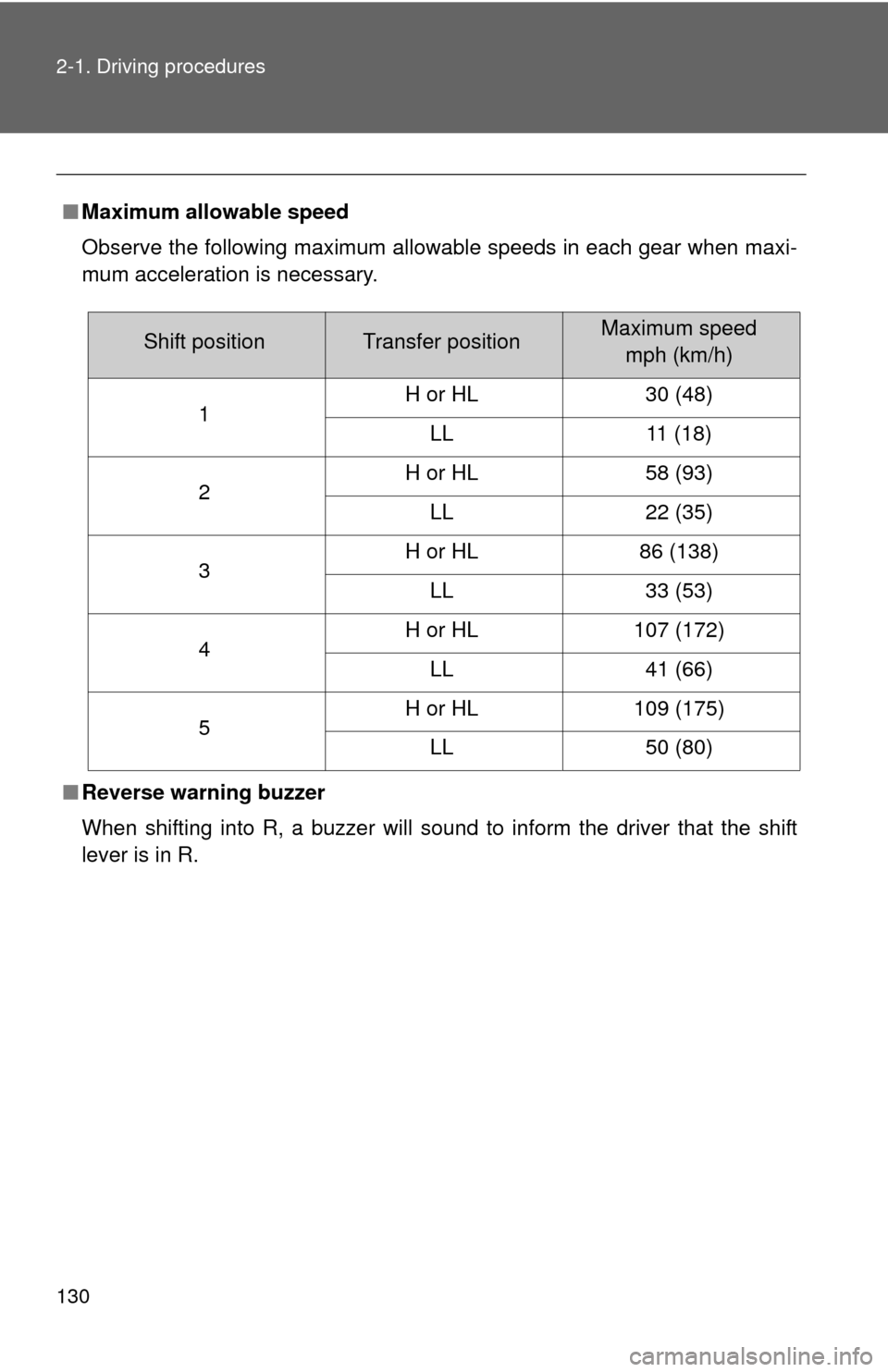
■Maximum allowable speed
Observe the following maximum allowable speeds in each gear when maxi-
mum acceleration is necessary.
■ Reverse warning buzzer
When shifting into R, a buzzer will sound to inform the driver that the shift
lever is in R.
Shift positionTransfer positionMaximum speed
mph (km/h)
1 H or HL 30 (48)
LL 11 (18)
2 H or HL 58 (93)
LL 22 (35)
3 H or HL 86 (138)
LL 33 (53)
4 H or HL 107 (172)
LL 41 (66)
5 H or HL
109 (175)
LL 50 (80)
Page 138 of 528
138
2-2. Instrument cluster
Indicators and warning lights
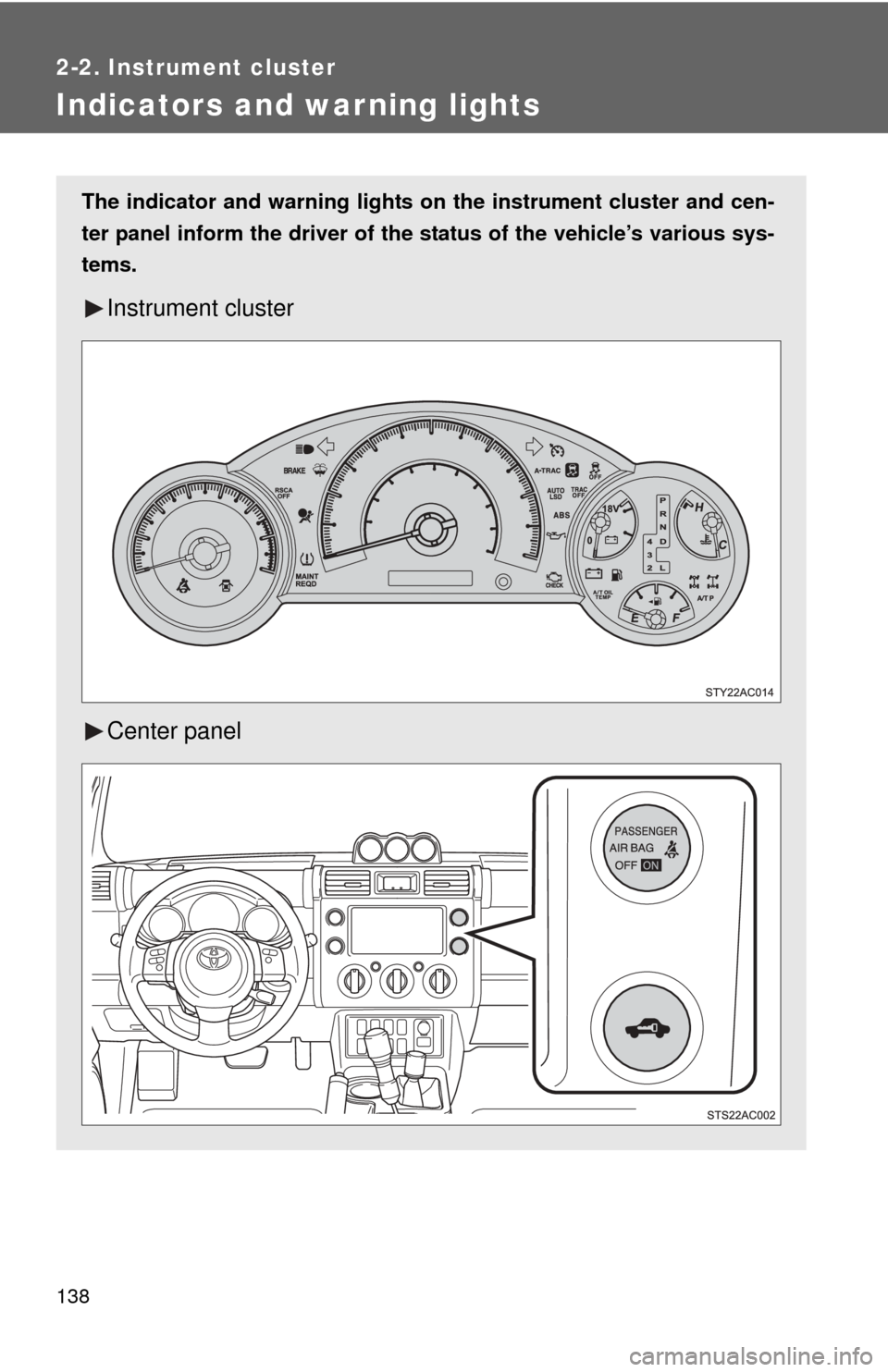
The indicator and warning lights on the instrument cluster and cen-
ter panel inform the driver of the status of the vehicle’s various sys-
tems.
Instrument cluster
Center panel
Page 140 of 528
140 2-2. Instrument cluster
CAUTION
■If a safety system warning light does not come on
Should a safety system light such as ABS and the SRS airbag warning light
not come on when you start the engine, this could mean that these systems
are not available to help protect you in an accident, which could result in
death or serious injury. Have the vehicle inspected by your Toyota dealer
immediately if this occurs.
■ Warning lights
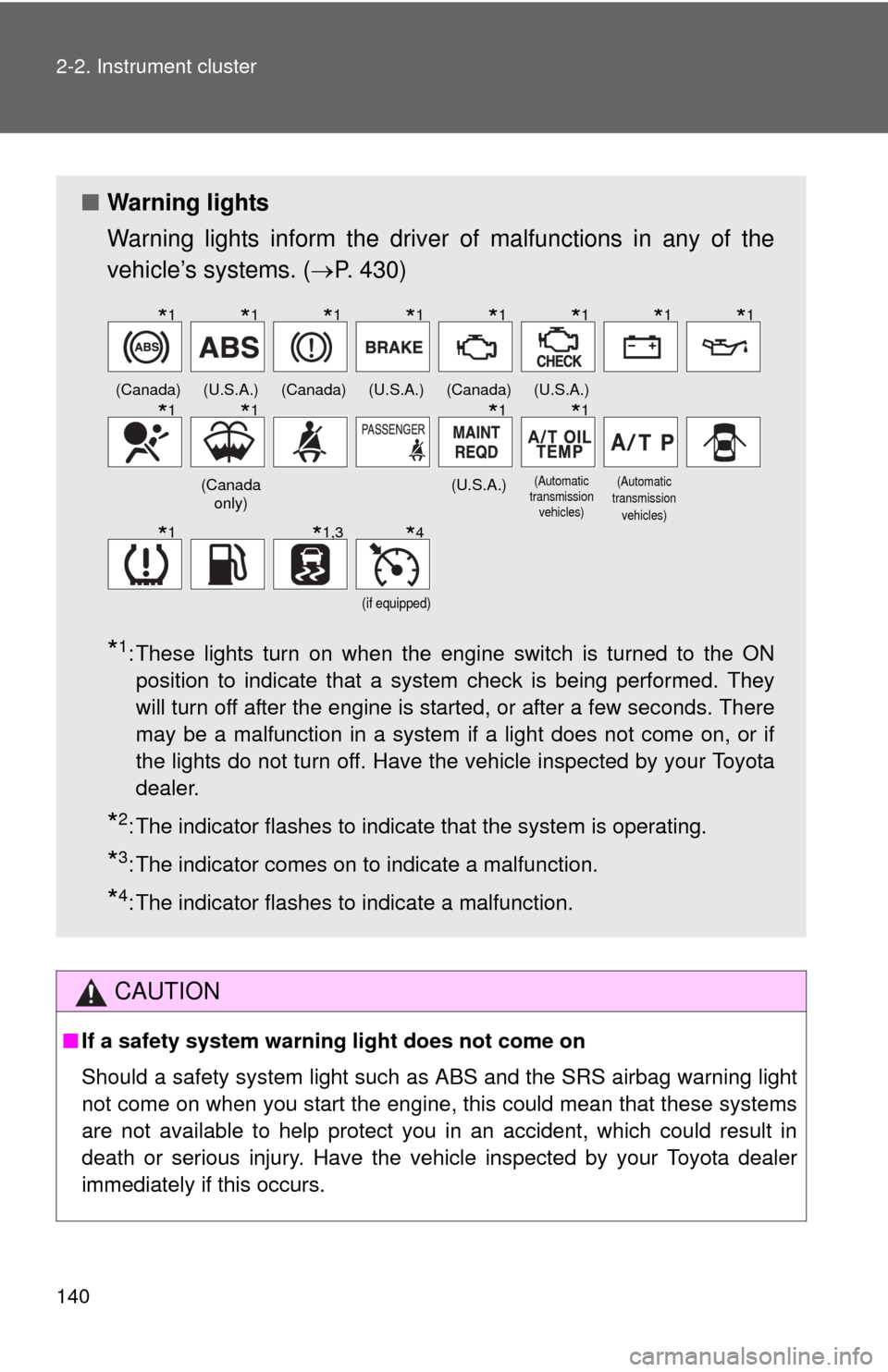
Warning lights inform the driver of malfunctions in any of the
vehicle’s systems. ( P. 430)
*1: These lights turn on when the engine switch is turned to the ON
position to indicate that a system check is being performed. They
will turn off after the engine is started, or after a few seconds. There
may be a malfunction in a system if a light does not come on, or if
the lights do not turn off. Have the vehicle inspected by your Toyota
dealer.
*2: The indicator flashes to indicate that the system is operating.
*3: The indicator comes on to indicate a malfunction.
*4: The indicator flashes to indicate a malfunction.
(Canada)(U.S.A.)(Canada)(U.S.A.)(Canada)(U.S.A.)
(Canada only)(U.S.A.)
(Automatic
transmission
vehicles)(Automatic
transmission vehicles)
(if equipped)
*1*1*1*1*1*1*1*1
*1*1*1*1
*1*1,3*4
Page 172 of 528
172 2-4. Using other driving systems
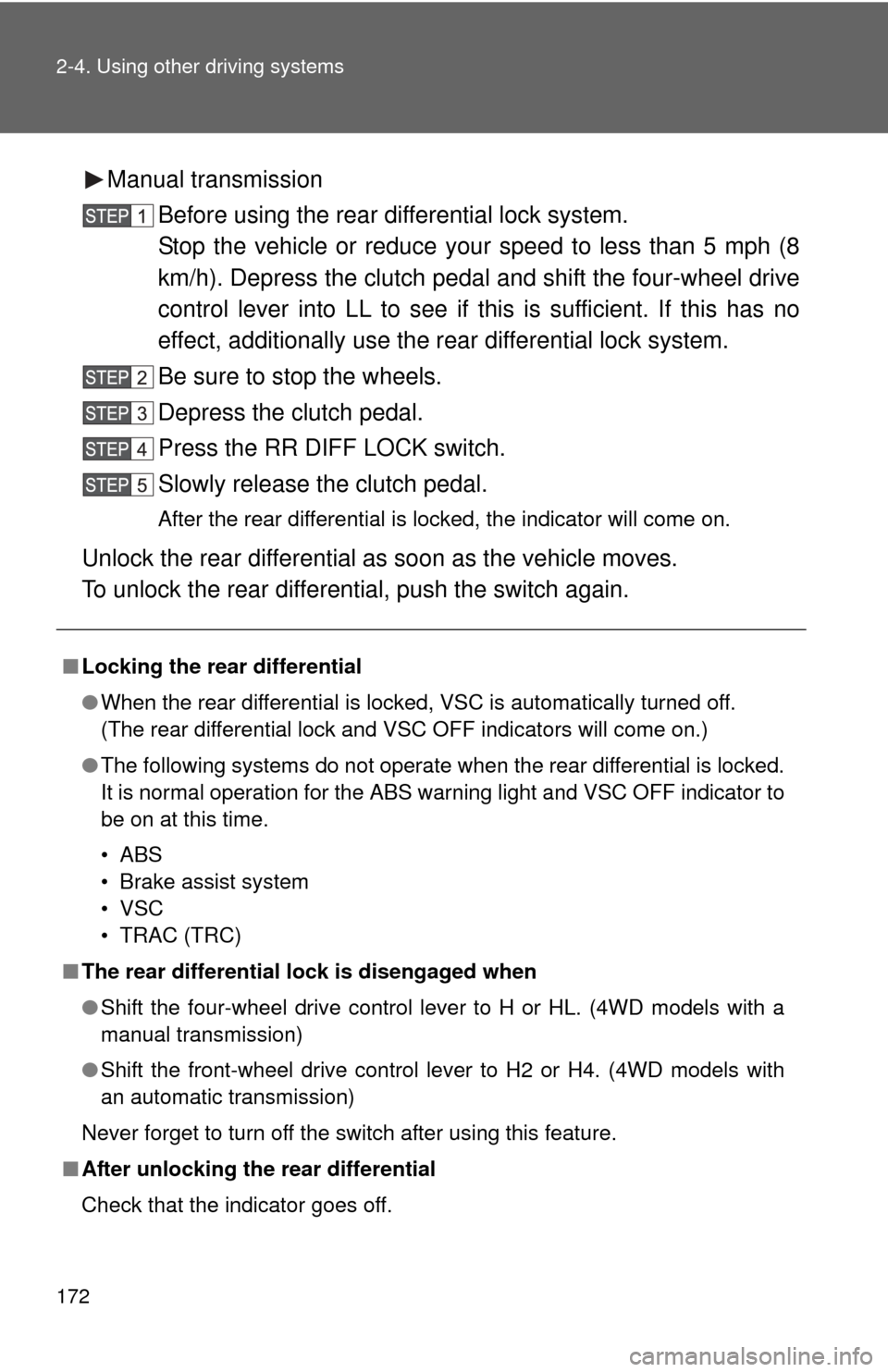
Manual transmissionBefore using the rear differential lock system.
Stop the vehicle or reduce your speed to less than 5 mph (8
km/h). Depress the clutch pedal and shift the four-wheel drive
control lever into LL to see if this is sufficient. If this has no
effect, additionally use the r ear differential lock system.
Be sure to stop the wheels.
Depress the clutch pedal.
Press the RR DIFF LOCK switch.
Slowly release the clutch pedal.
After the rear differential is locked, the indicator will come on.
Unlock the rear differential as soon as the vehicle moves.
To unlock the rear differential, push the switch again.
■ Locking the rear differential
●When the rear differential is locked, VSC is automatically turned off.
(The rear differential lock and VSC OFF indicators will come on.)
● The following systems do not operate when the rear differential is locked.
It is normal operation for the ABS warning light and VSC OFF indicator to
be on at this time.
•ABS
• Brake assist system
•VSC
• TRAC (TRC)
■ The rear differential lock is disengaged when
●Shift the four-wheel drive control lever to H or HL. (4WD models with a
manual transmission)
● Shift the front-wheel drive control lever to H2 or H4. (4WD models with
an automatic transmission)
Never forget to turn off the switch after using this feature.
■ After unlocking the rear differential
Check that the indicator goes off.
Page 192 of 528
192 2-5. Driving information
CAUTION
■Driving with snow tires
Observe the following precautions to reduce the risk of accidents.
Failing to do so may result in a loss of vehicle control and cause death or
serious injury.
●Use tires of the size specified for your vehicle.
● Maintain the recommended level of air pressure.
● Do not drive in excess of 75 mph (120 km/h) regardless of the type of
snow tires being used.
● Snow tires should be installed on all wheels.
● 4WD models:
Do not mix tires of different makes, models, tread patterns or treadwear.
■ Driving with snow chains
Observe the following precautions to reduce the risk of accidents.
Failing to do so may result in the vehicle being unable to be driven safely,
and may cause death or serious injury.
●Do not drive in excess of the speed limit specified for the tire chains being
used or 30 mph (50 km/h), whichever is lower.
● Avoid driving on bumpy road surfaces or over potholes.
● Avoid sudden turns and braking.
● Slow down sufficiently before entering a curve to ensure that vehicle con-
trol is maintained.
NOTICE
■Repairing or replacing snow tires
Request repairs of and obtain replacement snow tires from Toyota dealers or
legitimate tire retailers.
This is because the removal and attachment of snow tires affects the opera-
tion of the tire pressure warning valves and transmitters.
■ Fitting tire chains
The tire pressure warning valves and transmitters may not function correctly\
when tire chains are fitted.
Page 216 of 528
216 3-2. Using the audio system
■Using cellular phones
Interference may be heard through the audio system’s speakers if a cellular
phone is being used inside or close to the vehicle while the audio syste\
m is
operating.
■ Certification for the audio system
This device complies with part 15 of the FCC Rules and RSS-Gen of the IC
Rules. Operation is subject to the following two conditions: (1) This device
may not cause harmful interference, and (2) this device must accept an\
y
interference received, including interference that may cause undesired oper-
ation.
CAUTION
■For vehicles sold in U.S.A. and Canada
●Part 15 of the FCC Rules and RSS-Gen of the IC Rules
FCC WARNING:
Changes or modifications not expressly approved by the party responsible
for compliance could void the user’s authority to operate the equipment.
● Laser products
• Do not take this unit apart or attempt to make any changes by yourself.
This is an intricate unit that uses a laser pickup to retrieve information
from the surface of compact discs. The laser is carefully shielded so
that its rays remain inside the cabinet. Therefore, never try to disas-
semble the player or alter any of its parts since you may be exposed to
laser rays and dangerous voltages.
• This product utilizes a laser. Use of controls or adjustments or performance of procedures other
than those specified herein may result in hazardous radiation expo-
sure.
• The use of optical instruments with this product will increase eye haz- ard.
Page 264 of 528
264 3-3. Using the Bluetooth
® audio system
For vehicles sold in Canada
• Vehicles with CD changer IC ID: 2024B-FT0001A
MADE IN JAPAN
• Vehicles without CD changer IC ID: 775E-K025
MADE IN JAPAN
Operation is subject to the following two conditions: (1) this device may not
cause interference, and (2) this device must accept any interference, includ-
ing interference that may cause undesired operation of the device.
CAUTION
■ FCC WARNING
Changes or modifications not expressly approved by the party responsible
for compliance could void the user’s authority to operate the equipment.
Radio Frequency Radiation Exposure. This equipment complies with FCC/
IC radiation exposure limits set forth for uncontrolled equipment and meets
the FCC radio frequency (RF) Exposure Guidelines in Supplement C to
OET65 and RSS-102 of the IC radio frequency (RF) Exposure rules. This
equipment has very low levels of RF energy that it deemed to comply with-
out maximum permissive exposure evaluation (MPE). But it is desirable that
it should be installed and operated with at least 7.9 in. (20 cm) and more
between the radiator and person’s body (excluding extremities: hands,
wrists, feet and ankles).
This transmitter must not be co-located or operated in conjunction with any
other antenna or transmitter.
■ Caution while driving
Do not connect portable players or operate the controls.
NOTICE
■To prevent damage to portable players
Do not leave portable players in the vehicle. The temperature inside the
vehicle may become high, resulting in damage to the player.